The Raid (March 1, 1864)

Judson Kilpatrick, the controversial cavalry commander (Library of Congress).

Judson Kilpatrick, the controversial cavalry commander (Library of Congress).

Here’s Theodore Lyman’s behind-the-scenes look at the start of the Kilpatrick/Dahlgren raid  on Richmond. Maj. Gen. John Sedgwick’s VI Corps and Custer’s brigade of cavalry were designed to divert Confederate attention from the raid. After Lyman’s letter I include the report that Meade prepared for Henry Halleck (still the commander-in-chief of the Union armies, but not for long) on March 1 about the raid’s progress to that point. General Andrew Humphreys is Meade’s chief of staff.

. . . For some days General Humphreys has been a mass of mystery, with his mouth pursed up, and doing much writing by himself, all to the great amusement of the bystanders, who had heard, even in Washington, that some expedition or raid was on the tapis, and even pointed out various details thereof. However, their ideas, after all, were vague; but they should not have known anything. Que voulez-vous? A secret expedition with us is got up like a picnic, with everybody blabbing and yelping. One is driven to think that not even the prospect of immediate execution will stop Americans from streaming on in their loose, talking, devil-may-care ways. Kilpatrick is sent for by the President; oh, ah! everybody knows it at once: he is a cavalry officer; it must be a raid. All Willard’s chatters of it. Everybody devotes his entire energies to pumping the President and Kill-cavalry! Some confidential friend finds out a part, tells another confidential friend, swearing him to secrecy, etc., etc. So there was Eleusinian Humphreys writing mysteriously, and speaking to nobody, while the whole camp was sending expeditions to the four corners of the compass! On Saturday, at early morn, Uncle John Sedgwick suddenly picked up his little traps and marched with his Corps through Culpeper and out towards Madison Court House, away on our right flank. The next, the quiet Sabbath, was broken by the whole of Birney’s division, of the 3d Corps, marching also through Culpeper, with the bands playing and much parade. We could only phancy the feeling of J. Reb contemplating this threatening of his left flank from his signal station on Clark’s Mountain. Then the flaxen Custer, at the head of cavalry, passed through, and wended his way in the same direction. All this, you see, was on our right. That night Kilpatrick, at the head of a large body of cavalry, crossed at Ely’s Ford, on our extreme left, and drew a straight bead on Richmond! At two oclock that night he was at Spotsylvania C. H., and this is our last news of him. He sent back word that he would attack Richmond at seven this morning. The idea is to liberate the prisoners, catch all the rebel M. C.’s that are lying round loose, and make tracks to our nearest lines. I conceive the chances are pretty hazardous, although the plan was matured with much detail and the start was all that could be asked. . . .

Theodore Lyman’s letter is from Meade’s Headquarters, 1863-1865: Letters of Colonel Theodore Lyman from the Wilderness to Appomattox, pp 76-8. Edited by George R. Agassiz. Boston, Massachusetts Historical Society, 1922. Available via Google Books.

 Meade’s report is from the Official Records, ser. 1, Vol. 33, p. 169:

Meade March 1

Leap Year (February 29, 1864)

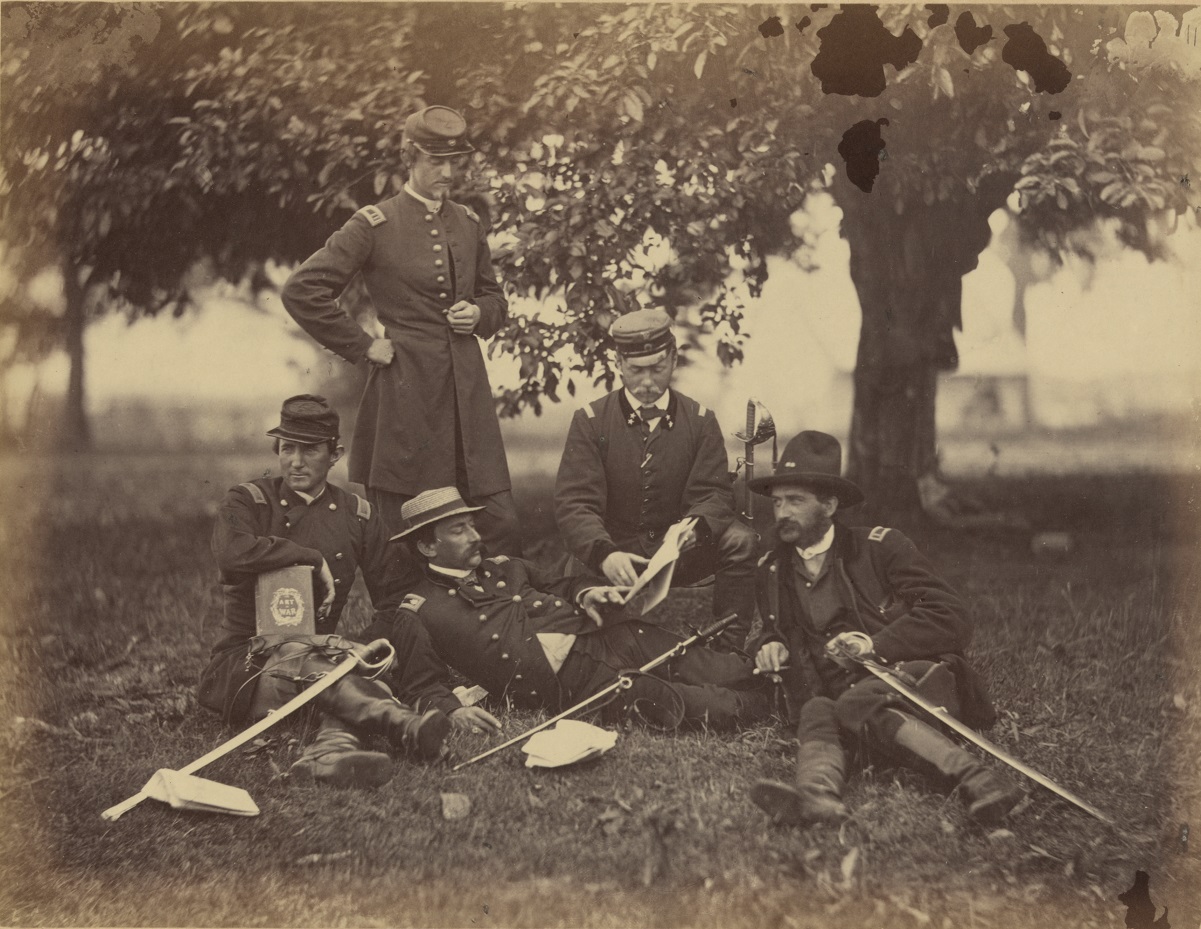
Alexander Gardner took this photograph at Fairfax Court House in June 1863, just before the start of the Gettysburg Campaign. He called it "Studying the Art of War." Ulric Dahlgren is the man standing. The man in the center is Count Ferdinand von Zeppelin, in the United States to observer. He will later become famous for the airships he develops. At the far right is Lt. Rosencranz, who will later serve on Meade's staff. Theodore Lyman mentions him often in his writings. To read Gardner's extensive caption for this photo, see below (Library of Congress).

Alexander Gardner took this photograph at Fairfax Court House in June 1863, just before the start of the Gettysburg Campaign. He called it “Studying the Art of War.” Ulric Dahlgren is the man standing. The man crouching  in the center is Count Ferdinand von Zeppelin, in the United States to observe the war. He will become known for the airships he later develops. Reclining is Joseph Dickinson. At the far right is Lt. Frederick Rosencrantz, who will later serve on Meade’s staff. Theodore Lyman mentions him often in his writings. Benjamin Ludlow, at left, was another Meade staffer. To read Gardner’s extensive caption for this photo, see below (Library of Congress).

1864 was a leap year, hence this letter from February 29. It is Meade’s last letter from February. March will be an eventful month, marking the arrival of Ulysses S. Grant, the investigations by the Joint Committee on the Conduct of the War, the reorganization of the Army of the Potomac, and the fallout from the Kilpatrick/Dahlgren raid on Richmond. As the last paragraph of Meade’s letter points out, March will also bring Ulysses S. Grant, the new general-in-chief of the Union armies, a post held until now by Henry Halleck.

Yesterday Mr. Dorr, from Christ Church, preached for us, and afterwards dined and spent the evening with me. During the evening one of the escaped prisoners from Libby prison, who had made his way from Richmond right through the main body of Lee’s army and into our lines, came to see me, and Mr. Dorr seemed very much interested in the narrative of his adventures. He returned home this morning, delighted with his visit to the army and all he had seen. He has a son who is a captain in Chapman Biddle’s regiment, the One Hundred and Twenty-first Pennsylvania Volunteers.

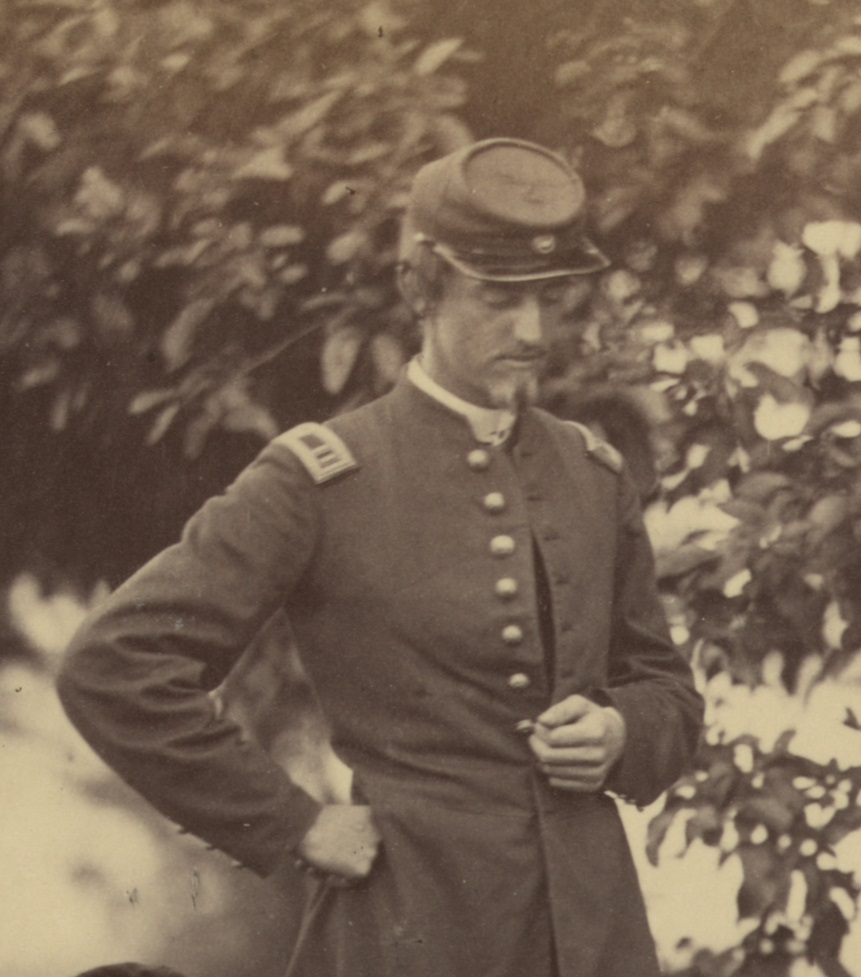
Ulric Dahlgren, in a close-up from Gardner's photograph (Library of Congress).

Ulric Dahlgren, in a close-up from Gardner’s photograph (Library of Congress).

My cavalry expedition for Richmond got off last night, and at 2 a.m., the last I heard from them, they were getting on famously, not having met any one or being, as far as they could tell, discovered by the enemy. I trust they will be successful; it will be the greatest feat of the war, if they do succeed, and will immortalize them all. Young Dahlgren, with his one leg, went along with them. The weather from having been most favorable, now that the expedition has gone, begins to look suspicious, and to-night we have a little rain.

I see Congress has passed the Lieutenant General bill. This will make Grant Commander-in-Chief; what will become of Halleck I can’t tell, and possibly when Grant is responsible for all military operations, he may want some one else whom he knows better in command of this army.

Meade’s correspondence taken from The Life and Letters of George Gordon Meade, Major-General United States Army, Vol. 2, (New York: Charles Scribner’s Sons, 1913), p. 168. Available via Google Books.

This is what Gardner wrote about “Studying the Art of War,” in a caption that appeared in Gardner’s Photographic Sketchbook of the War:

A group at the headquarters, near Fairfax Court-House, taken in June, 1863. Thoughtful and erect, the most prominent figure is Colonel Ulric Dahigren, then a Captain on the Staff of General Meade. Handsome, chivalric, one of the bravest of the brave, his character was fitly compared to that of the good knight, the Chevalier Bayard, and like him, he was truly “sans peur et sans reproche.” So noble a man, that of all the heroes who have perished for the nation, his loss is the hardest to realize. The story of his short but brilliant career has been written by abler hands, and is now a “household word.” Of its closing scenes, the writer narrowly escaped being a witness, having been invited to accompany the Colonel on that ill-starred expedition by which his life was sacrificed. Just recovering from the loss of his leg, and suffering acutely from any physical exertion, his active spirit could not be controlled, when he thought of his brothers in arms pining under the cruelties of Libby and Belle Isle. No ruthless raid was his, but a Christian effort to help the despairing Union Prisoners. None, who knew him, need be told how false was the document, claimed to have been found upon his person. General Meade, suspecting his inability to undergo the fatigues of an expedition in the inclement weather of February, was disinclined to give him permission; but Dahlgren, determined on his purpose, mounted his horse, and proceeding to a review of the Second Corps, rode so fearlessly over the fields, and under his frank smile, so well hid all traces of bodily suffering, that the General reluctantly permitted him to depart. After the review, when he came over (for the retirement it offered) to the writer’s tent, it was too evident how fearful had been the effort of his will.

The officer upon the ground, wearing a straw hat, is Lieutenant-Colonel [Joseph] Dickinson, Assistant Adjutant General to General Hooker a position he held from the time that General first commanded a brigade, until the battle of Gettysburg. In that action the Colonel was hit in the arm with a link of a chain, thrown with other misiles from a rebel shell. On the recovery of his wound he retired from the service, The gentleman in foreign uniform is Count Zeppelin, of the Prussian army, then on a visit to this country. On the left is the figure of Major [Benjamin] Ludlow, since better known as the General in Command of the Colored Brigade, which excavated, under a continual and heavy fire, the canal on the James, called Dutch Gap. The perils of that undertaking he faithfully shared, from first to last, doing much, by his cheerful bearing and example, to support his troops in their perilous work. The last of the group is Lieutenant (since Lieutenant Colonel) Rosencranz, a Swedish officer, on leave of absence, and occupying successively the position of Personal Aid upon the Staff of Generals McClellan, Burnside, Hooker, and Meade. A very reliable soldier, and one of the best Aids on the Staff, his genial disposition, unfailing amiability, and keen appreciation of humor, made him acceptable everywhere. He was probably as well known as any officer in the field.