The Vexed Question (December 4, 1864)

In this print, titled "Grant and his Generals," George Meade does make an appearance off to Grant's right (Library of Congress).

In this print, titled “Grant and his Generals,” George Meade does make an appearance off to Grant’s right (Library of Congress).

The “vexed question” of Meade’s promotion has been settled (although he will have to wait until February before the Senate gives its official seal of approval). In his notebook entry December 4, 1864, Theodore Lyman noted, “A telegraph came from [Secretary of War Edwin] Stanton announcing to the General that he had been made a Major General in the regular army, to rank next to Sherman. Whereat he was right content.” Meade is now the country’s ’s fourth highest ranked officer, with only Ulysses S. Grant, Henry Halleck, and William T. Sherman ahead of him.

I send you a telegram from the Secretary and my reply, which will show you the vexed question is at last settled. Much of the gratification that ought justly to accompany such a reward has been destroyed by the manner of doing it; so that what might have been a graceful compliment became reduced to a simple act of justice. Well, let us be satisfied with this, and believe it was more a want of knowledge how to do such things than any unfriendly feeling which caused it.

Meade’s correspondence taken from The Life and Letters of George Gordon Meade, Major-General United States Army, Vol. 2, (New York: Charles Scribner’s Sons, 1913), p. 249. Available via Google Books.

Looking for that perfect holiday gift? What could be better than Searching for George Gordon Meade: The Forgotten Victor of Gettysburg? (You can order the book from Amazon or Barnes and Noble.) Or maybe a 2015 George Gordon Meade calendar–the perfect way to commemorate the general’s bicentennial year! You can get the calendar right here.

“The Most Impartial Account” (December 3, 1864)

This Currier & Ives print from 1863 depicts a very heroic version of the victor of Gettysburg (Library of Congress).

This Currier & Ives print from 1863 depicts a very heroic version of the victor of Gettysburg (Library of Congress).

George Meade likes an article on Gettysburg by Captain Charles Cornwallis Chesney that appeared in British Army and Navy Review. “The grand address of Mr. Everett” that he mentions is the talk that Edward Everett gave at the dedication of the National Cemetery at Gettysburg on November 19, 1863. Everett prepared his epic oration with background material that Meade had asked Theodore Lyman to gather. (“Prepared, by order, a sort of résumé of Gen. Meade’s official report of the battle of Gettysburg, to be sent to Mr. Everett, who is to deliver an oration at the cemetery, to be made at that place,” Lyman had noted in his notebook entry for October 5, 1863.) Everett’s two-hour talk was overshadowed by the brief remarks of the speaker who followed him, President Abraham Lincoln.

I received the two volumes of the Army and Navy Review (British) and have read with great interest Captain Chesney’s critique of the battle of Gettysburg. It is decidedly the most impartial account of this battle that I have read, and I think does more justice to my acts and motives than any account by my countrymen, including the grand address of Mr. Everett. What has struck me with surprise is the intimate knowledge of many facts not made very public at the time, such as [Henry] Slocum’s hesitation about reinforcing [Oliver O.] Howard, [Daniel] Butterfield’s drawing up an order to withdraw, and other circumstances of a like nature. This familiarity with details evidences access to some source of information on our side, other than official reports or newspaper accounts. Captain Chesney’s facts are singularly accurate, though he has fallen into one or two errors. I was never alarmed about my small arm ammunition, and after Hancock’s repulsing the enemy on the 3d, I rode to the left, gave orders for an immediate advance, and used every exertion to have an attack made; but before the troops could be got ready, it became dark. There is no doubt the fatigue and other results of the three days’ fighting had produced its effect on the troops and their movements were not as prompt as they would otherwise have been. I have no doubt all his statements about Lee, and his having been overruled, are true. Lee never before or since has exhibited such audacity. I am glad this impartial account by a foreign military critic has been written.

One of the enjoyable things about Theodore Lyman’s letters is the way he casts light on day-to-day life in the Army of the Potomac. Here we learn a little bit about General Meade on pay-day. Lyman also writes about “contrabands,” escaped slaves who seek freedom with the Union army.

At the end of each month, General Meade sends up his pay-rolls, that is, a large printed sheet which each officer fills up, stating what the Government owes him, and saying that he hasn’t cheated Uncle Sam, and don’t owe him anything and is all right generally. The pay department keeps this as a receipt and returns your money for the past month. Lieutenant-Colonel Woodruff gets the General’s pay. One part he sends to Mrs. Meade and the rest he sends to the General, who, the moment that he gets it, sends violently for Mercier and John and everyone else to whom he is indebted, and pays them all, in hot haste, as if his last day were come. He is a thorough old soldier about money and regards greenbacks in a weak and helpless sort of way. “Once,” said he, “Mrs. Meade said it was my plain duty to go to market, as other gentlemen did: it would be so satisfactory and saving. I went the next morning. We had a famous dinner—oysters, terrapin, and lots of good things—the children were delighted; but, when I came to look, I found I had spent the week’s allowance in one day! I wasn’t allowed to go any more to market.” You would have laughed to see yesterday the crowd of contrabands that came in with Gregg. Usually, wherever they can, they cut and run, not showing that devotion to their masters described by the Southrons. It is sometimes rather remarkable the way they run off. Now in this lot (mostly women) there was all the way from a newly born baby to an old woman who, they told me, was over ninety, and who, from her looks, might very likely have been a hundred and fifty. The young women had their mistresses’ things on, if I know myself. There was one Christian Commission kuss who went whining about and saying: “Oh! you are free, free! Oh! thank God for it!” “Look here, my friend,” said I, “if you want to show your Christian feeling, go and tell your commission to get these people something to eat; they have had nothing since yesterday.” The pious party took this with an ill grace, but was fain to walk off “to see our agent,” who, I hope, made some good soup for them.

Meade’s correspondence taken from The Life and Letters of George Gordon Meade, Major-General United States Army, Vol. 2, (New York: Charles Scribner’s Sons, 1913), pp. 248-9. Available via Google Books.

Theodore Lyman’s letter is from Meade’s Headquarters, 1863-1865: Letters of Colonel Theodore Lyman from the Wilderness to Appomattox, pp. 287-8. Edited by George R. Agassiz. Boston, Massachusetts Historical Society, 1922. Available via Google Books.

Cavalry Raid (December 1, 1864)

GreggDavid McMurtrie Gregg was one of the Army of the Potomac’s best cavalry commanders. He was the cousin of Pennsylvania governor Andrew Gregg Curtin and had received his promotion of major general of volunteers in August. A couple of months after Theodore Lyman writes this letter, Gregg will abruptly resign from the army, for reasons that remain mysterious.

At daylight General Gregg made a start, with nearly his whole cavalry division, for Stony Creek station. For you must know that, since we have held the Weldon road, the enemy have been obliged to waggon much of their supplies from Stony Creek station, by cross roads to the Boydton plank and thus to Petersburg. Lately we have had reports that they were building a cross railroad from Stony Creek to the southside road. Gregg’s object therefore was to go to the station, which is over twenty miles by the road from our lines, find out if this railroad were really in progress or not, and do as much damage as possible. Instead of going straight down he, by advice of General Meade, bore a little to the east and then suddenly swung round, when he got a little below the station. The consequence was he came on them where they didn’t look for him. There were two redoubts, with regular ditch, etc., intended to keep off raiders; there was a thirty-pounder Parrott and a twelve-pounder field-piece mounted in them, and a few infantry as garrison. Their cavalry took to their heels, prudently. The infantry got in the redoubts and fired away with their cannon; but it got taken in a novel fashion. A regiment of cavalry charged to within 100 yards, then tumbled off their horses and made a rush at the parapet, and ran right over the occupants. This gave them possession of the station, and then there followed a scene of general smashing, which, according to witnesses, was highly amusing. The men, feeling like mischievous boys, went at everything tooth and nail. They took several hundred bales of hay and piled them against a stack of short forage, which contained between 3000 and 5000 bags. Then they set the whole on fire, and helped the blaze with a lot of new tents. Next they tied down the safety-valve of a locomotive, built a big fire under the boiler, and blew her up by this scientific process. After distributing the contents of a number of Rebel Thanksgiving boxes on the principle of spolia forti, they ended by a display of fireworks consisting of a shed full of ammunition, which was fired and allowed to go off at its convenience. Then they retreated, in great glee, taking with them 170 prisoners, who were not in such great glee. One was a scamp named Major Fitzhugh, who, when Captain Lazelle, of our cavalry, was made prisoner, put a pistol to his head and made him give him his boots. Captain Freikle told me he had a mind to make the scoundrel march the twenty miles barefooted, but couldn’t bring his mind to anything so mean. I would have made him do it.

Theodore Lyman’s letter is from Meade’s Headquarters, 1863-1865: Letters of Colonel Theodore Lyman from the Wilderness to Appomattox, pp. 285-7. Edited by George R. Agassiz. Boston, Massachusetts Historical Society, 1922. Available via Google Books.

It Was Them Darned Rebels (November 30, 1864)

Senator James W. Nesmith, D-OR (National Archives).

Senator James W. Nesmith, D-OR (National Archives).

The “Hon. Nesmith” whom Theodore Lyman mentions in this letter is Senator James W. Nesmith, the Democratic Senator from Oregon. He was born in New Brunswick to Maine parents and gradually made his way out west until he reached Oregon. His witticism about the loss of First Bull Run echoes something George Pickett supposedly said when asked why the Confederate attack at Gettysburg failed on July 3. “I think the Yankees had something to do with it,” Pickett said.

Did you hear how the Hon. Nesmith, whom I have mentioned, discovered the real cause of the defeat at the first Bull Run? He was in Washington at the time, and the military wiseacres, as soon as they got over the scare, were prolific in disquisitions on the topic. One evening Nesmith found a lot of them very verbose over a lot of maps and books. They talked wisely of flank movements and changes of front, and how we should have won a great victory if we had only done so and so; when he remarked solemnly: “Gentlemen, I have studied this matter and I have discovered the real reason of our defeat.” They were all ears to hear. “Well,” said Nesmith with immense gravity, “well, it was them darned Rebels!” . . .

Last night the 2d Corps picket line was relieved by the 9th—a delicate job in face of the enemy, who are pretty close up; but it all was done in entire quiet, to the relief of General Humphreys, who feels the new honor of the 2d Corps. That worthy officer stopped on his way to his new Headquarters and honored me by taking a piece of your plum cake. He was much tried by the noisy ways of Hancock’s late Headquarters. “They whistle of mornings,” said the fidgety little General, “and that Shaw, confound the fellow, amuses himself with imitating all the bugle-calls! Then the negroes turn out at four in the morning and chop wood, so that I am regularly waked up. But I shall stop it, I can tell you.” And I have no doubt he will, as he is wont to have his own way or know the reason why. I rode out with him to his new Headquarters and followed the line afterwards, and was much amused to see them drilling some of the worthless German recruits, in a polyglot style: “Steady there! Mehr heraus—more to the front. Shoulder arms! Eins, zwei! One, two!” etc.

Theodore Lyman’s letter is from Meade’s Headquarters, 1863-1865: Letters of Colonel Theodore Lyman from the Wilderness to Appomattox, pp. 284-5. Edited by George R. Agassiz. Boston, Massachusetts Historical Society, 1922. Available via Google Books.
Ingenious Inventions (November 29, 1864)

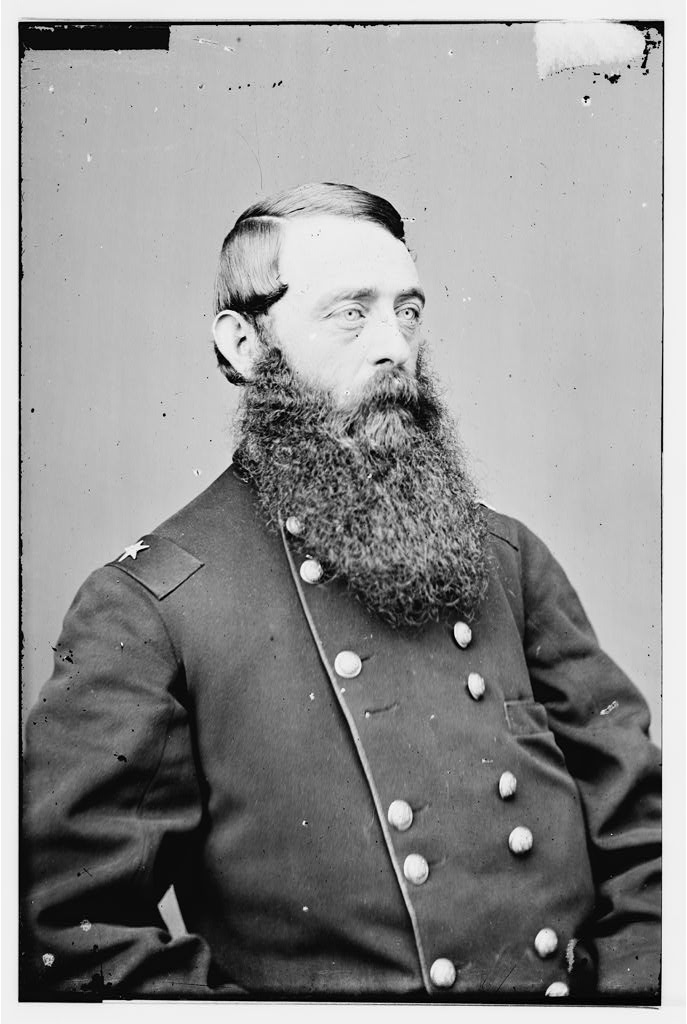
Benjamin Butler. He was a mediocre general but a wily politician (Library of Congress).

Benjamin Butler. He was a mediocre general but a wily politician (Library of Congress).

In his notebook entry for November 27, Theodore Lyman described how General Benjamin Butler said “when they made him a lawyer they spoiled a good mechanic; when they made him a general they spoiled a good lawyer.” Butler did have a weakness for invention. In fact, it will soon help lead to his downfall, following the failure of his great scheme to destroy Fort Fisher by stuffing a vessel with explosives and blowing it up.

I did not have room to tell you of the ingenious inventions of General Butler for the destruction of the enemy. He never is happy unless he has half a dozen contrivances on hand. One man has brought a fire-engine, wherewith he proposes to squirt on earthworks and wash them all down! An idea that Benjamin considered highly practicable. Then, with his Greek fire, he proposed to hold a redoubt with only five men and a small garden engine. “Certainly,” said General Meade; “only your engine fires thirty feet, and a minie rifle 3000 yards, and I am afraid your five men might be killed, before they had a chance to burn up their adversaries!” Also he is going to get a gun that shoots seven miles and, taking direction by compass, burn the city of Richmond with shells of Greek fire. If that don’t do, he has an auger that bores a tunnel five feet in diameter, and he is going to bore to Richmond, and suddenly pop up in somebody’s basement, while the family are at breakfast! So you see he is ingenious. It is really summer warm today; there are swarms of flies, and I saw a bumble-bee and a grasshopper.

Theodore Lyman’s letter is from Meade’s Headquarters, 1863-1865: Letters of Colonel Theodore Lyman from the Wilderness to Appomattox, p. 284. Edited by George R. Agassiz. Boston, Massachusetts Historical Society, 1922. Available via Google Books.

Greek Fire (November 28, 1864)

Black soldiers from the Army of the James labor on Benjamin Butler's canal at Dutch Gap (Library of Congress).

Black soldiers from the Army of the James labor on Benjamin Butler’s canal at Dutch Gap (Library of Congress).

Theodore Lyman continues his account of the visit to Benjamin Butler’s headquarters. One amazing thing about this post is that Lyman describes the test of what can only be called a flamethrower. In Meade’s Army: The Private Notebooks of Lt. Col. Theodore Lyman, editor David Lowe says the “Greek fire” was probably “a combustible solution of phosphorus in bisulfide of carbon.” Lyman writes more about Butler and his inventions in tomorrow’s letter.

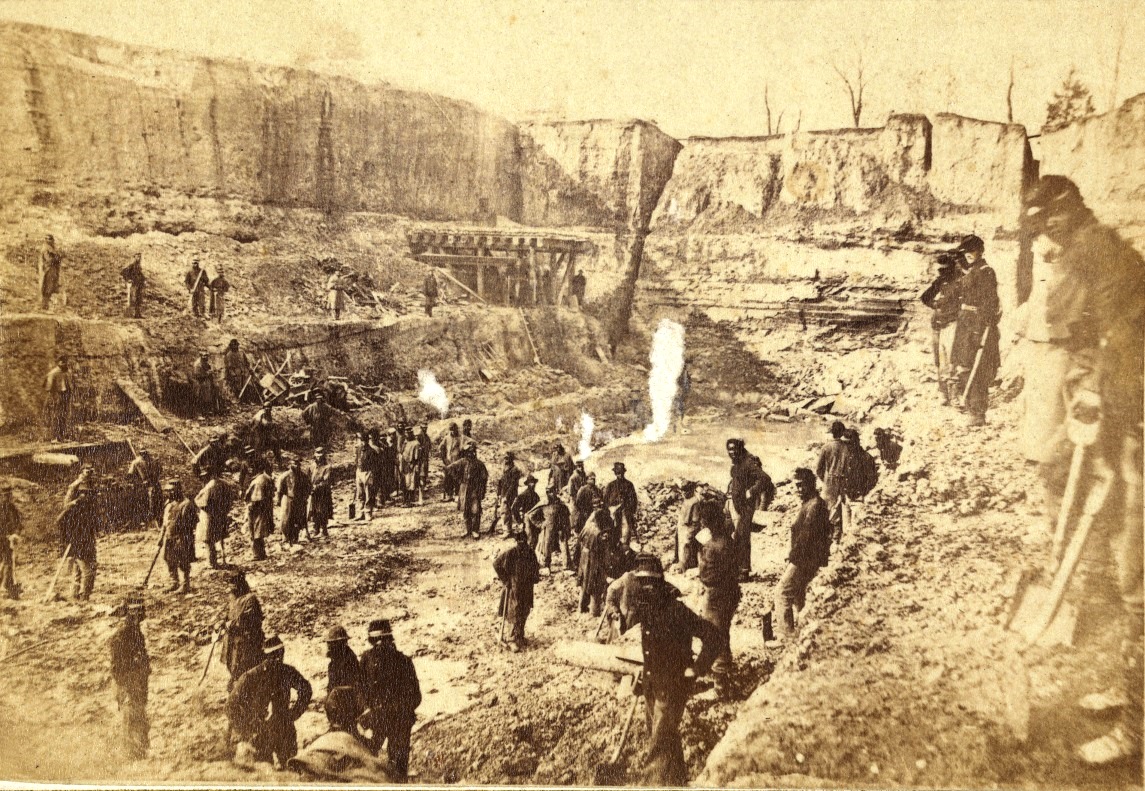
Let me see, I had got to Fort Harrison, had I not? Really I got so sleepy last night over the second sheet that I should not be surprised if it contains numerous absurdities. From the Fort you have an excellent view of the Rebs in their line opposite, their main fort being only 800 yards distant. I was surprised they did not fire upon us, as there was a great crowd and evidently several generals among us. But I believe they never shoot. The pickets, on either side, are within close musket-range but have no appearance of hostility. There was one very innocent “Turkey,” who said to me: “Who are those men just over there?” When I told him they were Rebs, he exclaimed: “God bless me!” and popped down behind the parapet. . . . Thence we all went to view the great canal. You will notice on the map, that the river at Dutch Gap makes a wide loop and comes back to nearly the same spot, and the canal is going through there. This cuts off five or six miles of river and avoids that much of navigation exposed to fire; and it may have strategic advantages if we can get iron-clads through and silence the Rebel batteries on the other bank. The canny Butler sent an aide to see if they were shelling the canal, who reported they were not; so we dismounted a little way off and walked to the place. It was very worth seeing. Fancy a narrow ridge of land, only 135 yards wide, separating the river, which flows on either side; a high ridge, making a bluff fifty feet high where it overhangs the water. Through this a great chasm has been cut, only leaving a narrow wall on the side next the enemy, which wall is to be blown out with several thousand pounds of gunpowder. We stood on the brink and looked down, some seventy feet, at the men and the carts and the horses at work on the bottom. Where we stood, and indeed all over the ridge, was strewed thickly with pieces of shell, while here and there lay a whole one, which had failed to explode. Had the Rebs known that a Lieutenant-General and two Major-Generals were there, they would hardly have left us so quiet. . . .

Though we got off very nicely (I thought as I stood there: “Now that line is the shortest one to our horses, and you must walk it with dignity—not too fast when they begin to shell”), there was a fat “Turkey” who came after us and was treated to a huge projectile, which burst over his head; he ran and picked up a piece and cried out: “Oh! it’s warm. Oh!! it smells of sulphur. Oh!!! let us go now.” He was delighted with this and all other adventures, and was quite elated when his horse tumbled in a ditch and muddied him greatly. After dark we were treated to an exhibition of a “Greek fire.” They burst a shell in a bunch of bush and immediately the whole was in a roaring blaze. “They’ve got the fuses to work well now,” said Grant calmly. “They tried the shells on three houses, the other side of the river, and burnt them all without difficulty.” Good thing for the owners! Then they spirted the stuff through a little hose and set the stream on fire. It was a beautiful sight and like the hell of the poets, with an unquenchable fire and columns of black smoke rolling up. Owing to these pyrotechnics, we only got home at midnight. In my next I will tell more of the genius of Butler. General Meade, you will be glad to learn, has been informed officially, that he will be appointed a Major-General in the Regular Army, to rank General Sheridan!

Theodore Lyman’s letter is from Meade’s Headquarters, 1863-1865: Letters of Colonel Theodore Lyman from the Wilderness to Appomattox, pp. 282-3. Edited by George R. Agassiz. Boston, Massachusetts Historical Society, 1922. Available via Google Books.
Butlerdom (November 27, 1864)

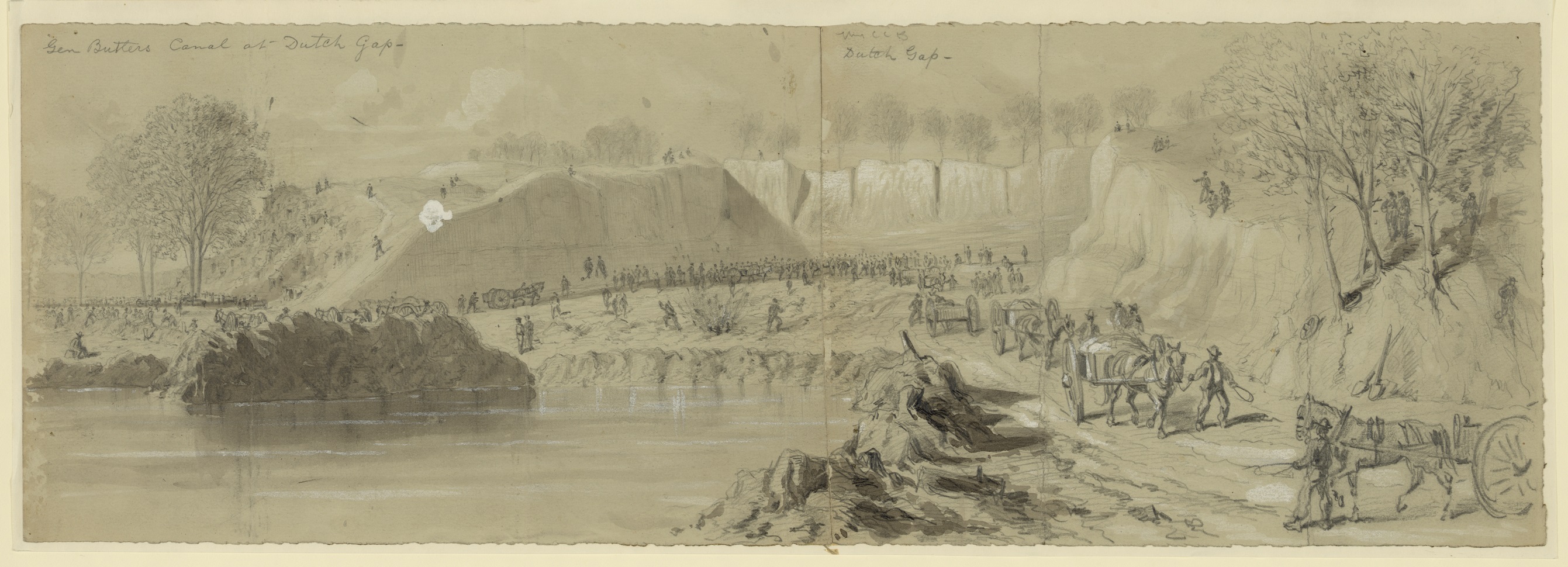
Artist William Waud sketched the activity at "Ben Butler's canal at Dutch Gap." Click to enlarge (Library of Congress).

Artist William Waud sketched the activity at “Ben Butler’s canal at Dutch Gap.” Click to enlarge (Library of Congress).

Both George Meade and Theodore Lyman write home about a visit to Maj. Gen. Benjamin Butler, commander of the Army of the James. Lyman, of course, provides the most detail. The Dutch Gap Canal was Butler’s ambitious scheme to foil the Confederate defense at Drewry’s Bluff on the James River by digging a canal across a neck of land and bypass them altogether. It was perfectly feasible on paper but a very difficult feat to accomplish. The canal was eventually completed, but not until after the war ended. Grant, who had attempted something similar against Vicksburg, seemed happy to let Butler occupy himself with canal digging.

Yesterday I accompanied General Grant on a visit to General Butler’s lines and the famous Dutch Gap Canal, which I had never seen. We had a very pleasant day, remaining with Butler till after dark to witness some experiments with the Greek fire, and getting home about 11 p.m.

I send you an extract from the Washington Chronicle, received to-day. It confirms what General Grant told me, and is designed to make people believe that I was already appointed when Sheridan was made. As Forney is closely allied with the powers that be, I take it for granted the above supposition is correct, and that he speaks by authority and for a purpose. I have no objection to this being arranged, so long as the essential point, justice to me, is conceded.

I had a visit this evening from Dr. McEuen who is here to take away his son Charles, who is major of the One Hundred and Ninety-eighth Pennsylvania, and who is now quite sick with fever. The doctor seems in good spirits and not much changed, except being considerable greyer than I used to see him years ago.

Lyman provides a characteristically entertaining account of the visit to “Butlerdom.” He also discusses a major change in the Army of the Potomac—the departure of Winfield Scott Hancock and his replacement at the head of the II Corps by Andrew Humphreys. The latter general, who had served as Meade’s chief of staff since just after Gettysburg, had long hungered for his own corps command—within limits. Back in July, Grant had suggested him for command of the X Corps in the Army of the James, which included African-American soldiers. Humphreys declined the offer because he did not want to command blacks, telling Grant, “I confess that while I have the kindliest feelings for the negro race and gladly see anything done that promises to ameliorate their condition, yet as they are not my own people, nor my own race, I could not feel towards negro troops as I have always felt towards the troops I have commanded, that their character, their reputation, their honor was a part of mine, that the two were so intimately connected that they could not be separated.”

Lyman provides an alternate account of the visit in his journal entry, which you can read in Meade’s Army: The Private Notebooks of Lt. Col. Theodore Lyman (edited by David W. Lowe, it is recommended reading). Lowe identifies “Pet” as Oliver Spencer Halsted, a New Jersey politician. He also describes Maj. Gen. John Gibbon’s reaction to Humphreys’ promotion to corps command. “Gibbon is mad, considering the appointment of Humphreys, to temporary command of the corps, a slight. He’s a fool! Gen. Meade has done everything for him, and now he sulks and asks to be relieved.”

Lyman’s almost Dickensian account of the visit will continue tomorrow.

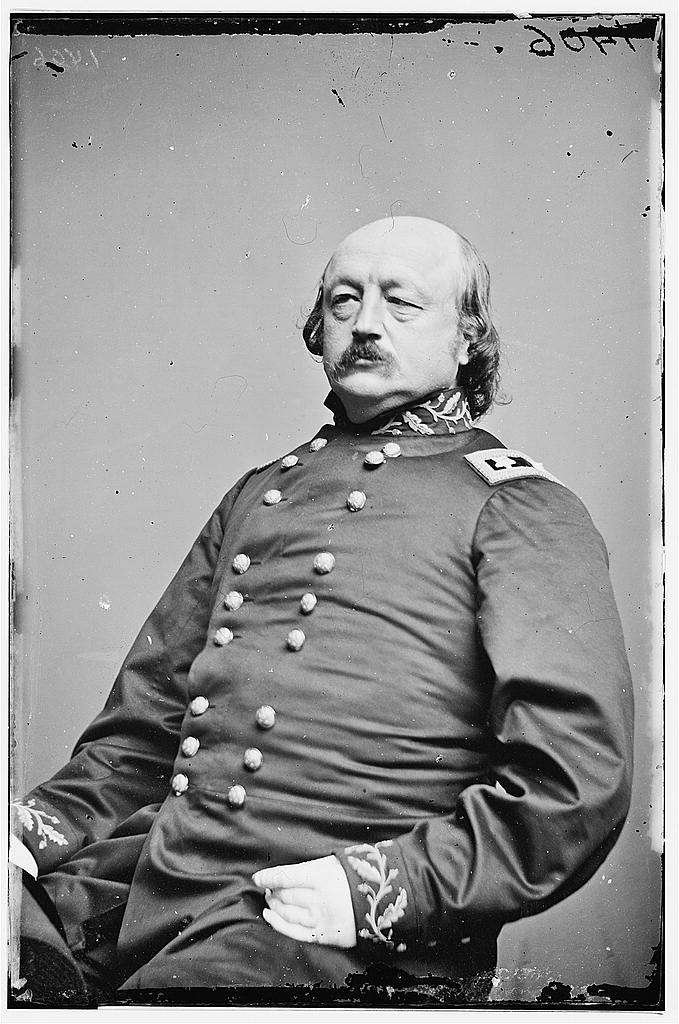
General Andrew Atkinson Humphreys. (Library of Congress)

General Andrew Atkinson Humphreys. (Library of Congress)

I think I will occupy the remainder of this letter with an account of our picnic yesterday to Butlerdom. The day was further remarkable for the departure of my dear General Humphreys to take command of the 2d Army Corps. For Hancock has got a leave of absence, and will doubtless be put to recruiting fresh troops, while it is hoped that the President will permanently assign Humphreys to this Corps. He is in high glee at going, and will be in despair if a big fight is not got up for his special benefit. He was a great favorite and was escorted by some fifteen mounted officers of the Staff to his new quarters, at which compliment I think he was gratified. I regretted not to be with him, but had to go with the General, who started by the mail train, at 8 a.m., to be early at Grant’s Headquarters, whence they were to start. We took our horses on a freight car. In the train we found Generals [Gouverneur] Warren and [Samuel] Crawford, who were invited to be of the party. Arrived at City Point, we discovered that the Lieutenant-General was still in bed, whereat Meade did laugh, but the three stars soon appeared and went to breakfast. After which meal, our horses were put on the boat and we put ourselves on, and off we started. The party was a big one. There were Generals Grant, Meade, Warren, Crawford and [Rufus] Ingalls, and several Staff officers. There were then the bourgeois: to wit, a great many “Turkeys” (gentlemen who had come down to distribute those Thanksgiving fowls); two men who wanted to sell a steamer; one Senator, viz., [James] Nesmith of Oregon, and one political blackguard named H____, whose special business was to praise a certain Greek fire, of which more anon. This fellow’s name is usually prefixed by “Pet.” He has wild hair and beard and a face showing a certain ability; his distinguishing mark, I am told, is the absence of any sort of morality or principle. With him was his son, a small and old boy, of whom they said that, if papa could not get the best at a game of poker, son would come in and assist. Senator Nesmith is a child of the people, and was prepared for his congressional duties by a residence of twenty-five years among the Indians. When he first got to Washington, he had never before seen a railroad, a telegraph, or a gas-light. “Senator Fessenden asked me what I thought of things. ‘Well,’ says I, ‘when I first came along I was full of the dignity of the position to which I had been elected; but now all I want to know is, who in thunder ever sent you fellers here!’“ He has plenty of brains, this same, but is a very coarse man. The “Turkeys” were of various sorts: several of them were Club men, e.g., Mr. Benson, a gentleman who seemed a middle-aged beau, with much politeness and no particular brains. He kept bowing and smiling and backing into persons, and offering his chair to everyone, from orderlies up to General Grant. He requested to know whether in my opinion he could be properly considered as having been “under fire; because,” said he, “I stood on the Avery house and could see the shells explode in the air, you know!” All this motley crowd started at once for Deep Bottom; nor should I omit to say that we had also on board a Secesh bishop—Leigh of Georgia—who was going by flag of truce to Richmond. He had remained in Atlanta, and Sherman had told him if he wished to get back, he must go via Richmond. From him they got a good deal of entertaining conversation. His opinion of Sherman was very high and complimentary. “The old Book tells us,” he said, “that the race may not be to the swift, nor the battle to the strong, and we feel that Providence will not desert our righteous cause.” “Yes,” said General Meade, “but then we feel that Providence will not desert our cause; now how are you going to settle that question?” Whereat they both laughed. The bishop was a scholastic, quiet-looking man, and no great fire-eater, I fancy. The boat made fast at Aiken’s landing, halfway between Deep Bottom and Dutch Gap. A Staff officer was there to receive us and conduct us, two miles, to General Butler’s Headquarters. Some rode and some were in ambulances. The James Army people always take pretty good care of themselves, and here I found log houses, with board roofs, and high chimneys, for the accommodation of the gentlemen of the Staff. You might know it was Butler’s Headquarters by the fact that, instead of the common ensign, he had a captured Reb battle-flag stuck up! This chieftain asked in the general officers and we were left to the care of the Staff, who were not behindhand in their civility. . . . Presently Butler climbed on his horse and led the way to see Fort Harrison, which was captured in the movements at the end of September. It was well worth seeing, for on our side of the river we have no hills: it is pretty much one plain with gullies. But here was a regular hill, of some size, dominating the whole country about. How they took the place, I hardly see, for the land is often for a mile in front of it, and the Rebs had artillery in position and a regular infantry running quite to the river. . . .

Meade’s correspondence taken from The Life and Letters of George Gordon Meade, Major-General United States Army, Vol. 2, (New York: Charles Scribner’s Sons, 1913), p. 248. Available via Google Books.

Theodore Lyman’s letter is from Meade’s Headquarters, 1863-1865: Letters of Colonel Theodore Lyman from the Wilderness to Appomattox, pp. 279-82. Edited by George R. Agassiz. Boston, Massachusetts Historical Society, 1922. Available via Google Books.
Satisfied (November 25, 1864)

In his letter, Meade mentions the Dutch Gap Canal. Benjamin Butler had initiated the digging of the canal on the James River to bypass Confederate forts. It wasn't completed until after the war (Library of Congress).

In his letter, Meade mentions the Dutch Gap Canal. Benjamin Butler had initiated the digging of the canal on the James River to bypass Confederate forts. It wasn’t completed until after the war (Library of Congress).

Meade receives word of his promotion and pronounces himself satisfied. The Mr. Cropsey is the newspaper reporter whom Meade had drummed out of camp at Cold Harbor. It seems he has now irritated Hancock, whose time with the Army of the Potomac is almost over.

On my return from my visit to General Grant, I found your letter of the 23d inst. General Grant told me that, as soon as he spoke to the President, the President acknowledged the justice of his statements, and said he had hesitated when appointing Sheridan on the very ground of its seeming injustice to me, and he at once, at General Grant’s suggestion, ordered the Secretary to make out my appointment, to date from August 19th, the day of the capture of the Weldon Railroad, thus making me rank Sheridan and placing me fourth in rank in the regular army. Grant virtually acknowledged that my theory of Sheridan’s appointment was the correct one, and that without doubt, had the matter been suggested at the time, I would have been appointed a few days in advance.

As justice is thus finally done me, I am satisfied—indeed, I question, if left to me, whether I should have desired my appointment announced in the way Sheridan’s has been. At one tiling I am particularly gratified, and that is at this evidence of Grant’s truthfulness and sincerity. I am willing to admit, as he does himself, that his omissions have resulted unfavorably to me, but I am satisfied he is really and truly friendly to me. I like Grant, and always have done so, notwithstanding I saw certain elements in his character which were operating disadvantageously to me.

To-morrow I am going with General Grant to visit General Butler’s famous canal at Dutch Gap. Grant does not think Mr. Stanton will be removed, or that he desires the Chief-Justiceship.

He says Stanton is as staunch a friend of mine as ever, and that the President spoke most handsomely of me.

You will perhaps not be surprised to learn that Mr. Cropsey has again gotten himself into trouble. I received to-day a letter from General Hancock, complaining of Mr. Cropsey’s account of our recent movement. I told General Hancock to put his complaints in the form of charges and I would have Mr. Cropsey tried by a commission, and abide by its decision.

Hancock leaves us to-morrow, he having a leave of absence, after which he will be assigned to recruiting duty. Humphreys takes his place. The change in my position has rendered it unnecessary to have an officer of Humphreys’s rank, as chief-of-staff. I deemed it due to him to suggest his name as Hancock’s successor.

Butler has finally succeeded in getting the colored troops with this army, replacing them with an equal number of white troops. He is going to organize a corps of colored troops, and expects to do very great things with them.

Meade’s correspondence taken from The Life and Letters of George Gordon Meade, Major-General United States Army, Vol. 2, (New York: Charles Scribner’s Sons, 1913), pp. 247-8. Available via Google Books.

The Best Man the War Has Yet Produced (November 24, 1864)

Ulysses S. Grant and his horse, Cincinnati. Click to enlarge  (Library of Congress).

Ulysses S. Grant and his horse, Cincinnati. Click to enlarge
(Library of Congress).

Anyone interested in the relationship between George Meade and Ulysses S. Grant should find this letter fascinating. In it, Meade writes to his brother-in-law, Henry A. Cram of New York, and analyzes his standing with the general in chief. Although irritated by the promotions of Sherman and (especially) Sheridan, Meade does not hold a grudge against Grant, believing he just doesn’t worry about such things. He also notes the fault in Grant that will later plague him as president: that he has a “a simple and guileless disposition, which is apt to put him, unknown to himself, under the influence of those who should not influence him, and desire to do so only for their own purposes.” All in all, this is a remarkably fair minded letter.

Following Meade’s letter, Theodore Lyman describes Thanksgiving with the Army of the Potomac.

I thank you most gratefully for your opinion that Time and History will do me justice, but I very much fear your kind feeling has caused the wish to be father to the thought. No man in this country will be appreciated who does not dazzle his fellow-citizens with continued brilliant success. Fortunately I knew so much of the fickleness and unreasonableness of public opinion, that when I was elevated to my present position I was prepared for the reaction and my fall; indeed, considering all things, I consider myself very fortunate in having retained my position so long as I have. However, I don’t want to inflict a letter of complaints on you. I have done and shall continue to do my duty to the best of my ability, and try to be contented under whatever it may please God to have happen to me. Adopting the philosophy of the Irishman who, when going into battle, said he would consider himself “kilt”; if he was, it would be no more than he expected; if he got through safe, it would be clear gain. So, expecting nothing, all acts of justice and kindness that fall to my lot I shall consider so much gain.

I am sorry to hear what you say of Grant, but it is in accordance with my theory and experience. Public expectation in his case, as in Sherman’s, having been wrought up to a false and unreasonable pitch, expecting impossibilities and miracles, visits on them the failure to do what only public imagination renders practicable. Both these men at one time were down. Sherman was pronounced crazy, and Grant was at one time deprived of command; and now, should success by any accident attend the efforts of either, their stars will be more in the ascendant than ever.

Grant is not a mighty genius, but he is a good soldier, of great force of character, honest and upright, of pure purposes, I think, without political aspirations, certainly not influenced by them. His prominent quality is unflinching tenacity of purpose, which blinds him to opposition and obstacles—certainly a great quality in a commander, when controlled by judgment, but a dangerous one otherwise. Grant is not without his faults and weaknesses. Among these is a want of sensibility, an almost too confident and sanguine disposition, and particularly a simple and guileless disposition, which is apt to put him, unknown to himself, under the influence of those who should not influence him, and desire to do so only for their own purposes. Take him all in all, he is, in my judgment, the best man the war has yet produced. When I say this, I refer more particularly to those I have come in contact with, and do not include Sherman, about whom I know nothing but what I see in the papers. I like Grant, and our relations have been very friendly. He has always in words expressed himself most kindly towards me, and I believe does feel so; but his acts, from causes alluded to above, have not been so; but I acquit him of any actual intention of injustice. His coming here has resulted virtually in setting me aside, almost as effectually as if I had been relieved. To be sure, I saw this plainly before he came. He did not see it then, and he don’t see it now; there is the difference between us. I over-sensitive, and he deficient in sensibility. There are many things in Grant that call for my warmest admiration, and but few that I feel called on to condemn. He has been greatly over-rated; but I should be really sorry to see him, through a reaction, under-estimated. Let all this be confidential between us. Grant will make use of me or any one else to carry out his views, but he will always do justice to others, though he may often be slow in doing so, and let slip opportunities presenting themselves, because he does not see they are opportunities. Early in the campaign he recommended me strongly for appointment as major general in the regular army, recommending Sherman at the same time. Yet he has not only had Sherman made, but has now permitted them to make Sheridan, who was not dreamed of at the time I was recommended. Still he did not appreciate that this was injustice to me; but when I called his attention to it, and explained how I thought it was unjust, he readily and frankly acknowledged I was right.

I am very glad to hear you propose to visit camp this winter. Unless we are much stronger than we are now, I see no prospect of taking Richmond. It is a pure question of numbers, requiring on our part great superiority, and even then it is not going to be a very easy task. If the good people will only turn out and fight with the unanimity they have voted to do so, we will soon bring the war to a close. There is no doubt the last dependence of the South is a divided North. The election has not dissipated this hope; but swelling our armies, promptly and cheerfully, with the bone and sinew of the country (not miserable foreigners and substitutes), who come to fight, and not for money, this, when it happens, will, in conjunction with hard fighting, open the eyes of the South and bring it to terms, if anything will.

In 1864, Thanksgiving meant turkey. Theodore Lyman writes home about the holiday.

This was Thanksgiving, which is sloppy and snowy and haily with us, as a general thing, but here was sunny and pleasant. All day the waggons were distributing turkeys to the patriots, of whom I believe all got some, sooner or later. Flint, having seen that his squadron had their poultry, called a sergeant and asked him how much it made to each man. “Well,” said the sergeant, “it makes about a quarter of a turkey, a piece of pie, and four apples.” “Oh!” said Flint, “quite a meal.” “Yes,” said the sergeant dubiously, “yes, a small meal; I could eat half a turkey myself!” The turkeys were ready cooked and were a great treat to our ragamuffins. I took a ride in some woody spots within the lines, and it was pleasant, in the warm hollows, to hear the wee birds twittering and warbling, visitors from a northern climate, that have left you some weeks ago. Then there was a pileated woodpecker (not known with us), a great fowl, as big as a crow; black, with white feathers in his wings, an ivory beak and a gay scarlet cockade. He thought himself of great account, and pompously hopped up and round the trunks of trees, making a loud, chattering noise, which quite drowned the wee birds, like a roaring man in a choir. The pompous old thing was very much scared when I approached, and flew away, but soon began his noise on a distant tree.

Meade’s correspondence taken from The Life and Letters of George Gordon Meade, Major-General United States Army, Vol. 2, (New York: Charles Scribner’s Sons, 1913), pp. 245-7. Available via Google Books.

Theodore Lyman’s letter is from Meade’s Headquarters, 1863-1865: Letters of Colonel Theodore Lyman from the Wilderness to Appomattox, pp. 278-9. Edited by George R. Agassiz. Boston, Massachusetts Historical Society, 1922. Available via Google Books.
Distinguished Foreigners (November 22, 1864)

George Meade did not vote in the presidential election. In 1860 he had voted for John Bell of the Constitutional Union Party. Bell’s running mate was Edward Everett. On November 19, 1863, Everett was the featured speaker at the dedication of the National Cemetery at Gettysburg. President Abraham Lincoln also spoke there.

I do not know how the fact of my not voting has reached Philadelphia, or is there considered a matter of importance. One of the Republican agents, formerly an officer in the Reserves, came to see me and desired I would vote at the polls of the regiment where he was going to be. I declined going to his polls, but did not intimate to him whether I was or was not going to vote. It is probable, however, that some zealous partisan has watched to see what I did. I cannot but be flattered that so much importance is attached to my action, particularly as nearly all other general officers, including Grant, did the same—that is, not vote.

I should like to see the article in the British Military Review you refer to. It is some consolation to know that distinguished foreigners think well of you.

Theodore Lyman takes the army’s British visitors out on a tour. In his notebooks he also mentions at stop at Winfield Scott Hancock’s headquarters. Andrew Humphreys is supposed to replace Hancock at the head of the II Corps. Lyman noted, “Hancock has not yet his orders, and Gen. Humphreys is fussing and fuming, afraid that he shan’t have any fighting this autumn–as he is to command the 2d Corps.”

As it was fine, after three days’ rain, General Humphreys bestirred himself to give rational entertainment to the two Englanders; and so General Meade ordered a couple of brigades of cavalry turned out and a horse-battery. We first rode along the rear line and went into a fort there. It made quite a cortege, for, besides the Generals and their officers and orderlies, there followed Mr. Lunn in a four-horse spring waggon, with General [Henry] Hunt to bear him company; for Lunn had received the horseback proposition with mild horror. So he followed in a waggon, much as Mr. Pickwick was wheeled after the shooting party, when he finally turned up in the pound. In the fort was a company of soldiers that you might know beforehand were Germans, so dirty and especially so grimy — they have a great facility for looking grimy do the Germans. It was funny to see the different chaps among them: one, evidently a ci-devant Prussian soldier, was seized with rigidity in all his muscles on beholding a live brace of Generals. There was another who was an unmistakable student; he had a moustache, a poetically fierce air, a cap with the brim turned up, and a pair of spectacles. There he stood, a most out-of-place individual, with our uniform on, watching anxiously the progress of a pot, boiling on a fire. The cavalry looked what I have learned to consider as very well; that is, the men looked healthy, the horses in good flesh, and the arms and equipments in proper repair. To a European they must have been fearful; very likely so to Major Smyth, though he was silently polite—no polish, horses rough and woolly, and of all sizes and colors; men not sized at all, with all kinds of beards and every known species of hat; but as I know that men do not fight with their hats and beards, I was satisfied to see evidences of good discipline. Thereafter we called on General Gregg, where I had a treat in form of some Newton pippins, of which excellent apple there was a barrel on hand.

Meade’s correspondence taken from The Life and Letters of George Gordon Meade, Major-General United States Army, Vol. 2, (New York: Charles Scribner’s Sons, 1913), pp. 244-5. Available via Google Books.

Theodore Lyman’s letter is from Meade’s Headquarters, 1863-1865: Letters of Colonel Theodore Lyman from the Wilderness to Appomattox, pp. 277-8. Edited by George R. Agassiz. Boston, Massachusetts Historical Society, 1922. Available via Google Books.