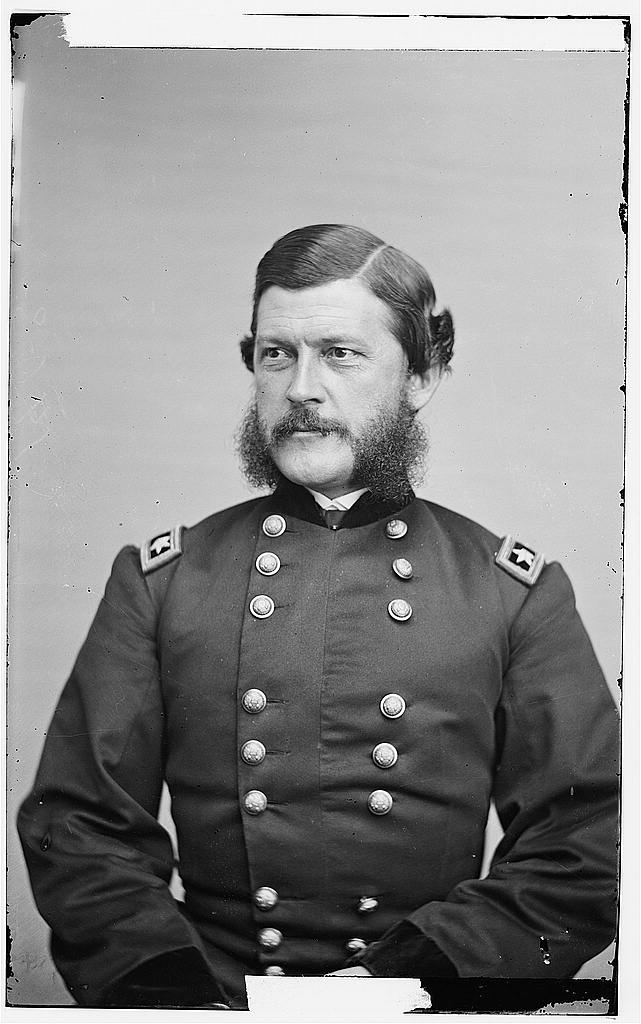
Poor Young Parker (October 9, 1864)

It’s been over a year since young Lt. Cortlandt Parker, a member of Meade’s staff and the nephew of a family friend, vanished. (See here.) Now word has arrived that Parker had been captured by Confederate guerillas who killed him when he attempted to escape. There’s more about Parker here. His story is just one small tragedy in a nation engulfed by them.

We have at last heard of the fate of poor young Parker, who was on my staff. An officer recently returned from Richmond says he was captured by guerrillas near Bristol Station, a few days after Parker’s disappearance; that when they were taking him off they cautioned him not to attempt to escape, for if he did they would be obliged to serve him as they had done General Meade’s aide a few days before, who in spite of their cautions tried to get away, and they were forced to shoot him. I have no doubt this is a true statement of the poor fellow’s fate. I have sent it to Cortlandt Parker.

Meade’s correspondence taken from The Life and Letters of George Gordon Meade, Major-General United States Army, Vol. 2, (New York: Charles Scribner’s Sons, 1913), p. 233. Available via Google Books.

Election Season (October 7, 1864)

President Abraham Lincoln (Library of Congress).

President Abraham Lincoln (Library of Congress).

In this letter Meade mentions the upcoming presidential election, which pitted President Abraham Lincoln against George McClellan, the former commander of the Army of the Potomac.

I was afraid you would be uneasy at not hearing from me during our recent operations, but my headquarters were some five or six miles from the scene of action, and it was always at midnight when I got back, tired out with the day’s work, and had to start early in the morning, so that I really did not have time to write.

I see the papers announce my narrow escape. It was a pretty close shave, as I have written you. You need not worry yourself; I am not going to commit the folly of foolish and unnecessary exposure. But there are times when it is my duty and it is proper I should take my chances. Let us hope Providence will always be as merciful and protecting as in this instance; for I take it, it was only God’s will that saved my leg and perhaps my life.

The enemy have allowed us to retain the ground acquired by our recent movement, and seem to be busy fortifying against another advance. We have been reinforced, but not to the extent imagined by the sanguine public; neither is Richmond so near its fall as you tell me people believe. However, these absurd alternations of exaggerated anticipations of successes and reverses seem to be chronic with our people, and no amount of experience will ever cure them of the folly.

I note all you say of politics, but in the army we take but little interest except earnestly to wish the election was over, as we see, until it is, nothing else will be thought of and no proper thought given to the war. It is generally believed here that McClellan has very little chance. I think he is very unfortunate in his friends and backers.

I see the Chronicle announces me as a supporter of Mr. Lincoln, and is pleased to class me among the ill-treated generals who have been driven into the opposition. Well, the one has as much authority for his assertion as the other, neither having anything on which to base his remarks.

Grant has gone to Washington, leaving Butler in command. To-day the enemy made a demonstration on Butler, and I thought we were going to have a grand time, but it passed off.

Theodore Lyman also wrote home on October 7. We have encountered Brig. Gen. Henry Washington Benham before. Channing Clapp was a classmate of Lyman’s at Harvard. Samuel Crawford, in temporary command of the V Corps in Gouverneur Warren’s absence, had been a surgeon at Fort Sumter. The Pennsylvania-born Crawford took command of Meade’s old division, the Pennsylvania Reserves, just before Gettysburg. Today he and Meade are neighbors in Philadelphia’s Laurel Hill Cemetery.

Brig. Gen. Henry Benham (Library of Congress).

Brig. Gen. Henry Benham (Library of Congress).

There is a certain General Benham, who commands the engineers at City Point, and was up about laying out some works. Channing Clapp is on his Staff. You ought to see this “Ginral.” He has the face and figure of Mr. Briggs and wears continually the expression of Mr. B. when his horse sat down at the band of music. When he had got through all the explanations, which were sufficient to have laid out a permanent work of the first class, the Meade rose with weariness, and eased his spirit by riding out and looking at my new camp-ground, and inspecting those everlasting redoubts. Now that the camp is arranged, the Meade is dubious about moving: that’s like him! When we got to the extreme left, he thought he would go out and take a peek at the picket line. First there was a little bunch of cavalry. They were of a jocose turn; they had found an old pair of wheels whereon they had mounted a keg, making a very good cannon, which pointed, in a threatening manner, down the road. Its ensemble was completed by a figure, closely resembling those that defend cornfields, and which was keeping steady guard with a small pole. A hundred yards beyond was the picket reserve, behind a barricade. Then, beyond, a couple of hundred yards more, the sentries, each standing and looking sharply to the front. The one in the road was a half-breed Indian, though he looked more like a Neapolitan. He had that taciturnity that clings to the last drop of blood. “Are you a picket here?” asked the General. “Yes.” “Is there anyone on your right and left?” “No.” “You are an Indian, are you not?” “Part.” All of which the red warrior delivered, without turning his gaze from the vista before him. Beyond this gentleman was a post of two cavalry videttes. From this place we could get a very good view of one of the Rebel lines of earthworks; but there seemed very few men behind it. I could only notice one or two. And so we rode back again past the perils of the keg cannon. General Warren has a short leave, and General Crawford commands the Corps, to the indignation, I presume, of old cocks like Griffin and Ayres; for C. was doctor in Fort Sumter, and thus got a star, and thus is an old brigadier, and thus ranks the regulars G. and A. General Grant was on a flying visit to Washington to-day. I like to have him down here: first, he gives a general balance and steadiness; then, what is most important, he can order—just order what groceries he pleases, and no questions asked behind the counter!

Meade’s correspondence taken from The Life and Letters of George Gordon Meade, Major-General United States Army, Vol. 2, (New York: Charles Scribner’s Sons, 1913), pp. 232-3. Available via Google Books.

Theodore Lyman’s letter is from Meade’s Headquarters, 1863-1865: Letters of Colonel Theodore Lyman from the Wilderness to Appomattox, pp. 241-3. Edited by George R. Agassiz. Boston, Massachusetts Historical Society, 1922. Available via Google Books.

Poor Biddle (October 6, 1864)

Once more, Meade’s aide James C. Biddle, provides some laughs at the expense of his dignity. Fortunately the laughs came unaccompanied by wounds. In this letter, Theodore Lyman also notes the arrival of more international visitors. In his journal (edited by David. W. Lowe and published in 2007 as Meade’s Army: The Private Notebooks of Lt. Col. Theodore Lyman), he adds a few more observations of Lord Mahon and Captain Hayter. “The former rather a soft subject, with a feeble aquiline nose. The latter rather dull, apparently, and good natured, with a certain air like Peel–both in the guards.”

Poor Biddle! I always begin his name with “poor.” He was detailed to examine the trenches occupied by the 2d Corps, and see that the pickets were properly arranged. This part of the works is much exposed to fire in many parts, being near the enemy; so that you have to stoop a good deal of the way. What did Biddle do but ride out by a road to the works, on horseback! In consequence of which the whole skirmish line opened on him, and he returned, after his inspection, quite gasping with excitement. As he was not hit, it was very funny. If there is a wrong road, he’s sure to take it. Lord Mahon (son of the Earl of Stanhope, who presided at that literary dinner I went to at London) and Captain Hayter, both of the Guards, were down here — Spoons rather, especially the nobil Lord.

Theodore Lyman’s letter is from Meade’s Headquarters, 1863-1865: Letters of Colonel Theodore Lyman from the Wilderness to Appomattox, p. 241. Edited by George R. Agassiz. Boston, Massachusetts Historical Society, 1922. Available via Google Books.

Roebling (October 4, 1864)

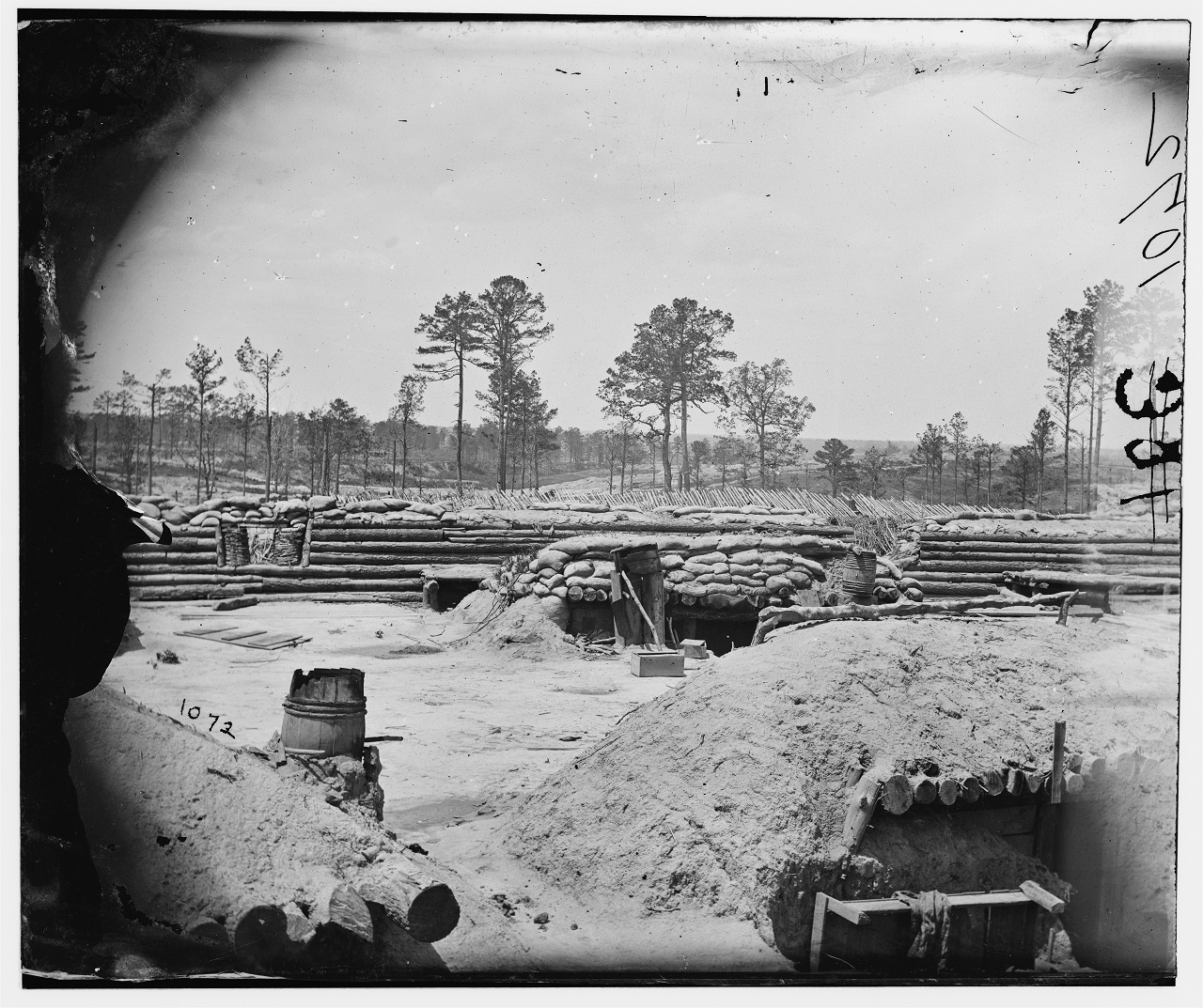
A view of the fortifications at Petersburg. Click to enlarge (Library of Congress).

A view of the fortifications at Petersburg. Click to enlarge (Library of Congress).

Anyone who has read David McCullough’s The Great Bridge has encountered the man Theodore Lyman writes about here. Washington A. Roebling was the son of engineer John Roebling, who designed and built revolutionary suspension bridges. After the war the senior Roebling took on this greatest task yet, constructing a bridge from Manhattan to Brooklyn. He died horribly of tetanus (contracted after a boat crushed his foot against a dock on the East River), so his son Washington took over as chief engineer of the Brooklyn Bridge. When Washington’s health failed before he could complete his epic project, his wife Emily–Gouverneur Warren’s younger sister—essentially took over as head engineer in his stead. Roebling had been with Warren on Little Round Top on July 2, 1863 and was instrumental in getting Strong Vincent’s brigade and the 140th New York to defend the position. It had also been Roebling, back on November 30, who brought the message to Meade from Warren announcing that Warren would not attack Lee’s forces at Mine Run.

When I visited Petersburg while writing Searching for George Gordon Meade: The Forgotten Victor of Gettysburg, I was pleased to see Lyman’s description of redoubt construction from this letter on one of the markers in Fort Stedman.

Washington Augustus Roebling (via Wikipedia).

Washington Augustus Roebling (via Wikipedia).

The General rode along the whole front of the new line and carefully examined it, accompanied by his Staff and by the taciturn Roebling. R. is a character, a major and aide-de-camp and engineer, and factotum to General Warren. He is a son of the German engineer, Roebling, who built the celebrated suspension bridge over the Niagara River. He is a light-haired, blue-eyed man, with a countenance as if all the world were an empty show. He stoops a good deal, when riding has the stirrups so long that the tips of his toes can just touch them, and, as he wears no boots, the bottoms of his pantaloons are always torn and ragged. He goes poking about in the most dangerous places, looking for the position of the enemy, and always with an air of entire indifference. His conversation is curt and not garnished with polite turnings. “What’s that redoubt doing there?” cries General Meade. “Don’t know; didn’t put it there,” replies the laconic one. The Chief growled a little while at the earthwork, but, as that didn’t move it, he rode onward. We passed at a clever time, for, a few minutes after, the Rebel skirmishers made a rush, and drove ours out of a house, and their bullets came over the corner of a field where we had been. Thereat our skirmishers made a counter-rush and drove theirs again away from the house, and our cannon fired and there was a small row generally. Some of our earthworks were really very workmanlike, handsomely sloped in front, and neatly built up with logs in the rear. It is really a handsome sight to get a view of half a mile of uniform parapet, like this, and see the men’s shelter-tents neatly pitched in the pine woods, just in rear, while in front a broad stretch of timber has been “slashed,” to give a good field of fire and break up any body of troops advancing to attack. It is quite interesting, too, to see a redoubt going up. The men work after the manner of bees, each at the duty assigned. The mass throw up earth; the engineer soldiers do the “revetting,” that is, the interior facing of logs. The engineer sergeants run about with tapes and stakes, measuring busily; and the engineer officers look as wise as possible and superintend. . . .

Theodore Lyman’s letter is from Meade’s Headquarters, 1863-1865: Letters of Colonel Theodore Lyman from the Wilderness to Appomattox, pp. 240-1. Edited by George R. Agassiz. Boston, Massachusetts Historical Society, 1922. Available via Google Books.
A Wonderful Escape (October 3, 1864)

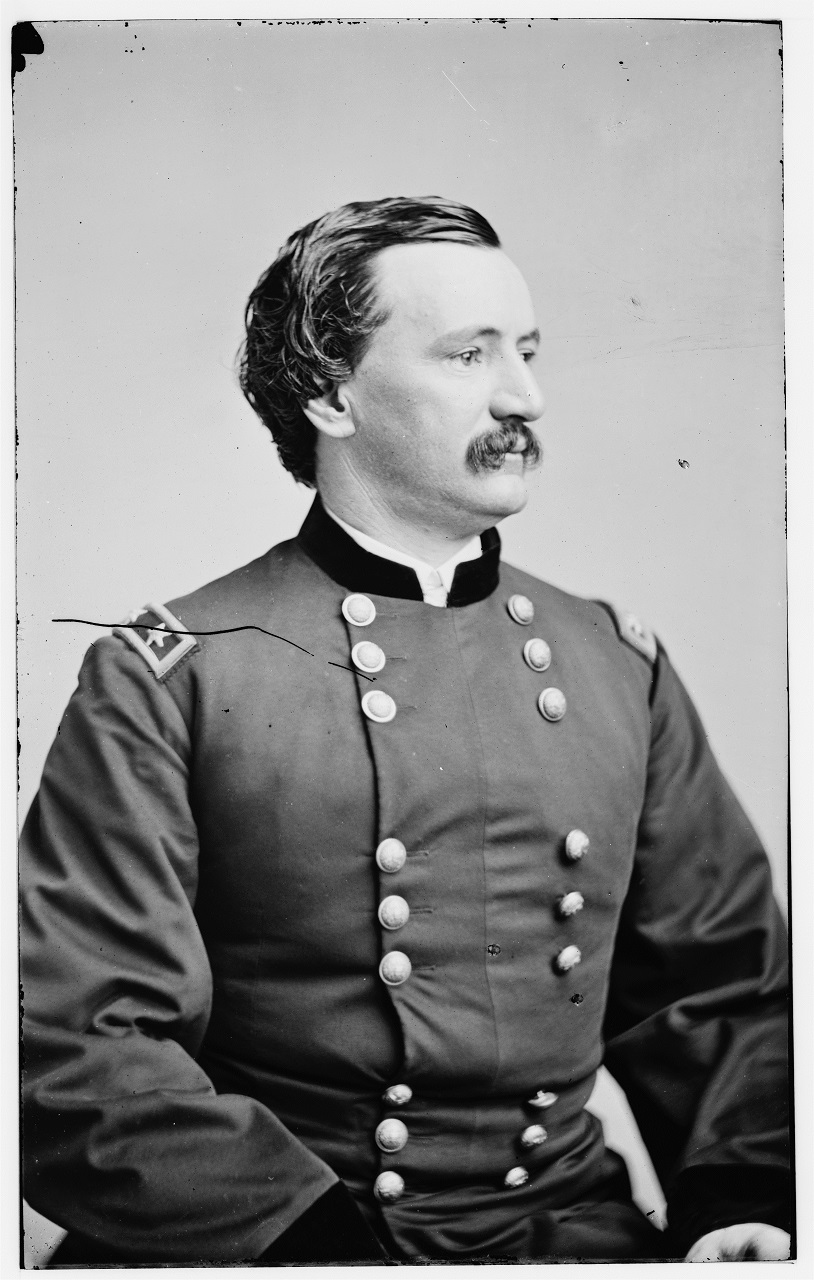
Joseph Bartlett (Library of Congress).

Joseph Bartlett (Library of Congress).

George Meade tells his wife about his narrow escape from an artillery shell. Theodore Lyman mentioned this incident in his letter from yesterday. The generals who shared Meade’s brush with death are Andrew Humphreys, Charles Griffin, and Joseph Bartlett. I would like to know what happened to the shell. Perhaps it’s in the collections of the Massachusetts Historical Society.

I have not been able to write you for several days, as I have been so absorbed in our recent movements, which I believe are now successful. These consisted in a movement by Butler on the north side of the James, in the hope of surprising the enemy, and possibly getting into Richmond. The enemy was surprised, and part of his third line of defenses taken from him and is still held by us. As Lee was obliged to detach heavily to meet Butler’s movement, it was thought probable I might, by extending to the left, get into Petersburg. I did extend my lines some two and a half miles, had quite a brisk affair with the enemy, but did not succeed in taking Petersburg. Of course, extending both flanks in this way, we had to weaken our centre, and this is the danger of this kind of movement; but Lee appears so determined to be prudent and cautious. He confines himself strictly to the defensive, and lets slip the chances for a coup we offer him.

On the second day, whilst I was on horseback on the field, talking to Generals Griffin and Bartlett, surrounded by my staff and escort, a shell fell in our midst, grazing Humphreys’s horse, grazing and striking my left leg, just below the knee, passing between Griffin and Bartlett, and embedding itself in the ground in the centre of a group of officers, covering them all with earth, but without exploding or injuring a soul. A more wonderful escape I never saw. At first I thought my leg was gone, as I felt and heard the blow plainly, but it only rubbed the leather of my riding-boot, without even bruising the skin. Afterwards Colonel Lyman had the shell dug up, and is going to preserve it. How would you like to have me back minus a leg and on crutches?

I have seen your brother Willie several times. He seems in good spirits and quite pleased at being assigned to the Army of the Potomac instead of Butler’s army. I had no place on my staff for your friend Captain Wister, but General Humphreys will take him for the present, as two of his aides have just left him, their times being out, though they intend trying to get new commissions to rejoin him. George is quite well. He was in the crowd when the shell dropped among us.

The two officers Lyman describes in this letter—Lt. Col. Charles G. Loring and Maj. Philip M. Lydig—had both been aides to General Burnside but had been sent on leave after the crater debacle. Here Lyman offers some more insights into Meade’s style of command, especially the way he liked to keep his officers on edge. Poor James C. Biddle often served as the butt of the staff’s humor.

Yesterday afternoon arrived Lieutenant-Colonel Loring and Major L_____ . The former looks in better health and immediately set to work on the duties of his office, as Inspector-General, under the easy rule of General Parke, who succeeds the rule of Burnside the Fat. L_____, always fancy, comes in much store clothes, a new shell jacket, double-breasted, and a pair of cerulean riding tights with a broad gold band, into which, according to report, he must be assisted by two strong men. Also his sabre newly burnished, and the names of the battles engraved on it, with other new and elegant touches. He was the young gentleman, you know, of whom the Reb paper said it was unworthy an honest officer to clasp the hand dipped in the gore of their brethren, even though cased in a glove of delicate kid! This was a quiet day, wherein we lay still and made ourselves comfortable. The “comfortable” meant, with many of the officers, lying abed till the classic hour of Richard and Robin; for the General, these last days, has been getting up and riding out at fitful and uncertain hours. I think, when he feels anxious and responsible himself, that he likes to keep others a little on the stretch also. So he would give no orders overnight, but suddenly hop up in the morning and begin to call for breakfast, orderlies, aides, horses, etc. I am sharp, and, at the first sound he makes, I am up and speedily dressed; whereas the others get caught and have to leave suddenly. Biddle is the funniest. There he was, trotting along, the other morning, talking away, like a spinster who had lost her lap dog. “Well, I do think it is too bad! The General never tells anyone when he is going out, and here I am with no breakfast—no breakfast at all!” And here B. opened his fingers and disclosed one boiled egg! To think of a Major on the General Staff riding after his General, with the reins in one hand and a boiled egg in the other!

Meade’s correspondence taken from The Life and Letters of George Gordon Meade, Major-General United States Army, Vol. 2, (New York: Charles Scribner’s Sons, 1913), pp. 231-2. Available via Google Books.

Theodore Lyman’s letter is from Meade’s Headquarters, 1863-1865: Letters of Colonel Theodore Lyman from the Wilderness to Appomattox, pp. 239-40. Edited by George R. Agassiz. Boston, Massachusetts Historical Society, 1922. Available via Google Books.

Quite a Stampede (October 2, 1864)

Lyman’s letters jump back and forth in time a bit. In this letter from October 2 he writes some more about his journey back to the army. The U.S. Christian Commission had been established in 1861 and continued its efforts until the end of the war. Lyman wrote down his impressions of the events from October 2 four days later, but I have included that account with today’s letter. General Meade will tell his wife about his narrow escape from the shell in his letter tomorrow.

. . . The Washington boat was much in the style of the other — rather worse and more crowded, people and freight similar. There were more Christian Commissioners, who were joined by those who had come with me. The funniest people you ever saw! Their great and overshadowing anxiety was dinner; that was the thing. Accordingly they had deputed the youngest—a divinity student, and supposed to be a terribly sharp fellow—to lie in wait at sundry times and secure tickets for the meal. “I have arranged it all with the steward; we shall sit together,” said this foxy one. Long before the hour, they all went down and stood against the door, like the queue at a French theatre. One of them came up, a little after, wiping his mouth; and asked me with surprising suddenness, if I “was on the side of the Lord.” They were mostly Methodists, and of course very pious. One of the soldiers on the lower deck, suddenly cried out: “Oh, H____!” upon which a Christian Commissioner said: “Mr. Smith, did you think to bring a bundle of the tracts on swearing?” I told him I hoped he had brought a good many, and of several kinds, as there was a wide field in the army. All of which reminds me of an anecdote. A group of these gentlemen, going on foot and with their carpet-bags towards the front, were addressed by a veteran with “Hullo! got any lemons to sell?” “No, my friend, we belong to the army of the Lord.” Veteran, with deep scorn: “Oh, ye—es; stragglers! stragglers!” I respect these Christian Commissioners, though they are somewhat silly often. Some of them had come all the way from Wisconsin. I arrived in camp somewhat after dark and was tenderly welcomed by all, from the General down. Barstow and Humphreys were highly pleased with their gifts. To-day a curious thing occurred. While I was away, looking for a place for the new camp, General Meade rode out with the Staff. There came a conical shell, which shaved a patch of hair off the tail of General Humphrey’s horse, scraped the leg of General Meade’s boot, passed between General Ricketts and Griffin who were standing within a foot of each other, and buried itself in the ground, covering several officers with sand and dirt. Four Generals just escaping by a turn of the head, so to speak! I got this shell and shall send it home as a great curiosity.

Lyman wrote this description of the events of October 2 on October 6. In his journal entry he describes a bit more about the scare the confederates gave “Abou Ben Butler.” “Butler has a stampede on–he sent one of his theatrical despatches saying he had a rebel deserter, an officer whom he had ‘put on his life,’ to give a correct account, and who made out pretty much all Lee’s people were over there, sworn to crush Gen. B ‘if it took every man they had!'”

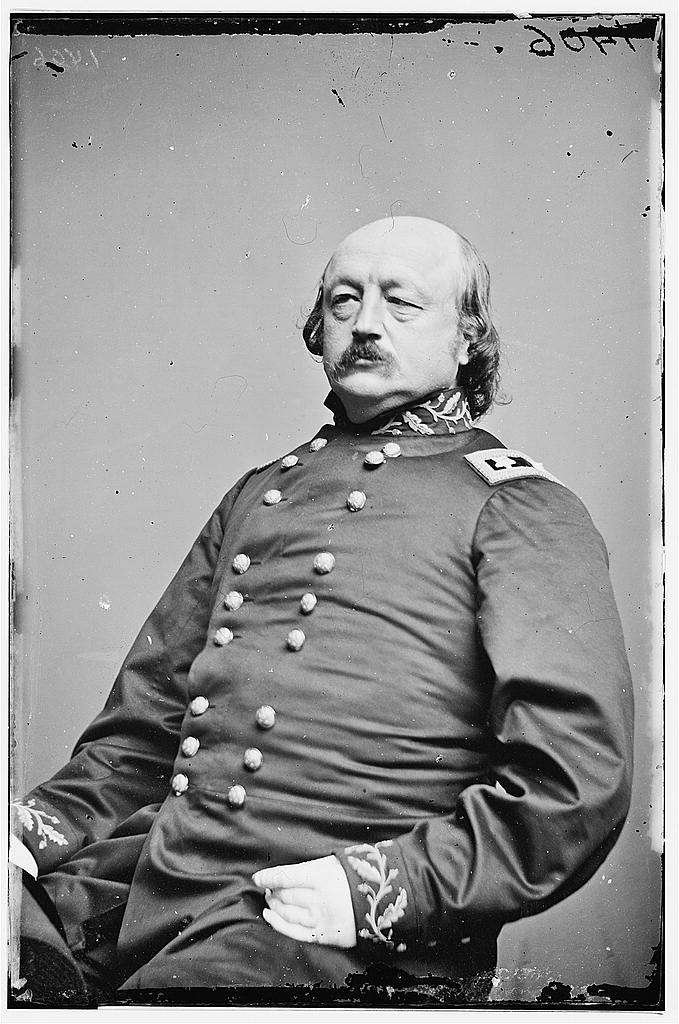
Benjamin Butler. He was a mediocre general but a wily politician (Library of Congress).

Benjamin Butler. He was a mediocre general but a wily politician (Library of Congress).

Abou Ben Butler had quite a stampede last night. Having got so far away from home, he conceived that the whole southern host was massed to crush him, and communicated the same with much eloquence, by the instrumentality of the magnetic telegraph; whereat Major-General Humphreys, Chief-of-Staff, had the brutality to laugh! We made our usual peregrination to Globe Tavern, where we got about 10 o’clock. Here General Meade sent me to look for a new camp, first enquiring if I felt well enough for that arduous service, as he looks on me as a tender convalescent! It was a tedious business getting a spot; for the whole country was either occupied, or was very dirty from old camps. At quarter to eleven, as I was poking about, I heard firing to the left, pretty sharp for a few minutes, and supposed there might be quite a fight; but it died away, shortly, except the cannon, which were not frequent. I got to the front about one, and met General Meade at the Peeble house. He had been to the Pegram house and it was near there he had such a narrow escape from a shell. I told them that, had I been there, I should have been the odd man that would have been hit; for they all said that the Staff could not well have been arranged again so that there would have been room for a three-inch shot to pass without hitting somebody. The cause of the firing was, that the whole line advanced, except the right division, and established a front position at the Pegram house. . . .

The engineers were trotting round briskly, you may depend, ordering a redoubt here and a battery there, all intent on fencing in our new property. Luckily, the soil is very light and easy to dig, for our earthworks have now to be measured by miles. Not only must the front be protected, but the exposed flank and the rear. With what men we have, we do a great deal. Since we left Culpeper, I have not seen the troops look so healthy. If we could work a little more backbone into that 9th Corps, it would help wonderfully; but they started green and that is no way to ripen men. Many faults there have been also in the command. The men are in good spirits, I think, and well conditioned for the prosecution of the campaign. The evening of Sunday we went to our new camp, having lived nearly three months in the old one. It seemed quite like leaving home; for you get used to your little canvas house, pitched in a particular spot. The new camp is well enough placed, but in a region of evil savors. There is a timber bridge near by, and, every waggon that went over it, the General would jump and say, “By Jove, there is heavy musketry!” Gradually he learned the difference of sound and settled down quietly. The weather has been very warm the last day or two.

Theodore Lyman’s letter is from Meade’s Headquarters, 1863-1865: Letters of Colonel Theodore Lyman from the Wilderness to Appomattox, pp. 231-2 and 237-8. Edited by George R. Agassiz. Boston, Massachusetts Historical Society, 1922. Available via Google Books.
A Few Hurried Lines (October 1, 1864)

As he indicates below, George Meade was indeed busy 150 years ago today. His army was fighting the battle of Peebles’ Farm in an attempt to force Robert E. Lee to extend his already thinly stretched lines. The Willie Sergeant to whom he refers is Mrs. Meade’s brother, a colonel in the 210th Pennsylvania Volunteers. George, of course, is the Meades’ son, assigned to the general’s staff.

I have only time to write you a few hurried lines. We have been actively engaged for the last two days, and yesterday we had a pretty sharp fight, gaining some advantages and meeting with some checks.

George and myself are well. Willie Sergeant has arrived with his regiment, and is under my command. He is well and in good spirits.

Meade’s correspondence taken from The Life and Letters of George Gordon Meade, Major-General United States Army, Vol. 2, (New York: Charles Scribner’s Sons, 1913), p. 231. Available via Google Books.

Peebles’ Farm (September 30, 1864)

Theodore Lyman provides a good description of the battle known as Peeble’s Farm. It was part of Grant’s strategy to force Lee to stretch his lines until they broke. While the Army of the James was attacking Lee’s left north of the James River, Meade’s Army of the Potomac hit the right. Fighting will continue on October 1.

If the General will ride out at 8.30 A.m., and get back at 10.30 P.m., and fight a good part of the day, how am I to feel wakeful and lively to write to you? I am very well and getting stronger; was in part of the battle beyond the railroad; but only had a few bullets and one solitary cannonball in my neighborhood. This going from Beverly to battle is quite a sharp contrast. Our advantage was signal and important if we have good luck in holding on, which I think we shall. There may be fighting to-morrow, but I incline to think not.

Globe Tavern, a landmark near the Weldon Railroad. The information for this image at the Library of Congress identifies the tavern as having been Meade's headquarters at Malvern Hill, which is not true. Meade was sent home wounded before that battle (Library of Congress).

Globe Tavern, a landmark near the Weldon Railroad. The information for this image at the Library of Congress identifies the tavern as having been Meade’s headquarters at Malvern Hill, which is not true. Meade was sent home wounded before that battle (Library of Congress).

On October 4, Lyman wrote out a more complete account of the events of September 30. I include it here for the sake of chronological consistency. Gouverneur Warren commands the V Corps. John Parke had replaced Ambrose Burnside at the head of the IX Corps. Samuel Crawford and Charles Griffin command V Corps divisions. Griffin is the profane general whom Grant wanted Meade to arrest for insubordination at the Wilderness; Meade had assured him that Griffin’s intemperate speech was only “his way.”

General John G. Parke (Library of Congress).

General John G. Parke (Library of Congress).

At 8.30 in the morning, the General, with the combative [Andrew] Humphreys and all the Staff, rode towards the left, stopping of course at the irresistible Hancock’s. At noon we got to Globe Tavern, which is some six miles from our old Headquarters. [Samuel] Crawford’s division still held the works on the Weldon road, while Warren, with two divisions, followed by [John] Parke, with two divisions of the 9th Corps, had moved out to the west, and already we could hear the Rebel artillery shelling our advance. . . . . At the Poplar Grove Church the Rebels began to throw shells, with a good deal of accuracy, into the road; for they had the range, though they could not see for the woods. Near here was a swampy run, where our skirmishers drove those of the enemy across, and the division then got over and kept ahead. General Meade, meantime, staid at the Globe Tavern, waiting for the movement to develop. He sent out an aide or two, to tell Warren he was there and to bring news of the progress. Warren sent in word that; having got across the run, he would soon see what could be done. At 12.45 we could hear pretty brisk musketry, which continued a short time and then ceased. Some time after, an aide came in from General Warren, with news that Griffin had captured a strong line and a redoubt, in handsome style. Not long after, the General rode to the front, where we arrived at 2.45. Most of the road was through a pleasant wood, chiefly oak. Passing the “church” (a little, old, wooden building that might seat forty persons), we turned to the right and came out on a large, open farm. On a roll of land, just ahead, was the Peeble house (pretty well riddled with bullets), and hence you looked over more open land ending in a fringe of wood. Perhaps 400 yards in front was the captured line and the redoubt: the former very strongly and handsomely made; the latter not quite finished inside, wanting still the platforms for the guns; otherwise it was done, with a ditch outside and an abattis. So far as I can learn, the occupying force was about equal to the attacking; but they did not make as good a fight as usual. The two assaulting brigades advanced very handsomely and rushed over the works. The enemy began at once to draw off their cannon, but the horses of one piece were shot, and it fell into our hands. The loss was very small in the assault, not over 100, which shows how much safer it is to run boldly on: the enemy get excited and fire high. I went into the redoubt. A Rebel artillery-man lay dead on the parapet, killed so instantly, by a shot through the head, that the expression of his face was unchanged. In front they were burying two or three of our men and a corporal was marking their names on a headboard, copying from letters found in their pockets. Parke was now ordered to form on the left of Warren ([Romeyn] Ayres being on the right of Griffin), and it was understood that the whole line would then advance from its present position, near the Pegram house, and see if it were practicable to carry the second line, which lay perhaps three fourths of a mile beyond. As I understand it, General Meade’s orders were not properly carried out; for Griffin did not form, so as to make an extension of Parke’s line. At 5.30 we were sitting in the Peeble house, waiting for the development of the attack, when we heard very heavy musketry beyond the narrow belt of the woods that separated us from the Pegram farm; there was was cheering, too, and then more musketry, and naturally we supposed that Parke was assaulting. But presently there came from the woods a considerable number of stragglers, making their way to the rear; then came even a piece of a regiment, with its colors, and this halted inside the captured works. The musketry now drew plainly nearer, and things began to look ticklish. I watched anxiously a brigade of the 5th Corps that stood massed in the edge of the wood, beyond the redoubt. Suddenly it filed to the left, at a double-quick, the brigade colors trotting gaily at the head, then formed line and stood still. In another moment the men leveled their muskets, fired a heavy volley and charged into the wood. The musketry receded again; a battery went forward and added itself to the general crash, which was kept up till darkness had well set in; while we sat and watched and listened, in comparative safety, just beside the captured redoubt. [Robert] Potter had been taken in the flank by the Rebels charging, and had been driven back in confusion. Griffin had advanced and restored the retired line. And who rides hither so placidly? It is General Humphreys: he has stolen off and, bless his old soul, has been having a real nice time, right in the line of battle! “A pretty little fight,” said he gingerly, “a pretty little fight. He! he! he!” Poor Potter! it wasn’t his fault. Our extreme advance was driven back, but the day was a great success, with important strategic bearing.

Theodore Lyman’s letter is from Meade’s Headquarters, 1863-1865: Letters of Colonel Theodore Lyman from the Wilderness to Appomattox, p. 231 and 234-7. Edited by George R. Agassiz. Boston, Massachusetts Historical Society, 1922. Available via Google Books.
A Grand Movement (September 29, 1864)

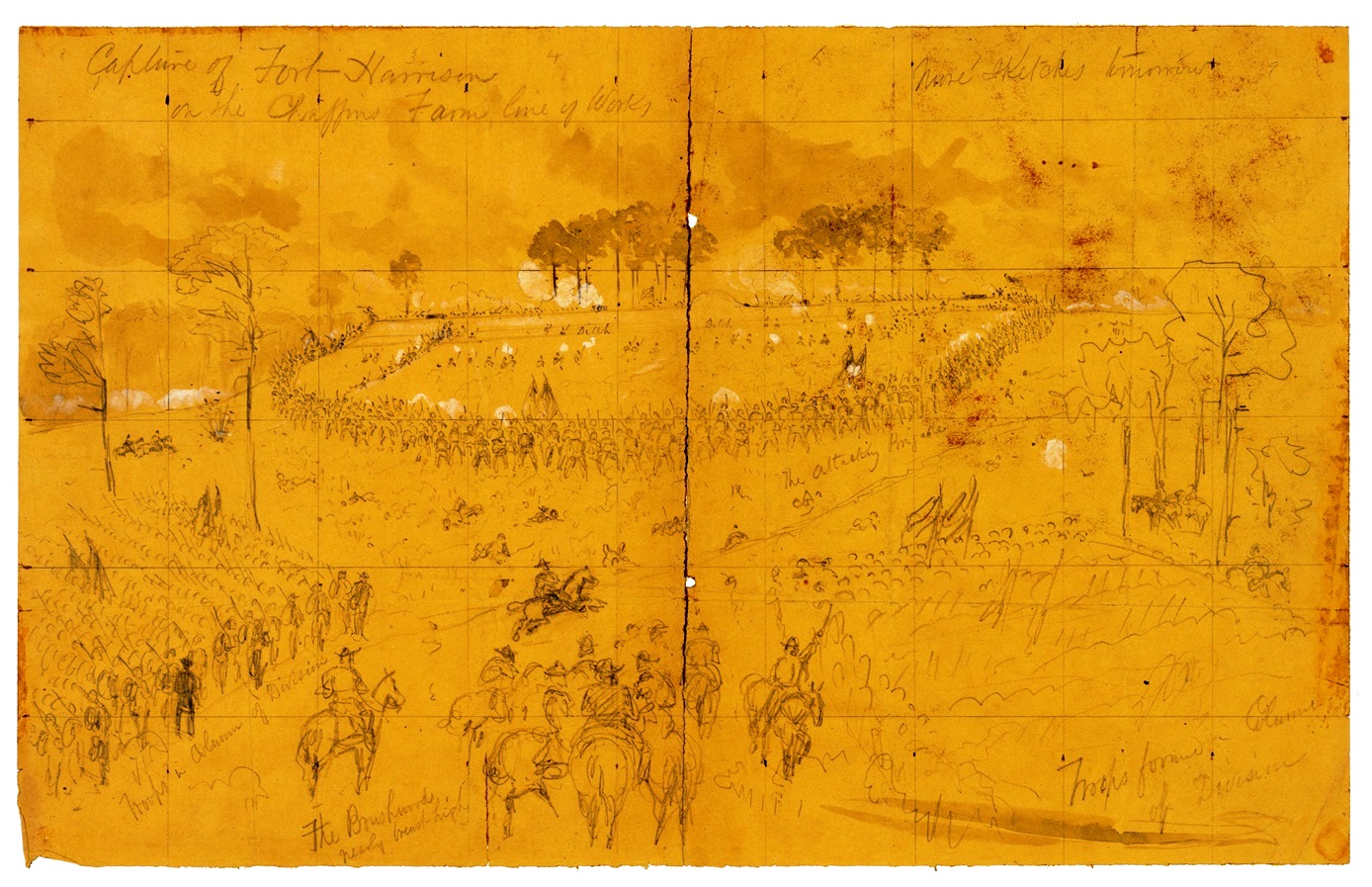
"Capture of Fort Harrison on the Chaffins Farm line of Works"by William Waud. Sketched on September 29, 1864 (Library of Congress).

“Capture of Fort Harrison on the Chaffins Farm line of Works”by William Waud. Sketched on September 29, 1864 (Library of Congress).

Theodore Lyman’ wrote this letter on October 3, but it covers the events of September 29. I thought I’d post it today.

The night of my arrival, curiously enough, was the eve of a grand movement. [ “The move now proposed consisted of an advance both on the right and the left flanks. On the right, towards Richmond, taking the north side of the river; on the left towards the Boydton plank road and southside rail. The strategic object was two-fold: first, to effect threatening lodgments as near as possible to these points, gaining whatever we could by the way; and, secondly, to prevent Lee from reinforcing Early.” — Lyman’s Journal. ] I never miss, you see. Rosey [aide-de-camp Frederick Rosencrantz]drew me aside with an air of mystery and told me that the whole army was ordered to be packed and ready at four the next morning, all prepared to march at a moment’s notice. Headquarters contented itself by getting up about half-past five, which was plenty early enough, as turned out. We rode down to General Hancock’s about 9.30. He was camped not far from us, or had been, for now his tents were struck and packed, and there lay the familiar forms of Lieutenant-Colonel Morgan and Major Mitchell, on some boards, trying to make up for their loss of sleep. The cheery Hancock was awake and lively. We here were near the point of the railroad, which excited General Meade’s indignation by its exposure. Now they have partly sunk it and partly built a bank, on the enemy’s side, so that it is covered from fire. Here we got news that Ord and Birney had crossed the James, the first near Dutch Gap, the other near Deep Bottom, and advanced towards Richmond. Birney went up the Newmarket road, took a line of works, and joined Ord, who took a strong line, with a fort, on Chapin’s farm, which is before Chapin’s bluff, which again is opposite Fort Darling. We got sixteen guns, including three of heavy calibre, also some prisoners. General Ord was shot in the thick of the leg, above the knee. There was another line, on the crest beyond, which I do not think we attacked at all. We went down then to the Jones house, where were Parke’s Headquarters, and talked with him. I saw there Charlie Mills, now on his Staff. Finally, at 1.30 we got to Globe Tavern where was the astute Warren. Everything was “set,” as he would say, for an advance by Griffin’s and Ayres’s divisions, while Willcox’s and Potter’s divisions of the 9th Corps were massed at the Gurley house, ready to support. General Gregg made an advance west of Reams’ station, and was heavily attacked about 5 p.m., but repulsed them. Their artillery blew up one of his caissons and we could see the cloud of smoke suddenly rise above the trees. This was all for that day in the way of fighting.

Theodore Lyman’s letter is from Meade’s Headquarters, 1863-1865: Letters of Colonel Theodore Lyman from the Wilderness to Appomattox, pp. 232-4. Edited by George R. Agassiz. Boston, Massachusetts Historical Society, 1922. Available via Google Books.

A Hooker Encounter (September 29, 1864)

Maj. Gen. Joseph Hooker(Library of Congress).

Maj. Gen. Joseph Hooker(Library of Congress).

Theodore Lyman resumes writing his detailed letters home, providing a wealth of detail about his experiences in the war. Here he describes how during the trip back to rejoin the army he encountered Joe Hooker, Meade’s predecessor as commander of the Army of the Potomac. Following his defeat at Chancellorsville, Hooker had been sent out west, where he served capably as a corps commander under Ulysses S. Grant in the Army of the Tennessee. But Hooker asked to be relieved when Grant promoted Gen. Oliver O. Howard over him following the death of Gen. John McPherson. In his journal entry, Lyman said that Hooker “was shaky about the legs, red in the face and had a boiled eye, like one who had been on a great spree.” Grant had no love for Hooker. In his memoirs he acknowledged that Hooker’s actions at Chattanooga had been “brilliant,” but added, “I nevertheless regarded him as a dangerous man. He was not subordinate to his superiors. He was ambitious to the extent of caring nothing for the rights of others. His disposition was, when engaged in battle, to get detached from the main body of the army and exercise a separate command, gathering to the standard all he could of his juniors.”

Lyman reaches the army just as Grant launched another offensive, with the Army of the James fighting the battles of Chaffin’s Farm and New Market Heights and for Forts Gilmer and Harrison, and the Army of the Potomac stretching out to probe the far left of its line. Interestingly enough, just last week the National Park Service discovered an unexploded shell from the Civil War in the moat around Fort Gilmer. It apparently dated from the battle on September 29, 1864. Confederate defenders may have rolled it into the moat so it would explode among the attacking soldiers of the Union States Colored Troops.

The 6.45 p.m. train, which bore me, on Monday, from the ancient town of Beverly, did arrive in very good season in Boston, where I hired a citizen, in the hack line, to convey me with speed and safety to the Worcester depot. With an eye to speculation the driver took in also a lone female, who looked with a certain alarm on me, doubtful as to whether I might not be in the highway-robbery line. She had evidently been on a sea-shore visit, and bore a small pitcher with a bunch of flowers therein. By a superior activity I got a place in the sleeping-car, for it seems to be the policy to have about half room enough for the sleepy passengers, so that those who don’t get places may look with envy on t’others and determine to be earlier next time. Geo. D____ was along. The canny man had got a good berth, in the middle of the day, and you should have seen his traveller’s fixings: a blanket, a sort of little knapsack, and finally a white handkerchief to tie over his head; “For,” said he, “perhaps the pillows are not very clean.” With martial indifference I took off boots and blouse, got on an upper shelf (not without convulsive kicks), and composed myself to the fitful rest which one gets under such circumstances. There was, as the conductor truthfully observed, “a tremendous grist of children in the car”—of all sizes, indeed, from a little one that publicly partook of its natural nutriment, to youths of some twelve summers. The first object I saw, on wakening in the morning, was an attentive Ma endeavoring to put a hooped skirt under the dress of a small gal, without exhibiting to a curious public the small gal’s legs; which attempt on her part was a lamentable failure. I was glad to get out of the eminently close locomotive dormitory and hop with agility on the horse-car, which landed me, a little before seven a.m., at the Astor House. Here I partook of a dollar and a quarter’s worth of tea and mutton-chop, and stretched my legs by a walk to the Jersey ferry, and there, as our pilgrim fathers would have said, took shipping for the opposite shore. I should not neglect to say that at the Astor I had noticed a tall man, in the three buttons of a Major-General, whom I at once recognized as the original of the many photographs of General Hooker. I was much disappointed in his appearance: red-faced, very, with a lack-lustre eye and an uncertainty of gait and carriage that suggested a used-up man. His mouth also is wanting in character and firmness; though, for all that, he must once have been a very handsome man. He was a passenger for Washington and sat near me. Next me was a worthy minister, with whom I talked; he, I do remember, delivered a prayer at our chapel last winter, at Headquarters. He was like all of that class, patriotic and one-sided, attributing to the Southerners every fiendish passion; in  of which he had accumulated all the horrible accounts of treatment of prisoners, slaves, etc., etc., and had worked himself into a great state. Evening. 10 p.m. I have got to Baltimore and can’t go a step farther; for all day have I been on the Weldon railroad with General Meade, and I must slap to bed, for I am most sleepy, though all right.

Theodore Lyman’s letter is from Meade’s Headquarters, 1863-1865: Letters of Colonel Theodore Lyman from the Wilderness to Appomattox, pp. 229-31. Edited by George R. Agassiz. Boston, Massachusetts Historical Society, 1922. Available via Google Books.