Back in Camp (September 10, 1864)

George Gordon Meade has returned to his army but his thoughts remain fixed on Philadelphia. In particular he is depressed about the health of his oldest son, John Sergeant. “Sargie” suffers from tuberculosis and his health is failing. The situation torments his parents.

The Secretary is Edwin Stanton, secretary of war.

I reached here about 4 p.m. to-day, very sad and dispirited, as I reflect on Sergeant’s ill health and your embarrassing position. I wrote you a few hurried lines from Washington by Willie Gerhard. I spent about half an hour with the President and some four hours with the Secretary. Both were very affable, apparently very glad to see me, and said many flattering things. The Secretary, particularly, kept me in his private room, to the exclusion of all other visitors, and was very sociable. I think I wrote you that when I told him of dear Sargie’s ill health, he at once said if I wanted to send him to Cuba or New Orleans, he would place at my disposition a Government steamer to take him out there, which I considered very handsome.

We left Washington at 6 p.m. in a special steamer, which, although quite comfortable, was a very slow one, and we did not reach City Point till 12 m. to-day, though the ordinary run would have brought us there at 6 p.m. yesterday. I saw Grant for a little while before coming here, and he told me he was near telegraphing me to come back on Monday, as on that day there were indications the enemy was going to attack; but they passed away, and he let me alone.

I have thought a great deal about you, and the more I think, the more I am puzzled. I really do not see anything that can be done except your accompanying Sergeant, and I think the best place to go is the Island of Madeira. This would not diminish our expenses any; still I don’t see what other arrangement can be made. If you could only hear of some kind friend who was going to Europe, who would take care of Sergeant, and thus render your going unnecessary, it would be a great relief, as your leaving the younger children is a very great disadvantage. Still, we must accommodate ourselves to things as they are, and not as we would have them, and yield everything in the hope that dear Sargie will be benefitted by the change of scene and air, and under the blessing of God his health restored. I dream about you all the time, and cannot dismiss you from my thoughts day or night.

Meade’s correspondence taken from The Life and Letters of George Gordon Meade, Major-General United States Army, Vol. 2, (New York: Charles Scribner’s Sons, 1913), pp. 226-27. Available via Google Books.

A Stop in Washington (September 8, 1864)

Secretary of War Edwin Stanton (Library of Congress).

Secretary of War Edwin Stanton (Library of Congress).

George Meade is on his way back to his army headquarters following a welcome chance to spend some time on leave in Philadelphia. The Willie to whom he refers is his wife’s brother. William Sergeant was appointed the colonel of the 210th Pennsylvania Volunteer Infantry on September 24. Meade will continue to update his wife about her brother over the following months.

I have been received with the greatest kindness both by the President and Mr. Stanton. At my request, Willie’s appointment was immediately made out and given to him, and Mr. Stanton said I might rest assured my major-generalcy would in due time be given me.

I am very much hurried and leave this afternoon at six.

Meade’s correspondence taken from The Life and Letters of George Gordon Meade, Major-General United States Army, Vol. 2, (New York: Charles Scribner’s Sons, 1913), p. 226. Available via Google Books.

Caldwell’s Division

0906141030It’s been a while since we’ve heard from George Meade, who has been back in Philadelphia on leave. But never fear—his letters resume tomorrow.

In the meantime, I spent yesterday on the Gettysburg battlefield, where I took a three-hour tour that covered the July 2 attack of Caldwell’s division through the Wheatfield. The tour was organized by Randy Drais of BattleofGettysburgBuff.com and conducted by licensed battlefield guide Steve Slaughter. I heard about the tour through Facebook and decided it sounded like a great way to spend a Saturday. I was right about that.

0906141021

The tour begins at the 148th PA monument.

We met at the 148th PA monument off Ayres Avenue and got going at 10:00. I guess there were about 20 people there for the tour, which cost us $17. It was a warm and steamy September morning, with the threat of thunderstorms later in the day. I was just pleased to be spending the day on the battlefield.

Slaughter proved to be an engaging and informed guide. He explained how Meade had ordered II Corps commander Winfield Scott Hancock to send a division to this part of the battlefield. Slaughter pointed out that Meade wanted it to support the V Corps—not Dan Sickles’ over-extended III Corps—which is interesting. However, since the V Corps was supporting the III, I guess you can still say that this was part of Meade’s promise that afternoon to Sickles that he would send whatever he could to help the III Corps, which he knew was in serious trouble because of Sickles’s ill-advised advance.

John c. Caldwell

John C. Caldwell

The best thing about tours like this is they give you a spatial sense of the battlefield that even the best maps can’t provide. (Slaughter advised us several times that it’s often best to take maps with a grain of salt, anyway, and he proved his point by having us make some corrections on one of the maps included in the packet we all received.) Slaughter explained how John Caldwell’s First Division of the II Corps was on that corps’ left on Cemetery Ridge, hence the obvious candidate to move toward the Wheatfield. It consisted of four divisions—the First under Edward E. Cross, the Second (the Irish Brigade) under Patrick Kelly, the third under Samuel K. Zook, and the Fourth, commanded by John R. Brooke. Over the tour’s three hours, Slaughter adroitly explained the movements of these four brigades and also their occasional entanglements with elements of the III and the V Corps. Seeing exactly where these soldiers moved and fought really helped me put the pieces together of the complex and bloody puzzle of the fighting here that day.

We hiked back and forth, down the Wheatfield Road, back up and through the Wheatfield itself, and on to the monuments along Brooke Avenue that mark the furthest advance of Brooke’s brigade. While at this advanced position, Randy Drais took us down into the woods behind Brooke Avenue to show us Brooke’s rock, upon which the brigade commander supposedly stood when he made a speech to rally his men. The rock has an X, barely visible, which, it is said, Brooke himself carved into the boulder on a post-war visit to indicate that this was the very rock that served as his platform.

The X on Brooke's Rock.

The X on Brooke’s Rock.

At the end of the day on July 2, 1863, the surging Confederates pushed the bloodied remains of Caldwell’s division back to the base of Little Round Top and the fighting ended for the day. Slaughter talked about the charge of the Pennsylvania Reserves, the V Corps division commanded by Samuel Crawford, but took some air out of the story by pointing out that most of the Confederates had pulled back by the time the Reserves moved forward. (Slaughter doesn’t much appreciate V Corps commander George Sykes, whom he said spent most of the day behind Little Round Top where people had trouble finding him. For what it’s worth, Sykes and Sickles are the only Union corps commanders at Gettysburg who don’t have statues on the battlefield.)

Steve Slaughter explains things at the monument to Wilson's battery (Battery D, 1st NY Light artillery).

Steve Slaughter explains things at the monument to Wilson’s battery (Battery D, 1st NY Light artillery).

Back at Ayres Avenue we all received tickets for a drawing and I won, choosing for my prize a copy of Bradley Gottfried’s book Brigades of Gettysburg. I even sold a copy of my Meade book to one of the attendees (who earlier had told me he though Meade was a poor general. Maybe he will change his mind after he reads the book).

As I said, it was a terrific way to spend a Saturday.

Now here’s the weird part. A few weeks ago a volunteer for the Gettysburg Foundation informed me that I had left a couple of monuments out of my Guide to Gettysburg Battlefield Monuments. I had found the one to Colonel George Willard of the 125th New York (in a thicket west of the Pennsylvania State Monument). I had not located the one to Captain Henry Fuller, of Co. F, 64th New York Infantry. The 64th belonged to Brooke’s brigade. Fuller was wounded in the leg as his regiment charged through the Wheatfield and he later received a second wound in the back that proved mortal. I knew the monument was somewhere above the old trolley bed that runs below Brooke Avenue, but there were no paths leading to it and the thick overgrowth made it very hard to locate. After the tour I set out to find it.

It was a frustrating search. I was crashing through the woods above the trolley line, pushing my way through bushes and spider webs, when I thought I spotted a figure ahead of me through the trees. He appeared to be wearing a Union uniform. I had seen a reenactor up by the 148th PA monument when we started the tour, so I figured it was him. He seemed to be waving me on, so I pushed through the thick undergrowth in his direction but lost sight of him as I was dodging branches. When I reached the spot where I thought he had been, I found the Fuller monument. The mysterious figure, however, was nowhere to be found! He had vanished—even though there was no way anyone could have crashed his way through the trees away from me without my noticing him.

Back at home I found a photograph of Fuller and nearly fell off my chair when I realized he was the spitting image of the figure I had seen in the woods!

Oh, c’mon! Did anyone really believe that story? Seriously? Well, sorry. I was messing with you. I agree with Sherlock Holmes on this one. “The world is big enough for us,” he told Dr. Watson. “No ghosts need apply.” Truth be told, I didn’t find the Fuller monument yesterday. I will try again once in the fall.

There are plenty of ghosts at Gettysburg, but they’re all in our imaginations. They emerge as we walk the fields where so many fought and died. That’s ghost enough for me.

Leaves (August 28, 1864)

George Gordon Meade (Library of Congress).

George Gordon Meade (Library of Congress).

After today we won’t be hearing from George Meade for a little while. Our loss is the general’s gain, for, despite what he says in the last line of this letter, he does receive permission to go home on leave. He departs camp on September 1 and reaches Philadelphia two days later. He will begin his return trip on September 7, with a stop in Washington, D.C.

The court of inquiry to which he refers is the one regarding the Battle of the Crater.

I received this evening yours of the 26th. In it you acknowledge the receipt, per Mr. England, of my testimony before the court of inquiry. The sittings of the court have been interrupted by our recent movements, but to-morrow they are to be resumed, and I trust they will push matters to a close and come to some conclusion before they are again interrupted.

I have written you of the fighting that has been going on for a week past. It has been quiet for the last two days. The enemy having left us in undisturbed possession of the railroad so long, our position is strengthened to such a degree he could not now drive us away. This is a great point gained, and we are satisfied with its accomplishment, notwithstanding it entailed heavy losses on us, particularly in prisoners. Poor young Grossman belonged to the regulars, and was killed in the first day’s fight on the railroad. I understand he was shot in the head, being unconscious from the moment of receiving his wound till he expired, which occurred soon after. I believe he had not joined very long, and I was not aware of his being here. I sympathize most sincerely with his afflicted parents, but this is one of those dispensations that are almost daily taking place here.

Julia Grant, in a photo taken after the war (Library of Congress).

Julia Grant, in a photo taken after the war (Library of Congress).

I understand General Grant has been to Fortress Monroe and returned to-day with his wife and children. He has one little girl, and either two or three boys. He seems very much attached to his children, and his wife is said to possess a great deal of good sense, and to have exercised a most salutary effect over him. I do not know why she has given up St. Louis, her native place, but Grant told me the other day he intended to keep his family in Philadelphia for the next few years, probably for the education of his children.

I think we shall be quiet for some time, unless the enemy attacks, which I hardly think probable. Butler is away now, but when he returns I shall make an effort to get off for a few days, to have a peep at you and the children; but don’t rely too much on my coming.

Theodore Lyman’s letter of August 27 is also the last we shall hear from him for a while. As the book of his letters explains, “The next day Lyman was surprised to have Meade say to him. ‘I think I must order you home to get me some cigars, mine are nearly out!’ But, as the former remarked, ‘It’s hard to surprise a man out of going home, after a five months’ campaign.’

“General [Seth] Williams gravely prepared a fifteen-day leave, and the aides tendered their congratulations. Lyman was bound for Richmond on secret service! So the Staff persuaded the inquisitive [James] Biddle, who talked about it all over camp, and got very mad when undeceived. He recovered, however, when tendered a cocktail as a peace offering.

“Lyman’s visit to the North proved longer than he expected. For, shortly after his arrival in Beverly, where Mrs. Lyman was passing the summer, he had an attack of malaria which kept him in bed for some time. According to the doctors, ‘The northern air, with the late cool change, had brought to the surface the malaria in the system.’ Consequently, he was not able to rejoin the army until the end of September.

“Meanwhile, the gloom was lifting, that had settled on the North after the failure to take Petersburg. For Sherman’s capture of Atlanta, and Sheridan’s victories over Early in the Shenandoah, had somewhat changed the situation, although the Army of the Potomac still lay before Petersburg, where it hovered for many weary months.”

Meade’s correspondence taken from The Life and Letters of George Gordon Meade, Major-General United States Army, Vol. 2, (New York: Charles Scribner’s Sons, 1913), pp. 225-26. Available via Google Books.

Every Satisfaction (August 26, 1864)

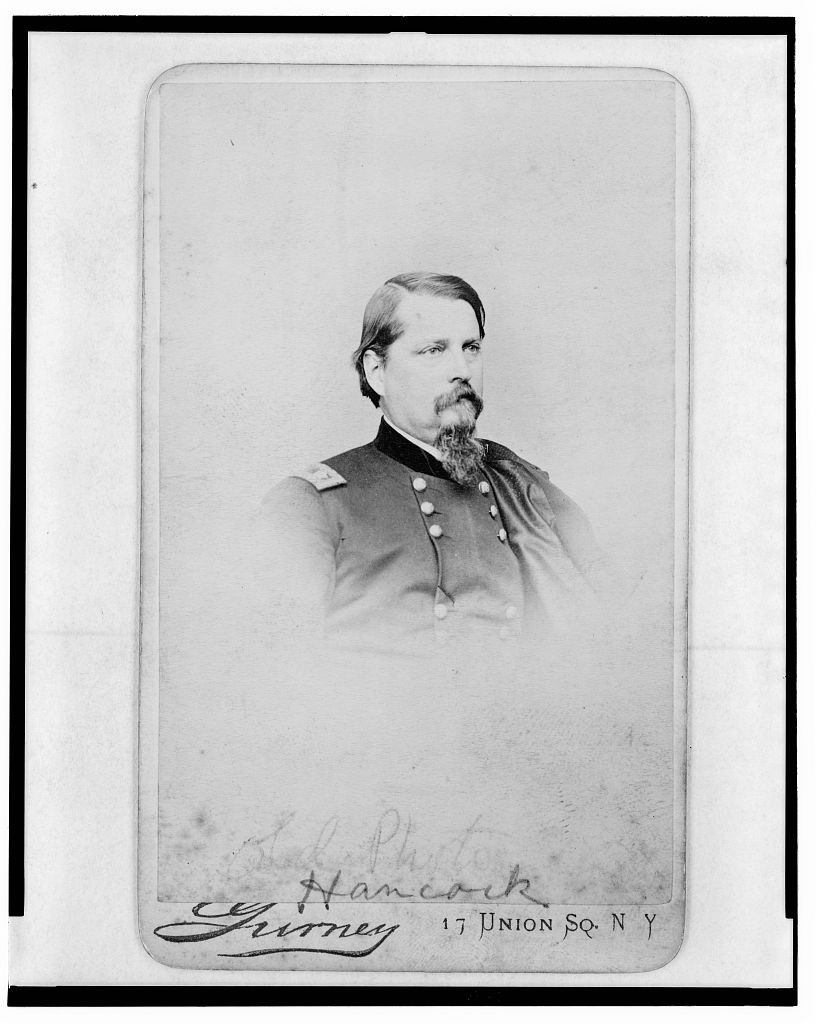
Winfield Scott Hancock (Library of Congress).

Winfield Scott Hancock (Library of Congress).

As mentioned yesterday, the Battle of Reams Station was an embarrassment for Winfield Scott Hancock and the II Corps. In his history of the II Corps, Francis A. Walker quoted Charles Morgan, Hancock’s chief of staff, as saying, “It is not surprising that General Hancock was deeply stirred by the situation, for it was the first time he had felt the bitterness of defeat during the war. He had seen his troops fail in their attempts to carry the intrenched positions of the enemy; but he had never before had the mortification of seeing them driven, and his lines and guns taken, as on this occasion. . . . Never before had he seen his men fail to respond to the utmost when he had called upon them personally for a supreme effort; nor had he ever before ridden toward the enemy followed by a beggarly array of a few hundred stragglers who had been gathered together and again pushed toward the enemy. He could no longer conceal from himself that his once mighty corps retained but the shadow of its former strength and vigor.” Walker, who was taken prisoner during the battle, blamed Meade, in part, for not reinforcing Hancock.

After the defeat, Meade sent a note to Hancock. “No one sympathizes with you more than I do in the misfortunes of this evening,” he wrote. “I am satisfied you and your command have done all in your power, and though you have met with a reverse, the honor and escutcheon of the old Second is as bright as ever, and will, on some future occasion, prove it is only when enormous odds are brought against them that they can be moved.

Don’t let this matter worry you, because you have given me every satisfaction.”

I have been for several days very much occupied, in the saddle all day, superintending the movements culminating in our securing a permanent lodgment on the Weldon Road. I think I wrote you of Warren’s movements and his fights, which, although attended with heavy losses in prisoners, yet resulted in our retaining our hold and eventually inflicting great damage on the enemy. Soon after Warren was in position, Hancock was brought from the north side of the James, and placed on the railroad, with two divisions of infantry and one of cavalry, and commenced the work of destroying the road. He had only destroyed about seven or eight miles, when the enemy, yesterday, attacked him with great vehemence and superior numbers. Hancock was in a good position, and repulsed all their attacks till about dark, when, becoming desperate, they hurled such masses against him, they were enabled to carry a small portion of his lines and a battery of eight guns. As soon as I found how heavily he was attacked, I hurried up reinforcements to him, but the distance was so great they did not arrive till after dark. Hancock’s object, the destruction of the road, being frustrated, he was withdrawn at night. This was the only unfortunate part of the affair, for we this morning ascertained from some of our men who remained on the field that the enemy retired also during the night, leaving their wounded, with their dead unburied. It is said to be one of the severest battles of the war, and the enemy, being the attacking party, suffered terribly, our losses being comparatively light. Still, the loss of guns and our withdrawal will tell against us, though I would do the same thing to-morrow, and willingly lose guns, to make the enemy lose five killed and wounded to our one. Hancock expressed himself as confident of maintaining his position, and did not call for reinforcements, which I nevertheless sent as soon as I found how heavily he was engaged, and he now says he ought to have kept his lines intact, and would have done so but for the bad conduct of a part of his command, giving away when there was no excuse for it. After withdrawing, the enemy retired within his lines at Petersburg, and will, I think, let us alone for some time, and will hardly try for some time the plan of attacking us. These frequent affairs are gradually thinning both armies, and if we can only manage to make the enemy lose more than we do, we will win in the long run, but unfortunately, the offensive being forced on us, causes us to seek battle on the enemy’s terms, and our losses are accordingly the greatest, except when they come out and attack, as recently, when they always get the worst of it.

In his journal entry from August 25, Theodore Lyman wrote that Meade and Hancock had “an almost sharp talk” about Hancock’s support at Reams Station and that Hancock had said, “I would never ask for reinforcements!” Lyman felt this was “a brave but not a soldierly remark.” In his notes for the book of Lyman’s journals (Meade’s Army: The Private Notebooks of Lt. Col. Theodore Lyman), editor David W. Lowe cites Francis Walker’s criticism of Meade’s handling of Reams Station. “If Meade did not intend to fight, Hancock should have been withdrawn,” Walker had written. “If he did intend to fight, Hancock should have been powerfully reinforced.” Added Lowe, “In hindsight, the criticism holds weight; Meade was lulled by Hancock’s bravado.”

It may be laid down as a general principle, that it is a bad thing, in a musket or a man, to go off at half-cock. In some respects I may be said so to have done in my letter last night. Our information this morning shows that, after dark, while we marched off the ground one way, the enemy marched off the other, leaving their dead unburied and some wounded. Accounts of the field show their loss to have been fearful, much greater than ours, which was not serious either in killed, wounded or prisoners. Thus, all the strategic results lie with us, and we hold the Weldon road. But I would not have you believe I was disposed to turn about and crow. No! I do not so much mind the loss of the guns—a mere matter of prestige—but I do mind the fact that the 2d Corps men did not all fight as they should have fought; had they done so, the Rebels (who I suppose were about as three to two) could never have budged them. As Major Mitchell observed: “The Rebels licked us, but a dozen more such lickings and there will be nothing left of the Rebel army!” My gracious, what a donkey am I to be solemnly sending a telegraph, when I have not been in a single fight. I felt like a donkey at the time, but I thought you would be fussing and imagining, because there had been fighting in various directions. But I will not be so silly in future. And there is your mother, bless her heart! thanking God I am safe out of it, when I have not been in it! Really, I feel it almost my duty to go on the picket line and get shot at by a grey-back, for the sake of doing something! Yes, ma’am, thirty-one is quite an old man, but I am “so as to be about,” can ride a horse and hold up my head; and, as the late T remarked, when he proposed, “I am good for ten years,” which turned out to be true (to the regret of Mrs. T.), for he lived twenty-five years after and begat sons and daughters. You must thank Madre* from me for the present of “Forbes’s Naked-eyed Medusa.” Tell her, also, that, having neglected my natural history for three years, [much] of which has been devoted to becoming semi-idiotic from having nothing to do but listen to cannon and mortars and rifles, and associate with young gentlemen still further advanced in semi-idiocy, I have not a clear idea of what a Medusa is; but am impressed with the notion that it is something flabby that lives in the sea.
*Lyman’s mother-in-law

Meade’s correspondence taken from The Life and Letters of George Gordon Meade, Major-General United States Army, Vol. 2, (New York: Charles Scribner’s Sons, 1913), pp. 224-25. Available via Google Books.

Theodore Lyman’s letter is from Meade’s Headquarters, 1863-1865: Letters of Colonel Theodore Lyman from the Wilderness to Appomattox, pp. 225-7. Edited by George R. Agassiz. Boston, Massachusetts Historical Society, 1922. Available via Google Books.

A Daily Dose of Arsenic (August 25, 1864)

reamsThe Battle of Reams Station was a serious embarrassment for Winfield Scott Hancock and the II Corps. Hancock’s men were following up Warren’s capture of the Weldon Railroad by moving south down the line and tearing up the rails, when they received word that elements of A. P. Hill’s corps were heading their way. On August 25 the Federals managed to beat back the first attacks, but then their lines crumbled. The proud Hancock, humiliated by the behavior of his soldiers, told one of his staff officers, “Colonel, I do not care to die, but I pray to God I may never leave this field.” God must not have been listening, for Hancock was forced to retreat. Theodore Lyman wrote about the battle on August 25; we’ll see what Meade has to say tomorrow.

There has been more fighting to-day. Hancock, at Reams’ station, was destroying the railroad (Weldon) and holding a position, also, for defence, having two of his divisions of infantry, besides Gregg’s cavalry. The Rebels sent down a large force to drive him off. They began attacking say about one o’clock and were severely repulsed,. till evening; but the last news is, that they made a desperate attempt on all sides and broke through a part of our right, just at nightfall. Hancock hoped to retake the part of the line lost, with the reinforcements coming up; but we have not yet heard the result. I feel rather anxious, though I don’t fear for Hancock’s safety; but I like to see him fully successful. Oh, bah! Captain Miller is just in (this is eleven o’clock at night). Hancock has lost eight guns—among them, I am told, Sleeper’s battery. Poor Sleeper was here this afternoon, wounded in the arm. It is too much all one way in this business, it really is! I don’t like to complain, because it troubles you, but it must break out occasionally. I get so mad and so bothered. For, when we have no good chance, or almost none, when our best undertakings fall through, I lose confidence in each move, and, when I hear the cannon, I look for nothing but our men coming back and a beggarly report of loss of prisoners. It is not right to feel so, but I can’t help it. When a man gets knocked down every time, he expects to go down the next. Well, well, well, I feel already a little better at this grumbling. I must be a sorry eel if I am not yet used to this sort of skinning. I like to see General Meade. I think these contretemps rather rouse and wind him up; he doesn’t seem to be depressed by that sort of thing; perhaps three years of it have made it necessary to his life, just as some persons enjoy a daily portion of arsenic.

Theodore Lyman’s letter is from Meade’s Headquarters, 1863-1865: Letters of Colonel Theodore Lyman from the Wilderness to Appomattox, pp. 224-5. Edited by George R. Agassiz. Boston, Massachusetts Historical Society, 1922. Available via Google Books.

A Man of Character and Honor (August 24, 1864)

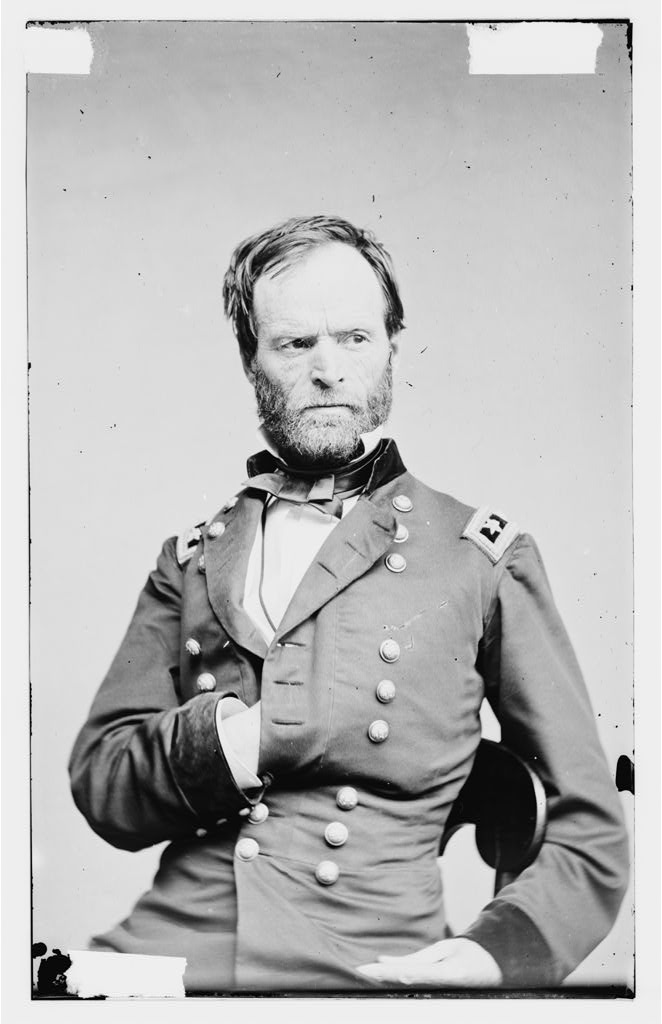
William T. Sherman (Library of Congress).

William T. Sherman (Library of Congress).

Winfield Scott Hancock (Library of Congress).

Winfield Scott Hancock (Library of Congress).

Philip Sheridan (Library of Congress).

Philip Sheridan (Library of Congress).

Meade receives what he perceives as a figurative slap in the face when he hear that William T. Sherman, Winfield Scott Hancock, and Phil Sheridan have all received promotions, while his own promised advancement to major general in the Regular Army remains stalled. He fumes about the slight and once again confronts Grant, as you can read in his letter of August 24.

I see you have heard of the promotion of Sherman, Hancock and Sheridan, and noted the absence of my name. I cannot tell you how I felt when I first heard this, but I determined to keep quiet till I could obtain some explanation from General Grant. To-day was the first time I have seen him since I learned the intelligence. On my asking him the reason of my name being omitted when those recommended at the same time had been appointed, he answered it was his act; that he had asked for the immediate appointment of the others, but had not asked for mine; and the reason he had not asked for mine was, that if Sherman and myself had been appointed on the same day, I would rank him, and he wished Sherman to rank me. That neither his opinion nor that of the President and Secretary had changed with regard to me; that it was still a settled thing that I was to have the vacancy; and that he proposed to have me appointed, when I should be assigned to the command of the Middle Division, which he said he would have done before now, but for the peculiar position Sheridan was placed in, having to fall back, and if superseded now, it would be construed into a disapproval of his course, which was not the case. Of course to all this I had nothing to say. My object was to ascertain whether any fault was found with me, or whether any change of opinion had taken place since the last time he had assured me I was to be appointed when the others were. As he had disclaimed any such reasons, I did not care to know why I had been left out. I never expected, nor did I much care about, the appointment except to prove to the ignorant public that they had been imposed upon by a lying press. Nothing more was said upon the subject. The whole substance of the explanation was that he desired to advance his favorites, Sherman and Sheridan. I was left out because it would interfere with Sherman’s rank to have me in, and Hancock was brought in because he could not appoint Sheridan before Hancock, not having recommended him when he did Hancock. Of course I could say nothing to this explanation. It would not do for me to claim promotion or express dissatisfaction at not receiving it. I had the right to ask why, after telling me I had been recommended, and would be appointed, I found I was not, but when the above explanation was made, however unjust I may have deemed such reasoning to be, I could take no notice of it, and could not with propriety complain. It is the same old story, an inability to appreciate the sensitiveness of a man of character and honor. Grant really thinks he is one of my best friends, and can’t conceive why I should complain of a little delay in giving me what he tells me I am certainly to have. It is rather hard to have denied me the vindication which the Government might give to my course, by conferring a promotion that I have the most positive evidence it, the Government, has acknowledged I merited and should have. However, I suppose this, like all else, must be borne with patience.

We have had some pretty hard fighting to secure our lodgment on the Weldon Railroad. Grant and Warren are the heroes of the affair. I must confess I do not envy either of them their laurels, although in the Weldon Railroad affair Grant was sixteen miles away, and knew nothing but what was reported to him by myself. We lost a good many men in killed and wounded, but principally in prisoners. Our army is becoming much weakened by these repeated losses, and our only hope is that the enemy suffers proportionately. Their papers acknowledge in their last affairs a loss of five general officers.

Theodore Lyman, in the meantime, takes a look at Meade’s record. When he says “those men are on the ground” I assume he means “in.”

What you say of Meade’s want of success is, as a fact, true; but what I don’t understand is, that the successes are Grant’s but the failures Meade’s. In point of reality the whole is Grant’s: he directs all, and his subordinates are only responsible as executive officers having more or less important functions. There have been cases where they might be said to act alone; for instance, the assault of the 18th of June, though under a general permission from Grant, was strictly an operation of Meade. He felt badly about that failure, “Because,” said he, “I should have taken Petersburg. I had reason to calculate on success. The enemy had no defences but what they had thrown up in a few hours; and I had 60,000 men to their 25,000.” All of which was true and the result showed the difference of morale. The men who stormed the Rappahannock redoubts in November ‘63 would have walked over the breastworks and driven Beauregard into the Appomattox; but those men are on the ground between here and the Rapid Ann, or fill the hospitals in the North. Put a man in a hole and a good battery on a hill behind him, and he will beat off three times his number, even if he is not a very good soldier.

Meade’s correspondence taken from The Life and Letters of George Gordon Meade, Major-General United States Army, Vol. 2, (New York: Charles Scribner’s Sons, 1913), pp. 223-24. Available via Google Books.

Theodore Lyman’s letter is from Meade’s Headquarters, 1863-1865: Letters of Colonel Theodore Lyman from the Wilderness to Appomattox, p. 224. Edited by George R. Agassiz. Boston, Massachusetts Historical Society, 1922. Available via Google Books.

Engineers (August 23, 1864)

George Cullum

General George Washington Cullum (Library of Congress).

James C. Duane, the Army of the Potomac’s chief engineer, took a liking to Theodore Lyman and liked to spend time with him. Here he shares a story with Lyman about another army engineer, General George Cullum. The fort in question is Fort Trumbull, today a Connecticut state park. Cullum, who grew up in Meadville, Pennsylvania, served as the superintendent of the West Point Military Academy from 1864-1866. He later married Henry Halleck’s widow. Lyman also provides a quick glimpse of Meade in full “Great Peppery” mode. In his journal, Lyman wrote that Meade “was in a mood to ‘rake’ people.” He also noted that Butler’s assistant adjutant general, who was supposed to send coffee through enemy lines to prisoners Joseph Hayes and Arthur Sedgwick, never sent it and did not return Lyman’s money! In addition, the journal entry mentioned Winfield Scott Hancock and the II Corps preparing to march to Reams Station, some inadvertently ominous foreshadowing.

Major Duane, who visits me much of evenings, because he can’t use his eyes, told me a story of Captain Cullum (now General Cullum) that I thought eminently Cullumish. Cullum was building a small fort at New London and was visited by a country editor, whom he received with high state and gave a lecture on the principles of fortification, after showing the small work on which he was engaged. He took as an example a large bastioned fort, and showed how it could be breached in forty days; and how the defenders would then make an interior line and drive out the stormers when they got inside the first. The editor, taking all this as applicable to the New London work, went home and published a tremendous leader, in which he said that the talented Captain Cullum was erecting the largest bastion fort in the world; that it would take you forty days to get inside it, and, when you were inside, you were worse off than you were before! The General rode along a new line we had been making, principally the work of the nigs, who are very faithful at making a breastwork and slashing the timber in front. A colonel or two got well pitched into for not having their men with their belts on and ready for action. I do believe our soldiers would sooner run the risk of getting shot twice a day, than take any little precaution. To-day I performed an act of military charity, by sending, per flag-of-truce boat, some coffee and sugar to Joe Hayes and Arthur Sedgwick.

Theodore Lyman’s letter is from Meade’s Headquarters, 1863-1865: Letters of Colonel Theodore Lyman from the Wilderness to Appomattox, pp. 223-4. Edited by George R. Agassiz. Boston, Massachusetts Historical Society, 1922. Available via Google Books.

Sergeant’s Condition (August 22, 1864)

Meade writes home about the sad case of his son John Sergeant. The young man (born in 1841) is fighting a losing battle against tuberculosis (he will die in February) and Meade’s letters are filled with anguished passages about his oldest son’s health. Meade’s son and grandson edited many of that material from the letters they published. Meade, of course, was not alone in fearing the death of a loved one during those terrible Civil War years, but that knowledge certainly did little to lighten his burden.

I have received your letters of the 18th and 19th insts. I have known of Sergeant’s condition for some time, because, when I found he was so sick, I wrote to Dr. Hewson, who at once replied to me. Everything has been done for Sergeant that could be done. He has had the best medical advice, and the most careful nursing. This should be continued, and the result left to that Power who governs and rules all things, and to whose decree we must submit with resignation.

I have been very much occupied for several days past in the operations of my command on the Weldon Railroad, particularly Warren’s Corps, who during this time has had three very pretty little fights, in all of which we have whipped the enemy, though we have suffered a good deal in casualties.

Meade’s correspondence taken from The Life and Letters of George Gordon Meade, Major-General United States Army, Vol. 2, (New York: Charles Scribner’s Sons, 1913), pp. 222-23. Available via Google Books.

Hancock’s Cavalry (August 21, 1864)

In his letter of August 21, Theodore Lyman mentions an incident during the fighting along the Weldon Railroad in which Confederate General Johnson Hagood shot Colonel D.B. Daily when Daily was demanding his surrender. It was considered a treacherous act by those on the Union side but merely an incident of war for the Confederates. In his Memoirs of the War of Secession (published in 1910) Hagood recounted his version of the encounter (in the third person). He spells Daily differently. Dailey survived his wound. Hagood wrote that after the war Dailey published an account in the New York Herald clearing the former Confederate of murder. Furthermore, Hagood said, Daly contacted him in 1879 and asked for an affidavit about the action to support his pension request. Here’s Hagood’s account:

“General Hagood was with Major Wilds, commanding the Twenty-first, who was cheering on his men to renewed assault (success being now their only hope of safety), when looking to the right he saw a mounted Federal officer among the men on the left portion of the brigade to the right, with a regimental color in his hands, and a confusion and parleying immediately around him that betokened approaching surrender. The fight was still raging to Hagood’s right and left; there was no cessation on our part except in the squad just around this officer, and none whatever that was perceptible on the part of the enemy. They had pushed out from the right and left a line behind us to cut off our retreat, and this officer (Captain Daly of General Cutler’s staffs had galloped out of a sally port, seized a color from the hands of its bearer, and demanded a surrender. Some officers and men surrendered, but were not carried in; others refused, but just around him ceased fighting. General Hagood called to the men to shoot him and fall back in retreat. They either did not hear him or bewildered by the surrender of part of their number, failed to obey. It was a critical moment and demanded instant and decided action. In a few minutes the disposition to surrender would have spread and the whole brigade have been lost. Making his way across the intervening space as speedily as he could, exposed to a regular fire by file from the enemy’s line, scarce thirty yards off, and calling to his men to fall back—which they did not do—General Hagood approached the officer and demanded the colors, and that he should go back within his own lines, telling him he was free to do so. He commenced arguing the hopelessness of further struggle, and pointed out the lines in our rear. Hagood cut him short, and demanded a categorical reply—yes, or no. Daly was a man of fine presence and sat with loosened rein upon a noble-looking bay that stood with head and tail erect and flashing eye and distended nostrils, quivering in every limb with excitement, but not moving in his tracks. In reply to his abrupt demand, the rider raised his head proudly and decisively answered, ‘No!’ Upon the word General Hagood shot him through the body, and, as he reeled from the saddle upon one side, sprang into it from the other, Orderly Stoney seizing the flag from Daly’s falling hands.”

Last night, Hancock, with his two remaining divisions, marched from Deep Bottom and took position on our left, ready to support Warren. The long, rapid marches of this Corps have given it the name of “Hancock’s cavalry.” When a halt was ordered, one soldier said to the next: “O Jim, what er we a-stoppin’ for?” “The Staff is getting fresh hosses!” replied James. At 9.30 in the morning we again heard Warren’s artillery opening very heavily. I felt anxious on account of the nature of the last attack. This, however, turned out a very different thing. You saw my diagram of his position in my last letter. In addition he now had made a short exterior flank line. The enemy formed in the woods, out of sight, so as to envelop his flank defence, and coming partly in rear; the troops were those of Beauregard and A. P. Hill, many of which had been concentrated from Deep Bottom. They first opened a heavy artillery fire from behind the woods, throwing most of the projectiles into the angle of the line. Then their infantry advanced, in three lines of battle, and attempted to charge, but were received by such a discharge of all sorts of things that they broke and ran back before getting anywhere near. A South Carolina brigade coming out of the woods, saw that they were on the prolongation of our front flank line, and, thinking they had us foul, immediately charged, and caught an awful musketry fire on their flank, from our rear flank line, which they had not noticed. Immediately they began throwing down their arms and shouting, and an officer and some men from our front ran out to accept their surrender. The officer approached General Hagood and either demanded or seized the flag he held in his hand, when Hagood shot him mortally with a pistol, and shouted to his men to run. Some did so, others (about 300) gave themselves up, and others were shot down as they ran. The conduct of Hagood is denounced as treacherous, but this all depends on the details of the affair, which remain to be proved. The next time I think we shall go on shooting till some official announcement of surrender is made! Hagood’s flag we got, a new one, with fifty-seven bullet holes through it! Also three or four other flags, and some 400 prisoners in all. The total loss of the enemy in the day’s work must have been from 1500 to 2000.

We left at about one o’clock, and rode down, first to the stalwart Hancock, who was just then at the Jones house, and then kept on and saw Warren; for we expected another heavy fight, and General Meade wished to be present and see all the troops worked to proper advantage. Warren proposed to attack in his turn, but I am glad he did not, for there was no advantage to be gained that I could see, and we had all we could desire, the possession of the railroad. . . .

Theodore Lyman’s letter is from Meade’s Headquarters, 1863-1865: Letters of Colonel Theodore Lyman from the Wilderness to Appomattox, pp. 221-3. Edited by George R. Agassiz. Boston, Massachusetts Historical Society, 1922. Available via Google Books.