Superior Men (August 20, 1864)

The struggle for control of the Weldon Railroad continues, as Gouverneur Warren retains his hold on that vital line. Theodore Lyman reports.

Dr. Thomas Andrew McParlin, the Army of the Potomac's medical director, in a sketch by Alfred Waud (Library of Congress).

Dr. Thomas Andrew McParlin, the Army of the Potomac’s medical director, in a sketch by Alfred Waud (Library of Congress).

A brigade of cavalry passed last night, coming from Deep Bottom, and reported this morning to General Warren, to cover his flank and rear, and help destroy the railroad. A Lieutenant McKibbin, who once went out with me on a flag of truce, was badly hit in the shoulder yesterday. He is a curious young man and belongs to a very fighting family. Being the son of a hotel-keeper, he joined the army as a sutler; but, at the battle of Gaines’s Mill, as soon as the musketry began, he deliberately anointed his tent with butter, set the whole shop on fire, took a gun and went into the fight, where he presently got a bullet, that entered on one side of his nose and came out under his ear! Thereupon he received a commission in the regulars, where he still remains. . . . There was rain still to-day, making the ground so bad that orders were finally issued that no waggons should go west of the plank road, all stores being sent thence on pack mules. In the morning came a couple of hundred Rebel prisoners, taken yesterday. Among them were a number of their Maryland brigade, quite well dressed and superior men, many of them. They were very civil, but evidently more touchy than the extreme Southerners, who exhibit no feeling at all. These Marylanders, however, were very anxious to say they were fighting hard when taken, which I don’t doubt they were. They had the remains of fancy clothes on, including little kepis, half grey and half sky-blue. There was one officer who was next-door neighbor of Dr. McParlin, our Medical Director, and the Doctor went to see him. General [Seth] Williams has just been in. His great delight is to rub the fuzz on top of my head with his finger, and exclaim: “Wonder what color the baby’s hair is going to be!”

Theodore Lyman’s letter is from Meade’s Headquarters, 1863-1865: Letters of Colonel Theodore Lyman from the Wilderness to Appomattox, pp. 220-1. Edited by George R. Agassiz. Boston, Massachusetts Historical Society, 1922. Available via Google Books.

Touching a Tiger’s Cubs (August 19, 1864)

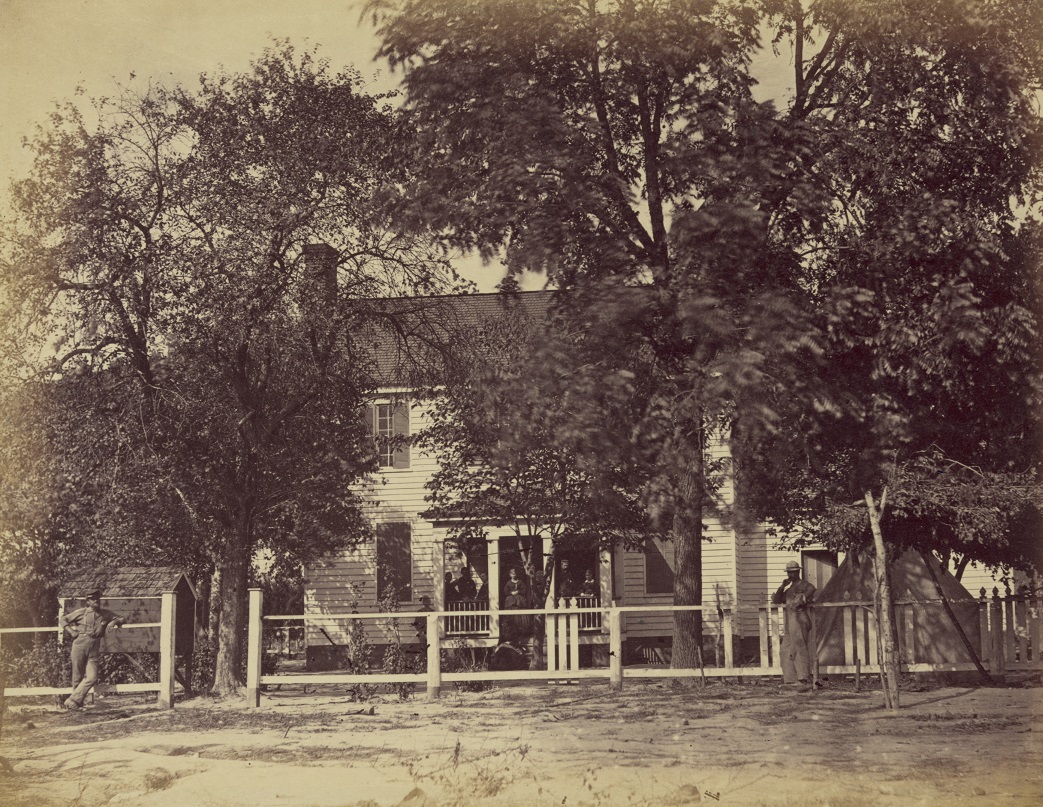
The Aiken House on the Weldon Railroad, a photo by Timothy Gardiner (Library of Congress).

The Aiken House on the Weldon Railroad, a photo by Timothy Gardiner (Library of Congress).

Theodore Lyman provides some detail about Gouverneur Warren’s capture of the Weldon Railroad. Not for the first (or last time) Lyman demonstrates that he had a good eye for military affairs. In fact, in his journal entry Lyman even criticizes Meade over the days’s action, something he didn’t often do. Regarding the way the Union lines offered the Confederates a perfect opportunity for a flank attack, Lyman wrote, “The position was faulty; Warren should have corrected it, and Meade should have known it.”

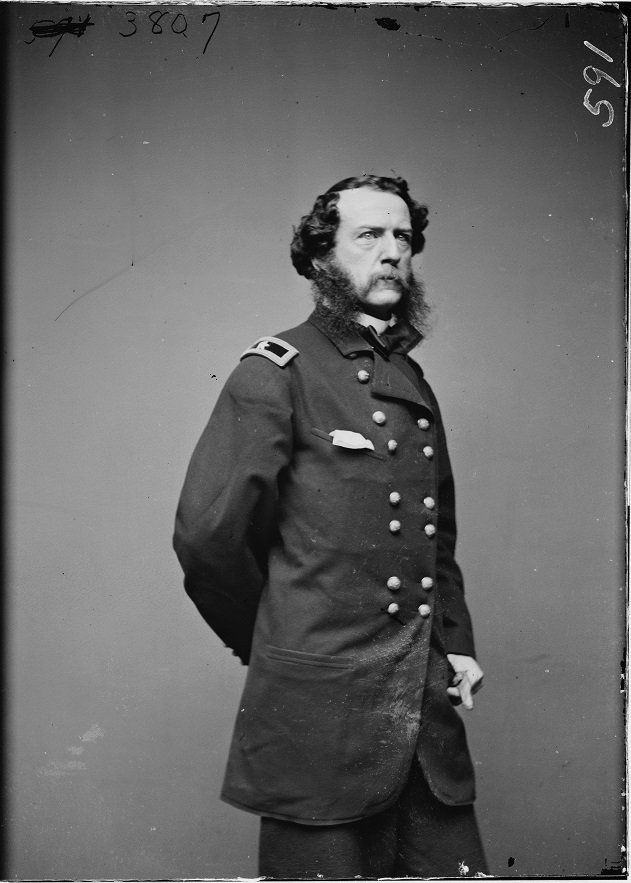
General Gersham Mott (Library of Congress).

General Gershom Mott (Library of Congress).

Some notes about the principals mentioned: Gershom Mott commanded a division in the II Corps and had been brought down from Deep Bottom, north of the James River. Robert Potter had a division in the IX Corps. Julius White had replaced James Ledlie as a IX Corps division commander; in his journal Lyman says of White, “He is no soldier but always ready to fight; a trait that goes far in war!” Brig. Gen. Joseph Hayes of the V Corps wax exchanged in April 1865, just in time to participate in the Appomattox campaign.

To-day I have been with the General to General Warren, who with the 5th Corps seized the Weldon railroad yesterday. It is touching a tiger’s cubs to get on that road! They will not stand it. Warren had a severe fight yesterday at midday, but they could not get him off. All was quiet this morning towards the railroad. Mott got in, through the mud, about seven, and began at once to relieve the 9th Corps, which was not an easy matter, for the covered way was, in many places, waist-deep in water, so the troops had to march up as well as they could, keeping behind hills, etc. The enemy opened on them with artillery but it was rather too late, and the columns were already pretty well out of reach. At noon the General started to go out to visit the scene of action. It was raining steadily, and we went slop, slop along. Near the Cheever house was a damp brigade of Potter’s division, halted. The General ordered me to tell it to move on, as it might be needed. General Potter himself was near by at General White’s Headquarters. . . . After which I was fain to gallop briskly to catch up with the Staff, which was jogging along the Williams house road. . . . Cutting through a skirt of wood, we came on a very large, flat, open farm, on which is the Globe Tavern, and through which runs the railroad. . . . General Warren had a narrow escape in the fight of yesterday. His horse was struck directly between the eyes by a minie ball. If his head had been down, there would have been nothing to save the General’s body. The Corps [Warren’s] was then formed in form of two sides of a rectangle, the longer arm lying across the railroad, the shorter parallel to it. It could scarcely fail to strike me that, while his left flank was well protected, his right was “in the air,”having nothing in connection with it but the picket line. However, as I am not a military critic, I thought no more of it. The enemy did think a good deal of it. In front of the position were dense woods, on its left a fine open tract, and, on the right, a wood separated it from the open farm of the Aiken house. We left at 3.30, and returned by the way we came. Both going and coming I quite expected to see the picket line tumbling in on top of us, and was not surprised, as we rode along near the Aiken house, to hear a number of dropping shots to our left. Just after we got to the plank road, we could hear the cannon opening, which continued a short time and then ceased. During the said short time was enacted one of those disgraceful surprises which we have in such perfection. The enemy, making a front attack, at the same moment threw a strong column down a road leading past the Linear house and outside our right flank. They smashed through the picket line, passed down the road, faced to their right, and rushed, yelling and firing, into the open fields, in rear of our right wing. Met here by a fire of artillery and reserve troops, they themselves fell into confusion, and rushing back through our lines, like a great tide, carried out to sea at least 2000 of our men, including most of our gallant little regular brigade with its commander, General [Joseph] Hayes. To be sure we drove them off and held the railroad, but we ought to have taken all that flanking column.

Theodore Lyman’s letter is from Meade’s Headquarters, 1863-1865: Letters of Colonel Theodore Lyman from the Wilderness to Appomattox, pp. 217-20. Edited by George R. Agassiz. Boston, Massachusetts Historical Society, 1922. Available via Google Books.

The Weldon Railroad (August 18, 1864)

An Alfred Waud drawing depicts Gouverneur Warren at the Weldon Railroad, supervising the construction of entrenchments by moonlight Click to enlarge (Library of Congress).

An Alfred Waud drawing depicts Gouverneur Warren at the Weldon Railroad, supervising the construction of entrenchments by moonlight. Click to enlarge (Library of Congress).

In his letter of August 18, Meade mentions Winfield Scott Hancock’s battles north of the James as well as the start of a movement by Gouverneur K. Warren, commander of the V Corps. This is the beginning of the attack during which Warren will finally get a toe hold on the Weldon Railroad, one of the lines vital to supplying Petersburg. Here’s what I wrote in Searching for George Gordon Meade: The Forgotten Victor of Gettysburg:

Samuel Crawford (Library of Congress).

Samuel Crawford (Library of Congress).

“Warren and the V Corps attacked here near a local landmark called Globe Tavern early on the morning of August 18, fighting off a Confederate counterattack to keep their grip on the railroad. The rebels counterattacked through a driving rain the next day. It was a close fight for a time, with the rebels overrunning Samuel Crawford’s division of the V Corps, but the Union soldiers, reinforced by a division of the IX Corps, thrust the enemy back. The rebels attacked again on Sunday, August 21, but by then Warren had his men positioned behind entrenchments, and once again they repulsed the Confederate attack. This portion of the Weldon Railroad was now in Union hands, and the construction of Fort Wadsworth–named after the New York politician-turned-general who had fallen in the Wilderness–was built here to make sure the Confederates couldn’t take it back. Now Confederate supplies coming to Petersburg could travel only as far as Stony Creek station, where they had to be unloaded, placed on wagons, and transported to Dinwiddie Court House and then up the Boydton Plank Road to the city.”

Here’s what Meade wrote on August 18:

Hancock’s movement across the James has resulted in bringing on an action with a part of Lee’s army, which at first was in our favor, but from their reinforcing him I judge Hancock has come to a stand still, and will not probably be able to effect more. Warren has gone to-day on a similar mission on our left, to see if he can find a weak spot in the enemy’s line. His guns are now plainly heard. These movements are made by Grant, with a view to keep the enemy on the alert, prevent his detaching any troops to Early, and, if possible, compel his bringing back some of the troops in the Valley, and thus give Sheridan more chance.

Now it’s Theodore Lyman’s turn:

Last night I had got well into the first sound sleep, when images of war began to intrude on my dreams, and these, taking on a more corporeal form, gradually waked me enough to prove to my mind that there was a big racket going on. The noise of a few shells and many muskets I don’t mind, as I am used to it, but, when it comes to firing heavy mortar shells in salvos, one is authorized to sit up in bed, even if it is one in the morning. Once awake, I recognized the fact that the largest kind of a cannonade was going on. The still, damp air was filled with the detonations of all sorts of big guns and projectiles. It was quite as extensive as the firing on the morning of the mine and sounded very much louder, in the night. Our side replied rather moderately, but the enemy kept up one roar of batteries for some two hours, and the air was full of the humming and bursting of the shells. At the end of that time they stopped, rather suddenly. We expended some 1500 rounds of ammunition and they must have fired much more, and all to kill and wound thirty men. . . . The great joke of the matter was, that General Meade (who is a sound sleeper, and was a little deaf from a cold in the head) remained calmly in the arms of Morpheus, till a telegraph from Grant at City Point, came in, asking what all that firing was about! It so happened that the General woke just at a lull in the cannonade; so he didn’t understand the despatch, but called the officer of the night to know if he had heard any more firing than usual! You should have seen the deshabille parade of officers in the camp: such a flitting of figures in a variety of not much clothing! General Humphreys said: “Yes, perhaps it would be well to have the horses saddled; for,” he added with a hopeful smile, “we may have a scrimmage, you know.” But he was disappointed, and we all went to bed again.

Meade’s correspondence taken from The Life and Letters of George Gordon Meade, Major-General United States Army, Vol. 2, (New York: Charles Scribner’s Sons, 1913), p. 222. Available via Google Books.

Theodore Lyman’s letter is from Meade’s Headquarters, 1863-1865: Letters of Colonel Theodore Lyman from the Wilderness to Appomattox, pp. 216-17. Edited by George R. Agassiz. Boston, Massachusetts Historical Society, 1922. Available via Google Books.

Fussell’s Mill (August 16, 1864)

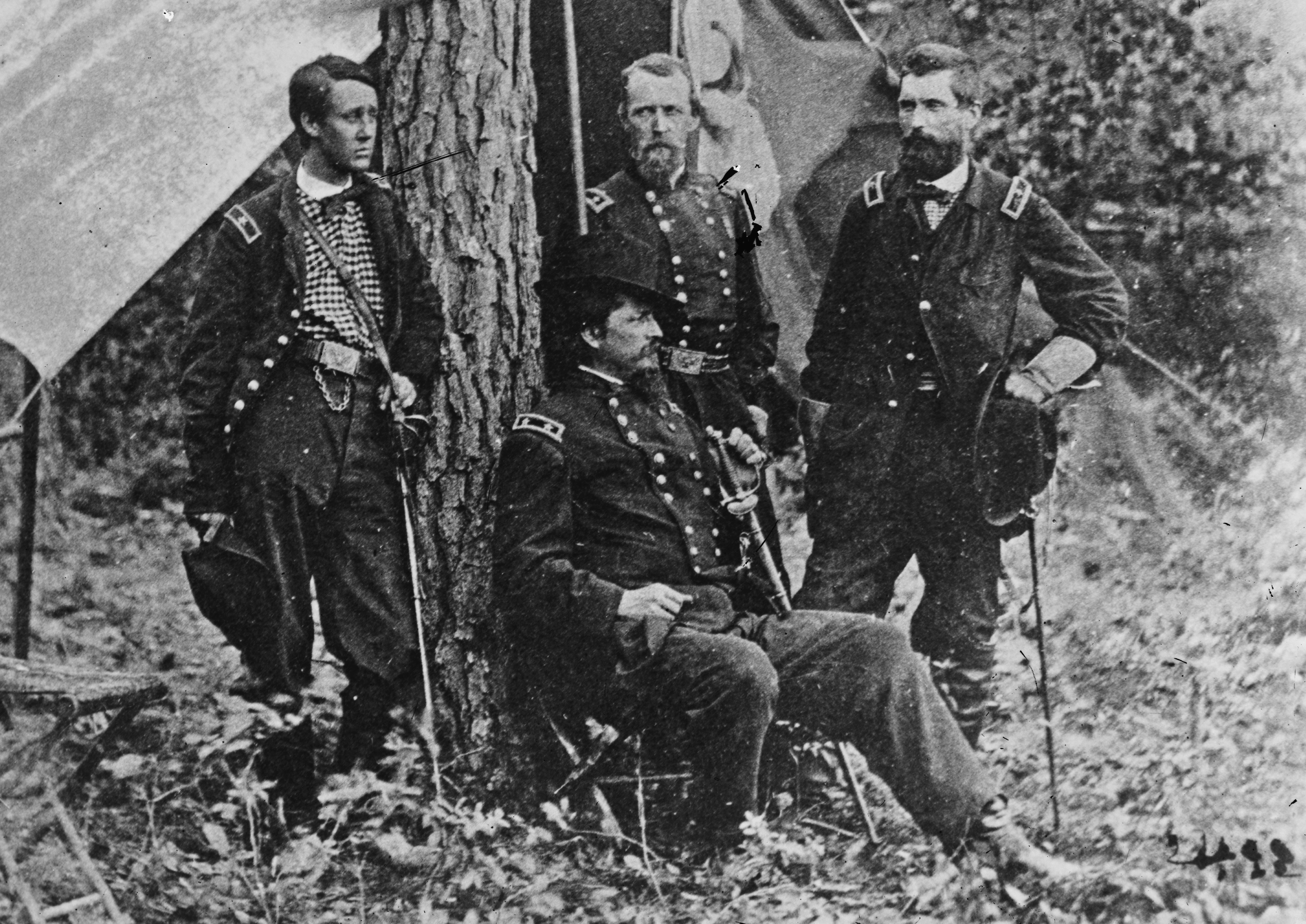
In this image taken at Cold Harbor in 1864, Winfield Scott Hancock (seated) poses with (left to right) Francis Barlow, David Birney, and John Gibbon (Library of Congress).

In this image taken at Cold Harbor in 1864, Winfield Scott Hancock (seated) poses with (left to right) Francis Barlow, David Birney, and John Gibbon (Library of Congress).

In their letters of August 16, both Meade and Lyman mention the fighting being done by Winfield Scott Hancock and the II and X Corps on the north bank of the James River. These references are to the second campaign of Deep Bottom and the battle known as Fussell’s Mill. Despite initial successes, the campaign was a failure. According to Francis Walker’s 1886 history of the II Corps, “Although it is freely confessed that the attack of the Second Corps near Fussell’s Mill was not made with the vigor fairly to be expected, nothing better could have resulted had the troops there displayed their pristine enterprise and resolution. The fact is, the expedition across the James had been undertaken upon erroneous information. General Grant believed that three divisions had been sent to reinforce Early. Only one, however (Kershaw’s), had actually gone. Field’s division of Longstreet’s corps had remained in the Deep Bottom and Bailey’s Creek intrenchments; Wilcox’s division of Hill’s corps was at Chapin’s Bluff, near at hand, ready to move down and reinforce Field; while Mahone’s division, also of Hill’s corps, with Hampton’s and W. H. F. Lee’s cavalry divisions, were, on the first intimation of Hancock’s movement, sent across the James to meet the impending attack.”

Walker continued, “General Grant had now ascertained that his information regarding the strength of the enemy had been erroneous; and he had therefore no thought of further pursuing the enterprise on the north bank of the James. Inasmuch, however, as he was now preparing a movement, with Warren’s corps, against the Weldon Railroad, on the extreme left, below Petersburg, he determined to retain Hancock’s troops in their position, threatening Richmond, a few days longer, to hold the enemy’s attention and occupy their forces.”

I am right glad the dear children are enjoying themselves. I wish I could be with you and them; but this is out of the question, and there is no use thinking about it. I have made up my mind to stick it out here, regardless of every consideration, except that of doing my duty at all hazards. They shall not say that any personal considerations caused me to turn my back upon the enemy.

Hancock has been fighting for two days across the James, and though he has met with success, yet he has not been able to break through the enemy’s lines, he finding them everywhere in strong force. His demonstration, however, has undoubtedly prevented the sending of reinforcements to Early, as we had reason to believe they designed doing. Hancock, with his usual luck, has captured some guns and colors.

Now for Lyman’s account of the events of the day. The assault he mentions is the Battle of the Crater. Lyman the Boston Brahmin looked down on those he considered to be below him, and that included Germans, Irish (“bog-trotters”) and blacks.

I have been well content to get your letter this afternoon. In regard to what you say for the troops for the assault, it is true that General Meade should have ordered in the best—and so he did. Express orders were given to put in the best troops and have the division generals lead them if necessary. General Meade made examinations in person of the enemy’s lines, and the orders drawn up by General Humphreys were more than usually elaborated. People have a vulgar belief that a General commanding a great army can, and ought to arrange in person every detail. This is not possible, nor is it desirable; the corps and division commanders would at once say: “Very well, if you have not enough confidence in me to let me carry on the ordinary business of my command, I ought to be relieved.” I see great discussion in the papers as to the conduct of the negroes. I say, as I always have, that you never, in the long run, can make negroes fight with success against white men. When the whole weight of history is on one side, you may be sure that side is the correct one. I told General Meade I had expressed myself strongly, at home, against the imported Dutchmen, to which he replied: “Yes, if they want to see us licked, they had better send along such fellers as those!” As I said before, the Pats will do: not so good as pure Yanks, but they will rush in and fight. There was a report at first that Colonel Macy of the 20th Massachusetts was mortally wounded, but I have since heard that it is not so. On Sunday, he had command of a brigade, and had his horse killed: he then came back, got another horse from Barlow and returned to the front. This horse either was shot or reared over with him, frightened by the firing, and crushed him badly. Let me see, I told you this before; never mind, you will be sure now to know it. Sometimes I get rather mixed because I write often a few words about a day, on the eve of the same, and then detail it more at length afterwards. The Rebels got well alarmed about Hancock and sent reinforcements, recalling troops that had started to help Early in the valley; an important point gained. Hancock had some hard fighting to-day, with considerable success, taking several hundred prisoners and driving the enemy. The Rebel General Chambliss was killed, and we found on him a valuable map containing the fortifications of Richmond. They also are said to have killed a General Gherrard; but I have an idea there is no such General in their service.* Perhaps he was a new appointment, or a colonel commanding a brigade. As to giving you an account of the engagement, it would be out of the question; as it is a perfect muddle to me. I only know that Gregg, with a cavalry division, went out on the Richmond road, to within six and one half miles of the city, and encountered a big crowd of infantry and had to come back. Barlow had to leave his division, sick, and go to friend Dalton, at City Point.

*It was Brig. Gen. Victor J. B. Girardey.

Meade’s correspondence taken from The Life and Letters of George Gordon Meade, Major-General United States Army, Vol. 2, (New York: Charles Scribner’s Sons, 1913), p. 222. Available via Google Books.

Theodore Lyman’s letter is from Meade’s Headquarters, 1863-1865: Letters of Colonel Theodore Lyman from the Wilderness to Appomattox, pp. 214-16. Edited by George R. Agassiz. Boston, Massachusetts Historical Society, 1922. Available via Google Books.

Parke (August 14, 1864)

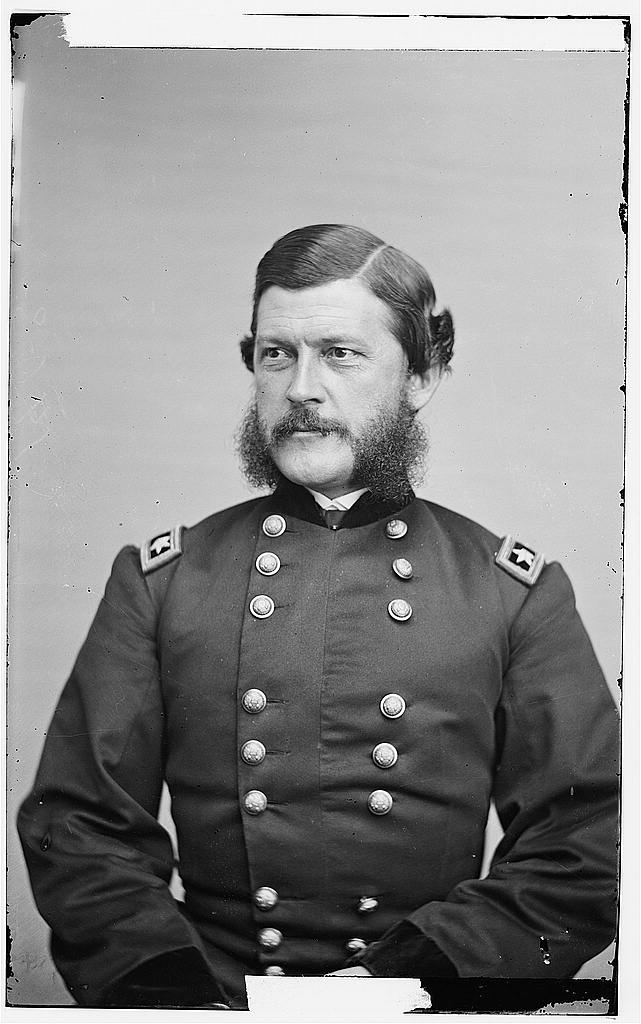
General John G. Parke (Library of Congress).

General John G. Parke (Library of Congress).

With Burnside sent on what would turn out to be a permanent leave, Maj. Gen. John Parke takes command of the IX Corps. Like Meade, Parke was a Philadelphian and a West Point-trained engineer. Here’s what Theodore Lyman had to say about him on August 14, 1864.

. . . General Parke got back from his sick leave and took command of the 9th Corps. He is a very pleasant-looking man and liked apparently by everyone. He has been obliged twice to return to the North by reason of malarial attacks, which is a pity, as he acted usually as adviser to General Burnside and had an excellent effect on him. He cured himself twice of malarial fever by accidentally taking an overdose of medicine. The last time, he had been told to take one pill, containing something very strong; but made a mistake and took four. After which he was somewhat surprised to find his face making a great many involuntary grimaces, and his body feeling uncommonly uncomfortable. However, next day he was all well, and the doctor told him it was a good dose to take, provided it did not unfortunately happen to kill him. Captain Fay took out the cits to-day, in an ambulance, and showed them the lines. After which the youth Falls was seized with a noble ambition to ride on horseback in company of Captain Guzman. Being provided with a hard trotter, he came near tumbling off, at the first start, and was obliged to change horses and perform the rest of the journey at a mild pace.

Theodore Lyman’s letter is from Meade’s Headquarters, 1863-1865: Letters of Colonel Theodore Lyman from the Wilderness to Appomattox, pp. 213-14. Edited by George R. Agassiz. Boston, Massachusetts Historical Society, 1922. Available via Google Books.

A Simple Matter of Justice (August 13, 1864)

George Gordon Meade confronts General Grant about the question of who should command the new military division, and remains baffled by his superior officer.

Grant was here yesterday to transact some business. I immediately asked him, how, after his promise to me, that if a military division was organized, I should be assigned to the command, he has placed my junior, Sheridan, there. He said Sheridan had not been assigned to the division, that no one was yet assigned to it, and that Sheridan had only been put in command of the troops in the field belonging to the different departments. I referred him to the order constituting the division, and assigning Sheridan temporarily to the command, and observed that temporarily I supposed meant as long as there was anything to do, or any object in holding the position. I further remarked that I regretted it had not been deemed a simple matter of justice to me to place me in this independent command. To which he made no remark. I really am not able to ascertain what are his real views. Sometimes I take the dark side, and think they are intentionally adverse to me, and at others I try to make myself believe that such is not his purpose. In confirmation of the last theory, I am of the opinion that he does not look and has not looked upon the movement in Maryland and the Valley in the important light it deserves, and that he considers it merely a raid which a display of force on our part will soon dissipate, when Sheridan and the troops will soon return here. But in this he is greatly mistaken. Already we have positive news that Lee has sent large reinforcements into the Valley, and there is no doubt it is his purpose to transfer the principal scene of operations there, if it can be accomplished. To-morrow we are going to make a move to test his strength here, and endeavor to make him recall his troops. Should this fail, we will be obliged to go up there and leave Richmond.

The weather continues intensely hot.

The court of inquiry was going on, but this move will stop it, and I fear it will never come to an end. I have given my testimony, which I will send you to preserve as my record in the case. I have insisted on Burnside’s being relieved. Grant has let him go on a leave, but he will never return whilst I am here.
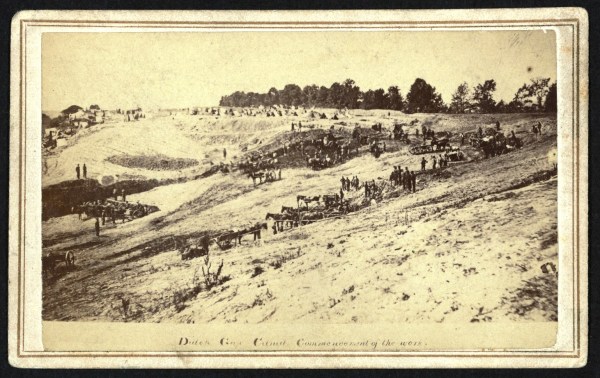
"Dutch Gap Canal, the commencement of the work" (Library of Congress).

“Dutch Gap Canal, the commencement of the work” (Library of Congress).

In his letter of August 13, Theodore Lyman remains bemused by African American soldiers. Stephen Weld of the 56th Massachusetts had been captured during the Battle of the Crater.

… I rode over to make some enquiry about Colonel Weld, of Loring, at Burnside’s Headquarters. As I drew near, I heard the sound as of minstrelsy and playing on the psaltry and upon the harp; to wit, a brass band, tooting away at a great rate. This was an unaccustomed noise, for Burnside is commonly not musical, and I was speculating on the subject when, on entering the circle of tents, I beheld a collection of Generals — not only Burnside, but also Potter, Willcox, and Ferrero. Speaking of this last, did you hear what the negro straggler remarked, when arrested by the Provost-Guard near City Point, on the day of the assault, and asked what he was doing there. “Well, saar, I will displain myself. You see, fus’ I was subjoined to Ginral Burnside; an’ den I was disseminated to Ginral Pharo. We wus advancing up towards der front, an’ I, as it might be, loitered a little. Presently I see some of our boys a-runnin’ back. ‘Ho, ho,’ sez I, ‘run is your word, is it?’ So I jes separates myself from my gun and I re-tires to dis spot.”

Well, there was “Ginral Pharo” taking a drink, and an appearance was about as of packing. Whereat I presently discovered, through the joyous Captain Pell (who asked me tauntingly if he could “do anything for me at Newport”), that Burnside and his Staff were all going on a thirty-day leave, which will extend itself, I fancy, indefinitely, so far as this army goes. On my return I found two fat civilians and a lean one. Fat number one was Mr. Otto, Assistant Secretary of the Interior; Fat number two, a Professor Matile, a Swiss of Neufchatel, and friend of Agassiz (you perhaps remember the delicious wine of that place). The lean was Mr. Falls, what I should call Mr. Otto’s “striker,” that being the name of an officer’s servant or hanger-on. Mr. Falls was very chatty and interrogative, following every sentence by “Is it not?” So that finally I felt obliged always to reply, “No, it isn’t.” I scared him very much by tales of the immense distances that missiles flew, rather implying that he might look for a pretty brisk shower of them, about the time he got fairly asleep. Professor Matile was bright enough to be one of those who engaged in the brilliant scheme of Pourtales Steiger to seize the chateau of Neufchatel on behalf of the King of Prussia. Consequently he since has retired to this country and has now a position as examiner at the Patent Office. Mr. Otto was really encouraging to look at. He did not chew tobacco, or talk politics, or use bad grammar; but was well educated and spake French and German. General Butler, having a luminous idea to get above the Howlett house batteries by cutting a ship canal across Dutch Gap, has called for volunteers, at an increased rate of pay. Whereupon the Rebel rams come down and shell the extra-pay volunteers, with their big guns; and we hear the distant booming very distinctly. I think when Butler gets his canal cleverly through, he will find fresh batteries, ready to rake it, and plenty more above it, on the river. The Richmond papers make merry, and say it will increase their commerce.

Meade’s correspondence taken from The Life and Letters of George Gordon Meade, Major-General United States Army, Vol. 2, (New York: Charles Scribner’s Sons, 1913), pp. 221-22. Available via Google Books.

Theodore Lyman’s letter is from Meade’s Headquarters, 1863-1865: Letters of Colonel Theodore Lyman from the Wilderness to Appomattox, pp. 211-13. Edited by George R. Agassiz. Boston, Massachusetts Historical Society, 1922. Available via Google Books.

Inside Petersburg (August 12, 1864)

Theodore Lyman writes about a curious incident of the war. War may be hell, but it does have its rules. Colonel Henry G. Thomas of Portland, Maine, commanded a brigade in Edward Ferrero’s IX Corps division. You can read his account of the situation Lyman describes here.

I did not yet mention that I had seen Colonel Thomas, who commands a negro brigade. A singular thing happened to him. He went out during the truce to superintend, and, when the truce was over, he undertook to return to the works, but took a wrong turn, passed inside the Rebel picket line, and was seized. He told them they had no right to take him, but they could not see it and marched him off. But he appealed to the commanding General who, after eighteen hours, ordered him set free. He was in and about Petersburg and told me the flower-patches were nicely cultivated in front of the houses, the canary birds were hung in cages before the doors, and everything looked as if the inhabitants meant to enjoy their property during their lives and hand it quietly down to their children. Little damage seemed to have been done by our shells, which I was glad to hear, for I hate this business of house-burning. Next time, I fancy the warlike Thomas will make no mistakes about turns.

Theodore Lyman’s letter is from Meade’s Headquarters, 1863-1865: Letters of Colonel Theodore Lyman from the Wilderness to Appomattox, p. 211. Edited by George R. Agassiz. Boston, Massachusetts Historical Society, 1922. Available via Google Books.
More Sheridan (August 11, 1864)

Theodore Lyman follows up on the Meade-Sheridan situation. It is safe to say that Meade did not like this situation at all.

Sheridan has been appointed to command all the upper Potomac forces, which is saying that he is to command all the troops to drive Early out of the Shenandoah Valley. He is a Major-General, and is an energetic and very brave officer. This command, however, is a very large one, larger than he ever before had. I have little doubt, that, for field-service, he is superior to any officer there. Things are cooking, and the Rebels will find they must fag away still, as well as we. I do not exactly know if Meade likes this appointment: you see they have taken one of his corps, added much of his cavalry and many other troops to it, and then given the command to his Chief of Cavalry, while he [Meade] is left, with a reduced force, at this somewhat negative Petersburg business. I rode out just at dark, and from an “elevated position,” as Smith would say, watched the flashes of the sharpshooters, and the fires of the camp.

Theodore Lyman’s letter is from Meade’s Headquarters, 1863-1865: Letters of Colonel Theodore Lyman from the Wilderness to Appomattox, pp. 210-11. Edited by George R. Agassiz. Boston, Massachusetts Historical Society, 1922. Available via Google Books.

Sheridan (August 10, 1864)

Philip Sheridan, the bane of Meade's existence (Library of Congress).

Philip Sheridan, the bane of Meade’s existence (Library of Congress).

The Phil Sheridan situation moves from the back to the front burner and Meade simmers with indignation.

The Washington papers of yesterday announce Sheridan being temporarily assigned to the military division which Grant told me was intended for me. Grant has been back two days, and has not vouchsafed one word in explanation, and I have avoided going to see him, from a sense of self-respect, and from the fear I should not be able to restrain the indignation I hold to be natural at the duplicity some one has practiced. In my last conversation with General Grant he distinctly told me that if a military division was organized I should have the command, and that it was designed to give Sheridan only the command of that part of the Army of the Potomac temporarily detached. This order is not consistent with that statement.

To-day I got through with my evidence before the court of inquiry. Burnside, in his cross-examination, through a lawyer, undertook to impeach my testimony, though he disclaimed any such intention; but I gave him as good as he sent. I hear he was about apologizing to me for his disrespectful despatch, and was then going to resign; but on returning from Grant’s headquarters, where he expressed this intention, he found my charges and letter, saying I had applied to have him relieved. I feel sorry for Burnside, because I really believe the man half the time don’t know what he is about, and is hardly responsible for his acts.

Meade’s correspondence taken from The Life and Letters of George Gordon Meade, Major-General United States Army, Vol. 2, (New York: Charles Scribner’s Sons, 1913), pp. 220-21 Available via Google Books.

Sabotage! (August 9, 1864)

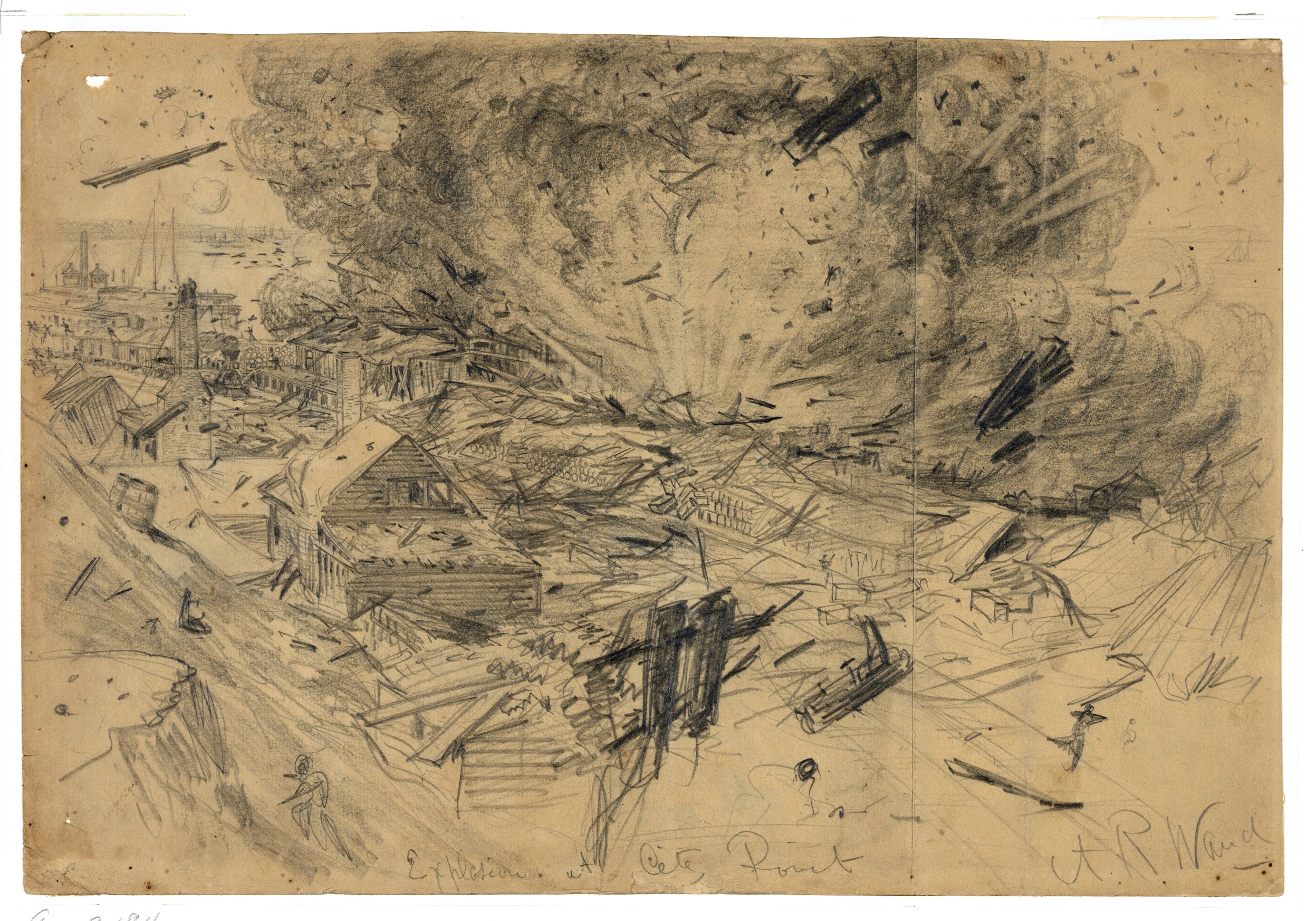
Alfred Waud depicted the explosion at City Point. Click to enlarge (Library of Congress).

Alfred Waud depicted the explosion at City Point. Click to enlarge (Library of Congress).

In their letters of August 9, both Meade and Theodore Lyman mention the explosion at the docks of City Point, not far from Grant’s headquarters. The war had completely transformed this formerly sleepy town at the confluence of the Appomattox and the James Rivers, about seven miles from Petersburg. Swarms of laborers began building docks, wharves, and warehouses, plus a hospital that could handle 6,000 patients. On August 9, 1864, a Confederate agent snuck an explosive aboard one of the ammunition barges at City Point. The resulting explosion killed 43 and injured 126 but did no major damage to the Union war effort.

It’s possible that Stanton’s opinion of Meade dated back to a letter Grant had written from Spotsylvania in May. “General Meade has more than met my most sanguine expectations,” he had written to Stanton. “He and Sherman are the fittest officers for large commands I have come in contact with.”

I am delighted to see your letter is written in such good spirits, and am truly rejoiced to hear I have so many and such warm friends. The attempt to implicate me in the recent fiasco was truly ridiculous; still, the public must in time be influenced by these repeated and constant attacks, however untrue and unjustifiable they may be. Have you ever thought that since the first week after Gettysburg, now more than a year, I have never been alluded to in public journals except to abuse and villify me? And why this is I have never been able to imagine.

I had a letter to-night from Cortlandt Parker, who has recently seen George Harding. He says Harding told him he had recently seen Stanton, who is an enthusiastic admirer of Grant, and that Stanton observed that Grant had a most exalted opinion of me, and told him, Stanton, that when he first came East he thought Sherman was the first soldier in the country, but now he believed I was his equal, if not superior. I send you this for what it is worth. I certainly think Grant has a queer way of showing his appreciation. Grant has not until recently seen Stanton, since we crossed the Rapidan, so could not have told him this; but Dana may have conveyed this information.

There was an awful explosion to-day at City Point of a powder and ammunition vessel. It is said sixty were killed and one hundred and fifty wounded.

I have been engaged for two days giving my testimony before the court of inquiry that is investigating the Petersburg disaster. It will take them a long time to get through, and I fancy active operations will interrupt their proceedings till such time that the witnesses will be scattered. Grant has not yet acted on my application to have Burnside relieved. The weather continues awfully hot, but the army is in good health.

Aftermath of the explosion (Library of Congress).

Aftermath of the explosion (Library of Congress).

Lyman’s entry is, a usual, much more descriptive and adds a fine note about Ulysses S. Grant.

In the forenoon, as we were sitting in camp, we heard a noise, like a quick, distant clap of thunder, but sharper. We concluded it must be an explosion, from the sound, and in a few minutes came a telegraph from Grant, at City Point, saying that an ordnance barge had blown up, with considerable loss of life. I think the number of killed will not exceed thirty-five; and, of the wounded, perhaps eighty; at first they thought there were many more. The greater part of the injured were negroes employed as wharf-laborers. To return to the explosion: Rosy, Worth, Cavada, and Cadwalader were at Grant’s Headquarters, and they said it perfectly rained shells, shot, bullets, pieces of timber, and saddles (of these latter there was a barge load near by). Two dragoons were killed, close to them, and a twelve-pounder solid shot went smash into a mess-chest in the tent. The only man who, at the first shock, ran towards the scene of terror was Lieutenant-General Grant, which shows his kind of character very well. We dined very pleasantly with Dalton. You should see his town of tents, with regular streets—accommodation easy for 8000 patients. Everything as neat as a pin. Steam-engine to pump water from the river; every patient of the 4000 on a cot; the best of food for all; and the most entire cleanliness. When Dalton heard the explosion, he jumped on his feet, and, true to his instincts, cried out: “Harness the ambulances!”

Meade’s correspondence taken from The Life and Letters of George Gordon Meade, Major-General United States Army, Vol. 2, (New York: Charles Scribner’s Sons, 1913), p. 220. Available via Google Books.
Theodore Lyman’s letter is from Meade’s Headquarters, 1863-1865: Letters of Colonel Theodore Lyman from the Wilderness to Appomattox, pp. 209-10. Edited by George R. Agassiz. Boston, Massachusetts Historical Society, 1922. Available via Google Books.