Dust (July 6, 1864)

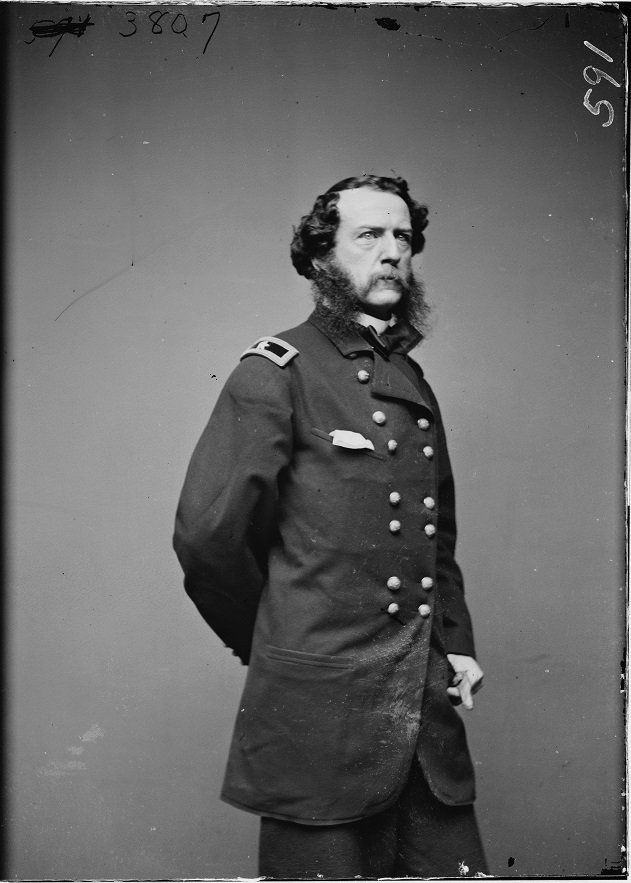
James B. Ricketts. The former artilleryman commanded a division in the VI Corps. His sister had married Meade's brother (Library of Congress).

James B. Ricketts. The former artilleryman commanded a division in the VI Corps. His sister had married Meade’s brother (Library of Congress).

Theodore Lyman goes into more detail about the moves to halt Jubal Early before he can attack Washington, D.C., an incident to which Lyman referred in his journal on July 5. He mentions Brigadier General James Ricketts, who had experienced an interesting war, to say the least. Ricketts began it as a battery commander and was wounded and captured at First Bull Run. He commanded a division in the I Corps at Antietam. When corps commander Joe Hooker was wounded and turned command over to Meade, Meade believed it was a mistake and tried to hand the command to Ricketts, who outranked him. (But it was Meade, not Ricketts, whom Hooker wanted in command). Ricketts was related to Meade by marriage—his sister had married Meade’s brother Robert.

Sent to Maryland, Ricketts’ division fought with General Lew Wallace (later the author of Ben-Hur) at the Battle of Monocacy in Maryland, which delayed Early long enough for Horatio Wright nd the rest of the VI Corps to reach Washington’s defenses. The General Tyler to whom Lyman refers must be Erastus B. Tyler, who was in command of Baltimore’s defenses and went to Wallace’s aid. I cannot find any reference to his history with Meade’s chief of staff, Andrew A. Humphreys.

We have no rain here — never expect any; air hazy with a faint dust, finer than twice volted flour, which settles on everything — but that won’t kill anybody. So Ewell is (or was — don’t know his whereabouts at this precise moment) at Harper’s Ferry. We knew he was poking up there somewhere. As to the A. of P., it is sitting here, trying to get some fresh cabbages, not very successfully, so far — the last issue, I am told, furnished one small one to every fifteen men. Old Uncle Lee is “in posish,” as General Williams would say, and seems to remark: “Here I am; I have sent off Ewell; now why don’t you come on?” I suppose you think I speak flippantly of what the French call the “situation”; but one gets so desperate that it is no use to be serious. Last night, after I had got to bed, I heard the officer of the day go with a despatch into the General’s tent and wake him up. Presently the General said: “Very well, tell General Wright to send a good division. I suppose it will be Ricketts’s.” And he turned over and went asleep again. Not so Ricketts, who was speedily waked up and told to march to City Point, thence to take steamers for Washington, or rather for Baltimore. We do not appreciate now, how much time, and labor, and disappointment, and reorganization, and turning out bad officers, have to be done, before an army can be got in such condition that a division of several thousand men may be suddenly waked at midnight and, within an hour or so, be on the march, each man with his arms and ammunition ready, and his rations in his haversack. Now, nobody thinks of it. General Meade says, “Send Ricketts”; and turns over and goes to sleep. General Ricketts says, “Wake the Staff and saddle the horses.” By the time this is done, he has written some little slips of paper, and away gallop the officers to the brigade commanders, who wake the regimental, who wake the company, who wake the non-commissioned, who wake the privates. And each particular private, uttering his particular oath, rises with a groan, rolls up his shelter-tent, if he has one, straps on his blanket, if he has not long since thrown it away, and is ready for the word “Fall in!” When General Ricketts is informed that all are ready, he says: “Very well, let the column move”—or something of that sort. There is a great shouting of “By the right flank, forward!” and off goes Ricketts, at the head of his troops, bound for City Point; and also bound, I much regret to say, for the Monocacy, where I fancy his poor men stood up and did all the fighting. From what I hear, I judge we had there about 10,000, of whom a good part were next to worthless. The Rebs had, I think, some 12,000, all good troops. This General Wallace is said by officers here to be no general at all, though brave; and General Tyler is the man whom General Humphreys had tried for cowardice, or some misbehavior in the presence of the enemy; and who has, in consequence, an undying hate for the Chief-of-Staff. I remember thinking to myself, as I went to sleep—“division—why don’t they send a corps and make a sure thing?” Behold my military forethought!

Theodore Lyman’s letter is from Meade’s Headquarters, 1863-1865: Letters of Colonel Theodore Lyman from the Wilderness to Appomattox, pp. 184-5. Edited by George R. Agassiz. Boston, Massachusetts Historical Society, 1922. Available via Google Books.

A Real, Live Slave (July 5, 1864)

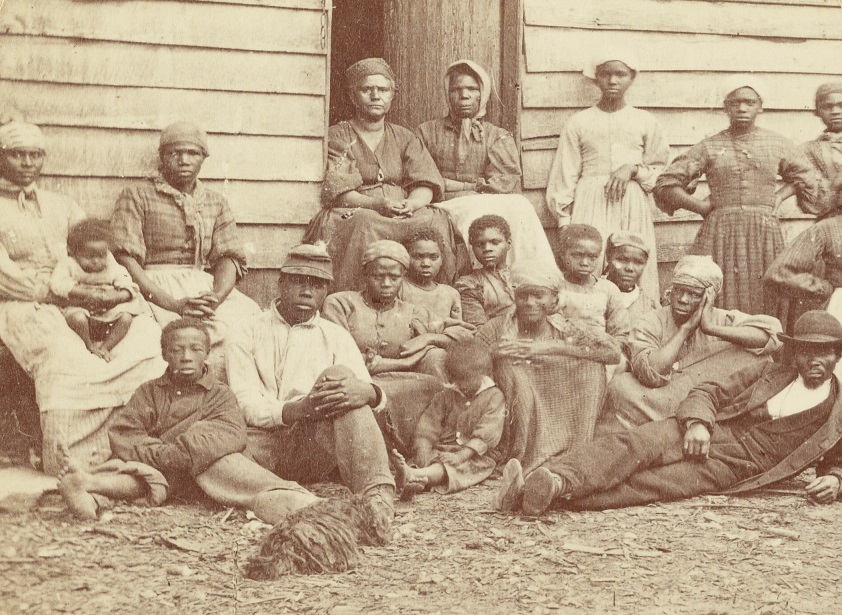
A group of ex-slaves freed by the advance of the Union armies. Such freed slaves became known as "contrabands of war" (Library of Congress).

A group of ex-slaves freed by the advance of the Union army. Such freed slaves became known as “contrabands of war” (Library of Congress).

As I have pointed out before, Theodore Lyman’s views on race and slavery were very much those of a nineteenth-century man. He was, it seems, gaining a grudging respect for the black fighting men but he appears little concerned about how the Civil War was ending the institution of slavery. For Lyman, African-Americans were strange and exotic creatures, the objects of amused and detached observation. A case in point is his letter of July 5, in which he encounters an elderly ex-slave. Lyman finds her entertaining without seeming to consider that being liberated from a long lifetime of working in bondage to a man who owned you might be cause for a good deal of chuckling. (“The two Frenchies” are the French observers who are visiting the Army of the Potomac.)

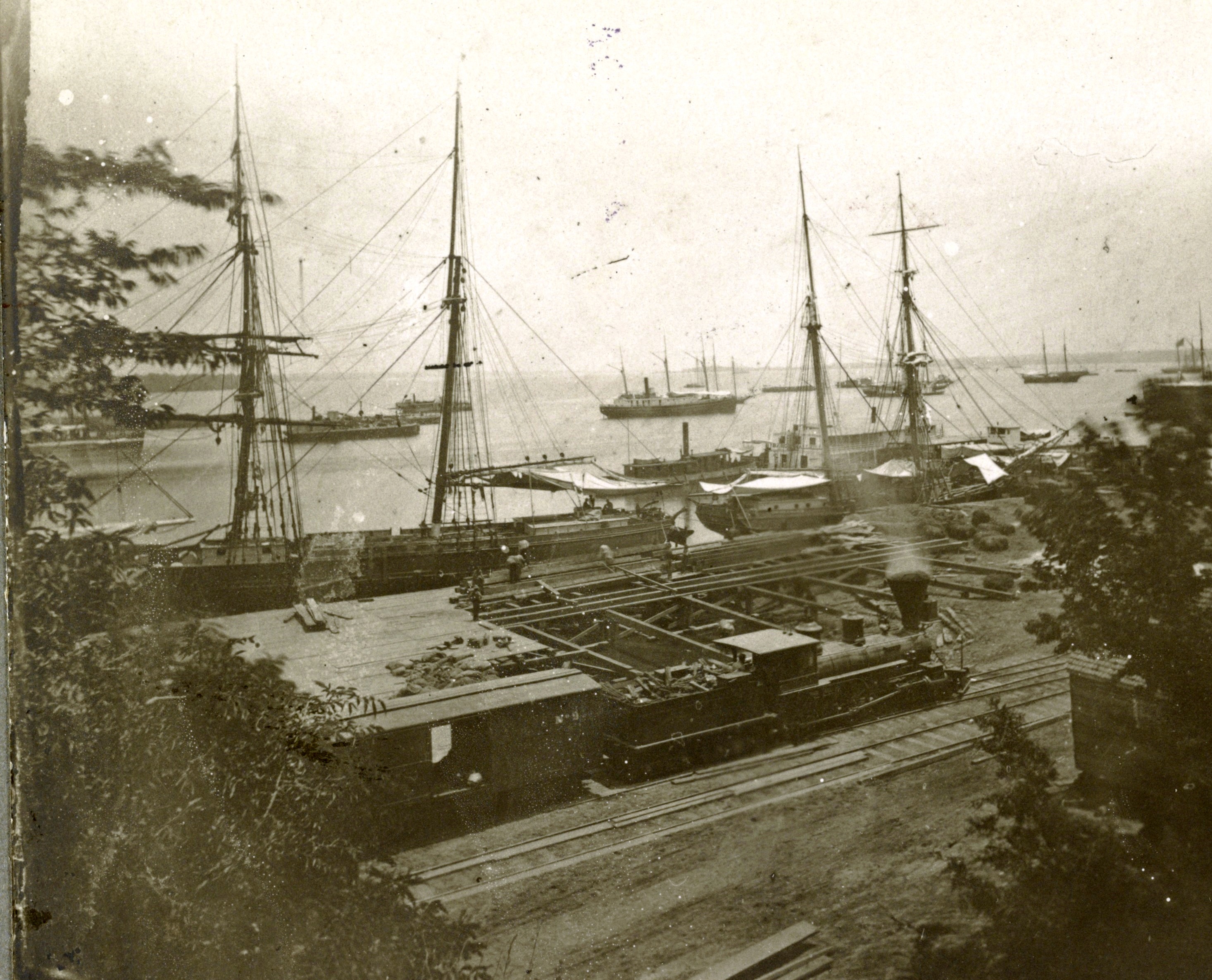
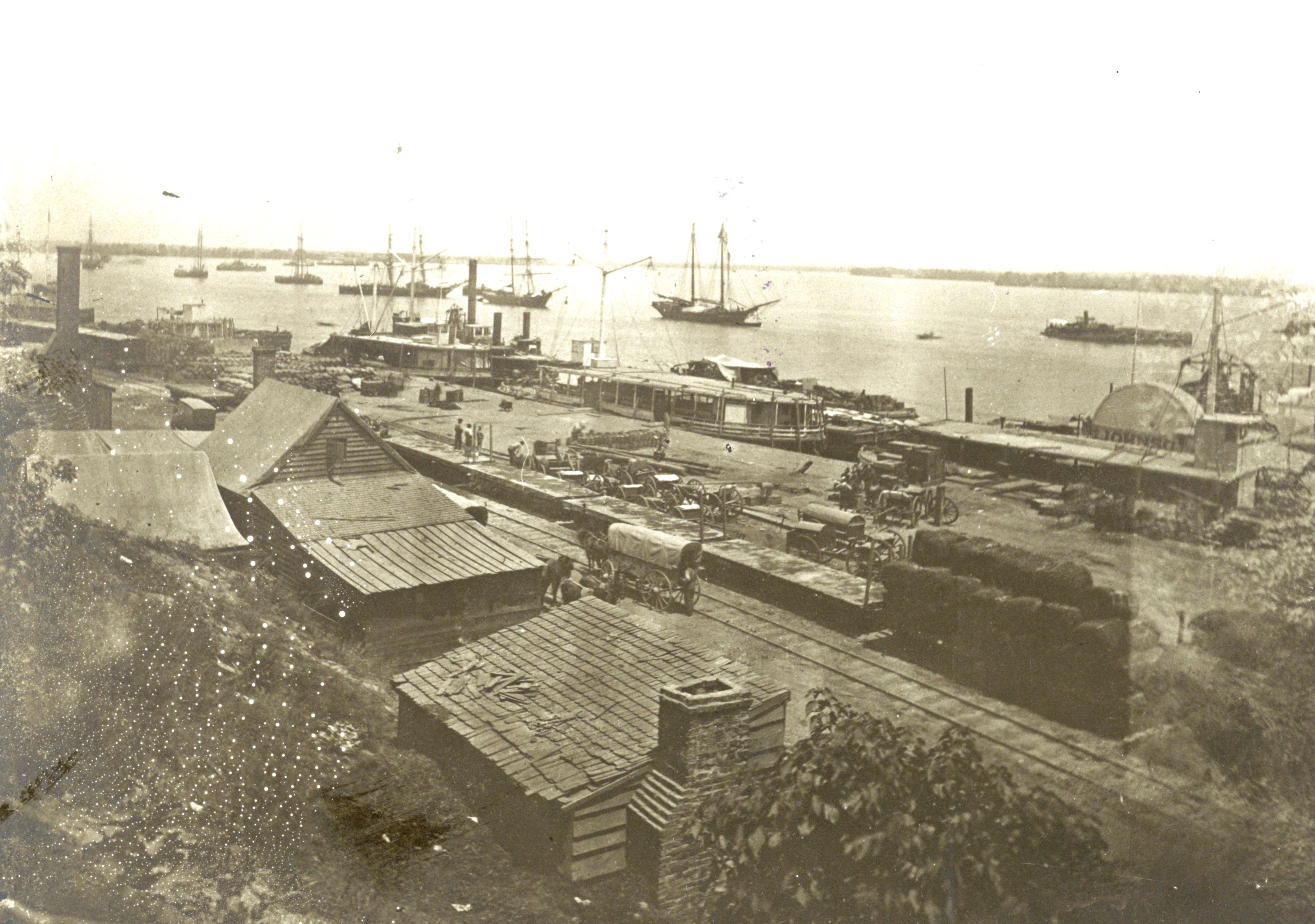
City Point was at the confluence of the Appomattox and James Rivers. Ulysses S. Grant had established his headquarters here, on a bluff high above the Appomattox. The arrival of the Union Army’s transformed the once quiet spot into a scene of great bustling activity.

A photograph of City Point, taken on July 5, 1864 (Library of Congress).

A photograph of City Point, taken on July 5, 1864 (Library of Congress).

In his journal entry for July 5, Lyman mentions hearing a messenger enter Meade’s tent with a dispatch that night. “Very well, tell Wright to send a good division,” he heard Meade say. “I supposed it will be Ricketts.” Then Meade went back to sleep. The occasion was an emergency to the north. While still at Cold Harbor, Lee had dispatched Jubal Early, his “bad old man,” on a mission to redirect the Union’s attention toward its own backyard. Early had marched north down the Shenandoah Valley, brushing aside Union resistance, and entered Maryland, where he battled outnumbered Federal defenders outside Frederick near the Monocacy River. He continued on until he reached Washington’s outer defenses. This was precisely the scenario that Lincoln had long feared—that the Army of the Potomac would move so far south that it would leave the nation’s capital wide open to a Confederate attack.

Another view of City Point, also taken on July 5, 1864 (Library of Congress).

Another view of City Point, also taken on July 5, 1864 (Library of Congress).

I forgot to tell you that yesterday there appeared a waggon of the Sanitary Commission bearing a gift for the comfort of Headquarters. With it came the agent, Mr. Johnson, a dried-up Philadelphian, of a serious countenance. He brought some ice, mutton, canned fruit, etc., for the behoof of the suffering hossifers, and was received with sweet smiles. This morning we made up a quartette, the two Frenchies, Rosencrantz and myself, and made a journey to City Point, distant some twelve or thirteen miles. It was not unpleasant, though the sun was extremely hot; for we took back roads in the woods and escaped a good share of dust. Before getting to the City Point road, near Bailey’s, we stopped at one Epps’s house. Epps himself with family had been called on sudden business to Petersburg, about the time Smith moved up; but some of his nigs remained. Among others a venerable “Aunty,” of whom I asked her age. “Dunno,” replied the Venerable, “but I know I’se mighty old: got double gran’ children.” She then began to chuckle much, and said: “Massa allers made me work, ‘cause he was ugly; but since you uns is come, I don’t have to do nuphun. Oh! I’se powerful glad you uns is come. I didn’t know thar was so many folks in the whole world as I seen round here.” I told the old lady to use up everything she could find, and left her chuckling continuously and plainly impressed with the idea that I was a very pleasant gentleman. Guzman, meantime, looked on with irrepressible astonishment, having never before seen a real, live slave. At City Point I delivered some despatches at General Grant’s, and after went down and saw the Sanitary boats. They have three of them, large ones, moored permanently side by side, and full of all sorts of things, and especially a host of boxes, no two alike. The upper deck, to render it attractive, was ornamented with a pile of two or three hundred pairs of crutches. For myself I got some iced lemonade on board, and retired much refreshed and highly patriotic. One of the great sights down there is the huge army hospital, a whole plain, white with large tents. These are capable of receiving 7000 patients and have at present about 3000. All are under charge of my excellent classmate, Dr. Ned Dalton.

Theodore Lyman’s letter is from Meade’s Headquarters, 1863-1865: Letters of Colonel Theodore Lyman from the Wilderness to Appomattox, pp. 182-4. Edited by George R. Agassiz. Boston, Massachusetts Historical Society, 1922. Available via Google Books.

Hail, Columbia (July 4, 1864)

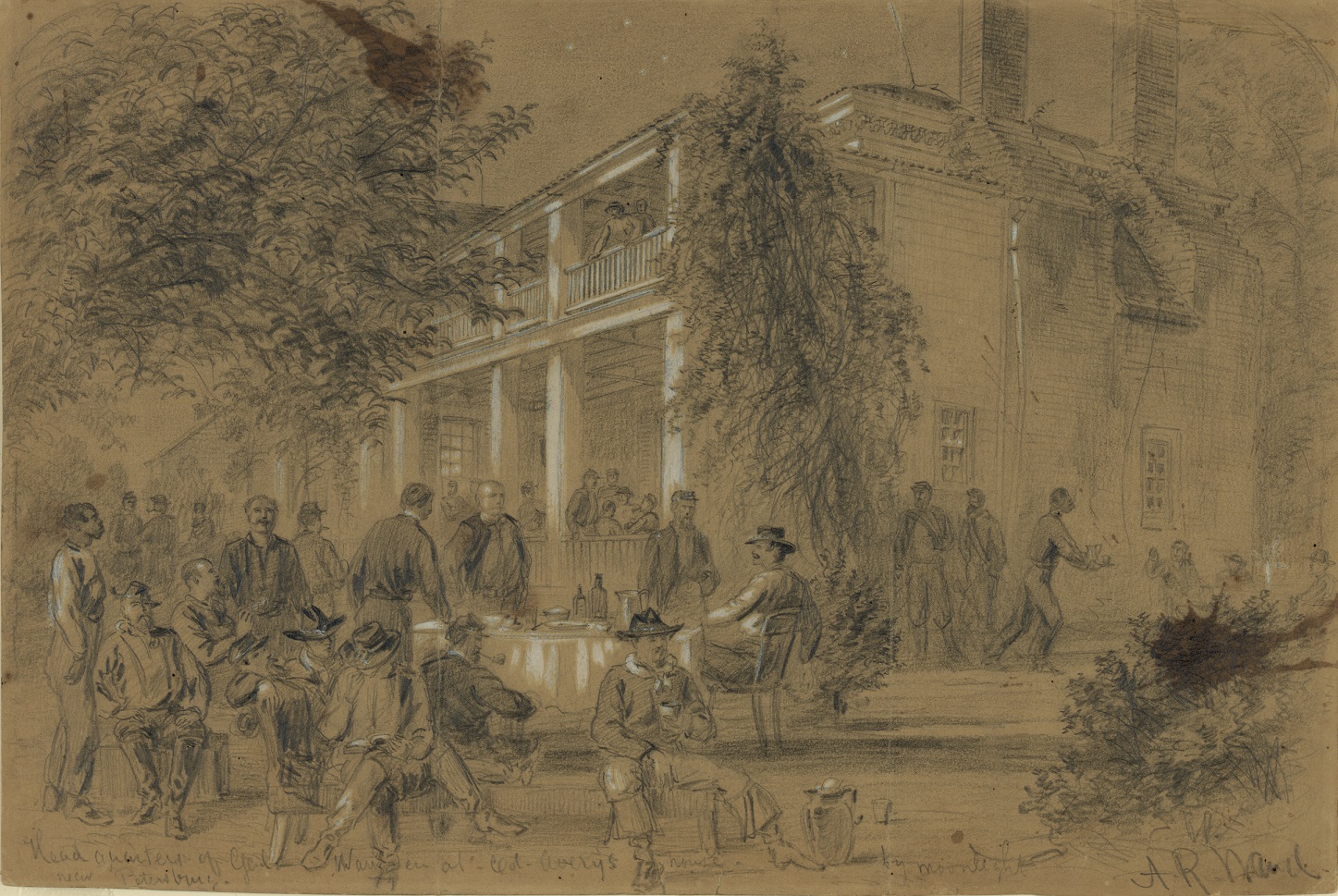
"Headquarters of Genl. Warren at Col. Avery's house-near Petersburg" by Alfred Waud (Library of Congress).

“Headquarters of Genl. Warren at Col. Avery’s house-near Petersburg” by Alfred Waud (Library of Congress).

Happy 4th of July! Most likely you are having a much better holiday than the soldiers of the Army of the Potomac and the Army of Northern Virginia enjoyed in their works outside Petersburg. It must have been interesting to celebrate the birth of your country even  as you were fighting to preserve it (or, in the case of the Confederates, break up that country and start a new one). Here Theodore Lyman provided an account of the day and the general conditions on the front.

Samuel Crawford, the former army surgeon who became indignant when soldiers called him "Old Pills" (Library of Congress).

Samuel Crawford, the former army surgeon who became indignant when soldiers called him “Old Pills” (Library of Congress).

Lyman also mentions some incidents involving Samuel Crawford, who commanded a division in the V Corps. Crawford had begun his Civil War career as a surgeon at Fort Sumter. Horace Porter told a story about Meade and an officer who must have been Crawford, although Porter merely identified him as “an officer serving in the Army of the Potomac who had formerly been a surgeon.” One day the officer arrived at Meade’s headquarters “in a high state of indignation.” As he had been riding over, some of the men had called him “Old Pills,” and he thought that was a great affront to his dignity. “I would like to have it stopped,” he said.

Meade put on his eyeglasses and glared through them at the complainer. “Well, what of that?” he demanded. “How can I prevent it? Why, I hear that, when I rode out the other day, some of the men called me a ‘damned old goggle-eyed snapping-turtle,’ and I can’t even stop that!” Now “Old Pills” and the “old goggle-eyed snapping-turtle” lie in the ground near each other at Philadelphia’s Laurel Hill Cemetery, neighbors for eternity.

What shall I say of the Fourth? Our celebration could not well amount to much; the men have to stay too close in camp to do such things. The band came in the morning and serenaded, and there was saluting enough in the form of cannon and mortars from our right. This siege—if you choose to call it a siege—is a curious illustration of the customs of old soldiers. On the right—say from the Appomattox to a point opposite the Avery house—the lines are very close and more or less of siege operations are going on; so every finger, or cap, or point of a gun that shows above the works, is instantly shot at, in addition to which batteries and mortars are firing intermittently. Nothing could be more hostile! But pass to the division a little to the left of this, where our lines swing off from the enemy’s, and you have a quite reversed state of things. There is not a shot! Behold the picket men, no longer crouching closely in their holes, but standing up and walking about, with the enemy’s men, in like fashion, as near to them, in some places, as the length of the Brookline house. At one part, there was a brook between, and our pickets, or theirs, when they want water, hold up a canteen, and then coolly walk down to the neutral stream. All this truce is unofficial, but sacred, and is honorably observed. Also it is a matter of the rank and file. If an officer comes down, they get uneasy and often shout to him to go back, or they will shoot. The other day General Crawford calmly went down, took out an opera-glass and began staring. Very quickly a Reb was seen to write on a scrap of paper, roll it round a pebble and throw it over to our line. Thereon was writ this pithy bit of advice: “Tell the fellow with the spy-glass to clear out, or we shall have to shoot him.” Near this same spot occurred a ludicrous thing, which is true, though one would not believe it if seen in a paper. A Reb, either from greenness or by accident, fired his musket, whereupon our people dropped in their holes and were on the point of opening along the whole line, when the Rebs waved their hands and cried: “Don’t shoot; you’ll see how we’ll fix him!” Then they took the musket from the unfortunate grey-back, put a rail on his shoulder, and made him walk up and down for a great while in front of their rifle-pits! If they get orders to open, they call out, “Get into your holes, Yanks, we are ordered to fire”; and their first shots are aimed high, as a sort of warning. Their liberties go too far sometimes, as when two deliberately walked up to our breastwork to exchange papers; whereat General Crawford refused to allow them to return, saying very properly that the truce was not official, and that they had chosen to leave their own works and come over to ours, and that now they could carry back information of our position. They expected an attack on the 4th of July—I suppose as a grand melodramatic stroke on Grant’s part; but, instead thereof, the Maryland brigade brought up their band to the trenches and played “Hail Columbia”; upon which, to the surprise of everyone, a North Carolina regiment, lying opposite, rose as a man and gave three cheers! The news is not precisely cheery from Maryland. With the preparations on foot, we ought to bag a large part of the Rebels; but I have a sublime confidence that the movements of our troops will, as usual, be a day too late. . . .

Theodore Lyman’s letter is from Meade’s Headquarters, 1863-1865: Letters of Colonel Theodore Lyman from the Wilderness to Appomattox, pp. 181-2. Edited by George R. Agassiz. Boston, Massachusetts Historical Society, 1922. Available via Google Books.

Anniversary (July 3, 1864)

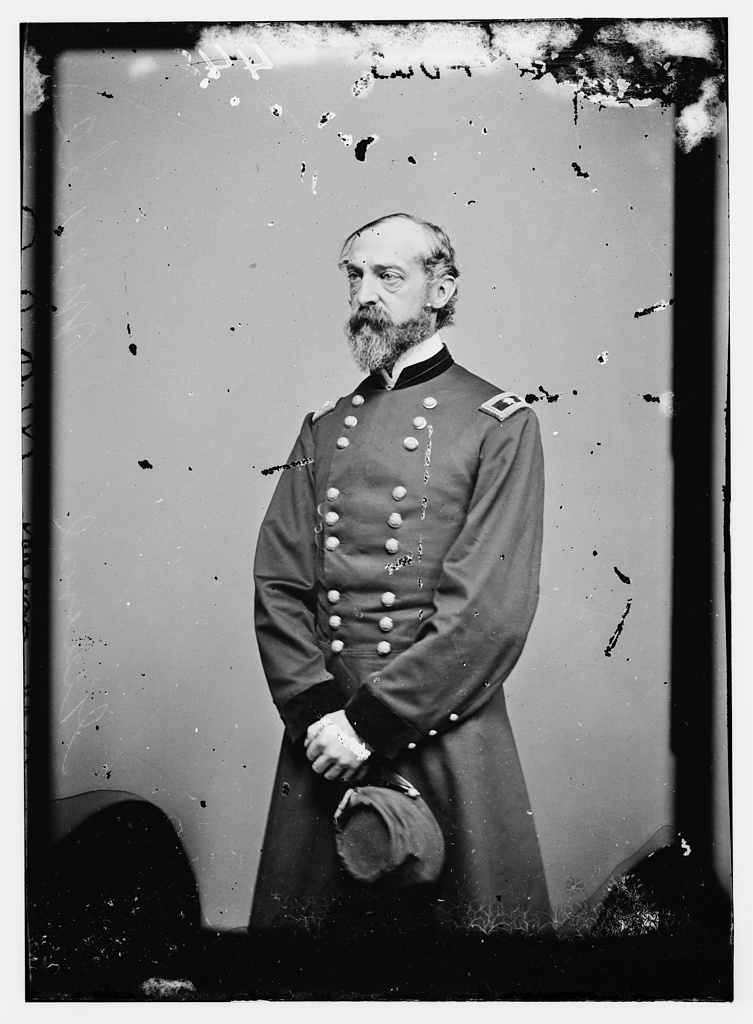
Major General George Gordon Meade (lLibrary of Congress).

Major General George Gordon Meade (lLibrary of Congress).

Here in the twenty-first century we are commemorating the 151st anniversary of the Battle of Gettysburg. In this letter George Gordon Meade looks back after only one year has passed, takes some time to reflect, and feels a small sense of satisfaction. Earlier this year he had complained, “I supposed after awhile it will be discovered that I was not at Gettysburg at all.”

To-day is the anniversary of the last day’s fight at Gettysburg. As I reflect on that eventful period, and all that has elapsed since, I have reason to be satisfied with my course, and cause to be most thankful. The longer this war continues the more will Gettysburg and its results be appreciated. Colonel de Chenal, who is still with me, says he studied the battle, with maps at Pau, but had no idea that on its anniversary he should be the guest of the victorious commander. He says in Europe it was looked on as a great battle.

It is said Washington is very unhealthy, and that many of our wounded are dying there. It is strange; the health of the army never was better—we have no sickness at all. But if we are kept here, I presume, as the summer advances, we must expect considerable sickness.

Meade’s correspondence taken from The Life and Letters of George Gordon Meade, Major-General United States Army, Vol. 2, (New York: Charles Scribner’s Sons, 1913), p. 210. Available via Google Books.

A Visit to Ferrero (July 1, 1864)

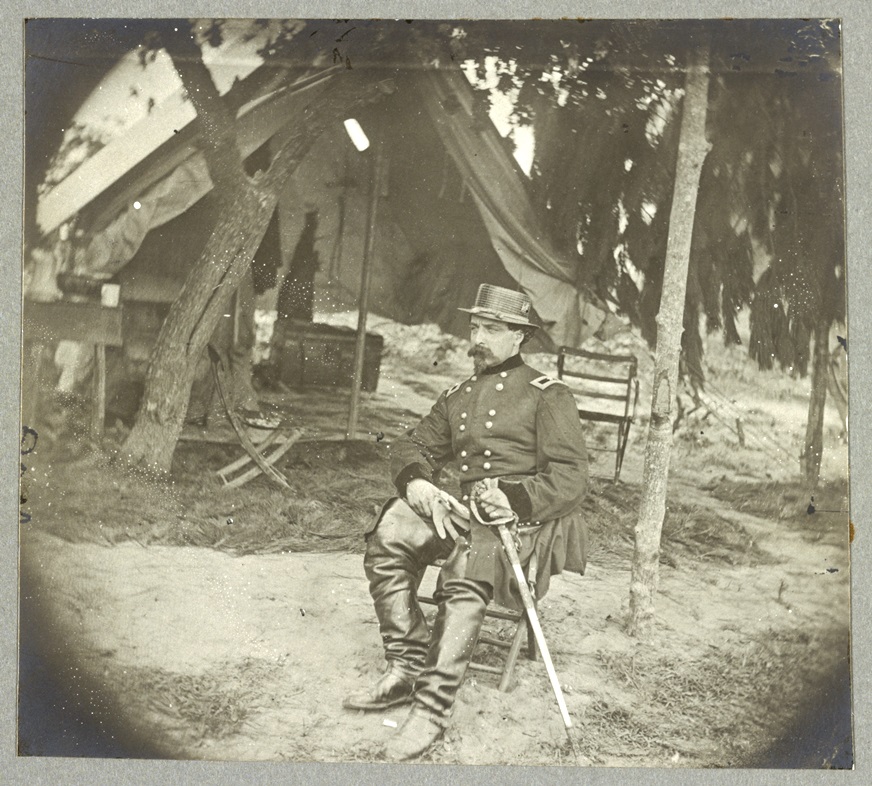
Edward Ferrero sitting in front of his headquarters tent at Petersburg (Library of Congress).

Edward Ferrero sitting in front of his headquarters tent at Petersburg (Library of Congress).

Today marks the 151st anniversary of the start of the Battle of Gettysburg. One hundred and fifty years ago John Buford and his cavalry began delaying the advance of Henry Heth and his division of A.P Hill’s corps. Soon John Reynolds and the Army of the Potomac’s I Corps arrived, to the great relief of Buford and his men, but Reynolds soon fell dead with a bullet in the back of his neck. The great battle had begun.

Today at Gettysburg the Civil War Trust will hold a press conference to announce its acquisition of Robert E. Lee’s headquarters. The little stone building stands on the grounds of a Quality Inn and has a small museum inside. The Trust plans to tear down the hotel and the adjoining ABC brewpub, restore the headquarters to its 1863 appearance, and donate the land to the park. That’s big news for the battlefield.

My wife and I visited the battlefield last weekend. We parked at Devil’s Den and then took a long walk over to the Wheatfield, up by the Peach Orchard, down past the Trostle barn (which is undergoing restoration), and then down Sedgwick Avenue and back to Devil’s Den. The coolest thing about the walk happened as we walked down Crawford Avenue back to our car. A little bridge just past Samuel Crawford’s statue crosses Plum Run’s swampy residue there. As I peered down into the murky waters I spotted something I thought was a large boulder. Then I spied a pair of reptilian eyes staring back at me from just above the waterline. This was no boulder! The boulder turned out to be a huge snapping turtle! And, as everyone reading this must know, George Meade was known as “the old goggle-eyed snapping turtle.”

Now let’s jump back 150 years ago to a letter Theodore Lyman wrote on July 1, 1864. Be warned: It does represent his nineteenth-century views on race but there’s also the sense of a growing, if grudging, respect Lyman is feeling for the fighting abilities of the Union’s African-American soldiers.

Lyman is taking the visiting French officers to see the men of Edward Ferraro’s division. Ferrero had been born in Spain and, like his Italian father, became a dance instructor. He taught West Point cadets how to dance and when war broke out he joined the Union army. At Antietam Ferrero’s men, part of the IX Corps, helped force the passage over Burnside Bridge. In 1864 he was given command of a division of black soldiers. For many Union officers, commanding African-Americans was not something to be held in high esteem. His past as a dancing master also opened Ferrero to ridicule. As Lyman noted in his July 1 journal entry, “people laugh at him rather—perhaps too much.” (The General Carr Lyman mentions is Joseph Carr.)

Edward Ferrero (Library of Congress).

Edward Ferrero (Library of Congress).

Nothing very new to-day. I took advantage of the propinquity of the nigger division (which had come to fill part of the 6th Corps’ line, during its absence) to show the unbleached brethren to my Imperial commissioners. We rode first to General Ferrero’s Headquarters. This officer, as his name hints, is an Italian by birth, his papa being of Milan. He is quite a well-looking man, and, like unto General Carr, was a dancing-master before he took to soldiering. He speaks Italian and some French and sputtered along very successfully with the visitors. There was turned out for them a regiment of darks. The sun was intense and the sable gents looked like millers, being indeed quite obscured except when they stood perfectly still. They did remarkably well, and the French officers, who were inclined to look favorably on them beforehand, were in ecstasies over their performances.

Theodore Lyman’s letter is from Meade’s Headquarters, 1863-1865: Letters of Colonel Theodore Lyman from the Wilderness to Appomattox, p. 180. Edited by George R. Agassiz. Boston, Massachusetts Historical Society, 1922. Available via Google Books.

Quite a Serious Disaster (June 30, 1864)

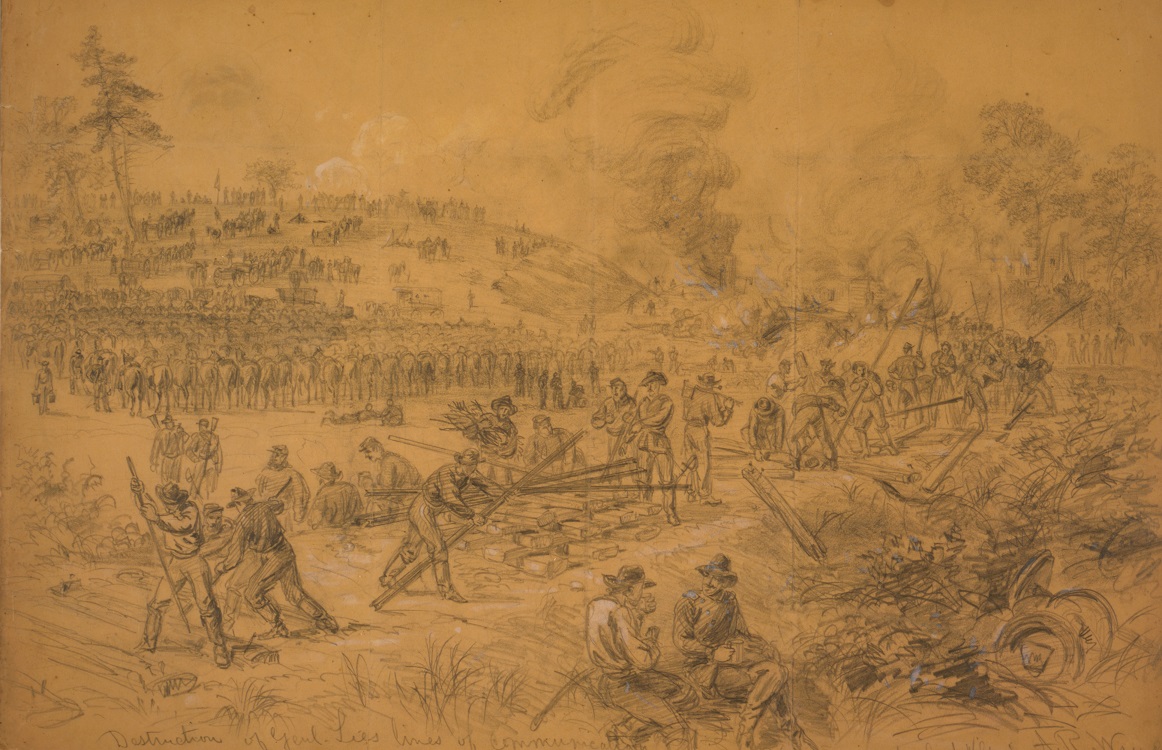
"Destruction of Genl. Lees lines of Communication in Virginia by Genl. Wilson" by Alfred Waud. Click to enlarge (Library of Congress).

“Destruction of Genl. Lees lines of Communication in Virginia by Genl. Wilson” by Alfred Waud. Click to enlarge (Library of Congress).

In his letter of June 30, Meade refers to the cavalry raid undertaken by James H. Wilson, August v. Kautz, and their 3,000 men against the railroad lines leading into Petersburg. The cavalry set out on June 22 and managed to tear up some track before being caught far behind enemy lines by cavalry under Wade Hampton and infantry commanded by William Mahone. The Union cavalry had to fight its way back to its own lines and suffered serious casualties.

James H. Wilson (Library of Congress).

James H. Wilson (Library of Congress).

I am sorry to tell you we have had quite a serious disaster. A whole division of cavalry, which was sent about a week ago to destroy the roads out of Petersburg, after accomplishing their work, were met on their return by three divisions of the enemy’s cavalry, supported by infantry, and after an honorable struggle were overpowered and dispersed. A large number have gotten in, but the greater portion are as yet missing, and I fear are in the hands of the enemy. I feel justified in telling you, though it is in the strictest confidence, that the sending this command was against my judgment, as I anticipated just this result, and I desired to wait till we could concentrate our cavalry before making an attempt to cut the enemy’s communications, but I was overruled. Now the result is, that our cavalry is no longer superior in numbers to the enemy, and, what is worse, has lost its prestige.

These ups and downs in war are to be expected, and perhaps are intended to prevent over-exultation and its consequences.

I cannot imagine where the report originated that this army was to be withdrawn, or on what grounds it was predicted. Such an act would be suicidal and could only result in the triumph of the enemy. No one here has ever dreamed of such a thing, though there may be different opinions as to the precise period when Richmond will fall.

Meade’s correspondence taken from The Life and Letters of George Gordon Meade, Major-General United States Army, Vol. 2, (New York: Charles Scribner’s Sons, 1913), pp. 209-10. Available via Google Books.

A “Pleasant Task” (June 27, 1864)

Letterhead from Philadelphia's Great Central Sanitary Fair (Library of Congress).

Letterhead from Philadelphia’s Great Central Sanitary Fair (Library of Congress).

General Meade writes a letter to his oldest son, John Sergeant, whose health fills him with trepidation. “Sargie” suffers from tuberculosis and his fate increasingly weighs on his parents’ minds. Once again Meade mentions the sword competition at the Great Central Sanitary Fair in Philadelphia. (Spoiler alert: Meade wins it. The sword is now in the collections of the Philadelphia History Museum at the Atwater Kent and is on temporary display at the Union League in Philadelphia.) It appears that Meade shares Theodore Lyman’s taste for irony, at least to a certain extent, as evidenced by his reference to “the pleasant task of sending people to eternity.”

Should I get the Philadelphia Fair sword, and the one from the City Councils, I think I shall be well off for weapons to wield in my country’s cause.

Hancock and myself are anxiously awaiting the decision in the great sword case, he having hopes some one will come down at the last moment in a sealed envelope with a clincher.

The weather has been so intensely hot, dry and dusty, that both sides were compelled to cease for awhile the pleasant task of sending people to eternity, which for the last fifty days we have been so successfully pursuing. The rest was much needed by both armies, and has been particularly enjoyed by myself.

I have now as guests two French officers sent by the Emperor, to see all they can; one of them, Colonel de Chenal, married a relative of the Hopkinsons. They are both intelligent gentlemen, and their visit has been very pleasant and agreeable.

I can hardly tell you what we are going to do next, whether to lay siege to Petersburg or something else; a few days I suppose will tell.

George continues quite well; Jim Biddle, Cadwalader and all the rest are in fine health and spirits.

Meade’s correspondence taken from The Life and Letters of George Gordon Meade, Major-General United States Army, Vol. 2, (New York: Charles Scribner’s Sons, 1913), p. 209. Available via Google Books.


Too Darned Hot (June 25, 1864)

Both Meade and Lyman mention the hot, dry weather that made the Petersburg front miserable for both armies. In addition, Meade mentions the Crapsey or Cropsey affair and how it has helped erase his presence in the newspapers. The wound of Hancock’s he mentions is the one the general received on the third day at Gettysburg. David Bell Birney has been in command of the II Corps while Hancock recovers. Gibbon is John Gibbon, one of Hancock’s division commanders.

Francis Markoe Bache, Meade's nephew (Library of Congress).

Francis Markoe Bache, Meade’s nephew (Library of Congress).

Francis Markoe Bache was Meade’s nephew and had joined his uncle’s staff from the 16th U.S. Infantry. When Lyman first met him, he called Bache “a remarkably empty-headed and ill-bred young man.” The two aides did not speak to each other for several months, until Bache finally apologized for his rudeness. General Meade had served under Bache’s father—who had married one of his sister’s—building lighthouses before the war.

We have had for ten days past most intensely hot weather, and in consequence have desisted from carrying on any more active operations than were absolutely necessary. Grant being at City Point, some eight miles distant, I see but little of him. He paid me a visit of an hour or two day before yesterday.

I received a few days ago a very kind letter from Cortlandt Parker, expressing much consideration for me in my present position, and saying it was well known how much of the work I was doing, and how little of the credit I was getting. Among other matters he alluded to the Cropsey affair, and said he was at George Harding’s when his brother came in with the news. Both the Hardings, he said, were quite excited, George the less so of the two; and Cortlandt thought he convinced him I was right, and advised me to write to him to endeavor to smooth it over. This I do not see how I can very well do, because I got Markoe Bache to write to him when the affair occurred, and to send him Cropsey’s confession, which he made, hoping by its publication in the Inquirer to get off. I asked Markoe to tell Mr. Harding that, as I could not let Cropsey off, he was at liberty to do as he pleased about the letter, though in my judgment the cause of truth and justice demanded its publication. The letter was never published, and the public are to this day ignorant of the real character of Cropsey’s offense.

Hancock’s wound discharged a big piece of bone the other day, and since then he has rapidly improved, and expects in a day or two to return to duty. In the meantime Birney has done very well.

Gibbon, whom I suppose you know I have finally succeeded in getting promoted, has been under the weather, but was about to-day.

And now Lyman, who remains busy serving as tour guide for the army’s two French guests.

I can only say that I have “sweltered” to-day—that is the word; not only has it been remarkably broiling, but this region is so beclouded with dust and smoke of burning forests, and so unrelieved by any green grass, or water, that the heat is doubled. We have had no drop of rain for twenty days, and but a stray shower for over a month. It is hardly necessary to say that neither army is what it was: the loss of a large proportion of the best officers, the nervous prostration of the men, the immense destruction of life, all tend to injure the morale and discipline and skill of both parties. As to the next step, I do not know; Grant is as calm and as apparently sure as ever. I have got from the region of fighting now, to the realm of lying idle, and it will not be so easy to fill a daily sheet. General Meade asked me to show the Gauls somewhat about; so I clapped them on their two horses, which they had from General Grant, and took them by easy stages to General Wright near by. The good General was comfortably in the woods. I say comfortably, because everything is relative. I mean he had his tents pitched and had iced water, two important elements. He speaks no French—De Chanal no English—so they smiled sweetly at each other. Old D. C. ought to be ashamed of himself. He married an American wife, but, like a true Gaul, utterly refused to learn a word of English. It is ever a part of a Frenchman’s religion to speak no language but his own. Little grasshopper Guzman chirped away and made up for two. Then Colonel Kent rode out with us, as a matter of politeness (for I knew that part of the line as well as he), and we showed them how our men made breastworks of rails, logs, and earth; how they lived and cooked; and all sorts of things. After which I took them out towards the picket line and showed them the country, and a tract of dense, young pines, through which our men advanced in double lines—a feat which I can never understand, but which is performed nevertheless. By this time, both distinguished foreigners being powdered a la marquise, I took them home, only showing them, before coming in, one more thing, only too characteristic of our war—the peculiar graves of our soldiers, marked each by a piece of cracker-box, with the man’s name in pencil, or hastily cut with a knife. I recollect sitting on the high bank of the Rapid Ann, at Germanna Ford, and watching the 5th and 6th Corps as they marched up from the pontoon bridges; and I remember thinking how strange it would be if each man who was destined to fall in the campaign had some large badge on! There would have been Generals Sedgwick, Wadsworth, and Rice, and what crowds of subordinate officers and of privates, all marching gaily along, unconscious, happily, of their fate.

Meade’s correspondence taken from The Life and Letters of George Gordon Meade, Major-General United States Army, Vol. 2, (New York: Charles Scribner’s Sons, 1913), pp. 208-9. Available via Google Books.

Theodore Lyman’s letter is from Meade’s Headquarters, 1863-1865: Letters of Colonel Theodore Lyman from the Wilderness to Appomattox, p. 178-80. Edited by George R. Agassiz. Boston, Massachusetts Historical Society, 1922. Available via Google Books.

The Great Peppery (June 24, 1864)

We begin our accounts of June 24, 1864, with General Meade’s report home to his wife. It is a very clear-eyed letter, explaining the pressures the army has been operating under and what the commanding general feels will be necessary for the Union to obtain victory. And victory is Meade’s goal here.

Following the general’s letter is one from Theodore Lyman as he examines the behavior of “the Great Peppery.” Lyman, for the most part, maintains a positive view of Both men write about the army’s need for more men.his boss but he is not unwilling to write about his various personal shortcomings, especially the legendary temper.

Both men write about the army’s need for more men.

In his book of Lyman’s journals, David W. Lowe identifies the two Frenchmen as Lt. Col. François De Chanal and Capt. Pierre Guzman, sent by Napoleon III as observers.

Our operations here for the last few days, though not so heavy as prior to the 18th, have still been very active. We have been extending our lines around Petersburg, and have encountered considerable opposition from the enemy, which has somewhat checked the rapidity of our progress.

I am sorry to see the feeling you report as existing with certain persons. Despondency is never going to get us through this war, and although this army has not accomplished all that ignorant people anticipated, it has really done more than could reasonably have been counted on. Our losses, it is true, have been large, but not larger than is incidental to operations of the character of ours, being offensive, and conducted on so grand a scale, with such numbers. Fifty days’ constant marching and fighting has undoubtedly had its influence on the army, and its condition is not what it was when we first crossed the Rapidan.

On the 18th I assaulted several times the enemy’s positions, deliberately, and with the expectation of carrying them, because I had positive information the enemy had not occupied them more than twelve hours, and that no digging had been done on the lines prior to their occupation. Nevertheless, I failed, and met with serious loss, principally owing to the moral condition of the army; for I am satisfied, had these assaults been made on the 5th and 6th of May, we should have succeeded with half the loss we met.

Another inconvenience we suffer from is in the loss of superior and other officers. Hancock’s Corps has lost twenty brigade commanders, and the rest of the army is similarly situated. We cannot replace the officers lost with experienced men, and there is no time for reorganization or careful selection. At the same time you must remember the enemy labors under like disadvantages. I conversed with some prisoners yesterday, who said they were completely exhausted, having had no rest or sleep for days, and being compelled to be all the time marching. I said to one of them, “Well, we will treat you well,” and he replied, “Oh, sir, you cannot treat us worse than we are treated on the other side.” In flags of truce, and on all occasions that we meet the rebel officers, they always begin conversation by asking when the war is going to be over, and expressing themselves as most heartily tired and anxious for peace. I believe these two armies would fraternize and make peace in an hour, if the matter rested with them; not on terms to suit politicians on either side, but such as the world at large would acknowledge as honorable, and which would be satisfactory to the mass of people on both sides. But while I ardently desire peace, and think a settlement not impracticable, I am opposed to any cessation of our efforts so long as the war has to be continued, and I regret to see symptoms of a discontent which, if persisted in, must paralyze our cause. Again, it is impossible for me personally to avoid my share of the odium, if any is to be cast on this army. I complain, and I think justly, that the press and the Government despatches fail to acknowledge my services, but I cannot reasonably do this, and expect to be shielded from complaints, if any are made of the operations.

You know I have never shut my eyes to the obstacles we have to encounter, and have always appreciated the difficulties to be overcome. The campaign, thus far, has been pretty much what I expected; if anything, rather greater obstacles than I anticipated. I still believe, with the liberal supply of men and means which our superior resources ought to furnish, we will win in the long run; but it is a question of tenacity and nerve, and it won’t do to look behind, or to calculate the cost in blood and treasure; if we do we are lost and our enemies succeed. You may remember I told the good people of Philadelphia, that what we wanted was men, fighting men; that the war could only be closed by desperate and bloody fighting; and the sooner the people realize this, and give evidence of their appreciation by coming forward to fight, the better.

I am well and seem to improve on hard work. I have had only three hours’ sleep for several nights past.

Here’s Lyman’s report, also from June 24. It provides some more close up views of “the Great Peppery” in action:

James C. Biddle, one of Meade's aides. He came from a good Philadelphia family but, as David W. Lowe notes in his book of Lyman's journals, "He could be something of a buffoon and was the target of much good-natured camp humor" (Library of Congress).

James C. Biddle, one of Meade’s aides. He came from a good Philadelphia family but, as David W. Lowe notes in his book of Lyman’s journals, “He could be something of a buffoon and was the target of much good-natured camp humor” (Library of Congress).

It is praise not to be pitched into by the Great Peppery: and he is very kind to me. To be sure, I watch him, as one would a big trout on a small hook, and those who don’t, catch volleys at all hours! Poor [James] Biddle, for instance, an excellent, bettyish sort of man, with no fragment of tact, when the General is full of anxiety for something that is not going right, is sure to come in, in his stuttering way, with “Ah, aw, hem, aw, General, they are going to pitch camp in a very sandy, bad place, sir; you will not be at all comfortable, and there is a nice grassy—” “Major Biddle!!!”—and then follows the volley. Sometimes it is very effective to contradict the General, provided you stick to it and are successful. I came in last night, feeling cross and not at all caring for commanders of armies or other great ones of this earth. “Well, Lyman, you’re back, are you?” “Yes, sir: I reported that the enemy were moving along our rear, but they got no further than—” “Rear! not at all! they were moving along the front.” “No, sir, they were not, they were moving along our rear.” “What do you mean by that? There is Russell, and there is Ricketts, and here is Wheaton; now of course that’s your front.” “Russell isn’t in such a position, sir, nor Wheaton either. They face so (dabs with a pencil), so that is our rear and can’t be anything else.” Whereupon the good chief graciously said no more. I do not know that he ever said anything pleasant about me except the day after the Wilderness battles, when I heard Hancock say that “Colonel Lyman had been useful to him, the day before.” To which the General replied: “Yes, Lyman is a clear-headed man.” I have heard him volunteer several favorable things about Captain Sanders; also he has remarked that Old Rosey (my tent-mate) [Frederick Rosenkrantz] was good at finding roads; and that is pretty much all of his praises, whereof no man is more sparing. By the way, old Rosey has his commission as captain. One thing I do not like—it is serious—and that is, that three years of bitter experience have failed to show our home people that, to an army on active campaign (or rather furious campaign), there must be supplied a constant stream of fresh men—by thousands. What do we see? Everyone trying to persuade himself that his town has furnished its “quota.” But where are they? We have large armies, but nothing compared with the paper statements. No! The few produced by drafts in good part run away; so too many of the “volunteers”—miserable fellows bought with money. None are shot—that is unmerciful—but the Powers that Be will let brave, high-toned men, who scorn to shirk their duty, be torn with canister and swept away with musketry, and that is inevitable.

This morning appeared General Grant with two French officers, who since have taken up their quarters with us and mess with us. They are two artillery officers, the elder a Colonel de Chanal, the other a Captain Guzman, both sent as a commission to observe the progress of the campaign. The Colonel is a perfect specimen of an old Frenchman, who has spent most of his life in provincial garrisons, in the study of all sorts of things, from antiquities down to rifled projectiles. He has those extraordinary, nervous legs, which only middle-aged Frenchmen can get, and is full of various anecdotes. Many years he has lived in Toulouse. The other is young and little and looks like a black-eyed and much astonished grasshopper. He is very bright, speaks several languages, and was on the Chinese expedition. General Grant staid some time in council, and took dinner with us. I was amused at him, for, the day being warm, he began taking off his coat before he got to the tent; and by the time he had said, “How are you, Meade?” he was in his shirt-sleeves, in which state he remained till dinner-time. He attempted no foreign conversation with the Gauls, simply observing; “If I could have turned the class the other end to, I should have graduated at West Point, very high in French”!

Meade’s correspondence taken from The Life and Letters of George Gordon Meade, Major-General United States Army, Vol. 2, (New York: Charles Scribner’s Sons, 1913), pp. 206-8. Available via Google Books.

Theodore Lyman’s letter is from Meade’s Headquarters, 1863-1865: Letters of Colonel Theodore Lyman from the Wilderness to Appomattox, p. 176-8. Edited by George R. Agassiz. Boston, Massachusetts Historical Society, 1922. Available via Google Books.

Chronic Troubles (June 23, 1864)

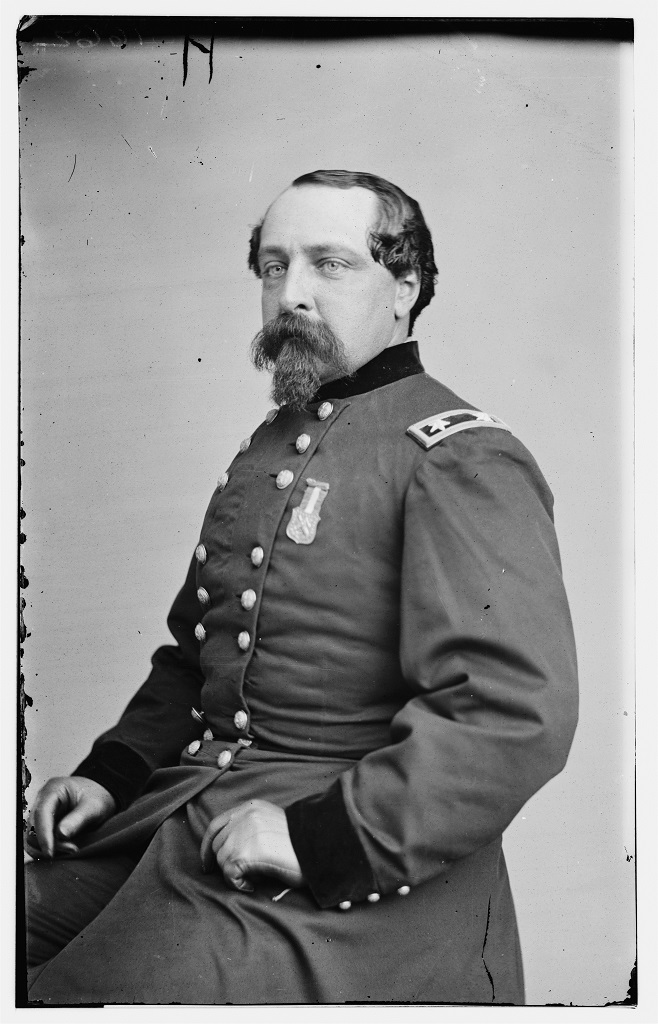
Horatio Wright took command of the VI Corps following the death of John Sedgwick (Library of Congress).

Horatio Wright took command of the VI Corps following the death of John Sedgwick (Library of Congress).

Theodore Lyman spends some time with Horatio Wright and the VI Corps, and is not impressed.

All were up at an early hour and ready for an advance, which had been ordered. On the right, towards the Gregory house, we were already against them, and I suppose my friend there, Major Crow, had seen us under more hostile circumstances. . . . By 4.30 General Meade started for General Wright’s Headquarters at the Williams house, where he ordered me to stay, when he left at seven. . . . I rode about with General Wright, who visited his line, which was not straight or facing properly. That’s a chronic trouble in lines in the woods. Indeed there are several chronic troubles. The divisions have lost connection; they cannot cover the ground designated, their wing is in the air, their skirmish line has lost its direction, etc., etc. Then General Meade gets mad with the delay. The commanders say they do as well as they can, etc. Well, Ricketts ran one way and Russell another; and then the 2d Corps—how did that run? and were the skirmishers so placed as to face ours? and what would General Birney do about it? How long was the line? could it advance in a given direction, and, if so, how? All of which is natural with a good many thousand men in position in a dense wood, which nobody knows much about. All this while the men went to sleep or made coffee; profoundly indifferent to the perplexities of their generals; that was what generals were paid for. When General Wright had looked a great deal at his line, and a great deal more at his pocket compass, he rode forth on the left to look at the pickets, who were taking life easy like other privates. They had put up sun-shades with shelter-tents and branches, and were taking the heat coolly. …

James B. Ricketts. The former artilleryman commanded a division in the VI Corps. His sister had married Meade's brother (Library of Congress).

James B. Ricketts. The former artilleryman commanded a division in the VI Corps. His sister had married Meade’s brother (Library of Congress).

About this time a Vermont captain (bless his soul!) went and actually did something saucy and audacious. With eighty sharpshooters he pushed out boldly, drove in a lot of cavalry, and went a mile and a quarter to the railroad, which he held, and came back in person to report, bringing a piece of the telegraph wire. . . . Some time in the morning, I don’t exactly know when, the signal officers reported a large force, say two divisions, marching out from the town, along the railroad, whereof we heard more anon. At noon there still had been no advance, and General Wright went to General Birney to arrange one. There was General Meade, not much content with the whole affair. They all pow-wowed a while, and so we rode back again, through the dreary woods, through which fires had run. It was after two when we returned. Now then—at last—all together—skirmishers forward! And away they go, steadily. Oh, yes! but Rebs are not people who let you sit about all the day and do just as you like; remember that always, if nothing else. There are shots away out by the railroad—so faint that you can scarce hear them. In comes a warm sharpshooter: “They are advancing rapidly and have driven the working party from the railroad.” Here come the two divisions, therefore, or whatever they are. “Stop the advance,” orders General Wright. “General Wheaton, strengthen that skirmish line and tell them to hold on.” The remainder of Wheaton’s division is formed on the flank, and begins making a breastwork; more troops are sent for. The fire of the skirmishers now draws nearer and gets distinct; but, when the reinforcement arrives, they make a stout stand, and hold them. . . . All the while the telegraph is going: “Don’t let ’em dance round you, pitch into them!” suggests General Meade (not in those exact words). “Don’t know about that—very easy to say—will see about it,” replies the cautious W.; etc., etc. Pretty soon the cavalry comes piling in across the Aiken oat-field; they don’t hold too long, you may be certain. This exposes the flank of the picket line, which continues to shoot valiantly. In a little while more, a division officer of the day gallops in and says they have broken his skirmishers and are advancing in line of battle. But the Rebels did not try an approach through the open oat-field: bullets would be too thick there; so they pushed through the woods in our rear. I could hear them whooping and ki-yi-ing, in their peculiar way. I felt uncomfortable, I assure you. It was now towards sunset. Our position was right in the end of the loop, where we should get every bullet from two sides, in event of an attack. General [Lewis] Grant, of the Vermont Brigade, walked up and said, in his quiet way: “Do you propose to keep your Headquarters here?” “Why not?” says Ricketts. “Because, when the volleys begin, nothing can live here.” To which Ricketts replied, “Ah?” as if someone had remarked it was a charming evening, or the like. I felt very like addressing similar arguments to General Wright, but pride stood in the way, and I would have let a good many volleys come before I would have given my valuable advice. A column of attack was now formed by us, during which the enemy pushed in their skirmishers and the bullets began to slash among the trees most spitefully; for they were close to; whereat Wright (sensible man!) vouchsafed to move on one side some seventy yards, where we only got accidental shots. And what do you think? It was too dark now for us to attack, and the Rebs did not—and so, domino, after all my tremendous description! Worse than a newspaper isn’t it? I was quite enraged to be so scared for no grand result.*

*“I look on June 22d and 23d as the two most discreditable days to this army that I ever saw! There was everywhere, high and low, feebleness, confusion, poor judgment. The only person who kept his plans and judgment clear was General Meade, himself. On this particular occasion Wright showed himself totally unfit to command a corps.”—Lyman’s Journal.

Theodore Lyman’s letter is from Meade’s Headquarters, 1863-1865: Letters of Colonel Theodore Lyman from the Wilderness to Appomattox, p. 173-6. Edited by George R. Agassiz. Boston, Massachusetts Historical Society, 1922. Available via Google Books.