No Chance for Peace (February 13, 1865)

paperback scanThe paperback edition of Searching for George Gordon Meade: The Forgotten Victor of Gettysburg is now available! You can purchase it through Stackpole Books, Amazon or Barnes and Noble. And don’t forget the 2015 George Meade seminar on February 15. Click here for more details.

The visit by the three Confederate peace commissioners has obviously failed to achieve any results. In George Meade’s opinion, another campaign appears inevitable. Spring approaches, and with it more fighting.

There is no chance for peace now. The South has determined to fight another campaign, and it is to be hoped the North will be equally united, and turn out men to fill up all our present armies and form others at the same time.

Grant returned from Washington to-day. He forgot to say anything about the court of inquiry, so I have to-day telegraphed Mr. Stanton, asking him to have the proceedings published.

Meade’s correspondence taken from The Life and Letters of George Gordon Meade, Major-General United States Army, Vol. 2, (New York: Charles Scribner’s Sons, 1913), p. 263. Available via Google Books.

Its Usual Malice (February 11, 1865)

A Meade bronze at the Union League. I am assuming this is the work of Franklin Simmons.

A Meade bronze at the Union League. I am assuming this is the work of Franklin Simmons.

Once again, George Meade takes issue with the press, this time over an account of the fighting known today as the Battle of Hatcher’s Run. He would have been well advised, I think, to have avoided reading newspapers altogether.

The Willie to whom Meade refers is his wife’s brother. He will not survive the war.

I assume the sculptor Meade mentions is Franklin Simmons. Born in Maine, Simmons sculpted the equestrian statue of Gen. John A. Logan that stands in the circle in Washington, D.C., that bears the general’s name. He was also commissioned to do a portrait of Abraham Lincoln, and met with the president about it on the day before Lincoln’s assassination. His bronze medallion of Meade (as well as those of other generals) is in the Union League in Philadelphia. There’s more about Simmons here.

I see the Tribune, with its usual malice, charges the recent movement as a failure, and puts the blame on me. I told Grant, before the movement was made, it would be misunderstood and called a failure. But he promised to telegraph to Washington what we intended to do, thinking by this to avoid this misapprehension. His telegram, if he sent one, was never published, nor has any of his or my telegrams to him about the affair been made public. Now, the facts of the case are that I accomplished a great deal more than was designed, and though the Fifth Corps at one time was forced back, yet we repulsed the enemy the day before, had been driving him all that day, and the next day drove him into his works, and on the whole the success was with us. It is rather hard under these circumstances to be abused; but I suppose I must make up my mind to be abused by this set, never mind what happens,

Willie’s regiment was in the thickest of the fight and suffered severely, but I believe behaved very well.

There is now here an artist in bronze, of the name of Simmons, who is sculpturing a life-size head of me, of which he intends casting a medallion in bronze. His work is pronounced excellent, and he promises to present you a copy, so you will have your Meade art gallery increased. Grant is still away.

Meade’s correspondence taken from The Life and Letters of George Gordon Meade, Major-General United States Army, Vol. 2, (New York: Charles Scribner’s Sons, 1913), pp. 262-3. Available via Google Books.

paperback scanThe paperback edition of Searching for George Gordon Meade: The Forgotten Victor of Gettysburg is now available! You can purchase it through Stackpole Books, Amazon or Barnes and Noble. And don’t forget the 2015 George Meade seminar on February 15. Click here for more details.

Report on the Mine (February 9, 1865)

Ambrose Burnside. The Battle of the Crater provided a good reason to get him out of the Army of the Potomac once and for all (Library of Congress).

Ambrose Burnside. The Battle of the Crater provided a good reason to get him out of the Army of the Potomac once and for all (Library of Congress).

General Meade writes home about the report of the Joint Committee on the Conduct of the War’s on the Battle of the Crater (a.k.a. the Mine). Meade was obviously no fan of the committee, which had come after him in the spring of 1864. In his book Over Lincoln’s Shoulder, historian Bruce Tap questioned the committee’s value, especially in its criticisms of Meade. “Other than contributing to the destruction of Meade’s reputation for generations to come, little was accomplished by the committee’s investigation except for reinforcing the hostility that army officers felt toward their civilian overseers.” Grant’s telegram supports Meade’s contention that the committee report was intended to support Ambrose Burnside. And once again he defends Grant when his wife questions the general-in-chief’s trustworthiness.

Meade also mentions the failure of the Confederate peace commissioners to strike any agreement with Lincoln, and stresses the need for a “vigorous prosecution of the war.”

The Beckham whose obituary Meade sends to his wife was Robert F. Beckham. As a lieutenant before the war, Beckham had served under Meade on a survey of Lake Huron. He joined the rebels when war broke out. J.L. Kirby Smith, not to be confused with Edmund Kirby Smith, the Confederate commander of the Trans-Mississippi Department, also served under Meade on the survey.

I note you have seen the report of the Committee on the Conduct of the War, about the Mine. You have done Grant injustice; he did not testify against me; but the committee has distorted his testimony, my own, and that of every one who told the truth, in order to sustain their censure. When you see all the testimony you will find their verdict is not sustained. Immediately on the appearance of this report Grant sent me a despatch, a copy of which I enclose, and from it you will see what he thinks of the course of the committee, and of Burnside’s testimony. (see below). I replied to him that, after the acknowledgment of my services by the President, the Secretary and himself, and the endorsement of the Senate, as shown by the large vote in my favor, I thought I could stand the action of the committee, and I felt confident that when the facts and the truth were laid before the public, the report of the committee would prove a more miserable failure than the explosion of the Mine. I, however, asked him to exert his influence to have published the proceedings of the court of inquiry. He has gone to Washington, and I am in hopes he will have this done; I think Burnside has used himself up.

Richmond papers of the 7th, have a message from Davis and the report of the commissioners, from which it appears they required recognition as an independent power, precedent to any negotiations. Of course this was out of the question, and I think Mr. Lincoln’s course ought to meet the approval of all true patriots.

We cannot and ought not ever to acknowledge the Confederacy or its independence, and I am surprised they took the trouble to send men into our lines with any such ideas. This conference ought to unite the North to a vigorous prosecution of the war; and the people, if they do not volunteer, should submit cheerfully to the draft. In the same paper, which I send you, is an obituary notice of Beckham, who, it appears, was killed in one of Thomas’s fights at Columbia, in Tennessee, he being colonel and chief of artillery to S. D. Lee’s Corps. Poor fellow, he and Kirby Smith have both been sacrificed!

DESPATCH FROM GENERAL GRANT TO GENERAL MEADE ON THE REPORT OF THE COMMITTEE ON THE CONDUCT OF THE WAR ABOUT THE PETERSBURG MINE EXPLOSION, MENTIONED IN LETTER OF FEBRUARY 9, 1865.

Grant to Meade:
Feb. 9, 10 a.m.

The Committee on the Conduct of the War have published the result of their investigation of the Mine explosion. Their opinions are not sustained by knowledge of the facts nor by my evidence nor yours either do I suppose. Gen. Burnside’s evidence apparently has been their guide and to draw it mildly he has forgotten some of the facts. I think in justification to yourself who seem to be the only party censured, Genl. Burnside should be brought before a Court Martial and let the proceedings of the Court go before the public along with the report of the Congressional Committee.

Meade’s correspondence taken from The Life and Letters of George Gordon Meade, Major-General United States Army, Vol. 2, (New York: Charles Scribner’s Sons, 1913), pp. 261-2 and p. 344. Available via Google Books.

Hatcher’s Run (February 7, 1865)

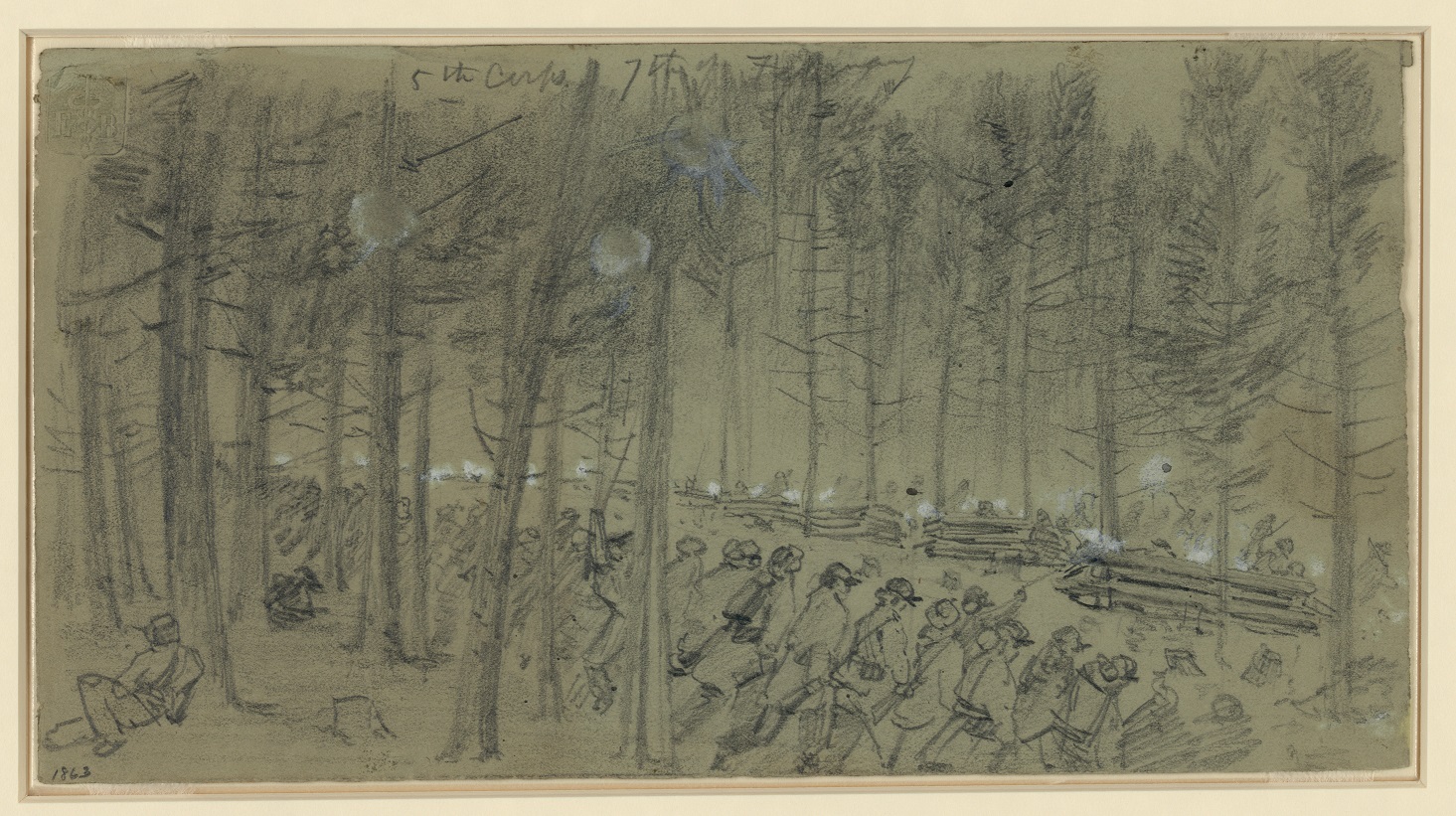
Alfred Waud sketched the fighting on February 7. On the back, he wrote, "The 1st Div 5th Corps charging some temporary breastworks of logs piled against trees on the morning of Tuesday 7th Feb. Thick pine woods. The ground smooth and covered with fine leaves. A.R.W. Near Hatchers Run." Click to enlarge (Library of Congress).

Alfred Waud made this sketch of the fighting on February 7. On the back, he wrote, “The 1st Div 5th Corps charging some temporary breastworks of logs piled against trees on the morning of Tuesday 7th Feb. Thick pine woods. The ground smooth and covered with fine leaves. A.R.W. Near Hatchers Run.” Click to enlarge (Library of Congress).

George Meade writes home about the Battle of Hatcher’s Run, yet another attempt to force Robert E. Lee to extend his lines around Petersburg to the breaking point. The operation began on February 5, with cavalry moving out in advance of the V Corps (Gouverneur Warren commanding) and the II (under Andrew A. Humphreys). Although not able to sever the Boydton Plank Road, an important Confederate supply line, the Union offensive did weaken the rebel defenses. “Although no man could tell what the next two months would bring forth, yet it was evident that the end was near for the capture of Petersburg,” wrote William Henry Powell in his 1896 history of the V Corps. “The continued extension of the Union lines to the left was very threatening to the only remaining railroad line of communication of the Confederate army directly with the South, and General Grant feared, from indications, that General Lee would abandon his Petersburg and Richmond intrenchments and endeavor to unite with Johnston’s army, then in front of Sherman, before he (Grant) was quite ready for the pursuit, Sheridan still being in the Shenandoah Valley. In preparing, therefore, for a contemplated pursuit, General Sheridan was summoned to Petersburg with his command.”

I have not written you for several days, owing to being very much occupied with military operations. Day before yesterday to prove war existed, whatever might be the discussions about peace, I moved a portion of my army out to the left. The first day the enemy attacked Humphreys, who handsomely repulsed him. The next day (yesterday) Warren attacked the enemy, and after being successful all day, he was towards evening checked and finally compelled to retrace his steps in great disorder. This morning, notwithstanding it was storming violently, Warren went at them again, and succeeded in recovering most of the ground occupied and lost yesterday. The result on the whole has been favorable to our side, and we have extended our lines some three miles to the left. The losses have not been so great as in many previous engagements, and I hear of but few officers killed or severely wounded.

I have been in the saddle each day from early in the morning till near midnight, and was too much exhausted to write.

Colonel Lyman sent me a box, which he said contained books and pickles. I find, on opening it, that there are about a dozen nice books and a box of champagne; so you can tell dear Sergeant he is not the only one that gets good things.

Meade’s correspondence taken from The Life and Letters of George Gordon Meade, Major-General United States Army, Vol. 2, (New York: Charles Scribner’s Sons, 1913), p. 261. Available via Google Books.

paperback scanThe paperback edition of Searching for George Gordon Meade: The Forgotten Victor of Gettysburg is now available! You can purchase it through Stackpole Books, Amazon or Barnes and Noble. And don’t forget the 2015 George Meade seminar on February 15. Click here for more details.

Follow-up (February 4, 1865)

Michigan's Senator Zachariah Chandler. (National Archives.)

Michigan’s Senator Zachariah Chandler. (National Archives.)

George Meade writes home with some follow-up on his Senate confirmation and the Confederate peace commissioners. The Chandler to whom he refers is Senator Zachariah Chandler of Michigan, a staunch Meade opponent. As members of the Joint Committee on the Conduct of the War, Chandler and Senator Ben Wade had spearheaded the effort to have Meade removed from the command a year earlier.

The peace commissioners had indeed met with Lincoln. I included Ulysses S. Grant’s account of the meetings in the post of February 1. I have my own follow-up to that post. In it, I had added this editorial comment: Clearly, Meade feels that he should not have spent time talking with the commissioners. I have even read an interview with one historian who says Meade’s actions here were treasonous.” Not wanting to point fingers, I kept the historian’s identity to myself. In a Facebook discussion that ensued, though, the historian in question stepped forward. He is Dr. Allen C. Guelzo, author of Gettysburg: The Last Invasion. The interview was one he did for Harry Smeltzer’s Bull Runnings blog, in which Dr. Guelzo said this about the letter in question:After reading this, the first question which burned through my mind was, Whose side are you on? What Union major-general gives talking points to Confederate negotiators as they are on their way to meet with Lincoln and Seward? No wonder Meade concluded the letter with the injunction, ‘all this I have written you, must be confidential, as it would not do to let it be known I had been talking with them, or what I have said.’ This letter appears nowhere in young Meade’s Life and Letters, or Freeman Cleaves’ well-known biography of Meade.” (You can find the entire interview here

I remember reading that interview and feeling my blood run cold.

Now, I will freely admit to making some errors in Searching for George Gordon Meade: The Forgotten Victor of Gettysburg. I still flush with embarrassment when I recall how I wrote that Col. Henry Baker died at the Battle of Ball’s Bluff. In fact, that was Col. Edward Baker. My subconscious must have been thinking of “The Adventure of the Blue Carbuncle,” the Sherlock Holmes story in which Henry Baker drops a Christmas goose that eventually leads to the recovery of a stolen gem. As far as I am aware, no Christmas gooses were dropped at Ball’s Bluff. I also referred to divisions as brigades (or perhaps vice versa) and at one point stated that Grant launched his Overland Campaign in 1865. (Incidentally, those errors have been corrected for the paperback edition, available here.)

But while I made some mistakes, I thought I correctly presented the big picture, which is that Meade had served his country well but had been unfairly ignored by history, for a variety of reasons. Yet apparently I had overlooked a letter that called into question Meade’s very loyalty to the Union. How had I missed it? I knew that his son and grandson left out passages and some entire letters when they edited his Life and Letters for publication, but I had looked over microfilmed copies of the originals from this period. Somehow this bombshell had eluded me. I felt chagrined and depressed.

But, as it turns out, Dr. Guelzo was mistaken. The letter was indeed included in Life and Letters. It had not been suppressed by the Meades. It’s right there for all to see. I had read the letter, but thought little of it. It did not make me question Meade’s loyalty. Meade obviously knew he was sticking his prominent nose into places it didn’t belong, but he was just repeating administration policy (that war could end only when the seceded states returned to the Union and slavery was abolished). I don’t consider that to be “giving talking points.” Had he written to his wife, “I told the rebels that the best way to throw Lincoln off his game was to mention Ann Rutherford,” or “if you want to make things work out your way, try contacting John Wilkes Booth and figure out when the president will be attending the theater,” then I would have seen things somewhat differently.

Anyway, my post of Meade’s letter led to a long and lively Facebook discussion among Dr. Guelzo, Meade supporter Scott Brown (who made some excellent points), and me. I remained insistent that Dr. Guelzo admit he had been mistaken when he said the letter had not appeared in Life and Letters. A small point, perhaps, but I felt it was important. Dr. Guelzo had used this mistaken assertion to underscore his interpretation of the letter as being especially damaging to Meade’s reputation. By this reasoning, the Meades could not let the letter see the light of day because it was so bad. That was simply not true. (Apparently Dr. Guelzo had repeated this assertion—and got the date of the letter wrong—in an article he had written for Gettysburg Magazine. I have not read that article.)

I am sure this was an honest mistake on Dr. Guelzo’s part, although I do think it hints at an underlying anti-Meade bias. Instead of seeing a meddlesome general, he saw a disloyal one. Perhaps I am too biased in the other direction, but I don’t agree with that interpretation at all.

Now, on to Meade’s letter from February 4. The Senators who voted against Meade’s confirmation were Zachariah Chandler (R-Michigan), James Harlan (R-Iowa), Samuel C. Pomeroy (R-Kansas), Benjamin Wade (R-Ohio), and Morton S. Wilkinson (R-Minnesota).

I hear from Washington the vote on my confirmation was thirty-two to five. I have not heard the names of my opponents, but their number is about what I expected, and I have no doubt they are all like Chandler, men whose opposition is rather creditable to you.

As to the Peace Commissioners, I presume their arrival will make a great stir; I have written you what passed between us when I called on them. I understand they afterwards went down to Fortress Monroe, where they met, some say, the President, and others, Mr. Seward. To-day they returned to Richmond, but what was the result of their visit no one knows. At the present moment, 8 p.m., the artillery on our lines is in full blast, clearly proving that at this moment there is no peace. I fear there is not much chance of any agreement between the contending parties until more decided successes are gained on our side.

I would have liked to have sent a few lines to Johnny Wise by the Commissioners, but they went up the river, and did not pass through my lines.

Meade’s correspondence taken from The Life and Letters of George Gordon Meade, Major-General United States Army, Vol. 2, (New York: Charles Scribner’s Sons, 1913), pp. 260-1. Available via Google Books.

Confirmation (February 2, 1865)

Meade receives word that Congress has finally confirmed his promotion to major-general in the regular army. This good news is tempered by that knowledge that his eldest son, John Sergeant, lays dying of tuberculosis back in Philadelphia.

Grant sent me a note this morning, saying a telegram from Washington announced my confirmation yesterday by a heavy majority; thus I have gained another victory, and have found that I really have more friends than I had any idea of.

There have been some English officers here this evening from the frigate Galatea, and they have kept me up so late that I cannot write as much as I would wish.

I thought my last visit was, excepting dear Sergeant’s sickness, most happy, but I cannot be happy and see my noble boy suffering as he does. I think of him all the time, and feel at times like asking to be relieved, that I may go home and help you nurse him. May God in his infinite mercy restore him to health, is my constant prayer!

Meade’s correspondence taken from The Life and Letters of George Gordon Meade, Major-General United States Army, Vol. 2, (New York: Charles Scribner’s Sons, 1913), p. 260. Available via Google Books.

paperback scanThe paperback edition of Searching for George Gordon Meade: The Forgotten Victor of Gettysburg is now available! You can purchase it through Stackpole Books, Amazon or Barnes and Noble. And don’t forget the 2015 George Meade seminar in just two weeks. Click here for more details.

Three Distinguished Gentlemen (February 1, 1865)

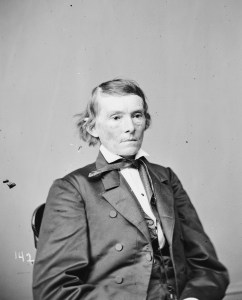
Alexander Stephens, the vice president of the Confederacy (Library of Congress).

Alexander Stephens, the vice president of the Confederacy (Library of Congress).

George Meade has just returned to the army after a short leave in Philadelphia His letter back home from February 1 is a very interesting one. In it, he tells his wife about his encounter with three peace commissioners sent by the Confederacy to meet with President Abraham Lincoln. The commissioners were Alexander Stephens, the Confederate vice president; assistant secretary of war John A. Campbell; and Robert M. T. Hunter, a Confederate senator. Their mission ended in failure because Lincoln stuck to his position that the requirements for peace included reunification of the Union and the abolition of slavery.

Clearly, Meade feels that he should not have spent time talking with the commissioners. I have even read an interview with one historian who says Meade’s actions here were treasonous. I can’t agree with that assessment at all. In his conversations with the rebels, Meade said nothing contrary to Lincoln’s stand that the only want to end the war was for the seceded states to return to the Union and for slavery to end, nor did he offer suggestions for ways in which the commissioners could circumvent Lincoln or suggest negotiating tactics. I think the charge of treason is ludicrous. Perhaps Meade transgressed the bounds of propriety, but he was not doing anything to undermine Lincoln, or to provide “aid and comfort to the enemy.”

In anyone went outside the boundaries, it was Grant. He knew that Lincoln and Secretary of War Edwin Stanton were both wary of meeting with the commissioners, whose instructions including making peace between the “two countries.” “At this point Grant, who was increasingly eager to finish off the war and who was not attuned to the niceties of diplomatic negotiations, intervened,” wrote Lincoln biographer David Herbert Donald. “He persuaded the commissioners to delete from their instructions the reference to two separate countries and wired to Washington that he hoped Lincoln would meet with them.”

After Meade’s letter, I include Grant’s view of the delegation.

I reached City Point at twelve o’clock last night, having had a very comfortable journey via Annapolis. We found a good deal of ice in the Chesapeake Bay and considerable in the James River; but to-day has been so mild and pleasant I think the ice will disappear.

From all I can gather, the Secretary’s telegram must have been based on something Ord sent to Washington; for Grant did not return till Monday night, and in ignorance of Mr. Stanton’s telegram, sent me one himself, yesterday morning.

I found on my arrival, last night, that three distinguished gentlemen, Mr. Alexander Stephens (Vice President of the Confederacy), Mr. R. M. T. Hunter (formerly United States Senator from Virginia), and Mr. Campbell, of Alabama (formerly Judge United States Supreme Court), were in our lines, having been passed in by General Grant, on their expressing a wish to go to Washington. After Grant had admitted them, he received a telegram from Washington directing they be retained outside our lines until a messenger despatched from Washington could arrive. They are now awaiting this messenger. They do not profess to be accredited commissioners, but state they are informal agents, desiring to visit the President and ascertain if any measures are practicable for the termination of the war. I called this morning, with General Grant, on them, and remained after General Grant left, and talked very freely with them. I told them very plainly what I thought was the basis on which the people of the North would be glad to have peace, namely, the complete restoration of the Union and such a settlement of the slavery question as should be final, removing it forever as a subject of strife. Mr. Stephens suggested that, if we could stop fighting, the matter might be discussed. I told him promptly that was entirely out of the question; that we could not stop fighting unless it was for good, and that he might be assured any proposals based on a suspension of hostilities would not be received. Mr. Stephens then said they did not consider the slavery question as so formidable a difficulty, but they feared the difficulty would be to obtain such modification of the old Constitution as would protect the States, in case of other questions arising to produce strife. I said if you mean to propose a reorganization and change in our Government, I don’t think you will meet with any success. We are satisfied with our Constitution, and you seem to be, since yours is identically ours, excepting the protection you give to slavery. Mr. Hunter then asked me what we proposed to do with the slaves after freeing them, as it was well known they would not work unless compelled. I replied this was undoubtedly a grave question, but not insurmountable; that they must have labor, and the negroes must have support; between the two necessities I thought some system could be devised accommodating both interests, which would not be so obnoxious as slavery. They then said they thought it a pity this matter could not be left to the generals on each side, and taken out of the hands of politicians. I answered I had no doubt a settlement would be more speedily attained in this way, but I feared there was no chance for this.

We then conversed on general topics. Judge Campbell asked after your family, and Mr. Hunter spoke of Mr. Wise, and said he had brought two letters with him, one of which I herewith enclose.

I judge from my conversation that there is not much chance of peace; I fear we will split on the questions of an armistice and State rights. Still, I hope Mr. Lincoln will receive them and listen to all they have to say, for if it can be shown that their terms are impracticable, the country will be united for the further prosecution of the war. At the same time the selection of three most conservative of Southern men indicates most clearly to my mind an anxiety on the part of Mr. Davis to settle matters if possible. All this I have written you must be confidential, as it would not do to let it be known I had been talking with them, or what I said.

I do most earnestly pray something may result from this movement. When they came within our lines our men cheered loudly, and the soldiers on both sides cried out lustily, “Peace! peace!” This was intended as a compliment, and I believe was so taken by them.

I am sorry I could not stay longer with you, but I don’t believe I should have had any satisfaction, as every report brought in would have a recall telegram.

Here are Grant’s recollections of the peace commission, taken from his memoirs (Vol. II, pp 420-3, available via Google Books):

On the last of January, 1865, peace commissioners from the so-called Confederate States presented themselves on our lines around Petersburg, and were immediately conducted to my headquarters at City Point. They proved to be Alexander H. Stephens, Vice-President of the Confederacy, Judge Campbell, Assistant-Secretary of War, and R. M. T. Hunter, formerly United States Senator and then a member of the Confederate Senate.

It was about dark when they reached my headquarters, and I at once conducted them to the steamer Mary Martin, a Hudson River boat which was very comfortably fitted up for the use of passengers. I at once communicated by telegraph with Washington and informed the Secretary of War and the President of the arrival of these commissioners and that their object was to negotiate terms of peace between the United States and, as they termed it, the Confederate Government. I was instructed to retain them at City Point, until the President, or some one whom he would designate, should come to meet them. They remained several days as guests on board the boat. I saw them quite frequently, though I have no recollection of having had any conversation whatever with them on the subject of their mission. It was something I had nothing to do with, and I therefore did not wish to express any views on the subject. For my own part I never had admitted, and never was ready to admit, that they were the representatives of a government. There had been too great a waste of blood and treasure to concede anything of the kind. As long as they remained there, however, our relations were pleasant and I found them all very agreeable gentlemen. I directed the captain to furnish them with the best the boat afforded, and to administer to their comfort in every way possible. No guard was placed over them and no restriction was put upon their movements; nor was there any pledge asked that they would not abuse the privileges extended to them. They were permitted to leave the boat when they felt like it, and did so, coming up on the bank and visiting me at my headquarters.

I had never met either of these gentlemen before the war, but knew them well by reputation and through their public services, and I had been a particular admirer of Mr. Stephens. I had always supposed that he was a very small man, but when I saw him in the dusk of the evening I was very much surprised to find so large a man as he seemed to be. When he got down on to the boat I found that he was wearing a coarse gray woollen overcoat, a manufacture that had been introduced into the South during the rebellion. The cloth was thicker than anything of the kind I had ever seen, even in Canada. The overcoat extended nearly to his feet, and was so large that it gave him the appearance of being an average-sized man. He took this off when he reached the cabin of the boat, and I was struck with the apparent change in size, in the coat and out of it.

After a few days, about the 2d of February, I received a dispatch from Washington, directing me to send the commissioners to Hampton Roads to meet the President and a member of the cabinet. Mr. Lincoln met them there and had an interview of short duration. It was not a great while after they met that the President visited me at City Point. He spoke of his having met the commissioners, and said he had told them that there would be no use in entering into any negotiations unless they would recognize, first: that the Union as a whole must be forever preserved, and second: that slavery must be abolished. If they were willing to concede these two points, then he was ready to enter into negotiations and was almost willing to hand them a blank sheet of paper with his signature attached for them to fill in the terms upon which they were willing to live with us in the Union and be one people. He always showed a generous and kindly spirit toward the Southern people, and I never heard him abuse an enemy. Some of the cruel things said about President Lincoln, particularly in the North, used to pierce him to the heart; but never in my presence did he evince a revengeful disposition—and I saw a great deal of him at City Point, for he seemed glad to get away from the cares and anxieties of the capital. Right here I might relate an anecdote of Mr. Lincoln. It was on the occasion of his visit to me just after he had talked with the peace commissioners at Hampton Roads. After a little conversation, he asked me if I had seen that overcoat of Stephens’s. I replied that I had. “Well,” said he, “did you see him take it off?” I said yes. “Well,” said he, “didn’t you think it was the biggest shuck and the littlest ear that ever you did see?” Long afterwards I told this story to the Confederate General J. B. Gordon, at the time a member of the Senate. He repeated it to Stephens, and, as I heard afterwards, Stephens laughed immoderately at the simile of Mr. Lincoln.

Meade’s correspondence taken from The Life and Letters of George Gordon Meade, Major-General United States Army, Vol. 2, (New York: Charles Scribner’s Sons, 1913), pp. 258-60. Available via Google Books.

paperback scanThe paperback edition of Searching for George Gordon Meade: The Forgotten Victor of Gettysburg is now available! You can purchase it through Stackpole Books, Amazon or Barnes and Noble. And don’t forget the 2015 George Meade seminar in just two weeks. Click here for more details.

Now Available in Paperback!

paperback scanThe paperback edition of Searching for George Gordon Meade: The Forgotten Victor of Gettysburg is now available! You can purchase it through Stackpole Books, Amazon or Barnes and Noble.

Here’s what the critics say:

“Despite his great victory at Gettysburg and his command of the army that forced Lee’s surrender at Appomattox, George Meade saw his fame eclipsed by that of Lee, Grant, and other Civil War generals. This book does a great deal to redress that historical injustice. Tom Huntington has invented a new genre of biography that shifts between past and present as he tells the story of Meade’s life and describes his own pilgrimage to the key sites of that life. The result is an engrossing narrative that the reader can scarcely put down.” –James M. McPherson, Pulitzer Prize-winning author of Battle Cry of Freedom

“Searching for George Gordon Meade is a splendid book! Well-researched, well-reasoned, and well-written, it’s a timely and vital addition to the all-too-meager literature on this neglected American hero. Strongly recommended for serious historians as well as for a general readership. Excellent!” –Ralph Peters, author of Cain at Gettysburg

“Much more than another Civil War biography, Tom Huntington’s gripping personal ‘search’ for George Gordon Meade is unique and irresistible: a combination life story, military history, travelogue, and cultural commentary that brings us closer than ever to the old general and his strange reputation–and also opens new windows to our own unending search for an understandable national identity.” –Harold Holzer, author and Chairman of Abraham Lincoln Bicentennial Foundation

Very Little Going On (January 22, 1865)

After writing this letter, General Meade left for Philadelphia. He reached there on January 28 and left to return to the army two days later. The main purpose for his visit was his oldest son, John Sergeant, who was near death with tuberculosis. Markoe Bache is Meade’s nephew and serves on the general’s staff; we have had of him before.

Markoe Bache, Meade's nephew (Library of Congress).

Markoe Bache, Meade’s nephew (Library of Congress).

Theodore Lyman remains in Boston. On January 18 he had received a letter from Meade, giving him permission to stay there indefinitely. “He is low in spirits, being anxious about his confirmation, and what is worse is eldest son is very low,” Lyman noted. The general also asked his aide to use what influence he had in Massachusetts to move Meade’s promotion forward, so Lyman wrote to Senators Charles Sumner and Henry Wilson and businessman John Murray Forbes and met personally with Governor John A. Andrews. Lyman also noted that Seth Williams, the extremely capable assistant adjutant-general for the Army of the Potomac, had been promoted by Grant to be the army inspector general. You can read all of Lyman’s journal entries in Meade’s Army: The Private Notebooks of Lt. Col. Theodore Lyman, edited by David W. Lowe (Kent State University Press, 2007). Highly recommended!

There is very little going on here. We have had a violent storm of rain. Grant is still away, and I have heard nothing from Markoe Bache, so that I am ignorant of what turn affairs are taking in Washington. I received a letter yesterday from Cram, enclosing me one from a correspondent in Washington, who advises him (Cram) that he has been reliably informed that I am likely to be rejected. Still, this may be a street rumor, circulated by those who want this result.

To-day Bishop Lee, of Delaware, held service in the chapel tent at these headquarters, and gave us a very good sermon. He came here with Bishop Janeway, of the Methodist Church, and a Mr. Jones, a lawyer from Philadelphia, who were a commission asking admission into the rebel lines, to visit our poor prisoners in their hands to relieve their spiritual wants; but I believe the Confederate authorities declined.

The Richmond papers are very severe on Davis, and there is every indication of discord among them. I hope to Heaven this will incline them to peace, and that there may be some truth in the many reports in the papers that something is going on!

(General Meade left head-quarters for Philadelphia where he arrived January 28. He left Philadelphia on the 30th.)

Meade’s correspondence taken from The Life and Letters of George Gordon Meade, Major-General United States Army, Vol. 2, (New York: Charles Scribner’s Sons, 1913), pp. 257-8. Available via Google Books.

Mortifying (January 21, 1865)

Senator Henry Wilson of Massachusetts. Meade considered him a supporter in Washington (Library of Congress).

Senator Henry Wilson of Massachusetts. Meade considered him a supporter in Washington (Library of Congress).

Although George Meade had received word that he would be promoted to major general in the regular army, the U.S. Senate has still not given its approval. The politicians in Washington had handled Meade roughly in the past, so he remains wary of the way he will be treated again. That is evident in this letter he wrote to his wife’s brother-in-law, Henry A. Cram, about the situation in Washington. Republican Senator Morton S. Wilkinson of Minnesota had already displayed his hostility toward Meade when he made a speech on the Senate floor in March 1864 alleging that the general had intended to retreat from Gettysburg. Word of this speech had been Meade’s first warning that the Joint Committee on the Conduct of the War had him in its sights. Henry Wilson was a Republican Senator from Massachusetts. Earlier in the war he had briefly served as an aide-de-camp to George McClellan, which may have made him less hostile than other Republicans to Meade’s former ties to McClellan. Wilson’s Senate Committee on Military Affairs was separate from the Joint Committee, and it acted with less hostility toward Union generals. Wilson later served as Grant’s second vice president.

Following Meade’s letters are the ones that Ulysses S. Grant wrote to further Meade’s cause. The Washburne to whom Grant wrote was his political patron, Congressman Elihu Washburne of Illinois.

Senator Morton S. Wilkinson. He was no friend to Meade  (Library of Congress).

Senator Morton S. Wilkinson. He was no friend to Meade (Library of Congress).

I have received yours of the 18th, with enclosures. The intelligence conveyed in Mr._____’s letter is not news to me, except that I have not been able to believe I was in danger of rejection. I, of course, expected opposition, and that it would be violent and malignant, being based on falsehood and personal hostility; but I did not suppose it would be formidable in numbers, and I have been relying on the truth, my record, and the fact that I was sustained by the Administration and Grant. I have, I know, some friends in the Senate, but they are few in number, being only such as I have accidentally met in the few visits I have paid to Washington. The Military Committee reported favorably on my nomination, but it is a rule of the Senate, when acting on nominations, to lay aside any name as soon as objection is made, so as to avoid discussion until they get through the list of those names to whom there is no objection offered. One man can thus postpone action in any case, and I take it this is all that has yet been done with me. Undoubtedly, when my name came up, either Mr. Wilkinson, of Minnesota, or Anthony, of Rhode Island, has objected, and under the rule I was laid aside. I expect to meet the opposition of the Tribune and Independent clique, then all such as can be influenced by ____, ____, ____,and others, each one of whom, of course, has some friends.

Whether they can concentrate enough votes to defeat me, remains to be seen. Grant is now in Washington. He promised to see Wilson, the Chairman of the Military Committee (who is friendly), and write a letter, to be read in the Senate, urging my confirmation. One difficulty I have to contend with is that those who are disposed to hit the President, Secretary or Grant, think they are doing so in hitting me. The nomination is, after all, only a compliment, and of no real practical value, as it will not deprive me of my superior rank in the volunteer service or my present command, the largest in the field. It is, nevertheless, mortifying to have a compliment thus detracted from.

LETTERS FROM GENERAL GRANT TO MR. WILSON, CHAIRMAN OF THE MILITARY COMMITTEE, AND MR. WASHBURNE, AT WASHINGTON, D. C., URGING GENERAL MEADE’S CONFIRMATION AS MAJOR-GENERAL IN THE REGULAR ARMY, MENTIONED IN LETTER OF JANUARY 21,1865.

Grant to Wilson:

City Point, Va., Jan. 23, 1865.

I see that Generals Thomas and Sheridan have been confirmed as Major Generals in the Regular Army, whilst no mention is made of General Meade’s confirmation to the same rank. From this I infer objections have been raised. This I regret.

General Meade was appointed at my solicitation after a campaign the most protracted, and covering more severely contested battles, than any of which we have any account in history.

I have been with General Meade during the whole campaign, and not only made the recommendation upon a conviction that this recognition of his services was fully won, but that he was eminently qualified for the command such rank would entitle him to.

I know General Meade well. What the objections raised to his confirmation are, I do not know. Did I know, I would address myself directly to these objections.

Hoping that your Honorable Body will consider this case favorably, etc.

Grant to Washburne (in part):

City Point, Va., Jan. 23, 1865.

I see some objections are raised to Meade’s confirmation as Major-General in the regular army. What the objections are I do not know and cannot therefore address myself to them. General Meade is one of our truest men and ablest officers. He has been constantly with that army confronting the strongest, best appointed and most confident army in the South. He therefore has not had the same opportunity of winning laurels so distinctly marked as have fallen to the lot of other Generals. But I defy any man to name a commander who would do more than he has done with the same chances.

I am satisfied, with a full knowledge of the man, what he has done, and the circumstances attending all his military acts, all objections would be removed. I wrote a letter to Senator Wilson to day in his behalf, which I hope will have some weight. If you can put in a word with some of the Senators particularly those who oppose his confirmation and are willing to do it, I will feel much obliged.

Meade’s correspondence taken from The Life and Letters of George Gordon Meade, Major-General United States Army, Vol. 2, (New York: Charles Scribner’s Sons, 1913), pp. 256-7. Grant’s letters are from pp. 343-4. Available via Google Books.