A Most Important and Brilliant Success (January 17, 1864)

A Currier & Ives print depicts the capture of Fort Fisher. The caption read: "Both the Army and Navy were engaged in this great exploit, the most terrific of its kind on record. The Iron clads and Frigates under command of Rear Admiral Porter poured in a most destructive fire of shot and shell; while the gallant Soldiers under Genl. A.H. Terry rushed to the assault, and after a bloody contest of several hours, drove the Rebels out of their strong hold, capturing over 2000 prisoners, the rebel Genl. Whiting, and 75 Guns of large calibre; many of them of 'celebrated English make'. Three cheers for the Army and Navy!" Click to enlarge (Library of Congress).

A Currier & Ives print depicts the capture of Fort Fisher. The caption read: “Both the Army and Navy were engaged in this great exploit, the most terrific of its kind on record. The Iron clads and Frigates under command of Rear Admiral Porter poured in a most destructive fire of shot and shell; while the gallant Soldiers under Genl. A.H. Terry rushed to the assault, and after a bloody contest of several hours, drove the Rebels out of their strong hold, capturing over 2000 prisoners, the rebel Genl. Whiting, and 75 Guns of large calibre; many of them of ‘celebrated English make’. Three cheers for the Army and Navy!” Click to enlarge (Library of Congress).

The reason Meade believes the fall of Fort Fisher will be bad news for Benjamin Butler is because Butler lost his command of the Army of the James because of his failure to take the fort back in December. The fort, at the mouth of the Cape Fear River, controlled access to Wilmington, North Carolina, the last open port for the Confederacy. Maj. Gen. Godfrey Weitzel’s XXV Corps (African-American troops led by white officers) had made the unsuccessful land attack. When the attack stalled, Butler had pulled out rather than follow Grant’s orders to place the fort under siege. A second attack, led by Brig. Gen. Alfred Terry (with support, once again, by a naval force under Adm. David Porter) captured the fort on January 15.

The interior of Fort Fisher (Library of Congress).

The interior of Fort Fisher (Library of Congress).

To-day we have the news that the second expedition has succeeded in taking Fort Fisher, which is a most important and brilliant success. It will, however, have a most damaging effect on Butler’s case, and will also materially injure Weitzel’s reputation. I must confess I thought Butler’s report cleared him in every particular except two. First, he should not have wasted three days, waiting for the enemy, when he knew the fort was weakly garrisoned. Secondly, he should not have left there because an assault was impracticable; and his statement that a siege was not within his instructions, is contradicted by Grant’s written instructions, which say that, if a landing is effected, and the work not carried, he is to entrench and hold on. There will, no doubt, be bitter controversy on these points.

Grant has been away for three days, to parts unknown, though I suppose Wilmington.

Meade’s correspondence taken from The Life and Letters of George Gordon Meade, Major-General United States Army, Vol. 2, (New York: Charles Scribner’s Sons, 1913), p. 256. Available via Google Books.

Unmerited Censure (January 14, 1865)

The relationship between George Meade and Ulysses Grant is often portrayed as antagonistic, with Meade complaining about the general-in-chief. That wasn’t always the case. Here we have another example of Meade defending Grant against charges he hadn’t done enough. Meade, of course, knew all too well what that kind of criticism felt like.

John Gibbon had commanded a division in the II Corps. Webb is Alexander Webb, who had commanded a brigade under Gibbon at Gettysburg and had been serving as Meade’s chief of staff.

John Gibbon (Library of Congress).

John Gibbon (Library of Congress).

I am sorry to hear what you write people say of Grant, because it is unjust, and I do not approve of injustice to any one. Grant undoubtedly has lost prestige, owing to his failure to accomplish more, but as I know it has not been in his power to do more, I cannot approve of unmerited censure, any more than I approved of the fulsome praise showered on him before the campaign commenced. Butler’s removal has caused great excitement everywhere. He will have some very powerful influences exerted in his favor, and he will use them efficiently. I see Wilson has moved in the Senate that the Committee on the Conduct of the War enquire and report on the Wilmington fiasco. This is the beginning of a war on Grant.

Gibbon has been assigned to the Twenty-fourth Corps, in Ord’s place, who takes Butler’s army. This has pleased him very much, and when here to-day to say good-by he was in quite a good humor. I shall probably have to send Webb to Gibbon’s division, although I believe he would prefer remaining on my staff.

Meade’s correspondence taken from The Life and Letters of George Gordon Meade, Major-General United States Army, Vol. 2, (New York: Charles Scribner’s Sons, 1913), p. 256. Available via Google Books.

Recalled (January 10, 1865)

One of the wharves at City Point, in a photograph taken during January 1865 (Library of Congress).

One of the wharves at City Point, in a photograph taken sometime in January 1865 (Library of Congress).

General Meade has returned to camp. He left the army for Philadelphia on December 30 and stayed there until he received a message recalling him on January. The visit home was tinged with sadness because of the failing health of his oldest son, John Sergeant. The return trip was not uneventful, as Meade describes in his letter of January 10. He also mentions the dismissal of Benjamin Butler. Grant had long longed to rid himself of the cockeyed political general, and Butler finally gave him the opportunity the general-in-chief sought by bungling an attack on Fort Fisher in North Carolina. Grant sent him packing.

I reached City Point at 6 p.m. to-day. I found the cause of my recall to be as I expected. General Grant had received information of Lee’s sending off two divisions of troops, and was, and is, under the impression that it is the commencement of the evacuation of Richmond. Should this prove to be the case, or should Lee materially weaken his force, we will take the initiative, and for this contingency I was required. I explained to General Grant Sergeant’s condition and my earnest desire to remain with him. He expressed regret he had not known all I told him, and promised to let me return to Philadelphia as soon as this affair was settled. As I do not believe Lee is going to give us any chance, I am in hopes it will not be long before I return. I telegraphed you this morning from Fortress Monroe, because we had last night an accident on the bay, which I feared might be exaggerated in the papers, and you alarmed. The night was dark and foggy, and we were run into by a schooner. Fortunately the damage was confined to the upper works, and although four lives were lost, and several bruised, we received no material injury, and our boat continued on. For a time, however, before the extent of the injury was known, there was much alarm and excitement on board our boat, which was unusually crowded, owing to the ice on the Potomac.

The great subject of discussion in the army is the recent relieving of General Butler. He was relieved by the President, on Grant’s request. The particular cause had not been made public.

It is hardly necessary I should tell you how much I have suffered since I left you. All I can do is earnestly to pray God to have mercy on dear Sergeant and yourself, and to give you strength to bear up under the affliction you are visited with. My heart is too full to write more.

Meade’s correspondence taken from The Life and Letters of George Gordon Meade, Major-General United States Army, Vol. 2, (New York: Charles Scribner’s Sons, 1913), p. 255. Available via Google Books.
An Action-Packed Bicentennial Year!

The cover of the paperback edition.

The cover of the paperback edition.

With George Meade’s 199th birthday ceremony rapidly receding in the rear view, it’s time to look forward at the next big events in the Meade universe. There are several coming right up. The first will take place way across the Atlantic Ocean on January 30, when the city of Cadiz, Spain will unveil a plaque on the house where the future general was born on December 31, 1815. The event, sponsored by the Literary, Artistic and Scientific Athenaeum of Cadiz, will take place at noon at the Plaza de España n.4. The American ambassador to Spain, the mayor of Cadiz, and the U.S. Naval commander at Rota will attend. I wish I had the budget to get there myself! I will try to obtain some photos from the ceremony and post them here.

The next big event—from my standpoint, anyway—will be the paperback publication of Searching for George Gordon Meade: The Forgotten Victor of Gettysburg. That will be available on February 1, for the very affordable price of $19.95. If you don’t already have the book, here’s your chance to correct the oversight.

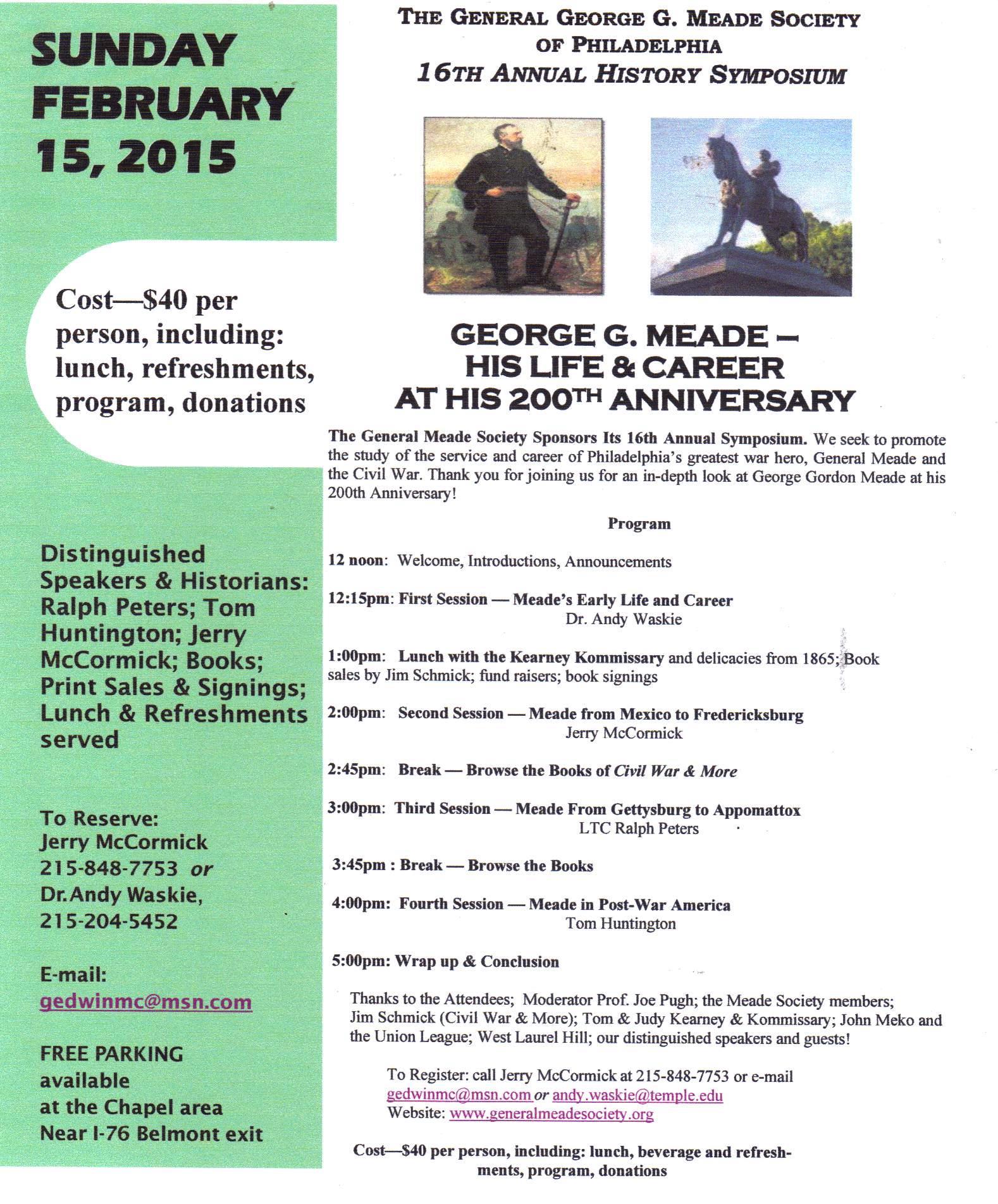
February is also the month for the annual Meade Symposium, sponsored by the General Meade Society of Philadelphia. The date this year will be Sunday, February 15, and the venue West Laurel Hill Cemetery in Philadelphia. Bad snowstorms last year forced the cancellation of the event, so keep your fingers crossed that the weather goods are feeling more beneficent in 2015. It should be a fun and fascinating day (I’ve posted the program below. Click on the image to enlarge.) Dr. Andy Waskie will talk about Meade’s early life, Jerry McCormick will discuss Meade’s military career through Fredericksburg, Ralph Peters will handle the rest of the Civil War, and I’ll talk about Meade’s post-war life. Jim Schmick of Civil War and More will be on hand with a fine selection of books, and the always dependable Kearney Kommissary will provide food. Make your reservation now!

The program for the 2015 Meade Symposium. Click to enlarge.

The program for the 2015 Meade Symposium. Click to enlarge.

2015 is, of course, Meade’s bicentennial year, and already my calendar is filling with Meade-centric events. I have talks scheduled for Chicago, Milwaukee, Petersburg, Chambersburg, Richmond, Gettysburg and Philadelphia. You can keep abreast of events right here.

And if you want a place to write things down, boy, do I have a calendar for you!

2014 Birthday Celebration

The scene at the Meade family plot on December 31, 2014 (Tom Huntington photo).

The scene at the Meade family plot on December 31, 2014 (Tom Huntington photo).

There are a few people who, when asked the musical question “What are you doing New Year’s Eve,” will answer, “Standing in a cemetery drinking champagne.” Those people are the folks who go to Philadelphia’s Laurel Hill Cemetery each December 31 to drink a champagne toast at General George Gordon Meade’s gravesite on the general’s birthday.

Dr. Andy Waskie makes some opening remarks, helped by Jerry McCormick, the Meade Society treasurer (Tom Huntington photo).

Dr. Andy Waskie makes some opening remarks, helped by Jerry McCormick, the Meade Society treasurer (Tom Huntington photo).

I guess technically it’s not really New Year’s Eve. It’s really the day of New Year’s Eve, but why quibble? It is the last day of the old year, and the event definitely takes place in a cemetery. This year a good-sized group gathered on a bright but cold and blustery afternoon to commemorate the generals 199th birthday. Dr. Andy Waskie, the founder and president of the General Meade Society of Philadelphia, once again served as the master of ceremonies for the event, the 24th annual. After making some introductory remarks by the cemetery’s gatehouse, he led the procession of reenactors, VIPs, and ordinary civilians through the cemetery down to the gravesite.

A visitor holds a brochure about the 2014 event (Tom Huntington photo).

A visitor holds a brochure about the 2014 event (Tom Huntington photo).

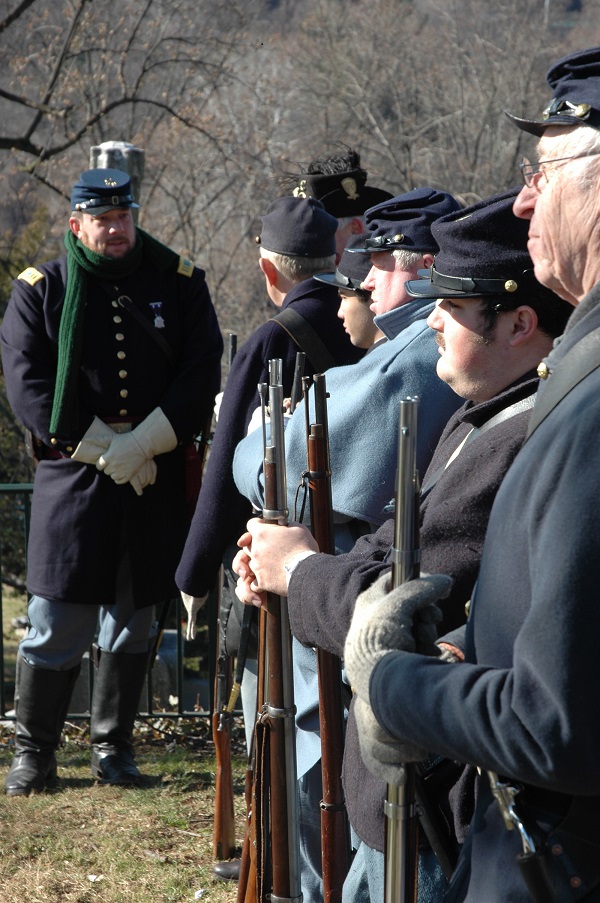
Living historians prepare to fire volleys over Meade's grave (Tom Huntington photo).

Living historians prepare to fire volleys over Meade’s grave (Tom Huntington photo).

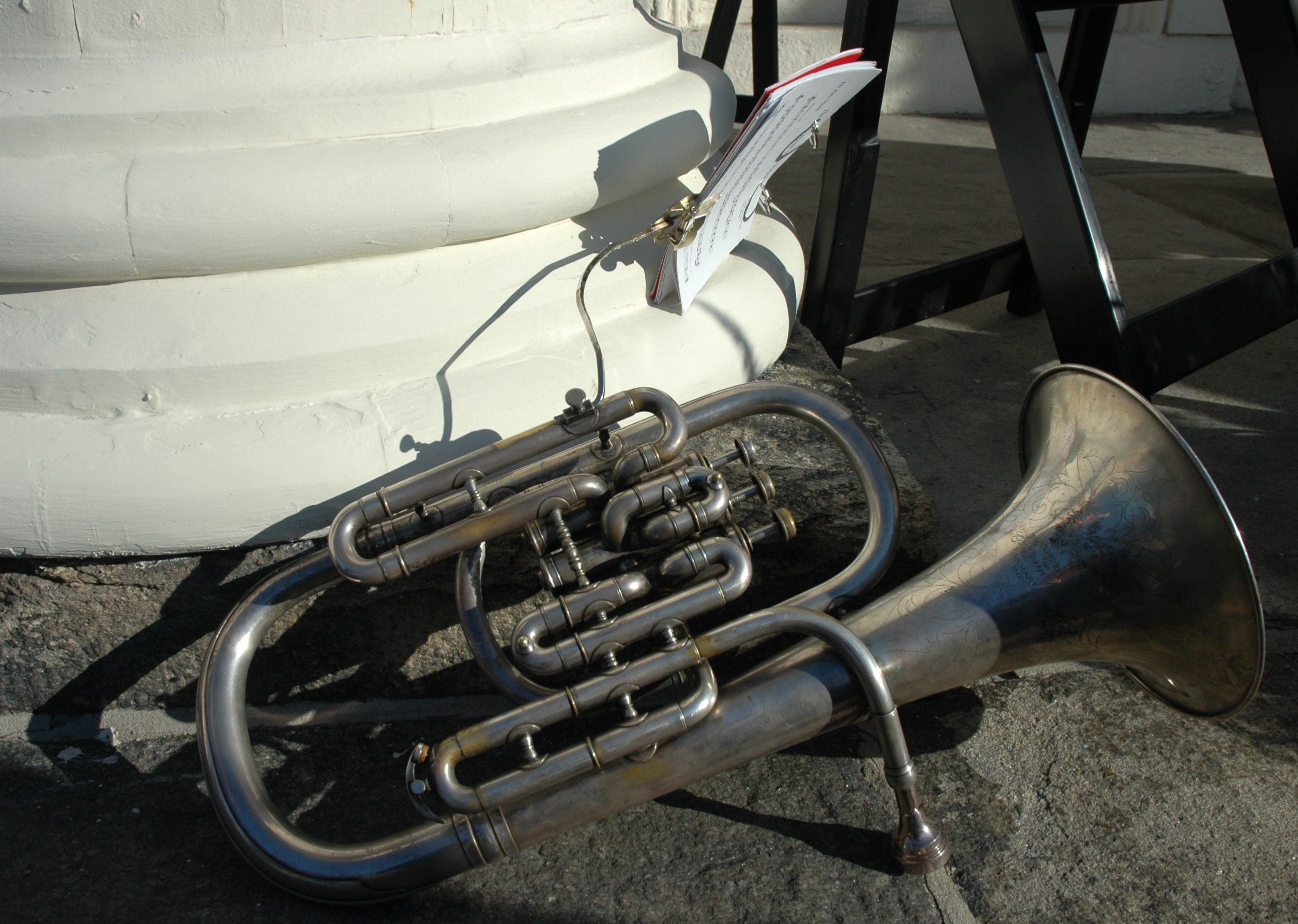
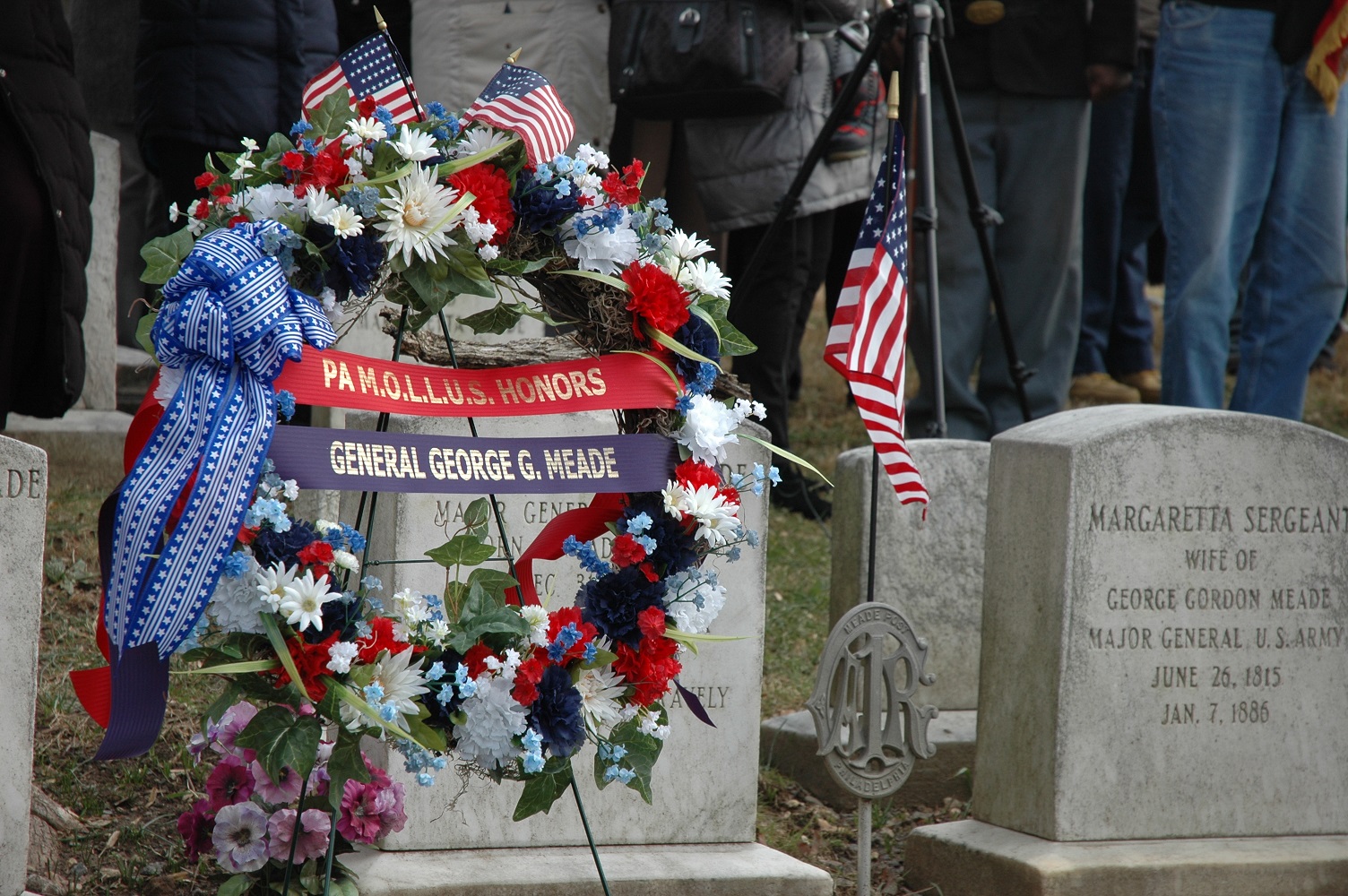
A cold wind blew across the Schuylkill River as speakers made short remarks. Beck’s band played a few numbers, including the “General Meade Funeral March.” (It could not have been easy to play brass instruments in the cold!) then there was a wreath-laying ceremony and the champagne toast. Back at the gatehouse, the visitors enjoyed a buffet luncheon and socializing.

The speakers at this year's graveside ceremony (Tom Huntington photo).

The speakers at this year’s graveside ceremony (Tom Huntington photo).

Mark your calendars for next year, which will be Meade’s bicentennial birthday celebration. It’s sure to be a big event, capping a year that will also mark the sesquicentennial of the end of the Civil War.

Volley

Instrument

Happy 199th Birthday, General Meade!

A wreath at General Meade's gravesite, from the 2013 birthday commemoration (Tom Huntington photo).

A wreath at General Meade’s gravesite, from the 2013 birthday commemoration (Tom Huntington photo).

George Gordon Meade was born on this day 199 years ago. (December 31 is also his wedding anniversary.) It has become an annual tradition for the General Meade Society of Philadelphia to hold a commemorative ceremony at the general’s grave at Philadelphia’s Laurel Hill Cemetery. I encourage anyone in the Philadelphia area to attend. I plan to be there, and I will have copies of my books and the 2015 George Gordon Meade Calendar available for purchase. It’s always a fun event and a great opportunity to spend the last day of the year in a cemetery! Here’s the society’s announcement:

GENERAL MEADE BIRTHDAY CELEBRATION
The annual General Meade Birthday Celebration will mark the 199th anniversary of the birth of General George G. Meade, commander of the Union Army at the Battle of Gettysburg. A parade of Civil War re-enactors, civilians in period attire, special dignitaries, heritage groups and participants will advance to Meade’s final resting place and memorialize his services to his nation. A 21-gun salute and champagne toast will cap off the program at graveside, and will be followed by a reception in the Cemetery Gatehouse. A tour of historic Laurel Hill will be offered following the festivities (weather permitting). This year holds special significance as we continue to commemorate the Sesquicentennial of the American Civil War.
The event will take place on Wednesday, December 31 at 12:00pm, departing from Laurel Hill Cemetery’s Gatehouse entrance at 3822 Ridge Avenue, Philadelphia, PA 19132. Free parking is located in the lot across the street from the Gatehouse.
Free and open to the public; a $10 donation in support of Laurel Hill Cemetery’s work and preservation is suggested and would be much appreciated. Additional information can be found by calling (215) 228-8200.
I intend to post photos from this year’s event today or tomorrow, so stay tuned!

Conquer a Peace (December 23, 1864)

"Santa Claus in Camp," an illustration from Harpers, January 3, 1863 (Library of Congress).

“Santa Claus in Camp,” an illustration from Harper’s Weekly, January 3, 1863 (Library of Congress).

After this letter, George Meade will go silent for a time. He will go on leave starting December 30—the day before his birthday (and wedding anniversary) and depart for camp on January 9.

The General Meade Society of Philadelphia will hold its birthday commemoration again this year on December 31 at Laurel Hill Cemetery in Philadelphia. It is always a fun event. I encourage everyone reading this to attend. In the meantime, Merry Christmas to all!

I have received a letter from the Earl of Fife, in Scotland, asking my good offices for a young kinsman of his, who, he understands, has got a commission in my army. I think I told you some time ago I had a letter from a Mr. Duff, just arrived in New York, asking to be taken on my staff, and sending a letter of introduction from Captain Schenley. I replied he would first have to get a commission, and indicated to him how to go about it. Since then I have not heard from him, but presume, from the Earl of Fife’s note, that he has succeeded in getting the commission, but perhaps has changed his mind as to the staff appointment.

Colonel James Biddle has gone on leave. Young Emory has also gone, to get married, and talks of trying to get a commission of colonel in Hancock’s new corps. Mason has got a leave, and Lyman I let go also, so that headquarters are a good deal changed.

I think the Confederacy is beginning to shake, and if we only can get the three hundred thousand men the President has called for, and they prove good fighting men, I believe next summer we will conquer a peace, if not sooner. God grant it may be so!

Meade’s correspondence taken from The Life and Letters of George Gordon Meade, Major-General United States Army, Vol. 2, (New York: Charles Scribner’s Sons, 1913), pp. 254-5. Available via Google Books.
A Hard Day (December 20, 1864)

Ambrose Burnside. The Battle of the Crater provided a good reason to get him out of the Army of the Potomac once and for all (Library of Congress).

Ambrose Burnside. The Battle of the Crater provided a good reason to get him out of the Army of the Potomac once and for all (Library of Congress).

Members of Congress arrive to investigate the Battle of the Crater. War is politics, and politics is war.

I have had a hard day to-day. This morning Messrs. Chandler and Harding, of the Senate, and Loan and Julian, of the House, all members of the Committee on the Conduct of the War, made their appearance to investigate the Mine affair. They gave me a list of witnesses to be called, from which I at once saw that their object was to censure me, inasmuch as all these officers were Burnside’s friends. They called me before them; when I told them it was out of my power, owing to the absence of my papers and official documents, to make a proper statement; that this whole matter had been thoroughly investigated by a court ordered by the President; the proceedings of which court and the testimony taken by it, were on file in the War Department, and I would suggest their calling for them as the best mode of obtaining all the facts of the case. I then read them my official report, and after numerous questions by Mr. Loan, who evidently wished to find flaws, I was permitted to leave. Mr. Chandler promised me to apply for the testimony taken by the court, and to let me know the answer given. In case the Department refuse, I shall then submit to the committee a copy of my testimony, as my statement of the case. I asked the committee to call before them General Hunt and Colonel Duane, two of my staff; but these officers came out laughing, and said as soon as they began to say anything that was unfavorable to Burnside, they stopped them and said that was enough, clearly showing they only wanted to hear evidence of one kind. I don’t intend to worry myself, but shall just let them take their course and do as they please; but I must try and find some friend in the Senate who will call for the proceedings of the court, and have them published. Mr. Cowan, from Pennsylvania, is the proper person, but I do not know him, and, moreover, do not want to run against Mr. Stanton, so perhaps will wait till I see the Secretary and can talk with him before I take any action. I presume their object is to get some capital to operate with, to oppose the confirmation of my nomination in the Senate.

Meade’s correspondence taken from The Life and Letters of George Gordon Meade, Major-General United States Army, Vol. 2, (New York: Charles Scribner’s Sons, 1913), pp. 253-4. Available via Google Books.

Looking for that perfect holiday gift? What could be better than Searching for George Gordon Meade: The Forgotten Victor of Gettysburg? (You can order the book from Amazon or Barnes and Noble.) Or maybe a 2015 George Gordon Meade calendar–the perfect way to commemorate the general’s bicentennial year! You can get the calendar right here.

Good News from Tennessee (December 18, 1864)

George Meade writes a somewhat gossipy letter to his wife on December 18. Among its items are Meade’s impressons of General George Thomas, who had just thrashed John Bell Hood at the battles of Franklin and Nashville. He also reports on new activity by th Joint Committee on the Conduct of the War, which has started to investigate the debacle of the Crater, and the latest news of Benjamin Butler, who has departed on his ill-fated attack on Fort Fisher.

I am glad you saw Major Smith and liked him. I found him very intelligent and amiable. I gave him a letter to Oliver Hopkinson, as he wanted to see some duck-shooting; but I believe he found some one in Baltimore who put him in the way of having some sport. I knew that Captain Chesney was the instructor of engineering at the Military College of Woolwich, but was not aware that his service had been confined to this duty.

We have all been greatly delighted at the good news from Tennessee. Thomas is very much liked by all who know him, and things at one time looked unfavorable for him, it appearing as if he was giving Hood too much time; but it now turns out Old Thom, as we call him, knew what he was about, and has turned the tables completely. Don’t you remember, when we were at West Point, meeting his wife, who was at the hotel? He was then in Texas, and she was expecting him home. She was a tall good-natured woman, and was quite civil to us.

I don’t believe the bill to cut off the heads of generals will either pass the Senate or be approved by the President. By-the-by, I see the Senate, on motion of Mr. Anthony, of Rhode Island, has directed the Committee on the Conduct of the War to enquire into the Mine fiasco on the 30th of July, and that Burnside has already been summoned to testify. This is a most ill advised step on the part of Burnside and his friends, and can only result in making public the incompetency of that officer. I would, of course, rather not have to appear again before this committee, because they are prejudiced and biased against me, and their examinations are not conducted with fairness. Still, I shall not shrink from the contest.

Grant is still in Washington, though expected back to-morrow. The change of affairs in Tennessee will render his presence there unnecessary.

An expedition sailed the other day from Fortress Monroe, composed of the fleet and a detachment of troops. Grant took these from Butler’s army, intending Weitzel should command them; but much to every one’s astonishment, Butler insisted on going, and did go, with the expedition.

Mrs. Lyman has sent me a Christmas present of a box of nice cigars.

Meade’s correspondence taken from The Life and Letters of George Gordon Meade, Major-General United States Army, Vol. 2, (New York: Charles Scribner’s Sons, 1913), pp. 252-3. Available via Google Books.

Looking for that perfect holiday gift? What could be better than Searching for George Gordon Meade: The Forgotten Victor of Gettysburg? (You can order the book from Amazon or Barnes and Noble.) Or maybe a 2015 George Gordon Meade calendar–the perfect way to commemorate the general’s bicentennial year! You can get the calendar right here.

Dissipated by Facts (December 16, 1864)

Edwin Forbes sketched the arrival in a Union cap at Rappahannock Station of newspapers from Washington. Click to enlarge (Library of Congress).

Edwin Forbes sketched the arrival of newspapers from Washington in a Union camp at Rappahannock Station . Click to enlarge (Library of Congress).

George Meade never had any love for the press or Congress. Here he advises his wife about both institutions.

I received this evening your letter of the 14th inst., having received day before yesterday the one dated the 12th. I am sorry the good public should have been disappointed in the result of Warren’s expedition, but the facts are, as I stated them, he accomplished all that he went for, namely, the destruction of some eighteen miles of the Weldon Railroad.

This passion of believing newspaper and club strategy will I suppose never be eradicated from the American public mind, notwithstanding the experience of four years in which they have from day to day seen its plans and hopes and fears dissipated by facts.

I don’t anticipate either Grant or his campaign will be attacked in Congress. In the first place he has too many friends; in the next place, Congress having legislated him into his present position, he can only be removed by their act, and that would be stultifying themselves.

Meade’s correspondence taken from The Life and Letters of George Gordon Meade, Major-General United States Army, Vol. 2, (New York: Charles Scribner’s Sons, 1913), p. 252. Available via Google Books.

Looking for that perfect holiday gift? What could be better than Searching for George Gordon Meade: The Forgotten Victor of Gettysburg? (You can order the book from Amazon or Barnes and Noble.) Or maybe a 2015 George Gordon Meade calendar–the perfect way to commemorate the general’s bicentennial year! You can get the calendar right here.