Poor Slovenly Ragamuffins (December 14, 1864)

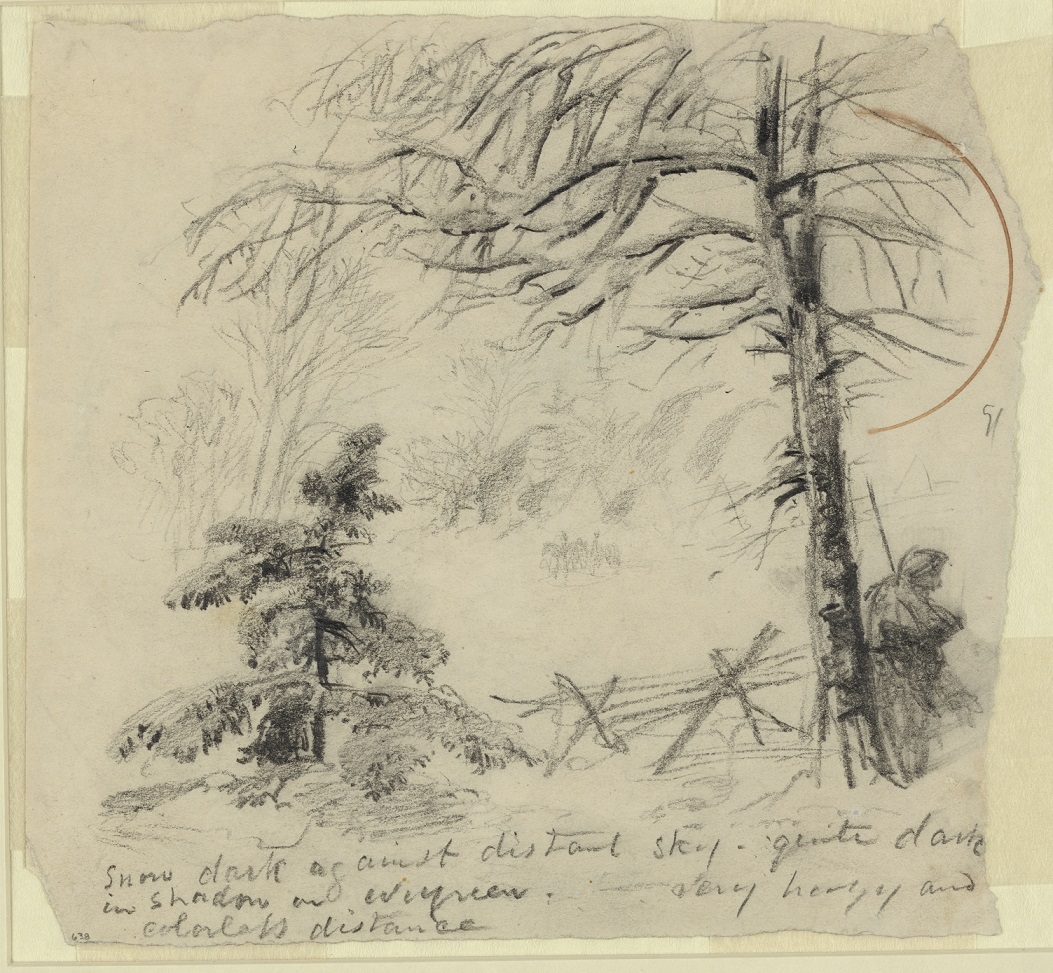
"Winter picket duty" by Alfred Waud. Click to enlarge (Library of Congress).

“Winter picket duty” by Alfred Waud. Click to enlarge (Library of Congress).

Sadly, this is the last we will hear from Theodore Lyman for a while. Around this time Meade said to him, “I have a Christmas present for Mrs. Lyman—a certain worthless officer whom I shall send home to her.” He gave Lyman a 30-day leave, with the understanding that he would return for the opening of the spring campaign.He will leave the army on December 20 and not return until March 1

In this letter , Lyman describes some of the miseries of a Civil War soldier in winter. His description of the men covered by snow while they sleep reminds me of a passage from Jack London’s The Call of the Wild, in which the same thing happens to the sled dogs. Lyman also details the nuts and bolts of picket duty.

General Winthrop [in speaking of Warren’s operations] said his brigade bivouacked in a cornfield; it blew, snowed and sleeted all night, and when reveille beat in the morning, you could only see what seemed a field full of dead bodies, each covered with a rubber blanket and encased with ice. Some of the men had to kick and struggle, they were so hard frozen down. Yet, despite this, I have not learned that it has caused much sickness. How would you like to carry forty or fifty pounds all day, be wet through, have your feet soaked with mud and snow-water, and then go to sleep in a cornfield, with a drifting sleet coming down on you all night? This is what twenty-five thousand men did, for more than one night, on that expedition. This is what our poor slovenly ragamuffins can do; and this it is to be a good soldier. The Rebels are still tougher, if anything. Being still in love with the new picket line, which has been established in our rear, I again went down what is called the Church road, until I struck the infantry pickets, near a Colonel Wyatt’s house. This once was a well-to-do establishment. The house is large and a huge cornfield testifies that he (or our cavalry) had gathered a good harvest that very year. There were the usual outbuildings of a well-to-do southern farmer: little log barns, negro huts, and odd things that might be large hencoops or small pigstyes. The Virginians have a great passion for putting up a great lot of diminutive structures as a kind of foil to the main building, which, on the contrary, they like to have as extensive as possible; just as the old painters added importance to a big saint by making a number of very small devotees, kneeling below him. A stout old gent, in a shocking bad beaver, who was walking about in the back yard was, I presume, the distinguished Colonel. Having stared at the house and been in turn stared at by a pretty little girl who threw up a window, to have a more clear view of the Yank, I went, still along the Church road, till I got to the Weldon road.

A picket line is always one of the most picturesque sights in an army, when it runs through woods and fields. You know it consists of a string of “posts,” each of half a dozen men, or so, and, in front of these, a chain of sentries who are constantly on the alert. The squads of men make to themselves a gipsy bough-house in front of which they make a fire in cool weather. They must always have their belts on and be ready to fight at a moment’s notice. In the woods, you follow along from one rustic shelter to another, and see the sentries, out in front, each standing behind a good tree and keeping a sharp lookout for Rebel scouts, bushwhackers and cavalry. A short distance in the rear you from time to time come on a “reserve,” which is a large body, perhaps of fifty or a hundred, who are concealed and who are ready to come to the assistance of the posts, if they are attacked. Picket duty is, of all others, that which requires most individual intelligence in the soldiers. A picket line, judiciously posted, in woods or swamps, will oppose a formidable resistance, even to a line of battle. There was careful Mr. Corps, officer of the day, with his crimson scarf across his shoulder, inspecting his outposts and reserves; each one falling in as he came along and standing at a shoulder.

Theodore Lyman’s letter is from Meade’s Headquarters, 1863-1865: Letters of Colonel Theodore Lyman from the Wilderness to Appomattox, pp. 300-02. Edited by George R. Agassiz. Boston, Massachusetts Historical Society, 1922. Available via Google Books.

Looking for that perfect holiday gift? What could be better than Searching for George Gordon Meade: The Forgotten Victor of Gettysburg? (You can order the book from Amazon or Barnes and Noble.) Or maybe a 2015 George Gordon Meade calendar–the perfect way to commemorate the general’s bicentennial year! You can get the calendar right here.

Return of the Sixth (December 13, 1864)

Horatio Wright took command of the VI Corps following the death of John Sedgwick (Library of Congress).

Horatio Wright took command of the VI Corps following the death of John Sedgwick (Library of Congress).

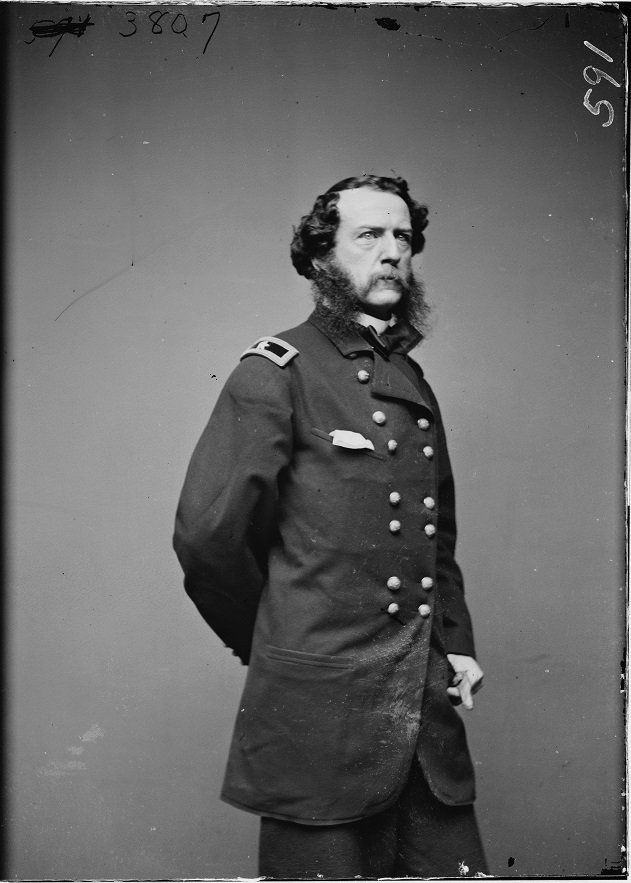
Theodore Lyman writes about the return of the VI Corps, commanded by Maj. Gen. Horatio Wright, to the Army of the Potomac. It had been fighting in the Shenandoah Valley under Philip Sheridan. Brig. Gen. Frank Wheaton commanded one of its divisions; earlier Lyman had noted that he was “excellent for a brigade, but probably hardly up to a division.” Another division commander, Truman Seymour, had been gobbled up by the rebels during John Gordon’s flank attack at the Wilderness and later exchanged. Samuel Crawford commanded the Pennsylvania Reserves, Meade’s old division, in the V Corps.

Samuel Crawford (Library of Congress).

Samuel Crawford (Library of Congress).

As the Rebels have known the fact for some time, and as the newspapers have hinted at it in unmistakable terms, I conceive there is no impropriety in my saying that we have now with us the 6th Corps once again. A week ago Sunday night the first division came from City Point on the cars, having come straight from the neighborhood of Winchester by car and boat. The next morning we were treated to the sight of the familiar red crosses, and soon General Wheaton rode up, to see the General and report. . . . Very loath were the Sixth Corps bucks to leave the valley (where they had plenty of sheep and chickens and victories, and no fighting except in the regular battles), and come to a place with which they only connected more or less fighting, day and night (rather more than less), much dust, heat, and drought, and no particular victories. However, they find things better now, and will doubtless get contented in time. What must have gratified them was that they relieved Crawford’s division of the 5th Corps, on the line, and took possession of their very nice log huts, which had been carefully constructed uniformly in all the brigades. Crawford’s people by no means saw the thing in the same light. They took down their canvas roofs and rolled them up with dudgeon, and marched off to take a temporary camp, previous to the Weldon road expedition. I rode along the breastworks as the red crosses marched into the deserted camps, and observed the aspect of grim satisfaction with which the new comers went about, looking into the abandoned huts. The luxurious Crawford had his nice log cabin taken down and carted to his new locality. “However,” said Wheaton, “I slept in Crawford’s kitchen, and that was good enough for me.” On Tuesday came the 3d division, also with a new commander, for brave General Ricketts lies at Washington, still suffering from his wound; and General Seymour, he who was taken the second day of the Wilderness, has the command. Seymour is a fiery and irrepressible sort of party, and enraged the inhabitants of Charlottesville beyond measure. When they told him they had had most extraordinary victories over Grant, he made them a speech, in which he said it didn’t make any sort of difference how many victories they had, it wouldn’t do them any sort of good; that in every battle we killed off a good many of them, and that we intended to keep piling up men indefinitely, until they knocked under, or were all shot! This enraged them much, and they invited him to air himself for sixteen miles on foot, after it. . . . It was only last Monday that the 2d division got here, under Getty, and with it came General Wright, commanding the corps. Good General Wright, though always pleasant, is, I think rather in low spirits. He has had poor luck, on numerous occasions, and it culminated at Cedar Creek, where he chanced to have command of the army when it was surprised. He had rallied it, when Sheridan arrived on the field; but of course Sheridan had the credit of the victory, and indeed he deserved it. All the officers say that Wright made prodigious exertions and rode along all parts of the line in the hottest fire.

Theodore Lyman’s letter is from Meade’s Headquarters, 1863-1865: Letters of Colonel Theodore Lyman from the Wilderness to Appomattox, pp. 298-300. Edited by George R. Agassiz. Boston, Massachusetts Historical Society, 1922. Available via Google Books.

Looking for that perfect holiday gift? What could be better than Searching for George Gordon Meade: The Forgotten Victor of Gettysburg? (You can order the book from Amazon or Barnes and Noble.) Or maybe a 2015 George Gordon Meade calendar–the perfect way to commemorate the general’s bicentennial year! You can get the calendar right here.

Sad Facts (December 11 and 12, 1864)

A marker at Fort Lee outside Petersburg indicates the location of Meade's headquarters during the campaign (Tom Huntington photo).

A marker at Fort Lee outside Petersburg indicates the location of Meade’s headquarters during the campaign (Tom Huntington photo).

I neglected to post this letter yesterday. George Meade wrote it on December 11, 1864, to Henry A. Cram, his wife’s brother in law. Meade often wrote at length to Cram about the greater issues of the war and they cast good insight on his way of thinking. Lyman’s letter from 150 years ago today follows.

I fear you good people confine your efforts to suppress the Rebellion too much to speechifying, voting, and other very safe and easy modes of showing firm determination never to yield; but the essential element to success, namely, turning out to fight, don’t seem to be so popular. You will have to stop filling quotas without adding to your armies before you can expect to finish the war. Do you know that the last loud call for five hundred thousand men has produced just one hundred and twenty thousand? Of these only about sixty thousand were sent to the field, and the share of my army, one of the largest in the field, was not over fifteen thousand; and of this number the greater part were worthless foreigners, who are daily deserting to the enemy. These are sad facts. I remember you were struck last winter with my telling the Councils of Philadelphia that this army, of whose fighting qualities there seemed to be a doubt, had lost, from official records, from April, 1862, to December, 1863, one hundred thousand, killed and wounded. I have now an official document before me in manuscript, being my report of the campaign from the Rapidan to the 1st of November, and it has a list of casualties showing the enormous number of ninety thousand men, killed, wounded and missing. All this is strictly confidential, as I would be condemned for telling the truth; but when people talk to me of ending the war, I must tell them what war is and its requirements; because you can then see how much prospect there is of finishing it, by forming your own judgment of the adaptation of the means to the end. No, my good friend, this war is not going to be ended till we destroy the armies of the Confederation; and in executing this work we shall have to expend yet millions of treasure and vast numbers of lives. Nothing is gained by postponing the exigencies which must be met. The people must make up their minds not only that the war shall be carried on, they must not only subscribe and cheerfully pay money to any extent, but they must themselves turn out, shoulder their muskets and come to the army, determined to fight the thing out. When I see that spirit, the men coming, and doing the fighting, then I will begin to guess when the war will be closed. Undoubtedly, the South is becoming exhausted; its calmly discussing the expediency of freeing and arming the slaves is positive evidence of its exhaustion and desperation; but unless we take advantage of this by increasing our armies and striking telling blows, it can prolong such a contest as we are now carrying on indefinitely.

I thank you for your kind congratulations on my appointment as major general in the regular army. If confirmed by the Senate, it places me fourth in rank in the army—Grant, Halleck and Sherman only being my seniors. Putting me ahead of Sheridan, from the popular position that officer now holds, may create opposition in the Senate; but it is well known my appointment was recommended by the lieutenant general, commanding, approved and determined on by the President, when Sheridan was my subordinate, commanding my cavalry, and before he had an opportunity of distinguishing himself, as he has since done. No injustice, therefore, has been done him, though when his appointment was announced in the theatrical manner it was, and mine not made, I felt called on to ask an explanation, which resulted in a disavowal to do me injustice, and the appointing me with a date which caused me to rank, as it was originally intended I should. So that, what ought to have been an acceptable compliment, became eventually a simple act of justice due to my remonstrance. Still, I ought to be and am satisfied and gratified, because I think it quite probable we are both of us placed far beyond our merits. I am afraid you will tire of so much personality and think I am greatly demoralized.

In his letter of December 12, Theodore Lyman provides an example of the Meade wit, which tended to be on the cutting side. Here his joke masks criticism of Grant. The raid to which Lyman refers is Warren’s expedition to destroy the Weldon Railroad.

Clear and cold we have had it this day, blowy this morning but still in the evening. Last night it blew in a tremendous manner. My tent flapped in a way that reminded one of being at sea, and my chimney, for the first time got mad and actually smoked. My only consolation was that the General’s smoked a great deal worse. He made quite a bon-mot at breakfast, despite the smoke: “Grant says the Confederates, in their endeavors to get men, have robbed the cradle and the grave; if that is the case, I must say their ghosts and babies fight very well!” I did not fail to ride out and see the raiders come in. The head of the column arrived about noon, or an hour before. I was much amused by a battery, the first thing that I met; one of the drivers was deeply intent on getting his pair of horses over a bad bridge, but, midst all his anxiety and pains on this head, he did not fail to keep tight hold of a very old rush-bottomed chair, which he carefully held in one hand! How far he had brought it or what he meant to do with it, I know not, but his face wore an expression which said: “You may take my life but you can’t have this very old rush-bottomed chair which I have been at much pains to steal.” Then came the infantry, with a good deal of weary straggling, and looking pretty cold, poor fellows; then another battery spattered with mud; then a drove of beef cattle, in the midst of which marched cows, calves, and steers that never more will graze on Rebel farms. Finally a posse of stragglers and ambulances and waggons, all putting the best speed on to get to a camping-place. I pitied the poor bucks who, for six days, had endured every fatigue and hardship.

Meade’s correspondence taken from The Life and Letters of George Gordon Meade, Major-General United States Army, Vol. 2, (New York: Charles Scribner’s Sons, 1913), pp. 250-2. Available via Google Books.

Theodore Lyman’s letter is from Meade’s Headquarters, 1863-1865: Letters of Colonel Theodore Lyman from the Wilderness to Appomattox, pp. 297-8. Edited by George R. Agassiz. Boston, Massachusetts Historical Society, 1922. Available via Google Books.

Looking for that perfect holiday gift? What could be better than Searching for George Gordon Meade: The Forgotten Victor of Gettysburg? (You can order the book from Amazon or Barnes and Noble.) Or maybe a 2015 George Gordon Meade calendar–the perfect way to commemorate the general’s bicentennial year! You can get the calendar right here.

The Evils of War (December 11, 1864)

George Meade weighs in on Gouverneur Warren’s expedition to tear up the Weldon Railroad. Following Meade’s letter, Theodore Lyman fills in some of the details.

Five days ago I sent Warren, with a large force, to destroy the Weldon Railroad, which the enemy continue to use up to a certain point. It was expected Lee would send a force after him, and that we should have some sharp fighting, but to-day Warren is returning, having, undisturbed, effectually destroyed some twenty miles of the road. During Warren’s absence we have had a violent storm and the poor men have suffered a great deal, but this is one of the evils of war and must be borne.

Lyman adds to Meade’s dutiful account and provides a quick overview of Union concerns around the country. General Potter is Robert Potter, who commanded a division in the IX Corps. In his letter yesterday, Lyman mentioned that Potter had been sent to support Warren.

Gen. Robert Potter.(Library of Congress).

Gen. Robert Potter.(Library of Congress).

Weather as before—only a little more so. I suppose they have a good deal such in England. If so, don’t want to live there. Pretty times for half the army, off and on, to be marching and reconnoitring and expeditionizing about the country, as if it were picnic season! And still stranger is it to be sitting quiet in my tent when so many people are running round loose. Our affairs are rather mixed up, you see. So are those of everybody. Sherman has disappeared in Georgia and nobody knows what awful strategy he contemplates. Not so Hood: he is poking about in a manner I don’t at all like: jamming Thomas up in Nashville, and now I fancy he is just marching round the city and into Kentucky. That won’t do! Old Lee don’t let us march round towns unless he chooses, or has at least a hard fight for it. However, I can’t think Hood can do severe damage with so powerful an army as that of Thomas in his neighborhood. Well, we will hope for a big thing, of some sort, somewhere, for there are a number of irons, small and great, in the fire, and as much activity prevails as if we were not near the real winter. One thing I am sure of, that, what with expeditions little and big, threatenings and reconnaissances, the Rebels must be kept in quite an active state of simmer. Poor General Potter! He had a frightful night march and was doubtless buoyed up by the feeling that he had a separate command and could distinguish himself if there was a fight, and slam in on Hill’s left flank, and win a great name for himself. What then was his disgust to see, about noon, the head of Warren’s column trudging peaceably back, on the other side of the river! There were two decent-sized armies staring at each other, across the stream, each wondering what the other meant by being there; and both wondering why so many men were concentrated against nobody. General Potter philosophically shrugged his shoulders, gave the word to face about, and put his best leg forward for home, where he arrived a little after dark. It was a terrible night for a bivouac, with an intensely piercing cold wind and everything frozen up. Warren crossed the river and spent the night on this side of it.

Meade’s correspondence taken from The Life and Letters of George Gordon Meade, Major-General United States Army, Vol. 2, (New York: Charles Scribner’s Sons, 1913), p. 250. Available via Google Books.

Theodore Lyman’s letter is from Meade’s Headquarters, 1863-1865: Letters of Colonel Theodore Lyman from the Wilderness to Appomattox, pp. 296-7. Edited by George R. Agassiz. Boston, Massachusetts Historical Society, 1922. Available via Google Books.

Looking for that perfect holiday gift? What could be better than Searching for George Gordon Meade: The Forgotten Victor of Gettysburg? (You can order the book from Amazon or Barnes and Noble.) Or maybe a 2015 George Gordon Meade calendar–the perfect way to commemorate the general’s bicentennial year! You can get the calendar right here.

A High Festival (December 10, 1864)

"Destruction of Water Ta[nk]s & Engines & engine houses for pumping water into them at Jarrets Station" by Alfred Waud depicts action from December 8 on the Weldon Railroad. Click to enlarge (Library of Congress).

“Destruction of Water Ta[nk]s & Engines & engine houses for pumping water into them at Jarrets Station” by Alfred Waud depicts action from December 8 on the Weldon Railroad. Click to enlarge (Library of Congress).

Theodore Lyman continues his account of the expedition across Hatcher’s Run to threaten the Boydton Plank Road. And he discusses other things as well. Duane is James C. Duane, the army’s chief engineer; William Riddle is another member of Meade’s staff. Riddle, a Philadelphian, had once served as an aide to Maj. Gen. John Reynolds and had been with that ill-fated general when a bullet struck him down during the first day at Gettysburg. In his letter Lyman leaves out one thing about Riddle’s going away party that he mentions in his notebooks, namely that aide Frederick Rosenkrantz got so disgracefully drunk “it brought the matter next morning to a crisis.” Rosenkrantz promised to mend his ways.

Lyman also writes about Gouverneur Warren’s expedition to destroy the Weldon Railroad. Joshua Lawrence Chamberlain, in command of a brigade in the V Corps, wrote home to his sister about the same expedition and the mutual retaliation it sparked. “Our stragglers fared hard when caught by the enemy’s scouts & guerrillas,” he wrote. “In fact they were murdered—their throats cut from ear to ear. . . . In retaliation our men on the return burnt almost every house on the road. This was a hard night.” Concluded Chamberlain, “It was a sad business.”

[Brig. Gen. Nelson] Miles, with the troops which had been sent to reinforce him, maintained a threatening attitude near Hatcher’s Run till afternoon, when he was ordered to withdraw again to our lines. The enemy undertook to follow up a little, but the rear guard faced about and drove them away.—There was I seized with a fearful sleepy fit last night and went to bed; thus missing a letter home to you. However, I have not before missed one in a very long time; and, if I followed Duane’s advice, I should miss much oftener. “Lyman,” says this ancient campaigner, “you are foolish to write so much. Now I write only once a week, so my letters are valued. You write every day, and probably Mrs. Lyman puts them in her pocket and pays no attention to them.” Ah! I was speaking of Miles, and had got him with all his forces, and put him inside the works, all right. We had to pay farewell respects to Riddle, for his resignation has been accepted and he goes to-morrow. For a long time he has been in miserable health and, in warm weather, is seldom well enough for hard duty. He has been twice wounded, at Antietam and on the Peninsula, and was taken prisoner, but got away from Libby and arrived, after many hardships, within our lines. He is a very good officer and quite a superior person, whom we shall miss on our Staff. The kind-hearted Woolsey invited us all to take oysters in his honor (for you must know that there is a log house where one may have a “fancy roast,” “plain stew,” or “one fried,” just across the road). We gathered in the greatest force, for oysters attracted, even if Riddle didn’t, and had a high festival. We had songs, whereof I sang several, with large applause. “You don’t drink,” said Duane, “but it don’t make any difference, because you look as if you had been drinking, and that’s all that is necessary.”

Before I finish this day I must go back to tell of the beginning and progress of the Weldon road expedition. Last Wednesday, General Warren, with his own Corps, Mott’s division of the 2d Corps, and nearly the whole of Gregg’s division of cavalry, started in the morning and marched down the Jerusalem plank road, striking across to the Nottoway River, at Freeman’s Bridge, a distance of from fifteen to seventeen miles. There a pontoon bridge was thrown and the whole command got over before daybreak the next morning, the advance getting that night to Sussex Court House. Meantime the enemy, getting [wind] of the move, sent off A. P. Hill’s Corps, that evening, twelve hours after Warren. Hill went to Dinwiddie Court House, but what became of him thereafter, I have not yet learned. Their place in the lines was taken, I presume, by some of Early’s men, who were nearly all come down from the valley and are helping Lee now. On Thursday Warren continued his march and struck the Weldon road, a little south of the Nottoway, in the afternoon, and immediately went to destroying the track and burning the river bridge. The work went on systematically: the line being halted on the road, the men stacked arms, and went at the track. Sleepers were torn up, and these, with fence-rails, made great bonfires, on which the rails were laid. Soon the iron would wax red-hot, when the weight of the ends would bend the rails. Some of the men, however, were so enthusiastic as to take rails and twist them round trees, which could be done while the ends were cool and the middle hot. As soon as a brigade had finished its work, it marched down to a new piece, passing the other men who were destroying; and so they kept on till midnight, when they had got to Jarrott’s station and there halted. Next day, Friday, the column kept on, as before, the cavalry preceding them, who, when they arrived at Meherrin Bridge, found strong earthworks on the opposite side and some ten guns, which immediately opened on them. . . . This night was a very severe one, with its high wind and snow, sleet and rain; but it was rendered tolerable by the big fires that the soldiers lighted to heat rails with. General Warren did not deem proper to cross the Meherrin, as it would take a day to flank the Rebels’ works, and he started with but six days’ provisions. Next day, Saturday to wit, he began his return march and the head of the column got as far as Sussex C.H. On this march the people of the country had the bad judgment to “bushwhack” our troops: that is, to kill any stragglers or small parties they could catch. This is against the rules of war. I will not say it is surprising, because the stragglers of an army always steal and plunder and exasperate the people. Colonel Sergeant told me he himself saw five of our men shot and stripped nearly naked. The troops were so enraged by such cases, that they fired every house on their march, and, what made them worse, they found a great amount of apple-brandy in the country, a liquor that readily intoxicates. The superior officers destroyed a great deal of it, but the men got some and many were drunk. The people make this brandy on account of its great price. It sells for $1500 a barrel. Colonel Wainwright told me he found two tithing-bills in one house, one a year old, the other recent; in the old one wheat was valued at $10 a bushel, in the recent, at $40, showing that it has quadrupled in price within a year. It was on this day that a cavalry reconnaissance that pushed out on the Vaughan road reported heavy artillery firing in the direction of Jarrott’s station. This made Grant so uneasy that he directed aid to be sent Warren. Accordingly Potter, with 9000 men, marched that night, and arrived next morning at five a.m. at the Nottoway, at Freeman’s Bridge. A wretched march indeed! in slush and mud and a damp cold; but his men followed on very well and arrived with little straggling, which surprised me.

Theodore Lyman’s letter is from Meade’s Headquarters, 1863-1865: Letters of Colonel Theodore Lyman from the Wilderness to Appomattox, pp. 293-6. Edited by George R. Agassiz. Boston, Massachusetts Historical Society, 1922. Available via Google Books.

Looking for that perfect holiday gift? What could be better than Searching for George Gordon Meade: The Forgotten Victor of Gettysburg? (You can order the book from Amazon or Barnes and Noble.) Or maybe a 2015 George Gordon Meade calendar–the perfect way to commemorate the general’s bicentennial year! You can get the calendar right here.

A Severe Skirmish (December 9, 1864)

Brig. Gen. Nelson Miles commanded a division of the II Corps (Lilbrary of Congress).

Brig. Gen. Nelson Miles commanded a division of the II Corps (Lilbrary of Congress).

Theodore Lyman continues his account of the Army of the Potomac’s movement across Hatcher’s Run toward the Boydton Plank Road. Nelson Miles, only 24 and already wounded four times, had replaced the ailing Francis Barlow as commander of the 1st Division of the II Corps. Nelson will remain in the army following the war, retiring as general in chief in 1903.

Miles’s division of the 2d Corps was sent to aid the cavalry in forcing Hatcher’s Run. They marched out early and found several regiments holding the crossing; a severe skirmish followed; our poor men went into the icy water up to their armpits and drove off the Rebels, though not without some loss to us. I know the cavalry Lieutenant, whom I saw bringing in all those stragglers last night, was killed there. Then Miles built a bridge and sent over the cavalry, which went as far as within sight of the Boydton plank, where they found the enemy in their works. They captured a Rebel mail-carrier and from him learned that A. P. Hill was yesterday at Dinwiddie. General Meade had to read all the letters, of course, and said there was one poor lover who promised to marry his sweetheart when the war was over, but “how could he support her now, on $12 a month?” We sent out another body of infantry and our own “red-legs” and the engineers, to support Miles, who we thought would be attacked. They all spent the night midst a wretched snow, sleet and rain, and raw wind.

Theodore Lyman’s letter is from Meade’s Headquarters, 1863-1865: Letters of Colonel Theodore Lyman from the Wilderness to Appomattox, pp. 292-3. Edited by George R. Agassiz. Boston, Massachusetts Historical Society, 1922. Available via Google Books.

Drown all Englishmen (December 8, 1864)

Major General Gouverneur Kemble Warren

Major General Gouverneur Kemble Warren (Library of Congress).

Lyman must entertain yet another foreign visitor to the Army of the Potomac. The editors of his letters disguised his name in the published version but David W. Lowe, in Meade’s Army: The Private Notebooks of Lt. Col. Theodore Lyman, has no such compunctions: it is Satterthwaite. In his notebook Lyman compares him to a barrel of apples, not potatoes. You can add Englishman to the list of people (Irish, German, and African-Americans among them) for whom Lyman has little patience. I guess you can add stragglers to the list as well.

In the meantime, Gouverneur K. Warren leads an expedition to destroy more of the Weldon Railroad.

There came down an elephant of a young Englishman, who, if there be brains in his skull, they are so well concealed that nobody has found them hereabout. To entertain him is like rolling a barrel of potatoes up a steep hill. Nevertheless, he is a Lieutenant of Engineers. I should think he might construct an earthwork in, say, a century. I fancy he has played out all his intellect in trying to spell and pronounce his own name which is the euphonious one of S-tt-rthw__t; you will find it gives you a cramp in your tongue to pronounce it. Query—would it not be for the best interests of the human race to drown all Englishmen? Gibbon’s division of the 2d Corps got in a towering passion, because, having erected log huts just a little way outside the line of parapet, they were ordered to pull them all down and come inside, for of course these huts would give cover to an attacking enemy. This was what I call a stupid thing all round. Stupid in the infantry commanders to allow it; stupid in the inspectors not to see it; stupid in the artillerists and engineers not to stop it—in fact, stupid all round. Gibbon came over and pitched into [Chief Engineer James C.] Duane, who received the attack with stolidity; so Gibbon thought he would get good-natured. At evening I had the greatest sight at a lot of stragglers that ever I did. It is always customary, when possible, to sweep the path of a column and gather up all stragglers, but I never before had a chance to see the leavings of a large force, marching by a single road. When Warren got to the Nottaway, he took up his pontoons behind him, so that the laggards, who were toddling leisurely behind, as well as those who really had no intention of catching up till their rations were out, were all caught on the north side. General Warren sent back about 100 cavalry to sweep the whole road and bring the men back to the lines: and after dark, they arrived, looking, in the dusk, like a large brigade. Schuyler, the Provost-Marshal, put them in ranks, had them sorted and counted, and there proved to be 856! Their way was not made soft to them. They were marched three miles more, making twenty in all, and were then put out on picket in a right frosty night. This seems a large number, and it is more than it ought to be, a great deal; but, in reality it only made four and a half men out of every 100 in Warren’s force. That they were able to go on is proved by the fact that they were able to come back, though some did limp merrily, and others were so stiff that, when once down, they could scarcely get up. A force of a few hundred cavalry was sent in the afternoon down the Vaughan road to reconnoitre, and see if they could see that any troops were moving against our rear, or against Warren. They got at dusk to Hatcher’s Run, where the opposite bank was held by the enemy in a breastwork; and, after losing half a dozen men, our cavalry came back.

Theodore Lyman’s letter is from Meade’s Headquarters, 1863-1865: Letters of Colonel Theodore Lyman from the Wilderness to Appomattox, pp. 291-2. Edited by George R. Agassiz. Boston, Massachusetts Historical Society, 1922. Available via Google Books.

Looking for that perfect holiday gift? What could be better than Searching for George Gordon Meade: The Forgotten Victor of Gettysburg? (You can order the book from Amazon or Barnes and Noble.) Or maybe a 2015 George Gordon Meade calendar–the perfect way to commemorate the general’s bicentennial year! You can get the calendar right here.

Brevets (December 6, 1864)

Maj. Gen. George H. Thomas. An engineer like Meade, he was also criticized for being cautious and methodical (Library of Congress).

Maj. Gen. George H. Thomas. An engineer like Meade, he was also criticized for being cautious and methodical (Library of Congress).

Today both George Meade and Theodore Lyman write home about brevets, and Lyman provides a full explanation of these honorary promotions. Meade also mentions his anxiety about Maj. Gen. George Thomas and the Army of the Cumberland. Thomas, a Virginian, had thrown in his lot with the Union at the start of the war and earned the nickname “The Rock of Chickamauga” at that 1863 battle. When William T. Sherman left Atlanta on his march to the sea, Thomas headed north to deal with John Bell Hood’s Army of Tennessee. Meade was not the only general to worry if “old Thomas” would come out all right; Grant was prepared to relieve him of command if he did not attack Hood. In the end, the methodical Thomas nearly annihilated Hood’s army at the battles of Franklin and Nashville.

To-night my commission, or rather letter of appointment, as major general in the regular army, to date from August 18th, 1864, has arrived. George has also received the appointment of major, by brevet, for gallantry and meritorious conduct on the campaign. Jim Biddle is also made lieutenant colonel, by brevet, for the same reasons. These appointments do not give them any increase of pay, but are an acknowledgment of the performance of their duty, and as such are much valued. I think I have reason to be proud that all my recommendations, amounting to two hundred, have been approved.

To-morrow I send off an expedition under Warren, which I trust will result in something decisive, as we are all anxious to have matters on a more settled basis than they now are before the winter.

I feel some anxiety about Thomas in Tennessee. I think I wrote you some time ago, when I first heard of Sherman’s movement, that its success would depend on Thomas’s capacity to cope with Hood. I think it was expected Sherman’s movement would draw Hood back to Georgia, but I anticipated just what he appears to be doing—a bold push for Kentucky, which, if he succeeds in, will far outbalance any success Sherman may have in going from Atlanta to the sea coast. Sherman took with him the largest part of his army, when he did not expect to meet any organized opposition, leaving Thomas with the lesser force to confront and oppose Hood, with the whole of his organized forces. I trust old Thomas will come out all right, but the news is calculated to create anxiety.

This letter of Lyman’s contains one of my favorite passages about Meade, when the general, in rare good humor, laughs and jokes with his staff as they receive their brevet promotions.

There arrived Captain Alden, with 253 brevets, of all grades, for the Army of the Potomac. Do you know what a brevet is, and the force thereof? A brevet commission gives the dignity, but not always the pay or the authority, of the rank it confers. If, for example, a colonel is breveted general, he may wear the stars and may rank as general on courts-martial, but, unless he be specially assigned by the President, he has only the command of a colonel, just as before. A colonel brevetted general in the regular army draws the pay of a general when assigned to duty by the President; but a brevet in the volunteers can under no circumstances bring additional pay. Brevets, like other appointments by the President, must be confirmed by the Senate before they become permanent. At any rate, however, they last from the time of appointment to the time of their rejection by the Senate. The object of brevets is to pay compliments to meritorious officers without overburdening the army with officers of high rank.

As aforesaid, there came a grist of these papers in all grades, from 1st lieutenant up to major-general. All the Headquarters’ Staff, with few exceptions, were brevetted one grade, in consequence of which I should not wonder if the Senate rejected the whole bundle! Barstow is Brevet Lieutenant-Colonel; Biddle, ditto; Duane has two brevets, which brings him to a full Colonel, and will give him a colonel’s pay, if he can be assigned, as they are in the regular army. We are all very melancholy over General Williams, who, though one of the most deserving officers in the whole army, could not be brevetted because that would make him rank the Adjutant-General of the whole army, Brigadier-General Thomas. They were not so careful to except Barnard, whom they formerly made a Major-General though his chief, Delafield, was only a Brigadier. It is to be considered, however, that Major-General Barnard had found leisure from his military duties to publish a criticism on the Peninsular Campaign, or, in other words, a campaign document against McClellan, which is a circumstance that alters cases. I should say, that the statement that General Meade was only a Brevet MajorGeneral in the regular service was a mistake naturally arising from the confusion with the other letters of appointment. .. .

General Grant was at the Headquarters for about an hour. He brought with him Captain de Marivault, a French naval officer and a very gentlemanly man. I took him as far as Fort Wadsworth, and showed him it and the neighboring line. He has had great chances of seeing this war, as he was at New Orleans, and, later, Admiral Dahlgren allowed him to go into Charleston, where he even went about in the city. Oh! I forgot to mention, in particular, that Rosencrantz is brevetted a Major, at which he is much pleased. There followed much merriment in the camp over shoulder-straps, those who had been promoted giving theirs to the next grade below. Majors’ straps were scarcest and were in great demand. The General was in high spirits (as he might well be, with a letter of appointment in his pocket) and stood in front of his tent, joking with his aides, a very rare performance with him. “Now here’s Lyman,” said he, looking like Mephistopheles in good humor, “he has no brevet, but I am going to write to the Governor of Massachusetts to make him a Field Marshal.” Whereat he rubbed the side of his long nose, as he always does when he laughs.

Meade’s correspondence taken from The Life and Letters of George Gordon Meade, Major-General United States Army, Vol. 2, (New York: Charles Scribner’s Sons, 1913), pp. 249-50. Available via Google Books.

Theodore Lyman’s letter is from Meade’s Headquarters, 1863-1865: Letters of Colonel Theodore Lyman from the Wilderness to Appomattox, pp. 289-91. Edited by George R. Agassiz. Boston, Massachusetts Historical Society, 1922. Available via Google Books.

Looking for that perfect holiday gift? What could be better than Searching for George Gordon Meade: The Forgotten Victor of Gettysburg? (You can order the book from Amazon or Barnes and Noble.) Or maybe a 2015 George Gordon Meade calendar–the perfect way to commemorate the general’s bicentennial year! You can get the calendar right here.

My Old School

DSC_6979“I’m never going back to my old school.”
–Steely Dan

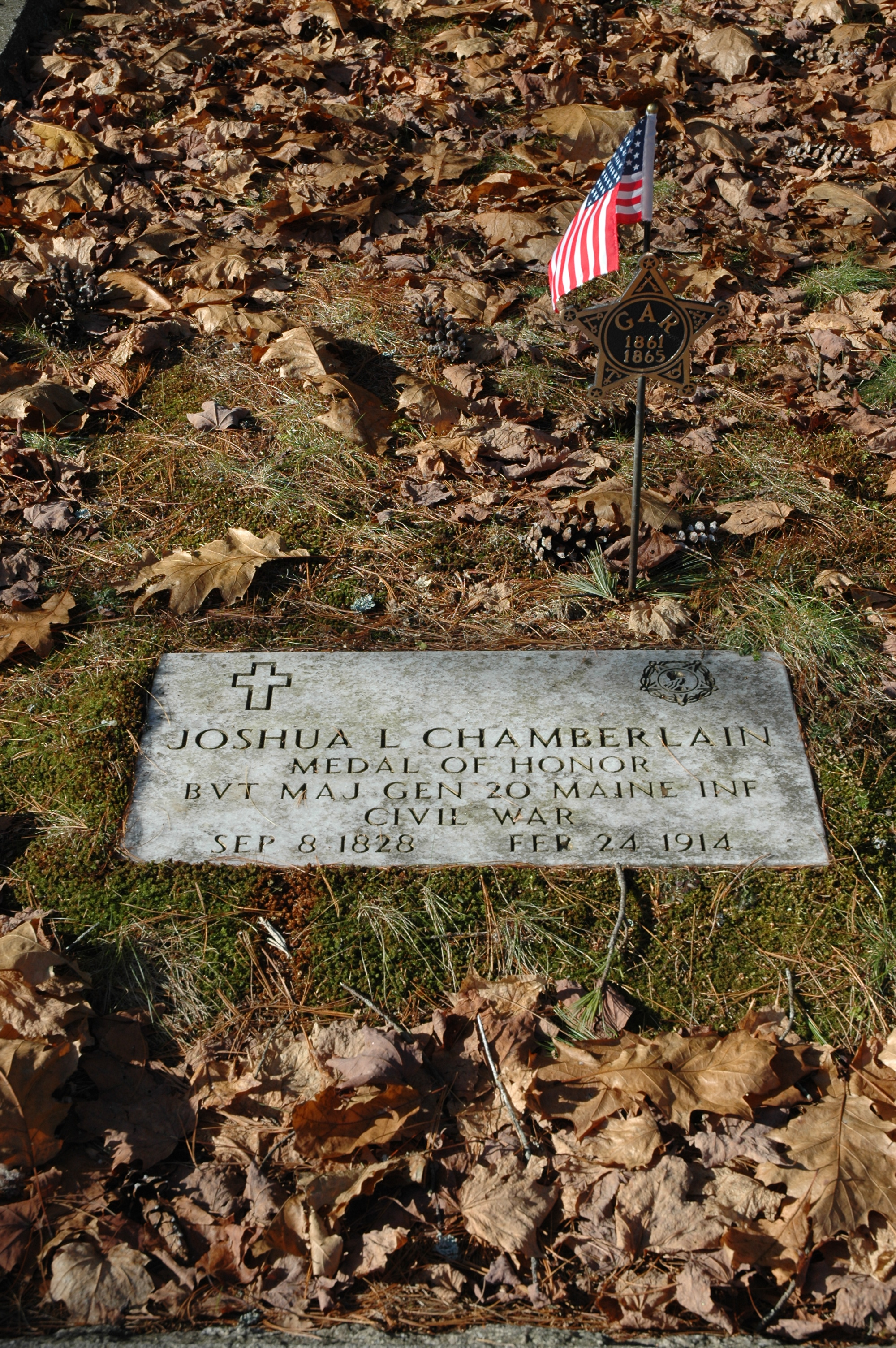
Well, recently I did go back to my old school, a place called Bowdoin College in Brunswick, Maine. I’ve been working on a magazine article that involves Joshua Lawrence Chamberlain, and I figured it was time I paid my respects to the old soldier. As most Civil War aficionados know, Chamberlain was a Bowdoin graduate who was teaching at the college when the Civil War began. He joined the army, received an appointment as the lieutenant colonel of the 20th Maine Volunteer Infantry, and was serving as the regiment’s commander at the Battle of Gettysburg. Historians argue about the overall importance of the 20th Maine’s defense of Little Round Top on July 2, but I don’t think anyone can deny it was a heroic and courageous stand. He was later badly wounded during the initial attacks on Petersburg, but returned to the army and presided over the official surrender of the Army of Northern Virginia at Appomattox. (I’ve written a bit more about Chamberlain’s reputation here.)

Joshua Lawrence Chamberlain (Library of Congress photo).

Joshua Lawrence Chamberlain (Library of Congress photo).

Like Chamberlain, I am a Maine native. I grew up in Augusta, where Chamberlain, who served four terms as the state’s governor, once made another heroic stand to face down militia preparing to mount a coup against the state government over disputed election returns. I attended Bowdoin for my first two years of college, before decamping to experience a completely different way of life at a university in Los Angeles. I can’t recall if I knew much of anything about Chamberlain at the time. Only later did I learn that he and I belonged to the same fraternity, and that the fraternity house (where I lived after my freshman year) stood just across Potter Street from the building that Chamberlain once called home. It was student housing when I was there; it now houses a small Chamberlain museum.

My wife and I reached Bowdoin on a bright but very cold afternoon in November and headed over to Pine Grove Cemetery to see the general’s grave. After a little bit of searching, we found it at one edge of the cemetery. It’s a modest stone, with just his name and birth and death years, with another marker behind it flush with the ground. Some people had placed pennies on the gravestone, so I followed suit, making sure I put the Lincoln side up.

DSC_6977Chamberlain was an interesting person, not just a plaster saint or a one-dimensional hero. “Chamberlain was much more complex and complicated than historians would have us believe,” noted biographer Edward G. Longacre. “Among other qualities, he was abstruse and direct, caring and insensitive, modest and pretentious, selfless and self-consumed, tolerant and narrow-minded.

“He was, in other words, a human being.”

And now he’s dust, dead a century ago as of last February. All things, including brevet major generals, must pass.

Looking for that perfect holiday gift? What could be better than Searching for George Gordon Meade: The Forgotten Victor of Gettysburg? (You can order the book from Amazon or Barnes and Noble.) Or maybe a 2015 George Gordon Meade calendar–the perfect way to commemorate the general’s bicentennial year! You can get the calendar right here.

Poor Ba-ba (December 5, 1864)

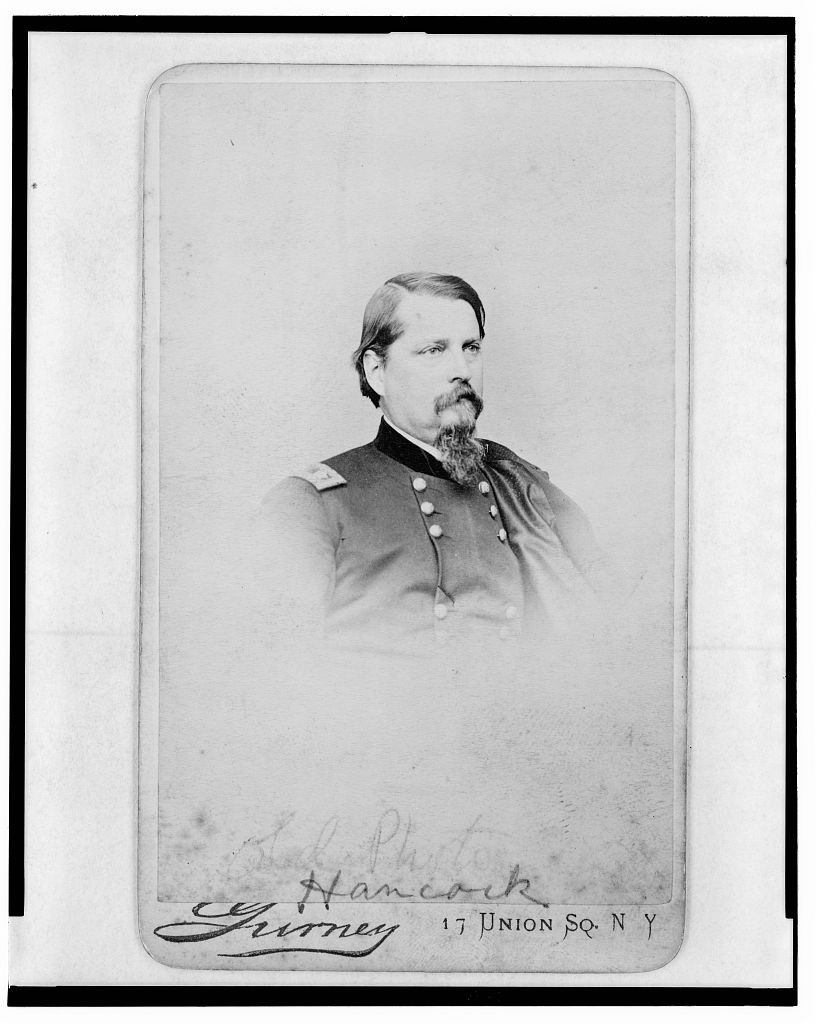
Winfield Scott Hancock (Library of Congress).

Winfield Scott Hancock (Library of Congress).

Winfield Scott Hancock has gone from the Army of the Potomac, but he is not forgotten. Here Theodore Lyman relates a story about Hancock, who had a legendary mastery of profanity.

The weather continues very fine and really warm of days, though the nights are provocative of blankets—weather, law! that isn’t very interesting, is it? My head has indeed been singularly empty for letter-writing; when a man talks about weather to his own wife he must be pretty hard up. I heard a characteristic anecdote of Hancock which made me laugh, as I knew his ways. It appears that he had issued stringent orders against plundering, despite which the troops had fallen on a large flock of sheep and were making short work of them. Away went Hancock, followed by the inevitable Morgan, Mitchell, and Parker. Very soon all these three were sent spinning off at tangents, after distant delinquents, and the General went frothing along alone. Presently he catches sight of four men pursuing a poor sheep, bayonet in hand, and off he goes, full tilt, to arrest them; but, before he can get in, poor ba-ba is down and still. “You blank blank all-sortsof-bad-things,” roars Hancock, “how dare you? How dare you kill that sheep?” “Please, General, we didn’t kill it,” cried the terrified soldiers. “What! Didn’t kill it! You liars! You infernal, desperate liars! I saw you kill it, with my own eyes; and there it lies dead!”—when—the sheep hopped up and ran away.

Theodore Lyman’s letter is from Meade’s Headquarters, 1863-1865: Letters of Colonel Theodore Lyman from the Wilderness to Appomattox, pp. 288-9. Edited by George R. Agassiz. Boston, Massachusetts Historical Society, 1922. Available via Google Books.

Looking for that perfect holiday gift? What could be better than Searching for George Gordon Meade: The Forgotten Victor of Gettysburg? (You can order the book from Amazon or Barnes and Noble.) Or maybe a 2015 George Gordon Meade calendar–the perfect way to commemorate the general’s bicentennial year! You can get the calendar right here.