A Gift (May 17, 1864)

A view of the Meade house on Delancey Place in Philadelphia today (Tom Huntington photo).

A view of the Meade house on Delancey Place in Philadelphia today (Tom Huntington photo).

Meade writes on May 17 on the eve of a renewed attack against Lee’s Spotsylvania lines. After the terrible fighting against the Mule Shoe salient, the Confederates had withdrawn to a new position, one the Federals hope will be more susceptible to assault.

The Gerhard Meade mentions is his wife’s brother-in-law. In the end Mrs. Meade will get her way regarding the house on Delancey Place in Philadelphia and the Meades will receive the home as a gift from their friends. The General died in the house in 1872. The building still stands and you can see the word “Meade” carved on one of the lintels.

To-morrow we shall begin fighting again, with, I trust, some decided result, for it is hardly natural to expect men to maintain without limit the exhaustion of such a protracted struggle as we have been carrying on.

The last few days have given our men rest, and the arrival of reinforcements has put them in good spirits. There is a determination on all sides to fight it out, and have an end put to the war; a result which I think will most certainly be accomplished if we can overcome the army before us.

I received to-day a kind letter from Mr. Gerhard, written from his sick room, and informing me of the generosity of kind friends in Philadelphia, who had subscribed to pay for your house in DeLancey Place. I have replied to Mr. Gerhard, and whilst I have tried to express my sense of the generosity of my friends, I have declined the gift, believing that, under existing circumstances, it would not be proper in me to accept. At the same time I have said if it should be God’s will that I should fall in this war, then anything to assist you and my orphans would be most gratefully and thankfully received. I hope you will approve of my course, and that my feelings will be understood. It would not do to lose our independence, and I don’t think we would be comfortable in a house bought with our friends’ money.

I have been riding all day, getting ready for to-morrow’s battle. I shall now retire to rest, earnestly praying God to protect us, and give victory to our side.

On May 17 Theodore Lyman resumes his account of the fighting in the Wilderness. Here he talks about Confederate General John B. Gordon’s flank attack on the Union right late in the day on May 6. As I write in Searching for George Gordon Meade: The Forgotten Victor of Gettysburg:
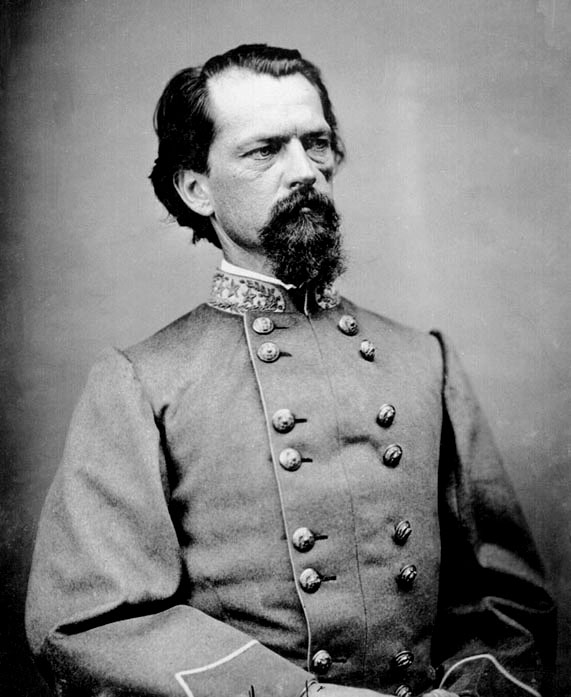
Confederate General John B. Gordon (National Archives).

Confederate General John B. Gordon (National Archives).

The attackers were under Brig. Gen. John Gordon, a hard-fighting Georgian. The first troops the screaming rebels hit were brigades under the command of Brigadier Generals Alexander Shaler and Truman Seymour. It was the continuation of a string of bad luck for Seymour, the general Meade had suspected of sucking up to Reynolds back in 1862. Since then Seymour had been disastrously defeated at the Battle of Olustree in Florida and seriously injured leading an attack on Battery Wagner outside Charleston, South Carolina. Now his bad luck continued. His troops broke for the rear. The Confederates captured both Seymour and Shaler.

The men of the VI Corps fell back against Warren’s V Corps to their right. “Suddenly there was a wild, fearful yell, a terrific crash, and the tide of battle rolled backward,” remembered Pvt. Theodore Gerrish of the 20th Maine. “A portion of the Sixth corps had given way, and the enemy followed up the advantage thus gained, until they had completely turned our flank, and the firing was almost in our rear. Some of the regiments in our brigade showed signs of alarm at this situation, but the sons of Maine were determined to hold their position, even if they were surrounded and destroyed in so doing. The enemy’s advance on our right was finally checked, and our line was re-established.”
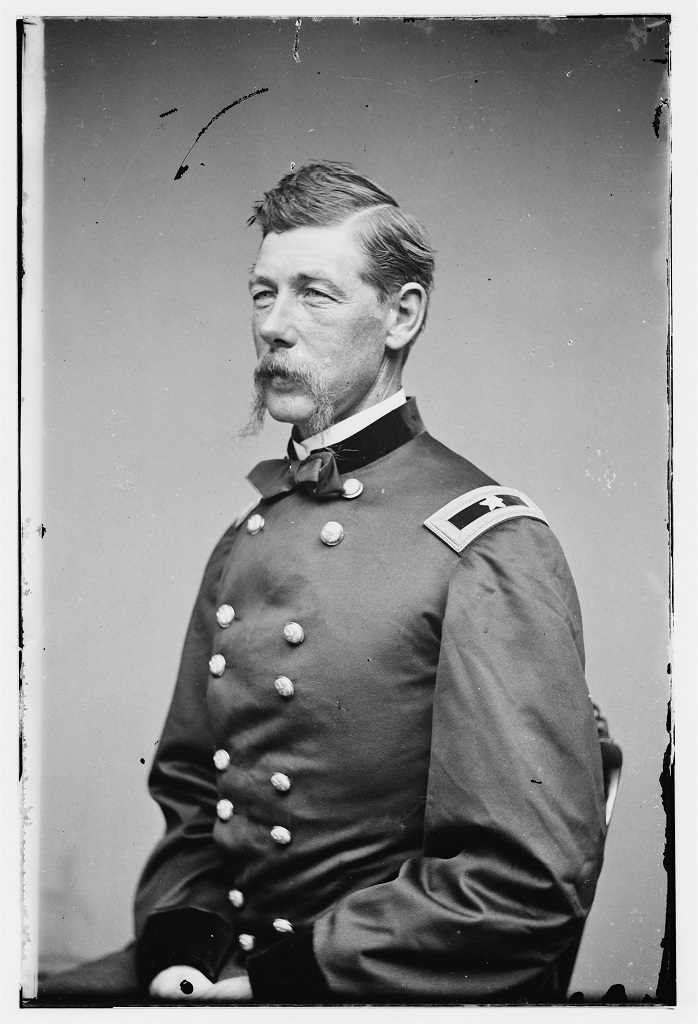
Alexander Shaler, who was taken prisoner in the Wilderness. He received the Medal of Honor for his actions during the Battle of Chancellorsville (Library of Congress).

Alexander Shaler, who was taken prisoner in the Wilderness. He received the Medal of Honor for his actions during the Battle of Chancellorsville (Library of Congress).

When Meade received reports that another Confederate flank attack had routed a portion of the Army of the Potomac in the Wilderness, he appeared less concerned about it than Grant did. Fixing a cold eye on the panicked courier who had reported the VI Corps’ destruction, he demanded sarcastically, “Do you mean to tell me that the Sixth Corps is to do no more fighting this campaign?” In fact, Sedgwick had ridden to the front to help rally his demoralized men and soon had things under control.

Things did look bad for a time. Horace Porter reported an incident in which a general whom he did not identify reached Grant’s headquarters and expressed his fears that Lee would seek to get between the Union army and the Rapidan, cutting off the line of communications. “I know Lee’s methods well by past experience,” the officer declared with some self-importance. The normally unflappable general in chief reacted with uncharacteristic temper. He stood up and yanked the cigar from his mouth. “Oh, I am heartily tired of hearing about what Lee is going to do,” Grant barked. “Some of you always seem to think he is suddenly going to turn a double somersault, and land in our rear and on both of our flanks at the same time. Go back to your command, and try to think what we are going to do ourselves, instead of what Lee is going to do.”

Meade and Grant were right not to worry. Gordon’s flank attack was the last major action of the Battle of the Wilderness. It had been two days of bloody and confused conflict, “a battle fought with the ear, and not with the eye,” according to Horace Porter. “All circumstances seemed to combine to make the scene one of unutterable horror. At times the wind howled through the tree-tops, mingling its moans with the groans of the dying, and heavy branches were cut off by the fire of the artillery, and fell crashing upon the heads of the men, adding a new terror to battle. Forest fires raged; ammunition-trains exploded; the dead were roasted in the conflagration; the wounded, roused by its hot breath, dragged themselves along, with their torn and mangled limbs, in the mad energy of despair, to escape the ravages of the flames; and every bush seemed hung with shreds of blood-stained clothing. It was as though Christian men had turned to fiends, and hell itself had usurped the place of earth.”

Here’s how Lyman wrote about it:
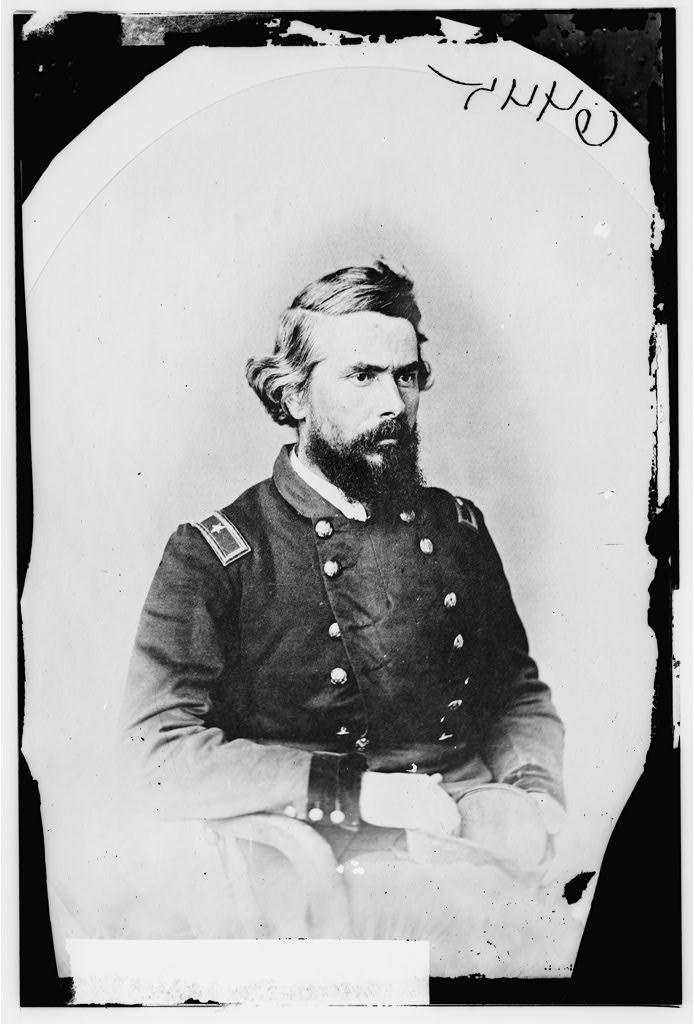
Truman Seymour (Library of Congress).

Truman Seymour (Library of Congress).

. . . Just at dark there occurred a most disgraceful stampede in the 6th Corps — a thing that has been much exaggerated in the papers, by scared correspondents. You will remember I told you that we had two dubious divisions in the army: one, the Pennsylvania Reserves, has done finely and proved excellent; but the other, General Ricketts’s division of the 6th Corps, composed of troops from Winchester, known as “Milroy’s weary boys,” never has done well. They ran on the Mine Run campaign, and they have run ever since. Now, just at dark, the Rebels made a sort of sortie, with a rush and a yell, and as ill-luck would have it, they just hit these bad troops, who ran for it, helterskelter. General Seymour rode in among them, had his horse shot, and was taken. General Shaler’s brigade had its flank turned and Shaler also was taken. Well, suddenly up dashed two Staff officers, one after the other, all excited, and said the whole 6th Corps was routed; it was they that were routed, for Wright’s division stood firm, and never budged; but for a time there were all sorts of rumors, including one that Generals Sedgwick and Wright were captured. In a great hurry the Pennsylvania Reserves were sent to the rescue, and just found all the enemy again retired. A good force of them did get round, by a circuit, to the Germanna plank, where they captured several correspondents who were retreating to Washington! Gradually the truth came out, and then we shortened the right by drawing back the 5th and 6th Corps, so as to run along the interior dotted line, one end of which ends on the Germanna plank.

General Meade was in favor of swinging back both wings still more, which should have been done, for then our next move would have been more rapid and easy.

The result of this great Battle of the Wilderness was a drawn fight, but strategically it was a success, because Lee marched out to stop our advance on Richmond, which, at this point, he did not succeed in doing. We lost a couple of guns and took some colors. On the right we made no impression; but, on the left, Hancock punished the enemy so fearfully that they, that night, fell back entirely from his front and shortened their own line, as we shortened ours, leaving their dead unburied and many of their wounded on the ground. The Rebels had a very superior knowledge of the country and had marched shorter distances. Also I consider them more daring and sudden in their movements; and I fancy their discipline on essential points is more severe than our own — that is, I fancy they shoot a man when he ought to be shot, and we do not. As to fighting, when two people fight without cessation for the best part of two days, and then come out about even, it is hard to determine.

Meade’s correspondence taken from The Life and Letters of George Gordon Meade, Major-General United States Army, Vol. 2, (New York: Charles Scribner’s Sons, 1913), pp. 196-7. Available via Google Books.

Theodore Lyman’s letter is from Meade’s Headquarters, 1863-1865: Letters of Colonel Theodore Lyman from the Wilderness to Appomattox, pp 97-9. Edited by George R. Agassiz. Boston, Massachusetts Historical Society, 1922. Available via Google Books.

Sheridan (May 16, 1864)

Philip Sheridan and Meade developed a cantankerous relationship (Library of Congress).

Philip Sheridan and Meade developed a cantankerous relationship (Library of Congress).

Meade mentions cavalry commander Philip Sheridan in his letter to his wife from May 16. In the battle of Yellow Tavern on May 11, one of Sheridan’s men mortally wounded Jeb Stuart, a major blow to Lee’s army. Meade does not mention the unpleasant encounter he had had with Sheridan early in the morning on May 8 at a place called Todd’s Tavern. Meade had been angry that Sheridan’s men hadn’t cleared the road all the way to Spotsylvania. Sheridan, already chafing under Meade’s command, was incensed that Meade had felt it necessary to issue some orders directly to his cavalry. According to Horace Porter of Grant’s staff, Meade was in “a towering passion” while Sheridan was “equally fiery.” The two men argued and Sheridan said, “If I am permitted to cut loose from this army I’ll draw Stuart after me and whip him, too.” Meade reported Sheridan’s insubordination to Grant, and repeated what the cavalry commander had said about Stuart. “Did Sheridan say that?” replied Grant. “Well, he generally knows what he is talking about. Let him start right out and do it.” Meade issued the orders, no doubt irritated that Grant was rewarding Sheridan for his insubordination to a superior officer. Sheridan did kill Stuart, but he also deprived the Army of the Potomac of the eyes and ears of his cavalry during a vital part of the Overland Campaign.

The weather still continues unfavorable for military operations, so, unless the enemy attack us, we shall probably remain quiet to-day. Our cavalry, under Sheridan, have been heard from. He was sent to get in the enemy’s rear, destroy their communications and supplies, fight their cavalry, and when his forage was exhausted, make his way to [Benjamin] Butler, on the James River. He reports having executed his orders, and it is said that J. E. B. Stuart was killed in the battle with Sheridan.

In his letter of May 16, Lyman resumes his account of the fighting in the Wilderness, especially the struggle around the Brock Road and the arrival of James Longstreet’s corps. Fortunately for the Union, Longstreet’s flank attack faltered when its commander was accidentally shot by his own troops. Lyman writes about the death of Henry Abbott, his Harvard friend and the commander of the 20th Massachusetts Earlier Abbot had commented on how Meade and Grant worked together. He thought the combination was “the next best thing to having a man of real genius at the head.” Meade was “a good combiner and maneuverer” and “unquestionably a clever man intellectually,” while Grant had “force” and “character” and wasn’t “afraid to take the responsibility to the utmost.”

I will continue the letter of this morning, describing our first day’s fight. I had got as far as the death of General Hays and the wounding of Carroll. This was between five and six o’clock. Hays commanded one brigade of Birney’s division. He was a strong-built, rough sort of man, with red hair, and a tawny, full beard; a braver man never went into action, and the wonder only is that he was not killed before, as he always rode at the very head of his men, shouting to them and waving his sword. Mott’s division behaved badly (as you observed, it broke and came back). This is a curious instance of a change of morale. It is Hooker’s old fighting division, but has since been under two commanders of little merit or force of character; then there was some discontent about re-enlistments and about the breaking up of the old 3d Corps, to which it had belonged; and the result has been that most of this once crack division has conducted itself most discreditably, this campaign. However, the fresh troops saved the day, and, at dark, we occupied our old line (the dotted one along the Brock road). . . .

Major General Winfield Scott Hancock (Library of Congress).

Major General Winfield Scott Hancock (Library of Congress).

It was long after dark when I rode back, and, with some difficulty, found our camp, now pitched in a dusty, ploughed field. The fight of this day had been an attack by parts of our three corps against the Corps of Ewell on our right, and of Hill on our left. The fight had swayed back and forth and ended in a drawn battle, both sides holding their lines. General Grant ordered the attack all along the line, the next morning at 4.30; but put it off to 5 o’clock on the representation that Burnside could not get up in time. He was ordered to get in position by daylight and to go in on Hill’s left flank, where you see a dotted line nearly parallel to the Parker’s Store road. We were all up right early on that Friday the 6th of May, you may depend. “Lyman,” said the General, “I want you to take some orderlies and go to General Hancock and report how things go there during the day.” It was after five when I mounted, and already the spattering fire showed that the skirmishers were pushing out; as I rode down the crossroad, two or three crashing volleys rang through the woods, and then the whole front was alive with musketry. I found General Hancock at the crossing of the plank: he was wreathed with smiles. “We are driving them, sir; tell General Meade we are driving them most beautifully. Birney has gone in and he is just cleaning them out be-auti-fully!” This was quite apparent from the distance of the receding firing and the absence of those infernal minie balls. “I am ordered to tell you, sir, that only one division of General Burnside is up, but that he will go in as soon as he can be put in position.” Hancock’s face changed. “I knew it!” he said vehemently. “Just what I expected. If he could attack now, we would smash A. P. Hill all to pieces!” And very true were his words. Meantime, some hundreds of prisoners were brought in; all from Hill’s troops. Presently, however, the firing seemed to wake again with renewed fury; and in a little while a soldier came up to me and said: “I was ordered to report that this prisoner here belongs to Longstreet’s Corps.” “Do you belong to Longstreet?” I hastened to ask. “Ya-as, sir,” said grey-back, and was marched to the rear. It was too true! Longstreet, coming in all haste from Orange Court House, had fallen desperately on our advance; but he had uphill work. Birney’s and Getty’s men held fast and fought with fury, a couple of guns were put in the plank road and began to fire solid shot over the heads of our men, adding their roar to the other din. The streams of wounded came faster and faster back; here a field officer, reeling in the saddle; and there another, hastily carried past on a stretcher. I stood at the crossing and assisted in turning back stragglers or those who sought to go back, under pretext of helping the wounded. To some who were in great pain I gave some opium, as they were carried past me.

It was about seven o’clock, I think, that Webb’s brigade marched along the Brock road, and, wheeling into the pike, advanced to the support of Birney. Among them was the 20th Massachusetts. Abbot smiled and waved his sword towards me, as he rode by, and I called out to him wishing him good luck; and so he went on to his death, as gallant a fellow as fell that day; a man who could ride into the fight with a smile on his face. Just before eight o’clock came one brigade of Stevenson’s division (Burnside’s Corps) which had been sent to strengthen Hancock; the other brigade came later and was put on our left, where we were continually paralyzed by reports that the enemy was coming up the Brock road to take us in the flank. This prevented proper mobility of our left, and, after all, they turned out to be a division of Rebel cavalry, who were defeated later in the day by our men. Stevenson’s brigade was now put in to relieve the advanced lines that had long been under fire, and all other fresh troops were marched to the front. But Longstreet knew full well (they know everything, those Rebels) that Burnside was coming up with two divisions, on his flank; and knew too that he was late, very late. If Hancock could first be paralyzed, the day was safe from defeat, which now impended. Gathering all his forces, of both corps, he charged furiously. At a little after eleven Mott’s left gave way. On the right the brigade of Stevenson, consisting of three raw Massachusetts regiments miscalled “Veterans,” broke, on being brought under a tremendous fire. . . .The musketry now drew nearer to us, stragglers began to come back, and, in a little while, a crowd of men emerged from the thicket in full retreat. They were not running, nor pale, nor scared, nor had they thrown away their guns; but were just in the condition described by the Prince de Joinville, after Gaines’s Mill. They had fought all they meant to fight for the present, and there was an end of it! If there is anything that will make your heart sink and take all the backbone out of you, it is to see men in this condition! I drew my sword and rode in among them, trying to stop them at a little rifle-pit that ran along the road. I would get one squad to stop, but, as I turned to another, the first would quietly walk off. There was a German color-bearer, a stupid, scared man (who gave him the colors, the Lord only knows!), who said, “Jeneral Stavenzon, he telled me for to carry ze colors up ze road.” To which I replied I would run him through the body if he didn’t plant them on the rifle-pit. And so he did, but I guess he didn’t stick. Meanwhile there was no danger at all; the enemy did not follow up — not he. He was busy swinging round to oppose Burnside, and was getting his men once more in order. At half-past one I rode to General Meade and reported the state of affairs. The Provost-General went out at once and stopped and organized the stragglers. At two o’clock Burnside, who had been marching and countermarching, did attack. He made some impression, but it was too late, and he had not enough force to follow on. About this time I returned to General Hancock.* His men were rallied along the road; but regiments and brigades were all mixed up; and we were obliged to listen to Burnside’s fighting without any advance on our part. In our front all was quiet; and I got permission to go back to the 2d Corps hospital and look up the body of Major Abbot. Two miles back, in an open farm surrounded by woods, they had pitched the hospital tents. I will not trouble you with what I saw there, as I passed among the dead and dying. Abbot lay on a stretcher, quietly breathing his last — his eyes were fixed and the ashen color of death was on his face. Near by lay his Colonel, Macy, shot in the foot. I raised Macy and helped him to the side of Abbot, and we stood there till he died. It was a pitiful spectacle, but a common one on that day. I left in haste, after arranging for sending the remains home, for the sudden sound of heavy firing told of some new attack. The Rebels (unquenchable fellows they are!), seeing that Burnside had halted, once more swung round and charged furiously on Hancock in his very rifle-pits. I rode at once to General Meade, to ask that Burnside might attack also. This he did, without further orders and with excellent effect. When I got back to the cross-road, I was told the enemy had broken through on the plank and cut us in two; this turned out an exaggeration. They did get into a small part of a rifle-pit but were immediately driven out leaving near sixty dead in the trench at the point.

*The book includes this footnote, taken from Lyman’s journal: “1.15 (about). Back to Hancock. He alone, in rear of Brock road; and there he asked me to sit down under the trees, as he was very tired indeed. All his Staff were away to set in order the troops. They had now constructed a tolerable rifle-pit extending along the Brock and to the head of the cross-road. He said that his troops were rallied but very tired and mixed up, and not in a condition to advance. He had given orders to have the utmost exertions put forth in putting regiments in order, but many of the field officers were killed and wounded, and it was hard. At 2 P.m. Burnside, after going almost to Parker’s Store and again back, made a short attack with loud musketry. Ventured to urge Hancock (who was very pleasant and talkative) to try and attack too; but he said with much regret that it would be to hazard too much, though there was nothing in his immediate front, which had been swept by Stevenson’s other brigade, which marched from left to right.”

Meade’s correspondence taken from The Life and Letters of George Gordon Meade, Major-General United States Army, Vol. 2, (New York: Charles Scribner’s Sons, 1913), pp. 195-6. Available via Google Books.

Theodore Lyman’s letter is from Meade’s Headquarters, 1863-1865: Letters of Colonel Theodore Lyman from the Wilderness to Appomattox, pp 92-7. Edited by George R. Agassiz. Boston, Massachusetts Historical Society, 1922. Available via Google Books.
A Few Lines (May 15, 1864)

On the night of May 15, 1864, both George Meade and Theodore Lyman sat down to put pen to paper and write letters home. Meade’s is short. As he often is, the general is concerned with how others think of his work. He has reason to feel good about it. The letter from Secretary of War Edwin Stanton read in part, “This department congratulates you and your heroic Army and returns its cordial thanks for their gallant achievements during the last seven days, and hopes that the valor and skill thus far manifested will be crowned with the fruits of ultimate and decisive victory.” The dispatch from Grant is quoted here.

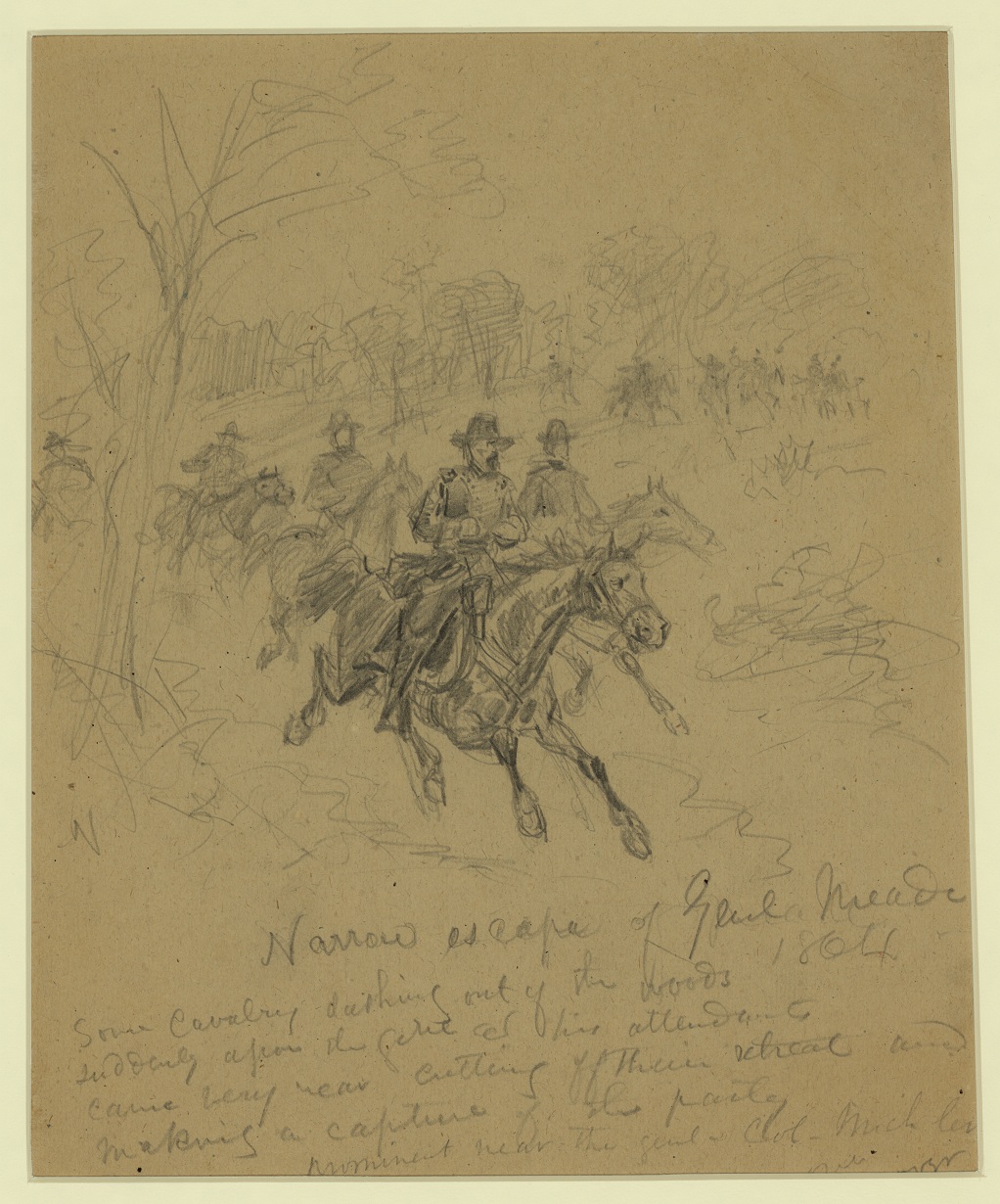
One thing Meade does not mention is how close he came to being captured on the previous day, May 14. Here’s what I wrote in Searching for George Gordon Meade: The Forgotten Victor of Gettysburg:

Artist Alfred Waud made a sketch of Meade's near capture by the Confederates on May 14 (Library of Congress).

Artist Alfred Waud made a sketch of Meade’s near capture by the Confederates on May 14 (Library of Congress).

On May 14 Meade almost fell into enemy hands when he rode forward to observe the Union position on Myer’s Hill . . . . Upton’s brigade was holding this forward position when Meade and Horatio Wright rode forward to examine the ground. The generals were conferring inside the house when the rattle of muskets and the thud of bullets striking the building delivered unwelcome news: the Confederates were attacking. Meade had to move fast. He jumped on his horse and, guided by Capt. Nathaniel Michler, a topographical engineer with some knowledge of the terrain, hastily made his way back toward the Ni River. A Confederate major galloped over to intercept him and even grabbed Meade’s bridle before his headquarters guard intervened and captured the rebel. The only thing Meade lost, other than his dignity, was his glasses.

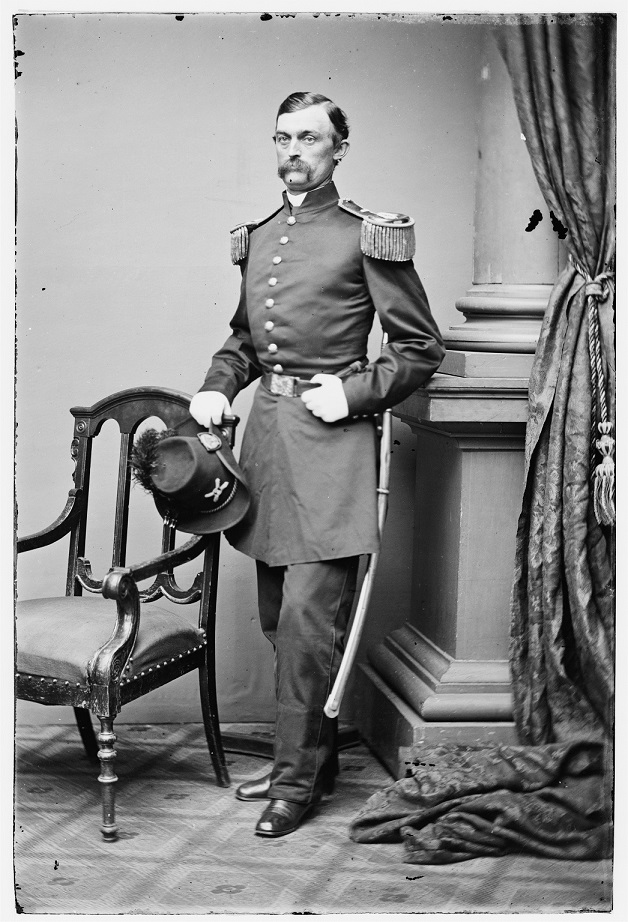
Charles Griffin. Like Meade, he had an explosive temper (Library of Congress).

Charles Griffin. Like Meade, he had an explosive temper (Library of Congress).

Theodore Lyman’s account of the fighting is much more detailed, the start of a fascinating and detailed account of the Overland Campaign. His letter of May 15 covers only the first day of fighting in the Wilderness. In it he mentions how General Charles Griffin rode up to headquarters and complained that Horatio Wright and the VI Corps had not protected the right of Griffin’s V Corps division. A footnote in the collection of Lyman’s letters includes a further description from Lyman’s journal. He wrote, “2.45. Griffin comes in, followed by his mustering officer, Geo. Barnard. He is stern and angry. Says in a loud voice that he drove back the enemy, Ewell, ¾ of a mile, but got no support on the flanks, and had to retreat—the regulars much cut up. Implies censure on Wright, and apparently also on his corps commander, Warren. Wadsworth also driven back. Rawlins got very angry, considered the language mutinous, and wished him put in arrest. Grant seemed of the same mind and asked Meade: ‘Who is this General Gregg? You ought to arrest him!’ Meade said: ‘It’s Griffin, not Gregg; and it’s only his way of talking.’” 

I have often read a little coda to that incident and I tracked it down to The Wilderness Campaign by Edward Steere, a book my publisher, Stackpole Books (then the Stackpole Company), issued way back in 1960. In Steere’s account, Grant stood up and began fastening the buttons of his blouse and as Meade spoke, “seeking as it were to placate an angry child with soothing words,” he helped Grant with his buttons. “Grant fastened the middle button without further comment,” Steere continued. “Resuming his seat, he lit a fresh cigar and lapsed into meditation.”

I always found this odd and out of character. I couldn’t imagine George Meade helping Grant button his shirt, picturesque as that image may be. Surely Lyman would have mentioned something so unusual. Then I read Steere’s footnote. “The author admits to a slight embellishment of Lyman’s account,” he wrote. “Lyman abruptly concludes with Meade’s remark: ‘And it’s only his way of talking.’ While a reasonable presumption, there is no documentary evidence that Grant lit a fresh cigar.” Or that Meade helped him with his clothing. While I’m glad Steere pointed out his fabrication, I wonder why he made that stuff up in the first place. It may be okay for historical fiction, but it’s not good history.

Spottsylvania Court House Battle-field, May 15, 9 p.m.

A lull in the roar of battle enables me to write you a few lines. It has been raining hard, both yesterday and to-day, putting the roads in such condition as to compel both armies to keep still—a rest that the men on both sides were glad to have. I do not see the papers, and therefore cannot tell how true their accounts are, and I have not time to give you any details. I think we have gained decided advantages over the enemy; nevertheless, he confronts us still, and, owing to the strong position he occupies, and the works he is all the time throwing up, the task of overcoming him is a very difficult one, taxing all our energies. I send you a letter received from the Secretary of War, for safe keeping, as it shows I am not utterly ignored by the Department. General Grant showed me a despatch he had written to the War Department, speaking in complimentary terms of my services, and asking I be made a major general in the regular army. I told him I was obliged to him for his good opinion, but that I asked and expected nothing from the Government, and that I did not myself attach any importance to being in the regular army, so long as I held an equal rank in the volunteer service. What the result will be I cannot tell.

Here is Lyman’s account of the first day’s fight in the Wilderness:

Well, to be more or less under fire, for six days out of seven, is not very good for the nerves, or very pleasant. But now that there is a quiet day, I thought I would make a beginning of describing to you the sad, bloody work we have been at. I will write enough to make a letter and so go on in future letters, only writing what can now be of no importance to the enemy. The morning of Wednesday the 4th of May (or rather the night, for we were up by starlight) was clear and warm. By daylight we had our breakfast, and all was in a hurry with breaking up our winter camp. To think of it to-night makes it seem a half-year ago; but it is only eleven days. About 5.30 A.m. we turned our backs on what had been our little village for six months.

Already the whole army had been some hours in motion. The 5th Corps, followed by the 6th, was to cross at Germanna Ford, and march towards the Orange pike. The 2d Corps to march on Chancellorsville, crossing at Ely’s Ford; each corps was preceded by a division of cavalry, to picket the roads and scour the country. The main wagon train rested on the north side at Richardsville. So you see the first steps were much like the Mine Run campaign. I have drawn a little map to help you in understanding; not very exact in proportions, but still enough so.

Lyman mapThe roads were hard and excellent, full of waggons and black with troops; as we got past Stevensburg and went through a more wooded country, there were the little green leaves just opening, and purple violets, in great plenty, by the wayside. As the sun got fairly up, it grew much warmer, as one could see by the extra blankets and overcoats that our men threw away, whenever they halted. By 8 a.m. we drew near the Ford, and halted at a familiar spot, where we had our camp on the Mine Run campaign. How bitterly cold it was then! And now there was green grass all about, and wild flowers. Griffin’s division was already over, and the others were following steadily on. At 9.30 we went over ourselves, and, for a long time, I sat on the high bank, some seventy feet above the river, watching the steady stream of men and cannon and trains pouring over the pontoons. It was towards six in the evening before the last were across; and then one bridge was left for Burnside to cross by; for he was marching in all haste, from Rappahannock station. Meantime the head of the 5th Corps had reached the Orange pike, and that of the 2d, Chancellorsville. The Headquarters pitched their now reduced tents on the bank of the river that night, and I went down and took a slight bath in the stream, by way of celebrating our advance. General Grant came up betimes in the morning and had his tents near ours. He has several very sensible officers on his Staff, and several very foolish ones, who talked and laughed flippantly about Lee and his army. But they have changed their note now, and you hear no more of their facetiousness. The more experienced officers were sober, like men who knew what work was ahead. Our first grief was a ludicrous one. Our cook, a small Gaul, had mysteriously disappeared, and all we had left to cook for us was a waiter lad, who however rose with the occasion and was very conspicuous for activity. It turned out after, that the cook was arrested as a suspicious person, despite his violent protestations. . . .

We were off betimes the next morning (Thursday, May 5th), and about 7 o’clock got to the junction of the plank and pike, the troops meantime marching past us, as we stood waiting news from the front. Presently Griffin (5th Corps), who was two miles out on the pike (going west), reported the enemy in his front; while the cavalry, thrown out on the plank road, towards Parker’s Store, sent to say that the Rebel infantry were marching down in force, driving them in. General Wright’s division of the 6th Corps was turned off the Germanna plank to the right and ordered to march down the cross-road you see on the map, leading to the pike; and he and Griffin were directed to press the enemy and try to make a junction by their wings. At 10.40 A.m. General Getty’s division (6th Corps) was sent to hold the Orange plank road. It marched down the Germanna plank and took the little cross-road where the dotted line is, and got to the Orange plank just in time to stop the advance of A. P. Hill’s Corps. Meantime the rest of the 5th Corps was ordered into position on the left of, or in support of, General Griffin, about parallel to the most westerly dotted line, crossing the pike. Word was sent to 2d Corps, near Chancellorsville, that the Rebels were moving on us, and ordering Hancock to at once bring his men across to the Brock road and so take position on the left in support of General Getty. At noon, I was sent to General Getty, to tell him the disposition of the various troops and to direct him to feel along to his right, and find roads to communicate with the left of the 5th Corps, where, you will see, there was a considerable gap. Our Headquarters were on a piney knoll near the join of the Germanna plank and the pike. I rode down the dotted cross-road and came immediately on General Eustis, just putting his brigade into the woods, on Getty’s right. I stopped and directed him to throw out well to the right and to try to find Crawford, or a road to him.

Here it is proper to say something of the nature of this country, whereof I have already spoken somewhat during Mine Run times. A very large part of this region, extending east and west along the plank and pike, and the south, nearly to Spotsylvania, is called “The Wilderness,” a most appropriate term—a land of an exhausted, sandy soil, supporting a more or less dense growth of pine or of oak. There are some cleared spaces, especially near Germanna plank, where our Headquarters are marked. The very worst of it is parallel with Orange plank and upper part of the Brock road. Here it is mostly a low, continuous, thick growth of small saplings, fifteen to thirty feet high and seldom larger than one’s arm. The half-grown leaves added to the natural obscurity, and there were many places where a line of troops could with difficulty be seen at fifty yards. This was the terrain on which we were called to manoeuvre a great army. I found General Getty at the plank road (a spot I shall remember for some years) and gave him instructions. He told me the whole of Hill’s Corps was in his front and the skirmishers only 300 yards from us. For all I could see they might have been in Florida, but the occasional wounded men who limped by, and the sorry spectacle of two or three dead, wrapped in their blankets, showed that some fighting had already taken place. I got back and reported a little before one o’clock, and had scarcely got there when B-r-r-r-r wrong went the musketry, in front of Griffin and of Wright, which for the next hour and a half was continuous—not by volley, for that is impossible in such woods; but a continuous crackle, now swelling and now abating, and interspersed with occasional cannon. Very soon the ambulances began to go forward for their mournful freight. A little before two, I was sent with an order to a cavalry regiment, close by. The pike was a sad spectacle indeed; it was really obstructed with trains of ambulances and with the wounded on foot; all had the same question, over and over again; “How far to the 5th Corps’ hospital?” As I returned, I saw, coming towards me, a mounted officer—his face was covered with blood and he was kept in the saddle only by an officer who rode beside him and his servant who walked on the other side. “Hullo, Lyman!” he cried, in a wild way that showed he was wandering; “here I am; hurt a little; not much; I am going to lie down a few minutes, and then I am going back again! Oh, you ought to have seen how we drove ’em—I had the first line!” It was my classmate, Colonel Hayes, of the 18th Massachusetts; as fearless a soldier as ever went into action. There we were, three of us together, for the officer who supported him was Dr. Dalton. Three classmates together, down in the Virginia Wilderness, and a great fight going on in front. I was afraid Hayes was mortally hurt, but I am told since, he will recover. I trust so.

Alexander Hays was killed in the Wilderness (Library of Congress).

Alexander Hays was killed in the Wilderness (Library of Congress).

Gradually the musketry died away; and, at a quarter before three, General Griffin rode up —his face was stern and flushed, as it well might be. He said he had attacked and driven Ewell’s troops three quarters of a mile, but that Wright had made no join on his right and Wadsworth had been forced back on his left, so that with both flanks exposed he had been obliged to fall back to his former position. Meantime we got word that the head of Hancock’s column had moved up the Brock road and made a junction with Getty. At 3.15 I was sent with an order to General Getty to attack at once, and to explain to him that Hancock would join also. He is a cool man, is Getty, quite a wonder; as I saw then and after. “Go to General Eustis and General Wheaton,” he said to his aides, “and tell them to prepare to advance at once.” And so we were getting into it! And everybody had been ordered up, including Burnside, who had crossed that very morning at Germanna Ford. General Grant had his station with us (or we with him); there he took his seat on the grass, and smoked his briarwood pipe, looking sleepy and stern and indifferent. His face, however, may wear a most pleasing smile, and I believe he is a thoroughly amiable man. That he believes in his star and takes a bright view of things is evident. At 4.15 P.m. General Meade ordered me to take some orderlies, go to General Hancock (whose musketry we could now hear on the left) and send him back reports, staying there till dark. Delightful! At the crossing of the dotted cross-road with the plank sat Hancock, on his fine horse—the preux chevalier of this campaign—a glorious soldier, indeed! The musketry was crashing in the woods in our front, and stray balls—too many to be pleasant—were coming about. It’s all very well for novels, but I don’t like such places and go there only when ordered. “Report to General Meade,” said Hancock, “that it is very hard to bring up troops in this wood, and that only a part of my Corps is up, but I will do as well as I can.” Up rides an officer: “Sir! General Getty is hard pressed and nearly out of ammunition!” “Tell him to hold on and General Gibbon will be up to help him.” Another officer: “General Mott’s division has broken, sir, and is coming back.” “Tell him to stop them, sir!!” roared Hancock in a voice of a trumpet. As he spoke, a crowd of troops came from the woods and fell back into the Brock road. Hancock dashed among them. “Halt here! halt here! Form behind this rifle-pit. Major Mitchell, go to Gibbon and tell him to come up on the double-quick!” It was a welcome sight to see Carroll’s brigade coming along that Brock road, he riding at their head as calm as a May morning. “Left face—prime—forward,” and the line disappeared in the woods to waken the musketry with double violence. Carroll was brought back wounded. Up came Hays’s brigade, disappeared in the woods, and, in a few minutes, General Hays was carried past me, covered with blood, shot through the head.

Meade’s correspondence taken from The Life and Letters of George Gordon Meade, Major-General United States Army, Vol. 2, (New York: Charles Scribner’s Sons, 1913), p. 195. Available via Google Books.

Theodore Lyman’s correspondence is from Meade’s Headquarters, 1863-1865: Letters of Colonel Theodore Lyman from the Wilderness to Appomattox, pp. 85-92. Edited by George R. Agassiz. Boston, Massachusetts Historical Society, 1922. Available via Google Books.
Letters from the Front (May 11-13, 1864)

Alfred Waud called this sketch "The toughest fight yet. The fight for the salient" (Library of Congress. Click to enlarge).

Alfred Waud called this sketch of the fighting for the Mule Shoe at Spotsylvania “The toughest fight yet. The fight for the salient” (Library of Congress. Click to enlarge).

Since the last time George Meade wrote home to his wife his army had undergone some serious punishment—and did some punishing itself. First came the two bloody days in the Wilderness and then the horrible, terrible fighting at Spotsylvania. The fighting for the bulge—the salient—in Lee’s lines that came to be called the Mule Shoe (and a portion of that was baptized the “Bloody Angle”) had ended with the Confederates pulling back to a second line. Although this appeared to be a victory for the Union forces, it merely moved the fighting to a new position. As I write in Searching for George Gordon Meade: The Forgotten Victor of Gettysburg, “After the rebels retreated, Rufus Dawes and his men from the 6th Wisconsin moved forward to occupy their entrenchments. They found a scene from hell. Dead and wounded men lay everywhere in the mud and filth. Dawes saw one corpse propped up in the corner, the head missing and the neck and shoulders badly burned. Dawes presumed it was the work of a Union mortar.

“Horace Porter surveyed the result of the fighting the next day and found it ‘harrowing in the extreme. Our own killed were scattered over a large space near the “angle,” while in front of the captured breastworks the enemy’s dead, vastly more numerous than our own, were piled upon each other in some places four layers deep, exhibiting every ghastly phase of mutilation. Below the mass of fast-decaying corpses, the convulsive twitching of limbs and the writhing of bodies showed that there were wounded men still alive and struggling to extricate themselves from their horrid entombment.’ Another soldier who witnessed the devastation called it ‘the most horrible sight I had ever witnessed.’

“That same day Grant wrote to Stanton: ‘General Meade has more than met my most sanguine expectations. He and Sherman are the fittest officers for large commands I have come in contact with. If their services can be rewarded by promotion to the ranks of major-generals in the regular army the honor would be worthily bestowed, and I would feel personally gratified. I would not like to see one of these promotions at this time without seeing both.’”

Battle-field, Spottyslvania Court House, May 11—9 a.m.

I have only time to tell you we are all safe—that is, George and myself—and as far as I know, all your friends, except General Wadsworth, who fell into the hands of the enemy, mortally wounded, without hopes of life.

We have been fighting continuously for six days, and have gotten, I think, decidedly the better of the enemy, though their resistance is most stubborn.

Return thanks to the Almighty for the gracious protection extended to us, and let us try to deserve its continuance.

I am quite well and in good spirits, and hope we shall continue to be successful and bring this unhappy war to an honorable close.

May 12, 1864—2 o’clock, p.m.

A severe battle is raging, with the advantages thus far on our side. We have captured to-day over thirty guns, four thousand prisoners, including three generals. The enemy are strongly posted and entrenched, which, with their desperation, makes the struggle stubborn.

8 a.m., May 13, 1864.

By the blessing of God I am able to announce not only the safety of George and myself, but a decided victory over the enemy, he having abandoned last night the position he so tenaciously held yesterday. Eight days of continuous fighting have thus resulted with the loss to the enemy of over thirty guns and eight thousand prisoners. Our losses have been frightful; I do not like to estimate them. Those of the enemy fully as great. Our work is not over, but we have the prestige of success, which is everything, and I trust our final success will be assured. I have not time to write much. God’s blessing be with you and the dear children! Pray earnestly for our success.

Here are Theodore Lyman’s accounts of the same period. His regular letters actually resume on May 15, but throughout this time he took up the habit of writing about the events of each day at a later point. I have taken these post-dated accounts and posted them here.

May 10, 1864

General Gersham Mott (Library of Congress).

General Gershom Mott (Library of Congress).

[Tuesday] there was sharp fighting all along the line. General Mott’s division of the 2d Corps was put on the left of the 6th Corps, with the idea of making a connection with Burnside and then swinging our left to take the enemy in flank. I was ordered early to go to General Wright and explain to him, then to General Mott and direct him to demonstrate along his front and feel on the left for Burnside. General Wright had moved his Headquarters and had put them a little back and on one side, being moved thereto by the fact that the first selection was a focus for shells. Then I rode along the lines to General Mott and got his position as well as I could, and gave him the order. Coming back to General Wright, I had a sharp corner to go through. A battery was firing at one of ours and the shells coming over struck right among our infantry. They cut the pine trees about me in a manner I didn’t like, and one burst close by, throwing the pieces round just as you see them in French battle pictures. All day there was firing. About eleven came General Meade and told me to go out at once to Mott and to get a written report from him, which I did; and a sharpshooter shot at me, which I hate — it is so personal. More by token, poor General Rice, a Massachusetts man and very daring, was to-day killed by a sharpshooter. The ball broke his thigh, and, when they amputated his leg, he never rallied. As he lay on the stretcher, he called out to General Meade: “Don’t you give up this fight! I am willing to lose my life, if it is to be; but don’t you give up this fight!” All day we were trying to select places for an assault. Barlow crossed the Po on the right, but was afterwards ordered back, and had a brilliant rear-guard fight in which he punished the enemy. From five to six p.m. there was heavy cannonading, the battalions firing by volley. At 6.30 Upton, with a heavy column of picked men, made a most brilliant assault with the bayonet, at the left of the Sixth Corps. The men rushed on, without firing a shot, carried the breastworks in the face of cannon and musketry, and took 900 prisoners. Some of the men, who faltered, were run through the body by their comrades! But Mott’s men on the left behaved shamefully, and so Upton was obliged again to fall back, bringing his prisoners with him.* . . .

*11 p.m. Grant in consultation with Meade. Wright came up also; he uttered no complaints, but said quietly and firmly to Meade: ‘General, I don’t want Mott’s men on my left; they are not a support; I would rather have no troops there!’ Warren is not up to a corps command. As in the Mine Run move, so here, he cannot spread himself over three divisions. He cannot do it, and the result is partial and ill-concerted and dilatory movements.” — Lyman’s Journal. 

May 12, 1864

This was the date of one of the most fearful combats, which lasted along one limited line, and in one spot, more than fourteen hours, without cessation. I fancy this war has furnished no parallel to the desperation shown here by both parties. It must be called, I suppose, the taking of the Salient.

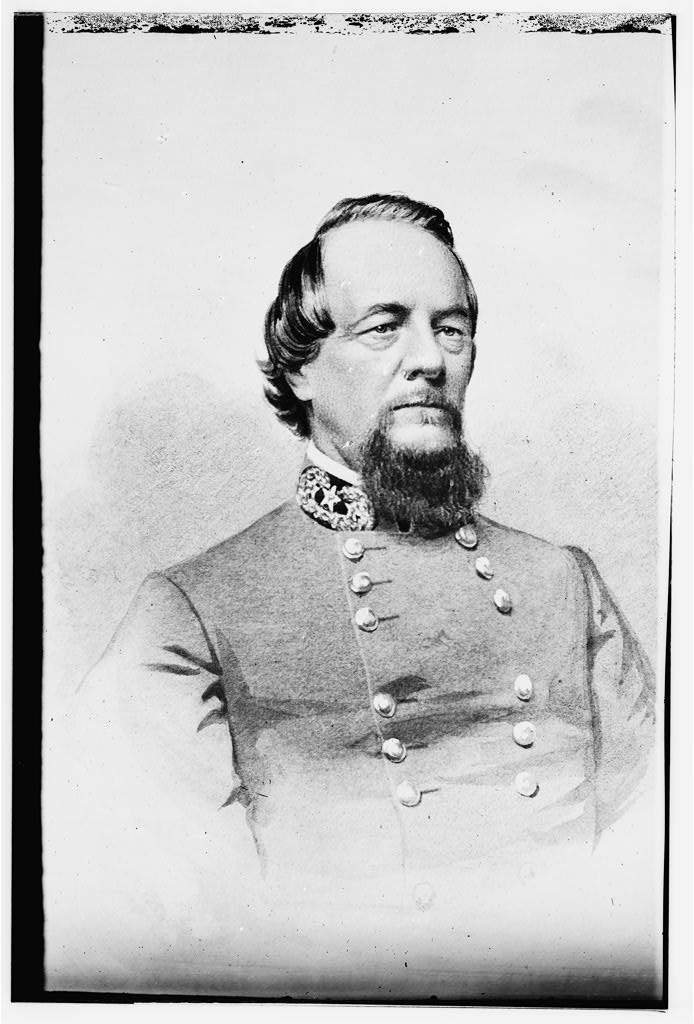
Confederate General Edward Johnson, also known as "Allegheny" or "Clubby" (Library of Congress).

Confederate General Edward Johnson, also known as “Allegheny” or “Clubby” (Library of Congress).

Hancock was ordered to attack with his corps as soon after four in the morning as possible and Burnside was to follow the example. A little after daylight we were all gathered round General Grant’s tent, all waiting for news of importance. The field telegraph was laid to all corps Headquarters and there we could hear from all parts. At a little after five o’clock, General Williams approached from the telegraph tent; a smile was on his face: Hancock had carried the first line! Thirty minutes after, another despatch: he had taken the main line with guns, prisoners and two generals! Great rejoicings now burst forth. Some of Grant’s Staff were absurdly confident and were sure Lee was entirely beaten. My own experiences taught me a little more scepticism. Hancock presently sent to ask for a vigorous attack on his right, to cover and support his right flank. General Wright was accordingly ordered to attack with a part of the 6th Corps. As I stood there waiting, I heard someone say, “Sir, this is General Johnson.” I turned round and there was the captured Major-General, walking slowly up. He was a strongly built man of a stern and rather bad face, and was dressed in a double-breasted blue-grey coat, high riding boots and a very bad felt hat. He was most horribly mortified at being taken, and kept coughing to hide his emotion. Generals Meade and Grant shook hands with him, and good General Williams bore him off to breakfast. His demeanor was dignified and proper. Not so a little creature, General Steuart, who insulted everybody who came near him, and was rewarded by being sent on foot to Fredericksburg, where there was plenty of mud and one stream up to his waist. Our attack was a surprise: the assaulting columns rushed over the breastworks without firing a shot, and General Johnson, running out to see the reason of the noise, found himself surrounded by blue blouses. I was now sent by General Meade to see how far General Wright’s column of attack was prepared. I found the columns going into the woods south of the Brown house; the enemy had seen them and the shells were crashing through the thick pines. When I came back and reported, the General said: “Well, now you can take some orderlies and go to General Wright and send me back intelligence from time to time.” There are some duties that are more honorable than pleasant! As I turned into the pines, the musketry began, a good way in front of me. I pressed past the column that was advancing. Presently the bullets began to come through the pine trees. Then came back a Staff officer, yelling: “Bring up that brigade! Bring it up at the double-quick!” “Doublequick,” shouted the officers, and the column started on a run.

Meade’s correspondence taken from The Life and Letters of George Gordon Meade, Major-General United States Army, Vol. 2, (New York: Charles Scribner’s Sons, 1913), pp. 194-5. Available via Google Books.

Theodore Lyman’s correspondence is from Meade’s Headquarters, 1863-1865: Letters of Colonel Theodore Lyman from the Wilderness to Appomattox, pp. 108-11. Edited by George R. Agassiz. Boston, Massachusetts Historical Society, 1922. Available via Google Books.

Upton’s Attack (May 10, 1864)

Emory Upton (Library of Congress).

Emory Upton (Library of Congress).

On May 10, 1864, Emory Upton led a famous charge against a portion of the Confederate lines outside Spotsylvania. Here’s an adaptation of my account of the fighting, taken from Searching for George Gordon Meade: The Forgotten Victor of Gettysburg. The book is available via Amazon, Barnes and Noble, and at quality bookstores.

Lee’s defensive line here above Spotsylvania had one very distinctive characteristic: there was a large bulge in his line. Because of its shape, this protrusion, or salient, became known as the Mule Shoe. Such salients were usually weak spots in a defensive line because attackers could strike them from different angles. On the west side of the big Mule Shoe salient was a smaller bulge, called Doles’s Salient after the Confederate general whose brigade defended it. This is the spot where Upton intended to make his attack.

The war had entered a new phase. Early in the war, when Lee had resorted to defensive measures, people had derided him as the “King of Spades.” No more. By the time of Mine Run, the Army of the Potomac had come to understand the futility of attacking a well-dug-in position. “With the formidable rifles now in use, a single line of veteran soldiers, behind a three-foot breastwork of earth and rails or a stone fence, can drive back and almost destroy three similar lines approaching to attack them,” noted one Union captain. “Give either our army or the rebels twenty-four hours’ notice of an approaching attack, and they will select a good position, and throw up intrenchments, which it is folly for any but overwhelmingly superior numbers to attempt to carry.”

The defensive works here had proven equally resistant to attack, but Upton thought he could breach them. He was determined to leave the field either “a live brigadier general or a dead colonel.” Upton planned to make a rapid and concentrated assault at a single spot, and Doles’s Salient seemed to offer the perfect opportunity.

Upton, a severe-looking young man with roundish face, high cheekbones, a mustache, and a trim beard, looks fierce and resolute in his photograph. Born in New York, Upton attended Ohio’s Oberlin College before he entered West Point. In 1859 he fought a duel with a fellow cadet Wade Hampton Gibbes, a South Carolinian who had declared that Upton, an ardent abolitionist, had slept with black students at integrated (and co-educational) Oberlin. The two cadets fought with swords one evening in an upstairs room at the barracks. Upton received a cut on the face but emerged with his honor intact. He graduated from West Point in May 1861; just over two months later he fired the first gun at the First Battle of Bull Run.

Upton’s brigade had participated in the successful charge at Rappahannock Station the previous fall, so that may have influenced his thinking here. His plan was to have his men rush the enemy in a narrow column without stopping to fire. Once they broke through the enemy’s works, they would swing left and right to widen the breach and wait for reinforcements. He had twelve hand-picked regiments, about five thousand  men. The regiments are listed on the monument here. They came from Maine, Pennsylvania, Wisconsin, Vermont, and New York.On hearing the command “Forward,” one man with the 121st Pennsylvania remembered, “I felt my gorge rise, and my stomach and intestines shrink together in a knot, and a thousand things rushed through my mind.” He knew the terrible odds against him. So did all the others. “I looked about in the faces of the boys around me, and they told the tale of expected death.” The men charged across the two hundred yards or so that separated them from the enemy. They saw puffs of smoke appear from behind the log breastworks–each one an announcement of potential death or dismemberment. Men began to fall. The orders, though, prohibited stopping for any reason–not even to fire and certainly not to help a wounded comrade.

Upton’s men dashed through the hail of Confederate lead until they reached the enemy’s line. They tore down the abatis–tangled tree limbs and branches thrown down as a barrier–and clambered over the log breastworks. The rebels on the other side waited, guns cocked, to fire bullets through the first heads that appeared over the works. Union attackers tumbled down dead.“Others seeing the fate of their comrades, held their pieces at arm’s length and fired downwards, while others, poising theirs vertically, hurled them down upon the enemy, pinning them to the ground,” Upton reported. His men poured over the enemy breastworks. “The enemy’s lines were completely broken,” said Upton, “and an opening had been made for the division that was to have supported, but it did not arrive.”

That supporting division belonged to the II Corps’ Gershom Mott, but because of confusing orders and limited manpower (and, rumor had it, because Mott was drunk), his attack proved ineffectual. Down to the right, Warren, eager to show his fighting spirit, had already made his attack. Even farther down the line a brigade of Hancock’s II Corps under Brig. Gen. J. Hobart Ward made another temporary break in the Confederate line before being driven back. On the far Union left Burnside made a feeble advance that accomplished nothing. Upton’s men killed and captured more than a thousand enemy soldiers, but they lost nearly as many. Lacking support, they were finally forced to withdraw, past the spot where monument to them stands today, and into the sheltering woods.

Grant gave Upton his promotion to brigadier general, and Upton’s attack gave Grant an idea. If something like that could almost work with five thousand men, what would happen if he tried it with four times that number? Why not attack the Mule Shoe with the entire II Corps?

Adapted from Searching for George Gordon Meade: The Forgotten Victor of Gettysburg by Tom Huntington, pp. 272-4. Copyright © 2013 by Stackpole Books.

Famous Last Words

Major General John Sedgwick. His men called him "Uncle John" (Library of Congress).

Major General John Sedgwick. His men called him “Uncle John” (Library of Congress).

Today marks the 150th anniversary of the death of Maj. Gen. John Sedgwick, commander of the VI Corps. He was killed outside Spotsylvania by a sharpshooters bullet. Here’s how I wrote about it in Searching for George Gordon Meade: The Forgotten Victor of Gettysburg. The book is available via Amazon, Barnes and Noble, and at quality bookstores.

From where we’re standing we can see the heavy stone memorial at the park entrance. This marks the spot where John Sedgwick died, killed by a Confederate sharpshooter who fired from someplace around here. If there were a Famous Last Words Hall of Fame, Sedgwick would hold a place of honor. On the morning of May 9 he was near the Union front lines when he noticed some of his artillerymen dodging sharpshooters’ bullets. He chastised them for their fear. “Why, what are you dodging about?” he asked. “They couldn’t hit an elephant at that distance.” Just then a bullet struck him below his left eye. His chief of staff, Col. Martin McMahon, was standing next to him when the bullet hit. Sedgwick turned toward him, and McMahon saw blood spurting from the wound like a fountain. Then the general fell, knocking McMahon to the ground, too. Sedgwick died almost instantly, a smile still on his lips.

The Sedgwick monument at Spotsylvania.

The Sedgwick monument at Spotsylvania.

Poor Sedgwick! “We bore him tenderly to an ambulance, and followed it to army headquarters where an evergreen bower had been prepared, and there he lay in simple state with the stars and stripes around him,” remembered Major Hyde, whom the general had been good-naturedly teasing just before he died. “All who came remained to weep; old grizzled generals, his comrades for many years; young staff officers, and private soldiers: all paid this tribute to his modest greatness.”

Meade was bothered by the fact that he had been sharp with Sedgwick at their last meeting the night before. Meade thought Sedgwick had been relying too much on Warren’s judgment, so he snapped at him, saying he wished “he would take command of his own corps.” It was the last time they spoke. “I feel more grieved at his death because we had not parted entirely in good feeling,” he told Lyman. Maj. Gen. Horatio Wright took over the VI Corps.

Excerpt from Searching for George Gordon Meade: The Forgotten Victor of Gettysburg by Tom Huntington, pp. 271-2. Copyright © 2013 by Stackpole Books.

The Wilderness, Day Two

Artist Alfred Waud labeled this drawing "Rebel advance through the smoke, and seizure of a part of the breastworks on Brock road. The logs had caught fire." It depicted fighing that took place later in the day on May 6. Click to enlarge (Library of Congress).

Artist Alfred Waud labeled this drawing “Rebel advance through the smoke, and seizure of a part of the breastworks on Brock road. The logs had caught fire.” It depicted fighing that took place later in the day on May 6. Click to enlarge (Library of Congress).

Here’s another short excerpt from Searching for George Gordon Meade: The Forgotten Victor of Gettysburg. This one is about the start of the fighting on May 6, 1864, the second day of the bloody struggle in the Wilderness.  The book is available via Amazon, Barnes and Noble, and at quality bookstores.

Fighting resumed bright and early on May 6. Grant had wanted the army to move at 4:30 a.m., but Meade, thinking that was too early for the exhausted and disorganized men–and perhaps because he suspected Burnside and the IX Corps would be late as usual–suggested 6:00. Grant said he would delay things by half an hour. Near dawn Meade and Lyman rode out to the Germanna Plank Road to find Burnside, who was supposed to move his men into the gap between the forces on the plank road and the turnpike. Burnside was late, however, delayed in part because the roads were clogged with artillery. One of his aides arrived and told Meade that if the general authorized the clearing of the roads, he would go back and hurry Burnside along. “No, Sir, I have no command over General Burnside,” Meade replied. The IX Corps was not under his control–that was Grant’s responsibility.

Back at headquarters the general ordered Lyman to report on Hancock’s progress down by the Brock Road intersection. Lyman mounted his horse at around 5:00 in the morning. Already he could hear musket fire from skirmishers, followed by the loud, crashing volleys that meant major fighting had erupted.

He found Hancock in a good mood. “We are driving them, sir; tell General Meade we are driving them most beautifully,” he said. But Hancock’s mood darkened when Lyman informed him of Burnside’s delay. “Just what I expected,” Hancock snapped. “If we could attack now, we would smash A. P. Hill all to pieces!”

The Union forces were doing a pretty good job of it even without Burnside’s help. The situation was looking increasingly desperate for Lee’s army. But then, as a blood red sun rose higher in the sky, its light diffused by the smoke of battle, James Longstreet and the I Corps arrived, moving east down the Orange Plank Road toward the fighting.

A historical marker on the Wilderness battlefield driving tour details an incident that occurred as Longstreet’s men came up and prepared to counterattack. It took place near the Widow Tapp farm, where Lee had his headquarters. As the Texas Brigade, under the command of Brig. Gen. John Gregg began to advance, Lee rode along with it, swept up in the excitement of battle. But Gregg’s men refused to let him risk his life with them. “Lee to the rear! Lee to the rear!” they yelled, some of them tugging on his bridle, until the general reluctantly turned back.

“Lee to the rear!” is a stirring story, even to a dyed-in-the-wool Yankee like me. It has entered the treasury of great Civil War tales. But as I read the story on the marker I think about Meade at Gettysburg on day two, sitting atop his horse on Cemetery Ridge, sword unsheathed, aides nervously arrayed behind him, with nothing between him and the advancing enemy. No markers recount that moment. No one after the war sought to add the patina of glory that would elevate the incident into legend. True, Meade lacked Lee’s charisma. He had been in command of his army for mere days at that point. His men hardly knew him. Yet it is also a great story and one that deserves to be told.

But perhaps Union soldiers felt less need to repeat such tales of glory. After all, Meade’s army had won the war. Lee’s veterans had to find solace in something other than victory.

Excerpt from Searching for George Gordon Meade: The Forgotten Victor of Gettysburg by Tom Huntington, pp. 259-60. Copyright © 2013 by Stackpole Books.

May 4, 1864

Elements of the Army of the Potomac cross the Rapidan River at Germanna Ford on May 4, 1864 (Library of Congress).

Elements of the Army of the Potomac cross the Rapidan River at Germanna Ford on May 4, 1864 (Library of Congress).

We will not hear from George Meade for a little while. He has much to command his attention at this point. Same with Theodore Lyman. In the meantime, here’s a short excerpt from Searching for George Gordon Meade: The Forgotten Victor of Gettysburg explaining the events of May 4, 1864. (If you do not have the book already, shame on you! It is available via Amazon, Barnes and Noble, and quality bookstores.)

The army began moving at midnight. “There is a kind of weird excitement in this starting at midnight,” noted Col. Charles Wainwright, now handling artillery for the V Corps. “The senses seemed doubly awake to every impression–the batteries gathering around my quarters in the darkness; the moving of lanterns, and the hailing of the men; then the distant sound of the hoofs of the aid’s horse who brings the final order to start. Sleepy as I always am at such times, I have a certain amount of enjoyment in it all.”

The plan for the campaign had the II Corps crossing the Rapidan at Ely’s Ford and the V and VI Corps farther upstream at Germanna Ford. Meade and his staff left their winter camp at 5:25 a.m. on their way to Germanna Ford. The sun rose at the start of a beautiful spring day and illuminated a mighty host on the move. “As far as the eye could reach the troops were wending their way to the front,” wrote Horace Porter. “Their war banners, bullet-riddled and battle-stained, floated proudly in the morning breeze. The roads resounded to the measured tread of the advancing columns, and the deep forests were lighted by the glitter of their steel.”

Meade soon found an occasion for an outburst of temper. At 7:00 he encountered a cavalry wagon train blocking the road, one of his pet peeves. The general gave the quartermaster a tongue-lashing and ordered him to move his wagons out of the way. An hour later he reached the ford, the same spot where his men had camped during the withdrawal from Mine Run. It had been bitter cold then and the army had been disheartened; now spring was bursting out in all its glory and the Union soldiers felt confident. “The troops were very light-hearted, almost as joyous as schoolboys; and over and over again as we rode by them, it was observed by members of the staff that they had never seen them so happy and buoyant,” recalled a staff member.

Congressman Eli Washburne of Illinois, a great supporter of Ulysses S. Grant (Library of Congress).

Congressman Eli Washburne of Illinois, a great supporter of Ulysses S. Grant (Library of Congress).

Meade and his staff crossed the river at 9:30. Grant and his staff, accompanied by Congressman Eli Washburne, joined them shortly afterward. Lyman noted that some of Grant’s staff talked “flippantly” about Lee and his army and regarded the war as nearly won. Grant established his headquarters at an old farmhouse overlooking the Rapidan. Meade dropped by that evening and took a camp chair by a blazing fire of fence rails. Grant offered him a cigar and helped him light it. The two generals sat by the cheery fire, smoking their cigars and talking over their plans for the next day. The move across the Rapidan had gone off without a hitch. “This I regarded as a great success,” said Grant, “and it removed from my mind the most serious apprehensions I had entertained: that of crossing the river in the face of an active, large, well-appointed, and ably commanded army, and how so large a train was to be carried through a hostile country and protected.”

As Grant and Meade talked, messengers brought telegrams informing Grant that the other armies under his command—Ben Butler’s on the James River, Fritz Sigel’s in the Valley, and Sherman’s in Georgia—were advancing according to his plan to apply pressure all over the Confederacy. The Army of the Potomac appeared to be playing its own part in Grant’s grand design. So far, so good. But the army had yet to emerge from the Wilderness.

And So It Begins (May 3, 1864)

Alexander Gardner called this photograph "Breaking Camp.: It shows General George H. Sharpe's deserted headquarters at Brandy Station. Sharpe headed the army's Bureau of Military Information. Winter camp is over; the army is on the move (Library of Congress).

Alexander Gardner called this photograph “Breaking Camp.: It shows General George H. Sharpe’s deserted headquarters at Brandy Station. Sharpe headed the army’s Bureau of Military Information. Winter camp is over; the army is on the move (Library of Congress).

We are now on the very eve of the Overland Campaign, a bloody, protracted slugging match between the Army of the Potomac under Meade (accompanied by Grant) and Robert E. Lee’s Army of Northern Virginia. At the start of the campaign Grant warned Meade that he did not intend to fight by “maneuvering for position.” Meade must have seen that as a critique of the army’s campaigns from the previous fall. He replied, “General Grant, you are opposed by a general of consummate ability, and you will find that you will have to maneuver for position.” Meade will be right. Throughout the Overland Campaign Grant will attempt to overwhelm the Confederates with direct assaults, and then order Meade’s army on wide, sweeping maneuvers in attempts to outflank Lee.

The letter from Lee that Meade mentions here is the one the Confederate general sent demanding to know the truth about Ulric Dahlgren’s orders for his ill-fated raid on Richmond. Papers found on his body indicated he intended to kill Jefferson Davis and his cabinet and burn Richmond. Meade had denied that anyone had issued such orders. Pennie is Meade’s son Spencer.

I send herewith original letter recently received from General Lee, which you can give to Pennie, as it has General Lee’s autograph, and on the envelope an original endorsement by Jeb Stuart, the great reb. cavalry general.

I also enclose you a printed copy of an address issued to-day by me to the army. To-morrow we move. I hope and trust we will be successful, and so decidedly successful as to bring about a termination of this war. If hard fighting will do it, I am sure I can rely on my men. They are in fine condition and in most excellent spirits, and will do all that men can do to accomplish the object. The enemy have had time, I expect, to bring up all available reinforcements. This is all the better for us, if we succeed, as it will make the battle and victory more decisive. The telegraph will convey to you the first intelligence, though I shall endeavor to keep you posted. I beg of you to be calm and resigned, to place full trust in the mercy of our heavenly Father, who has up to this time so signally favored us, and the continuance of whose blessing we should earnestly pray for. Do not fret, but be cheerful, and go about and do just as if nothing was going on, and above all things don’t anticipate evil; it will come time enough. Give my love to all the dear children. I shall think a great deal of you and them, notwithstanding the excitement of my duties. I feel quiet and determined, satisfied I have ever striven to do my duty to the best of my ability, and believing that in time posterity will do justice to my career. Good-by! God bless and protect us all!

“Address” mentioned in last letter:

Head-quarters, Army Of The Potomac, May 4, 1864.

Soldiers!

Again you are called upon to advance on the enemies of your country. The time and the occasion are deemed opportune by your Commanding General to address you a few words of confidence and caution.

You have been re-organized, strengthened and fully equipped in every respect. You form a part of the several armies of your country, the whole under the direction of an able and distinguished General, who enjoys the confidence of the government, the people and the army. Your movement being in co-operation with others, it is of the utmost importance that no effort should be left unspared to make it successful.

Soldiers! the eyes of the whole country are looking with anxious hope to the blow you are about to strike in the most sacred cause that ever called men to arms.

Remember your homes, your wives and children, and bear in mind that the sooner your enemies are overcome, the sooner you will be returned to enjoy the benefits and blessings of peace. Bear with patience the hardships and sacrifices yon will be called upon to endure. Have confidence in your officers and in each other. Keep your ranks on the march and on the battlefield, and let each man earnestly implore God’s blessing and endeavor by his thoughts and actions to render himself worthy of the favor he seeks. With clear consciences and strong arms, actuated by a high sense of duty, fighting to preserve the Government and the institutions handed down to us by our forefathers—if true to ourselves—victory, under God’s blessing, must and will attend our efforts.

Geo. G. Meade,
Official: Major General Commanding

Here’s what Theodore Lyman wrote home on the same day. Lyman wrote detailed and fascinating letters home about the fighting during the Overland Campaign and I will post them here on the appropriate days.

At last the order of march, for to-morrow at 5 a.m.! Of it more when it is over — if I am here to write. Only spring waggons go for our little mess kits and baggage; other things go with the main train. May God bless the undertaking at last and give an end to this war! I have made all preparations for the campaign.

Meade’s correspondence taken from The Life and Letters of George Gordon Meade, Major-General United States Army, Vol. 2, (New York: Charles Scribner’s Sons, 1913), pp. 192-4. Available via Google Books.

Theodore Lyman’s letter is from Meade’s Headquarters, 1863-1865: Letters of Colonel Theodore Lyman from the Wilderness to Appomattox, p. 84. Edited by George R. Agassiz. Boston, Massachusetts Historical Society, 1922. Available via Google Books.

Aristocrats (May 1, 1864)

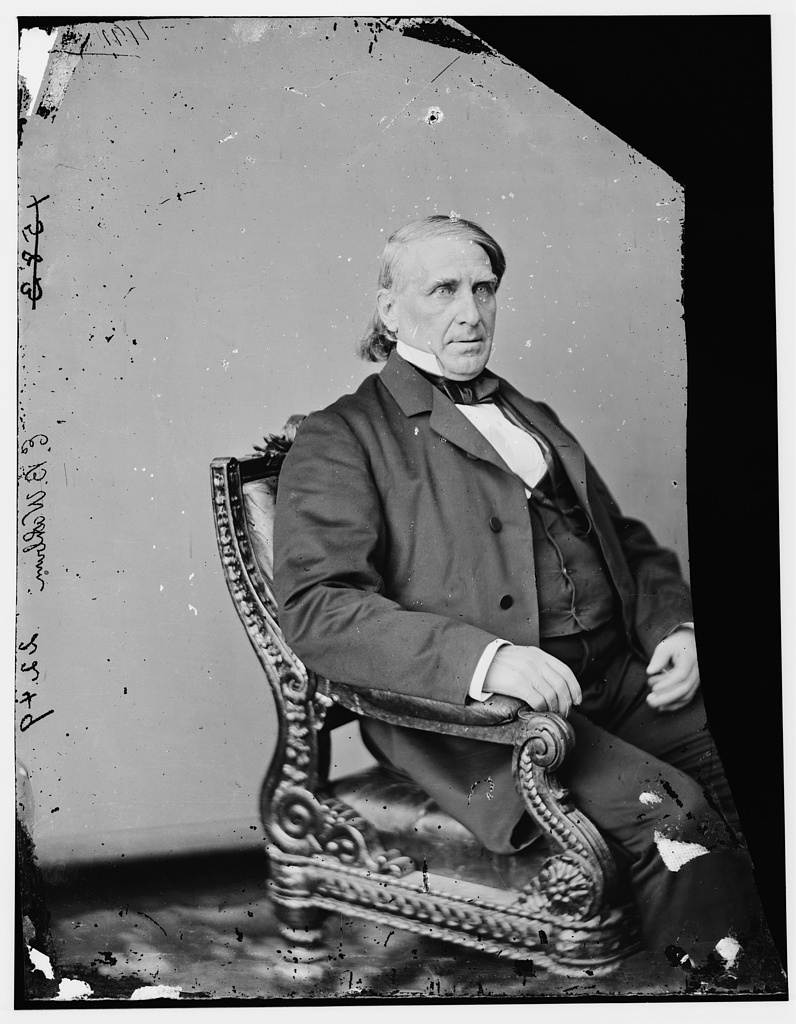
Republican Senator Thaddeus Stevens (Library of Congress).

Republican Senator Thaddeus Stevens (Library of Congress).

It’s surprising to hear of Thaddeus Stevens as a Meade supporter. Radical Republicans such as the Pennsylvania senator tended to eye men like Meade, perceived as being too close to George McClellan, with suspicion. As interesting as it is to hear a Radical Republican say something nice about Meade, it’s even more interesting to have Meade describe Philip Sheridan as “quite distinguished.” It will not be long before his opinion changes.

The Sypher Meade mentions is Josiah Sypher. Born in Liverpool, he studied law with Stevens and became a newspaper reporter/editor. After the war he wrote History of the Pennsylvania Reserve Corps: A Complete Record of the Organization ; and of the Different Companies, Regiments and Brigades ; Containing Descriptions of Expeditions, Marches, Skirmishes, and Battles ; Together with Biographical Sketches of Officers and Personal Records of Each Man During His Term of Service ; Compiled from Official Reports and Other Documents.

The Augur mentioned in this letter is General Christopher C. Augur. As commander of the Department of Washington, he was in a good position to acquire the photographs that Mrs. Meade desired.

I am sorry for your trouble about the generals. Augur happened to be in my tent when I received your letter, and I told him of your distress. He said if you would send him the names of those you wished, he thought he could get their photographs for you. I will ask Sheridan for his. He is our new cavalry commander, and quite distinguished.

I have to-night a note from a Mrs. Brown, 1113 Girard Street, on the Dry Goods Committee, asking for a lock of my hair, but I have been compelled to decline on the ground of the shortness of my locks.

The weather continues fine, and the time approaches for active operations. Some indications would lead to the belief that Lee will take the initiative, but I can hardly believe he will be so blind to the experience of the two past campaigns. The defensive policy is clearly the true one for him; still, he may not think so.

I don’t think I told you I had a visit from Mr. Sypher, formerly a correspondent of the Inquirer, but afterwards of the Tribune. He is a great friend of Thaddeus Stevens, and lives in the same house with him in Washington. He told me Mr. Stevens was a firm friend of mine, and recently, when some member was attacking me in conversation, he brought against me the charge that I was an aristocrat. Mr. Stevens laughed and said he knew all about my family, and he wished the country had more such aristocrats.

Meade’s correspondence taken from The Life and Letters of George Gordon Meade, Major-General United States Army, Vol. 2, (New York: Charles Scribner’s Sons, 1913), p. 192. Available via Google Books.