Conspiracy (March 8, 1864)

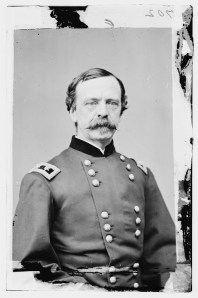
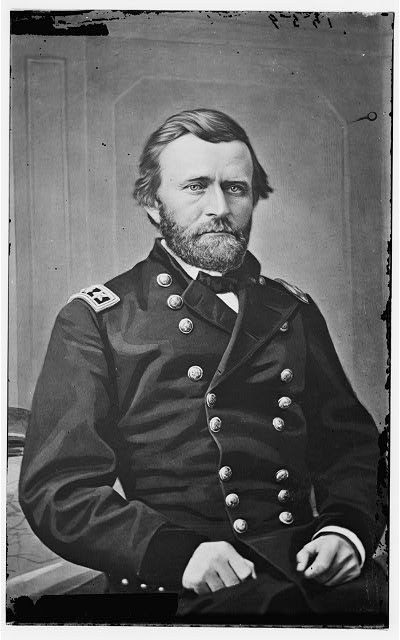
On March 9 Ulysses S. Grant will become general in chief of the Union armies (Library of Congress).

On March 9 Ulysses S. Grant will become general in chief of the Union armies (Library of Congress).

I am curious to see how you take the explosion of the conspiracy to have me relieved, for it is nothing less than a conspiracy, in which the Committee on the Conduct of the War, with Generals Doubleday and Sickles, are the agents. Grant is to be in Washington tonight, and as he is to be commander in chief and responsible for the doings of the Army of the Potomac, he may desire to have his own man in command, particularly as I understand he is indoctrinated with the notion of the superiority of the Western armies, and that the failure of the Army of the Potomac to accomplish anything is due to their commanders.

Meade’s correspondence taken from The Life and Letters of George Gordon Meade, Major-General United States Army, Vol. 2, (New York: Charles Scribner’s Sons, 1913), p. 176. Available via Google Books.

Congress (March 6, 1864)

Daniel Sickles commanded the III Corps at Gettysburg and began attacking Meade's reputation afterwards (Library of Congress).

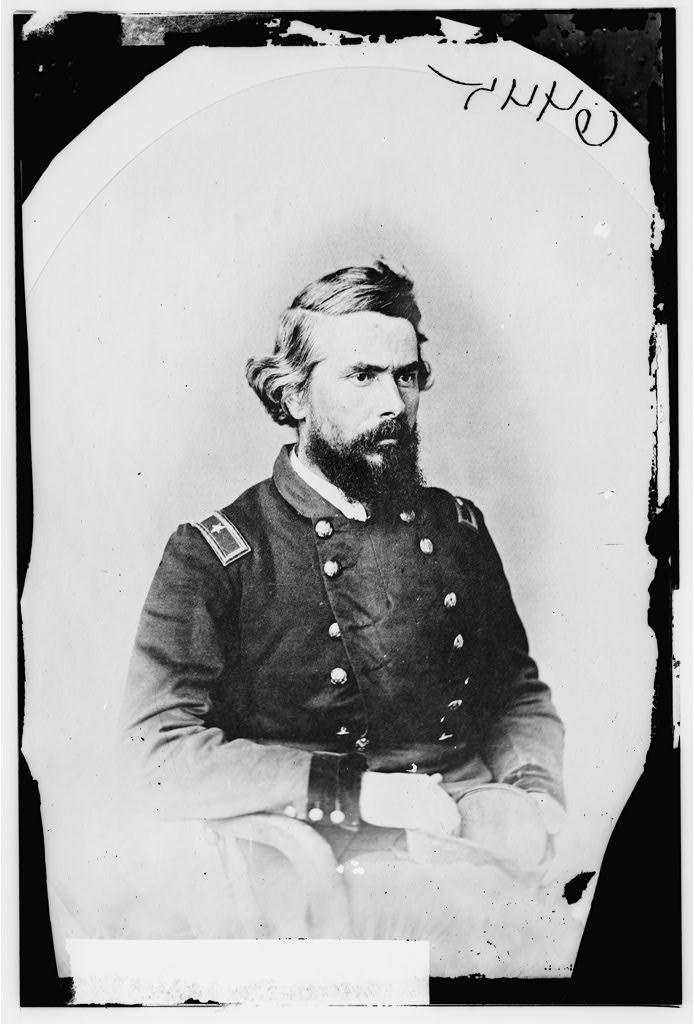
Daniel Sickles commanded the III Corps at Gettysburg and began attacking Meade’s reputation afterwards (Library of Congress).

We are now entering into a troubling time for George Gordon Meade, as he discovers his generalship is being questioned by the Joint Committee on the Conduct of the War, a Congressional body investigating the Union war effort. The driving forces behind the committee were Republican senators Zachariah Chandler of Michigan and Ben Wade of Ohio. Both of them despised General George McClellan and wanted to root out all taints of McClellanism from the Army of the Potomac. The found a willing ally in General Daniel Sickles, who had moved his III Corps forward at Gettysburg, lost a leg, and began spreading the story that Meade had intended to retreat from the battlefield; by helping precipitate the fighting on July 2, Sickles told people,  the III Corps had kept Meade from leaving. Other generals, including Abner Doubleday, also testified against Meade. Here’s what I write in Searching for George Gordon Meade: The Forgotten Victor of Gettysburg:

Starting in February 1864 and continuing through April, seventeen generals from the Army of the Potomac trooped through the Capitol’s corridors so they could testify in the basement room where members of the Joint Committee on the Conduct of the War examined its witnesses. They brought with them a collection of bruised egos, simmering resentments, and unrestrained ambition—leavened here and there by a dash of true patriotism and a desire to see more progress in the war.

Chandler and Wade wanted Joe Hooker returned to command, even though he was another West Pointer who had once resisted the idea of emancipation. Later, though, he apparently had seen which way the wind was blowing and shifted his position on that subject. His aggressive talk about fighting also made committee members think he was the aggressive, offensive-minded general they needed, Chancellorsville notwithstanding. Perhaps most important, Hooker showed no signs of political ambition; any military success he achieved would not create a potential rival at the ballot box.

Sickles was an equally unlikely ally for a committee dominated by Radical Republicans, for he was a partisan Democrat who had emerged from the highly politicized party machinery in New York City. Yet “the enemy of my enemy is my friend.” Sickles was out to get Meade and so was the committee.

Sickles testified on February 26. Wade asked all the questions. When he did not outright lie—for example, by saying the III Corps had occupied Little Round Top when it clearly had not—Sickles used his lawyer skills to carefully skirt the truth. For example, when he read into the record Meade’s Pipe Creek Circular, which he said demonstrated that Meade had intended to retreat from Gettysburg, he did not read this line: “Developments may cause the commanding general to assume the offensive from his present position.” In other words, it was a contingency plan, not a plan to retreat.

Abner Doubleday took over command of the I Corps at Gettysburg after the death of John Reynolds. Meade replaced him with John Newton and Doubleday never forgot the slight (Library of Congress).

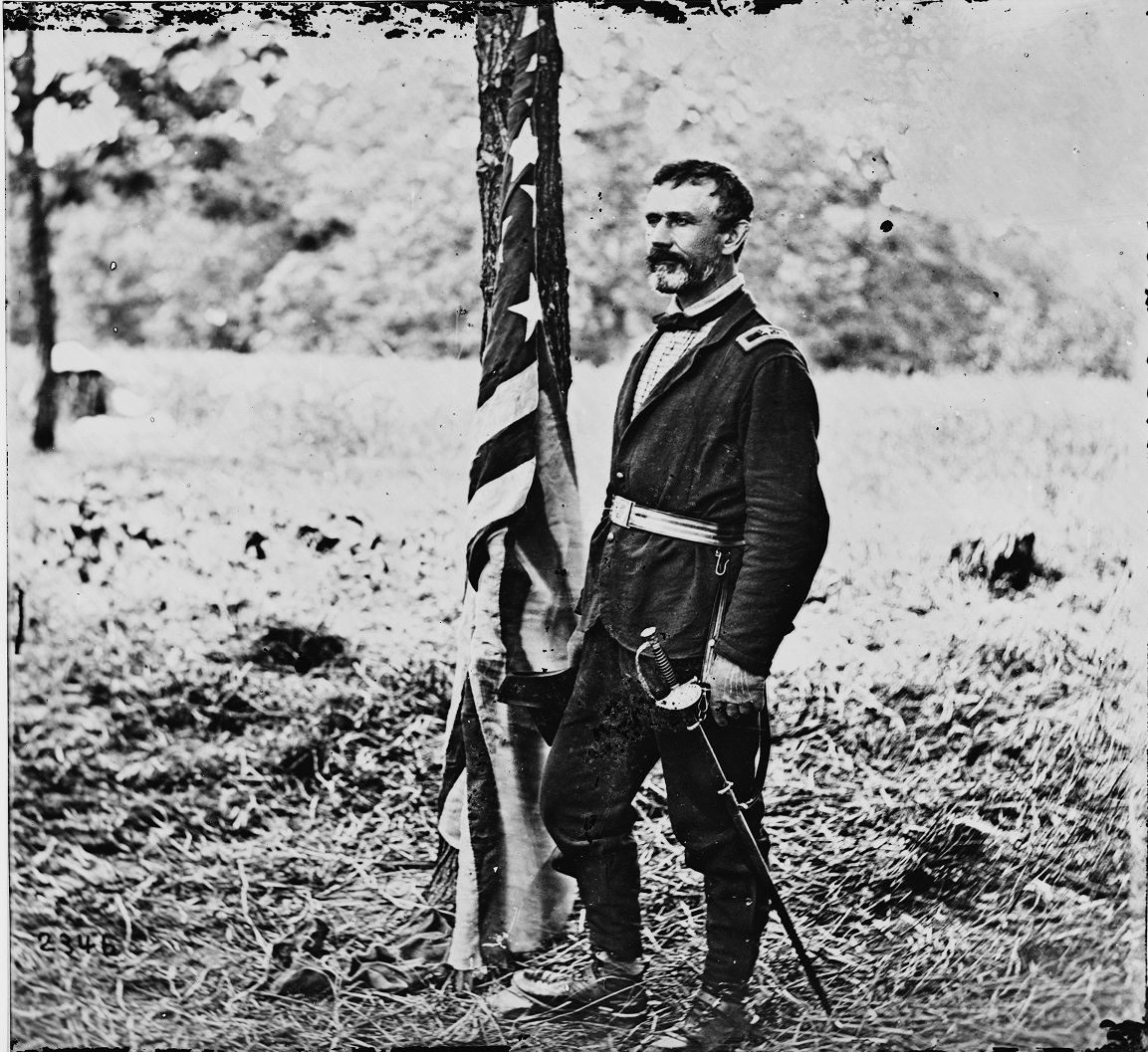
Abner Doubleday took over command of the I Corps at Gettysburg after the death of John Reynolds. Meade replaced him with John Newton and Doubleday never forgot the slight (Library of Congress).

Abner Doubleday testified on March 1. Like Sickles, he was still nursing grievances against Meade because Meade had replaced him at the head of the I Corps with John Newton following [John] Reynolds’s death. The aggrieved Doubleday told the committee that Meade’s plan was to make him and General [Oliver O.] Howard scapegoats in case the battle turned out badly. Meade, he said, liked to place his personal friends in power. “There has always been a great deal of favoritism in the army of the Potomac,” he claimed. “No man who is an anti-slavery man or an anti-McClellan man can expect decent treatment in that army as at present constituted.”

Brig. Gen. Albion Howe, “a zealot who despised anyone he thought to be an admirer of General McClellan,” had commanded a division of the VI Corps at Gettysburg. He continued Doubleday’s line of reasoning when he testified on March 3 and 4. Responding to some leading questioning by Wade, Howe explained that Meade and other generals in the Army of the Potomac had been tainted by the connection with McClellan., that there were “certain sympathies, feelings, and considerations of action which seem to govern now as they did then.” In fact, Howe decided, the problem within the Army of the Potomac was an epidemic of “copperheadism.”

After hearing all this Wade and Chandler went to see Stanton and Lincoln and urged them to replace Meade with Hooker . . . .

While in Washington Meade heard that Sen. Morton S. Wilkinson, a Republican from Minnesota and a Chandler ally, had attacked him on the Senate floor the previous day. Wilkinson told the Senate he had learned that before the Battle of Gettysburg, “the order went forth from the commander of that army to retreat; and but for the single fact that one of the corps commanders had got into a fight before the dispatch reached him, the whole army would undoubtedly have been retreating.”

At the end of his letter Meade mentions that the Kilpatrick/Dahlgren raid had failed. There will be repercussions from the raid to come later. For Meade’s report on the raid, from the Official Records, series, 1, volume 33, see below.

Senator Ben Wade of Ohio (via Wikipedia).

Senator Ben Wade of Ohio (via Wikipedia).

I returned from Washington to-day. I went there Friday morning on business connected with the reorganization of the army. The night before I left I saw Mr. Wilkeson’s attack on me in the Senate and Reverdy Johnston’s reply and defense. When I reached Washington I was greatly surprised to find the whole town talking of certain grave charges of Generals Sickles and Doubleday, that had been made against me in their testimony before the Committee on the Conduct of the War. On Saturday I was summoned before the committee. I found there only Mr. Wade, of Ohio. He was very civil, denied there were any charges against me, but said the committee was making up a sort of history of the war and was now taking evidence to enable it to give an account of the battle of Gettysburg, and my administration since commanding the army. I then occupied about three hours giving a succinct narrative of events. Subsequently Mr. Stanton told me (this is strictly confidential), that there was and had been much pressure from a certain party to get Hooker back in command, and that thinking, through Sickles and others, they might get me out (a preliminary step) they had gotten up this halloobaloo in the Committee on the Conduct of the War; but that I need not worry myself, there was no chance of their succeeding. The only evil that will result is the spreading over the country certain mysterious whisperings of dreadful deficiencies on my part, the truth concerning which will never reach the thousandth part of those who hear the lies. I suppose and fear you will be worried about them, but I beg you to be calm and quiet, and rest satisfied that I will come out all right in the end.

I saw nobody in Washington, except people about the Government, except Mr. Howard, of Michigan, whom I went to see and to whom I explained the absurd charge of Sickles, that I had ordered a retreat at Gettysburg, and that that battle was fought in spite of all my efforts to prevent it.

It is a melancholy state of affairs, however, when persons like Sickles and Doubleday can, by distorting and twisting facts, and giving a false coloring, induce the press and public for a time, and almost immediately, to take away the character of a man who up to that time had stood high in their estimation. However, I suppose we cannot change human nature; we must be patient, await the period when the truth will slowly and surely make itself be known.

You have doubtless seen that Kilpatrick’s raid was an utter failure. I did not expect much from it. Poor Dahlgren I am sorry for.
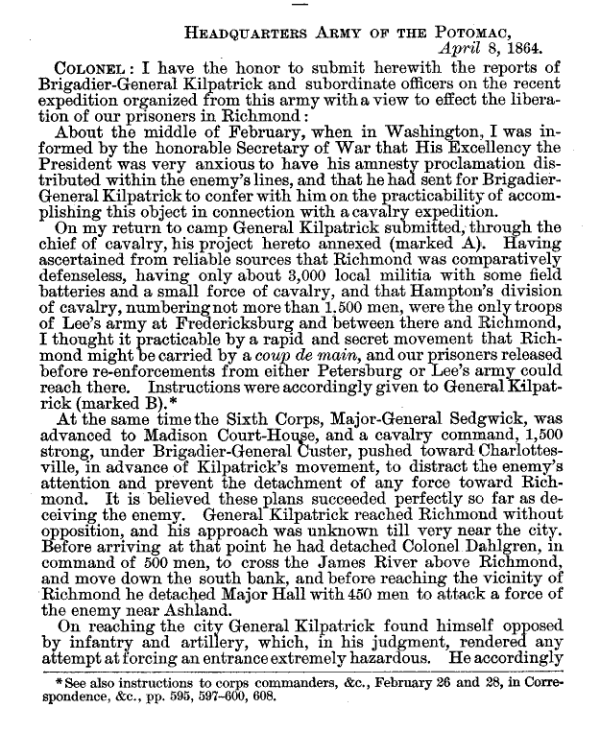
Meade's report on the Kilpatrick/Dahlgren raid, page 1

Meade’s report on the Kilpatrick/Dahlgren raid, page 1

Meade's report, page 2

Meade’s report, page 2

Meade’s correspondence taken from The Life and Letters of George Gordon Meade, Major-General United States Army, Vol. 2, (New York: Charles Scribner’s Sons, 1913), pp. 169-70. Available via Google Books.

Humphreys (March 5, 1864)

Gen. Andrew Humphreys, in a photo taken during the 1862 Peninsula campaign (Library of Congress).

Gen. Andrew Humphreys, in a photo taken during the 1862 Peninsula campaign (Library of Congress).

While George Meade is in Washington, dealing with some unpleasant matters on Capitol Hill and elsewhere (more about that in tomorrow’s post), Theodore Lyman writes a letter from the Army of the Potomac’s winter quarters. One thing he notes is the failure of the Kilpatrick/Dahlgren raid, and he touches on the political winds blowing the army’s way from Washington (including the movement up there to replace Meade with Joe Hooker).

He also writes about Andrew Humphreys, who became Meade’s chief of staff shortly after the battle of Gettysburg. Here’s what I wrote about him in Searching for George Gordon Meade: The Forgotten Victor of Gettysburg: “Humphreys was from Philadelphia. An engineer like Meade, he had graduated from West Point four years before him. He had served on McClellan’s staff and later commanded a division at Antietam and during the bloody battle for Marye’s Heights at Fredericksburg. As a division commander in the III Corps at Gettysburg he had held the right of Sickles’s advanced position. ‘He was a small, bow-legged man, with chopped-off, iron gray moustache; and when he lifted his army hat you saw a rather low forehead, and a shock of iron-gray hair,’ a staff member recalled. ‘His blue-gray dauntless eyes threw into his stern face the coldness of hammered steel.’ Assistant Secretary of War Charles Dana, who would get to know Humphreys during the Virginia Campaign of 1864, considered him to be ‘the great soldier of the Army of the Potomac.’ ‘He was a very interesting figure,’ Dana wrote. ‘He used to ride about in a black felt hat, the brim of which was turned down all around, making him look like a Quaker. He was very pleasant to deal with, unless you were fighting against him, and then he was not so pleasant. He was one of the loudest swearers that I ever knew.’ Although Humphreys desired a corps command, he consented to become Meade’s chief of staff, Dana believed, out of pure patriotism.”

Truman Seymour (Library of Congress).

Truman Seymour (Library of Congress).

The “Florida Reverse” Lyman mentions was the Battle of Olustree, a defeat for Union general Truman Seymour. Meade served with but did not like Seymour. In letters to his wife he had complained about the way Seymour used to suck up to John Reynolds, their Pennsylvania reserves division commander. Back in August 1862 Meade had written, “I am sad to say that Reynolds appears to be greatly under Seymour’s influence and I fear my position in the Reserves will not be as agreeable as it has been.” He reports a conversation in which Reynolds told Seymour that he, Seymour, would probably not be with the division long because he would certainly be made a major general. At that Reynolds caught Meade’s eye and hastily added, “Meade too for that matter.” No doubt Meade experienced a bit of schadenfreude over Seymour’s reverse.

General Andrew Atkinson Humphreys. (Library of Congress)

General Andrew Atkinson Humphreys. (Library of Congress)

I found myself late and galloped four miles in about twenty minutes, only to find I had heated the mare for nothing, insomuch that the venerable Humphreys had put off dinner to six p.m. That young man of fifty has gone in his ambulance to see, I presume, some ladies, and I will here and now wager that we don’t dine till eight p.m. Sich is his nature. Really he should be dismissed the service for conduct to the prejudice of good order and military discipline. Au reste, there never was a nicer old gentleman, and so boyish and peppery that I continually want to laugh in his face. I am in fear he won’t be confirmed as major-general. There are some persons, the very dregs of politicians, whom he tried by court-martial, when under him, that now do all they can against his promotion. I find that politicians, like [Charles] Sumner and company, have a way of saying of officers who have had their very clothes shot off their back and have everywhere displayed the utmost skill and courage, that “their hearts are not in the cause,” or “they are not fully with us”; meaning that these officers do not happen to fully agree with every political dogma the party may choose to enunciate. I am of the opinion that the question is: Does such and such an officer fight bravely and with skill? Anyone who has been under fire will be ready to acknowledge that it is a pretty good place to test principles; and if a man goes into the thick of it time and again, I do not ask any better proof of his earnestness. However, it would appear that Washington people often think the best test of faithfulness is to stay away from the fighting and make a good many speeches to people who entirely agree with your sentiments. To my certain knowledge, great exertions are now making to put a man at the head of this army who has made one of the most bloody failures of the War, and who is utterly incompetent to the post. Why is he pushed? Because he professes to be an ultra-Republican, ah, voila! . . .

Pa Meade is at Washington but I hope to have him back to-morrow. Behold my prophecy in regard to Killcavalry’s raid fulfilled. I have heard many persons very indignant with him. They said he went to the President and pressed his plan; told Pleasonton he would not come back alive if he didn’t succeed; that he is a frothy braggart, without brains and not over-stocked with desire to fall on the field; and that he gets all his reputation by newspapers and political influence. These charges are not new and I fancy Kill has rather dished himself. It is painful to think of those poor prisoners hearing the sound of his guns and hoping a rescue was at hand! Now all that cavalry must be carried back in steamers, like a parcel of old women going to market! Bah! Pour moi, I say nothing, as I never criticize superior officers; but I have mine own opinions, quite strong. However, these raids and the like do not much affect the War one way or the other. Nor does such a thing as the Florida reverse. Things have narrowed down now to two or three great centres, and upon large operations there depends the result. It is a favorite remark of General Meade, that “there is but one way to put down this rebellion, namely, to destroy the military power of the Rebels.” Their great armies must be overwhelmed, and there will end their hopes. . . .

Theodore Lyman’s letter is from Meade’s Headquarters, 1863-1865: Letters of Colonel Theodore Lyman from the Wilderness to Appomattox, pp 78-80. Edited by George R. Agassiz. Boston, Massachusetts Historical Society, 1922. Available via Google Books.
The Raid Continues (March 2, 1864)

As Judson Kilpatrick and Ulric Dahlgren make their move on Richmond, the Army of the Potomac waits anxiously for news. Kilpatrick did not allow George Armstrong Custer on his raid, “no doubt a punishment for past insubordination,” as Kilpatrick biographer Samuel J. Martin speculates. Instead, Custer makes a diversionary attack.

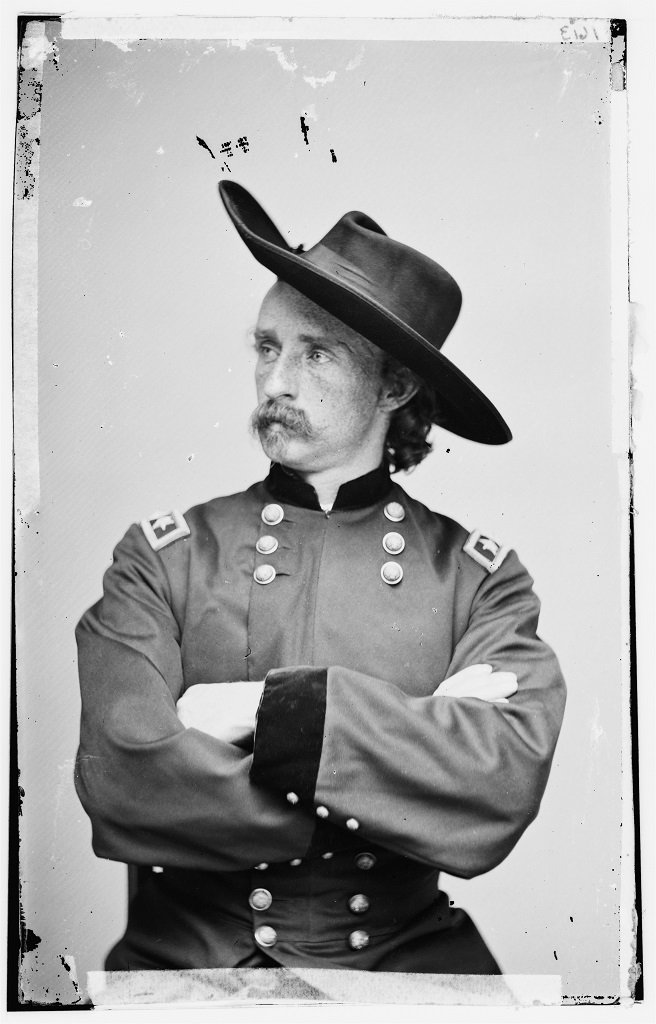
George Armstrong Custer (Library of Congress).

George Armstrong Custer (Library of Congress).

We have all been in a state of excitement about our recent cavalry raids. On the 28th, I moved the Sixth Corps and part of the Third to Madison Court House, threatening the enemy’s left flank. At the same time Custer, with fifteen hundred cavalry and two pieces of artillery, was sent to Charlottesville to try and cut the Gordonsville and Lynchburg Railroad near that place, where there is an important bridge over the Ravenna River. Custer got within two miles of the bridge, but found it too strongly guarded. He, however, skirmished with the enemy, destroyed and captured a great deal of property, took fifty prisoners, and on his return cut his way through a large cavalry force, commanded by Jeb. Stuart, that had been sent to cut him off, thus being quite successful. In the meantime, while the enemy’s attention was fully occupied with Custer, and they were under the impression I was moving in that direction, Kilpatrick, with four thousand cavalry and six guns, at night crossed the Rapidan on our left and pushed straight for Richmond. He fortunately captured the picket on the Rapidan, thus preventing early intelligence of his movement being communicated. He left Sunday night, and the last we have heard of him was Monday afternoon, when he was within thirty miles of Richmond. Of course you can imagine our anxiety to know his fate. If he finds Richmond no better guarded than our information says it is, he will have a great chance of getting in and liberating all the prisoners, which is the great object of the movement. God grant he may, for their sakes and his.

I suppose you have seen by the papers that I have been confirmed as a brigadier general in the regular army.

Meade’s correspondence taken from The Life and Letters of George Gordon Meade, Major-General United States Army, Vol. 2, (New York: Charles Scribner’s Sons, 1913), pp. 168-9. Available via Google Books.

The Raid (March 1, 1864)

Judson Kilpatrick, the controversial cavalry commander (Library of Congress).

Judson Kilpatrick, the controversial cavalry commander (Library of Congress).

Here’s Theodore Lyman’s behind-the-scenes look at the start of the Kilpatrick/Dahlgren raid  on Richmond. Maj. Gen. John Sedgwick’s VI Corps and Custer’s brigade of cavalry were designed to divert Confederate attention from the raid. After Lyman’s letter I include the report that Meade prepared for Henry Halleck (still the commander-in-chief of the Union armies, but not for long) on March 1 about the raid’s progress to that point. General Andrew Humphreys is Meade’s chief of staff.

. . . For some days General Humphreys has been a mass of mystery, with his mouth pursed up, and doing much writing by himself, all to the great amusement of the bystanders, who had heard, even in Washington, that some expedition or raid was on the tapis, and even pointed out various details thereof. However, their ideas, after all, were vague; but they should not have known anything. Que voulez-vous? A secret expedition with us is got up like a picnic, with everybody blabbing and yelping. One is driven to think that not even the prospect of immediate execution will stop Americans from streaming on in their loose, talking, devil-may-care ways. Kilpatrick is sent for by the President; oh, ah! everybody knows it at once: he is a cavalry officer; it must be a raid. All Willard’s chatters of it. Everybody devotes his entire energies to pumping the President and Kill-cavalry! Some confidential friend finds out a part, tells another confidential friend, swearing him to secrecy, etc., etc. So there was Eleusinian Humphreys writing mysteriously, and speaking to nobody, while the whole camp was sending expeditions to the four corners of the compass! On Saturday, at early morn, Uncle John Sedgwick suddenly picked up his little traps and marched with his Corps through Culpeper and out towards Madison Court House, away on our right flank. The next, the quiet Sabbath, was broken by the whole of Birney’s division, of the 3d Corps, marching also through Culpeper, with the bands playing and much parade. We could only phancy the feeling of J. Reb contemplating this threatening of his left flank from his signal station on Clark’s Mountain. Then the flaxen Custer, at the head of cavalry, passed through, and wended his way in the same direction. All this, you see, was on our right. That night Kilpatrick, at the head of a large body of cavalry, crossed at Ely’s Ford, on our extreme left, and drew a straight bead on Richmond! At two oclock that night he was at Spotsylvania C. H., and this is our last news of him. He sent back word that he would attack Richmond at seven this morning. The idea is to liberate the prisoners, catch all the rebel M. C.’s that are lying round loose, and make tracks to our nearest lines. I conceive the chances are pretty hazardous, although the plan was matured with much detail and the start was all that could be asked. . . .

Theodore Lyman’s letter is from Meade’s Headquarters, 1863-1865: Letters of Colonel Theodore Lyman from the Wilderness to Appomattox, pp 76-8. Edited by George R. Agassiz. Boston, Massachusetts Historical Society, 1922. Available via Google Books.

 Meade’s report is from the Official Records, ser. 1, Vol. 33, p. 169:

Meade March 1

Leap Year (February 29, 1864)

Alexander Gardner took this photograph at Fairfax Court House in June 1863, just before the start of the Gettysburg Campaign. He called it "Studying the Art of War." Ulric Dahlgren is the man standing. The man in the center is Count Ferdinand von Zeppelin, in the United States to observer. He will later become famous for the airships he develops. At the far right is Lt. Rosencranz, who will later serve on Meade's staff. Theodore Lyman mentions him often in his writings. To read Gardner's extensive caption for this photo, see below (Library of Congress).

Alexander Gardner took this photograph at Fairfax Court House in June 1863, just before the start of the Gettysburg Campaign. He called it “Studying the Art of War.” Ulric Dahlgren is the man standing. The man crouching  in the center is Count Ferdinand von Zeppelin, in the United States to observe the war. He will become known for the airships he later develops. Reclining is Joseph Dickinson. At the far right is Lt. Frederick Rosencrantz, who will later serve on Meade’s staff. Theodore Lyman mentions him often in his writings. Benjamin Ludlow, at left, was another Meade staffer. To read Gardner’s extensive caption for this photo, see below (Library of Congress).

1864 was a leap year, hence this letter from February 29. It is Meade’s last letter from February. March will be an eventful month, marking the arrival of Ulysses S. Grant, the investigations by the Joint Committee on the Conduct of the War, the reorganization of the Army of the Potomac, and the fallout from the Kilpatrick/Dahlgren raid on Richmond. As the last paragraph of Meade’s letter points out, March will also bring Ulysses S. Grant, the new general-in-chief of the Union armies, a post held until now by Henry Halleck.

Yesterday Mr. Dorr, from Christ Church, preached for us, and afterwards dined and spent the evening with me. During the evening one of the escaped prisoners from Libby prison, who had made his way from Richmond right through the main body of Lee’s army and into our lines, came to see me, and Mr. Dorr seemed very much interested in the narrative of his adventures. He returned home this morning, delighted with his visit to the army and all he had seen. He has a son who is a captain in Chapman Biddle’s regiment, the One Hundred and Twenty-first Pennsylvania Volunteers.

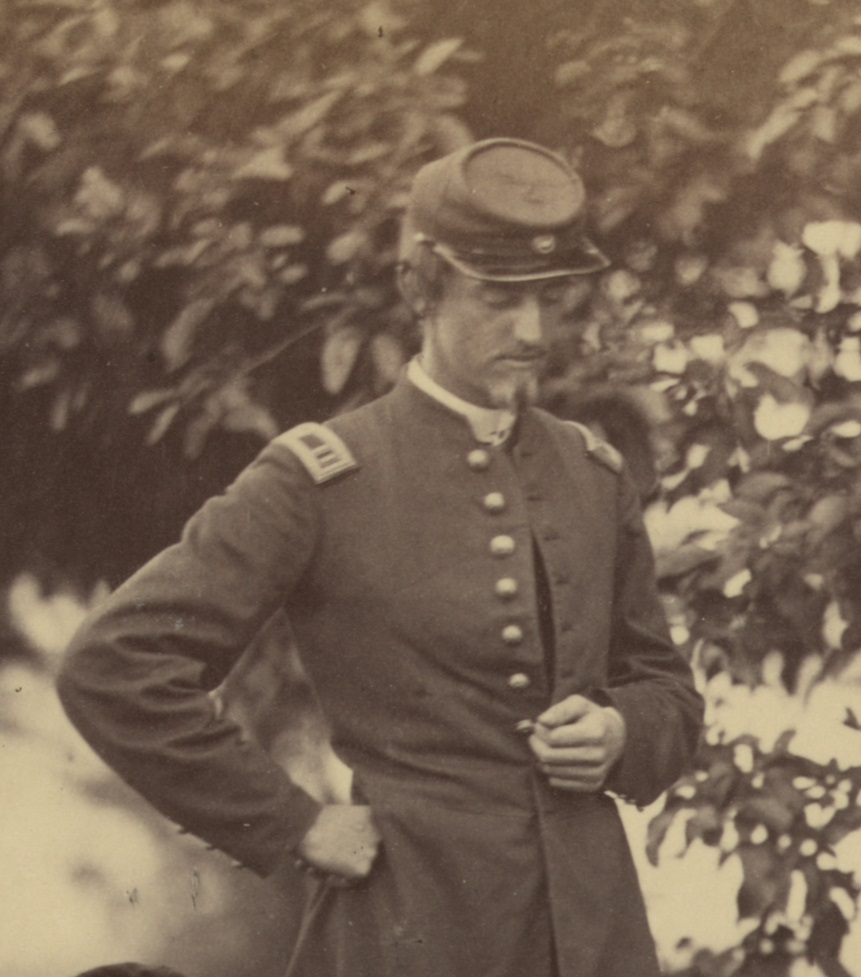
Ulric Dahlgren, in a close-up from Gardner's photograph (Library of Congress).

Ulric Dahlgren, in a close-up from Gardner’s photograph (Library of Congress).

My cavalry expedition for Richmond got off last night, and at 2 a.m., the last I heard from them, they were getting on famously, not having met any one or being, as far as they could tell, discovered by the enemy. I trust they will be successful; it will be the greatest feat of the war, if they do succeed, and will immortalize them all. Young Dahlgren, with his one leg, went along with them. The weather from having been most favorable, now that the expedition has gone, begins to look suspicious, and to-night we have a little rain.

I see Congress has passed the Lieutenant General bill. This will make Grant Commander-in-Chief; what will become of Halleck I can’t tell, and possibly when Grant is responsible for all military operations, he may want some one else whom he knows better in command of this army.

Meade’s correspondence taken from The Life and Letters of George Gordon Meade, Major-General United States Army, Vol. 2, (New York: Charles Scribner’s Sons, 1913), p. 168. Available via Google Books.
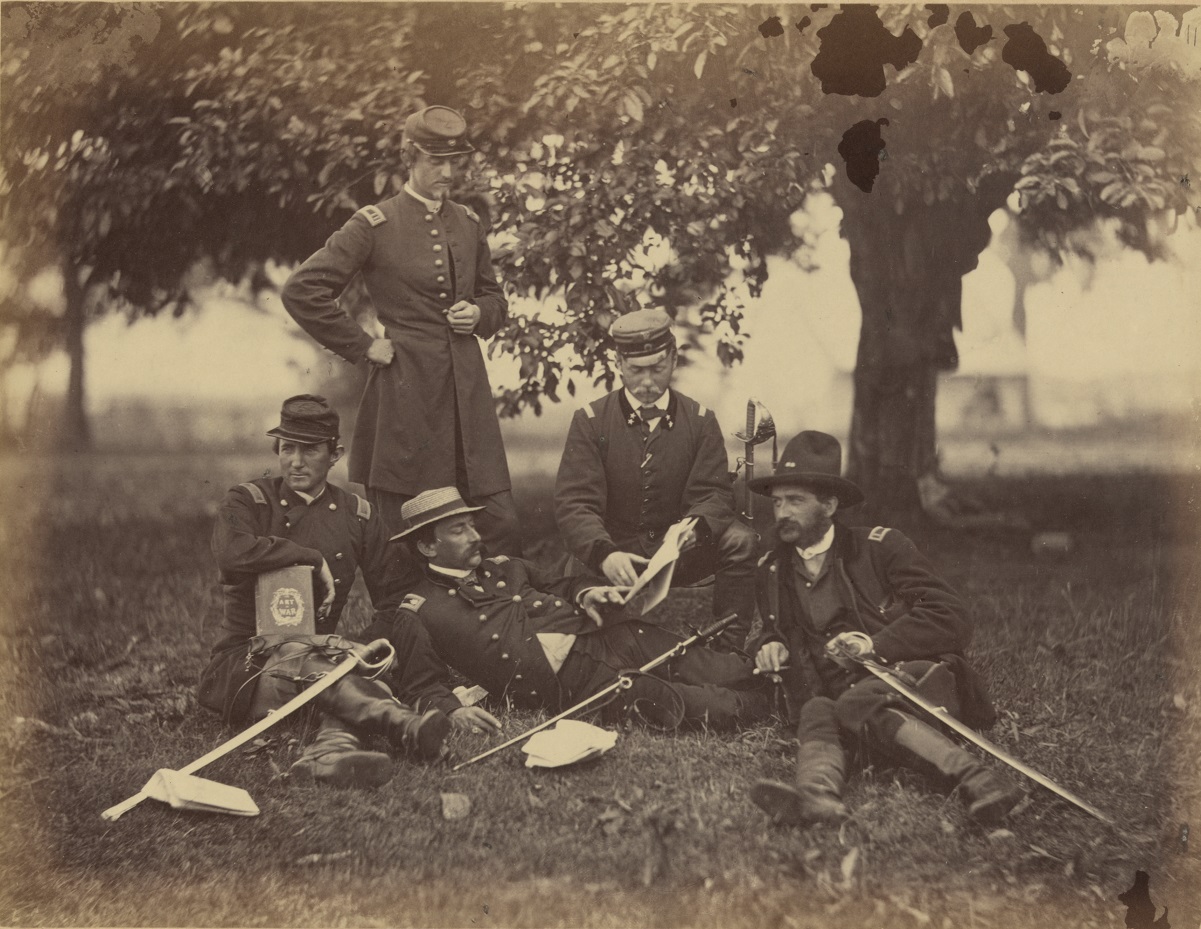
This is what Gardner wrote about “Studying the Art of War,” in a caption that appeared in Gardner’s Photographic Sketchbook of the War:

A group at the headquarters, near Fairfax Court-House, taken in June, 1863. Thoughtful and erect, the most prominent figure is Colonel Ulric Dahigren, then a Captain on the Staff of General Meade. Handsome, chivalric, one of the bravest of the brave, his character was fitly compared to that of the good knight, the Chevalier Bayard, and like him, he was truly “sans peur et sans reproche.” So noble a man, that of all the heroes who have perished for the nation, his loss is the hardest to realize. The story of his short but brilliant career has been written by abler hands, and is now a “household word.” Of its closing scenes, the writer narrowly escaped being a witness, having been invited to accompany the Colonel on that ill-starred expedition by which his life was sacrificed. Just recovering from the loss of his leg, and suffering acutely from any physical exertion, his active spirit could not be controlled, when he thought of his brothers in arms pining under the cruelties of Libby and Belle Isle. No ruthless raid was his, but a Christian effort to help the despairing Union Prisoners. None, who knew him, need be told how false was the document, claimed to have been found upon his person. General Meade, suspecting his inability to undergo the fatigues of an expedition in the inclement weather of February, was disinclined to give him permission; but Dahlgren, determined on his purpose, mounted his horse, and proceeding to a review of the Second Corps, rode so fearlessly over the fields, and under his frank smile, so well hid all traces of bodily suffering, that the General reluctantly permitted him to depart. After the review, when he came over (for the retirement it offered) to the writer’s tent, it was too evident how fearful had been the effort of his will.

The officer upon the ground, wearing a straw hat, is Lieutenant-Colonel [Joseph] Dickinson, Assistant Adjutant General to General Hooker a position he held from the time that General first commanded a brigade, until the battle of Gettysburg. In that action the Colonel was hit in the arm with a link of a chain, thrown with other misiles from a rebel shell. On the recovery of his wound he retired from the service, The gentleman in foreign uniform is Count Zeppelin, of the Prussian army, then on a visit to this country. On the left is the figure of Major [Benjamin] Ludlow, since better known as the General in Command of the Colored Brigade, which excavated, under a continual and heavy fire, the canal on the James, called Dutch Gap. The perils of that undertaking he faithfully shared, from first to last, doing much, by his cheerful bearing and example, to support his troops in their perilous work. The last of the group is Lieutenant (since Lieutenant Colonel) Rosencranz, a Swedish officer, on leave of absence, and occupying successively the position of Personal Aid upon the Staff of Generals McClellan, Burnside, Hooker, and Meade. A very reliable soldier, and one of the best Aids on the Staff, his genial disposition, unfailing amiability, and keen appreciation of humor, made him acceptable everywhere. He was probably as well known as any officer in the field.

A Desperate Undertaking (February 27, 1864)

In this letter Meade alludes to an upcoming raid on Richmond. The story of this raid will continue in Meade’s future letters. Led by Judson Kilpatrick with assistance by one-legged Ulric Dahlgren, who lost his limb fighting in Hagerstown during the Gettysburg campaign, it will not end well. There will be repercussions.

I am glad George wrote you an account of the ball. I should have been delighted, if I had owned the carpet in the Arabian Nights to have transported sister and yourself to the army for that night, but the journey here and back, the expense and fatigue, besides exposure, were all drawbacks, greater than the compensation to be found in the pleasure of your presence.

I have been a good deal occupied with an attempt I am about making, to send a force of cavalry into Richmond to liberate our prisoners. The undertaking is a desperate one, but the anxiety and distress of the public and of the authorities at Washington is so great that it seems to demand running great risks for the chances of success.

Meade’s correspondence taken from The Life and Letters of George Gordon Meade, Major-General United States Army, Vol. 2, (New York: Charles Scribner’s Sons, 1913), pp. 167-8. Available via Google Books.
A Ball and a Review (February 24, 1864)

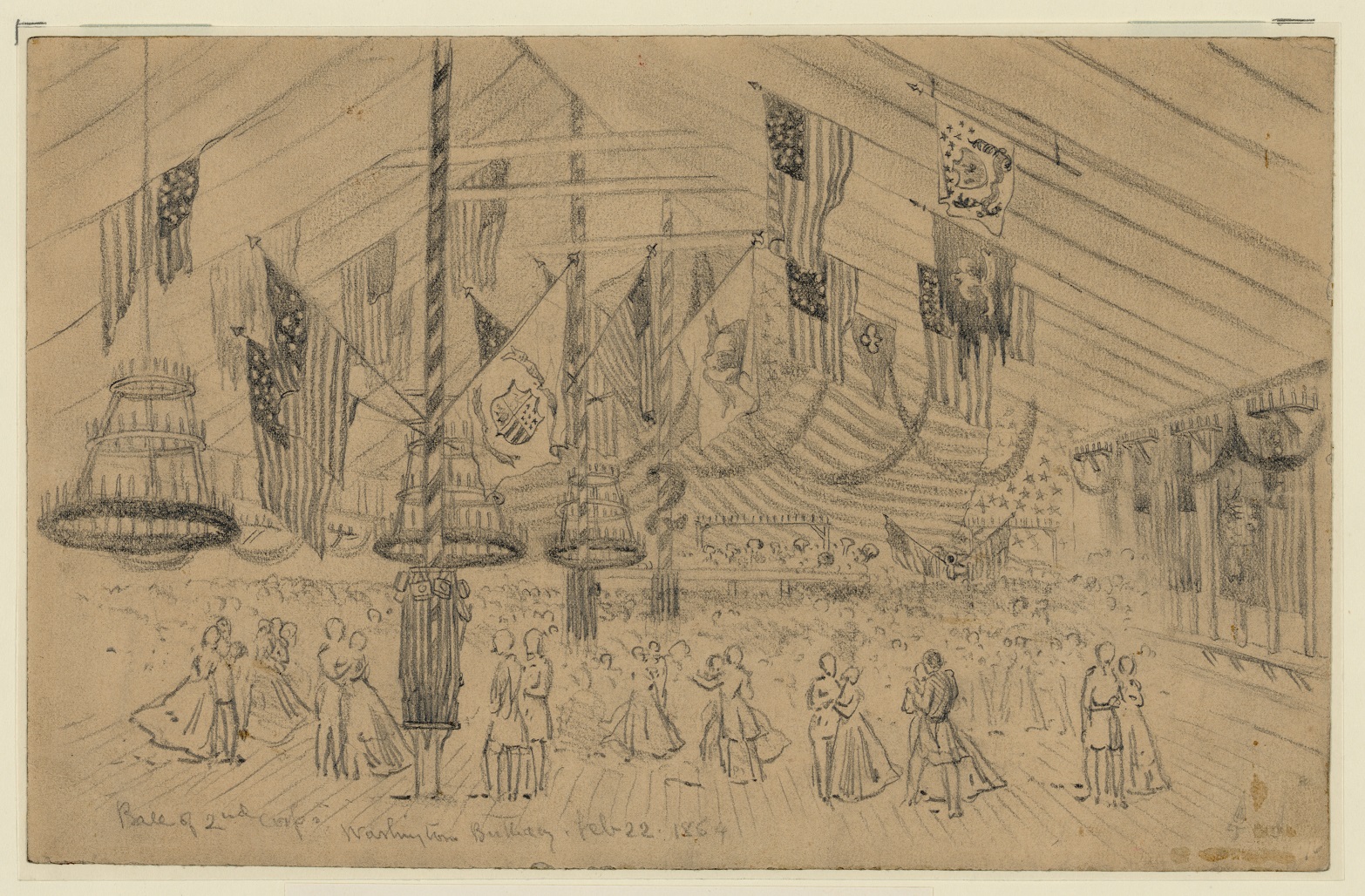
Artist Edwin Forbes sketched the 2nd Corps ball, held in honor of Washington's Birthday, 1864. Click to enlarge (Library of Congress).

Artist Edwin Forbes sketched the 2nd Corps ball, held in honor of Washington’s Birthday, 1864. Click to enlarge (Library of Congress).

Today we have the opportunity to see how General Meade and his aide, Theodore Lyman, wrote about events in the Army of the Potomac in letters composed on the same day. Meade first:

Since writing last we have had quite a gay time. The ball of the Second Corps came off on the 22d, and was quite a success. The room constructed for the purpose was beautifully decorated. There were present about three hundred ladies, many coming from Washington for the occasion, an elegant supper furnished by Gautier, indeed everything in fine style. I rode over in an ambulance a distance of five miles, and got back to my bed by four o’clock in the morning. The next day I reviewed the Second Corps for the benefit of our lady guests. I mounted my horse at 11 o’clock, rode over to the review and got back at six, having been seven hours in the saddle, and I believe I was less fatigued than any of my staff, so you can judge I have quite recovered my strength. George went to the ball and enjoyed himself hugely.

And here’s Lyman’s account, which provides much more detail than Meade’s rather terse description. Governor Sprague is the governor of Rhode Island; the vice president is Hannibal Hamlin of Maine. The “Abbott” Lyman mentions is fellow Harvard graduate Henry Abbott. Within a few months, in the Wilderness, Lyman will sit by Abbott’s hospital bed and watch him die of his wounds.

Judson Kilpatrick. Lyman did not think much of him (Library of Congress)

Judson Kilpatrick. Lyman did not think much of him (Library of Congress)

…I went yesterday to a review of the 2d Corps gotten up in honor of Governor Sprague. It was some seven or eight miles away, near Stevensburg, so that it was quite a ride even to get there. General Meade, though he had been out till three in the morning at the ball, started at eleven, with the whole Staff, including General Pleasonton and his aides, the which made a dusty cavalcade. First we went to the Corps Headquarters, where we were confronted by the apparition of two young ladies in extemporaneous riding habits, mounted on frowsy cavalry horses and prepared to accompany. General Meade greeted them with politeness, for they were some relations of somebody, and we set forth. The review was on a large flat (usually very wet, but now quite dry, yet rather rough for the purpose) and consisted of the Corps and Kilpatrick’s division of cavalry. When they were all ready, we rode down the lines, to my great terror, for I thought the womenkind, of whom there were half a dozen, would break their necks; for there were two or three ditches, and we went at a canter higglety-pigglety. However, by the best of luck they all got along safe and we took our place to see the troops march past. We made a funny crowd: there were the aforesaid ladies, sundry of whom kept chattering like magpies; then the Hon. Senator Wilkinson of Minnesota, in a suit of faded black and a second-hand felt that some officer had lent him. The Honorable rode bravely about, with a seat not laid down in any of the textbooks, and kept up a lively and appropriate conversation at the most serious parts of the ceremony. “Wall, Miss Blunt, how do you git along? Do you think you will stan’ it out?” To which Miss Blunt would reply in shrill tones: “Wall, I feel kinder tired, but I guess I ‘ll hold on, and ride clear round, if I can.” And, to do her justice, she did hold on, and I thought, as aforesaid, she would break her neck. Then there was his Excellency, the Vice-President, certainly one of the most ordinary-looking men that ever obtained the suffrages of his fellow citizens. Also little Governor Sprague, a cleanly party, who looked very well except that there is something rather too sharp about his face. Likewise were there many womenkind in ambulances discreetly looking on. The cavalry came first, headed by the valiant Kilpatrick, whom it is hard to look at without laughing. The gay cavaliers themselves presented their usual combination of Gypsy and Don Cossack. Then followed the artillery and the infantry. Among the latter there was a good deal of difference; some of the regiments being all one could wish, such as the Massachusetts 20th, with Abbot at its head; while others were inferior and marched badly. Thereafter Kill-cavalry (as scoffers call him) gave us a charge of the 500, which was entertaining enough, but rather mobby in style. And so home, where we did arrive quite late; the tough old General none the worse.

Edwin Forbes sketched the stand where the band played at the 2nd Corps' ball. Click to enlarge (Library of Congress).

Edwin Forbes sketched the stand where the band played at the 2nd Corps’ ball. Click to enlarge (Library of Congress).

Meade’s correspondence taken from The Life and Letters of George Gordon Meade, Major-General United States Army, Vol. 2, (New York: Charles Scribner’s Sons, 1913), p. 167. Available via Google Books.
Theodore Lyman’s letter is from Meade’s Headquarters, 1863-1865: Letters of Colonel Theodore Lyman from the Wilderness to Appomattox, pp 75-6. Edited by George R. Agassiz. Boston, Massachusetts Historical Society, 1922. Available via Google Books.

Excellent Spirits (February 22, 1864)

For those who can’t get past the image of George Gordon Meade as “the old goggle-eyed snapping turtle,” the idea of the general cracking jokes and telling stories may come as a surprise. But such accounts provide the joy of reading Theodore Lyman’s accounts of his life with the Army of the Potomac and the detailed portraits of Meade and the other generals he encounters. Here he talks about not only Meade but also chief of staff Andrew Humphreys, another general with a temper (and an admirable command of profanity).

In this letter Lyman touches on the question of African-Americans serving in the army. Lyman was not in favor of it. Later in the spring he will write, “Can we not fight our own battles, without calling on these humble hewers of wood and drawers of water, to be bayoneted by the unsparing Southerners?” The idea that these may also be the black man’s battles did not seem to cross his mind. Ironically, one of Lyman’s Harvard friends had been Robert Gould Shaw, who will die commanding the black troops of the 54th Massachusetts.

The Mr. Kennedy of the Census Bureau was Joseph C.G. Kennedy, who served as the bureau’s head from 1853-1855 and again from 1860-1865. According to the bureau’s website, “Joseph Kennedy was a major innovator in census taking; specializing schedules to cover specific demographic areas and centralizing data processing to improve control and efficiency.”

A tale of two tempers: Meade and Humphreys (Library of Congress).

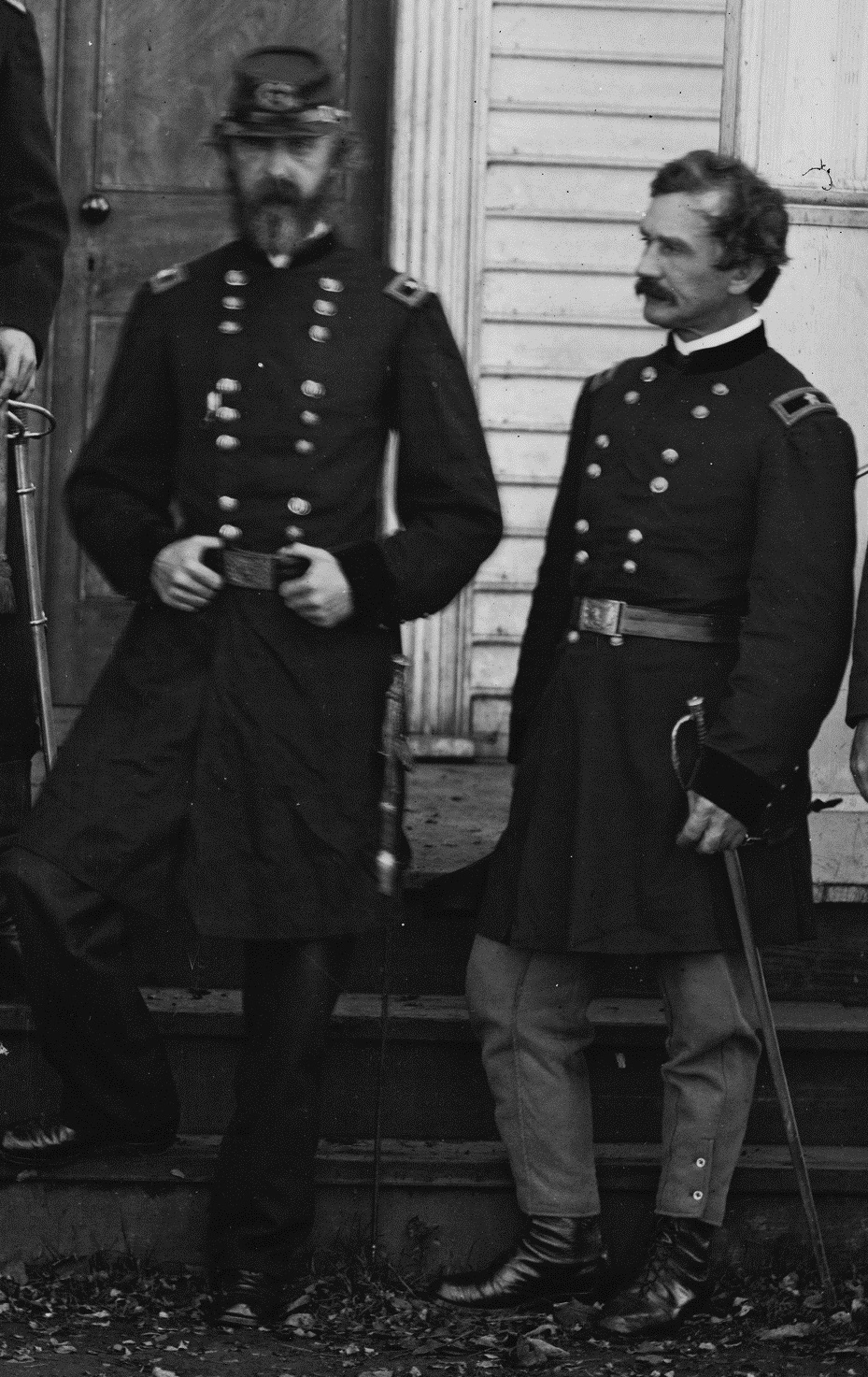
A tale of two tempers: Meade and Humphreys (Library of Congress).

General Meade is in excellent spirits and cracks a great many jokes and tells stories. You can’t tell how different he is when he has no movement on his mind, for then he is like a firework, always going bang at someone, and nobody ever knows who is going to catch it next, but all stand in a semi-terrified state. There is something sardonic in his natural disposition, which is an excellent thing in a commander; it makes people skip round so. General Humphreys is quite the contrary. He is most easy to get on with, for everybody; but, practically, he is just as hard as the Commander, for he has a tremendous temper, a great idea of military duty, and is very particular. When he does get wrathy, he sets his teeth and lets go a torrent of adjectives that must rather astonish those not used to little outbursts. There came down with the General (who returned yesterday from Washington) a Mr. Kennedy, Chief of the Census Bureau, a very intelligent man, full of figures. He can tell you how many people have pug noses in Newton Centre, and any other little thing you want. There was a bill passed in the House of Reps to raise 100,000 negro troops, from the free colored men of the North. When the bill came before the Senate, Mr. Kennedy sent in word that there were less than 50,000 colored men who were free and capable of bearing arms in the whole North, which rather squelched the bill! He says that the free negroes South increase hardly at all; while those in the North even decrease; but the slaves increase more than any other class. So I think it will be best to free the whole lot of them and then they will sort of fade out.

There are perfect shoals of womenkind now in the army — a good many, of course, in Culpeper, where they can live in houses. The rest of them must live a sort of Bedouin life. The only one I have seen of late is Mrs. Captain Commissary Coxe, for behold we had a service al fresco, near General Patrick’s tent. There was Mr. Rockwell as clergyman, quite a good preacher, and very ready to speak, nevertheless not too long in his remarks. I marched over with a camp-stool very solemnly. There were quite a collection of officers from the Headquarters, also a company of cavalry, which was marched down dismounted and stood meekly near by; for this cavalry belongs to General Patrick, and the General is pious, and so his men have to be meek and lowly. Likewise came some of the red-legs, or Zouaves, or 114th Pennsylvania, who finally had an air of men who had gone to a theatre and did not take an interest in the play. There too were some ladies, who were accommodated with a tent open in front, so as to allow them to see and hear. The band of the Zouaves sang the hymns and were quite musical. .. . To-night is a great ball of the 2d Corps. The General has gone to it; also General Humphreys. None of the Staff were invited, save George Meade, to the huge indignation of the said Staff and my great amusement.

Theodore Lyman’s letter is from Meade’s Headquarters, 1863-1865: Letters of Colonel Theodore Lyman from the Wilderness to Appomattox, pp 73-5. Edited by George R. Agassiz. Boston, Massachusetts Historical Society, 1922. Available via Google Books.

Washington Fatigue (February 21, 1864)

One of the tasks facing Meade in the winter of 1864 was working with Henry Halleck and others in Washington, D.C., to reorganize the Army of the Potomac. Big changes were afoot, with some corps destined to be sent west and others to be eliminated completely. The congressman Meade mentions is Moses Odell, a Democrat from New York. It would be interesting to know what the two men talked about. The only House Democrat on the Joint Committee on the Conduct of the War, which will target Meade in the spring, Odell will support the general on an otherwise hostile panel. Judge Harris is probably Ira Harris, who had served on the New York State Supreme Court before becoming a Republican senator from that state. Speaker Colfax is Schuyler Colfax of Indiana, who had been elected Speaker of the House back in December.

Congressman Moses Odell, a Democratic congressman from New York (Wikipedia).

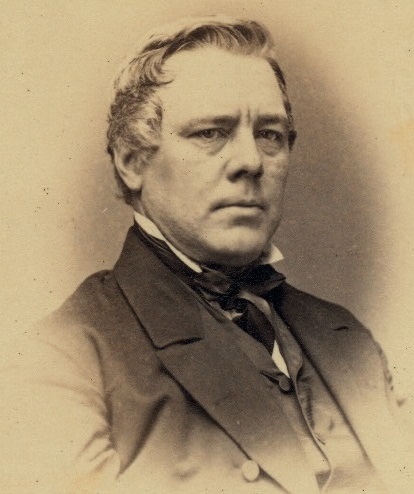
Congressman Moses Odell, a Democratic congressman from New York (Wikipedia).

I returned from Washington to-day, very much fatigued and worn out with two days passed in that place. I reached there Friday about 2 P. M., and immediately went to the Department, where I stayed till 6 P. M., returned to the hotel, dined, and spent the evening with Mr. Odell, member of Congress, and Judge Harris. The next day, Saturday, I was with General Halleck till 3 P. M., when I went out to Georgetown and saw Margaret [Meade’s sister]. I ought to have mentioned that before going to see Margaret, I stopped at the President’s, where Mrs. Lincoln was holding a levee, and spent a half-hour. I also ought to have stated that the evening before, after leaving Judge Harris, I was persuaded by Mr. Harding and Cortlandt Parker to go to Speaker Colfax’s reception, where I was a great lion, Mr. Colfax himself turning usher and bringing every man and woman in the room to introduce to me. All this going about, sitting up late at night and standing so much, had its effect on me, wearying and fatiguing me so that I was very glad to get back to-day.

The army is overrun with women. There is to be a grand ball to-morrow at the headquarters of the Second Corps, and I believe half of Washington is coming down to attend. I expected the Secretary of the Interior and his lady to come down with me to-day, but he did not come to the cars. As the ball is nearly five miles from my headquarters, I don’t think I shall have the courage to go. I don’t mind the going, but it is the coming back which is so unpleasant.

Meade’s correspondence taken from The Life and Letters of George Gordon Meade, Major-General United States Army, Vol. 2, (New York: Charles Scribner’s Sons, 1913), pp. 166-7. Available via Google Books.