Cold and Colds (February 18, 1864)

In today’s letter Meade actually says something favorable about a member of the press. Perhaps it helped that said member was dead. Barstow is Maj. Simon Forrester Barstow. Like Theodore Lyman, Barstow was a Harvard man.

I have got quite well again; the slight cold I had in Washington has disappeared, and I have lost the sensation of weakness which I retained till I left Washington. I find there has been a good deal of pneumonia in camp. Major Barstow, on my staff, was quite sick with it. He is now well. He is, by-the-by, a son of your father’s old friend in Salem and remembers visiting your house in Philadelphia. To-day a very nice fellow, the agent of the Associated Press, died of pneumonia. Everything was done for him in the way of medical attendance and nursing, but without avail. The weather has been intensely cold, the thermometer last night being as low as zero. To-day it is more moderate and cloudy, looking like snow.

I have to go up to Washington to-morrow, which I dislike very much, besides its being so expensive. Affairs here are very quiet.

I have not seen many of the officers except those immediately around me. I have to go to Washington to arrange the details of the proposed reorganization, which will make a great noise when they are made public.

Meade’s correspondence taken from The Life and Letters of George Gordon Meade, Major-General United States Army, Vol. 2, (New York: Charles Scribner’s Sons, 1913), p. 166. Available via Google Books.

Back in Camp (February 16, 1864)

George Gordon Meade as he appeared in a carte de visite (Library of Congress).

George Gordon Meade as he appeared in a carte-de-visite (Library of Congress).

After a long absence, George Gordon Meade returns to the Army of the Potomac.

I reached camp yesterday about 4 p.m., but was so much engaged talking to those who came to see me that I had no time to write to you. I had a grand sleep last night in my old buffalo robe, and feel a great deal better to-day, the cold in my head being much better. Indeed, it may be imagination, but I think getting back to camp has been decidedly beneficial, notwithstanding I arrived in a snow storm and that it has been very cold to-day. My friend Lyman had a big fire in my tent all day before I came. By-the-by, Lyman tells me his father-in-law, Mr. Russell, studied law in your father’s office, and remembers you very well. If you see Colonel Bache, you can tell him Lyman is the son of his old friend, as Lyman tells me his father was Mayor of Boston and married a Miss Henderson, of New York.

I have been overwhelmed with business and papers to-day. Among others, I have some fifteen applications for autographs and cartes-de-visite.

Meade’s correspondence taken from The Life and Letters of George Gordon Meade, Major-General United States Army, Vol. 2, (New York: Charles Scribner’s Sons, 1913), pp. 165-6. Available via Google Books.

The Return of Meade (February 14, 1864)

Secretary of the Interior John Palmer Usher (Library of Congress).

Secretary of the Interior John Palmer Usher (Library of Congress).

George Gordon Meade has been in Philadelphia, on a leave from the army that became extended after he fell ill. The result has been a long gap with no letters home. Now recovered, Meade has left Philadelphia behind to begin his journey back to the Army of the Potomac.

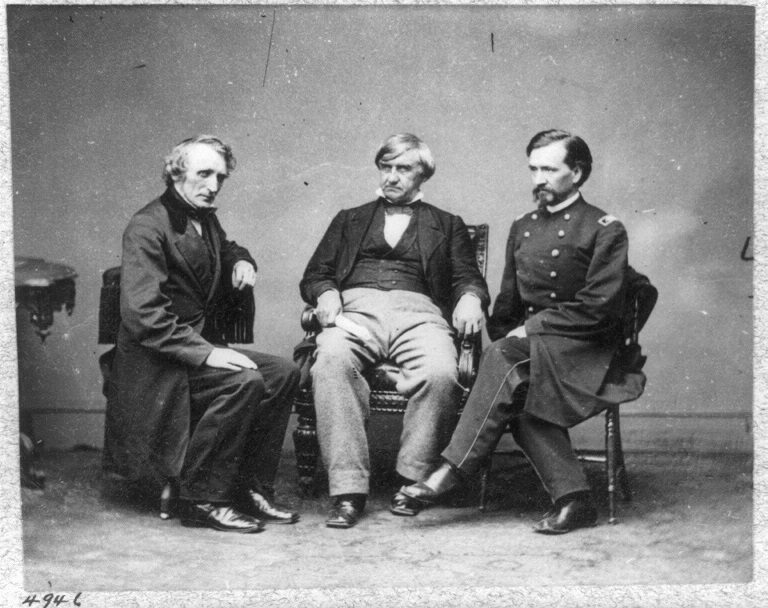
A note about some of the people he mentions in this letter. Henry Cram was Meade’s wife’s brother-in-law. Colonel Hartman Bache was not only Meade’s brother-in-law, before the war Meade had served under him in the topographical engineers, making lighthouses. The Senators with whom Meade dined included Jacob Collamore of Vermont and Henry Wilson of Massachusetts (later the vice president under President Ulysses S. Grant). “Wilkeson” was probably Morton S. Wilkinson of Minnesota; and Powell must have been Lazarus Powell of Kentucky. If that is so, Powell was the odd man out, as the only Democrat present as well as a harsh critic of the Lincoln administration. The host, Secretary of the Interior John Palmer Usher of Indiana, had traveled with President Lincoln to Gettysburg back in November and had been seated with the president on the stage when Lincoln delivered the Gettysburg Address. Judge Holt was Joseph Holt, later one of the three prosecutors at the trial of Lincoln’s assassins. As the Union Army’s judge advocate general, Holt had also presided over the court-martial of General Fitz John Porter. The conversation at Usher’s dinner party must have been interesting indeed.

Joseph Holt (center) was one of the guests at Secretary of the Interior Usher's dinner party (Library of Congress).

Joseph Holt (center) was one of the guests at Secretary of the Interior Usher’s dinner party (Library of Congress).

I felt very badly at leaving you, but I tried to reconcile myself to what was inevitable and could not be helped. We had a very pleasant journey to this place. Mr. Cram and Colonel Bache joined us at the depot, and at Wilmington I found General Hartsuff and Colonel Sackett on the train and took them into the car. Mr. Felton, the president of the company, was at the cars and was very civil. When we crossed the Susquehanna an elegant cold collation with champagne was set out, of which we all freely partook. On arriving here we took tea, and soon afterwards, about nine o’clock, I went to bed. The next day I spent all the day at the Department and White House. The Secretary was, as he always is, very civil and ready to accede to all my suggestions. He gratified me very much by saying that there was no officer in command who had to so great a degree the implicit confidence of all parties as myself; but he said there were several officers in my army that did not have the confidence of the country, and that I was injuring myself by retaining them. I told him I did not know who they were, but that if he was aware of this fact, I thought it was his duty to retire them, and I should not object; and I suppose the result will be a pretty general sweeping out. While with the Secretary, Mr. Usher, Secretary of the Interior, came in and invited me to his house at seven o’clock. Supposing it to be an evening party, where I could show myself and slip out, I accepted; but on going there I found it to be a regular dinner party. Senators Collamore, Wilson, Wilkeson and Powell, together with Judges Holt and Law, and the ladies of the family, constituted the party. All received and treated me with great distinction and civility, and about 10 p.m. I got home, and, after a talk with Cram, went to bed, a little tired. I had intended to go down to the army this morning, but received last night a note from the Secretary, saying he wanted to see me to-day; so I had to spend some four or five hours at the Department, and the rest of the day have remained quietly in the house with Cram.

Mr. Harding with Mrs. Harding are here, also Cortlandt Parker. I have not seen our friends the Harrises, except the Senator.

Meade’s correspondence taken from The Life and Letters of George Gordon Meade, Major-General United States Army, Vol. 2, (New York: Charles Scribner’s Sons, 1913), pp. 164-5. Available via Google Books.

Dinner Party (February 12, 1864)

Winter camp could be muddy, cold, damp, uncomfortable and boring, but it sometimes offered compensations, at least for officers. Here Theodore Lyman describes one example. He and Joseph Hayes had attended Harvard together. Hayes started the war with the 18th Massachusetts. Later, Hayes will be wounded in the head in the Wilderness and captured in the fighting for the Weldon Railroad during the Petersburg campaign.

General George Sykes. (Library of Congress photo.)

General George Sykes. (Library of Congress photo.)

In this epistle I shall describe to you the whirl of fashion, the galaxy of female beauty, the grouping of manly grace. Behold, I have plunged into the wild dissipation of a military dinner-party. The day before yesterday, there appeared a mysterious orderly, with a missive from Colonel Hayes (my classmate) saying that he should next day entertain a select circle at dinner at five of the clock, and wouldn’t I come and stay over night. To which I returned answer that I should give myself that pleasure. The gallant Colonel, who commands the 3d Brigade, 1st Division, 5th Corps, has his Headquarters on the north side of the river, about half a mile from Rappahannock station. At 4 P.m. I was ready, very lovely to look on, with full tog and sash, neatly finished by white cotton gloves and my thick laced shoes. With great slowness did I wend on my sable mare, for fear of splashing myself in a run or a puddle. On the other side of the pontoon bridge I fell in with Lieutenant Appleton wending the same way — he splashed his trousers in Tin Pot Run, poor boy! The quarters were not far, and were elegantly surrounded by a hedge of evergreen, and with a triumphal arch from which did float the Brigade flag. Friend Hayes has an elegant log hut, papered with real wall-paper, and having the roof ornamented with a large garrison flag. The fireplace presented a beautiful arch, which puzzled me a good deal, till I found it was made by taking an old iron cog-wheel, found at the mill on the river, and cutting the same in two. Already the punctual General Sykes, Commander of the Corps, was there, with Mrs. S., a very nice lady, in quite a blue silk dress. . . . Also several other officers’ wives, of sundry ages, and in various dresses. Then we marched in and took our seats, I near the head and between Mrs. Lieutenant Snyder and Mrs. Dr. Holbrook. Next on the left was General Bartlett, in high boots and brass spurs. There must have been some twenty-four persons, in all. The table ran the length of two hospital tents, ingeniously floored with spare boards from the pontoon-train and ornamented with flags and greens. The chandeliers were ingeniously composed of bayonets, and all was very military. Oyster soup had we; fish, biled mutting, roast beef, roast turkey, pies, and nuts and raisins; while the band did play outside. General Sykes, usually exceeding stern, became very gracious and deigned to laugh, when one of his captains said: “He was the mildest-mannered man that ever cut a throat or scuttled ship.”

After dinner, songs were encouraged, and General Sykes told two of his Staff, if they didn’t sing immediately, he would send them home at once! I sang two comic songs, with immense success, and all was festive. I passed the night there, and took breakfast this morning, when Albert came down with the horses. Joe Hayes is a singular instance of a man falling into his right notch. In college he was not good at his studies at all; but, as an officer, he is remarkable, and has a reputation all through the Corps. Though only a colonel, he was entrusted, at Mine Run, with bringing off the picket line, consisting of 4000 men, which he did admirably. . . .

Theodore Lyman’s letter is from Meade’s Headquarters, 1863-1865: Letters of Colonel Theodore Lyman from the Wilderness to Appomattox, pp 71-3. Edited by George R. Agassiz. Boston, Massachusetts Historical Society, 1922. Available via Google Books.

A Taste of Combat (February 7, 1864)

Artist Alfred Waud captured in pencil the same scene Lyman sketched in words. He titled this drawing "Scene at the late reconnaisance at Morton Ford -(night). It appeared as an engraving in Harper's Weekly on March 5, 1864. Click to enlarge (Library of Congress).

Artist Alfred Waud captured in pencil the same scene Lyman sketched in words. He titled this drawing “Scene at the late reconnaisance at Morton Ford -(night).” It appeared as an engraving in Harper’s Weekly on March 5, 1864. Click to enlarge (Library of Congress).

In this descriptive letter from February 7, Theodore Lyman describes an action that took place the previous day. He also included an account of these events in his journals, edited by David W. Lowe and published in 2007 by Kent State University Press as Meade’s Army: The Private Notebooks of Lt. Col.  Theodore Lyman. In that version, Lyman included this detail: “On the other side saw a soldier laid out for burial, as sad a sight as could be; his white hands folded across his breast and the cape of his coat folded up over his face.” Perhaps Lyman kept this from his letter because he wanted to shield his family back home from this glimpse of death. Lowe reports the casualties from this brief encounter as 255 (dead, wounded and missing) for Warren’s II Corps and 15 for the cavalry. With Meade still ill back in Philadelphia, John Sedgwick had temporary command of the Army of the Potomac.

It is one in the morning and I have, so to speak, just taken a midnight dinner, having come in from the front between 11 and 12 oclock. Well, who would have thought of marching out of comfortable winter quarters, to go poking round the Rapidan! . . . Only last night orders were suddenly issued to the 1st and 2d Corps to march at sunrise, the one on Raccoon, the other on Morton’s Ford; where they were to make a strong demonstration and perhaps cross at Morton’s (Raccoon being too strong). Certain cavalry, also, were to go to other points, with special orders. The whole thing was very sudden, all round, and none of our fish. This morning we took an early breakfast, which, with the ready horses, quite reminded one of campaigning times. General Sedgwick was over, being in command, as viceroy. At 10.30 we began to hear the cannon, but General Humphreys would not stir, as he said he must stay to attend to the despatches and telegraph. However, at 3 p.m., he suddenly did start, with his own aides and Biddle, Mason, Cadwalader and myself, de la part de General Meade; also Rosencrantz. To Morton’s Ford is some ten miles, but you might as well call it fifty, such is the state of the roads. Mud, varying from fetlocks to knees, then holes, runs, ditches and rocks — such was the road. With utmost diligence it took fully two hours. . . . Here we had thrown across a division, and General Warren was with them. The enemy had offered a good deal of opposition, with a skirmish fire and with artillery; despite which the whole division had waded the stream, up to their waists (cold work for the 6th of February!), and were now in line, behind some ridges; while a heavy skirmish line covered their front. Enclosing them, almost in a semi-circle, were the Rebel earthworks. It looked a shaky position for us! All was quiet; the men were making coffee, and nothing broke the stillness but an occasional shot from the sharpshooters. “Well,” said General Humphreys, “I must go across and look about, while there is light left. I don’t want many to go. McClellan, you will come; and Major Biddle and Colonel Lyman, if you would like, I shall be glad of your company.” So off we four rode, and met Warren coming back, before we got to the river. But he at once turned horse and kept on with us. The ford was very bad, deep and with steep sides, but we floundered over, and I was once again south of the Rapid Ann. … As we got to the main line, “Now,” said General Warren, “get off here and I will take you as far as you can go, very soon.” We dismounted and remained, while the two Generals went some 150 yards to Morton’s house on the crest of the ridge, where they no sooner got than a sharpshooter fired at them and the ball flew harmless over our heads, though it came close to General Warren. But hang it all! We had not been there five minutes when that infernal old sound came, whing-z-z-z-z, and over went a spherical case! “Fall in, fall in!” shouted the colonels, and the men took their arms. Whing-z-z! Bang! came another, right into the infantry, killing a poor man. “Steady! steady!” roared the colonels. Whing-z-z-z-z! Bang! and one of the pieces struck close to me, while one of the bullets struck the scabbard of the orderly next me, who coolly picked up the missile. We were a little sheltered by the road, but, I don’t care who knows it, I did duck when that spherical case came over. By this time the Generals got back and mounted, the enemy continuing the fire but throwing their shot too high. We had not got far towards the river, when they began with musketry, a very heavy skirmish fire, and seemed about to make a general attack; but it turned out to be a strong attempt to drive back our skirmish line from a favorable fence they had secured; and the artillery was a cover for their advance. When we got back to the high ground by Robinson’s, we could look across and see the fight, though it was growing dark and the air was very foggy. Our artillery opened on them also, and, in course of an hour or so, night set in, and the firing ceased, our line holding its own everywhere. And now the poor wounded fellows began to come in, some alone, some supported, and some in ambulances. The surgeons were numerous and all that could be wished for. Except one or two mortally hurt, there was nothing sad in it, so manly were the men and so cheerful. Not a groan, not a complaint. I asked one man who was staggering along, if he were much hurt. “Very slightly,” he remarked, in a lively tone. I found what he called “very slightly” was a musket-ball directly through the thigh. These men are wonderful, much more so, I think (proportionately), than the officers. There was a whole division wet to the waist, on a rainy February day, exposed each instant to attack, and yet making little pots of coffee, in the open air, as calmly as if at Revere House.

Oh! what a ride had we home! It took us over three hours, with the help of a lantern. . . .

Theodore Lyman’s letter is from Meade’s Headquarters, 1863-1865: Letters of Colonel Theodore Lyman from the Wilderness to Appomattox, pp 68-71. Edited by George R. Agassiz. Boston, Massachusetts Historical Society, 1922. Available via Google Books.

Butler (February 5, 1864)

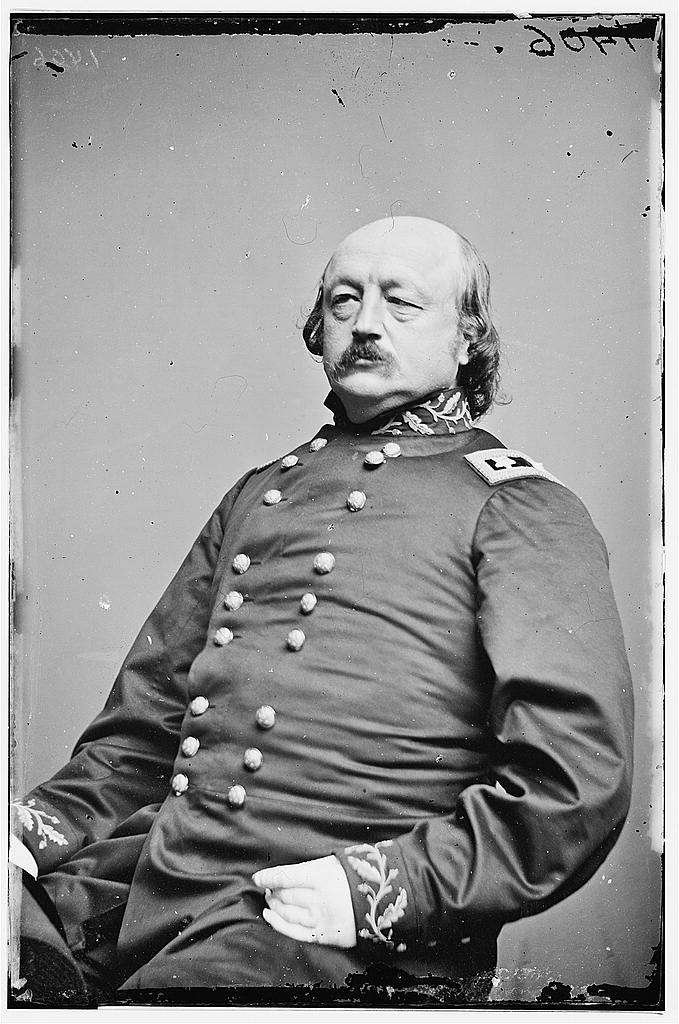
Another letter from Theodore Lyman, while Meade remains ill in Philadelphia. In this missive Lyman mentions Major General Benjamin Butler, who commanded the Army of the James. Butler was one of the Union’s political generals, promoted not because of military experience but because of his political influence. He had aroused Southern ire for his heavy-handed military rule in New Orleans (where he earned the nickname of “Spoons” for allegedly looting the town. Southerners also called him “Beast” Butler.) During Grant’s spring  campaign, the cockeyed Butler and his army were supposed to form one part of Grant’s multipronged campaign against the Confederacy. Instead, Butler had gotten his army bottled up at Bermuda Hundred with his back against the James River, where it remained, impotent and useless until it was too late for them to do any good. Here Lyman describes a plan by Butler and the opinions about it expressed by the non-political generals of the Army of the Potomac.

Benjamin Butler. He was a mediocre general but a wily politician (Library of Congress).

Benjamin Butler. He was a mediocre general but a wily politician (Library of Congress).

General [Andrew] Humphreys sent for me and showed me a cipher correspondence between Butler and [Henry] Halleck, and Halleck and [John] Sedgwick. B. telegraphed that large reinforcements had been sent from the Rapid Ann to North Carolina, and that he wished a demonstration to “draw their forces from Richmond.” S. replied that, with the exception of some two or three brigades, nobody had been sent to that place from the army in our front. B. then said he was going to move on Richmond, or something of the sort, and would like a demonstration not later than Saturday (to-morrow). S. said it was too short a time to make any great show and that it would spoil our chances for a surprise on their works, in future. H. then telegraphed to do, at any rate, what we could. So [Judson] Kilpatrick has been sent to their right via Mine Ford, and [Wesley] Merritt is to threaten Barnett’s Ford; and to threaten Raccoon Ford, while the 2d will make a stronger demonstration at Morton’s Ford. Old Sedgwick and General Humphreys are cross at the whole thing, looking on it as childish.

Theodore Lyman’s letter is from Meade’s Headquarters, 1863-1865: Letters of Colonel Theodore Lyman from the Wilderness to Appomattox, p. 68. Edited by George R. Agassiz. Boston, Massachusetts Historical Society, 1922. Available via Google Books.
← Back

Thank you for your response. ✨

A Party of Ladies (January 29, 1864)

John Sedgwick and staff stand in front by the VI Corps headquarters near Culpeper. Taken in March 1864, this photo shows Sedgwick standing third from right (Library of Congress).

John Sedgwick and staff stand in front by the VI Corps headquarters near Culpeper. Taken in March 1864, this photo shows Sedgwick standing third from right (Library of Congress).

The business of war wasn’t always hell; there was frivolity, too, especially in winter camp. In this letter Theodore Lyman details some of the less-serious side of life in the Army of the Potomac. Humphreys, of course, is Meade’s chief of staff, Andrew Humphreys.

General Andrew Atkinson Humphreys. (Library of Congress)

General Andrew Atkinson Humphreys. (Library of Congress)

If you saw the style of officers’ wives that come here, I am sure you would wish to stay away. Quelle experience had I yesterday! I was nearly bored to death, and was two hours and a half late for my dinner. Oh, list to my harrowing tale. I was in my tent, with my coat off, neatly mending my maps with a little paste, when Captain [Adolphus] Cavada poked in his head (he was gorgeous in a new frockcoat). “Colonel,” said he, “General Humphreys desires that you will come and help entertain some ladies!” I held up my pasty hands in horror, and said,”What!” “Ladies!” quoth Cavada with a grin; “ a surprise party on horseback, thirteen ladies and about thirty officers.” There was no moyen; I washed my hands, put on the double-breaster, added a cravat, and proceeded, with a sweet smile, to the tent, whence came a sound of revelry and champagne corks. Such a set of feminine humans I have not seen often; it was Lowell factories broken loose and gone mad. They were all gotten up in some sort of long thing, to ride in. One had got a lot of orange tape and trimmed her jacket in the dragoon style; another had the badge of the Third Corps pinned all askew in her hat; a third had a major’s knot worked in tarnished lace on her sleeve; while a fourth had garnitured her chest by a cape of grey squirrel-skin. And there was General Humphreys, very red in the face, smiling like a basket of chips, and hopping round with a champagne bottle, with all the spring of a boy of sixteen. He spied me at once, and introduced me to a Mrs. M , who once married somebody who treated her very badly and afterwards fortunately went up; so Mrs. M seemed determined to make up lost time and be jolly in her liberty. She was quite bright; also quite warm and red in the face, with hard riding and, probably, champagne. Then they said they would go over to General [John] Sedgwick’s, and General Humphreys asked if I would not go, too, which invitation it was not the thing to refuse; so I climbed on my horse, with the malicious consolation that it would be fun to see poor, modest Uncle John with such a load!

Major General John Sedgwick. His men called him "Uncle John" (Library of Congress).

Major General John Sedgwick. His men called him “Uncle John” (Library of Congress).

But Uncle John, though blushing and overcome, evidently did not choose to be put upon; so, with great politeness, he offered them sherry, with naught to eat and no champagne. Then nothing would do but go to Headquarters of the 3d Corps, whither, to my horror, the gallant Humphreys would gang likewise. Talk about cavalry raids to break down horses! If you want to do that, put a parcel of women on them and set them going across the country. Such a Liitzow’s wild hunt hath not been seen since the day of the respected L. himself! Finally one lady’s horse ran away, and off went the brick, Humphreys, like a shot, to stop her. Seeing her going into a pine tree, he drove his horse between the tree and her; but, in so doing, encountered a hidden branch, which slapped the brisk old gent out of his saddle, like a shuttlecock! The Chief-of-Staff was up in a second, laughing at his mishap; while I galloped up, in serious alarm at his accident. To make short a long story, the persistent H. tagged after those womenfolk (and I tagged after him) first to Corps Headquarters, then to General Carr’s Headquarters, and finally to General Morris’s Headquarters, by which time it was dark! I was the only one that knew the nearest way home (we were four miles away) and didn’t I lead the eminent soldier through runs and mud-holes, the which he do hate!

To-day we have had a tremendous excitement: a detail of 250 men to “police” the camp, under charge of [James C.] Biddle, just appointed Camp Commandant. They have been sweeping, cutting down stumps, burning brush, and, in general, making the worst-looking camp in the army neat and respectable.

Theodore Lyman’s letter is from Meade’s Headquarters, 1863-1865: Letters of Colonel Theodore Lyman from the Wilderness to Appomattox, pp 65-7. Edited by George R. Agassiz. Boston, Massachusetts Historical Society, 1922. Available via Google Books.

Annual Seminar

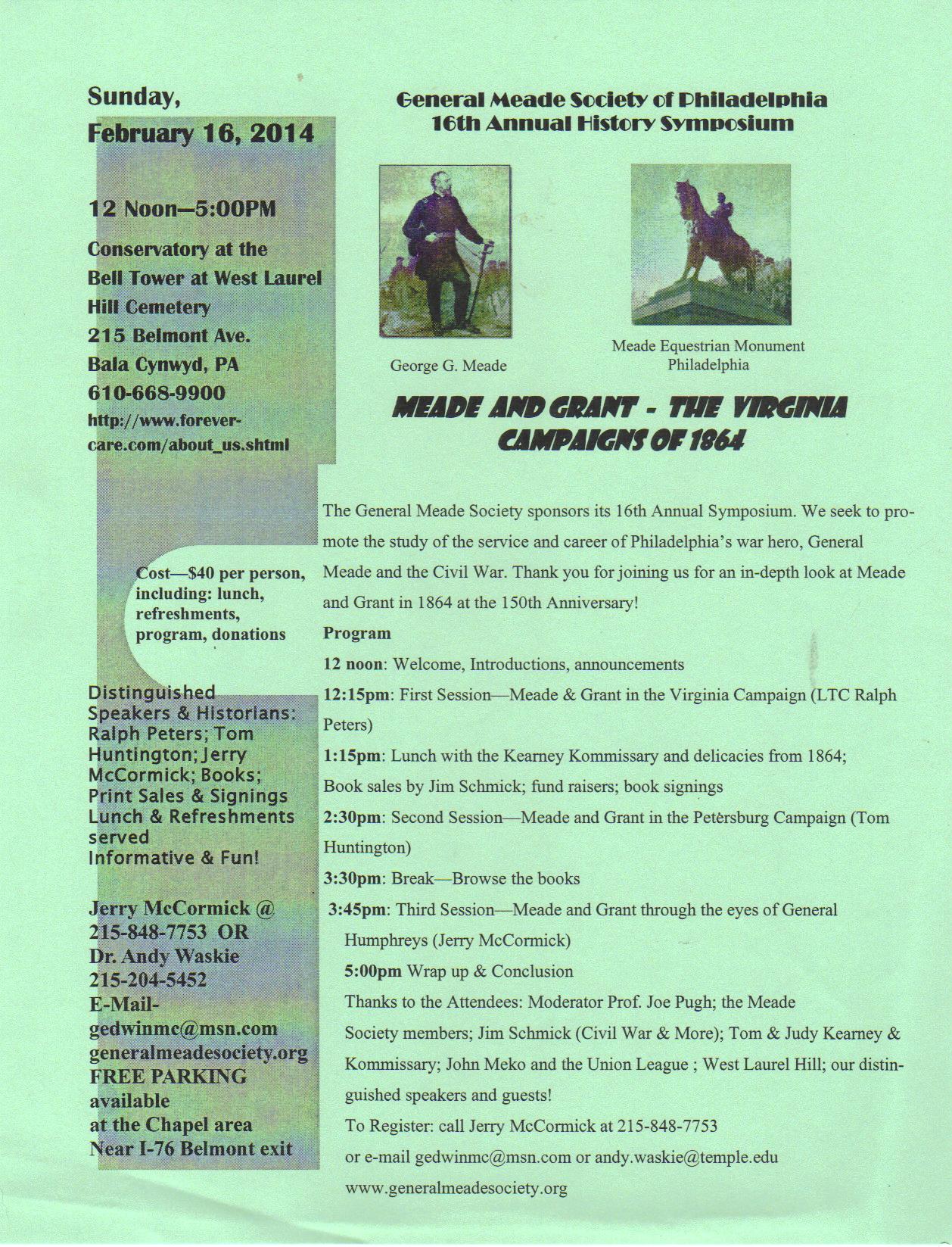
Every year the General Meade Society of Philadelphia holds a seminar focusing on some Meade-related aspect of the Civil War. This year the topic is “Meade and Grant–The Virginia Campaign of 1864.” It will take place on Sunday, February 16, 2014, at the conservatory at the West Laurel Hill Cemetery in Bala Cynwyd, Pennsylvania. The speakers will be Ralph Peters, author of Cain at Gettysburg and Hell or Richmond; Tom Huntington (author of Searching for George Gordon Meade: The Forgotten Victor of Gettysburg) and Jerry McCormick (the world’s leading authority on General Andrew Humphreys). In addition, the Kearney Kommissary will serve its delicious food and Jim Schmick of Civil War and More will be on hand with a large selection of books. Like all the society events, it promises to be both informative and fun.

The $40 admission cost includes lunch. I encourage all the attend!

I’ve posted the flyer. Click on it to see a larger version.Meade seminar

Order of Merit

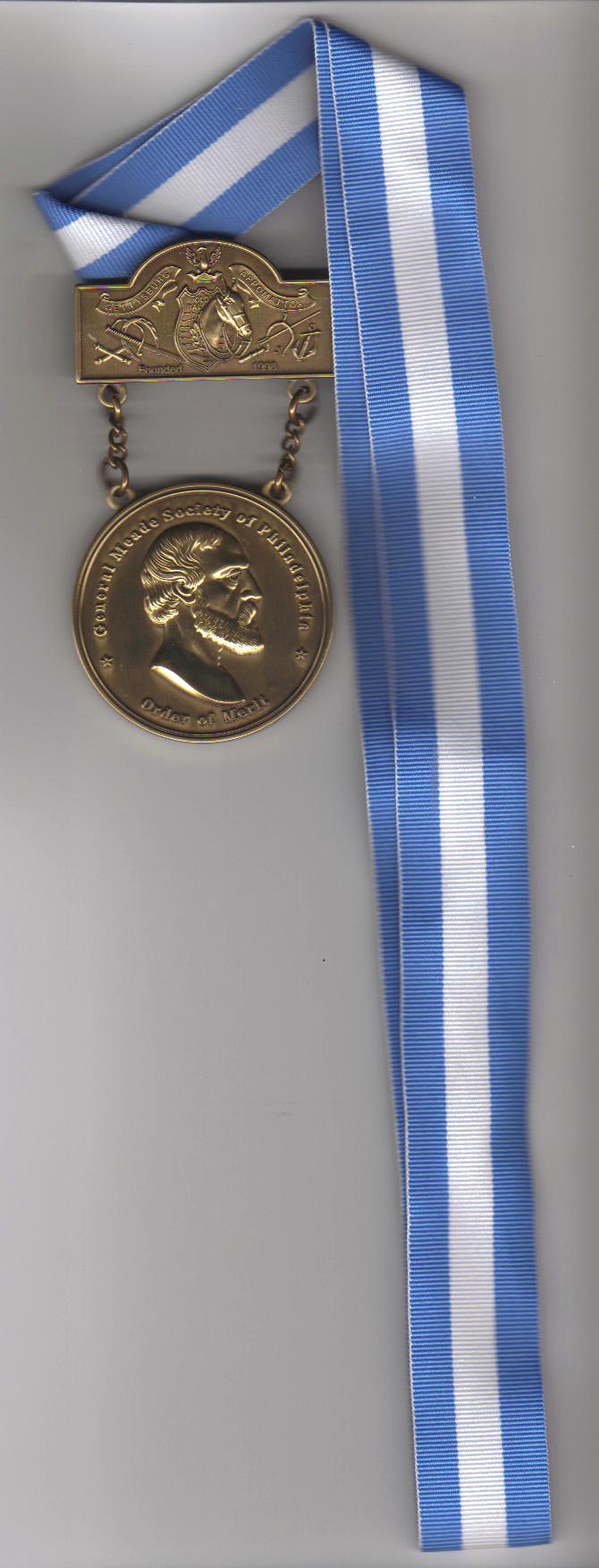
Order of MeritI just got home from George Gordon Meade’s home town, where I was honored and flattered to receive the Order of Merit from the General Meade Society of Philadelphia. Anyone who has read my book, Searching for George Gordon Meade: The Forgotten Victor of Gettysburg, should know about the General Meade Society because the book included some accounts of its activities. Among them were the “grand unveiling” of the head of Old Baldy, Meade’s horse, at the Grand Army of the Republic Library and Museum, as well as the annual birthday celebrations in Philadelphia’s Laurel Hill Cemetery. Well, every year the Society awards the Order of Merit to an individual who they feel deserves to be honored for furthering the society’s mission of commemorating the memory of General Meade. I’m very pleased to say the board members picked me this year. At the annual champagne brunch and awards ceremony I received a beautiful medal (pictured). Many thanks to Andy Waskie, president and founder of the Meade Society, and to all the board members who made this possible. It was a wonderful day and, like all the Meade events I’ve attended, a lot of fun. And I guess I should extend my thanks to General Meade, too, without whom none of this–including the book–would have been possible!

Lyman Returns (January 23, 1864)

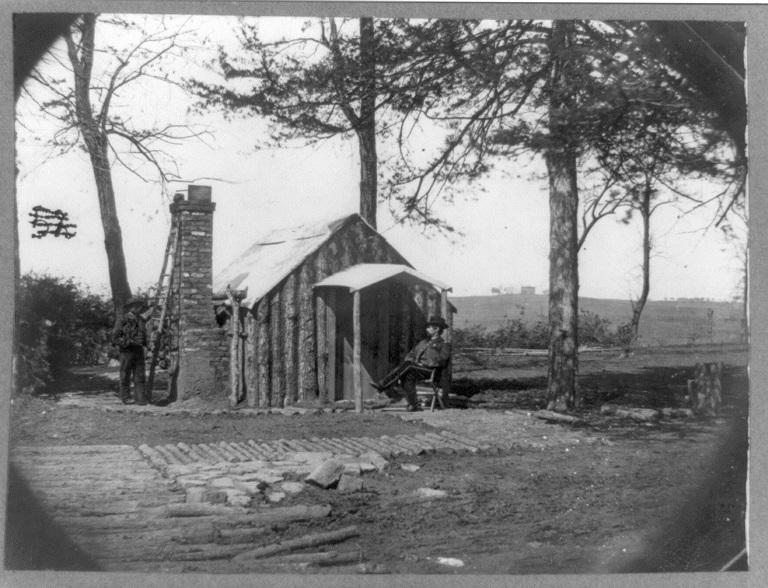
An officer of the Army of the Potomac lounges outside his winter quarters. No wonder soldiers sought to go home on leave (Library of Congress).

An officer of the Army of the Potomac lounges outside his winter quarters at Brandy Station. No wonder soldiers sought to go home on leave (Library of Congress).

George Gordon Meade and his aide, Theodore Lyman, both stopped writing letters when they departed for their respective homes while the Army of the Potomac established winter camp, thus depriving us of their observations on current affairs. But Lyman finally returns to the fold with a letter dated January 23. I include the editorial note included in Meade’s Headquarters, 1863-1865: Letters of Colonel Theodore Lyman from the Wilderness to Appomattox (1923). General Humphreys is Andrew Humphreys, Meade’s chief of staff.

[Toward the end of December, the army being then well settled in winter quarters, Lyman obtained leave of absence, passed Christmas at home, and returned to the army about the middle of January. He found Headquarters almost deserted, General Meade sick in Philadelphia with an attack of inflammation of the lungs, General Humphreys, and his tent-mate Rosencrantz, away on leave of absence, and Barstow sick and weak, with a cold on the lungs.]

Yesterday came General Humphreys, to my great content. His son, with Worth and myself, rode down to bid him welcome. Such a sea of mud round Brandy Station was enough to engulf the most hardy. There is no platform to get on; nothing but the driest spot in the mud. You should have seen the countenances of the unfortunate officers’ wives, as they surveyed, from the height of the platform, this broad expanse of pap! Then the husband would appear, in great excitement, and encourage them to descend, which they presently would do, and dab across to an ambulance, seeming mutely to say, that this wasn’t quite what they expected. The neat General (who left in hard weather) was entirely aghast, and said, in painful accents, “What! must I get down there? Oh, the deuce!” I do believe that officers will next be trying to bring down grand pianos. You needn’t talk of coming here with “small hoops.” I have too much respect for you to allow the shadow of such an idea. As Frank Palfrey sensibly observed: “I think I should consider some time before I brought my wife to a mud-hill.” . . . The whole country, besides the mud, is now ornamented with stumps, dead horses and mules, deserted camps, and thousands upon thousands of crows. The deserted camps (than which nothing more desolate) come from the fact that several divisions have lately changed position. General Meade has been seriously ill at home; but we have a telegraph that he is much better, and I have forwarded him, for his edification, a variety of letters, opened by me at General Williams’s request.

Theodore Lyman’s letter is from Meade’s Headquarters, 1863-1865: Letters of Colonel Theodore Lyman from the Wilderness to Appomattox, pp 64-5. Edited by George R. Agassiz. Boston, Massachusetts Historical Society, 1922. Available via Google Books.