Zouaves (January 6, 1864)

The 114th PA band, photographed at army headquarters, Brandy Station, in the spring of 1864 (Library of Congress).

The 114th PA band, photographed at army headquarters, Brandy Station, in the spring of 1864 (Library of Congress).

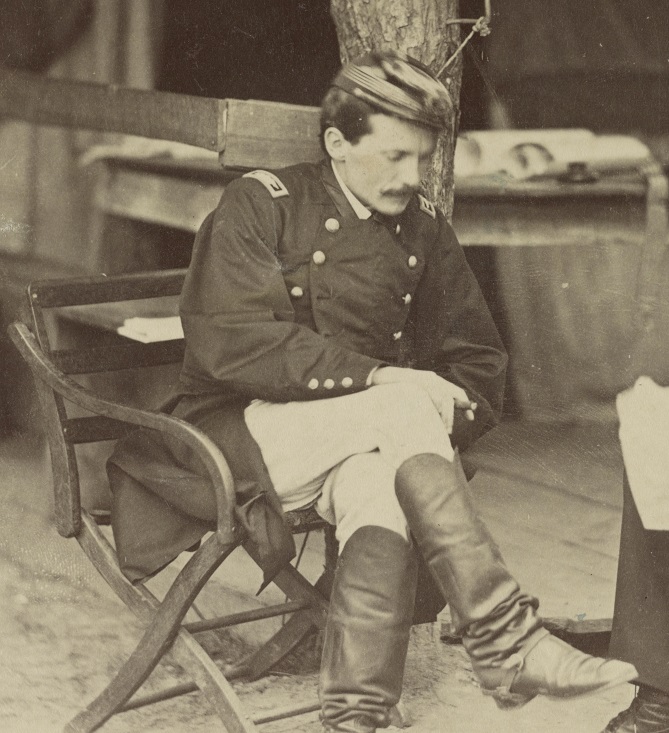
Charles Collis, taken at Petersburg in 1864 (Library of Congress).

Charles Collis, taken at Petersburg in 1864 (Library of Congress).

George Meade wrote this brief note to his son John Sergeant on January 6, 1864. The “Zu-Zu” regiment to which he refers is the 114th Pennsylvania, also known as the Collis Zouaves after its former commander, Charles Collis. The 144th PA had been assigned as the army’s headquarters guard. The regiment had adopted the bright Zouave uniforms inspired French and Algerian soldiers. Before the war the most famous zouave unit was a crack drill outfit raised by Elmer Ellsworth, later killed in Alexandria, Virginia, when he removed the Confederate flag atop a hotel there and was shot to death by the owner.

Born in Ireland, Charles Collis had been wounded at Chancellorsville and did not fight at Gettysburg but he returned there after the war and built a house that he called Red Patch, after the III Corps’ insignia. The house still stands on Confederate Avenue and recently became a bed and breakfast. Collis is buried in the National Cemetery and has a monument there.

We have now at headquarters Collis’s “Zu-Zu” Regiment, commanded by one of the Bowens, Collis being in command of a brigade in the Third Corps. They have a fine band, one of the best in the army.

A good many of the old volunteers have re-enlisted—more than I expected—and if Congress allows the bounty hitherto paid, many more will re-enlist.

Meade’s correspondence taken from The Life and Letters of George Gordon Meade, Major-General United States Army, Vol. 2, (New York: Charles Scribner’s Sons, 1913), p. 165. Available via Google Books.

Happy Birthday, General Meade!

gravesite volley

Once again the General Meade Society of Philadelphia hosted a successful birthday commemoration of General George Gordon Meade at Philadelphia’s Laurel Hill Cemetery on December 31. It would have been Meade’s 198th birthday (and also his wedding anniversary). Living historians, VIPs and others braved the cold to gather at the cemetery gatehouse and proceeded to the general’s gravesite for a short ceremony and a champagne toast. Here are a few photos.

Outside the gatehouse of Laurel Hill Cemetery. George Meade and his family, as well as scores of other notable people, are buried on the grounds here.

Outside the gatehouse of Laurel Hill Cemetery. George Meade and his family, as well as scores of other notable people, are buried on the grounds here.

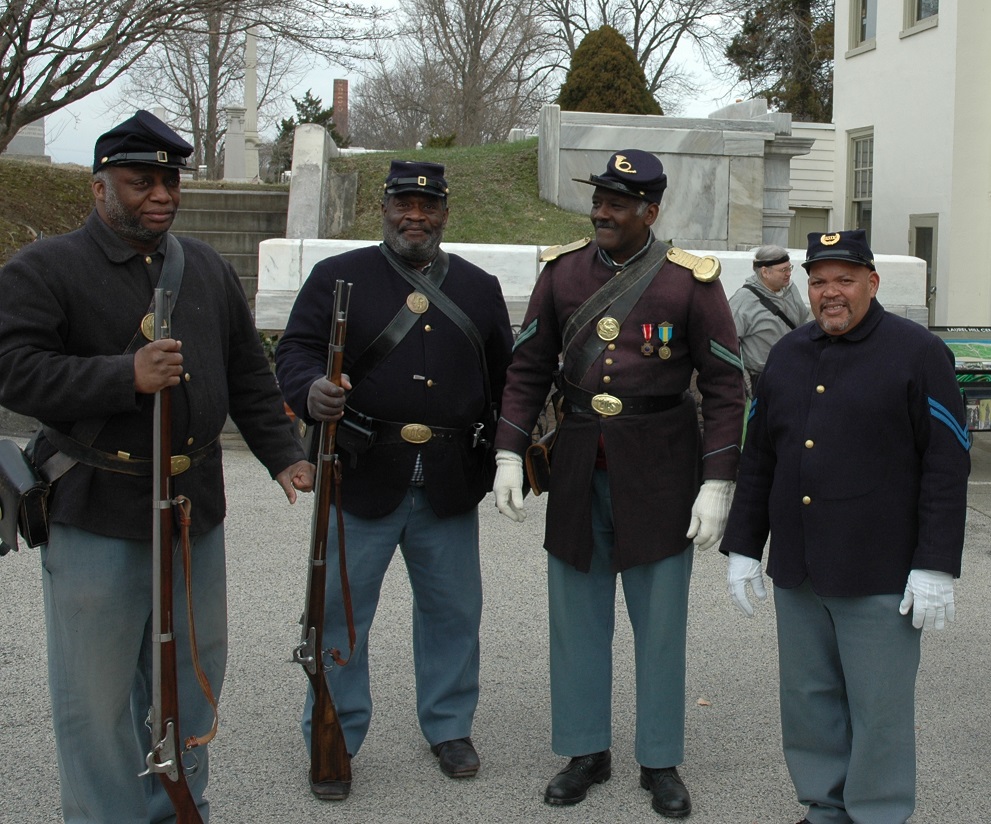
Living historians represent members of the United States Colored Troops.

Living historians represent members of the United States Colored Troops.

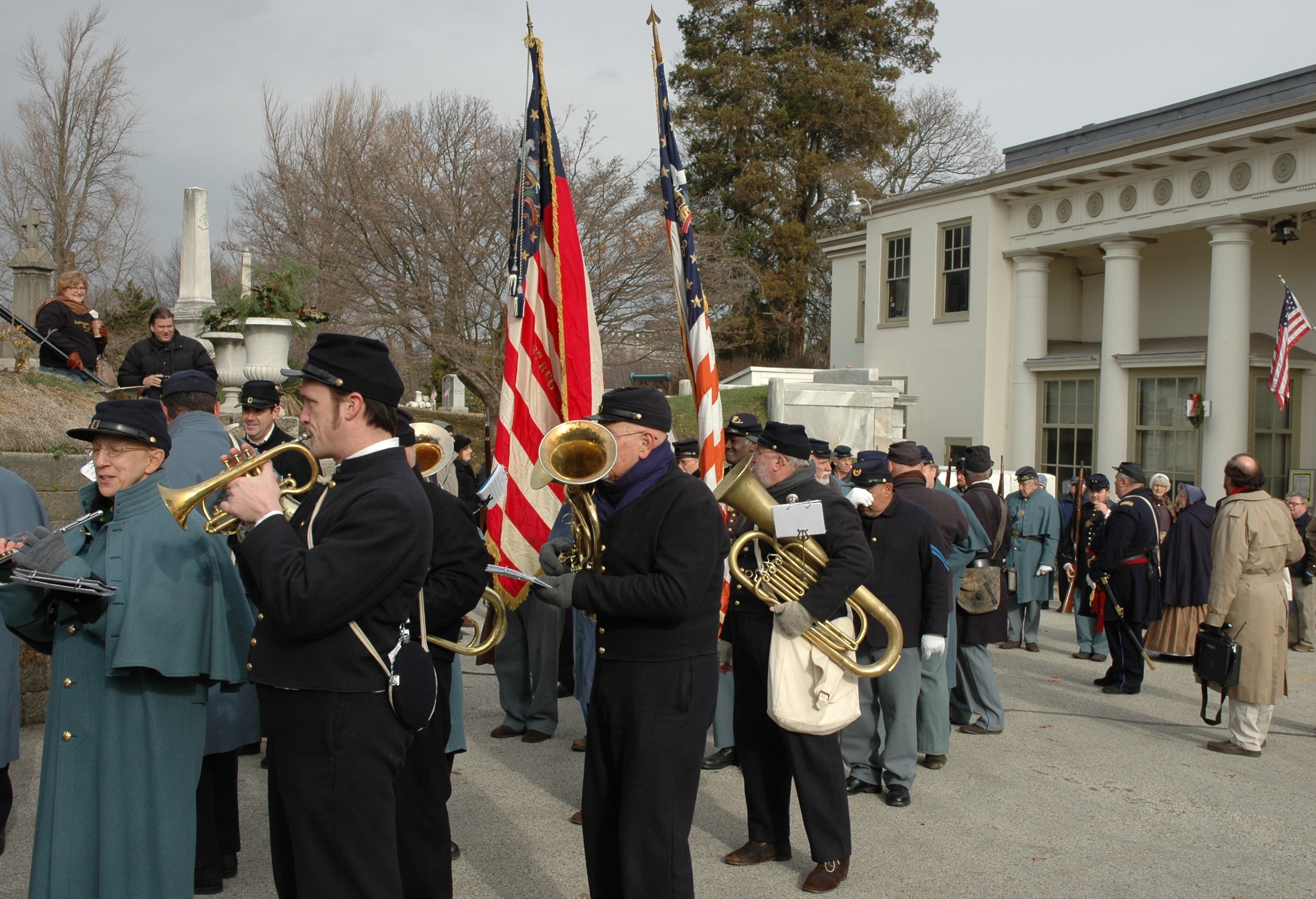
Beck's Band prepares to lead the procession to the gravesite. Not easy temperatures for playing brass instruments!

Beck’s Band prepares to lead the procession to the gravesite. Not easy temperatures for playing brass instruments!

The ceremony included the laying of several wreaths at the gravesite.

The ceremony included the laying of several wreaths at the gravesite.

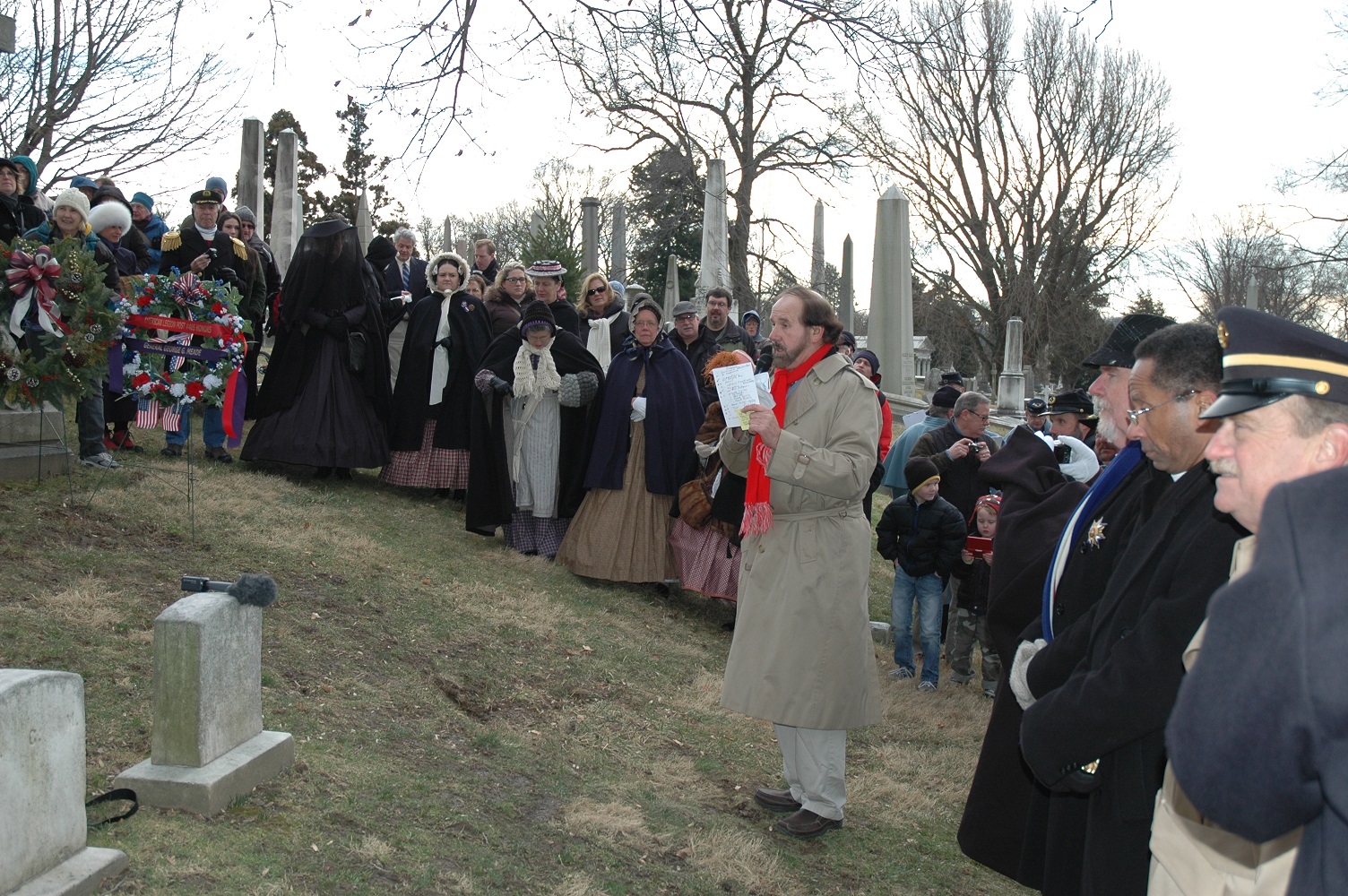
Prof. Andy Waskie, the founder and president of the General Meade Society of Philadelphia, leads the ceremony at the gravesite.

Prof. Andy Waskie, the founder and president of the General Meade Society of Philadelphia, leads the ceremony at the gravesite.

Tom Huntington, author of Searching for George Gordon Meade: The Forgotten Victor of Gettysburg (and this blog) makes a few appropriate remarks.

Tom Huntington, author of Searching for George Gordon Meade: The Forgotten Victor of Gettysburg (and this blog) makes a few appropriate remarks.

Credit (December 28, 1863)

Once again George Meade complains about the press. This is not the first time he singled out the coverage from the Spirit of the Times, a New York weekly published by George Wilkes. (For another example, see this entry.)

This is Meade’s last letter from 1863. In three days he will celebrate his 48th birthday (and also his wedding anniversary). That event will be commemorated once again this year at Philadelphia’s Laurel Hill Cemetery by General Meade Society of Philadelphia. I encourage all readers of this blog to attend! It is a fun event and a good way to salute the victor of Gettysburg (and I don’t mean Joe Hooker).

I was very sorry I could not be at home to spend Christmas with you and the children, but was glad to let George go. I spent a very quiet day in camp, attending to the business of re-enlisting the veteran volunteers, to which I had to give much personal attention, as I had let [Seth] Williams, [Andrew] Humphreys, and many others, go to Washington to spend the day.

Major General Winfield Scott Hancock had been wounded during the third day's fighting at Gettysburg. His wound troubled him for the rest of the war (Library of Congress).

Major General Winfield Scott Hancock had been wounded during the third day’s fighting at Gettysburg. His wound troubled him for the rest of the war (Library of Congress).

Yesterday General [Winfield Scott] Hancock arrived. He has been with me all the time since his arrival, and we have had a long talk. He says it was undoubtedly intended at first to relieve me, and it was, as I surmised, intimated to him that he would be placed in command. Such was his impression till the day before he came down, when, on reporting to Halleck, he was told the design was abandoned, and that he could go down to his old corps. Hancock further says that Halleck declares he saved me; that they were going to relieve me at once on the receipt of the intelligence that I had returned; but that he, Halleck, said, “No, an officer who gained the battle of Gettysburg is entitled to more consideration. Let us wait and hear what General Meade has to say, and if his report is not satisfactory, then we can act advisedly.” This was agreed to, and the unanimous opinion of all returning officers, together with my report, changed the whole aspect of the case. I must say I am gratified some little consideration was extended towards me and that justice was finally awarded.

I understand there is a bitter article in Wilkes’s Spirit of the Times, asserting that Hooker planned the campaign of Gettysburg, and that Butterfield wrote all the orders for the movements, in accordance with Hooker’s plans. I furthermore hear that General Sickles asserts that Hancock selected the position, and that he (Sickles), with his corps, did all the fighting at Gettysburg. So, I presume, before long it will be clearly proved that my presence on the field was rather an injury than otherwise.

The President has written me that he desires to see me upon the subject of executing deserters; so, as soon as I can get time, I shall have to go up to Washington.

The article that raised Meade’s ire, originally run in Wilkes’ Spirit of the Times, December 26, 1863)

BATTLE OF GETTYSBURG—HONOR TO WHOM HONOR IS DUE

General Halleck, in his report of the operations of our armies in the field during the past year, in commenting upon the Battle of Gettysburg, says: “To General Meade belonged the honor of a well-earned victory, in one of the greatest and best fought battles of the war.”

As a public journalist, we cannot allow such a record to be made in the face of the well-known history of the battle of Gettysburg, now made classic by the eloquence of Everett, and in view of the important part the gallant Hooker and his chief of staff performed preliminary to, and during the battle, without entering our solemn protest against it. And in doing this, we do not mean to detract in the slightest degree from the reputation and honor of General Meade.

Joseph Hooker (Library of Congress).

Joseph Hooker (Library of Congress).

It is a matter of history that the army of the Potomac was never in finer drill, or better discipline, or more thoroughly in “fighting trim” than it was when it fought at Gettysburg. So much to the credit of General Hooker.

It is a matter of history that when the advance column of the rebel army was within a day’s march of the capital of Pennsylvania, and the main body of the rebel army was in Maryland, following the advances, Lee, supposing that he had out-generaled Hooker, and made sure of Baltimore and Washington, was startled to find Hooker across the Potomac and right on his flank. So much to the credit of the latter.

It is a matter of history that when General Hooker was about to direct some of the troops in the field (on Maryland Heights) under his command to prepare for a blow upon Lee’s flank, before the latter could contract his lines, which would have resulted in cutting the rebel army in two, Hooker’s plans were interrupted by the general-in-chief, and at his (Hooker’s) own request, feeling justly indignant at the treatment he had received, he was relieved. General Lee, in his report to Jeff Davis, acknowledges he was outflanked and outgeneraled by Hooker. So much to the credit of the latter.

Daniel Buttefield. In the words of early Gettysburg historian John Bachelder, he "has never lost the occasion to stab General Meade's reputation under the fifth rib."

Daniel Buttefield. In the words of early Gettysburg historian John Bachelder, he “has never lost the occasion to stab General Meade’s reputation under the fifth rib.”

It is a matter of history that when General Butterfield made out his line of marches in Maryland, he was directed by Hooker to keep well to the right in order to cover Baltimore, intending thereby to force Lee to fight at Gettysburg or thereabouts. So much to the credit of Hooker.

It is a matter of history that Hooker had formed a general plan of battle: that his Chief of Staff had that plan; that Gen. Meade knew it; that, as Hooker’s successor, Meade had not only the benefit of Hooker’s plans and necessarily acted upon them, but he also had Hooker’s Chief of Staff (Gen. Butterfield) by his side constantly, and, if General Hooker dislikes to acknowledge the facts briefly cited above in his report, it does not detract any the less from the gentlemanly and soldierlike conduct of Gen. Meade, who, immediately after the battle of Gettysburg, in a personal letter to Gen. Butterfield, acknowledged his great indebtedness to that officer for his valuable aid, without which, he stated, he could not have succeeded. Gen. Butterfield knew all of Hooker’s plans, and was instructed by the latter to communicate them freely to Gen. Meade, and we happen to know that Gen. Meade received them, acted upon them, and, after the battle, like a true gentleman, acknowledged his gratitude. So much to the credit of Gen. Hooker.

It is not a matter of history, but it is a matter of the plainest common sense, that neither Gen. Meade or any other military chieftain living could have taken the Army of the Potomac, and in so short a time have it well enough “in hand” to hurl it successfully against such a witty, well organized, and well led host, without aid from his immediate predecessor.

Gen. Meade can ask for no higher honor than that which he acquired by winning such a victory over the best disciplined army the rebels have in the field, in a series of battles which commenced only about forty-eight hours after he assumed command of the Army of the Potomac, even upon the plans of another!

Mr. Everett, in his oration at Gettysburg, did not fail to do Gen. Hooker justice; nor did Gen. Lee, the leader of the crestfallen and defeated rebel army. We regret the more, therefore, that the General-in-Chief of the army of the United States, in making up an official report, which is now a part of the history of the present war, and to whom the country looks for a faithful chronicler of passing military events, should have omitted to do so, especially in view of the signal service Gen. Hooker has recently rendered by his dashing and daring exploits in the mountain fastnesses of the west, astonishing, even the peerless Grant, who promptly awarded to “Fighting Joe” and his brave troops the credit so justly due to him and them. Honor to whom it is due.

Meade’s correspondence taken from The Life and Letters of George Gordon Meade, Major-General United States Army, Vol. 2, (New York: Charles Scribner’s Sons, 1913), pp. 164-5. Available via Google Books.

French Visitors (December 24, 1863)

The Army of the Potomac’s proximity to Washington made it a magnet for foreign visitors who wanted to get a personal sense of warfare. In their correspondence, both Meade and his aide, Theodore Lyman, noted the various dignitaries they entertained.

The Hutton whom Meade mentions may be Captain Charles Hutton, who did serve as an aide to Ambrose Burnside before being dismissed from the army in September after challenging another officer to a duel, a violation of the 25th Article of War.

George will tell you of my French visitors, and that they took up so much of my time that I could not write. To-day I have sent them out under the escort of a staff officer, and have embraced the chance to send you a few lines. They are very clever gentlemen— indeed, the most gentlemanly Frenchmen I have ever met. I understand they belong to the haute noblesse. One is the Prince d’Aremberg and the other the Comte de Choiseul. They have with them a young Englishman named Blount, who is an habitue of the Paris salons, and who came over with them. The two Frenchmen are officers of cavalry in the army, one on leave from his regiment in Paris, and the other going to Mexico. They brought me a very strong note from Mr. Mercier, the French Minister at Washington, who only refrained from accompanying them because he is about to return next week to Europe. They have in their company a Mr. Hutton, from New York, who used to be on Burnside’s staff.

Meade’s correspondence taken from The Life and Letters of George Gordon Meade, Major-General United States Army, Vol. 2, (New York: Charles Scribner’s Sons, 1913), p. 163. Available via Google Books.

Grant (December 20, 1863)

Christmas is coming—and in a few short months, so will Ulysses S. Grant. Obviously the papers in late 1863 had much to say about Grant, who had captured Vicksburg back in July and had relieved Chattanooga in November. It is very interesting to read Meade’s take on his fellow general at this stage.

Greeley is Horace Greeley, the activist and somewhat erratic editor of the New York Tribune. It sounds as though the Tribune had attacked Meade for his ties to George McClellan before being forced to retreat from its criticism.

As to the Christmas box you ask about, it is hardly necessary to send it, as the Frenchman who messes me provides me liberally with everything, and these boxes are very expensive. I expect you will have your hands full with the children at Christmas, and I think you had better throw into this fund the amount you would expend on me for a box and mufti.

I have had several visitors recently. One was the Chevalier Danesi, a young Sardinian officer, who has come to this country with a view of serving in our army. The other was an English gentleman, from Liverpool, an original Union man, who desired to see our army in the field. Danesi brought me a letter from McClellan, and the Englishman one from Mr. Seward, Secretary of State. They both spent a day very pleasantly, and I endeavored to be civil to them.

I suppose you have seen Greeley’s apology about the New Jersey letter. After he found it was written to a loyal Republican, he changed his tune about the character of its contents. I wonder what these people want if they are not satisfied with my services and my practical devotion to their cause?

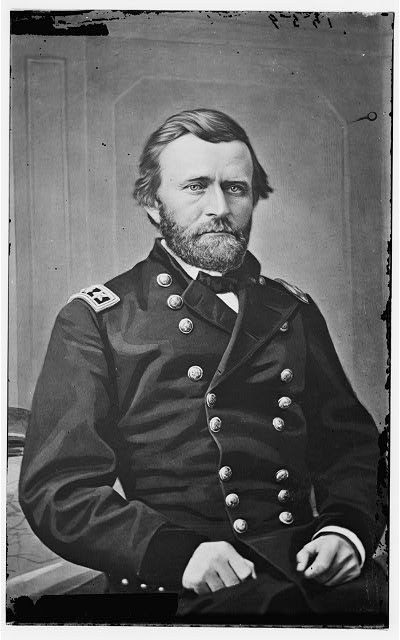
In March Ulysses S. Grant will travel east and become general in chief of the Union armies (Library of Congress).

In March Ulysses S. Grant will travel east and become general in chief of the Union armies (Library of Congress).

You ask me about Grant. It is difficult for me to reply. I knew him as a young man in the Mexican war, at which time he was considered a clever young officer, but nothing extraordinary. He was compelled to resign some years before the present war, owing to his irregular habits. I think his great characteristic is indomitable energy and great tenacity of purpose. He certainly has been very successful, and that is nowadays the measure of reputation. The enemy, however, have never had in any of their Western armies either the generals or the troops they have had in Virginia, nor has the country been so favorable for them there as here. Grant has undoubtedly shown very superior abilities, and is I think justly entitled to all the honors they propose to bestow upon him.

Meade’s correspondence taken from The Life and Letters of George Gordon Meade, Major-General United States Army, Vol. 2, (New York: Charles Scribner’s Sons, 1913), pp. 162-3. Available via Google Books.

Politicians (December 18, 1863)

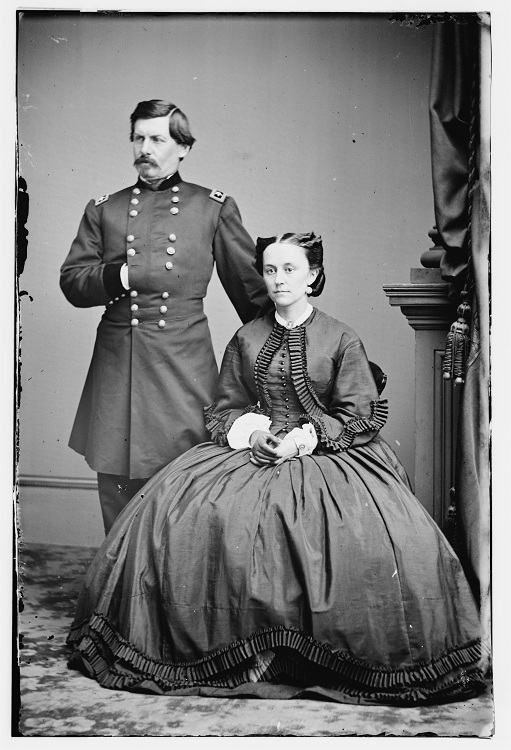
General George B. McClellan strikes a Napoleonic pose with his wife by his side (Library of Congress).

General George B. McClellan strikes a Napoleonic pose with his wife by his side (Library of Congress).

Like a small moon affected by the gravitational pull of a much larger body, the Army of the Potomac was always being pushed and pulled by the forces in Washington. Politics and politicians were unavoidable. Even in exile, George B. McClellan, the army’s first commander, remained an influence, for good or ill. Congressional Republicans looked with suspicion on any general suspected of being tainted by McClellanism. In 1864 that will create political challenges for Meade. Yet he does retain his command until the end of the war, so maybe he is right when he says he can keep the politicians “in their proper places.”

To-day Captain Chauncey handed me your letter of the 13th inst.

As to politics and politicians, as I never have had anything to do with them, and have personal friends in all parties, I don’t see why I am to fear them now. I think I can keep them in their proper places. Already the Tribune has charged that the gentleman in New Jersey, my correspondent, is George B. McClellan, and asks why this is not openly avowed. I have no political aspirations. I have the ambition to prove myself a good soldier, and intend to try to afford evidences of this to the last. Major Jim Biddle has gone on leave; so you will hear all the latest news from the camp.

Meade’s correspondence taken from The Life and Letters of George Gordon Meade, Major-General United States Army, Vol. 2, (New York: Charles Scribner’s Sons, 1913), p. 162. Available via Google Books.

The Russians are Coming! (December 16, 1863)

Brig. Gen. John Buford, who died on December 16, 1863  (Library of Congress).

Brig. Gen. John Buford, who died on December 16, 1863 (Library of Congress).

On December 16 George Meade and Theodore Lyman both write home about an Russian invasion of sorts, as they Army of the Potomac received a delegation of naval officers from that country. Both letters are included here. Lyman included more details, and strong dash of anti-Semitism, in his diary entry for December 15 (which you can read in Meade’s Army: The Private Notebooks of Lt. Col. Theodore Lyman, edited by David W. Lowe). The leader was a “a very well looking, intelligent man, with somewhat of a Sclavic [Slavic] face, short nose, round countenance, and eyes rather small and sunken.” Lyman noted that some of the other men were “palpable Jews.”

Meade also expresses his indignation at a recent action of Congress, which issued an official thank you for the victory at Gettysburg. The first person named was Joe Hooker. Meade came second, with Oliver O. Howard third. It was an indication of the troubles Meade would face in Washington in 1864.

In his diary entry for December 16 Lyman mentions receiving word of a great loss for the Army of the Potomac–the death of John Buford. The stalwart cavalryman had died of typhoid in Washington.

I received yesterday your letter of the 13th inst., and would have answered it at once, but about 2 p. m. we had a sudden invasion of Muscovites, some twenty-four officers of the fleet visiting the army, and I had to give them my attention till after 10 P. M., when they returned to Alexandria. I had the Sixth Corps paraded and some artillery to show them. We had great fun with them in mounting them on horseback, which they all insisted on attempting; but we had not proceeded far before one was thrown and some half a dozen ran away with. After the review we gave them some dinner, with plenty of brandy and whisky, and, making them jolly, sent them back highly delighted with their visit and reception. They appeared intelligent and gentlemanly, almost all speaking English quite well. The admiral did not honor us, Captain Bourtakoff being the senior officer with the party.

I presume you have seen how highly honored I have been in having my name associated with General Hooker by Mr. Wilson, in the Senate, in a vote of thanks for the Gettysburg campaign. Why they confined the including of my predecessors to Hooker I am at a loss to imagine. He certainly had no more to do with my operations and success at Gettysburg than either Burnside or McClellan; but I presume Mr. Wilson, who is a great friend and admirer of Hooker, was a little doubtful of a distinct resolution on his behalf getting through.

Here is Theodore Lyman’s view of things from December 16. This is his last letter of 1863 as he will soon head to Boston on leave.

Yesterday we had one of the funniest exhibitions that the Army has been favored with in a long while. The peaceful dolce far niente of the forenoon was suddenly broken by a telegraph, announcing a Russian invasion — nothing less than a legion of Muscovite naval officers pouring down, to the number of twenty-four, in a special train, on our devoted heads! And they were to come in a couple of hours! Would they pass the night? if so, where put them, in a camp where two or three guests make a crowd? Would they be fed? Even this was a problem, unless we ordered the Commissary to open a dozen boxes of the best stearine candles. However, General Meade at once orders the 6th Corps to parade, and gets hold of all the ambulances of the Staff, which are forthwith sent to the depot, after the serene Bears. And soon the vehicles returned, with flat caps hanging out of all the openings. Then the thing was to put them on horseback, as soon as possible, for it grew late in the day, already. You have heard of “Jack on horseback,” and this was a most striking instance. Each one sat on his McClellan saddle, as if doublereefing a topsail in a gale of wind. Their pantaloons got up, and their flat caps shook over their ears; and they kept nearly tumbling off on one side and hoisting themselves up again by means of the pommel. Meanwhile they were very merry and kept up a running fire of French, English and Russian. The extraordinary cavalcade having reached a hill, near the ground, there was found an ambulance, which had brought such as did not wish to ride, including the Captain, Bootekoff, who was the head feller. He, however, was persuaded to mount my mare, while I remained in the carriage. Thereupon the other carriage company were fired with a desire also to mount. So a proper number of troopers were ordered to get down, and the Russians were boosted into their saddles, and the procession moved off; but suddenly —

A horseman darted from the crowd
Like lightning from a summer cloud.

It was a Muscovite, who had discovered that the pommel was a great thing to hold on to, and who had grasped the same, to the neglect of the rein; whereupon the steed, missing his usual dragoon, started at a wild gallop! Off flew the flat cap and away went the horse and rider, with a Staff officer in full chase! Example is contagious, and, in two minutes, the country was dotted with Russians, on the wings of the wind, and vainly pursuing officers and orderlies. Some tumbled off, some were caught and brought back; and one chief engineer was discovered, after dark, in the woods, and in the unpleasant vicinity of the enemy’s picket line. However, the most of them were at last got up and viewed the troops from their uncertain positions. After which they were filled up with large quantities of meat and drink and so sent in a happy frame of mind to Washington. The Captain was a very intelligent man; but most of the rest had no character or manliness in their faces, and two or three of them seemed to me almost full-blooded Jews. . . .

To-morrow I lose my tent-mate, the phlegmatic countryman of Gustav Adolf and Charles XII. He could not get permission to remain on General Hunt’s Staff and so will have the satisfaction of joining his cavalry regiment, which is hutted somewhere in the mud, near Culpeper! In his place I shall probably have Rosencrantz, another Swede, and for some time at Headquarters as A.D.C. He is a courteous man, an old campaigner, and very amusing with his broken English.*

*This final paragraph is from a letter dated December 15.

Meade’s correspondence taken from The Life and Letters of George Gordon Meade, Major-General United States Army, Vol. 2, (New York: Charles Scribner’s Sons, 1913), p. 161. Available via Google Books.
Theodore Lyman’s letter is from Meade’s Headquarters, 1863-1865: Letters of Colonel Theodore Lyman from the Wilderness to Appomattox, pp 61-3. Edited by George R. Agassiz. Boston, Massachusetts Historical Society, 1922. Available via Google Books.
News at Last (December 12, 1863)

Meade finally learns that he will not be replaced–but he gets that news from a newspaper. John W. Forney was the Chronicle’s editor and was close to the president, so close that opponents called him “Lincoln’s dog.”

The mail has just come in and brings to-day’s Washington Chronicle, which announces I am not to be relieved. As this paper is edited by Forney, who is supposed to have confidential relations with the Administration, I presume this announcement may be considered semi-official.

Meade’s correspondence taken from The Life and Letters of George Gordon Meade, Major-General United States Army, Vol. 2, (New York: Charles Scribner’s Sons, 1913), p. 161. Available via Google Books.

Defending Meade (December 12, 1863)

Theodore Lyman defends his boss. As time passes it becomes more certain that Meade will remain in command of the Army of the Potomac. I do not know who he means by his reference to the “Hon. Kellogg,” but the quote Lyman credits to him does remind me of something from a letter Meade wrote back in December 20, 1862, just after the Battle of Fredericksburg.It is understood [General in Chief Henry] Halleck says: ‘This army shall go to Richmond, if it has to go on crutches,’ which (as over ten thousand cripples were made the other day) seems likely to occur before long.”

I still think, and more strongly than ever, that no change will be made in our chief command; and those who have been to Washington think the same. I am more and more struck, on reflection, with General Meade’s consistency and self-control in refusing to attack. His plan was a definite one; from fault of his inferiors it did not work fast enough to be a success; and he had firmness to say, the blow has simply failed and we shall only add disaster to failure by persisting. By this time the officers here know just about how well the Rebels fight, and what we have a reasonable expectation of taking, and what not. It should be remembered, also, as a fundamental fact, that this line is not approved as a line of operations, and never has been; but we are forced to work on it. Those who think that (according to the Hon. Kellogg) “it would be better to strew the road to Richmond with the dead bodies of our soldiers rather than that there should nothing be done!” may not be content; but those who believe it best to fight when you want to, and not when your enemy wants to, will say simply they are sorry nothing could be effected, but glad that there was no profitless slaughter of troops that cannot be replaced.

Theodore Lyman’s letter is from Meade’s Headquarters, 1863-1865: Letters of Colonel Theodore Lyman from the Wilderness to Appomattox, p 61. Edited by George R. Agassiz. Boston, Massachusetts Historical Society, 1922. Available via Google Books.

Continuing Silence (December 11, 1863)

In this image taken at Cold Harbor in 1864, Winfield Scott Hancock (seated) poses with (left to right) Francis Barlow, David Birney, and John Gibbon. Prior to Ulysses S. Grant's promotion to general-in-chief, Birney had supported efforts to get Joe Hooker returned to command of the Army of the Potomac (Library of Congress).

Two officers Meade mentions in his December 11 letter appear in this image taken at Cold Harbor in 1864. Winfield Scott Hancock (seated) poses with (left to right) Francis Barlow, David Birney, and John Gibbon. Prior to Ulysses S. Grant’s promotion to general-in-chief, Birney had supported efforts to get Joe Hooker returned to command of the Army of the Potomac (Library of Congress).

Time passes and still Meade hears nothing from Washington after his failed Mine Run Campaign. As he frets, Meade speculates about potential successors. Joe Hooker, of course, was his predecessor as commander of the Army of the Potomac and there was a movement afoot to have Fighting Joe return to command. Thomas is George Thomas, who had received the nickname of “The Rock of Chickamauga” after his stand at that September battle helped prevent the complete rout of William Rosecrans’ army. Gibbon is John Gibbon, who commanded a division of the II Corps (and at times the entire II Corps) at Gettysburg. Winfield Scott Hancock had been the II Corps commander when not in charge of other corps as well as his own. Like Gibbon, he had been wounded on the third day at Gettysburg.

I have not heard a word from Washington, but from what I see in the papers, and what I hear from officers returning from Washington, I take it my supersedure is decided upon, and the only question is who is to succeed me. I understand the President and Secretary Chase are very anxious to bring Hooker back; but Halleck and Stanton will undoubtedly oppose this. A compromise may perhaps be made by bringing Thomas here, and giving Hooker Thomas’s army.

I have very kind letters from Gibbon and Hancock, both hoping I will not be relieved, and each saying they had not lost a particle of confidence in me. Many officers in the army have expressed the same feeling, and I really believe the voice of the army will sustain me. This, though, goes for nothing in Washington. I will not go to Washington to be snubbed by these people; they may relieve me, but I will preserve my dignity.

Meade’s correspondence taken from The Life and Letters of George Gordon Meade, Major-General United States Army, Vol. 2, (New York: Charles Scribner’s Sons, 1913), pp. 160-1. Available via Google Books.