Meanwhile, Back in Gettysburg (November 19, 1863)

With Meade remaining silent, we stick with Theodore Lyman’s accounts of live with the Army of the Potomac with his letter from November 19, 1863. On this day in Pennsylvania, Abraham Lincoln was speaking at the dedication of the new National Cemetery in Gettysburg. The president was not the headliner, though. That honor fell to Edward Everett, a former congressman, Massachusetts governor, and president of Harvard. Everett had also run for vice president on the Union platform with John Bell, the ticket for which Meade and Lyman voted in the 1860 election. Everett’s speech at Gettysburg ran for more than two hours—about sixty times longer than the president’s—but who today remembers what he said? The situation reminds me of the scene in Raiders of the Lost Ark where Indiana Jones encounters a scimitar-wielding assassin who dazzles him with an elaborate display of swordsmanship. Indy then draws his gun and shoots him dead with a single shot.

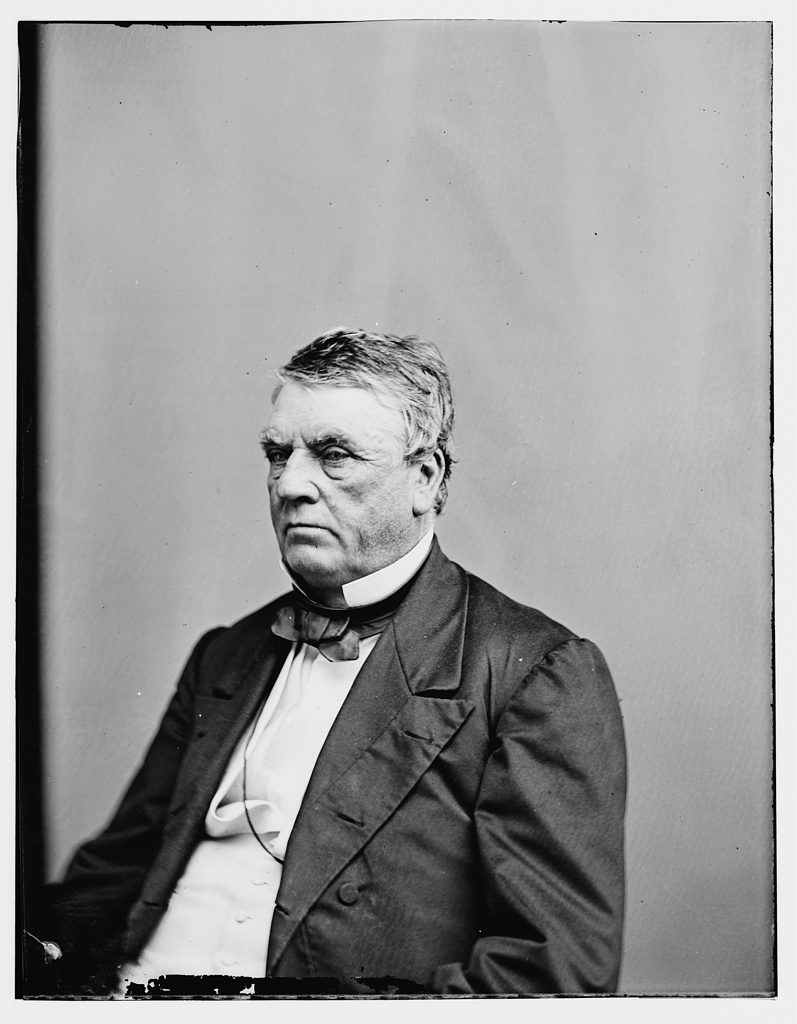
Edward Everett, the man who spoke before Lincoln at Gettysburg and therefore forever doomed to be a footnote to history (Library of Congress).

Edward Everett, the man who spoke before Lincoln at Gettysburg and therefore forever doomed to be a footnote to history (Library of Congress).

Meade was invited to attend the ceremonies at Gettysburg but obviously had other matters demanding his attention. However, he and Lyman were, in a small fashion, involved with Everett’s speech. In his journal entry for October 5 (quoted in Meade’s Army: The Private Notebooks of Lt. Col. Theodore Lyman, edited by David Lowe) Lyman says this: “Prepared, by order, a sort of résumé of Gen. Meade’s official report of the battle of Gettysburg, to be sent to Mr. Everett, who is to deliver an oration at the cemetery, to be made at that place.” On October 26 he noted getting a letter from Everett asking for more information about the battle. Lyman was a Harvard graduate himself and his father and Everett had once traveled through Europe together. Lyman happened to be in Boston in January 1865 when Everett died and attended the funeral, “which took place with the usual solemnities.”

Meade made his own Gettysburg Address in 1869, which you can find here.

The Britons still continue with us. Yesterday we took them, with a small escort, to [John] Buford’s Headquarters beyond Culpeper. By Brandy Station we came across a line of rifle-pits that the Rebs had thrown up, probably on the Saturday night of their retreat, so as to cover the trains falling back on the Rapid Ann. We found the cavalry Chief afflicted with rheumatism, which he bore with his usual philosophy. Hence we made haste, across the country, to General [Gouverneur K.] Warren’s, where he had prepared some manoeuvres of infantry for us. This was one of the finest sights I have seen in the army. There were some 6000 or 7000 men on the plain, and we stood on a little hill to look. The evolutions ended by drawing up the force in two lines, one about 300 yards in rear of the other; and each perhaps a mile long. Then they advanced steadily a short distance, when the order was given to charge, and, as if they were one man, both fines broke into a run and came up the hill, shouting and yelling. I never saw so fine a military spectacle. The sun made the bayonets look like a straight hedge of bright silver, which moved rapidly toward you. But the great fun was when part of the line came to a stone wall, over which they hopped with such agility as to take Colonel Earle prisoner, while Captain Stephenson’s horse, which was rather slow, received an encouraging prod from a bayonet. Which events put us in great good humor, and we rode merrily home.

Theodore Lyman’s letter is from Meade’s Headquarters, 1863-1865: Letters of Colonel Theodore Lyman from the Wilderness to Appomattox, p. 50. Edited by George R. Agassiz. Boston, Massachusetts Historical Society, 1922. Available via Google Books.

A Very British Visit (November 15, 1863)

Captain Henry J. Sleeper, whom Lyman mentions in his November 15 letter, sits at the right in this photograph showing members of the 10th Massachusetts Battery. This was taken in December 1863. The man on the left is not a battery member--he is artist Alfred Waud (Library of Congress).

Captain Henry J. Sleeper, whom Lyman mentions in his November 15 letter, sits at the right in this photograph showing members of the 10th Massachusetts Battery. This was taken in December 1863. The man on the left is not a battery member–he is artist Alfred Waud, who just a few weeks earlier had sketched the battery in action (Library of Congress).

Foreigners loved to visit the Army of the Potomac, and Theodore Lyman’s letters and journal entries are filled with accounts of people from overseas popping in for a look-see. The Sir Robert Peel he mentions is Britain’s former prime minister. The McClellan saddle is a saddle that George McClellan had designed. Sleeper, the artillery man Lyman mentions, is Captain Henry Sleeper, who served with the 10th Massachusetts Battery, not the 9th.

Yesterday the General made a start at six A.m. for Washington, taking with him Major Biddle, Captain Meade, and Captain Mitchell, and suppose he will perhaps get back to-morrow. A little before one o’clock came a telegraph that four officers of the “Ghords” were coming in the train, and that we were to send an officer, with ten men, also four led horses, to bring them up. So Major Barstow asked if I would go, whereat, there being nothing to do, I said I would. It is about eight miles to Bealton, the nearest place the railroad runs to, and, by making haste a little, we got there by two o’clock, and the train came a few minutes after. And there, sure enough, were four gents, much braided and striped, who were the parties in question: viz., Lieutenant-Colonel Earle, and Lord Castle Cuff (Grenadier Guards), Captain Peel and Captain Stephenson (Scotch Fusiliers). This was the best lot of Bulls I have seen for a long time. The nobile Lord is, I should say, about sixteen, and, with his cap off, is as perfect a specimen of a Pat as you ever saw; but he is manly, and not so green as many I have seen of double his age. Colonel Earle is extremely quiet and well mannered, and was down here in Burnside’s time. Captain Stephenson is in the beefy style, and Captain Peel (son of Sir Robert) is of the black order; but both have free use of their legs and tongues, a remarkable phenomenon in a Bull. We put them on horses, where they were well at home, except they would persist in trying to rise to the trot in a McClellan saddle, which is next to impossible. We had to cross the river, close to the railroad, where I showed them the work they took last Saturday; at which they remarked: “Oh! Ah! A nasty place, a very nasty place!” Then we rode to Headquarters, just in time to avoid a heavy rain, which continued much of the night. To-day we have lain quiet; but this evening we took them over to see Captain Sleeper, 9th Massachusetts Battery. The Colonel was very inquisitive about artillery, whereupon the enthusiastic Sleeper had a newly contrived shell, which was loaded, suddenly brought into the tent! The great improvement in the shell seemed to be that it was bound to go off, somehow; so that there was a marked nervousness about him of the Guards, as the Captain poked and twisted the projectile, to illustrate its manifold virtues! . . .

Theodore Lyman’s letter is from Meade’s Headquarters, 1863-1865: Letters of Colonel Theodore Lyman from the Wilderness to Appomattox, pp. 48-9. Edited by George R. Agassiz. Boston, Massachusetts Historical Society, 1922. Available via Google Books.
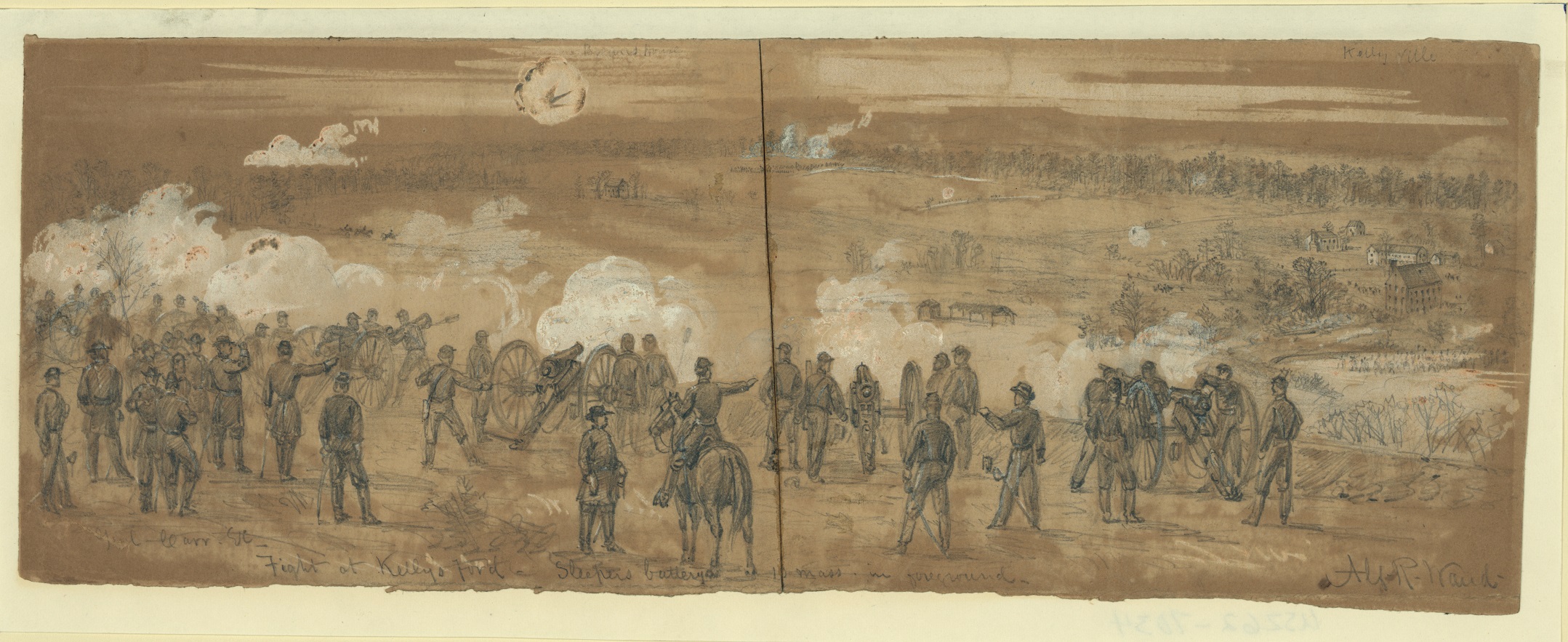
Alfred Waud drew Sleeper's Battery at work during the November 7 battle at Kelly's Ford, part of William French's diversionary attack during the Battle of Rappahannock Station (Library of Congress; click to enlarge).

Alfred Waud drew Sleeper’s Battery at work during the November 7 battle at Kelly’s Ford, part of William French’s diversionary attack during the Battle of Rappahannock Station (Library of Congress; click to enlarge).

“Tough and Unterrified” (November 13, 1863)

There are no letters from Meade for a while, but on November 13 Theodore Lyman weighs in with his observations on the Army of the Potomac after the victory at Rappahannock Station. He also runs into an old friend, whose experiences demonstrate how tough life could be for a Union man in Virginia.

John Minor Botts (Library of Congress).

John Minor Botts (Library of Congress).

Here we continue to dwell in our pine wood, in grave content, consuming herds of cattle and car-loads of bread with much regularity. Yesterday, who should turn up but John Minor Botts, the tough and unterrified. [We met Botts here.] The Rebs treated him pretty badly this time, because he invited General Meade to dine; burnt his fences, shot his cattle and took all his corn and provisions, and finally arrested him and took him as far as Culpeper, but there concluded he was a hot potato and set him free. He was inclined to pitch into us, for not following sharper after the Rebs on Sunday morning, that is, the day after we forced the river. He said the first of their waggons did not pass his house till two at night and the rear of the column not till ten next morning; that the roads were choked with footmen, guns, cavalry and ambulances, all hurrying for the Rapid Ann. In good sooth I suppose that a shade more mercury in the feet of some of our officers might do no harm; but, on the other hand, it is to be noticed that we had excellent reason to expect, and believe, that they would not run, but only retire to the ridges near Brandy Station and there offer battle. In this case, the premature hurrying forward of a portion of the troops might well have ruined the day. All of which reminds me of Colonel Locke’s remark: “If we were omniscient, omnipresent, and omnipotent, we might, with care, get a very pretty fight out of the Rebs!” As it was, what we did do was done as scientifically as any army in the world could have done it, and with a minimum loss of life. I do assure you that Rappahannock station was a position where thousands of men might have been destroyed, with no gain whatsoever, if managed by unskilful officers; and even Kelly’s Ford was not without serious difficulties. I don’t recollect whether I told you that the enemy had made preparations for nice winter quarters, and were hutting themselves and had made some capital corduroy roads against the mud season. In one hut was found a half-finished letter, from an officer to his wife, in which he said that the Yanks had gone into winter quarters, and that they were doing the same, so that he expected a nice quiet time for some months. Poor man! The Yanks made themselves very comfortable that same evening in his new cabin. Our future movements, or standing still, lie between the General and the weather. Meantime we have to pause a little, for there isn’t a thing to eat in this broad land, and every pound of meat and quart of oats for tens of thousands of men and animals must come by a broken railroad from Alexandria. . . . The Palatinate, during the wars of Louis XIV, could scarcely have looked so desolate as this country. The houses that have not been actually burnt usually look almost worse than those that have: so dreary are they with their windows without sashes, and their open doors, and their walls half stripped of boards. Hundreds of acres of stumps show where once good timber stood, and the arable fields are covered with weeds and blackberry vines, or with the desolate marks of old camps — the burnt spots, where the fires were, the trenches cut round the tents, and the poles, and old bones and tin pots that invariably lie about. . . .

As you walk about the country, you often see fragments of shell scattered around; for all this country has been fought over, back and forth, either in skirmishes or battles; and here and there, you come on a little ridge of earth, marked by a bit of board, on which is scrawled the name of the soldier, who lies where he fell, in this desert region. Our people are very different from the Europeans in their care for the dead, and mark each grave with its name; even in the heat of battle.

Theodore Lyman’s letter is from Meade’s Headquarters, 1863-1865: Letters of Colonel Theodore Lyman from the Wilderness to Appomattox, pp. 46-8. Edited by George R. Agassiz. Boston, Massachusetts Historical Society, 1922. Available via Google Books.
Satisfaction (November 9, 1863)

On November 9 Meade writes to his wife with his comments on the Battle of Rappahannock Station.

When I last wrote to you I thought we were on the eve of a great battle, and I was also under the impression that the work I had before me was likely to prove a very severe task. The enemy occupied very strong positions on the Rappahannock, which at one place I knew were strongly entrenched, and I believed they were so at other points. Thanks, however, to their being entirely deceived as to my capacity to move, and to the gallantry of my men, we were enabled to carry then- strong works and to force the passage of the river (considered one of the most critical operations in war), with a comparatively small loss, and with great eclat, as we captured four guns, eight battle flags and nearly two thousand prisoners. The operation being successful, the army is in fine spirits, and of course I am more popular than ever, having been greeted yesterday as I rode through the ranks with great cheering; and my having forced the passage of the Rappahannock and compelled Lee to retire to the Rapidan, will I trust convince the intelligent public that my retreat to Centreville was not to avoid battle, and that Lee, who was not outflanked, or had his communications threatened, but was attacked in front, and yet withdrew, is really the one who has avoided battle. I certainly expected he would fight, and can only now account for his not doing so on the ground that he was deceived as to my strength and construed my sudden and bold advance into an evidence that I had been strongly reinforced and greatly outnumbered him. I must say I was greatly disappointed when I found Lee refused my offer of battle, because I was most desirous of effecting something decisive, and I know his refusal was only a postponement of a question that had to be met and decided.

I have received a telegram from the President, expressing his satisfaction with my operations.

Meade’s correspondence taken from The Life and Letters of George Gordon Meade, Major-General United States Army, Vol. 2, (New York: Charles Scribner’s Sons, 1913), pp. 155-6. Available via Google Books.

Rappahannock Station (November 7, 1863)


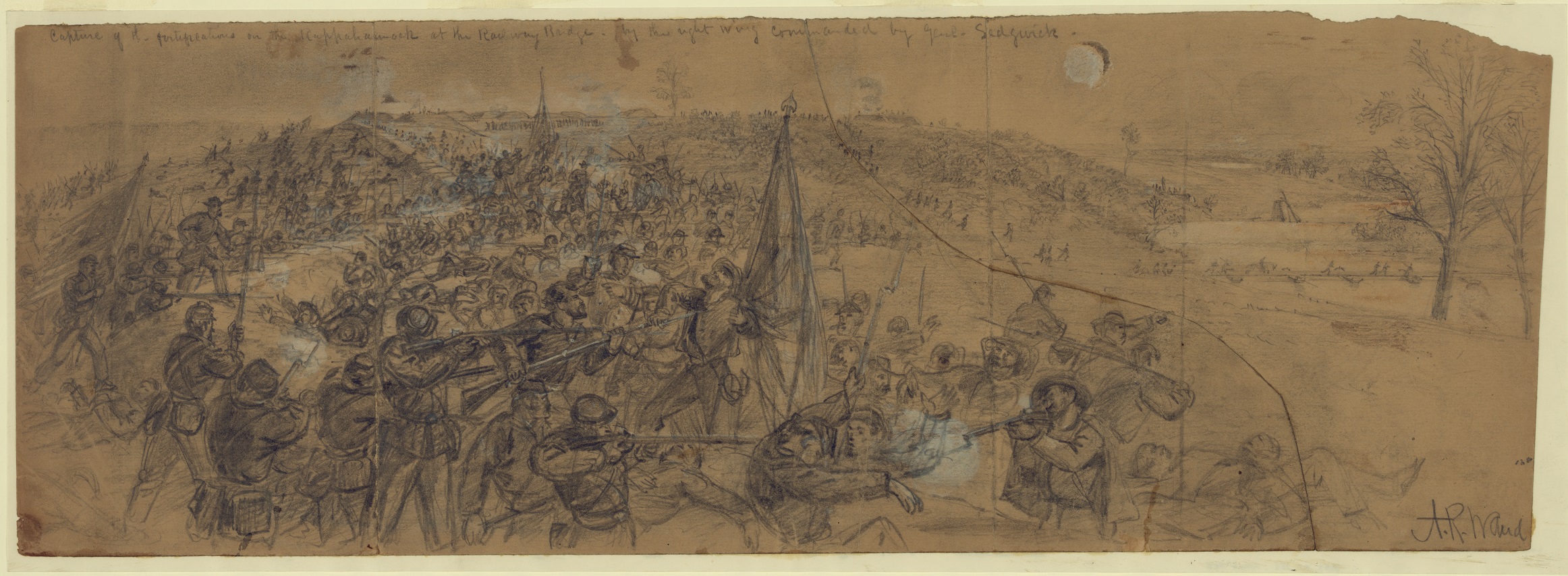
Artist Alfred Waud called this drawing "Capture of the fortifications on the Rappahannock at the Railway Bridge--by the right wing commanded by Genl. Sedgwick" (Library of Congress). Click to enlarge.

Artist Alfred Waud called this drawing “Capture of the fortifications on the Rappahannock at the Railway Bridge–by the right wing commanded by Genl. Sedgwick” (Library of Congress). Click to enlarge.

In his letter of November 7, 1863, Theodore Lyman describes the Army of the Potomac’s small but unexpected triumph at a spot called Rappahannock Station. Today the small village alongside the river is called Remington, but it’s been a place of many names. First a riverside gristmill gave it the name of Millview. In 1850 it became Bowenville, after a prominent resident. Three years later the arrival of the Orange and Alexandria Railroad rechristened it Rappahannock Station. In 1890 the post office requested a change because of confusion with a town called Tappahannock. A Captain Remington was supposedly a popular conductor on the railroad, so the residents decided to name it after him.

Back in 1863 Meade’s plan called for William French and the III Corps to cross the Rappahannock River downstream at ever-busy Kelly’s Ford. At the same time John Sedgwick, in overall command of the V and VI Corps (with Brig. Gen. Horatio Wright taking immediate command of Sedgwick’s corps), would attack the rebel breastworks at Rappahannock Station. Most of the Confederate army lay in wait on the other side of the river, but the rebels had constructed a strong advance position on the north bank, using entrenchments that Union soldiers had constructed earlier in the war. For once, not only did everything go according to plan, but everything went better than anyone dared hope. On the morning of November 7 French successfully crossed the river at Kelly’s Ford. At Rappahannock Station, the VI Corps approached the Confederate works to the right of the railroad, with the V Corps to the left. Then the men of the VI Corps began charging the rebel lines at double-quick and rushed over the works like a tsunami. The first man over the Confederate breastworks was supposedly a sergeant from the 6th Maine, who looked around, realized he was surrounded by rebel troops, and shouted that he surrendered. Then he saw other men from his regiment jumping over the works behind him. “I take it back!” he cried and snatched up an enemy flag. The fighting was fierce and concentrated until elements of the V Corps attacked from the flank and rear, shattering the rebel defenses. Night fell and the battle was over. It was a sudden and unexpected victory, with the Federals having killed, wounded, or captured more than sixteen hundred Confederates.

 . . . This morning, forward march! horse, foot, and artillery, all streaming towards Dixie; weather fresh and fine, nothing to mar but a high wind, and, in some places, clouds of dust. Everyone was hearty; there was General [Alexander] Hays, in bed with rheumatism, but he hopped up, and got on his horse, remarking that, “if there were any Rebs to catch, he was all well.” Our last Headquarters were on the Warrenton branch railroad, half a mile north of it and three miles from Warrenton Junction. This morning, about 8.30, when all the troops were reported under way, the General started and rode, first to Warrenton Junction, and then down the railroad, towards the Rappahannock. At a rising ground, where a smoke-stained chimney marked the ruins of “Bealton,” we halted. Hence we could see a considerable distance, in both directions, and here was canny [Gouverneur] Warren, waiting while his corps filed past, his little black eyes open to everything, from the grand movements of the entire army down to the inscription on my swordguard, which he immediately detected, and read with much gravity. The last I saw of him he climbed on his big white horse and remarked with a wink: “As soon as I get there, I shall bring on a general action, right off.” It was here that I had quite a surprise. Looking through my glass at General [Alexander] Webb’s division, I detected two civilians, in English-looking clothes, riding with the Staff. As they approached, it seemed to me that the face of one was familiar; and as they rode up, behold, to be sure, the Hon. Mr. Yorke, who was our fellow passenger and played on the fiddle and admired the baby! He was in the Royal Artillery, you know, and had come down to see what he could. And there he was, much covered with dust, but cheerful and pleasant to the last.

A view of the modern railroad bridge across the Rappahannock at Remington. In 1863 this was Rappahannock Station and the bridge had been burned (Tom Huntington photo).

A view of the modern railroad bridge across the Rappahannock at Remington. In 1863 this was Rappahannock Station and the bridge had been burned (Tom Huntington photo).

It was a fine sight to see the great, black columns of infantry, moving steadily along, their muskets glittering in the sun (for the day was quite perfect as to clearness), and then the batteries on the flank, and, in the rear, the train of ambulances preceded by their yellow flag. As the masses drew near, they resolved themselves, first into brigades, then into regiments, and then you could distinguish the individual soldiers, covered with dust and bending under their heavy packs, but trudging manfully along, with the patient air of old sojers. And so we kept on to these Headquarters; but we were only half way (at 1.30), when bang! bang! we heard the cannon, in the direction of Rappahannock station. It was General Sedgwick attacking the enemy’s works on this side of the river. We had not got a mile, when whang! whang! in another direction, announced General French preparing to force Kelly’s Ford. For, at these two points, among others, we proposed to cross and wake up our Uncle Lee. The gallant General did not wait to play long shots or throw pontoon bridges. An entire division took to the water, forded the river, in face of the enemy, and, charging up the opposite bank, took 300 prisoners. The Rebs threw forward a supporting division, but the crafty French had established guns on this side of the river, that suddenly opened on them and drove them back. All the afternoon Sedgwick has been engaged against the rifle-pits and a redoubt, that the enemy held on this side of the river. Quite late, we got a despatch that he had driven them from their rifle-pits, and we thought he had done pretty well for an afternoon. But, just at dusk, the distant roll of musketry indicated that he was assaulting; and a telegraph has just come, that he has taken the redoubt with four cannon, and some prisoners; I do not yet know how many. So we go to sleep, encouraged and hopeful. Our losses I do not know, but they can hardly be much, as but a portion has been engaged. . . .

Theodore Lyman’s letter is from Meade’s Headquarters, 1863-1865: Letters of Colonel Theodore Lyman from the Wilderness to Appomattox, pp. 42-4. Edited by George R. Agassiz. Boston, Massachusetts Historical Society, 1922. Available via Google Books.

Dissatisfaction (November 3, 1863)

This image, taken in September 1863 outside Culpeper, shows Meade with several of his generals. From left to right we have Gouverneur Warren, then in temporary command of the II Corps while Winfield Scott Hancock recovered from his Gettysburg wound; William French, commanding the III Corps; Meade; Henry Hunt, the army's artillery chief, chief of staff Andrew Humphreys; and George Sykes (V Corps).

This image, taken in September 1863 outside Culpeper, shows Meade with several of his generals. From left to right we have Gouverneur Warren, then in temporary command of the II Corps while Winfield Scott Hancock recovered from his Gettysburg wound; William French, commanding the III Corps; Meade; Henry Hunt, the army’s artillery chief, chief of staff Andrew Humphreys; and George Sykes (V Corps).

In his letter home on November 1, Meade remains defensive about his recent operations. He knew that President Lincoln and General in Chief Henry Halleck were not happy with the results, but he felt they should remove him from command if they thought someone could do better. Yet when he did propose a plan of action—an attempt to flank Lee’s army by crossing the Rappahannock at Banks Ford and Fredericksburg—Lincoln refused permission. Perhaps Meade’s projected strategy aroused bad memories of Ambrose Burnside’s disastrous campaign, but almost certainly the president worried that the movement risked leaving Washington exposed. It’s interesting to speculate, though, what would have happened had the Army of the Potomac been in Fredericksburg in the spring of 1864 instead of having to fight its way through the Wilderness.

Within the army rumor had it that Meade was going to be replaced. “Candidly, we feel every confidence in Meade, and if anyone succeeds him but McClellan, the dissatisfaction will be intense,” noted one officer.

There is no doubt my failure to engage Lee in battle during his recent advance created great disappointment, in which feeling I fully shared. I have seen and heard of no indications of absolute dissatisfaction, though this may have existed without its being manifested. The General in Chief did telegraph me I had better fight instead of running away, but as he did not explain how I could fight to advantage, I paid no attention to the very rough manner in which he expressed his views, except to inform him that, if my judgment was not approved, I ought to be and deserved to be relieved; to which I received no reply beyond a disclaiming of any intention to give offence. Now I have clearly indicated what I thought feasible and practicable and my plan is disapproved. I think under these circumstances justice to me and the true interests of the country justify their selecting some one else to command.

Meade’s correspondence taken from The Life and Letters of George Gordon Meade, Major-General United States Army, Vol. 2, (New York: Charles Scribner’s Sons, 1913), p. 155. Available via Google Books.

Have you read Searching for George Gordon Meade: The Forgotten Victor of Gettysburg yet? If not, you can buy it here!

Feeling Defensive (October 30, 1863)

Meade and his staff pose for a photo  in Culpeper in September 1863 ((Library of Congress).

Meade and his staff pose for a photo in Culpeper in September 1863. That’s Theodore Lyman second from right; Andrew Humphreys is to Meade’s right  ((Library of Congress).

Meade strikes a defensive tone when he writes to his wife on October 30. While he may not consider his move back to Centreville a retreat, many others obviously saw it that way. However, by campaign’s end the Armies of the Potomac and Northern Virginia had regained their former positions. Meade knew, however, that his masters back in Washington wanted to see some offensive action before the end of the campaigning season. Ambrose Burnside had felt the same pressure in the fall of 1862. The result was the debacle at Fredericksburg. How would Meade react?

You seem to be very much puzzled about my retreat, as you misname it. It was not a retreat, but a withdrawal of the army—manoeuvring to get into a proper position to offer battle, and made to prevent Lee from compelling me to fight at a disadvantage. Had I been able to ascertain his movements, I would have given him battle the day Warren was attacked; but I was misled by information which induced me to believe he was farther ahead. As it afterwards turned out, I was ahead of him; which was the object I was trying to attain before fighting. It was greatly to my interest to fight, and I was most anxious to do so, but I would not do so with all the advantages on his side, and the certainty that if the battle went against me I could not extricate the army from its perilous position. I don’t suppose I shall ever get credit for my motives, except with the army. The soldiers realize the necessity of not letting the enemy have the game in their hands entirely; hence they cheerfully submitted to all the hardships, such as night and forced marches, that I was compelled to impose on them.

Meade’s correspondence taken from The Life and Letters of George Gordon Meade, Major-General United States Army, Vol. 2, (New York: Charles Scribner’s Sons, 1913), pp. 154-5. Available via Google Books.

Lyman Reports (October 26 and 28, 1863)

Theodore Lyman reports from the Army of the Potomac on October 26 and 28. In the first letter he comments on Meade’s notorious temper, which Lyman indicates served a useful purpose.

Ah! we are a doleful set of papas here. Said General Meade: “I do wish the Administration would get mad with me, and relieve me; I am sure I keep telling them, if they don’t feel satisfied with me, to relieve me; then I could go home and see my family in Philadelphia.” I believe there never was a man so utterly without common ambition and, at the same time, so Spartan and conscientious in everything he does. He is always stirring up somebody. This morning it was the cavalry picket line, which extends for miles, and which he declared was ridiculously placed. But, by worrying, and flaring out unexpectedly on various officers, he does manage to have things pretty ship-shape; so that an officer of Lee’s Staff, when here the other day, said: “Meade’s move can’t be beat.” Did I tell you that Lee passed through Warrenton and passed a night. He was received with bouquets and great joy. . . . The last three nights have been cool, almost cold, with some wind, so that they have been piling up the biggest kind of camp-fires. You would laugh to see me in bed! First, I spread an india-rubber blanket on the ground, on which is laid a cork mattress, which is a sort of pad, about an inch thick, which you can roll up small for packing. On this comes a big coat, and then I retire, in flannel shirt and drawers, and cover myself, head and all, with three blankets, laying my pate on a greatcoat folded, with a little india-rubber pillow on top; and so I sleep very well, though the surface is rather hard and lumpy. I have not much to tell you of yesterday, which was a quiet Sunday. Many officers went to hear the Rebs preach, but I don’t believe in the varmint. They ingeniously prayed for “all established magistrates”; though, had we not been there, they would have roared for the safety of Jeff Davis and Bob Lee! . . .

A view of Richmond's Libby Prison as it looked in August 1863 (Library of Congress).

A view of Richmond’s Libby Prison as it looked in August 1863 (Library of Congress).

And on October 28 Lyman wrote:

. . . The guerillas are extremely saucy of late, and, in a small way, annoying. Night before last they dashed at a waggon train and cut loose upwards of a hundred mules and horses, which they made off with, teamsters and all, leaving the waggons untouched. These men are regularly enlisted, but have no pay, getting, in lieu thereof, all the booty they can take, except horses, which they must sell to the Rebels at a fixed rate. They have taken several officers who, from carelessness, or losing their way, have gone alone beyond the lines. Prisoners are treated with consideration, but I fancy that, from all accounts, Libby Prison is pretty dirty and crowded. When some of our officers were taken through Warrenton, on the retreat of Lee, the inhabitants gave them supper; for the 6th Corps were long quartered there and treated the people kindly. When you are here you see how foolish and blind is the clamor raised by some people, to have all property destroyed by the army in the Rebel states, as the troops passed. There was, you know, a great talk about putting guards over houses of Rebels; but, 1st, it is very wrong to punish a people en masse, without regard to their degree of guilt and without properly measuring the punishment; and, 2d, nothing so utterly and speedily demoralizes an army as permission to plunder. It is our custom to put guards over the houses that are inhabited; but, despite that, the cavalry and advanced guard take a good slice of the live-stock; forage, and vegetables. .. .

Theodore Lyman’s letters are from Meade’s Headquarters, 1863-1865: Letters of Colonel Theodore Lyman from the Wilderness to Appomattox, pp. 38-40. Edited by George R. Agassiz. Boston, Massachusetts Historical Society, 1922. Available via Google Books.

A Capital Visit (October 23, 1863)

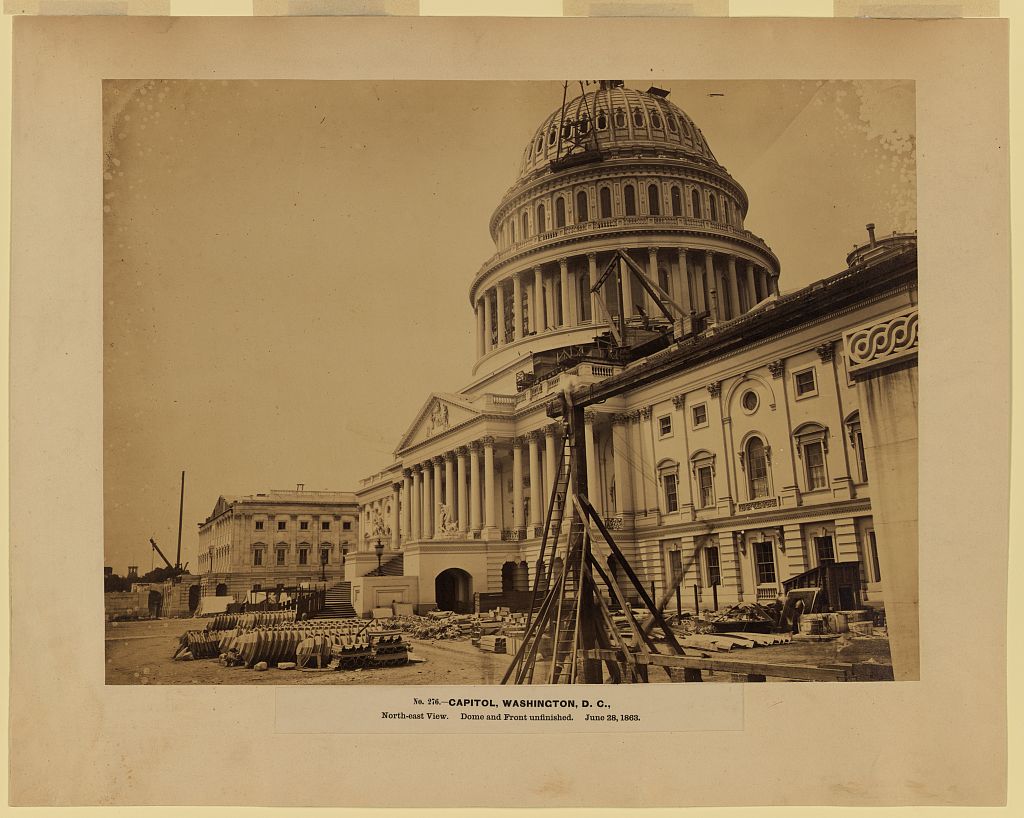
The United States Capitol as it appeared on June 28, 1863, coincidentally, the day that Meade received command of the Army of the Potomac. William Franklin, under whom Meade had served at Fredericksburg, had been the engineer in charge of the new dome construction before the war (Library of Congress).

The United States Capitol as it appeared on June 28, 1863, coincidentally, the day that Meade received command of the Army of the Potomac. William Franklin, under whom Meade had served at Fredericksburg, had been the engineer in charge of the new dome construction before the war (Library of Congress).

In which General Meade describes a summons to Washington. His laconic account in this letter to his wife is not terribly informative. Fortunately we have Theodore Lyman to fill in the details (and add, it must be said, a taste of the casual racism that would have been considered perfectly normal in the nineteenth century but grates against twenty-first century sensibilities). I’ve included Lyman’s letters from both October 23 and 24 here.

Yesterday I received an order to repair to Washington, to see the President. I arrived in Washington at 2 P. M., and expected to leave at 6 P. M., but was detained so late that I remained there all night, and left this morning, early. The President was, as he always is, very considerate and kind. He found no fault with my operations, although it was very evident he was disappointed that I had not got a battle out of Lee. He coincided with me that there was not much to be gained by any farther advance; but General Halleck was very urgent that something should be done, but what that something was he did not define. As the Secretary of War was absent in Tennessee, final action was postponed till his return.

Here’s Lyman’s much more expansive account:

Major General John Sedgwick. His men called him "Uncle John." (Library of Congress)

Major General John Sedgwick. His men called him “Uncle John.” (Library of Congress)

And where do you think I was all yesterday? I will tell you. Early, the orderly, poked his head into the tent saying: “Colonel Lyman, the General will have breakfast at seven” (which was an hour earlier than he had said the night before). As soon as I sat down, says the General: “I am going to Washington; would you like to go?” . . . Major-General Humphreys said he too would go, and the General’s son George completed the party. In much haste I ran, and crammed my best coat, pantaloons, shoes, sash, gauntlets, and brushes into my big saddle-bags, the which I entrusted to a mounted orderly. Thereupon we speedily got on horseback, and first rode to General Sedgwick (familiarly called “Uncle John”), to whom General Meade handed over the command, in his absence at Washington, to consult about the late moves and those consequent on them. Uncle John received the heavy honors in a smiling and broad-shouldered style, and wished us all a good journey, for he is a cheery soul. With little delay, we again mounted and rode twelve miles, briskly, to Gainesville, whither the railroad comes. The Chief stepped into a little room, used as a telegraph-office, and, quicker than winking, he stood, arrayed only in his undergarments; then, before, almost, I could get my coat off, he had put on a pair of shoes, a new coat, and an elegant pair of trousers! “Now then, Lyman, are you ready? Where’s Humphreys? Humphreys is always late! Come, come along, the train is going to start!” You should have seen the unfortunate Aide — his coat unbuttoned, his shoestrings loose; on one arm the saddle-bags, on the other, his sword, sash, etc., etc., and he hastening after the steam-engine Meade! However I completed my toilette in the car, which was all to ourselves; and flatter myself that my appearance was considerably peacock. We went rattling and bumping over a railroad that reminded me of the one from Civita Vecchia, to Manassas Junction, and thence to Washington, over a route I have already described to you when I came down. Only this time we came through Alexandria, and, instead of taking there a boat, kept on and went across the long bridge, going thus into the very city by the rail. There was a carriage from Willard’s awaiting us; the guardpost near by turned out in our honor, and we drove in great state to General Halleck’s office; where General Meade went in and held a solemn pow-wow; the two came forth presently and walked over to the White-House, where they held another pow-pow with the President. Captain George and I, meanwhile, studied the exterior architecture, and I observed a blind had been blown off and broken and allowed to lie outside. In fact they have a nigger negligence, to a considerable extent, in this half-cooked capital.

October 24, 1863

We went to Willard’s after the pow-pow and got a very good dinner; only poor General Meade was bored to death and driven out of all peace of mind, by dirty politicians who kept coming up and saying: “Ah, General Meade, I believe; perhaps you do not recollect meeting me in the year 1831, on a Mississippi steamboat? How do you do, sir? What move do you propose to execute next? Have you men enough, sir? What are the intentions of Lee, sir? How are the prospects of the rebellion, sir? Do you look upon it as essentially crushed, sir? Or do you think it may still rear its head against our noble Union, sir?” etc., etc. All of which the poor Chief (endeavoring to snatch a mouthful of chicken, the while) would answer with plaintive courtesy; while the obscure aides-de-camp were piling in all kinds of delicacies. . . . The papers say General Meade received imperative orders to give Lee battle; not a word of truth in it! You might as well give imperative orders to catch a sea-gull with a pinch of salt. Lee would perhaps have given us a chance; but the same storm that prevented our advance carried away the Rapidan bridge, and he could get nothing to eat. His forces were, I think, larger than supposed, especially in cavalry, which was very numerous.

Meade’s correspondence taken from The Life and Letters of George Gordon Meade, Major-General United States Army, Vol. 2, (New York: Charles Scribner’s Sons, 1913), p. 154. Available via Google Books.

Theodore Lyman’s letter is from Meade’s Headquarters, 1863-1865: Letters of Colonel Theodore Lyman from the Wilderness to Appomattox, pp. 36-8. Edited by George R. Agassiz. Boston, Massachusetts Historical Society, 1922. Available via Google Books.

 Have you read Searching for George Gordon Meade: The Forgotten Victor of Gettysburg yet? If not, you can buy it here!

Back to Warrenton (October 21, 1863)

A photograph of the country courthouse in Warrenton, Virginia, taken in August 1862 (Library of Congress).

A photograph of the country courthouse in Warrenton, Virginia, taken in August 1862 (Library of Congress).

When he writes home to his wife on October 21, Meade has returned to Warrenton, Virginia. The pendulum is swinging back the other way and this time it is Lee who is retreating. Meade is realistic about how he reacted to the Army of Northern Virginia’s flanking maneuver.

Lee has retired across the Rappahannock, after completely destroying the railroad on which I depend for my supplies. His object is to prevent my advance, and in the meantime send more troops to Bragg. This was a deep game, and I am free to admit that in the playing of it he has got the advantage of me.

Meade’s correspondence taken from The Life and Letters of George Gordon Meade, Major-General United States Army, Vol. 2, (New York: Charles Scribner’s Sons, 1913), p. 154. Available via Google Books.