An Army in Motion (October 19, 1863)

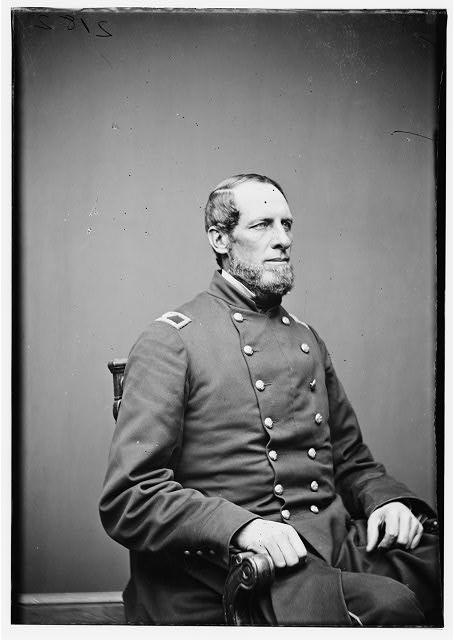
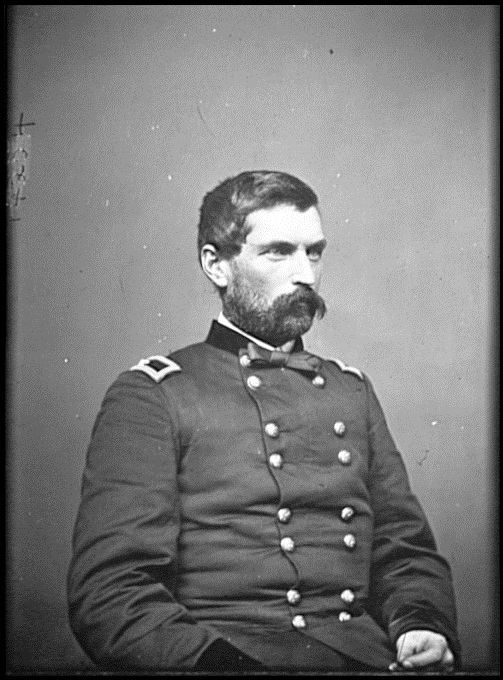
Brig. Gen. John Buford (Library of Congress).

Brig. Gen. John Buford (Library of Congress).

There’s no letter from Meade for October 19, but once again Theodore Lyman steps into the breach to provide a detailed account of the Army of the Potomac during what became known as the Bristoe Campaign. The “Rebel regiment of horse” he mentions was none other than Jeb Stuart, who had found himself trapped between two sections of Meade’s army late on October 13. He spent the night hidden in some woods a mere 400 yards from a division of the II Corps, opened up with his horse artillery in the morning, and then escaped.

Lyman also mentions one of the Union’s best cavalrymen, John Buford. When he first encountered Buford, Lyman described him as “a compactly built man of middle height, with a tawny moustache and a little, triangular gray eye, whose expression is determined, not to say sinister. His ancient corduroys are tucked into a pair of ordinary cowhide boots, and his blue blouse is ornamented with holes; from one pocket thereof peeps a huge pipe, while the other is fat with a tobacco pouch. Notwithstanding this get-up he is a very soldierly looking man. He is of a good-natured disposition, but not to be trifled with.”

The attack on Warren’s rear that Lyman mentions is the Battle of Bristoe Station. “Poor Paul Revere” was the grandson of the famed midnight rider. He had been killed at Gettysburg. The 20th Massachusetts was also known as “the Harvard Regiment.”

Lyman also provides a good look at Meade and the general’s gunpowder disposition. Nothing ticked him off more than wagon trains blocking the army’s progress, as Lyman describes here.

The bracketed portion of the text is how it appears in Meade’s Headquarters.

It seems to me I had got to Sunday morning, the 11th, when we began to march back. We started from Headquarters and passed through Brandy Station, forded the Rappahannock, close to the railroad, and took up our camp near the railroad and about two miles from the river. . . . This move, though in the wrong direction, was, without question, a good one, as it bothered the enemy and caused them to hesitate. … In the morning we got off about ten (for the General does not mount till he has heard that the army is properly under way) and rode along the north side of the railroad, past the camp I first came to (H.Q. near Warrenton Junction), and so to Catlett’s Station, where we found the 1st Corps taking their noon rest; also their chief, General Newton, and General (Professor) Eustis, partaking from a big basket. A spy came in also, who gave such information as showed that the Rebels had made less rapid progress than we supposed. Going a mile or two on, we saw a spectacle such as few even of the old officers had ever beheld; namely, 2500 waggons, all parked on a great, open, prairie-like piece of ground, hundreds of acres in extent. I can compare it to nothing but the camp of Attila, where he retreated after the “Hun Schlacht,” which we saw at the Berlin Museum. They were here got together, to be sent off to the right, by Brentsville, to Fairfax Station, under escort of General Buford’s division. How these huge trains are moved over roads not fit for a light buggy, is a mystery known only to General Rufus Ingalls, who treats them as if they were so many perambulators on a smooth sidewalk! We turned off to a house, two miles from Catlett’s, and again pitched our movable houses, on a rocky bit of a field. . . .

At daylight next morning, every corps was in motion, tramping diligently in the direction of the heights of Centreville, via Manassas Junction. We of the Staff had hardly dressed, when there was a great cracking of carbines in the woods, not a mile off, and we discovered that a Rebel regiment of horse had coolly camped there during the night, and were now engaged with our cavalry, who soon drove them away. Pretty soon the sound of cannon, in the direction of Auburn, announced that the Rebels, marching down from Warrenton, had attacked General Warren’s rear. He, however, held them in check easily with one division, while the other two marched along, passing our Headquarters at 9.30 A.m. As they went on, I recognized the Massachusetts 20th, poor Paul Revere’s regiment. And so we jogged, General Meade (who has many a little streak of gunpowder in his disposition) continually bursting out against his great bugbear, the waggons; and sending me, at full gallop, after General Sykes, who was a hundred miles, or so, ahead, to tell him that the rear of his ambulance train was quite unprotected. . . . The 15th was employed in feeling the intentions of the enemy and resting the exhausted men. On the 16th came on a deluge of rain which spoiled our contemplated move next day. On the 18th, yesterday, we got some information of reliable character for the first time, viz: that they had torn up the railroad and were falling back on Warrenton. Before that there was every kind of report: that they were going up the Shenandoah Valley; marching on Washington, and falling back on Richmond; and they keep so covered by cavalry, that it is most difficult to probe them. Thus far in the move they have picked up about as many prisoners as we, say 700; but we have the five guns and two colors, they having none. To-day we all marched out at daylight, and are now hard after them, the General praying for a battle. Our cavalry has been heavily engaged this afternoon, and they may make a stand, or indeed, they may not. I think I was never so well and strong in my life. General Buford came in to-day, cold and tired and wet; “Oh!” said he to me, “do you know what I would do if I were a volunteer aide? I would just run home as fast as I could, and never come back again!” The General takes his hardships good-naturedly.

[The result of the manoeuvres brought the army toward Washington, which caused uneasiness and dissatisfaction at the Capitol. “At Centreville,” writes Lyman, “we had a set-to between Meade and Halleck. Meade had asked, by telegraph, for some advice, and stated that he was not sufficiently assured of the enemy’s position to risk an advance; so conflicting were the reports. Halleck, apparently after dinner, replied in substance, ‘Lee is plainly bullying you. If you can’t find him, I can’t. If you go and fight him, you will probably find him!’ General Meade, much offended, prepared a reply in some such words as these: ‘If you have any orders, I am ready to obey them; but I must insist on being spared the infliction of such truisms in guise of opinions as I have recently been favored with. If my course is not satisfactory, I ought to be and I desire to be relieved.’ He had written ‘bunsby opinions,’ and consulted me as to whether it would do; to which I replied that the joke was capital, but not in accordance with the etiquette of a commander-in-chief; so he substituted the other. Poor General Meade! Said he, ‘I used to think how nice it would be to be Commander-inChief; now, at this moment, I would sooner go, with a division, under the heaviest musketry fire, than hold my place!’“ Lee, finding that he could not outflank Meade, fell back, and Halleck apologized.]

Theodore Lyman’s letter is from Meade’s Headquarters, 1863-1865: Letters of Colonel Theodore Lyman from the Wilderness to Appomattox, pp. 33-6. Edited by George R. Agassiz. Boston, Massachusetts Historical Society, 1922. Available via Google Books.

Have you read Searching for George Gordon Meade: The Forgotten Victor of Gettysburg yet? If not, you can buy it here!
From Centreville (October 17, 1863)

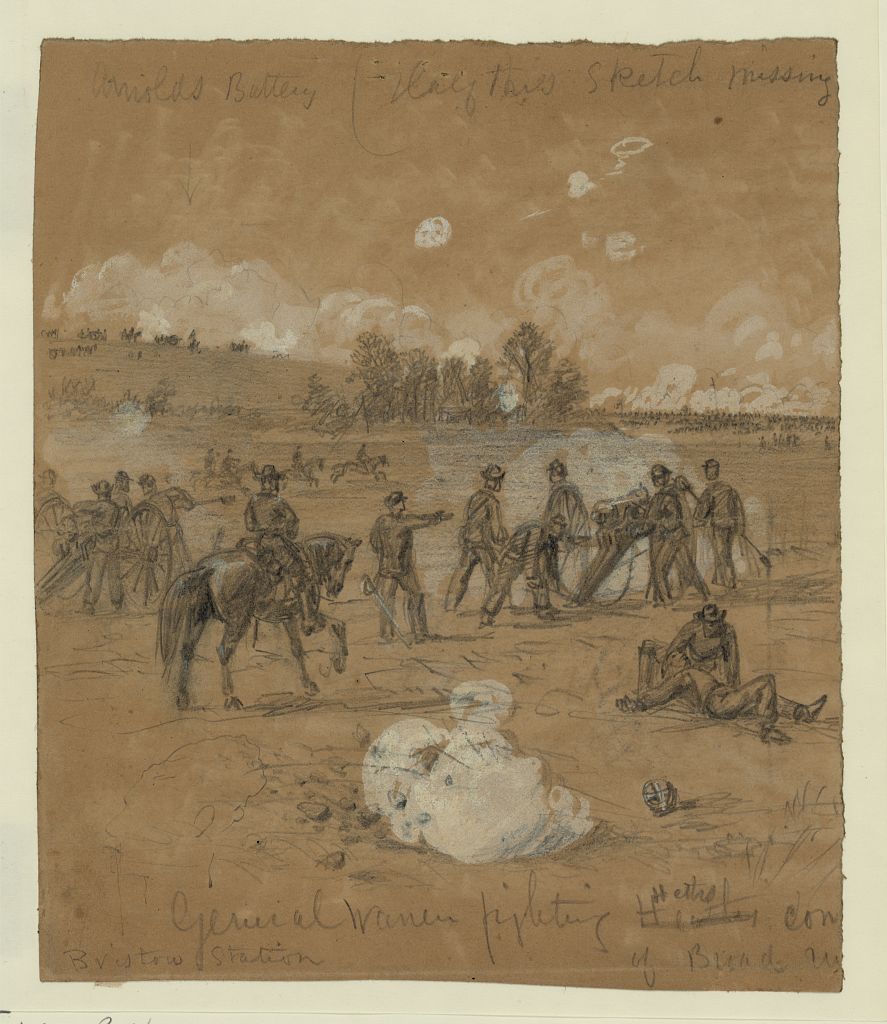
Alfred Ward titled this drawing "General Warren fighting at Bristoe Station." Warren and the II Corps gave the Confederates a bloody nose during the battle on October 14, 1863 (Library of Congress).

Alfred Ward titled this drawing “General Warren fighting at Bristoe Station.” Warren and the II Corps gave the Confederates a bloody nose during the battle on October 14, 1863 (Library of Congress).

On October 17 Meade wrote to his wife from Centreville, Virginia. He had pulled the Army of the Potomac back to his position in reaction to Robert E. Lee’s attempt to flank him. Here’s a little of what I wrote about the campaign in Searching for George Gordon Meade: The Forgotten Victor of Gettysburg:

[General in chief Henry] Halleck wasn’t happy about Meade’s “retrograde” movements or his complaints about his inability to obtain accurate information about the enemy’s whereabouts. “Lee is unquestionably bullying you,” he telegraphed Meade on October 18. “If you cannot ascertain his movements, I certainly cannot. If you pursue and fight him, I think you will find out where he is. I know of no other way.”

“If you have any orders to give me, I am prepared to receive and obey them,” Meade snapped back, “but I must insist on being spared the infliction of such truisms in the guise of opinions as you have recently honored me with, particularly as they were not asked for.” When drafting this message Meade had initially used the words “bunsby opinions,” a reference to a character in Charles Dickens’s Dombey and Son who was noted for his baffling advice. Before sending it he asked Lyman if he thought that was the best choice of words. [Theodore] Lyman didn’t. He advised “that the joke was capital, but not in accordance with the etiquette of a commander-in-chief.” They decided to use “truisms” instead.

During all the movements to and fro, it was Lee’s army that suffered the only serious punishment. The encounter took place near Bristoe Station on the Orange and Alexandria Railroad. It happened on October 14 when Gen. A. P. Hill’s forces made a rash attack on what they thought was the Army of the Potomac’s rear guard as the Union army moved north. Had Hill taken the time to adequately reconnoiter, he would have discovered that Warren’s II Corps was still nearby.

Lee made a desperate effort to get in my rear, but I succeeded in out-manoeuvring him, and got into position at this place, Centreville, with my back to Washington, and ready for his attack if he had chosen to make it. This is the third day we have been here and he has not come forward; I am trying to find out where he now is. If he is near me I shall attack him, but I fear that, failing in his manoeuvre, he is either going back, or going up into the Valley of the Shenandoah, where I shall have to follow him.

Meade’s correspondence taken from The Life and Letters of George Gordon Meade, Major-General United States Army, Vol. 2, (New York: Charles Scribner’s Sons, 1913), pp. 153-4. Available via Google Books.

If you haven’t already purchased Searching for George Gordon Meade: The Forgotten Victor of Gettysburg, why not buy it now?

“Our Great Object” (October 12, 1863)

As George Meade moves his army to avoid Robert E. Lee’s flanking maneuver he’s a little too busy to write home with news. Fortunately, Theodore Lyman has enough time. Here’s what he wrote on October 12 to explain Meade’s mind-set during this campaign of maneuver.

You will probably have all sorts of rumors of defeats, or victories, or something. The facts are very simple: as our great object is Uncle Lee’s army (one might properly say our only object), we have to watch and follow his movements, so as, 1st, to catch him if possible in a good corner; or, 2d, to prevent his catching us in a bad corner; also 3d, to cover Washington and Maryland, which, for us, is more important than for him to come to Richmond. Thus we have to watch him and shift as he shifts, like two fencers. One may say, pitch into him! But do you think he is so soft as to give us any decent chance, if he knows it? Not he! Meanwhile Meade knows what hangs on this army, and how easy it is to talk about raising 3,000,000 men and how hard it is to raise 30,000. He said yesterday: “If Bob Lee will go into those fields there and fight me, man for man, I will do it this afternoon.” But “Bob” doesn’t see it. Sharp chaps those Rebs. … I do hope that no great battle will be fought unless we can really deal a staggering blow to the enemy. The great fault of the Potomac campaign has been the fighting without any due prospect of profit. This will be found, I think, a good trait in our General, that he will hold his forces in hand for a proper occasion. Meanwhile the papers say, “The fine autumn weather is slipping away.” Certainly; and shall we add, as a corollary, “Therefore let another Fredericksburg be fought!” Put some flesh on our skeleton regiments, and there is no difficulty; but if, instead of ten conscripts, only one is sent, que voulez vous!

Theodore Lyman’s letter is from Meade’s Headquarters, 1863-1865: Letters of Colonel Theodore Lyman from the Wilderness to Appomattox, pp. 31-2.Edited by George R. Agassiz. Boston, Massachusetts Historical Society, 1922. Available via Google Books.


An Explanation (October 12, 1863)

Here Meade explains the current movements of his army. He also mentions how he wants to get promotions for John Buford, commander of the cavalry division that had slowed the Confederates at Gettysburg on July 1, and John Gibbon, the II Corps division commander who had also performed ably at Gettysburg (and been badly wounded on July 3).

On Saturday I found Lee was turning my right flank and assuming an offensive position. As to have remained where I was would have endangered my communications, I yesterday fell back to the Rappahannock. As I do not hear to-day anything of his movement on my right being continued, I have sent a force back towards Culpeper, to see whether he will give me battle at any point between the two rivers. If he will, I shall fight him at all hazards. At the present moment there is firing heard, but I have not received any report.

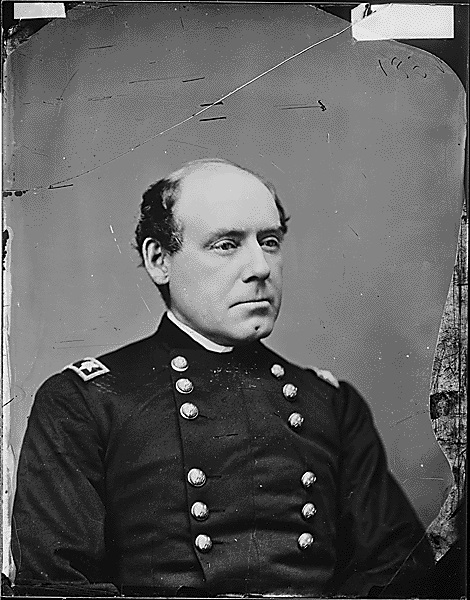
Brigadier General John Gibbon. He became a major general in June 1864 (Library of Congress).

Brigadier General John Gibbon. He became a major general in June 1864 (Library of Congress).

I have most earnestly, by special telegram, recommended Gibbon for promotion. Indeed, himself and Buford are the only two that I have urged in this special manner on the attention of the department. The difficulty is that there are no vacancies in the grade of major general, and several appointments have been made in excess of the number authorized by law.

Meade’s correspondence taken from The Life and Letters of George Gordon Meade, Major-General United States Army, Vol. 2, (New York: Charles Scribner’s Sons, 1913), p. 153. Available via Google Books.

An Army on the Move (October 11, 1863)

Artist Alfred Waud drew Union soldiers burning the railroad bridge at Rappahannock Station on October 13 as the Army of the Potomac fell back to keep from being outflanked (Library of Congress). Click to enlarge.

Artist Alfred Waud drew Union soldiers burning the railroad bridge at Rapphannock Station on October 13 as the Army of the Potomac fell back to keep from being outflanked (Library of Congress). Click to enlarge.

There’s no letter from George Meade on October 11, but his aide Theodore Lyman wrote a typically fascinating account in which he described the Army of the Potomac on the move. Robert E. Lee had sparked the activity by putting his own army into motion, the start of a flanking maneuver much like the one that had caused so much grief for John Pope in the Second Bull Run campaign. In order to prevent his army from being outflanked, Meade opted to pull back from his position on the Rappahannock towards Centreville. Lyman observed it all in his inimitable fashion.

As all is packed, I take to pencil correspondence. Uncle Lee has concluded that we have stared long enough at each other, and so is performing some fancy antics, though whether he means to fight, or retreat after a feint, or merely take a walk, I know not. He is now paddling along, in the general direction of Warrenton, between us and the Blue Ridge; and so has entirely left his station on the other bank of the river. . . . Last night I, being of a foxy disposition, turned in at an early hour, so that I was fresh and fine at four this morning, when we were routed out, and assisted to coffee and bread and cold ham. It was a Murillo-esque (!) sight to behold the officers, in big coats and bigger sabres, standing with the bright light of the camp-fire on their faces. The cavalry cloaks, slouched hats, and great boots, though, as Co [Lyman’s sister] says, “drunk “-looking, are much more suited to a painter than the trig uniforms of the Europeans. So here we are, with horses saddled, waiting to see what is what. You understand that Mr. Reb is not very near us, in fact further off than before, but he is moving, and so we, too, are “en garde.” Our army, I say with emphasis, ought to be able to whip the gentlemen. Down comes General Meade; I clap the pencil in my pocket, and in two minutes we are off, escort, orderlies, Staff and all, winding our way midst miles of baggage and ammunition waggons and slow columns of moving infantry. Ha, ha, ha! They don’t look much like the “Cadets,” these old sojers on the march. There is their well-stuffed knapsack, surmounted by a rolled gray blanket, the worse for wear; from their belt is slung a big cartridge-box, with 1 His sister. forty rounds, and at their side hangs a haversack (satchel you would call it) quite bursting with three days’ rations. Hullo! what has that man, dangling at the end of his musket? A coffee-pot! an immense tin coffee-pot! and there is another with a small frying-pan — more precious to them than gold. And there goes a squad of cavalry, the riders almost obscured by the bags of oats and the blankets and coats piled on pommel and crupper; their carbine hangs on one side and their sabre clatters from the other. And then behold a train of artillery (the best-looking arm of the service), each gun drawn by six or eight horses, and the caissons covered with bags of forage. And so the face of the country is covered, when an army is on the march, the waggons keeping the road, the infantry winding through the open land. It is singular, in regard to the latter, that, however dirty or slovenly the men may be, their muskets always shine like silver; they know it is an important member. Well, you perceive I have leisure to get a pen-full of ink, to continue the letter, begun this morning. In fact we have done our day’s march and our movable houses are all up at a new “Headquarters.” We hear nothing much of the Insurges, but are all ready to pitch into them if we find them in a soft spot. . . .

Theodore Lyman’s letter is from Meade’s Headquarters, 1863-1865: Letters of Colonel Theodore Lyman from the Wilderness to Appomattox, pp. 29-30.Edited by George R. Agassiz. Boston, Massachusetts Historical Society, 1922. Available via Google Books.

Reading Material (October 7, 1863)

The article in Blackwood’s Magazine to which Meade refers in this letter to his son, John Sergeant, was written by Arthur Fremantle, a British officer who was present at Gettysburg with Lee’s army. You can read the entire article here.

I have read the article in Blackwood, which is tolerably fair for a “secesh” Englishman. The general officer referred to as being cheered was your humble servant, and I was at that time riding down the line to the left, for the purpose of ordering an attack; but it was so late and the distance to the enemy’s line so great, that by the time the troops were in motion the day was at an end.

Lee’s report has just been published. Considering all things, it is pretty fair, in some places a little too much of what the lawyers call the suppressio veri. Still, I am willing to leave to history the fact, which he plainly admits, that after the battle of Gettysburg he had to retreat continuously till he reached the south bank of the Rappahannock, from whence he had started to destroy my army and accomplish other valuable results.

Meade’s correspondence taken from The Life and Letters of George Gordon Meade, Major-General United States Army, Vol. 2, (New York: Charles Scribner’s Sons, 1913), p. 153. Available via Google Books.

A Report and a Disappearance (October 4, 1863)

Solomon Meredith (Library of Congress).

Solomon Meredith was 6′ 7′ tall and became known as “Long Sol”  (Library of Congress).

We have discussed Meade’s official report about Gettysburg previously, especially the negative reactions to it.  As to young Arthur Parker, the aide who disappeared, more than a year will pass before Meade gets any clues about his disappearance. I, however, was able to find a bit more about Parker here. He was the nephew of Cortlandt Parker, a Meade family friend. The Sol. Meredith whom Meade contacted to get information appears to be Solomon Meredith of Indiana, who had commanded the Iron Brigade (and was wounded) at Gettysburg. The battlefield’s Meredith Avenue was named after him.

I wish Margaretta Meade’s letters had survived; I would like to hear her reasons for thinking someone was opening Meade’s letters. McClellan, in exile in New Jersey, began to think the same thing.

I have been very busy writing my report of the battle of Gettysburg, which has been delayed till this time by the want of the reports of my subordinate commanders, many of whom were absent, wounded. I have at last got through with it, and feel greatly relieved, although I have made it as short and simple as possible.

I can hardly believe my letters are opened, as you suspect. I can see no object to be gained, and the crime is so heinous I cannot believe any one would be guilty of it.

I have heard nothing definite of young Parker since he disappeared. I wrote to Sol. Meredith (Brigadier General), who is at present our commissioner at Fortress Monroe for the exchange of prisoners, and asked him to enquire through the Confederate Commissioner whether Lieutenant Parker had reached Richmond. He answered he would do so, and send any intelligence to his father at Boston. I presume, however, he would let me know also if he heard anything.

The only member of my staff, besides Humphreys, who messes with me, is Colonel Lyman. As he is an unpaid volunteer, and came to me on personal considerations, I took him into my mess.

Meade’s correspondence taken from The Life and Letters of George Gordon Meade, Major-General United States Army, Vol. 2, (New York: Charles Scribner’s Sons, 1913), p. 152. Available via Google Books.

Anxiety (September 30, 1863)

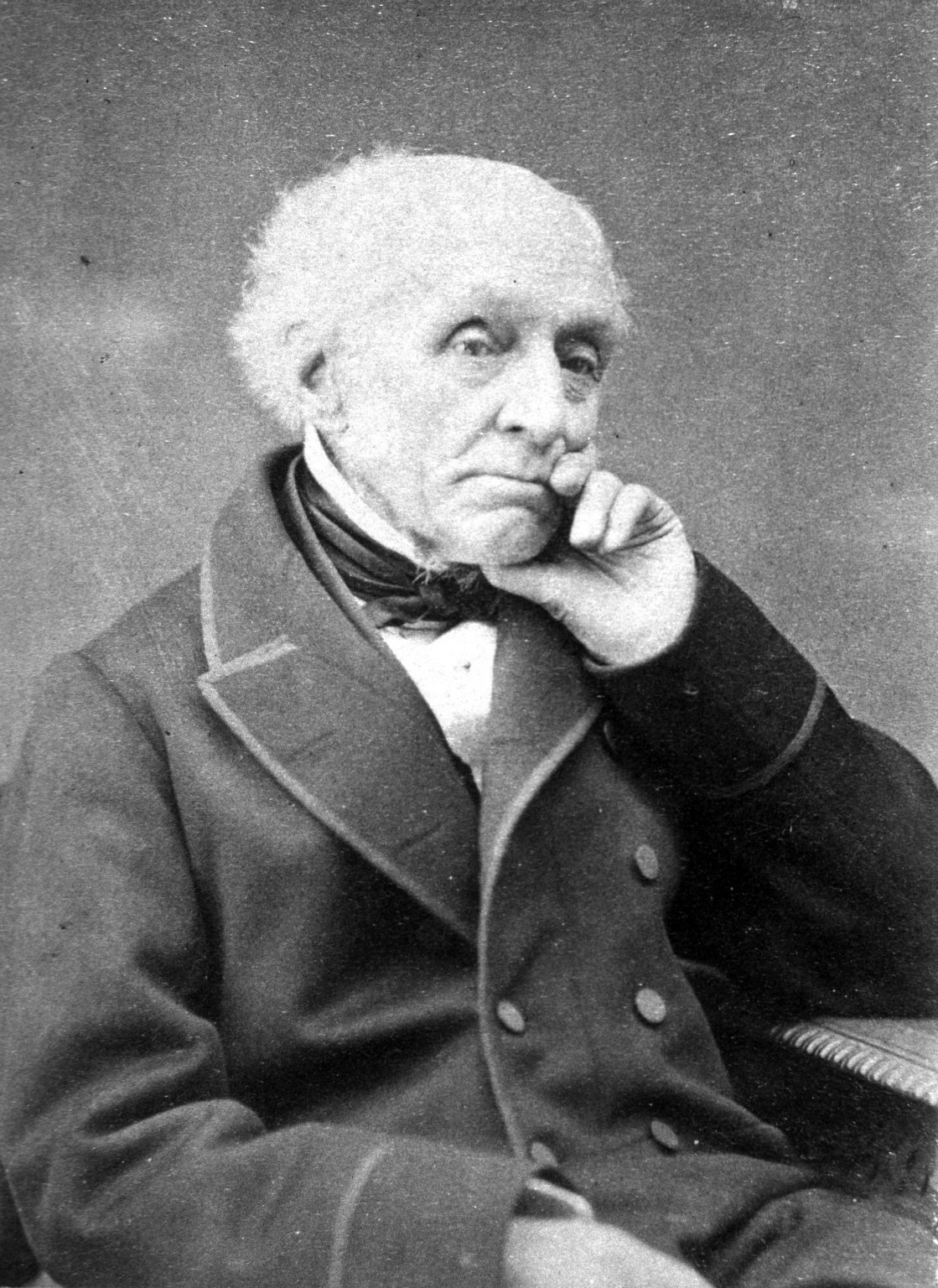
Sir Henry Holland, travel writer and Royal physician (via Wikipedia).

Sir Henry Holland, travel writer and Royal physician (via Wikipedia).

In an earlier letter Theodore Lyman mentioned Sir Henry Holland, the British Royal Physician who was visiting the Army of the Potomac. Besides being a medical man who attended the British royal family, Holland was also a noted travel writer whose books included Travels in the Ionian Isles, Albania, Thessaly, Macedonia, &c. During the Years 1812-1813. He died in 1873. (To see what Holland wrote about his visit, see below.)

Meade obviously had other things than British visitors on his mind, as this letter to his wife indicates.

I am sorry to see you so anxious about me, because it is impossible to keep you constantly advised of what is going on, and your imagination undoubtedly makes matters worse. You must try and be resigned, and not anticipate evil, but wait for its actual arrival. My position is of course liable to misconstruction so long as the public are ignorant of the truth, but the time will come when they will be enlightened, and then I shall be all right. Of course, if people believe that Lee has no army, and that I have an immense one, it is hard to expect them not to inquire why I do not do something; but when they come to know that just as I was about trying to do something, my army was suddenly reduced to a figure a little greater only than Lee’s, and that he occupies a very strong position, where the natural advantages in his favor more than equalize the difference in our forces, they will understand why I cannot do anything. I have remained here to offer Lee battle if he chooses to come out of his stronghold, and to prevent by my threatening attitude his sending any more troops to Bragg. Whether I will get any credit for this is perhaps questionable. The whole matter, however, reverts to what I have always told you, that I intend to act up to the French motto, “Faites bien, laissez dire.”

I don’t think I wrote to you that I had a very pleasant visit from a General Cortez, of the Mexican army, who came here with letters from the Secretaries of State and War. He spent a day with me, and I took him around the camps and showed him different portions of the army, and he went away much gratified. I also had a visit from Sir Henry Holland, physician to the Queen of England. He was a very agreeable, intelligent gentleman, over seventy years of age, who had crossed the Atlantic fourteen times. He seemed greatly interested with everything we showed him.

To-day Gouverneur Paulding and a Dr. Young, of Cold Spring, New York, have been here to present General Warren with a sword. Paulding I have known from a boy, and Dr. Young married a daughter of old Parson Hawley, of Washington. They also have been delighted with their visit.

Here’s Lyman’s letter from September 29. He touches on some of the same topics, but in a much livelier style. He also mentions Seth Williams, the army’s assistant adjutant general. Like me, Williams was born in Augusta, Maine. He was apparently much liked in the army for I never found anyone who had a bad word to say about him. Lyman also mentions General Henry Benham, whom we have encountered on this blog before. From this brief mention it does not appear that Benham had cleaned up his act since his disgraceful appearance during the Chancellorsville campaign. Channing Clapp was one of Lyman’s Harvard classmates.

Seth Williams of Augusta, Maine (National Archives).

Seth Williams of Augusta, Maine (National Archives).

I see such flocks of generals now, that I do not always take the pains to describe them. On Sunday there arrived General Benham, one of the dirtiest and most ramshackle parties I ever saw. Behind him walked his Adjutant General, a great contrast, in all respects, being a trig, broad-shouldered officer, with a fierce moustache and imperial and a big clanking sabre. I gazed at this Adjutant General and he at me, and gradually, through the military fierceness, there peeped forth the formerly pacific expression of Channing Clapp! There never was such a change, Achilles and all other warlike persons; and is much improved withal. That same evening enter another general (distinguished foreigner this time), El General Jose Cortez, chevalier of some sort of red ribbon and possessor of a bad hat. He was accompanied by two eminent Senors, Mexicans and patriotic exiles. We were out riding when they came; but, after our return, and in the midst of dinner, there comes an orderly with a big official envelope, proving to be a recommendation from Mr. Seward. “Oh,” says the General, “another lot, hey? Well, I suppose they will be along to-morrow”; and went on quietly eating dinner. Afterwards I went into the office of General Williams (or “Seth” as they call him here) and there beheld, sitting in a corner, three forlorn figures. Nobody seemed to know who they were, but the opinion prevailed that they were a deputation of sutlers, who were expected about that time! But I, hearing certain tones of melancholy Spanish, did presently infer that they were the parties mentioned in the big, official envelope, and so it proved! They were speedily entered into the General’s presence and, after a few compliments, anxiously asked when the next train left for Washington; for it appears that they had supposed Culpeper was a pleasant jaunt of about fifteen minutes from the Capitol, and was furnished with elegant hotels and other conveniences; consequently they had brought no sac de nuit, and had had nothing to eat since early morning, it being then dark! Their surprise was considerable, after a weary ride of some hours, to be dumped in a third rate village, deserted by its inhabitants and swarming with dusty infantry. John made ready with speed, and, after a meal and a bottle of champagne, it was surprising to see how their barometers rose, especially that of small Sefior, No. 2, who launched forth in a flood of eulogium on the state of civil liberty in the United States. Our next care was to provide them sleeping-accommodations; no easy matter in the presence of the fact that each has barely enough for himself down here. But I succeeded in getting two stretchers from the hospital (such as are used to bring in the wounded from the field) and a cot from Major Biddle; three pillows (two india-rubber and one feather) were then discovered, and these, with blankets, one tin basin, one bucket, and one towel, made them entirely happy. Really, how they looked so fresh next morning was quite a marvel. Then, after a good breakfast, we put them all on horseback (to the great uneasiness of the two Sefiors) and followed by a great crowd of a Staff (who never can be made to ride, except in the higglety-pigglety style in which “Napoleon et ses Marechaux” are always represented in the common engravings), we jogged off, raising clouds of red dust, to take a look at some soldiers. … El General was highly pleased and kept taking off his bad hat and waving it about. Also he expressed an intense desire that we should send 50,000 men and immediately wipe out the French in Mexico.

“Why doesn’t Meade attack Lee?” Ah, I have already thrown out a hint on the methods of military plans in these regions. But, despite the delays, I should have witnessed a great battle before this; if, If, IF, at the very moment the order had not come to fill up the gap that the poltroonery of two of Rosecrans’ Corps has made in the western armies. I do believe that we should have beaten them (that’s no matter now), for my Chief, though he expressly declares that he is not Napoleon, is a thorough soldier, and a mighty clear-headed man; and one who does not move unless he knows where and how many his men are; where and how many his enemy’s men are; and what sort of country he has to go through. I never saw a man in my life who was so characterized by straightforward truthfulness as he is. He will pitch into himself in a moment, if he thinks he has done wrong; and woe to those, no matter who they are, who do not do right! “Sir, it was your duty and you haven’t done it; now go back and do it at once,” he will suddenly remark to some astonished general, who thinks himself no small beer. Still I do wish he would order the Provost-Marshal to have a few more of the deceased horses buried. The weather here is perfect—could not be finer.

Here’s what Sir Henry Holland wrote about his visit to the United States during the Civil War, which he published in Recollections of Past Life (D. Appleton & Co., 1872, and available via Google Books. This passage is from pp. 64-66.)

In travelling through Holstein and the Danish Isles in 1848, I saw something of the petty war of Germans and Danes then going on, since followed on the same field by events of so much higher import. At a later period (in 1863), when 75 years of age, I was an active spectator—I will not say an actor—in the midst of the great civil war then raging in America. At the headquarters of the Federal army in Virginia, and with the advanced division on the Rapidan in front of General Lee’s army, and still more in the country through which I passed to reach the army, I saw warfare on its largest scale of action and devastation. Twice before I had traversed this part of Virginia, then very different in aspect—a happy and flourishing country, where the evils of slavery were mitigated by various social conditions more or less peculiar to this great State. The contrast of scene, as I saw it in the heat of war, was saddening to the eye and to the mind. But in a region so variously favoured by nature, time and tranquillity will restore what has been lost. The too sudden advance of the Negro to political power may retard this restoration, but cannot prevent it. Eight weeks of absence from my own house in Brook Street comprised this extraordinary spectacle of American warfare, with much besides of political and social interest, to which my several preceding visits to the United States gave me access. Living in the hospitable house of my excellent friend Mr. Seward at Washington, and seeing much of President Lincoln, I enjoyed facilities which few travellers can obtain. Mr. Staunton [sic], then Secretary of War, sent Adjutant-General Townshend with me to the army of the Potomac; an accomplished soldier and admirable companion, to whom the expedition was a luxury, as he had hitherto known the war only through his heavy official duties at Washington. General Meade, the recent victor at Gettysburg, was at this time in command of the army. By him, and the other generals and officers at head-quarters, as well as those at the advanced posts, I was received with a courtesy which I cannot readily forget. Such interludes are not common in the life of a London physician. But I have already confessed to a certain pleasure, whether rational or not, from these sudden contrasts; and in the instance just given, this taste, such as it is, was amply satisfied.

Meade’s correspondence taken from The Life and Letters of George Gordon Meade, Major-General United States Army, Vol. 2, (New York: Charles Scribner’s Sons, 1913), pp. 151-2. Available via Google Books.

Theodore Lyman’s letter is from Meade’s Headquarters, 1863-1865: Letters of Colonel Theodore Lyman from the Wilderness to Appomattox, pp. 23-4.Edited by George R. Agassiz. Boston, Massachusetts Historical Society, 1922. Available via Google Books.

Relations (September 27, 1863)

Henry Wise, the former governor of Virginia and George Meade's brother-in-law (Library of Congress).

Henry Wise, the former governor of Virginia and George Meade’s brother-in-law (Library of Congress).

In this letter Meade mentions the Wises. He’s speaking of Henry Wise and his family. Wise was a relative—his first wife (deceased) had been Magaretta Meade’s sister, making Henry Wise Meade’s brother-in-law. He was also the former governor of Virginia—in fact, it was Wise who signed John Brown’s death warrant after the radical abolitionists failed attempt to spark a slave insurrection at Harpers Ferry. He was a fiery secessionist who waved his pistol when he took the podium at Virginia’s secessionist convention in April 1861 and demanded that his state leave the Union. Once war began Wise joined the Confederate army and, as a brigadier general, led his troops to a successful defense of Petersburg when the Union army attempted to capture it in 1864—a battle in which Joshua Lawrence Chamberlain was badly wounded.

Chamberlain later wrote of an encounter he had with Wise immediately following Lee’s surrender at Appomattox. Hearing a Confederate general railing at his own troops, the Union general decided to ride over and offer him some words of solace. He saluted and remarked on how well the men on both sides were responding to the surrender. “This promises well for our coming good-will,” he said. “Brave men may become good friends.”

“You are mistaken, sir, we won’t be forgiven, we hate you, and that is the whole of it,” Wise snapped at Chamberlain. He gestured towards his chest. “There is a rancor in our hearts which you little dream of. We hate you, sir.”

According to another story, Robert E. Lee once took Wise aside to gently chastise him about his strong language. Wise claimed he cut Lee off and said, “General Lee, you certainly play Washington to perfection and your whole life is a constant reproach to me. Now I am perfectly willing that Jackson and yourself shall do the praying for the whole army of Northern Virginia; but, in Heaven’s name, let me do the cussin’ for one small brigade.”

Lee laughed. “Wise, you are incorrigible,” he said.

We are having lovely weather at present; our camps are beautifully situated at the foot of the Blue Ridge, with the mountains in view, with pure air and plenty of good water; the best country in Virginia we have yet been in.

I had a visit yesterday from the Rev. Mr. Coles, Episcopal minister at the village, who told me he had seen Mr. Wilmer some few weeks since, and he had talked a great deal of me, and told him I had been his parishioner. He says Mr. Wilmer is not connected with the army, and has no church, but occupies himself in works of charity, and when he saw him he was on his way to visit the sick and wounded of the Confederate army, after its return from Pennsylvania.

I have tried, but unsuccessfully, to get some news of the Wises. Mr. Wise’s command undoubtedly went with Longstreet to Tennessee, but whether he went I am not able to ascertain.

Meade’s correspondence taken from The Life and Letters of George Gordon Meade, Major-General United States Army, Vol. 2, (New York: Charles Scribner’s Sons, 1913), p. 151. Available via Google Books.

Meetings in Washington (September 24, 1863)

In his letter of September 24, Meade tells his wife about the events that led to the XI and XII Corps being taken from his army and sent to reinforce the Army of the Cumberland under Maj. Gen. William Rosecrans in Chattanooga following the Union defeat at Chickamauga. (The administration also sent Joe Hooker with the two corps, answering the question of what to do with Meade’s predecessor in command.) This move cost the Army of the Potomac some 16,000 men.

Secretary of War Edwin Stanton (Library of Congress).

Secretary of War Edwin Stanton (Library of Congress).

The last time I wrote I told you of my having referred to Washington the question of a further advance. As I expected, no decisive answer was sent to me, but I was told to act in accordance with my own judgment. The next thing I was summoned to Washington and informed that the President considered my army too large for a merely defensive one, and proposed to take a portion of it away. I objected and reasoned against this, and left Washington with the belief that the President was satisfied. I had just arranged the programme for a movement, and was about issuing the orders, when orders came from Washington, taking troops away. Of this I do not complain. The President is the best judge of where the armies can be best employed, and if he chooses to place this army strictly on the defensive, I have no right to object or murmur. I was in Washington from 11 p. M. Tuesday till 1 p. M. Wednesday; saw no one but the President, Mr. Stanton and General Halleck; was treated very courteously by all. I told the President and General Halleck that if they thought I was too slow or prudent, to put some one else in my place. Halleck smiled very significantly, and said he had no doubt I would be rejoiced to be relieved, but there was no such good luck for me. I cannot very well tell you all that transpired; the intelligence, by no means favorable, had been received from Rosecrans, and it was evident, without any one knowing what exactly might or could be done, that there still existed a feverish anxiety that I should try and do something. Now that I have been weakened, I presume the country will not be so exigeante.

Theodore Lyman, Meade’s aide, wrote home on the same day. It’s interesting to see things from his perspective:

Yesterday we were favored with the presence of Sir Henry Holland, the Queen’s physician, who is one of the liveliest old birds for one of seventy-five that ever was seen. He travels two months every year, and has already been four or five times in these United States. Dr. Letterman, the Medical Director, put him in an ambulance, and Colonel Townsend and myself completed the party. What pains wounded people may suffer in ambulances, I know not; but I do know that, when driven at a trot, over open fields and through little ditches, the jolting is not to be expressed in words. But the royal medical person maintained his equanimity wonderfully and continued to smile, as if he were having a nice drive over a turnpike. First he was halted on a rising spot, when he could see four batteries of horse artillery, which did defile before him, to his great admiration. Then we bumped him six miles farther, to the Headquarters of the 12th Corps, close to the river. Here he hobnobbed with General Slocum, and then got on a horse and rode about the camps. After which he was taken to a safe spot, whence he could behold the Rebels and their earthworks. He returned quite fresh and departed in a most amiable mood.

There seems to me no particular prospect of a battle. I thought this morning, that we should have a great fight within a couple of days; but movements, which I dare say you will read of in the papers before this letter reaches you, have just knocked it. Entre nous, I believe in my heart that at this moment there is no reason why the whole of Lee’s army should not be either cut to pieces, or in precipitate flight on Richmond. In saying this to you, I accuse nobody and betray no secrets, but merely state my opinion. Your bricks and mortar may be of the best; but, if there are three or four chief architects, none of whom can agree where to lay the first brick, the house will rise slowly.

Meade’s correspondence taken from The Life and Letters of George Gordon Meade, Major-General United States Army, Vol. 2, (New York: Charles Scribner’s Sons, 1913), pp. 150-1. Available via Google Books.

Theodore Lyman’s letter is from Meade’s Headquarters, 1863-1865: Letters of Colonel Theodore Lyman from the Wilderness to Appomattox, pp. 21-2. Edited by George R. Agassiz. Boston, Massachusetts Historical Society, 1922. Available via Google Books.