Presentation Day Approaches (August 27, 1863)

At long last, the day when the Pennsylvania Reserves give Meade his presentation sword is almost here!

To-morrow is the grand presentation day. I have not made the slightest preparation in the way of a speech, and have not the slightest idea what I shall say. Governor Curtin, I understand, is to make the presentation address; so, of course, I shall be overwhelmed with his eloquence and perhaps dumfounded. On reflection, I thought it absurd for me to make any labored effort; that it being entirely out of my line, I should most likely do worse than if I just trusted to luck and said what at the time seemed to me pertinent and suitable.

Meade’s correspondence taken from The Life and Letters of George Gordon Meade, Major-General United States Army, Vol. 2, (New York: Charles Scribner’s Sons, 1913), p.145. Available via Google Books.

Beached (August 23, 1863)

Meade’s letter from August 23, 1863, provides a glimpse of vacations 1863-style. It doesn’t sound much different from what families do today. Taking the train to Cape May was, indeed, something new, for the line had just opened that summer. You can read more about it here.

It must be very strange, traveling to Cape May in a railroad car, though I have no doubt, after you get there, everything, as you say, looks like old times. I wish dearly I could be with you, to enjoy the breeze and the luxurious bathing in the surf, to say nothing of the great fun of building forts in the sand with dear Willie, Sarah and Henrietta. But such happiness is denied me, and all I can do is to hope you will enjoy yourselves and benefit by the trip.

To-day is Sunday. I attended service this afternoon, held by the chaplain of the regiment attached to my headquarters. It was a mongrel sort of service, being made up from our service and the Presbyterian. He made a short and pertinent discourse. We never have had the right kind of men for chaplains in the army. They mostly come apparently only for the pay, and either do nothing, or else make themselves obnoxious by interfering in matters they have no business with.

Meade’s correspondence taken from The Life and Letters of George Gordon Meade, Major-General United States Army, Vol. 2, (New York: Charles Scribner’s Sons, 1913), pp.144-5. Available via Google Books.

The Draft (August 21, 1863)

A depiction of the New York draft riots from the harpers Pictorial History of the Civil War. The worst atrocities were committed against blacks (Library of Congress).

A depiction of the New York draft riots from the Harper’s Pictorial History of the Civil War. The worst atrocities were committed against blacks (Library of Congress).

The draft was a touchy subject for the North, especially after the ugliness of the draft riots that took place in New York shortly after the Battle of Gettysburg. Meade even had to send men from the Army of the Potomac north to help subdue the disturbances there. But as he said over and over again in his letters home, Meade felt it was absolutely essential that the government reinforce the army, and that required a successful draft.

The Meades had been living in Detroit when war broke out. In the excitement following the attack on Fort Sumter, Detroit citizens organized a rally and asked the army officers there to publicly take an oath of loyalty to the United States. Meade and his other officers, save one, refused to do this on principle, although Meade said he would be happy to take the oath if the War Department requested it. Meade’s stubborn, if principled, stand displeased Sen. Zachariah Chandler of Michigan. He did not forget the incident.

The draft, so far as the drawing of the names, appears to have passed off quietly in New York, but the tug will be when they attempt to secure the men. As, however, the Councils have appropriated money enough to buy off all the quota from the city, I should think the difficulty might be avoided.

I had a visit to-day from Mason Norvell, whom you may remember in Detroit. He was just from Detroit, and brought me many messages from my friends there, and said I could not realize how much they thought of me in Detroit.

I don’t think you need fear my becoming a politician, and I believe such persons will let me alone so long as I am successful, or do not meet with any disaster; and if I am unlucky, it will not make much difference what my sentiments are; I shall have to go by the board.

Meade’s correspondence taken from The Life and Letters of George Gordon Meade, Major-General United States Army, Vol. 2, (New York: Charles Scribner’s Sons, 1913), p.144. Available via Google Books.

Recruiting (August 19, 1863)

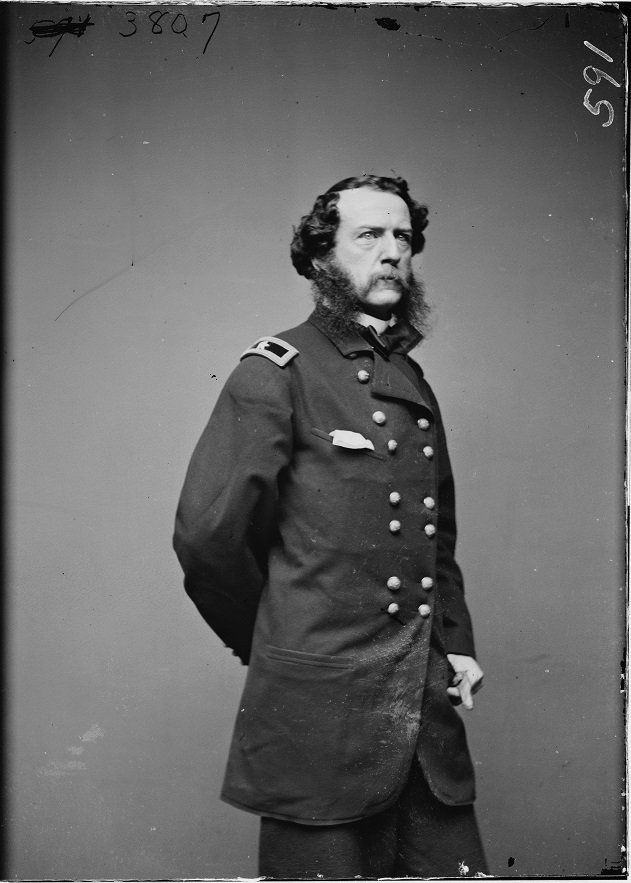
In this letter Meade mentions William “Baldy” Smith. They were apparently on good terms at this point but would have a falling out by the end of the war. After Fredericksburg Smith and William Franklin, who had commanded the Left Grand Division under Ambrose Burnside there, went to Washington to complain about Burnside’s leadership. Franklin was exiled out West. Smith would eventually follow. There he would earn the confidence of Ulysses S. Grant and when Grant came east to become general-in-chief in 1864 there was talk that Smith would get command of the Army of the Potomac. Instead he received command of the XVIII Corps in the Army of the James. Meade aide Theodore Lyman described Smith as “a short, quite portly man, with a light-brown imperial and shaggy mustache, a round, military head, and the look of a German officer, altogether.” He possessed “unusual powers of caustic criticism” and quarreled incessantly with his superior officers.

Lee finds it as hard to recruit his army as I do mine. I do not hear of any reinforcements of any consequence joining him. At the same time it is very difficult to obtain any minute or reliable intelligence of his movements.

William F. "Baldy" Smith was a Meade friend who eventually turned enemy. (Library of Congress)

William F. “Baldy” Smith was a Meade friend who eventually turned enemy. (Library of Congress)

I saw to-day a note from Baldy Smith, who is at Hagerstown, commanding four hundred men and a “secesh” hospital. He says he is afraid to make any stir, for fear they should serve him as they have Franklin, who is at Baton Rouge, commanding a division under Banks. This is pretty hard for Franklin, and I feel sorry for him.

I had a visit yesterday from a Mrs. Harris, a lady belonging to the Sanitary and Christian Commissions, who has been connected with the army for a long time, and who, every one says, does a great deal of good. She talked a great deal about Philadelphia, where she belongs, and where she was going on a visit, and said every one would be inquiring about me, so that she had to come and see me.

Meade’s correspondence taken from The Life and Letters of George Gordon Meade, Major-General United States Army, Vol. 2, (New York: Charles Scribner’s Sons, 1913), pp.143-4. Available via Google Books.

A Visit to Washington (August 16, 1863)

I had a very quiet journey back, arriving at my headquarters about 10 p.m. I found that important despatches had been sent to me at 4 p. m., indicating a probable movement on the part of the enemy; so that it was very well that I returned. This information, brought by a scout, does not seem up to this moment to have been confirmed, and the stampede produced by it has pretty nearly passed away. I hope you had a pleasant journey to Philadelphia, and found them all well at home.

The manner in which I was received and treated in Washington by all with whom I came in contact was certainly most gratifying to me. I really believe I have the confidence of all parties and will continue to retain it, unless some great disaster should overtake me, which I ought not to anticipate. It will be best for both of us to look upon the future in the most favorable light, and trust to that kind Providence which hitherto has so signally blessed and protected us.

Meade’s correspondence taken from The Life and Letters of George Gordon Meade, Major-General United States Army, Vol. 2, (New York: Charles Scribner’s Sons, 1913), p.143. Available via Google Books.

Worthless Material (August 9, 1863)

Samuel Crawford, the former army surgeon who became indignant when soldiers called him "Old Pills" (Library of Congress).

Samuel Crawford, the former army surgeon who became indignant when soldiers called him “Old Pills” (Library of Congress).

The long affair of the Pennsylvania Reserves’ presentation sword is finally approaching its end. (See the entry for April 5, 1863, for more about the saga.) General Crawford is Samuel Crawford, who began the war as an army surgeon at Fort Sumter when war began. He is buried in Philadelphia’s Laurel Hill Cemetery, not far from Meade. Theodore Lyman, who served as an aide to Meade later in the war and left behind richly detailed journals and letters, told an amusing story about Crawford, who, in Lyman’s words, had “some reputation for possessing a decided admiration of the looks and figure of his own self.” This is what Lyman had to say in a letter published in Meade’s Headquarters, 1863-1865: Letters of Lt. Col. Theodore Lyman from the Wilderness to Appomattox (edited by George R. Agassiz. Boston: Massachusetts Historical Society, 1922, available via Google Books):

There came to the army a young artist, who was under a certain monied person. The young artist was to make models for bronze medallions, and the monied person was to sell the same and take the profits, if any. He proposed to model the commander of the army, and each of the corps commanders, and General [Alexander] Webb, but no one else. As the artist was modelling away at General Webb, he asked: ‘Isn’t General Crawford rather an odd man?’ ‘What makes you ask that?’ says the Chief-of Staff? ‘Why, he waked me up in the middle of the night, and asked what I could make a statuette of him for! I told him $400 and he said he thought he would have it done!’ Webb, who is a cruel wag, said naught, but, the next time he met C, asked him if he had seen the young sculptor who had come down. ‘Seen him!’ quoth C. ‘My dear fellow, he has done nothing but follow me round, boring me to sit for a statuette!'”

General Crawford, commanding Pennsylvania Reserves, has notified me that the sword which they desire to present me with is ready, and asked me to allow an officer to go to Philadelphia to get it, and make the necessary arrangements, which I have done; so this affair of long standing will soon come off.

I note what you say reports as the secession talk of New York; the same thing has been said in the Times, Tribune and Herald; but I was ahead of all these gentlemen, as in the despatch I sent General Halleck, urging to be permitted to advance, I told him that in my judgment, reasoning from the past, and in view of the power hitherto exercised over the people of the Confederacy, and the fertility of resources exhibited by them, I was of the opinion delay would be more advantageous to the enemy than to us, and that Lee would be reinforced more rapidly than I would be. Every day confirms me in this view. Up to the present time they have taken from this army over twenty regiments, between eight and ten thousand men, and as yet have sent only one hundred and twenty miserable creatures, substitutes for drafted men, to a Pennsylvania regiment; a dozen of whom it is already ascertained were discharged from old regiments for physical disability; four of them had delirium tremens the day they joined, and several have already deserted. Such worthless material, as these men, are no addition to this army, but only a clog, and if the draft is not heartily responded to, the Government had better make up its mind to letting the South go. Don’t misunderstand me; I am nothing of a copperhead. I am for a vigorous prosecution of the war; but the war cannot be prosecuted with any hope of success, not only without men, but a great many willing men; men who have their hearts in the business and who are determined to fight and to conquer, or die. I have had [Gouverneur] Warren made a major general, and George’s friend, Colonel Ganard, a brigadier.

Meade’s correspondence taken from The Life and Letters of George Gordon Meade, Major-General United States Army, Vol. 2, (New York: Charles Scribner’s Sons, 1913), pp.142-3. Available via Google Books.

The Hooker Problem (August 6, 1863)

The Union had an interesting problem during the war: What to do with former commanders of the Army of the Potomac? George McClellan was in exile in New Jersey, eventually to emerge as the Democratic candidate for president. Ambrose Burnside had been packed off to the Department of the Ohio and would eventually return to command of the IX Corps and serve under Meade—to the benefit of neither. Now the question was, what to do with Joe Hooker?

I think I told you confidentially that Halleck had ordered me to halt and cease pursuing Lee, that I had given my judgment against the measure, but had been over-ruled. I do not know the reason.

The other day, as you saw in the papers, I pushed my cavalry forward, which alarmed them (the enemy), so that Lee immediately withdrew all his infantry behind the Rapidan. I am quite sure if I was to advance now, he would fall back to Richmond. What I fear from the delay is that he will recruit faster than I, for, from all I can gather, I fear our draft will prove a perfect failure, and that the few men it does produce will be worthless, and will desert the first opportunity. As the question never will be settled till their military power is destroyed, I think it unfortunate we do not take advantage of their present depression to push them as far as possible.

I think I told you that the President wrote me privately, to know if I would object to Hooker being assigned to a corps under me, and that I answered, no. To-day I have a private letter from _______ written undoubtedly at Halleck’s instigation, saying it is reported Hooker is to be sent, provided I apply for him, and urging me strongly not to do so, on the ground that he will go to work to get up cliques against me, and to demoralize my army. I have written to _________ exactly what has occurred, and said that though my relations with Hooker would not justify me in objecting to his being ordered, yet I had no idea of applying for him, and I did not think either Hooker or his friends could or would expect me to do so. It would be very difficult for Hooker to be quiet under me or any one else, and I sincerely trust some independent command will be found for him, and that it will not be necessary to send him here.

(Hooker did not rejoin the Army of the Potomac. He was sent out West, along with the XI and XII Corps, and fought well at Chattanooga. Hooker later became the focus of various machinations to have him replace Meade as commander of the Army of the Potomac, but nothing came of it. )

Meade’s correspondence taken from The Life and Letters of George Gordon Meade, Major-General United States Army, Vol. 2, (New York: Charles Scribner’s Sons, 1913), pp.141-2. Available via Google Books.

Pursuit Ends (August 3, 1863)

I send a few lines by Sergeant, who returns to-day. We see by the Herald that two of General Meade’s sons are drafted, and the inference is that Sergeant’s name has been drawn, and he ought therefore to be at home to attend to it. He has had a very nice time, of which he will give you the particulars. There was a handsome little fight that Buford’s cavalry had day before yesterday, that he might have seen, but the weather was very warm and the scene of operations quite distant from my headquarters, so I did not say anything to him about it. He will give you all the news and tell you all my troubles.

The Government, for some reason best known to itself, has ordered me to cease the pursuit of Lee, though I strongly recommended an advance. This is confidential, though the newspapers for some days have been announcing that I would have to assume the defensive. Halleck in one despatch said it was because a considerable part of my army would be required to enforce the draft, but afterwards said he would only require sixteen hundred men, which I have sent. I don’t know what this all means, but I suppose in time it will all come right.

Meade’s correspondence taken from The Life and Letters of George Gordon Meade, Major-General United States Army, Vol. 2, (New York: Charles Scribner’s Sons, 1913), p.141. Available via Google Books.

Meade’s Repy to Halleck (July 31, 1863)

On July 31 Meade wrote two letters, one to his wife and one to General-in-Chief Henry Halleck. The one to his wife comes first, followed by the letter to Halleck, which is his reply to Halleck’s letter of July 28.

I enclose you two letters recently received—one from the President to General Howard, who thought it proper to write to Mr. Lincoln, deprecating his dissatisfaction with me, and informing him I had the full confidence of the army. The other is from General Halleck, written voluntarily and without any particular call that I know, unless he has had repeated to him something that I have said. His letter is certainly very satisfactory, and places the matter, as I have replied to him, in a very different light from his telegram. Disappointment was a feeling natural to every one, and was fully shared in by myself. It could have been entertained without implying censure, but dissatisfaction implied a failure on my part, which I repudiated at the time and since. I have answered Halleck in the same spirit as his letter, thanking him for his kind feeling and good opinion, and explaining my position, and stating that personal considerations aside, I hope that whenever the President thinks I am wanting, or has another whom he deems better suited, I trust he will at once put me aside.

I see by the Richmond papers that Lee denies we had any fight at Falling Water, or that I captured any organized body of prisoners. He has been misinformed and it will be easy to prove the truth of my despatches.

Meade to Halleck:
Headquarters, A. P., July 31, 1863. (Unofficial.)
Major-general Halleck, General-in-Chief.

My Dear General: I thank you most sincerely and heartily for your kind and generous letter of the 28th inst., received last evening. It would be wrong in me to deny that I feared there existed in the minds both of the President and yourself an idea that I had failed to do what another would and could have done in the withdrawal of Lee’s army. The expression you have been pleased to use in a letter, to wit, a feeling of disappointment, is one that I cheerfully accept and readily admit was as keenly felt by myself as any one. But permit me, dear General, to call your attention to the distinction between disappointment and dissatisfaction. The one was a natural feeling in view of the momentous consequences that would have resuited from a successful attack, but does not necessarily convey with it any censure. I could not view the use of the latter expression in any other light than as intending to convey an expression of opinion on the part of the President, that I had failed to do what I might and should have done. Now let me say in the frankness which characterizes your letter, that perhaps the President was right. If such was the case, it was my duty to give him an opportunity to replace me by one better fitted for the command of the army. It was, I assure you, with such feelings that I applied to be relieved. It was, not from any personal considerations, for I have tried in this whole war to forget all personal considerations, and I have always maintained they should not for an instant influence any one’s action. Of course you will understand that I do not agree that the President was right—and I feel sure when the true state of the case comes to be known, however natural and great may be the feeling of disappointment, that no blame will be attached to any one. Had I attacked Lee the day I proposed to do so, and in the ignorance that then existed of his position, I have every reason to believe the attack would have been unsuccessful and would have resulted disastrously. This opinion is founded on the judgment of numerous distinguished officers, after inspecting Lee’s vacated works and position. Among these officers I could name Generals Sedgwick, Wright, Slocum, Hays, Sykes, and others.

The idea that Lee had abandoned his lines early in the day that he withdrew, I have positive intelligence is not correct, and that not a man was withdrawn until after dark. I mention these facts to remove the impression which newspaper correspondents have given the public: that it was only necessary to advance to secure an easy victory. I had great responsibility thrown on me: on one side were the known and important fruits of victory, and on the other, the equally important and terrible consequences of defeat. I considered my position at Williamsport very different from that at Gettysburg. When I left Frederick it was with the firm determination to attack and fight Lee without regard to time or place as soon as I could come in contact with him. But, after defeating him and requiring him to abandon his schemes of invasion, I did not think myself justified in making a blind attack, simply to prevent his escape, and running all the risks attending such a venture. Now, as I said before, in this perhaps I erred in judgment, for I take this occasion to say to you, and through you to the President—that I have no pretensions to any superior capacity for the post he has assigned me to—that all I can do is to exert my utmost efforts and do the best I can; but that the moment those who have a right to judge my actions think or feel satisfied either that I am wanting, or that another would do better, that moment I earnestly desire to be relieved, not on my own account, but on account of the country and the cause. You must excuse so much egotism, but your kind letter in a measure renders it necessary. I feel, General, very proud of your good opinion, and assure you I shall endeavor in the future to continue to merit it. Reciprocating the kind feeling you have expressed, I remain, General, most truly and respectfully yours,

George G. Meade, Major-General.

Meade’s correspondence taken from The Life and Letters of George Gordon Meade, Major-General United States Army, Vol. 2, (New York: Charles Scribner’s Sons, 1913), pp. 137-8 and 139-41. Available via Google Books.

Letter from Halleck (July 28, 1863)

Major General Henry Halleck, a.k.a. "Old Brains."

Major General Henry Halleck, a.k.a. “Old Brains.” (Library of Congress)

On July 28 general-in-chief Henry Halleck wrote Meade an unofficial letter to clarify his and the president’s reactions to Lee’s escape after Gettysburg.

I take this method of writing you a few words which I could not well communicate in any other way. Your fight at Gettysburg met with universal approbation of all military men here. You handled your troops in that battle as well, if not better, than any general has handled his army during the war. You brought all your forces into action at the right time and place, which no commander of the Army of the Potomac has done before. You may well be proud of that battle. The President’s order of proclamation of July 4th showed how much he appreciated your success. And now a few words in regard to subsequent events. You should not have been surprised or vexed at the President’s disappointment at the escape of Lee’s army. He had examined into all the details of sending you reinforcements to satisfy himself that every man who could possibly be spared from other places had been sent to your army. He thought that Lee’s defeat was so certain that he felt no little impatience at his unexpected escape. I have no doubt, General, that you felt the disappointment as keenly as any one else. Such things sometimes occur to us without any fault of our own. Take it all together, your short campaign has proved your superior generalship, and you merit, as you will receive, the confidence of the Government and the gratitude of the country. I need not assure you, General, that I have lost none of the confidence which I felt in you when I recommended you for the command.

Very respectfully, your obedient servant,
H. W. Halleck.

Halleck’s letter taken from The Life and Letters of George Gordon Meade, Major-General United States Army, Vol. 2, (New York: Charles Scribner’s Sons, 1913), pp. 138-9. Available via Google Books.