Disappointed Again (July 26, 1863)

From Searching for George Gordon Meade: The Forgotten Victor of Gettysburg:

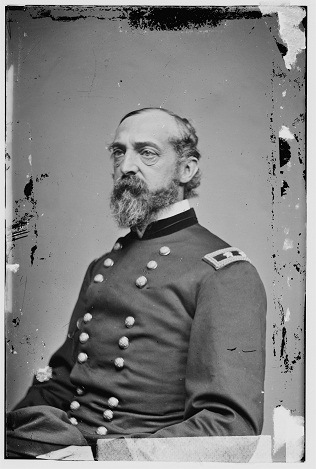
Maj. Gen. William French, who had command of the III Corps following Sickles' wounding. He did not demonstrate any particular ability (Library of Congress).

Maj. Gen. William French, who had command of the III Corps following Sickles’ wounding. He did not demonstrate any particular ability (Library of Congress).

On July 22 Meade sensed an opportunity and sent a force, with William French and the III Corps in advance, through Manassas Gap with the design of slicing the long serpent of Lee’s army in half. Unfortunately, French made only a half-hearted push through the gap and didn’t reach the vicinity of Front Royal until near evening, much too late to surprise the rebels. It must have been with a heavy heart that Meade telegraphed Halleck the next day: “I regret to inform you that, on advancing this morning at daylight, the enemy had again disappeared, declining battle, and though an immediate advance was made and Front Royal occupied, nothing was seen of him but a rear guard of cavalry with a battery of artillery.”

I think my last letter to you was about the 21st or 22d, when I was embarrassed at not ascertaining anything definite in regard to Lee’s movements. The next day, the 22d, I had positive information he was moving up the Valley of the Shenandoah. I immediately put my army in motion and pushed through Manassas Gap, where I met a part of his force. By the evening of the 24th I drove his force through Manassas Gap, and debouched with the head of my army into the open country beyond, in the vicinity of Front Royal, and having collected five corps together, expected to get a fight out of him on the 25th; but on advancing on that day he was again gone, having moved his whole army and trains (principally through Strasburg), day and night, on the 23d and 24th. Of course I was again disappointed, and I presume the President will be again dissatisfied. It is evident Lee is determined not to fight me till he gets me as far away from Washington as possible and in a position where all the advantages will be on his side. I hear from officers who have been in Washington that the President offered the command of this army to Grant, who declined it, but recommended Sherman. I consider I have done a great deal in compelling Lee to abandon the Valley of Virginia, where, but for my movements, he undoubtedly would have stayed, as he did last year, employing his army in gathering in the bountiful crops of that region, and sending them to his depots at Staunton and Gordonsville for use in the winter. As soon as I can get ready I shall move on again, and it remains to be seen whether he will make a stand on the Rappahannock or behind the Rapidan. Some people think they are preparing to abandon Virginia altogether, but I doubt this.

Meade’s correspondence taken from The Life and Letters of George Gordon Meade, Major-General United States Army, Vol. 2, (New York: Charles Scribner’s Sons, 1913), p. 137. Available via Google Books.

Defense (July 21, 1863)

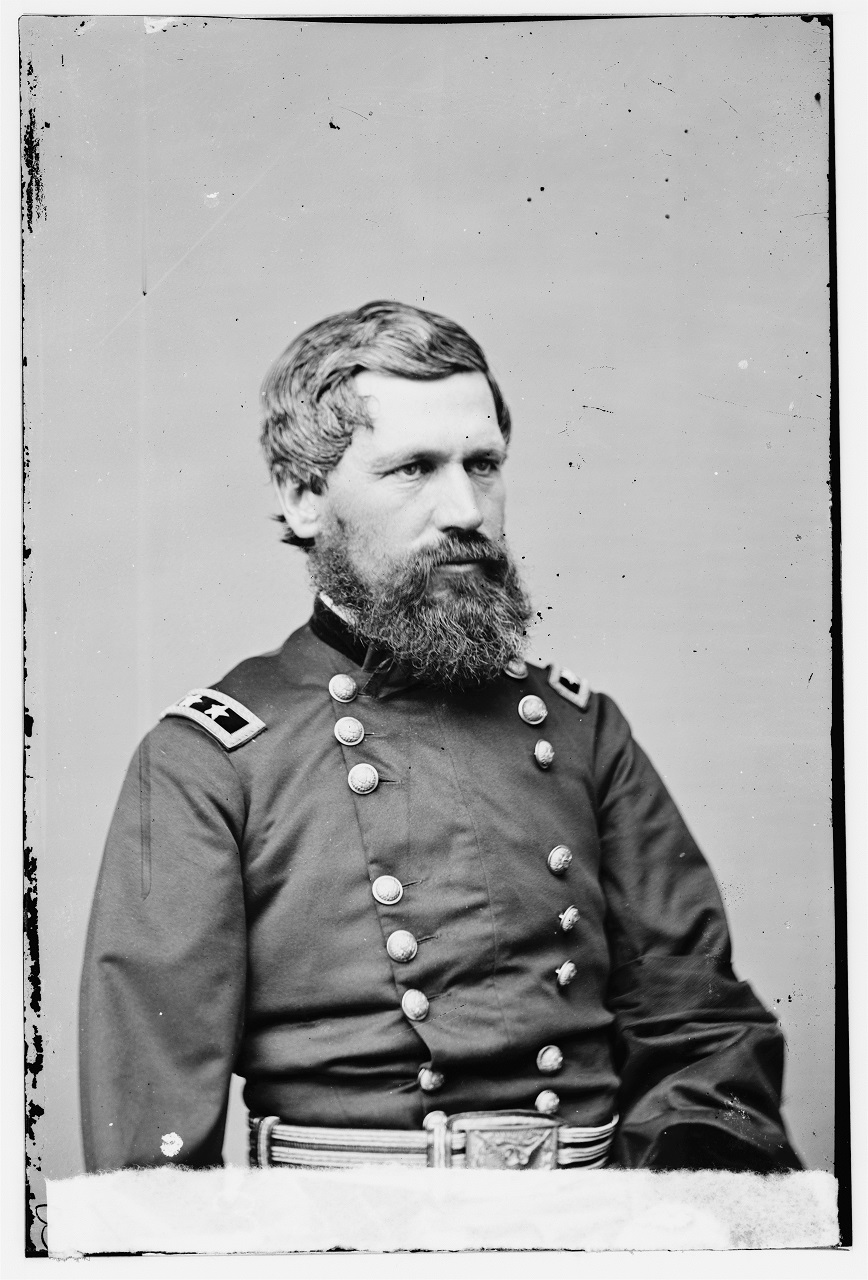
Maj. Gen. Oliver O. Howard. He defended Meade in a letter to President Lincoln (Library of Congress).

Maj. Gen. Oliver O. Howard. He defended Meade in a letter to President Lincoln (Library of Congress).

When Meade wrote to his wife on July 21 he was still steaming over the reaction from Washington to Robert E. Lee’s escape to Virginia. Apparently, President Lincoln’s attitude had softened somewhat over the ensuing week. Maj. Gen. Oliver O. Howard had written a letter to the president defending Meade (for the full text of the letter, scroll down) and on July 21 Lincoln replied. “I was deeply mortified by the escape of Lee across the Potomac, because the substantial destruction of his army would have ended the war, and because I believed such destruction was perfectly easy—believed that General Meade and his noble army had expended all the skill and toil and blood up to the ripe harvest, and then let the crop go to waste,” Lincoln wrote Howard. “A few days having passed I am now profoundly grateful for what was done, without criticism for what was not done. General Meade has my confidence as a brave and skillful officer and a true man.”

Your indignation at the manner in which I was treated on Lee’s escape is not only natural, but was and is fully shared by me. I did think at one time writing frankly to the President, informing him I never desired the command, and would be most glad at any time to be relieved, and that, as he had expressed dissatisfaction at my course, I thought it was his duty, independent of any personal consideration, to remove me. After reflection, however, I came to the conclusion to take no further action in the matter, and leave it entirely with them. I took the command from a sense of duty. I shall continue to exercise it, to the best of my humble capacity, in the same spirit. I have no ambition or ulterior views, and whatever be my fate, I shall try to preserve a clear conscience. I have received very handsome letters, both from Generals McClellan and Pope, which I enclose for your perusal and preservation. I have answered them both in the same spirit as appears to have dictated them.

This is what McClellan wrote to Meade:

My Dear General: I have abstained from writing to you simply because I hear that you have no time to read letters—but I will say a word now, anyhow.

I wish to offer you my sincere and heartfelt congratulations upon the glorious victory you have achieved, and the splendid way in which you assumed control of our noble old army under such trying circumstances.

You have done all that could be done and the Army of the Potomac has supported you nobly. I don’t know that, situated as I am, my opinion is worth much to any of you—but I can trust saying that I feel very proud of you and my old Army. I don’t flatter myself that your work is over—I believe that you have another severe battle to fight, but I am confident that you will win. That God may bless you and your army in its future conflicts is the prayer of

Your sincere friend

CEO. B. McCLELLAN

This is the letter Howard wrote to Lincoln. (From Official Records, Series I, Volume 27, Part 1, p. 700.)

Sir:

Having noticed in the newspapers certain statements bearing upon the battle of Gettysburg and subsequent operations, which I deem calculated to convey a wrong impression to your mind, I wish to submit a few statements.

The successful issue of the battle of Gettysburg was due mainly to the energetic operations of our present commanding general prior to the engagement, and to the manner in which he handled his troops on the field. The reserves have never before during this war been thrown in at just the right moment. In many cases when points were just being carried by the enemy, a regiment or brigade appeared to stop his progress and hurl him back. Moreover, I have never seen a more hearty co-operation on the part of general officers than since General Meade took the command.

As to not attacking the enemy prior to leaving his stronghold beyond the Antietam, it is by no means certain that the repulse of Gettysburg might not have been turned upon us. At any rate, the commanding general was in favor of an immediate attack, but with the evident difficulties in our way, the uncertainty of a success, and the strong conviction of our best military minds against the risk, I must say that I think the general acted wisely. As to my request to make a reconnaissance on the morning of the 14th, which the papers state was refused, the facts are, that the general had required me to reconnoiter the evening before, and give my opinion as to the practicability of making a lodgment on the enemy’s left, and his answer to my subsequent request was that the movements he had already ordered would serve the same purpose. We have, if I may be allowed to say it, a commanding general in whom all the officers with whom I have come in contact express complete confidence.

I have said this much because of the censure and of the misrepresentations which have grown out of the escape of Lee’s army. Very respectfully, your obedient servant.

O. O. HOWARD,
Major- General

Meade’s correspondence taken from The Life and Letters of George Gordon Meade, Major-General United States Army, Vol. 2, (New York: Charles Scribner’s Sons, 1913), pp. 136 and 312. Available via Google Books.

July 18, 1863

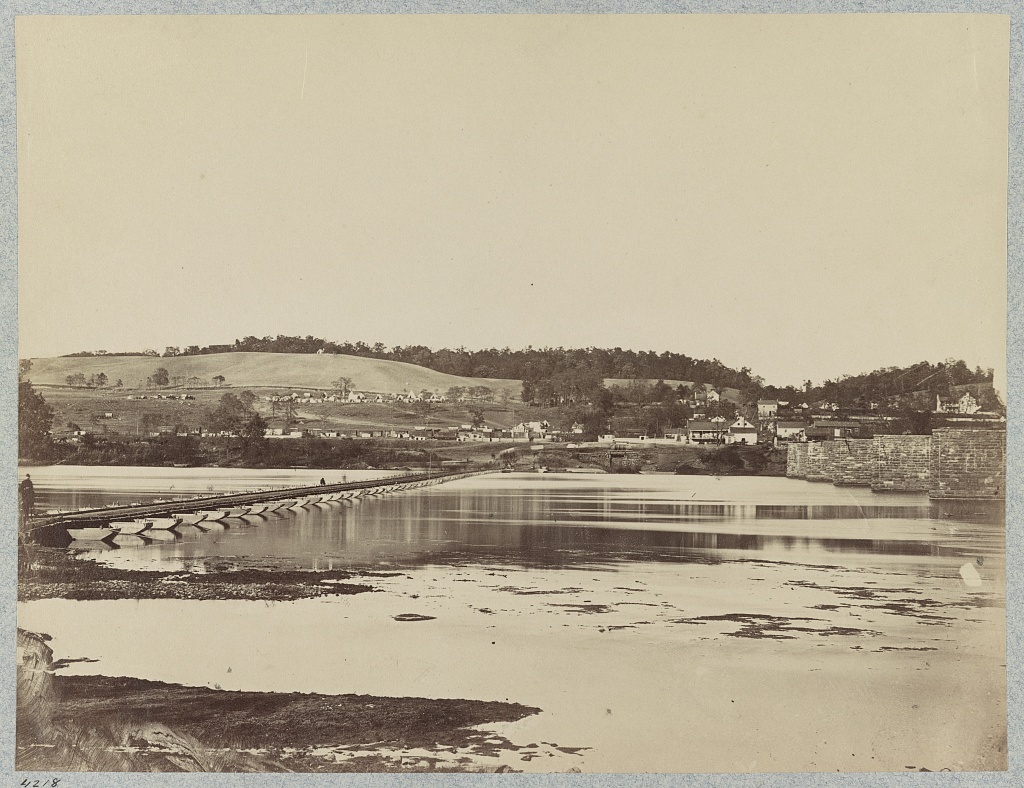
This photo of a pontoon bridge over the Potomac River was taken in October 1862, when George McClellan began his pursuit of Lee after Antietam (Library of Congress).

This photo of a pontoon bridge over the Potomac River was taken in October 1862, when George McClellan began his pursuit of Lee after Antietam (Library of Congress).

On July 18 Meade wrote another letter to his wife from Berlin, Maryland, on the banks of the Potomac.

I try to send you a few lines every chance I can get, but I find it very difficult to remember when I have written. I don’t think I told you that on my way here, three days ago, I stopped and called on Mrs. Lee (Miss Carroll that was), who lives about six miles from this place. Mrs. Lee received me with great cordiality, insisted on my dining with her and daughter, which I did, and had a very nice time, it being quite refreshing to be once more in the presence of ladies, surrounded with all the refinements and comforts of home. I wish, if you see any of the Jacksons and Bayards, you would say how gratified I was at the kind hospitality of Mrs. Lee and daughter, and what a nice girl I thought the latter was. The army is moving to-day over the same road I took last fall under McClellan. The Government insists on my pursuing and destroying Lee. The former I can do, but the latter will depend on him as much as on me, for if he keeps out of my way, I can’t destroy. Neither can I do so if he is reinforced and becomes my superior in numbers, which is by no means improbable, as I see by the papers it is reported a large portion of Bragg’s army has been sent to Virginia. The proper policy for the Government would have been to be contented with driving Lee out of Maryland, and not to have advanced till this army was largely reinforced and reorganized, and put on such a footing that its advance was sure to be successful. As, however, I am bound to obey explicit orders, the responsibility of the consequences must and should rest with those who give them. Another great trouble with me is the want of active and energetic subordinate officers, men upon whom I can depend and rely upon taking care of themselves and commands. The loss of Reynolds and Hancock is most serious; their places are not to be supplied. However, with God’s help, I will continue to do the best I can.

Meade’s correspondence taken from The Life and Letters of George Gordon Meade, Major-General United States Army, Vol. 2, (New York: Charles Scribner’s Sons, 1913), pp. 135-6. Available via Google Books.

Spurring (July 16, 1863)

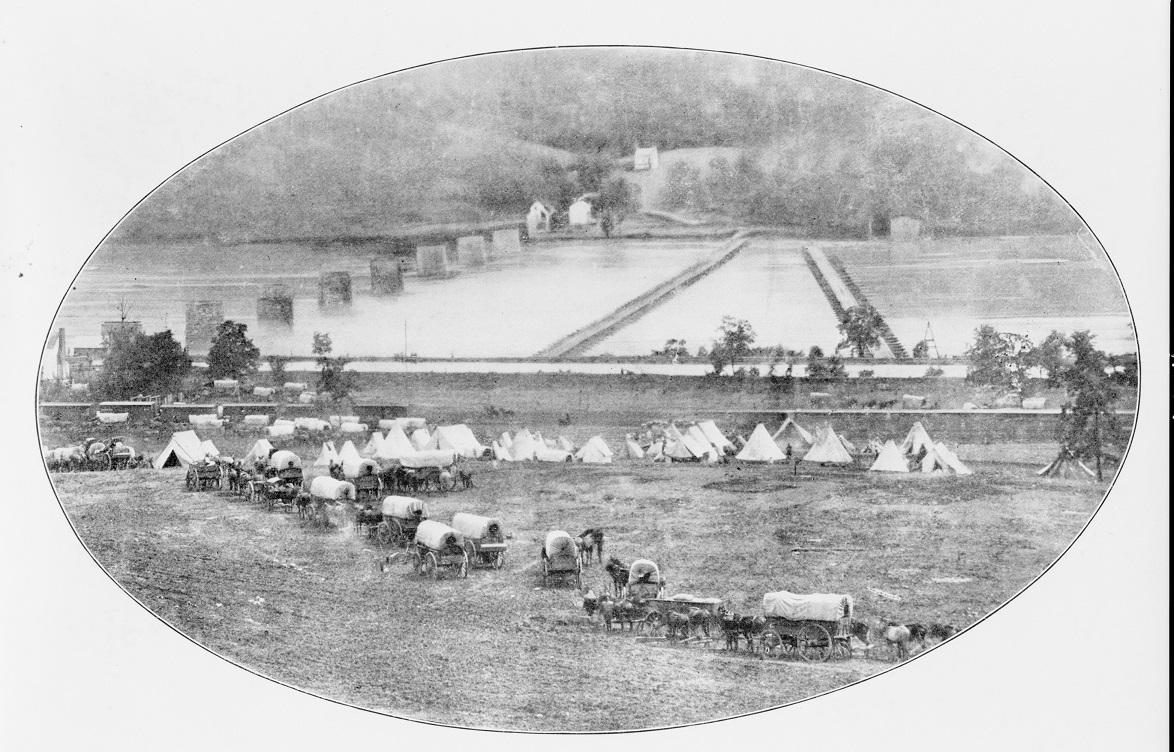
The magazine that eventually published this Matthew Brady photograph of the Army of the Potomac's crossing at Berlin, Maryland (now Brunswick) called it "Leisurely Pursuit" (Library of Congress).

The magazine that eventually published this Matthew Brady photograph of the Army of the Potomac’s crossing at Berlin, Maryland (now Brunswick) called it “Leisurely Pursuit” (Library of Congress).

Meade was not in a good place when he wrote to his wife on July 16, 1863, from Berlin, Maryland. Lee had escaped and his superiors in Washington had made their displeasure felt. They did not, however, accept Meade’s offer to resign his position.

I wrote to you of the censure put on me by the President, through General Halleck, because I did not bag General Lee, and of the course I took on it. I don’t know whether I informed you of Halleck’s reply, that his telegram was not intended as a censure, but merely “to spur me on to an active pursuit,” which I consider more offensive than the original message; for no man who does his duty, and all that he can do, as I maintain I have done, needs spurring. It is only the laggards and those who fail to do all they can do who require spurring. They have refused to relieve me, but insist on my continuing to try to do what I know in advance it is impossible to do. My army (men and animals) is exhausted; it wants rest and reorganization; it has been greatly reduced and weakened by recent operations, and no reinforcements of any practical value have been sent. Yet, in the face of all these facts, well known to them, I am urged, pushed and spurred to attempting to pursue and destroy an army nearly equal to my own, falling back upon its resources and reinforcements, and increasing its morale daily. This has been the history of all my predecessors, and I clearly saw that in time their fate would be mine. This was the reason I was disinclined to take the command, and it is for this reason I would gladly give it up.

I consider the New York riots very formidable and significant. I have always expected the crisis of this revolution to turn on the attempt to execute the conscription act, and at present things look very unfavorable.

Meade’s correspondence taken from The Life and Letters of George Gordon Meade, Major-General United States Army, Vol. 2, (New York: Charles Scribner’s Sons, 1913), p. 135. Available via Google Books.

Lee Escapes (July 14, 1863)

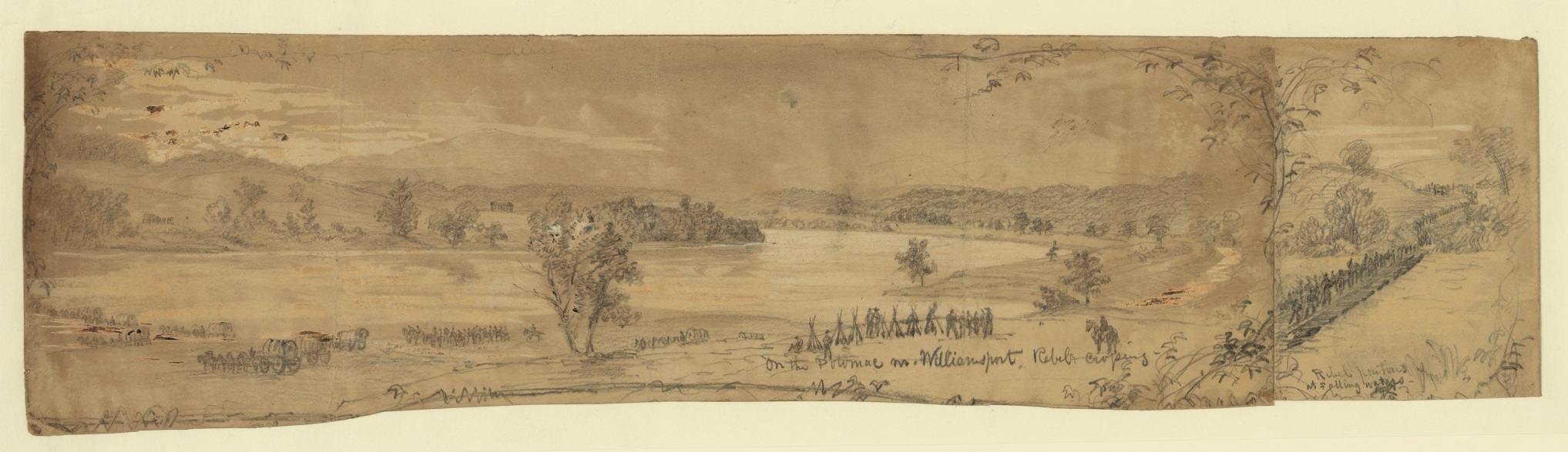
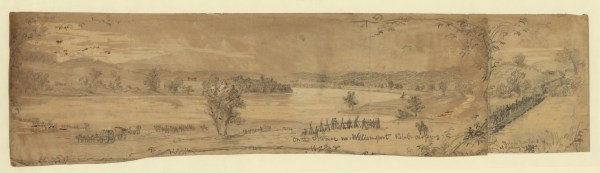
 A drawing by Alfred Waud, labeled, "On the Potomac nr. Williamsport. Rebel crossing ; Rebel Pontoons at Falling Waters" (Library of Congress).


A drawing by Alfred Waud, labeled, “On the Potomac nr. Williamsport. Rebel crossing ; Rebel Pontoons at Falling Waters” (Library of Congress).

July 14, 1863, was not a good day for Maj. Gen. George Gordon Meade. He and his army had had Robert E. Lee and the Army of the Northern Virginia backed up against the Potomac River at Williamsport, Maryland. As I write in Searching for George Gordon Meade: The Forgotten Victor of Gettysburg:

The council took place in Meade’s small and crowded tent at Devil’s Backbone. Howard and Maj. Gen. James Wadsworth, who had taken over the I Corps from an ill Newton, voted to attack. The rest of the corps commanders voted to hold off until the army could better investigate Lee’s defenses. Perhaps remembering what had happened at Chancellorsville when Hooker overruled his corps commanders, Meade decided to defer to his generals’ advice. He postponed his attack for a day.

Meade wired Halleck the next day. It was a lengthy message with a slightly defensive tone. “In my dispatch of yesterday I stated that it was my intention to attack the enemy to-day, unless something intervened to prevent it,” he said. “Upon calling my corps commanders together and submitting the question to them, five out of six were unqualifiedly opposed to it. Under these circumstances, in view of the momentous consequences attendant upon a failure to succeed, I did not feel myself authorized to attack until after I had made more careful examination of the enemy’s position, strength, and defensive works. These examinations are now being made. So far as completed, they show the enemy to be strongly intrenched on a ridge running from the rear of Hagerstown past Downsville to the Potomac. I shall continue these reconnaissances with the expectation of finding some weak point, upon which, if I succeed, I shall hazard an attack.”

He received a terse message from Halleck in reply. “You are strong enough to attack and defeat the enemy before he can effect a crossing,” said the general in chief. “Act upon your own judgment and make your generals execute your orders. Call no council of war. It is proverbial that councils of war never fight. Re-enforcements are pushed on as rapidly as possible. Do not let the enemy escape.”

On the morning of July 13 war correspondent Charles Carleton Coffin of the Boston Journal rode over to Meade’s headquarters at Devil’s Backbone. There he found Seth Williams, the army’s adjutant general, in Meade’s tent. Williams told Coffin that Meade was out reconnoitering the rebel lines.

“Do you think that Lee can get across the Potomac?” Coffin asked.

“Impossible!” replied Williams. “The people resident here say that it cannot be forded at this stage of the water. He has no pontoons. We have got him in a tight place. We shall have reinforcements to-morrow, and a great battle will be fought. Lee is encumbered with his teams, and he is short of ammunition.”

As Coffin talked with Williams, Meade entered the tent, dripping wet from the rain. “His countenance was unusually animated,” Coffin wrote. “He had ever been courteous to me, and while usually very reticent of all his intentions or of what was going on, as an officer should be, yet in this instance he broke over his habitual silence, and said, ‘We shall have a great battle to-morrow. The reinforcements are coming up, and as soon as they come we shall pitch in.’”

But when Meade’s soldiers moved forward on July 13 they found that Lee had, in fact, slipped across the river. The next day Meade wrote to his wife:

I found Lee in a very strong position, intrenched. I hesitated to attack him, without some examination of the mode of approaching him. I called my corps commanders together, and they voted against attacking him. This morning, when I advanced to feel his position and seek for a weak point, I found he had retired in the night and was nearly across the river. I immediately started in pursuit, and my cavalry captured two thousand prisoners, two guns, several flags, and killed General Pettigrew. On reporting these facts to General Halleck, he informed me the President was very much dissatisfied at the escape of Lee. I immediately telegraphed I had done my duty to the best of my ability, and that the expressed dissatisfaction of the President I considered undeserved censure, and asked to be immediately relieved. In reply he said it was not intended to censure me, but only to spur me on to an active pursuit, and that it was not deemed sufficient cause for relieving me. This is exactly what I expected; unless I did impracticable things, fault would be found with me. I have ignored the senseless adulation of the public and press, and I am now just as indifferent to the censure bestowed without just cause.

I start to-morrow to run another race with Lee.

In the letter, Meade mentions these exchanges he had with Henry Halleck:

Halleck to Meade, July 14 (in part):

I need hardly say to you that the escape of Lee’s army without another battle has created great dissatisfaction in the mind of the President, and it will require an active and energetic pursuit on your part to remove the impression that it has not been sufficiently active heretofore.

Meade to Halleck, July 14:

Having performed my duty conscientiously and to the best of my ability, the censure of the President conveyed in your dispatch of 1 p. M. this day, is, in my judgment, so undeserved that I feel compelled most respectfully to ask to be immediately relieved from the command of this army.

Halleck to Meade July 14:

My telegram stating the disappointment of the President at the escape of Lee’s army was not intended as a censure, but as a stimulus to an active pursuit. It is not deemed a sufficient cause for your application to be relieved.

Meade’s correspondence taken from The Life and Letters of George Gordon Meade, Major-General United States Army, Vol. 2, (New York: Charles Scribner’s Sons, 1913), pp. 134-5 and 311-12. Available via Google Books.

Back to South Mountain (July 10, 1863)

July 10, 1863, found Meade still in pursuit of the Confederate army. He wrote to his wife from the Mountain House, in South Mountain’s Turner’s Gap. (The building is still there on Alt. Rt. 40 and today operates as the South Mountain Inn.)

I have been so busy I could not write. You must depend on George for letters.

Lee has not crossed and does not intend to cross the river, and I expect in a few days, if not sooner, again to hazard the fortune of war. I know so well that this is a fortune and that accidents, etc., turn the tide of victory, that, until the question is settled, I cannot but be very anxious. If it should please God again to give success to our efforts, then I could be more tranquil. I also see that my success at Gettysburg has deluded the people and the Government with the idea that I must always be victorious, that Lee is demoralized and disorganized, etc., and other delusions which will not only be dissipated by any reverse that I should meet with, but would react in proportion against me. I have already had a very decided correspondence with General Halleck upon this point, he pushing me on, and I informing him I was advancing as fast as I could. The firm stand I took had the result to induce General Halleck to tell me to act according to my judgment. I am of opinion that Lee is in a strong position and determined to fight before he crosses the river. I believe if he had been able to cross when he first fell back, that he would have done so; but his bridges being destroyed, he has been compelled to make a stand, and will of course make a desperate one. The army is in fine spirits, and if I can only manage to keep them together, and not be required to attack a position too strong, I think there is a chance for me. However, it is all in God’s hands. I make but little account of myself, and think only of the country.

The telegram I sent you was because I could not write, and I thought it would make you easy to know we were well. George,1 I suppose, has written you what a narrow escape he had. I never knew of it till last night. His horse was struck with a piece of shell, killing him, and coming so near George as to carry away a part of the back of his saddle. This was on the 3d, just after we had repulsed the last assault, when I rode up to the front, and George was the only officer with me.

Meade and Halleck also kept communicating.

Meade to Halleck, July 10, 1863, 1 P. M.

MeadeThe information received to-day indicates that the enemy occupy positions extending from the Potomac, near Falling Water, through Downsville to Funkstown and to the northeast of Hagerstown, Ewell’s Corps being to the northeast of Hagerstown, Longstreet’s at Funkstown and A. P. Hill’s on their right. These positions they are said to be intrenching.

I am advancing on a line perpendicular to the line from Hagerstown to Williamsport, and the Army will this evening occupy a position extending from the Boonsboro and Hagerstown road, at a point one mile beyond Beaver Creek, to Bakersville, near the Potomac. Our cavalry advance this morning drove the enemy’s cavalry, on the Boonsboro pike, to within a mile of Funkstown, when the enemy deployed a large force and opened a fire from heavy guns (20-pounders).

I shall advance cautiously on the same line to-morrow until I can develop more fully the enemy’s position and force, upon which my future operations will depend.

General Smith is still at Waynesboro; a dispatch was received from him at that place, this morning. Instructions similar to those of yesterday were sent to him.

Halleck to Meade: July 10, 9 P. M.

halleckI think it will be best for you to postpone a general battle till you can concentrate all your forces and get up your reserve and reinforcements. I will push on the troops as fast as they arrive. It would be well to have staff officers at the Monocacy to direct the troops arriving where to go and see that they are properly fitted out. They should join you by forced marches. Beware of partial combats, bring up and hurl upon the enemy all your forces, good and bad.

Meade’s correspondence taken from The Life and Letters of George Gordon Meade, Major-General United States Army, Vol. 2, (New York: Charles Scribner’s Sons, 1913), pp. 133-4 and 311. Available via Google Books.
Return to Frederick (July 8, 1863)

Old Baldy, in a photo taken after the war (Library of Congress).

Old Baldy, in a photo taken after the war (Library of Congress).

On July 7 Meade left Gettysburg and traveled all the way to Frederick, not far from the spot where Colonel Hardie had arrived to bring him trouble just nine days earlier. For Meade it seemed like a lifetime. He had been living in “a great state of mental anxiety,” he wrote his wife. “Indeed, I think I have lived as much in this time as in the last thirty years.” Since taking command he had not changed his clothes, had a full night’s sleep, eaten a regular meal, or even had much chance to wash his face and hands.

Meade found the streets of Frederick crowded with people eager to get a glimpse of him. The citizens treated him “like a lion,” but he did not allow it to go to his head. After the botched opportunities of Antietam, George McClellan had written to his wife that he had fought a “masterpiece of war.” Meade was cut from a different cloth.

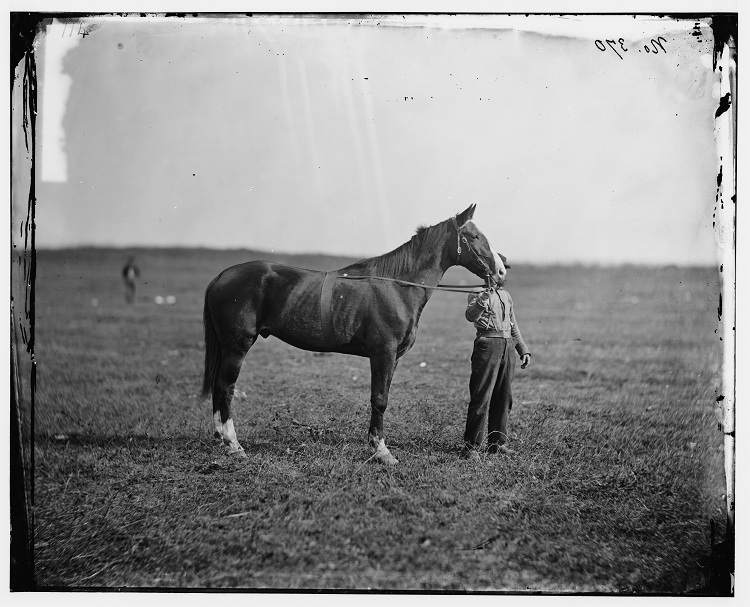
Baldy, of course, is Meade’s horse. He not only survived his wounds, he went on to outlive his master by 10 years.

I arrived here yesterday; the army is assembling at Middletown. I think we shall have another battle before Lee can cross the river, though from all accounts he is making great efforts to do so. For my part, as I have to follow and fight him, I would rather do it at once and in Maryland than to follow into Virginia. I received last evening your letters of the 3d and 5th inst., and am truly rejoiced that you are treated with such distinction on account of my humble services. I see also that the papers are making a great deal too much fuss about me. I claim no extraordinary merit for this last battle, and would prefer waiting a little while to see what my career is to be before making any pretensions. I did and shall continue to do my duty to the best of my abilities, but knowing as I do that battles are often decided by accidents, and that no man of sense will say in advance what their result will be, I wish to be careful in not bragging before the right time. George is very well, though both of us are a good deal fatigued with our recent operations. From the time I took command till to-day, now over ten days, I have not changed my clothes, have not had a regular night’s rest, and many nights not a wink of sleep, and for several days did not even wash my face and hands, no regular food, and all the time in a great state of mental anxiety. Indeed, I think I have lived as much in this time as in the last thirty years. Old Baldy is still living and apparently doing well; the ball passed within half an inch of my thigh, passed through the saddle and entered Baldy’s stomach. I did not think he could live, but the old fellow has such a wonderful tenacity of life that I am in hopes he will.

The people in this place have made a great fuss with me. A few moments after my arrival I was visited by a deputation of ladies, and showers of wreaths and bouquets presented to me, in most complimentary terms. The street has been crowded with people, staring at me, and, much to my astonishment, I find myself a lion. I cannot say I appreciate all this honor, because I feel certain it is undeserved, and would like people to wait a little while. I send you a document1 received yesterday afternoon. It will give you pleasure I know. Preserve it, because the terms in which the General in Chief speaks of the battle are stronger than any I have deemed it proper to use myself. I never claimed a victory, though I stated that Lee was defeated in his efforts to destroy my army. I am going to move as soon as I can get the army supplied with subsistence and ammunition.

Meade’s correspondence taken from The Life and Letters of George Gordon Meade, Major-General United States Army, Vol. 2, (New York: Charles Scribner’s Sons, 1913), pp. 132-3. Available via Google Books.
A Most Decided Victory (July 5, 1863)

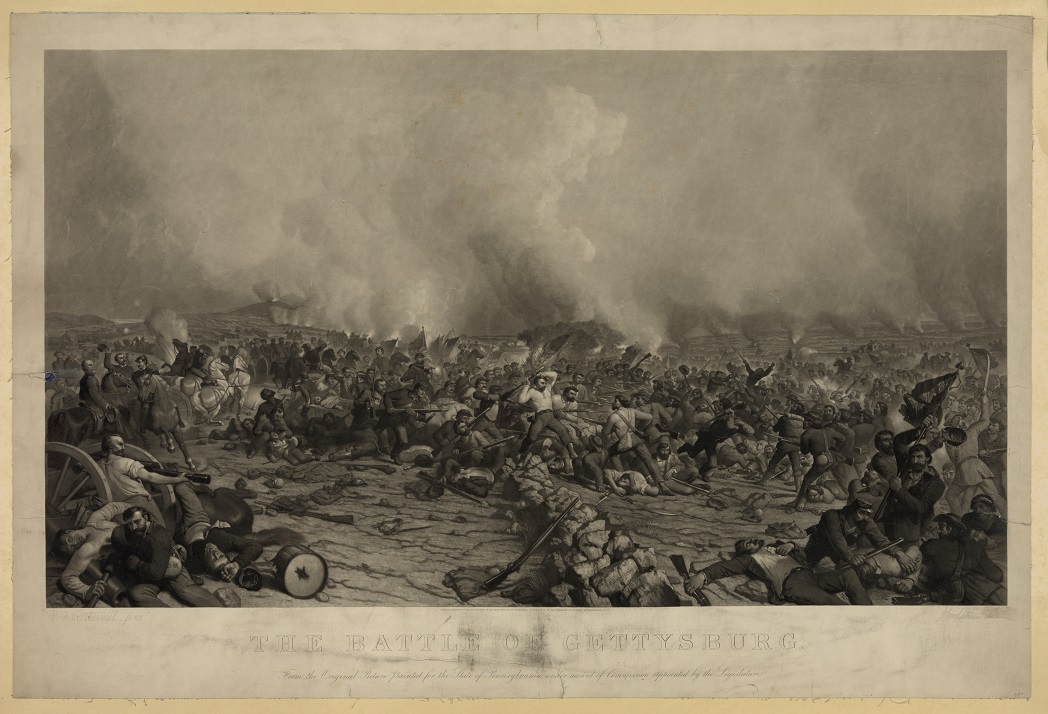
An engraving of Peter Rothermel's 1870 depiction of the fighting on July 3. This shows the climactic struggle at the Angle. Meade appears to the left. When he saw the original painting, Meade complained about the historical inaccuracy of having him on the front lines as his army was repulsing Pickett's charge. Rothermel defended the artistic license Library of Congress).

An engraving of Peter Rothermel’s 1870 depiction of the fighting on July 3. This shows the climactic struggle at the Angle. Meade appears to the left. When he saw the original painting, Meade complained about the historical inaccuracy of having him on the front lines as his army was repulsing Pickett’s charge. Rothermel defended the artistic license (Library of Congress).

The Battle of Gettysburg was over. Now remained the task of pursuing Robert E. Lee’s retreating army. On July 4 Meade issued a circular praising his soldiers for their victory but this seemingly innocuous announcement raised Abraham Lincoln’s ire. This is what Meade issued:

The Commanding General, in behalf of the country, thanks the Army of the Potomac for the glorious result of the recent operations.

An enemy superior in numbers and flushed with the pride of a successful invasion, attempted to overcome and destroy tin’s Army. Utterly baffled and defeated, he has now withdrawn from the contest. The privations and fatigue the Army has endured, and the heroic courage and gallantry it has displayed will be matters of history to be remembered.

Our task is not yet accomplished, and the Commanding General looks to the Army for greater efforts to drive from our soil every vestige of the presence of the invader.

It is right and proper that we should, on all suitable occasions, return our grateful thanks to the Almighty Disposer of events, that in the goodness of His Providence He has thought fit to give victory to the cause of the just.

When President Lincoln read that, he exclaimed, “Drive the invaders from our soil! Great God! Is that all?” To another listener the president complained, “Will our Generals never get that idea out of their heads? The whole country is our soil.”

On July 5 Meade sent this message to Henry Halleck in Washington:

The enemy retired under cover of the night and heavy rain in the direction of Fairfield and Cashtown. All my available Cavalry are in pursuit on the enemy’s left and rear. My movement will be made at once on his flank via Middletown and South Mountain Pass. I cannot give you the details of our capture in prisoners, colors and arms. Upwards of twenty battle flags will be turned in from one Corps. I cannot delay to pick up the debris of the battle field and request that all those arrangements may be made by the Departments. My wounded, with those of the enemy in our hands, will be left at Gettysburg. After burying our own, I am compelled to employ citizens to bury the enemy’s dead. My Head-Quarters will be to-night at Cregerstown. Communication received from Gen. Smith, in command of 3,000 men, on the march from Carlisle towards Cashtown. Field returns last evening give me about 55,000 effectives in the ranks, exclusive of Cavalry, baggage guards, ambulance attendants, etc. Every available reinforcement is required and should be sent to Frederick without delay.

And on July 5 Meade found time to write home to his wife.

I hardly know when I last wrote to you, so many and such stirring events have occurred. I think I have written since the battle, but am not sure. It was a grand battle, and is in my judgment a most decided victory, though I did not annihilate or bag the Confederate Army. This morning they retired in great haste into the mountains, leaving their dead unburied and their wounded on the field. They awaited one day, expecting that, flushed with success, I would attack them when they would play their old game of shooting us from behind breastworks—a game we played this time to their entire satisfaction. The men behaved splendidly; I really think they are becoming soldiers. They endured long marches, short rations, and stood one of the most terrific cannonadings I ever witnessed. Baldy was shot again, and I fear will not get over it. Two horses that George rode were killed, his own and the black mare. I had no time to think of either George or myself, for at one time things looked a little blue; but I managed to get up reinforcements in time to save the day. The army are in the highest spirits, and of course I am a great man. The most difficult part of my work is acting without correct information on which to predicate action.

Meade’s correspondence taken from The Life and Letters of George Gordon Meade, Major-General United States Army, Vol. 2, (New York: Charles Scribner’s Sons, 1913), pp. 122-3 and 125. Available via Google Books.

Dedication

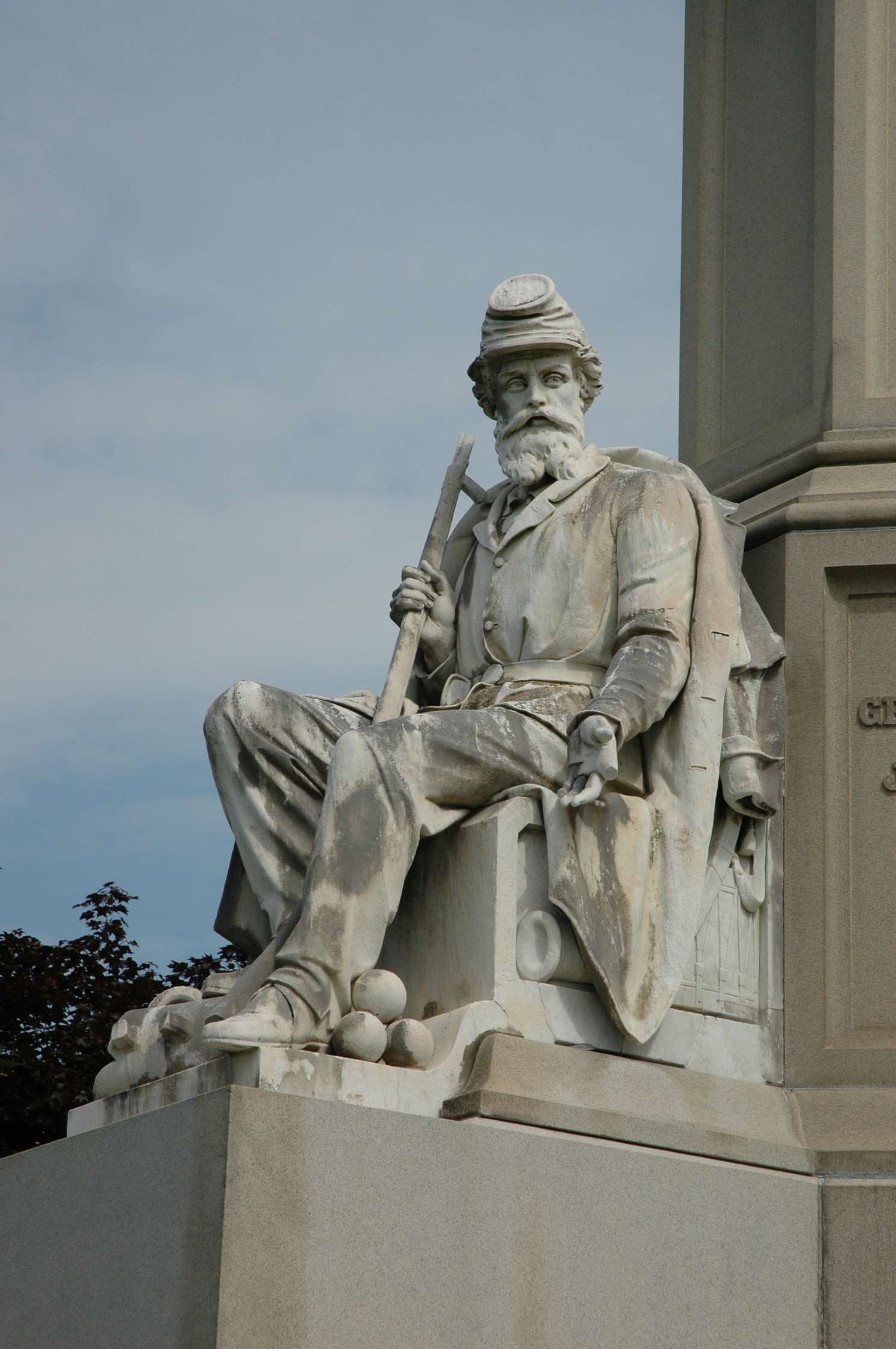
Detail of the Soldiers National Monument at Gettysburg's National Cemetery (Tom Huntington).

Detail of the Soldiers National Monument at Gettysburg’s National Cemetery (Tom Huntington).

Yesterday marked the 150th anniversary of the battle of Gettysburg’s third and final day. The fighting here in 1863 had been fierce and bloody, with something like 8,000 dead from both sides. Most of the fallen were initially buried near where they died. Many of the Union troops were eventually laid to rest in the new National Cemetery, site of President Lincoln’s address on November 19, 1863. General Meade was invited to the cemetery dedication but had business with General Lee in Virginia at the time. On July 1, 1869, he returned to Gettysburg to speak at the dedication ceremonies for the Soldiers’ National Monument in the National Cemetery. It was, for its time, a short speech so I have posted the entire address here. Especially interesting are Meade’s remarks about the Confederate dead at Gettysburg.

My fellow citizens, ladies and gentlemen,

Six years ago I stood upon this ground under circumstances very different from those which now surround us. These beautiful hills and valleys, teeming with luxuriant crops, these happy faces around me, are widely different from the tumultuous roar of war and the terrible scenes enacted at that time. Four years ago I stood here, by invitation of some honorable gentlemen who have brought me here this time, and laid the corner-stone of the Monument which we are brought here to-day to dedicate; and now, for the third time, I appear before you at the request of the managers of the Monument Association, to render my assistance, humble as it is, in paying respect to the memory of the brave men who fell here, by dedicating this Monument to them; and at the request of these gentlemen I am about to make to you a few, a very few remarks which are incident to this occasion and suggested by it. When I look around and see, as I now see, so many brave men who were by my side in that memorable battle, among them his Excellency the present Governor of Pennsylvania, General Geary, and others who were with me at that time; when I look back and think upon the noble spirits who then fought so well, and now sleep that sleep that knows no waking—gallant Reynolds, my bosom friend, as well as my right hand officer; brave Vincent, and Zook, and Weed, and others, far more in number than I have time of words to mention,—my feelings are those of mingled sadness and joy,—sadness, my friends, to think that there ever was an occasion when such men should be arrayed in battle, as they were here; that we should ever have been called upon, as we were upon this held, to defend the flag of our country and Government, which had been handed down to us from our forefathers. It is sad to think of the mourning and desolation which prostrated our whole land, North and South; it is sad to contemplate the vast destruction of life which we here wrought in obedience to our highest duty. I am filled with sadness to think of the host of mourning widows and orphans left throughout the land by that deadly struggle. Such thoughts necessarily crowd upon us. At the same time I give thanks to the Almighty, who directed the event, and who selected me as an humble instrument, with those then around me upon this field, to obtain that decisive victory which turned the tide of that great war, and settled for ever the trust in this country of the great principles of personal liberty and constitutional freedom. I feel grateful, too, that our fellow-countrymen have been moved to such respect and honor as we are now paying to the memory of those men who, in the discharge of their duty, laid down their lives, proving, by the highest sacrifice man can render, their devotion to the cause they were defending. Gratitude to those present to-day, who, by their presence, contribute to render the high honor justly due to the fallen brave.

There is one subject, my friends, which I will mention now and on this spot, while my attention is being called to it, and on which I trust my feeble voice will have some influence. When I contemplate this field, I see here and there the marks of hastily dug trenches in which repose the dead against whom we fought. They are the work of my brothers in arms the day after the battle. Above them a bit of plank indicates simply that these remains of the fallen were hurriedly laid there by soldiers who met them in battle. Why should we not collect them in some suitable place! I do not ask that a monument be erected over them; I do not ask that we should in any way endorse their cause or their conduct, or entertain other than feelings of condemnation for their course: but they are dead! They have gone before their Maker to be judged. In all civilized countries it is the usage to bury the dead with decency and respect, and even to fallen enemies respectful burial is accorded in death. I earnestly hope that this suggestion may have some influence throughout our broad land, for this is only one of a hundred crowded battle fields. Some persons may be designated by the Government to collect these neglected bones and bury them without commemorating monuments, simply indicating that below sleep misguided men who fell in battle for a cause over which we triumphed.

I shall delay you no longer, for you are about to listen to one of the most eloquent men in this country. My purpose was simply to comply with the kind invitation given me to speak meet words of praise for the dead heroes sleeping around, and to aid in the solemnities of this occasion. I thank you for your attention, and will now unveil the statue.

From The Soldiers’ National Cemetery at Gettysburg: With the Proceedings at its Consecration, at the Laying of the Corner-stone of the Monument, and at its Dedication by John Russell Bartlett (Printed by the Providence Press Co. for the Board of Commissioners of the Soldiers’ National Cemetery, 1874). Available via Google Books.

A Quick Note (July 3, 1863)

Meades HQJuly 3, 1863, was the third and final day of the Battle of Gettysburg, the largest battle on the North American continent. It climaxed with the Confederate attack we now remember as Pickett’s Charge. Before that happened, General Meade found time to write a quick note to his wife.

All well and going on well with the Army. We had a great fight yesterday, the enemy attacking and we completely repulsing them; both Armies shattered. To-day at it again, with what result remains to be seen. Army in fine spirits and every one determined to do or die. George and myself well. Reynolds killed the first day. No other of your friends or acquaintances hurt.

Meade’s letter taken from The Life and Letters of George Gordon Meade, Major-General United States Army, Vol. 2, (New York: Charles Scribner’s Sons, 1913), p. 103. Available via Google Books.