Naval Setback and a Princess (April 17, 1863)

A Currier & Ives print of Samuel DuPont's failed April 7 attack on Charleston, South Carolina (Library of Congress).

A Currier & Ives print of Samuel Du Pont’s failed April 7 attack on Charleston, South Carolina (Library of Congress).

In his letter of April 17, Meade writes about Rear Admiral Samuel Du Pont’s failure to capture Charleston, South Carolina, with a flotilla of monitors. The Confederate defenders badly shot up the Union ironclads, which didn’t even make it past Fort Sumter. Du Pont asked to be relieved as head of the blockading fleet and was replaced by John Dahlgren, whose son, Ulric, would later serve as an aide to Meade.

The Princess “Slam Slam” to whom Meade prefers was actually Princess Salm-Salm, the American wife of Felix Constantin Alexander Johann Nepomuk, Prince Salm-Salm. The Prussian aristocrat and cavalryman had traveled to the United States and volunteered to fight for the Union. His wife was the former Agnes Elizabeth Winona Leclerc Joy, who had been born in Vermont. She met her future husband in Washington. Below Meade’s letter I have included an account of the princess by Noah Brooks, the newspaperman who accompanied Lincoln on his trip to visit the army. He included it in his 1895 book Washington in Lincoln’s Time. I have also included Princess Salm-Salm’s own recollections of Lincoln, taken from her 1876 book Ten Years of My Life.

I regret to see you are in bad spirits and take so much to heart our apparent reverses. The affair at Charleston was pretty much as I expected, except I did think the ironclads would be able to pass Sumter and get at the town. I did not expect this would give us the place, or that they could reduce the batteries. They never have yet reduced any batteries of consequence, except those at Port Royal and Fort Donelson, but they have proved their capacity to run by them and stand being shot at, which I think they did in an eminent degree at Charleston. I see some of the papers are disposed to criticise and find fault with duPont, but I have just read a vigorous defense of him in the New York Tribune, so he is all right. You must not be so low-spirited. War is a game of ups and downs, and we must have our reverses mixed up with our successes. Look out for “Fighting Joe’s” army, for the grand reaction in our favor. A big rain storm we had on the 14th has kept us quiet for awhile, but Joe says we are to do great things when we start.

The great lady in the camp is the Princess Slam Slam, who is quite a pretty young woman. The Prince Slam Slam has a regiment in Sigel’s corps.

Meade’s letter taken from The Life and Letters of George Gordon Meade, Major-General United States Army, Vol. 1, (New York: Charles Scribner’s Sons, 1913), p. 366. Available via Google Books.

Here are Noah Brooks’ recollections of Princess Salm-Salm:
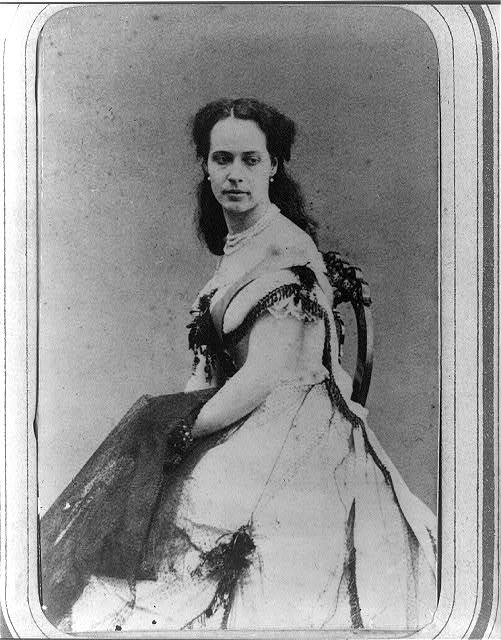
Princess Salm-Salm (Librayr of Congress).

Princess Salm-Salm (Library of Congress).

While the President and his party were with the Army of the Potomac at the time previously referred to, pleasant collations were occasionally served at the headquarters of the various corps commanders whose troops were being reviewed. At a luncheon given by General Sickles at his headquarters, among the ladies present was the Princess Salm-Salm, whose husband was a staff-officer in the army. This lady attracted much admiration by her graceful and dashing riding in the cavalcade that attended the reviews. Before her marriage she was a Miss Joyall of Philipsburg. It was this remarkable woman who astonished the President, on his entering General Sickles’s headquarters, by flying at him, and imprinting a bouncing kiss on his surprised and not altogether attractive face. As soon as he could collect himself and recover from his astonishment, the President thanked the lady, but with evident discomposure; whereupon some of the party made haste to explain that the Princess Salm-Salm had laid a wager with one of the officers that she would kiss the President. Her audacious sally won her a box of gloves.

I have called the princess remarkable; and her career certainly deserves a parenthetical note, for she was a conspicuous figure in some social circles of Washington during Lincoln’s time. Her parents were of humble origin, living in Philipsburg, at the Canadian end of Lake Champlain, called Missisquoi Bay. The girl earned her living by service among the neighboring farmers, but subsequently became an actress in a strolling company of players. From this time her life was picturesque and varied. It was said that her well-known skill and deftness in the care and management of horses were acquired when she was a circus-rider; at that period of her checkered career she was billed as “Miss Leclerq.” Prince Salm-Salm served as a volunteer staff-officer during our war, after which he and his wife went to Mexico, where they identified themselves with the failing cause of the Emperor Maximilian. The lady narrated her remarkable adventures in Mexico in a bright book, and the couple returned to Austria, whence the prince had been previously expelled on account of his profligate habits, but where he was now made welcome and was given a pension and a post in one of the royal palaces near Vienna. It was subsequently reported that this American princess joined herself to the French forces under the Geneva cross, in the Franco-Prussian war, and that her husband was killed while fighting on the same side at the battle of Gravelotte.

 From Noah Brooks, Washington in Lincoln’s Time (New York: Century Co., 1895), pp. 68-70. Available via Google Books here.

The Princess’s account. Curiously, she does not mention the kissing incident.

Prince Salm-Salm (Library of Congress).

Prince Salm-Salm (Library of Congress).

There were, of course, plenty of newspaper reporters in our camp; and as they had not much to write about the war, they described our sports and festivals, which descriptions tempted many people to pay us a visit; and even Mr. Lincoln, or perhaps Mrs. Lincoln, could not resist . The announcement of this visit caused, of course, great excitement; and preparations were made to entertain them as well as possible. They were to stay at General Hooker’s head-quarters; but the real maitre de plaisirs was General Sickles, who had been in Europe, and who knew all about it. He wanted to introduce even some novelties of a monarchical smack, and proposed to appoint for the time of the visit some ladies of honour to attend on Mrs. Lincoln. This plan was, however, not to the liking of the American ladies, each of whom thought herself quite as sovereign as the wife of the President.

President Lincoln’s features are well known. People said that his face was ugly. He certainly had neither the figure nor features of the Apollo of Belvedere; but he never appeared ugly to me, for his face, beaming with boundless kindness and benevolence towards mankind, had the stamp of intellectual beauty. I could not look into it without feeling kindly towards him, and without tears starting to my eyes, for over the whole face was spread a melancholic tinge, which some will have noticed in many persons who are fated to die a violent death.

A German author, I think it is L. Tieck, says somewhere that one loves a person only the better on discovering in him or her something funny or ridiculous, and this remark struck me as very correct. We may worship or revere a perfect person; but real warm human affection we feel towards such as do not overawe us, but stand nearer to us by some imperfection or peculiar weakness provoking a smile. President Lincoln’s appearance was peculiar. There was in his face, besides kindness and melancholy, a sly humour nickering around the corners of his big mouth and his rather small and somewhat tired looking eyes.

He was tall and thin, with enormously long loose arms and big hands, and long legs ending with feet such as I never saw before; one of his shoes might have served Commodore Nutt as a boat. The manner in which he dressed made him appear even taller and thinner than he was, for the clothes he wore seemed to be transmitted to him by some still taller elder brother. In summer, when he wore a suit made of some light black stuff, he looked like a German village schoolmaster. He had very large ears standing off a little, and when he was in a good humour I always expected him to flap with them like a good-natured elephant.

Notwithstanding his peculiar figure, he did not appear ridiculous; he had of the humourous just as much about him as the people like to see in public characters they love. Lincoln was beloved by the Americans more than any other man; he was the most popular President the United States ever had, Washington and Jackson not excepted.

I need not say that everything was done by the commanding generals to entertain Mrs. Lincoln and the President, who on reviewing the troops was everywhere received with heartfelt cheers.

From Agnes Elizabeth W. Salm-Salm, Ten Years of My Life (Richard Bentley & Son, 1876), pages 44-46. Available from Google Books here.

Death and Taxes

Today is tax day so I felt it would be appropriate to say something about the American Civil War’s role in the creation of the national income tax. I’ve adapted this from an article I wrote several years ago when I was doing some P.R. work for the National Civil War Museum in Harrisburg, Pennsylvania.

“Nothing in this world is certain but death and taxes,”” said Benjamin Franklin. The American Civil War was responsible for plenty of both.

Congress passed the first Federal income tax in 1861 to help fund the Union effort. Although Great Britain already had an income tax and some states had experimented with the concept, it was a first for the U.S. government. But the times cried out for innovation. South Carolina had seceded from the Union in December 1860, starting a chain reaction as other Southern states followed its lead. On April 12, 1861, Southern guns in Charleston, South Carolina, opened fire on Union-held Fort Sumter. The Civil War had begun.

Few realized how much it would cost—by 1863 the Union was spending more than $2 million a day on the war. The country’s previous methods of raising money, primarily from tariffs and the sale of public land, were inadequate to handle this new crisis.

Salmon P. Chase, Lincoln's secretary of the treasury and a member of his "team of rivals." Young George Gordon Meade had once been a student at a school that Chase ran. When he later met the treasury secretary during the Civil War, Meade declined to point out their former connection (Library of Congress).

Salmon P. Chase, Lincoln’s secretary of the treasury and a member of his “team of rivals.” Young George Gordon Meade had once been a student at a school that Chase ran. When he later met the treasury secretary during the Civil War, Meade declined to point out their former connection (Library of Congress).

President Abraham Lincoln’s Treasury Secretary was Salmon P. Chase, a former Ohio governor and senator who had been Lincoln’s rival for the Republican nomination in 1860. When Congress returned to Washington in July 1861 Chase told it the government needed $318 million—six times what it had spent the year before. He expected most of it would come from loans and some from land sales and tariffs, but Chase estimated a $20 million shortfall. He asked Congress to use its “superior wisdom” and close the gap.

The income tax was just one way to do that. In August Congress passed a bill that imposed a flat 3% rate on net earnings after an $800 exemption, with taxes due by June 30, 1862. It also introduced the nation’s first tax loophole: Interest from government bonds was taxed at only 1.5%, in an attempt to spur sales.

The 1861 tax was one everyone could love, because Congress created no system to collect it. By the next spring the realities of the war’s costs were obvious to all, and Congress set out to tax with a vengeance. It passed an internal revenue bill that was seventeen pages long—119 sections of tiny type printed in three columns. It included stamp taxes, excise taxes, inheritance taxes, license taxes—taxes, it seemed, on just about everything. President Lincoln signed it on July 1, 1862.

The bill taxed incomes at a rate of 3% on earnings between $600 and $10,000, and 5% above that, with deductions allowed for other taxes paid. The progressive rate was merely a point of practicality. As John F. Witte pointed out in The Politics and Development of the Federal Income Tax, “[P]rogressivity was introduced not out of concern for equity, but rather to increase revenues.” Only a small percentage of Americans paid the income tax, because relatively few earned more than $600 a year. For example, a private in the army earned a mere $13 a month.

To collect all the new taxes, Congress established the first Bureau of Internal Revenue, and Chase asked George S. Boutwell, a former Massachusetts governor, to serve as its first commissioner. Boutwell did not lack self-esteem. “Mr. Chase’s mental processes were slow,” he said of his boss, “but time being given, he had the capacity to form sound opinions.” The new commissioner set himself up in a small office in the Treasury Building and oversaw the creation of a growing bureaucracy that would employ almost 4,000 people by war’s end.

One of Boutwell’s first hires was a cashier to handle the millions of dollars in incoming revenue. The cashier started at a salary of $1,200 a year, $600 of it subject to income tax. As a federal employee, his taxes would have been withheld directly from his paycheck—something we take for granted today.

Non-federal employees dealt with tax collectors, who handed out four-page forms of personal questions. If that weren’t bad enough, until 1870 newspapers printed individuals’ incomes and payments for everyone to see. As one taxpayer wrote, “The satisfaction of knowing how much our neighbor was worth was no compensation for the exposure of our own affairs.”

The Confederacy, in increasingly dire financial straits, passed its own income tax in April 1863, even though it ran contrary to its states’ rights philosophy. The Confederacy’s tax had a $1,000 exemption, a 1% rate for the first $1,500 after that, and 2% for incomes above $2,500. It was too little, too late.

Congress revised the federal tax in 1864. By then the national debt had ballooned to $1.8 billion, so the new tax raised rates to 5% for incomes between $600 to $5,000; 7.5% for $5,000 to $10,000, and 10% above that. Now the idea of progressivity sparked some serious debate. “It is seizing the property of men for the crime of having too much,” protested Vermont Representative Justin Morrill.

Congress began to find ways to fiddle with the tax laws—adding new deductions (for example, rent) and adding exceptions for farmers. And as an emergency measure in 1864 it raised rates for the previous year’s incomes, to 8% for earnings between $600 and $10,000.

Income tax revenues trickled in slowly at first. In 1863 the tax raised only $2 million—enough to fund the war for a day. In 1866 it raised $73.5 million. In the end income taxes accounted for only about 20% of government revenue during the Civil War. By 1867 the war was over and income tax revenues were declining, as Congress raised exemptions and lowered rates, and as more and more citizens simply stopped paying. “Does anybody believe that out of the whole 40,000,000 people in the United States there are only 272,843 who have incomes exceeding $1,000, that only about half that number have incomes not above $1,400?” sputtered an outraged Congressman in 1870.

Congress also began hearing from an ever-increasing variety of “special interests” who wanted the income tax repealed. “They speak through the daily press, from high official stations, from great corporations, from cities where wealth accumulates, and with all the advantages of social, personal, and delegated influence,” complained Ohio Senator John Sherman.

Congress finally killed the income tax in 1872. It lay dormant until 1894, when Congress, after much heated debate, passed a flat 2% tax. The Supreme Court struck down the bill as unconstitutional. Ratification of the 16th amendment in 1913 ended any questions about the tax’s constitutionality and Congress passed a limited income tax that ushered in the age of Form 1040.

The income tax has been with us ever since.

Things to Come (April 14, 1863)

The saga of the sword presentation continues. (See the entry for April 5).  I especially like the way Meade expresses his “horror at the prospect of being made a lion.” In his last line he hints at things to come, as he prepares for the movement that will lead to the battle of Chancellorsville.

Major General Joseph Hooker (Library of Congress).

Major General Joseph Hooker (Library of Congress).

Yesterday I received a letter asking me to appoint a day to receive the sword, etc. I referred it to General Hooker, who replied that it was entirely out of the question, my being absent at this time, and recommending the postponement of the presentation, which I accordingly wrote to the committee. I am just as well satisfied, for I looked with great horror at the prospect of being made a lion, and having to roar for the benefit of outsiders. I trust now they will come quietly down here, make the presentation, and let me send the sword back to you, for it is too precious to carry in the field.

I have been busy all day making preparations for the march.

Meade’s letter taken from The Life and Letters of George Gordon Meade, Major-General United States Army, Vol. 1, (New York: Charles Scribner’s Sons, 1913), pp. 366. Available via Google Books.

Regrets (April 12, 1863)

Lt. Arthur Dehon, who was serving as Meade's aide when he was killed at Fredericksburg (Courtesy Rick Lawrence).

Lt. Arthur Dehon, who was serving as Meade’s aide when he was killed at Fredericksburg (Courtesy Rick Lawrence). You can learn more about Dehon here.

Meade opens today’s letter on a mournful note. Arthur Dehon and Hamilton Kuhn were aides who had been killed in earlier battles, Dehon at Fredericksburg and Kuhn at Glendale, the same fight in which Meade had been wounded. Dehon’s father had even visited Margaret in Philadelphia. Back on January 2 Meade had written to Margaret, “I send you a piece from a Boston paper on poor Dehon, sent to me by some friend or relative. It does no more than justice to Dehon, who was a gallant officer and clever gentleman. I have felt his loss even more than poor Kuhn’s, because, in his case, I was directly instrumental in placing him where he received his death wound, though at the time I sent him I had no idea of the great danger attending his mission. Kuhn, you know, was not with me when he fell, and I have never been able to ascertain whether he fell before or after I was wounded, but think it must have been very near the same time, and that he could not have been very far from me, though I did not see him.”

I am not sure to which scandal of Hooker’s Margaret had referred but Hooker was not unacquainted with scandalous behavior regarding women. It’s interesting to see that Meade defends him against drunkenness, one charge that many others were willing to throw at the current army commander.

Meade continues to be concerned about the fate of William Franklin, his former corps commander whom the Joint Committee on the Conduct of the War had criticized for his actions at Fredericksburg.

I feel very sad when I think of young Dehon and Hamilton Kuhn, both so full of life and promising so much; to be cut off in the way they were, is truly mournful, and I feel sometimes as if I was individually responsible, and in some measure the cause of the misfortune of their friends.

I have had another hard day’s work. No sooner had the President left, than a Major General Follarde, of the Swiss army, comes down here, with orders to Hooker to show him every attention, and as he does not speak English, and I have some pretensions to speaking French, Hooker turned him over to me, and I have, to-day, been taking him all through my camps and showing him my command. He seems like all foreign officers of rank, intelligent and educated. He expressed himself delighted and wonder-struck with all he saw, and says our troops will compare favorably with the best troops in Europe, and he has seen them all. If he goes back to Philadelphia, I will give him a letter to you, for I think he will interest you.

I note what you say of General Hooker. I think he will outlive that scandal, for it most certainly is a scandal. Whatever may have been his habits in former times, since I have been associated with him in the army I can bear testimony of the utter falsehood of the charge of drunkenness.

I spoke to the President when here about Franklin, and endeavored to convince him that the whole affair turned on a misapprehension, Burnside thinking he was saying and ordering one thing and Franklin understanding another. I know that Franklin did not, nor did any of those around him, believe or understand that Burnside intended our attack for the main attack, which Burnside now avers was always his intention.

Meade’s letter taken from The Life and Letters of George Gordon Meade, Major-General United States Army, Vol. 1, (New York: Charles Scribner’s Sons, 1913), pp. 365-6. Available via Google Books.

Sucking Up (April 11, 1863)

On April 9, 1863, Alfred Waud sketched President Lincoln as he and various Union generals reviewed the Army of the Potomac. Someone has clipped off Joe Hooker's head. Click on the image for a larger version (Library of Congress).

On April 9, 1863, Alfred Waud sketched President Lincoln as he and various Union generals reviewed the Army of the Potomac. Someone has clipped off Joe Hooker’s head. Click on the image for a larger version (Library of Congress).

George Meade was an ambitious man. That’s obvious even in his edited letters, which appeared in print as The Life and Letters of George Gordon Meade, Major-General United States Army in 1913. The unedited versions show even more clearly how much Meade aspired to reach a position to which he felt entitled. He often expressed his ambitions in his letters to his wife. In this one he amusingly details some of his efforts to ingratiate himself with Abraham Lincoln when the president visited the Army of the Potomac. (It’s possible that Meade is the only person to refer to Mary Todd Lincoln as “amiable.)

The Lancers are the cavalry regiment to which Meade’s son, George, belonged. Stoneman was George Stoneman, commander of the army’s cavalry corps.

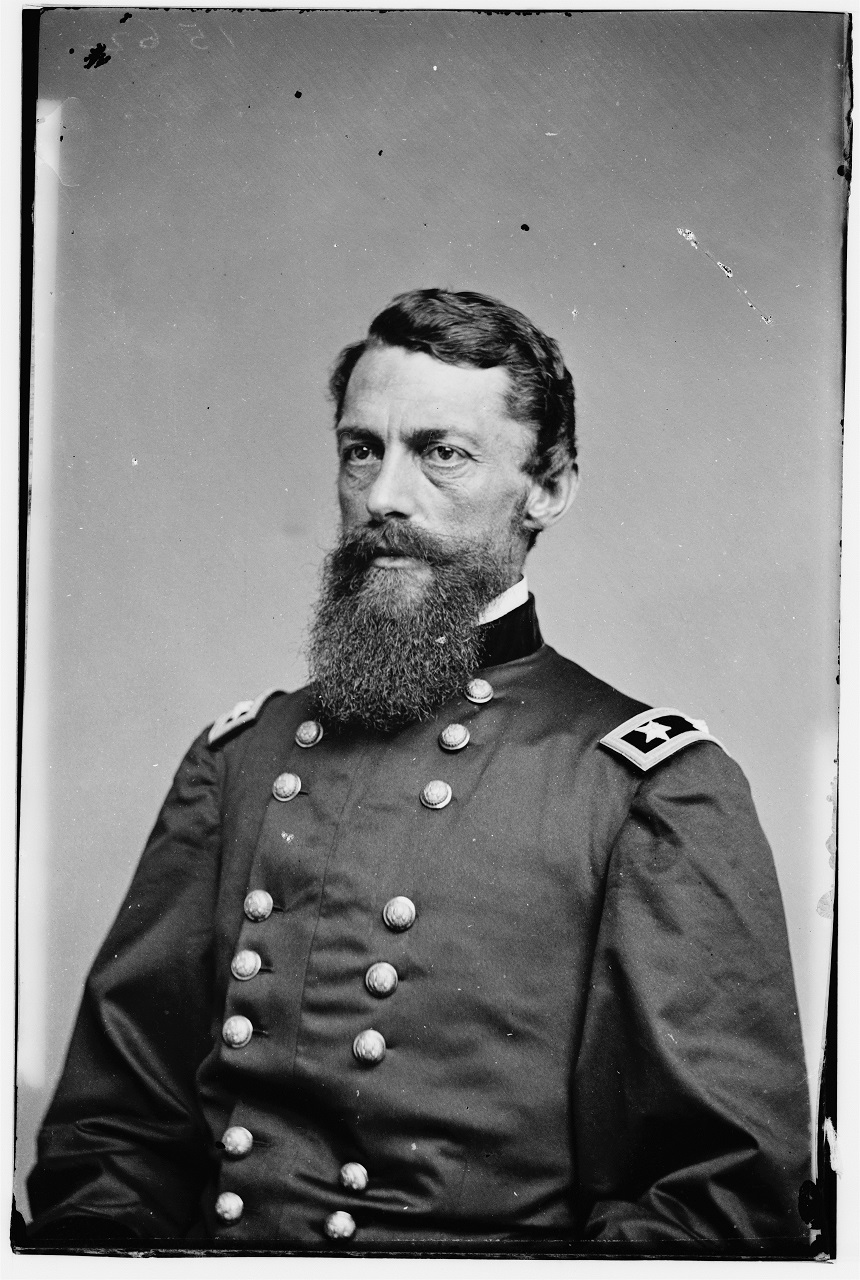
Major General George Stoneman, who commanded the cavalry corps (Library of Congress).

Major General George Stoneman, who commanded the cavalry corps (Library of Congress).

The President has now reviewed the whole army, and expresses himself highly delighted with all he has seen. Since our review, I have attended the other reviews and have been making myself (or at least trying so to do) very agreeable to Mrs. Lincoln, who seems an amiable sort of personage. In view also of the vacant brigadiership in the regular army, I have ventured to tell the President one or two stories, and I think I have made decided progress in his affections. By-the-by, talking of this vacancy, I have been very much gratified at the congratulations I have received from several distinguished general officers on the prominence that has been given my name in connection with this appointment. The other day, Major General Stoneman came up to me and said he was very glad to hear I was so much talked of in connection with this vacancy; that he hoped I would get it, and that he believed the voice of the army would be in my favor. Coming as this does from those who are cognizant of my services, some of whom are themselves candidates, I cannot but regard it as most complimentary and gratifying, and I am sure it will please you. Stoneman also told me that, hearing I had a boy in the Lancers, he had sent for him and introduced him to Mrs. Stoneman. Stoneman also spoke very handsomely of the Lancers, and said he intended they should have full chance to show what they were made of.

Meade’s letter taken from The Life and Letters of George Gordon Meade, Major-General United States Army, Vol. 1, (New York: Charles Scribner’s Sons, 1913), pp. 364-5. Available via Google Books.

A Presidential Visit (April 9, 1863)

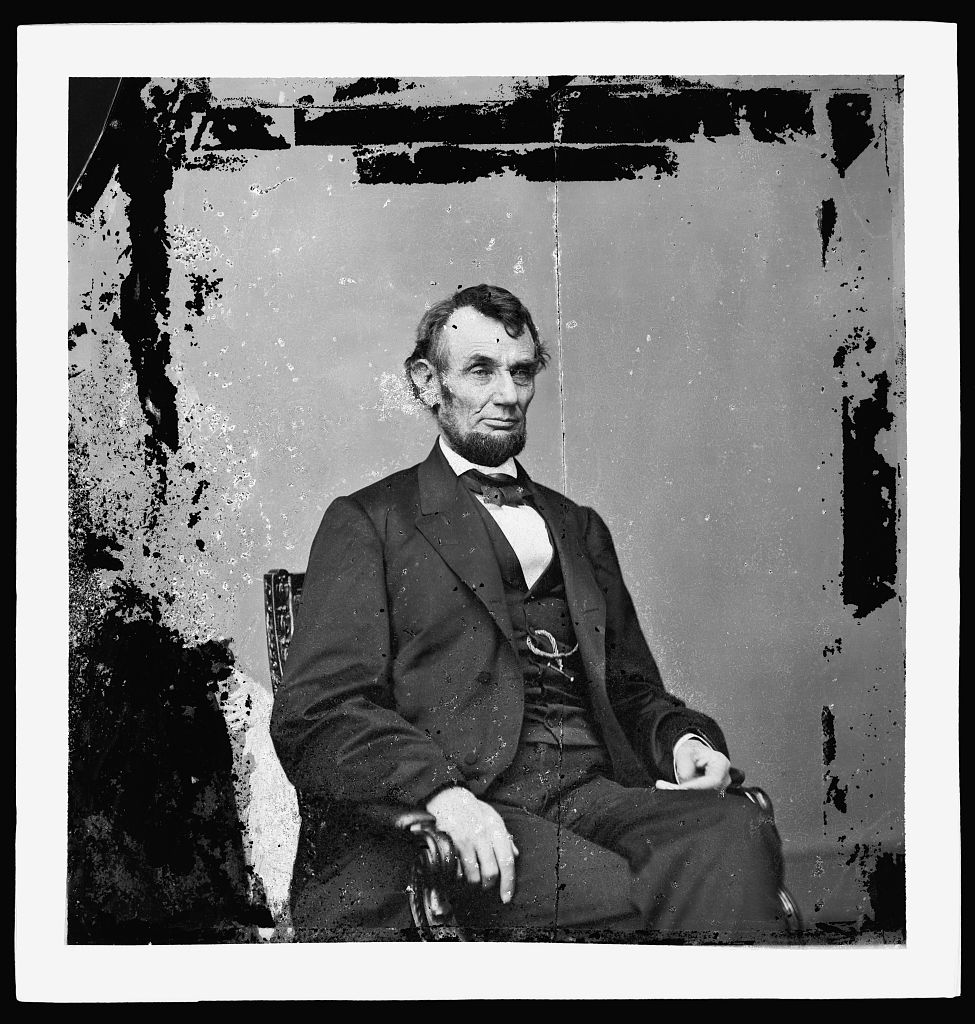
President Abraham Lincoln (Library of Congress).

President Abraham Lincoln (Library of Congress).

In early April President Abraham Lincoln traveled down to Virginia to meet with Joseph Hooker and review the Army of the Potomac. It was the eve of the spring campaigning season and Lincoln wanted to see the force he hoped would help put an end to the war. He also wanted to get out of Washington. Meade remarked on how tired the president looked. Newspaperman Noah Brooks, a friend of the president who was traveling with Lincoln’s party, noted the same thing but watched as Lincoln became more cheerful as the days passed. “I remarked this one evening as we sat in Hooker’s headquarters, after a long and laborious day of reviewing,” wrote Brooks. “Lincoln replied: “It is a great relief to get away from Washington and the politicians. But nothing touches the tired spot.”

I have omitted writing for a day or two, as I have been very much occupied in the ceremonies incidental to the President’s visit. I think my last letter told you he arrived here on Sunday, in the midst of a violent snow storm. He was to have had a cavalry review on that day, but the weather prevented it. The next day, Monday, the cavalry review came off; but notwithstanding the large number of men on parade, the weather, which was cloudy and raw, and the ground, which was very muddy, detracted from the effect greatly. Orders were given for an infantry review the next day (Tuesday). I was invited on this day (Monday) to dine with General Hooker, to meet the President and Mrs. Lincoln. We had a very handsome and pleasant dinner. The President and Mrs. Lincoln, Mr. Bates, Secretary of the Interior, a Dr. Henry, of Colorado, who accompanied the President, Mrs. Stoneman, wife of Major General Stoneman, besides the corps commanders, constituted the party. The next day, owing to the ground not being in condition, the infantry review was postponed; but the President did me the honor to visit my camps and inspect them, and I believe (leaving out the fatigue) passed a very pleasant day. Yesterday (Wednesday) we had the grand infantry review, there being out four corps, or over sixty thousand men. The review passed off very well indeed. The day, during the early part of it, was not favorable, being cloudy and raw, but after noon the sun came out and rendered everything more cheerful. Mrs. Carroll and Mrs. Griffin and the two Misses Carroll, together with two other young ladies, having come down to General Griffin’s, I was invited to meet them at dinner, which I did yesterday evening, and had a very pleasant time. So you see we are trying to smooth a little the horrors of war. I saw George the day of the cavalry review. He told me he was to have a leave that day, so that he will undoubtedly be there when this reaches you.

The day I dined with Hooker, he told me, in the presence of Mr. Bates, Secretary of the Interior, that he (Hooker) had told the President that the vacant brigadiership in the regular army lay between Sedgwick and myself. I replied that I had no pretensions to it, and that if I were the President I would leave it open till after the next battle. The next day, when riding through the camp, Hooker said the President had told him he intended to leave this position open till after the next fight.

You have seen the report of the Committee on the Conduct of the War. It is terribly severe upon Franklin. Still, I took occasion when I had a chance to say a good word for Franklin to the President, who seemed very ready to hear anything in his behalf, and said promptly that he always liked Franklin and believed him to be a true man. The President looks careworn and exhausted. It is said he has been brought here for relaxation and amusement, and that his health is seriously threatened. He expresses himself greatly pleased with all he has seen, and his friends say he has improved already.

Meade’s letter taken from The Life and Letters of George Gordon Meade, Major-General United States Army, Vol. 1, (New York: Charles Scribner’s Sons, 1913), pp. 363-4. Available via Google Books.

Presentations (April 5, 1863)

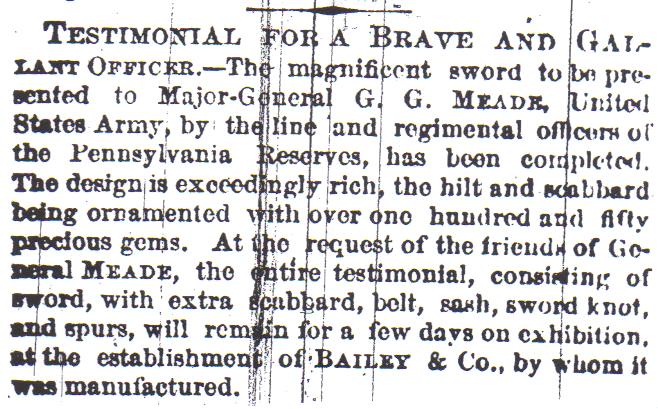
TestimonialCivil War soldiers liked to give their officers fancy (and expensive) presentation swords. It was a way to honor their commanders and also acknowledge their own performances. In the letter below Meade writes about the sword that his old division, the Pennsylvania Reserves, had ordered to present to him. I’ve included scans of the articles from the Philadelphia Inquirer of April 1, 1863, to which he was referring. At the end I’ve included a scan of the item that appeared immediately above the one about Meade’s sword. It says something about public reaction to the subject of black soldiers.

Meade did not actually receive the sword until August 27 and he had to admit it was a thing of beauty. It had a blade of Damascus steel and a scabbard of gold. His initials were engraved near the hilt and inlaid with enamel, gold and diamonds. Precious stones circled the handle. Engraved on the blade were the battles that Meade and the reserves had shared. “The more I examine my sword the more I am delighted with its beauty,” Meade wrote home. “It is really most chaste and artistic. It seems a pity, though, to waste so much money on an article that from its great value is actually rendered useless.” The sword had been on display at the Civil War museum on Pine Street in Philadelphia but went into storage when that museum closed. I hope it will go on display someplace for the Gettysburg 150th anniversary.

I have to assume the letter he mentions at the end is this one, which New York Times reporter Samuel Wilkeson wrote about David Birney, with whom Meade had clashed at Fredericksburg. (Apparently Wilkeson was under the impression he was dealing with David’s brother William, another Union general.) Wilkeson, who had been with the Tribune during the Peninsula campaign, was reporting for the New York Times when he was with the Army of the Potomac at Gettysburg. His son, 19-year-old Bayard Wilkeson, was at Gettysburg, too, as the commander of Battery G, 4th U.S. Artillery. The young Wilkeson died during the first day’s fighting, after being forced to amputate his own shattered leg.

Yesterday I received yours of the 2d instant, announcing you had been to Bailey’s to see my sword. I saw the item in the Inquirer you allude to, and was not a little taken down by another in the next column, in which the presentation fever was most justly inveighed against. I did all I could to prevent anything being given to me, and on several occasions when I was approached to know what I would like to have, I always refused to take anything, and earnestly requested as a personal favor to have the thing stopped. This last affair was gotten up after I had left the division, and the first I knew of it was that the sword had been ordered and would soon be ready for presentation. There is to be a grand jollification at Willard’s, I hear, on the occasion, when the Governor and divers other big-bugs will be present to gas and make me feel uncomfortable. I would give a good deal to escape this ordeal, and am in hopes we shall be on the move before they get ready. I would much prefer the men giving their money to their wives, or, if they are not so blessed, to the widows and orphans that the war has made. I see by the Inquirer of yesterday that the 18th instant is the day appointed for the presentation, but I rather think that by that date I shall have other work on hand.

Some one has sent me a copy of the Evening Journal with Wilkeson’a letter about Birney in it.

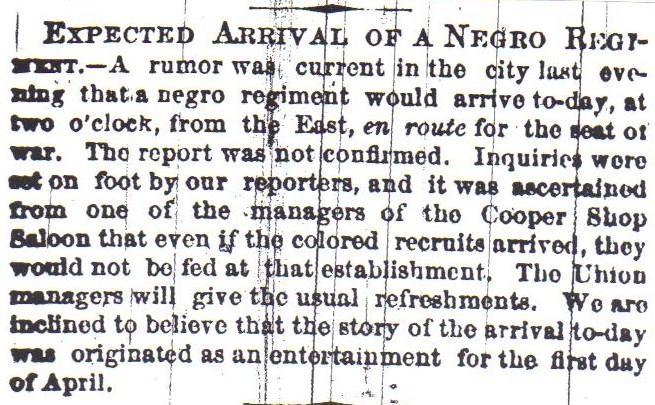
Meade really did not need to worry about this article. It was complaining about the presentations of swords to doctors, not to soldiers.

Meade did not need to worry about this article. It was complaining about sword presentations to doctors, not soldiers.

This is the item that appeared in the Inquirer just above the one about Meade’s sword:

This is the news items that appeared directly above the one about Meade's sword in the Philadelphia Inquirer on April 1, 1863.

Meade’s letter taken from The Life and Letters of George Gordon Meade, Major-General United States Army, Vol. 1, (New York: Charles Scribner’s Sons, 1913), pp. 362-3. Available via Google Books.

A Beautiful Day at Gettysburg

The 96th PA monument on Wheatfield Road

The 96th PA monument on Wheatfield Road.

It was such a gorgeous day yesterday that I decided to drive down to Gettysburg and walk around the battlefield. I was especially interested in following the bed of the old trolley that once circled around Devil’s Den. I’ve been researching battlefield history for an article I’m writing for a special Gettysburg publication, and one of the things that really intrigued me was the story of this trolley. The Gettysburg Electric Railroad Company started blasting and excavating the trolley bed in 1893—and they even blew up rocks and boulders around Devil’s Den. This so infuriated Daniel Sickles, then an aged Congressman from New York, that he introduced a bill to make the battlefield into a national park. In the meantime the U.S. government used its powers of eminent domain to try to condemn battlefield land and stop the trolley. The case went all the way to the United States Supreme Court, which ruled that the government could condemn land for preservation purposes. It was too late to stop the trolley, though, and it carried passengers over the battlefield until it ceased operations in 1916.

The 40th New York monument in the Slaughter Pen opposite Devil's Den. The 99th PA monumet is in the background..

The 40th New York monument in the Slaughter Pen opposite Devil’s Den. The 99th PA monument is in the background.

The rails were taken up in 1917 but the old bed still remains as a hiking trail. I followed the old bed around Devil’s Den, climbed up a hill to see the remains of a quarry that had operated here (and was probably the source for the big boulder on the grounds of Prospect Hall, outside Frederick, Maryland, where Meade met with Joseph Hooker on June 28, 1863, to exchange command of the Army of the Potomac). Then I followed the bed to the Wheatfield and walked back up to Little Round Top until I returned to my car near the 20th Maine monument.

The view from Round Top looking over towards Devei's Den. You can see the trails of Ski Liberty in the distance.

The view from Round Top looking over towards Devil’s Den. You can see the trails of Ski Liberty in the distance.

After that I visited the visitor center to make sure they had Searching for George Gordon Meade: The Forgotten Victor of Gettysburg (they did) and then drove down Baltimore Pike to Powers Hill. During the battle Henry Slocum, commander of the Union’s XII Corps, made his headquarters here. When the shelling on July 3 made Meade’s Leister House headquarters on Taneytown Road too dangerous, Meade rode over here to establish new headquarters but he headed back when he discovered that the signalmen who were supposed to remain at his old HQ were not there. He rode back and reached Cemetery Ridge just after Pickett’s Charge had been repulsed. (You can read all about it in the book.) The park service recently finished cutting down a lot of trees here to restore the area more to its 1863 appearance. There are a few monuments to Union artillery batteries on top of the hill, along with some newly cleaned and painted cannons and carriages, and you can get some nice views over towards Culp’s Hill. I have to believe that the landscape was even clearer during the battle because there’s no way now you can see through the trees to the Leister House.

Monuments on Powers HIll. Battery M, 1st New York Light Artillery, is in the foreground, then Battery E, Pennsylvania Light Artillery (Knap's Battery) and Battery A, 1st Maryland Light Artillery (Rigby's Battery).

Monuments on Powers HIll. Battery M, 1st New York Light Artillery, is in the foreground, then Battery E, Pennsylvania Light Artillery (Knap’s Battery) and Battery A, 1st Maryland Light Artillery (Rigby’s Battery).

It was an absolutely beautiful day and once again I was struck by the incongruity of how much enjoyment I can get walking around a place that has been preserved because of the horrors it witnessed. So many men were killed and wounded here yet it now offers visitors like me a place of picturesque beauty. Then I thought about the Victorian garden cemetery movement, which created attractive places not only to bury the dead, but also to give living visitors places to visit and picnic and enjoy. Laurel Hill Cemetery, Meade’s final resting place, is one product of that movement. Perhaps Gettysburg isn’t too different. It’s a place to remember the dead (aided by the profusion of statuary) but also a place for the living to enjoy.

Which is what I did at Gettysburg yesterday.

Courtesy Call (March 30, 1863)

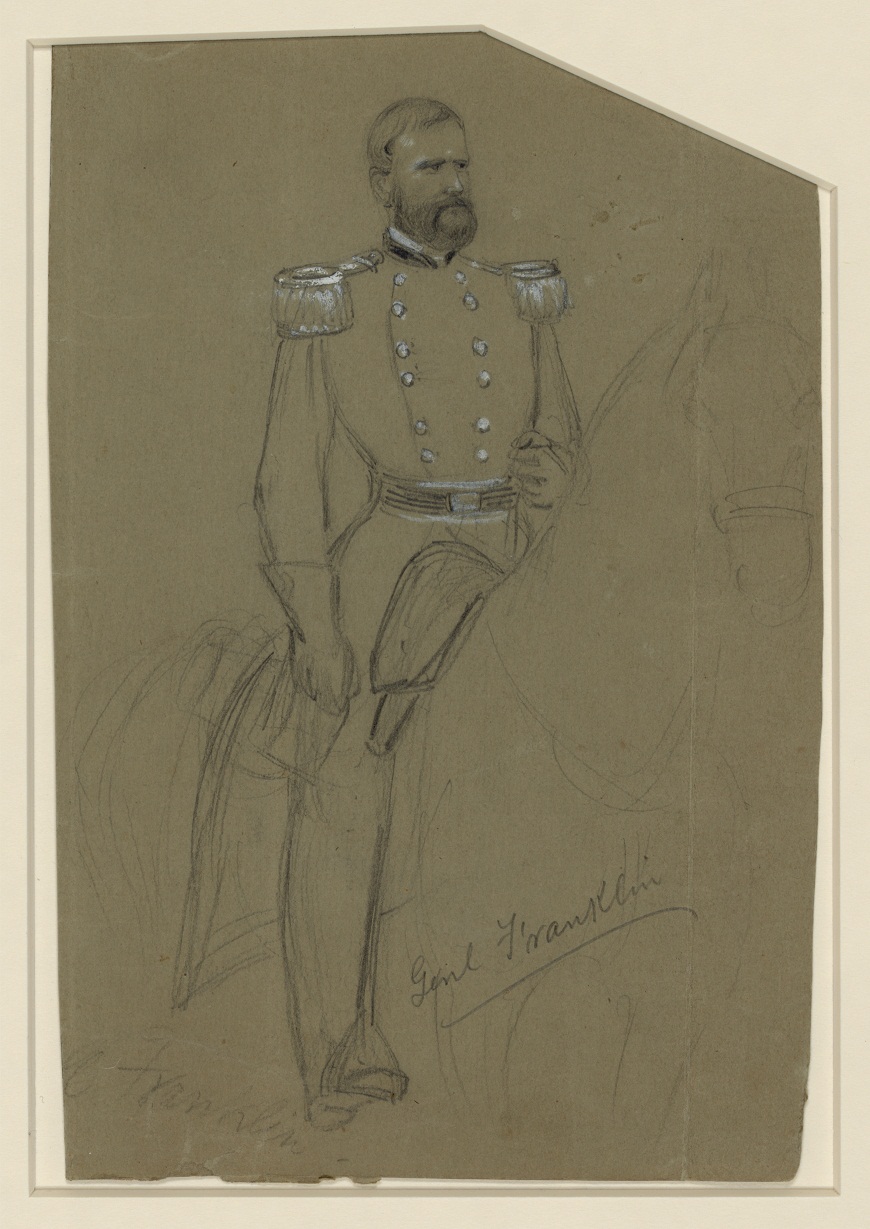
When Meade’s fellow generals passed through Philadelphia they often paid visits to Margaret Meade. Her husband always appreciated such courtesy and often mentioned the visits in his letters. Here he’s writing about William Franklin, the embattled former head of the VI Corps, who had become the target of a Congressional inquiry over his actions at Fredericksburg.

An Alfred Waud drawing of General William Franklin (Library of Congress).

An Alfred Waud drawing of General William Franklin (Library of Congress).

I am truly glad to hear Franklin called to see you. I am sure you will bear testimony to the respect and good feeling I have always expressed towards Franklin, and my earnest desire to avoid being drawn into the controversy between himself and Burnside. I think Franklin missed a great chance at Fredericksburg, and I rather infer from his letter that he thinks so now; but I have always said he was hampered by his orders and a want of information as to Burnside’s real views and plans. A great captain would have cast them aside and assumed responsibility. At the same time I must say that he knew and I know that if he had failed, then his going beyond his orders would prove utter ruin.

Deserters from the other side say the men are really suffering from the want of sufficient food, but that their spirit is undaunted, and that they are ready to fight. The morale of our army is better than it ever was, so you may look out for tough fighting next time.

Meade’s letter taken from The Life and Letters of George Gordon Meade, Major-General United States Army, Vol. 1, (New York: Charles Scribner’s Sons, 1913), p. 362. Available via Google Books.

The Plot Thickens (March 29, 1863)

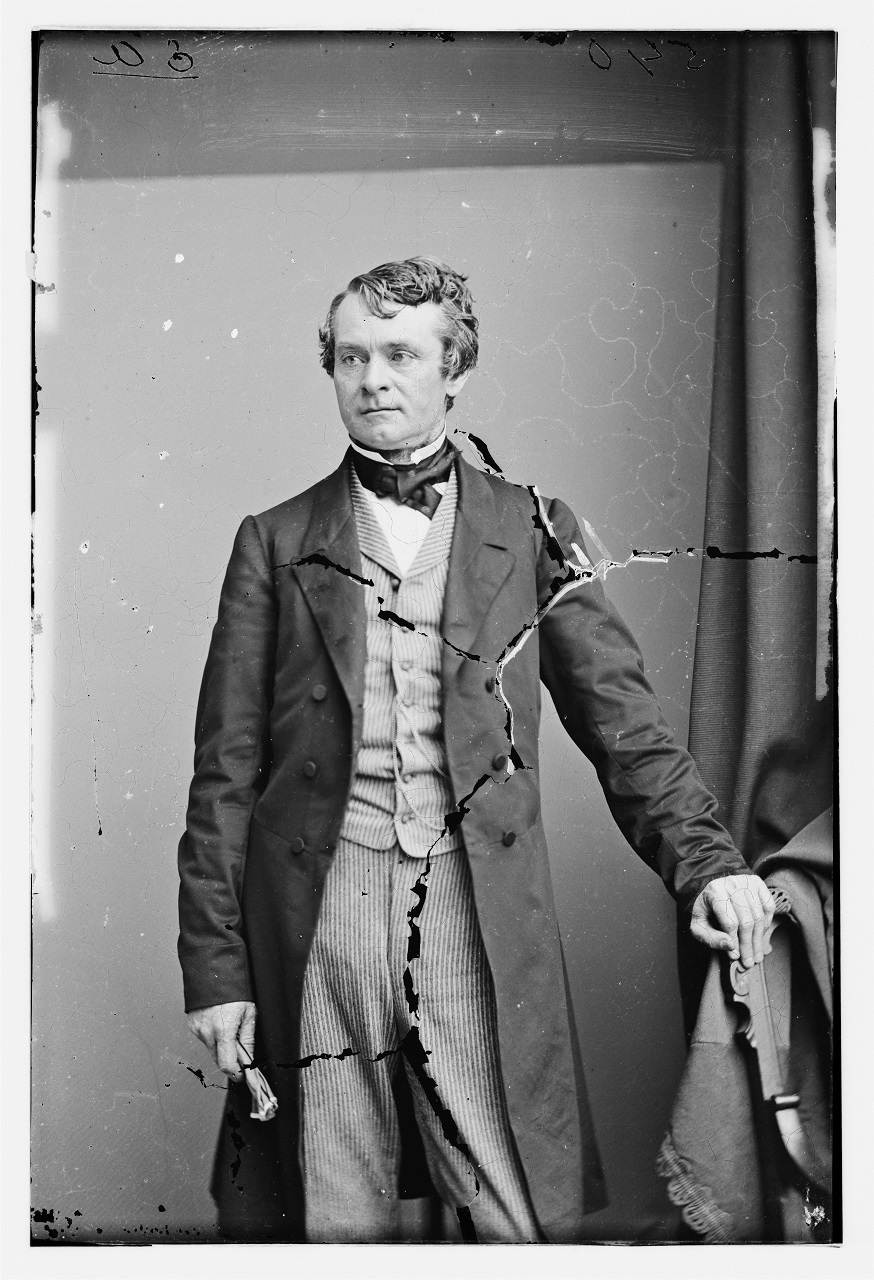
Pennsylvania's Governor Andrew Gregg Curtin (Library of Congress).

Pennsylvania’s Governor Andrew Gregg Curtin (Library of Congress).

As March approaches its end Meade still finds himself entangled in the fallout from the Fredericksburg battle. Now he’s stuck in a war of words between William Franklin and Ambrose Burnside over the question of who would end up being cast as the fall guy for the December disaster. The Birney whom Meade mentions is David Bell Birney, with whom he exchanged some harsh words at Fredericksburg. Governor Curtin is Andrew Gregg Curtin, the governor of Pennsylvania. The Republican Curtin had been elected in 1860 and soon realized that war was inevitable. He had met with President Lincoln only four days before the attack on Ft. Sumter ushered in hostilities and after returning to Pennsylvania asked the legislature to help the state prepare for war. Curtin will later add to the tension between Meade and Joseph Hooker following the Battle of Chancellorsville.

I received yesterday your letter of the 26th. The same mail brought me a letter from Franklin. It is evident from Franklin’s letter that my surmise was correct, that he had taken it into his head that I had been talking to Burnside and furnishing him with data for the controversy. I don’t intend to quarrel with Franklin if I can help it, because I feel that in all this war he has shown more real regard for me and appreciation for me than any other man. I have never had any official relations with Franklin, till Fredericksburg, and I know that he has on numerous occasions referred to me as one who has not been advanced in proportion to his merits. Besides this feeling, selfish to be sure, my judgment is that Burnside is making a mistake in holding Franklin responsible for the disaster at Fredericksburg. Franklin may be chargeable with a want of energy, with failing, without reference to orders, to take advantage of a grand opportunity for distinction, with, in fact, not doing more than he was strictly required to do; but it is absurd to say he failed to obey, or in any way obstructed the prompt execution of his orders; that is, so far as I know them.

Burnside says he sent him orders about the middle of the day to attack with his whole force. Franklin, I understand, denies having received any such orders. Moreover, Baldy Smith, I hear, has sworn that a day or two before Franklin was relieved, Burnside told him (Baldy Smith) that he was going to give up the command of the army and urge the President to put Franklin in his place. This seems very inconsistent with his subsequent course, as there is no doubt Franklin’s command was taken away from him on the representations of Burnside. My position, with my friendly feelings for both, is not only peculiar but embarrassing.

We had some grand races day before yesterday, gotten up by Birney. I went over there and met Governor Curtin. He returned with me and inspected several of the Pennsylvania regiments in my command, making little speeches to each.

Meade’s letter taken from The Life and Letters of George Gordon Meade, Major-General United States Army, Vol. 1, (New York: Charles Scribner’s Sons, 1913), pp. 361-2. Available via Google Books.