Art and War (March 21, 1863)

In the letter below Meade refers to a production of The Merry Wives of Windsor. It appears he is not talking about a production of Shakespeare’s play; the reference appears to be to Die Lustigen Weiber Von Windsor, an operatic adaptation by Otto Nicolai to a libretto by Salomon Hermann Mosenthal . The 1849 opera made its American debut in Philadelphia in 1863.

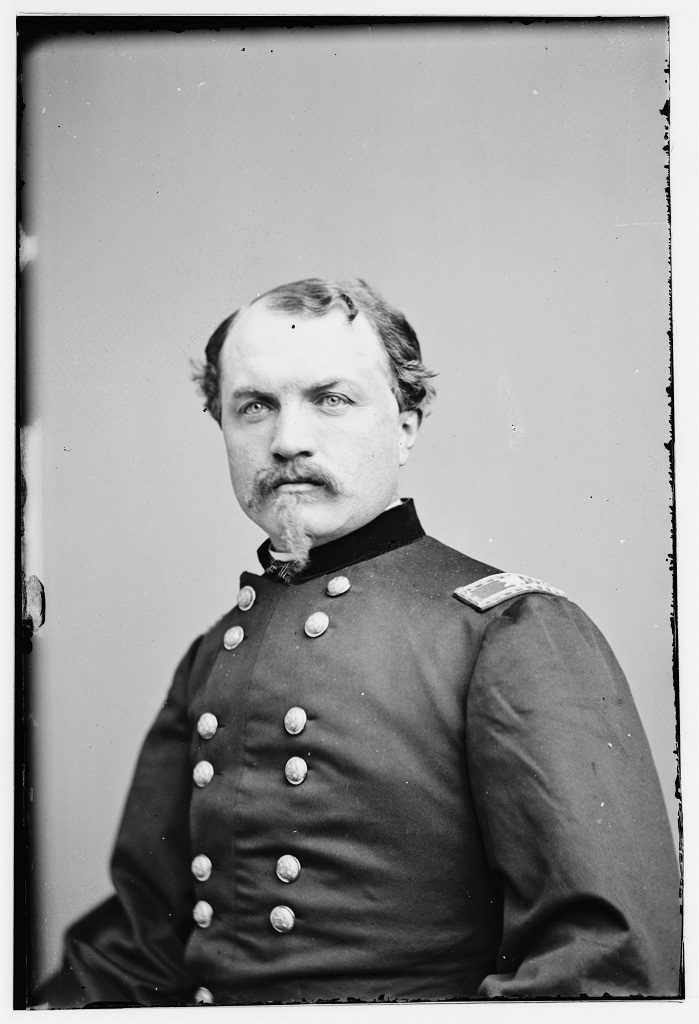
William Averell, who commanded the cavalry that fought at Kelly's Ford on March 17, 1863.

William Averell, who commanded the cavalry that fought at Kelly’s Ford on March 17, 1863 (Library of Congress).

“Averell’s brilliant cavalry foray” was the battle that took place up the Rappahannock at Kelly’s Ford Union, when cavalry under Brig. Gen. William Averell battled Fitzhugh Lee’s Confederate horsemen on March 17, 1863. Here’s how I describe it in the book:

 Averell had a score to settle with his old friend Fitzhugh Lee, Robert E. Lee’s nephew. After an earlier cavalry skirmish had gone badly for the Union, Lee left behind a taunting note for Averell: “I wish you would put up your sword, leave my state, and go home. You ride a good horse, I ride a better. If you won’t go home, return my visit, and bring me a sack of coffee.”

Averell brought about three thousand men with him to answer Lee’s taunt. He made a difficult crossing of the swiftly flowing river at Kelly’s Ford and launched a spirited cavalry battle on the other side. Averell’s ingrained caution prevented him from routing Lee’s forces, but he made a surprisingly good showing for the until-then toothless Union cavalry. He also left behind some coffee and a note. “Dear Fitz,” it read. “Here’s your coffee. Here’s your visit. How do you like it?”

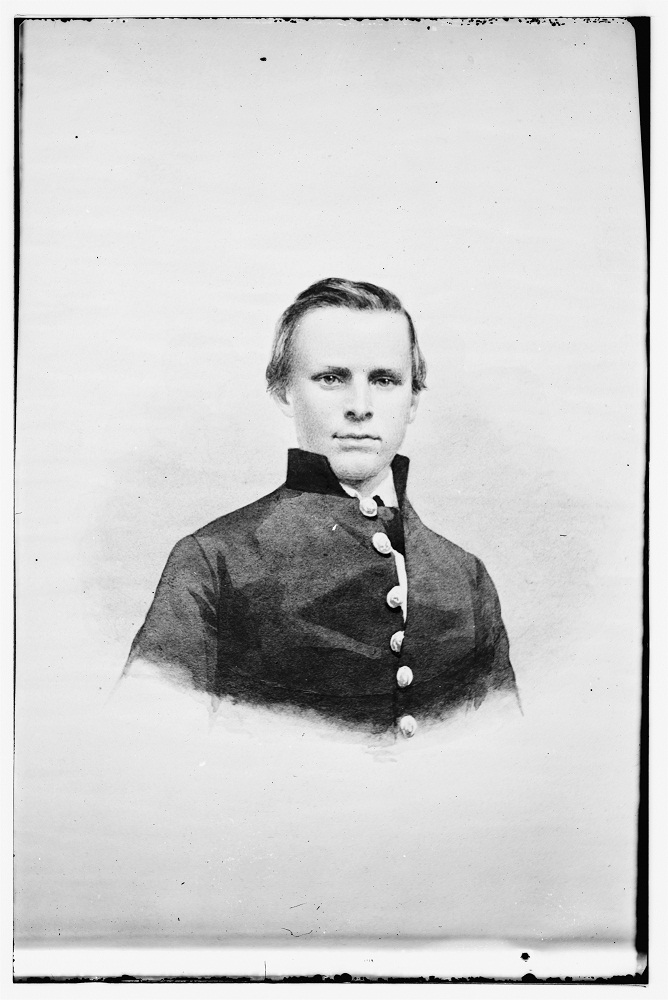
John Pelham, who was mortally wounded in the fighting at Kelly's Ford.

John Pelham, who was mortally wounded in the fighting at Kelly’s Ford.

One of the Confederates who died in the fighting was “Gallant” John Pelham, the young officer who had troubled Meade with his horse artillery at Fredericksburg.  There’s a small monument to him hidden away in the trees near Kelly’s Ford.  

I had seen in the papers a glowing account of the “Merry Wives of Windsor,” which must have been a great treat. There is nothing I feel so much the deprivation of as hearing good music, and I was very sorry that there was no opportunity to indulge myself while in Philadelphia.

We have literally nothing new or exciting in camp. Averell’s brilliant cavalry foray has been the camp talk. The enemy, through Richmond papers, admit they were whipped and believe it to be the commencement of Hooker’s campaign, and already talk of the probable necessity of Lee’s having to fall back nearer Richmond. This confirms what we have suspected, that their force opposite to us had been much reduced, and that when we pressed them they would retire. There is not much chance of doing this at present, however. Yesterday it snowed all day, and to-day it is raining, so that our roads are again, or will be, in a dreadful condition.

Meade’s letter taken from The Life and Letters of George Gordon Meade, Major-General United States Army, Vol. 1, (New York: Charles Scribner’s Sons, 1913), p. 361. Available via Google Books.

The Pelham monument near Kelly's Ford.

The Pelham monument near Kelly’s Ford.

Investigations (March 17, 1863)

General William Franklin (Library of Congress photo).

General William Franklin (Library of Congress photo).

This letter from March 17, 1863, is fascinating. In it Meade discusses the political fallout from the debacle at Fredericksburg. Burnside, of course, is Ambrose Burnside, who commanded the Army of the Potomac. Franklin is William Franklin. Born in York, Pennsylvania, Franklin had come in first in his West Point class of 1843. Like Meade he was an engineer and he had been in charge of constructing the new dome of the Capitol in Washington when war broke out. At Fredericksburg he had been in charge of the army’s left wing, which included Meade’s division. Franklin was angry with Burnside. He had been under the impression that Burnside wanted Franklin’s wing would make the main attack from below Fredericksburg and didn’t learn otherwise until the morning of the attack. Now both men were being investigated by the Joint Committee on the Conduct of the War.

The General Parke whom Meade mentions is John Parke. Wright is Horatio Wright, later to succeed John Sedgwick at the head of the VI Corps.

I returned to-day from Washington. I went up day before yesterday, the 15th, arriving in Washington about 7 P. M. I went to Willard’s, where, as usual, I saw a great many people. Finding Burnside was in the house, I sent up my name and was ushered into his room, where I found himself and Mrs. Burnside, the latter a very quiet, lady-like and exceedingly nice personage, quite pretty and rather younger than I expected to see. Burnside was very glad to see me, and we had a long talk. Among other things he read me a correspondence he had had with Franklin. Franklin had called his attention to the letter which appeared in the Times, said this was known to be written by Raymond, the editor, and it was generally believed his information was derived either from Burnside himself or some of his staff. Hence this letter was considered authority, and as it did him, Franklin, great injustice, he appealed to his, Burnside’s, magnanimity to correct the errors and give publicity to his correction. Burnside replied that he had not read the article till Franklin called his attention to it; that he was not responsible for it, nor was he aware that any of his staff had had any part in its production. Still, he was bound to say that in its facts it was true; that as to the inferences drawn from these facts, he had nothing to say about them and must refer him to Raymond, the reputed author. Several letters had passed, Franklin trying to get Burnside to (as he, Burnside, expressed it) whitewash him. This Burnside said he was not going to do; that Franklin must stand on his own merits and the facts of the case; that he had never made any accusation against him, except to say that the crossing of the river, being against his, Franklin’s, judgment, he thought Franklin had been wanting in a zealous and hearty co-operation with his plans. That about the time my attack failed, hearing from one of his, Burnside’s, staff officers, just from the field, that Franklin was not attacking with the force and vigor he ought to, he immediately despatched him an order “directing him to attack with his whole force if necessary,” which order he assumed the responsibility of not executing, and he must now take the consequences, if blame was attached to him for it.

This illustration by Arthur Lumley shows Ambrose Burnside talking with William Franklin about evacuating his position following the debacle at Fredericksburg. At the bottom Lumley wrote, "Franklin corps in the distance and Rebel batteries on the mountains." (Library of Congress.)

This illustration by Arthur Lumley shows Ambrose Burnside talking with William Franklin about evacuating his position following the debacle at Fredericksburg. At the bottom Lumley wrote, “Franklin corps in the distance and Rebel batteries on the mountains.” (Library of Congress.)

The next morning I went up to the Capitol, to the committee room, and found only the clerk present. He said the committee had been awaiting me some days; that Senators Chandler and Wade were the only two members present, and now down town; that he would hunt them up, and have them at the room by three o’clock, if I would return at that hour. At three I again presented myself to the committee, and found old Ben Wade, Senator from Ohio, awaiting me. He said the committee wished to examine me in regard to my attack at Fredericksburg. I told him I presumed such was the object in summoning me, and with this in view I had brought my official report, which I would read to him, and if he wanted any more information, I was prepared to give it. After hearing my report, he said it covered the whole ground, and he would only ask me one or two questions. First, was I aware that General Burnside, about the time of my attack, had ordered General Franklin to attack with his whole force? I answered, “At the time of the battle, No; indeed, I only learned this fact yesterday evening, from General Burnside himself.” Secondly, what, in my judgment, as a military man, would have been the effect if General Franklin had, when my attack was successful, advanced his whole line? I said I believed such a movement would have resulted in the driving back of the enemy’s right wing; though it would, without doubt, have produced a desperate and hard-contested fight; but when I reflected on the success that attended my attack, which was made with less than ten thousand men (supports and all), I could not resist the belief that the attack of fifty thousand men would have been followed by success. This was all he asked, and except the last question, the answer to which was a mere matter of opinion, I don’t think any one can take exception to my testimony. My conversations with Burnside and Wade satisfied me that Franklin was to be made responsible for the failure at Fredericksburg, and the committee is seeking all the testimony they can procure to substantiate this theory of theirs. Now, Franklin has, first, his orders, as received from Burnside, and then the fact that the execution of these orders was entrusted to Reynolds, for his defense. Before the committee, of course, he will not be heard, but after their report comes out, it will be incumbent on him to notice their statements and demand an investigation. I feel very sorry for Franklin, because I like him, and because he has always been consistently friendly to me.

After returning from the Capitol, I dined with General and Mrs. Burnside and Parke. Parke said he was about being left off the list of major generals, when Burnside’s opportune arrival saved him, Halleck giving as a reason that he had exercised no command since his appointment. Burnside, however, had his name sent in, and now he is going to supersede Baldy Smith and take command of the Ninth Corps, which is to accompany Burnside in his new command, to which he, Burnside, expects to be ordered in a few days.

The best piece of news I learned when in Washington was that the President was about issuing his proclamation putting in force the conscription law, and ordering immediately a draft of five hundred thousand men. Only let him do this, and enforce it and get the men, and the North is bound to carry the day.

I sometimes feel very nervous about my position, they are knocking over generals at such a rate. Among others, Wright, who was my beau ideal of a soldier, and whom I had picked out as the most rising man, has had his major-generalcy and his command both taken away from him, because he could not satisfy the extremists of Ohio (anti-slavery) and those of Kentucky (pro-slavery), but tried by a moderate course to steer between them.

Did I tell you the old Reserves had subscribed fifteen hundred dollars to present me with a sword, sash, belt, etc.? It is expected they will be ready about the close of the month, when I am to go, if possible, to their camp near Washington to receive them.

Meade’s letter taken from The Life and Letters of George Gordon Meade, Major-General United States Army, Vol. 1, (New York: Charles Scribner’s Sons, 1913), pp. 358-61. Available via Google Books.

Foreshadowing (March 15, 1863)

Meade wrote the following letter to his oldest son, John Sergeant, on March 15, 1863. (The George he mentions is the son who was serving with the army’s cavalry with the 6th Pennsylvania Cavalry, a.k.a. “Rush’s Lancers.”) The Joint Committee on the Conduct of the War is an agency with which Meade would have many unpleasant dealings in the future. Here’s what I say in the book:

Michigan's Senator Zachariah Chandler. (National Archives.)

Michigan’s Senator Zachariah Chandler. (National Archives.)

Michigan’s Republican senator Zachariah Chandler had spearheaded the committee’s creation to investigate war-related matters following the Union disasters of Bull Run and Ball’s Bluff. Three senators and four congressmen served on the committee. Chandler and another Republican senator, Ohio’s Ben Wade of Ohio, were the committee’s driving force, but Democrats served on it as well, including Andrew Johnson, later Lincoln’s vice president and successor. In the years since the Civil War historians have gone back and forth on the question of the committee’s impact on the war. Some think it had a negative effect, others a positive, and still others little cumulative effect at all. Yet writing in 1881 Alexander S. Webb, who won the Medal of Honor for his actions at Gettysburg and even served as Meade’s chief of staff, wrote, “That body must be counted among the President’s most influential advisors. It was a power during the war.”

This letter also demonstrates how Meade’s opinions about how to approach the war had evolved over time. Back in February 1862 he had said the people in the North should “deport ourselves more like the afflicted parent who is compelled to chastise his erring child, and who performs the duty with a sad heart.” Compare that to the passage below. I think we can link the changes in Meade’s thinking to the disillusionment he felt over George McClellan, who he felt erred “on the side of prudence and caution.”

Ohio's Senator Benjamin "Bljff Ben" Wade (National Archives).

Ohio’s Senator Benjamin “Bljff Ben” Wade (National Archives).

I am obliged to go up to Washington to-day, to appear before the “Committee on the Conduct of the War.” I have no idea what they want me for, but presume it is in relation to the Fredericksburg battle, and that my being called is due to the testimony of General Burnside, who has perhaps referred to me in his statement. I am very sorry I have been called, because my relations and feelings towards all parties are and have been of the most friendly character, and I shall be sorry to become involved in any way in the controversies growing out of this affair.

I have only seen George once since my return; the weather and roads have been so bad that neither of us could get to the camp of the other. The regiment has been very highly complimented by General Stoneman. One squadron has been armed with carbines, and it is expected that in a short time the whole regiment will be thus equipped and the turkey-driving implement abandoned.

I am completely fuddled about politics, and am afraid the people are very much demoralized. I trust one thing or another will be done. Either carry on the war as it ought to be, with overwhelming means, both material and personal, or else give it up altogether. I am tired of half-way measures and efforts, and of the indecisive character of operations up to this time. I don’t know whether these sentiments will be considered disloyal, but they are certainly mine; with the understanding, however, that I am in favor of the first, namely, a vigorous prosecution of the war with all the means in our power.

Meade’s letter taken from The Life and Letters of George Gordon Meade, Major-General United States Army, Vol. 1, (New York: Charles Scribner’s Sons, 1913), pp. 357-8. Available via Google Books.
Nothing Lasts Forever

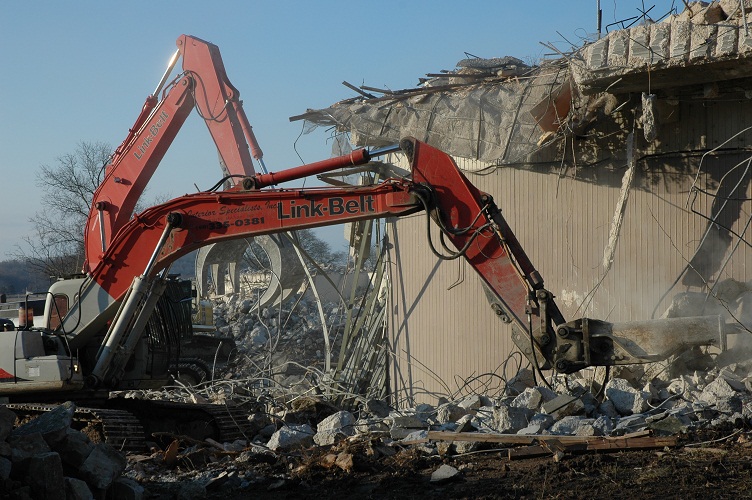
The old Cyclorama Building meets its Waterloo.

The old Cyclorama Building meets its Waterloo.

I went down to Gettysburg yesterday to do some work in the library at the visitor center and walk along the old trolley bed that circles around Devil’s Den, part of my research for an upcoming magazine article. It was an interesting day. As I was drove around the battlefield I listened the news reports from Rome, where a crowd of some 100,000 people were waiting in St. Peter’s Square for the announcement of the new Pope. On the battlefield I was passing over land where history had already happened as I heard about new history being made.

Before going to library I stopped to watch the work crews that were tearing down the old Cyclorama Building. Constructed in 1962 to house Paul Philippoteaux’s huge, 360-degree painting of the fighting on the battle’s third day, the building had outlived its usefulness once the Cyclorama had been removed for installation in the new visitor center. Some preservationists wanted to save the building but the park service was determined to tear it down and restore the landscape on Cemetery Ridge to something closer to its appearance in July 1863. Since I had never been inside the old Cyclorama Building I had no nostalgic ties to it and I was glad to hear that it was going away. The big concrete structure just didn’t belong there.

At the library I was amused to come across a quote from the building’s architect, Richard Neutra. Back in 1959 he said this about his design: “The building will last forever. Many honored guests will come here and many distinguished speaker[s] will speak. Their speeches must be brief because the building itself is most important and comes first. This building will be a shrine for many nations and the free world . . . . It is a building for eternity because it has deeper characters than any of the finest buildings  in the world.”

Cyclorama

Science!

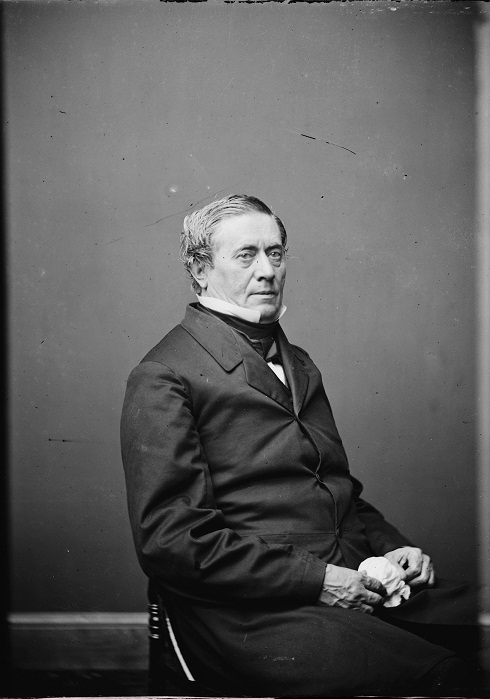
Joseph Henry, the secretary of the Smithsonian Institution who didn't want to see Meade become "food for powder." (Library of Congress.)

Joseph Henry, the secretary of the Smithsonian Institution who didn’t want to see Meade become “food for powder.” (Library of Congress.)

George Meade spent much of his time just before the war doing scientific work, including a survey of Lake Superior. “Many were the regrets expressed at this time by those with whom he had come in contact in the course of those labors, at the loss to science of one who had evinced for it such high qualifications,” wrote his son in the first volume of Meade’s Life and Letters. “So strong was this feeling on the part of Professor [Joseph] Henry, the distinguished secretary of the Smithsonian Institution, that he endeavored to dissuade General Meade from seeking active service. They had been thrown much together during the last few years while General Meade was conducting the lake survey, and Professor Henry had come to regard him as one possessed of so great aptitude for that class of work that he was unwilling to lose him from the ranks of science, to which he was himself so enthusiastically devoted. Professor Henry even went so far as to call upon Mrs. Meade, on the occasion of a visit of his to Philadelphia, for the express purpose of beseeching her to lend her aid to prevent a step which would result in so great a loss to science. From his point of view he regarded it as sheer waste for one possessed of the scientific qualifications of General Meade to relinquish his brilliant future in the field of science, and, as he expressed it, become mere food for powder.” The opening of Meade’s letter from March 13, 1863, shows that he still retained his interest in science. If the professor is John C. Cresson, Meade must have gotten to know him better after the war when both men served as commissioners for Philadelphia’s Fairmount Park.

I am glad you went to Professor Cresson’s experiments on the polarization of light, which must have been very interesting, even though unintelligible!

Captain Magaw and ladies left us to-day. Though we were utterly unprepared for such visitors, we managed to make them quite comfortable, and they left delighted. Yesterday I put the ladies in an ambulance and mounted Magaw on Baldy, and we went over and took a look at Fredericksburg, and afterwards called on Hooker. The General was, however, absent at a grand wedding which took place yesterday in camp, followed last night by a ball, and I understand another ball is given to-night by General Sickles. Not being honored with an invitation to these festivities, I did not go.

Meade’s letter taken from The Life and Letters of George Gordon Meade, Major-General United States Army, Vol. 1, (New York: Charles Scribner’s Sons, 1913), p. 357. Available via Google Books.

Confirmation (March 12, 1863)

George Meade, like all officers in the Union army, was very aware of his rank and where he stood in comparison to other officers in the army. The confirmation he mentions in this letter is his promotion to major general in the volunteers. At the Battle of Fredericksburg Meade had carried his letter from Secretary of War Stanton regarding his promotion in his pocket and he cited his new rank when he ordered David Birney to send troops to support Meade’s Pennsylvania Reserves. Now Congress had finally put its seal on the promotion.

John Fulton Reynolds

John Fulton Reynolds

The Reynolds he mentions is his division commander, Maj. Gen. John Reynolds. Meade and Reynolds had a decent relationship, although one that was sometimes strained by events. For example, after the Battle of Fredericksburg, where Meade felt Reynolds had not given him the necessary support, he wrote to Margaret, “He knows I think he was in some measure responsible for my not being supported on the 13th as he was commanding the corps & had the authority to order up other troops—and it was his business to have seen that I was properly supported, and the advantage that I had gained, secured by promptly advancing reinforcements.” Yet Meade retained his affection for Reynolds. “He is a very good fellow, and I have had much pleasant intercourse with him during the past eighteen months, and considering how closely we have been together and the natural rivalry that might be expected, I think it is saying a good deal for both that we have continued good friends.”

You will see by the papers that we have all been confirmed, with the dates of our appointment.

You have never mentioned Reynolds in your letters. He has been off on ten-days’ leave, and I presumed he would be in Philadelphia. Did you hear of his being there? I have not seen him since his return to ask. I was invited to his headquarters yesterday to dine, it being the anniversary of the organization of the First Corps; and as I had for a time commanded the corps, and also a division in it, I was honored with an invitation. The dinner was given by the staff.

This evening Captain Magaw, of the navy, with his mother, wife and a young lady friend, made their appearance at headquarters, and asked hospitality. He commands the gun-boat flotilla in the Potomac. His wife is quite a sweet, pretty woman, is the daughter of a navy officer, and was born at Pensacola when my sister, Mrs. Dallas, was there, and is named after her and Margaret. The young men on the staff turned out with alacrity and fitted up a tent in which they are quite comfortable.

Meade’s letter taken from The Life and Letters of George Gordon Meade, Major-General United States Army, Vol. 1, (New York: Charles Scribner’s Sons, 1913), p. 357. Available via Google Books.
March 7, 1863

The Alexander Coxe whom Meade mentions in this letter was a Philadelphian who had served as one of the general’s aides. Back in January Meade had written to Margaret with delight about a conversation Coxe had overheard on a street in Washington when a couple of passing men spotted Meade.  “What major general is that?” asked one of them.

“Meade,” his companion replied.

“Who is he?” asked the first man. “I never saw him before.”

“No, that is very likely, for he is one of our fighting generals, is always on the field, and does not spend time in Washington hotels.”

William Jay would return to Meade’s staff, after serving for a time with George Sykes. He was the grandson of John Jay, the first chief justice of the U.S. Supreme Court. The paper linked below includes this quote from a letter Jay wrote during the Overland Campaign: The papers seem to give all the credit of the campaign to Grant which is an immense mistake. He looks on and puts in his oar occasionally I suppose, but General Meade commands the army… It is not enough that you should give all the credit to Grant, but history will give General Meade an equal if not larger share of the honor of this campaign. If it does not, it ought to.”

Before this reaches you, you will have seen Alexander Coxe, who left this morning for home. I am most truly sorry to lose him, for he has not only rendered himself most useful to me, but has attached himself to me as a friend, from his manly character and social qualities. I sincerely hope he will be benefited by rest and medical treatment at home, and will be able to return.

Captain [William] Jay has joined me, and seems quite a clever gentleman. We have also had at our mess John Williams, who has been taken away from Ricketts and ordered to report to this army for duty, but who has not yet been assigned to any general.

The bill amalgamating the two corps of Engineers has passed, so the old Topographical Corps is defunct, and I shall have the honor of being borne on the register as a Major of Engineers. The bill makes one brigadier general (Totten), four colonels (of which Bache will be one), ten lieutenant colonels, twenty majors (of whom I shall be the tenth), thirty captains, thirty first lieutenants and ten second lieutenants. It don’t make much difference to me, if the war lasts as long as I expect it to and I survive it.

Meade’s letter taken from The Life and Letters of George Gordon Meade, Major-General United States Army, Vol. 1, (New York: Charles Scribner’s Sons, 1913), pp. 356. Available via Google Books.

A Tribute from a Former Adversary

One great disappointment about writing a book is that I sometimes come across material I would have liked to include, but only after it’s too late. Such is the case with this passage from Confederate General John B. Gordon’s Reminiscences of the Civil War. I had read Gordon’s book when I was working on Pennsylvania Civil War Trails (I was especially interested in his account of the burning of the Wrightsville Bridge) but I didn’t recall this passage until I came across it while working on another project.

I understand that historians have sometimes questioned Gordon’s veracity (especially regarding his story about meeting the Union’s Francis Barlow at Gettysburg and after the war) but I still think this is an interesting passage, coming as it does from one of Meade’s former adversaries.

Confederate General John B. Gordon (National Archives).

Confederate General John B. Gordon (National Archives).

To the Union commander, General George Gordon Meade, history will accord the honor of having handled his army at Gettysburg with unquestioned ability. The record and the results of the battle entitle him to a high place among Union leaders. To him and to his able subordinates and heroic men is due the credit of having successfully met and repelled the Army of Northern Virginia in the meridian of its hope and confidence and power. This much seems secure to him, whether his failure vigorously to follow General Lee and force him to another battle is justified or condemned by the military critics of the future. General Meade’s army halted, it is true, after having achieved a victory. The victory, however, was not of so decisive a character as to demoralize Lee’s forces. The great Bonaparte said that bad as might be the condition of a victorious army after battle, it was invariably true that the condition of the defeated army was still worse. If, however, any successful commander was ever justified in disregarding this truism of Bonaparte’s, General Meade was that commander; for a considerable portion of Lee’s army, probably one third of it, was still in excellent fighting trim, and nearly every man in it would have responded with alacrity to Lee’s call to form a defensive line and deliver battle.

It was my pleasure to know General Meade well after the war, when he was the Department Commander or Military Governor of Georgia. An incident at a banquet in the city of Atlanta illustrates his high personal and soldierly characteristics. The first toast of the evening was to General Meade as the honored guest. When this toast had been drunk, my health was proposed. Thereupon, objection was made upon the ground that it was “too soon after the war to be drinking the health of a man who had been fighting for four years in the Rebel army.” It is scarcely necessary to say that this remark came from one who did no fighting in either army. He belonged to that curious class of soldiers who were as valiant in peace as they were docile in war; whose defiance of danger became dazzling after the danger was past. General Meade belonged to the other class of soldiers, who fought as long as fighting was in order, and was ready for peace when there was no longer any foe in the field. This chivalric chieftain of the Union forces at Gettysburg was far more indignant at the speech of the bomb-proof warrior than I was myself. The moment the objection to drinking my health was suggested, General Meade sprang to his feet, and with a compliment to myself which I shall not be expected to repeat, and a rebuke to the objector, he held high his glass and said, with significant emphasis: “I propose to drink, and drink now, to my former foe, but now my friend, General Gordon, of Georgia.”

Taken from Reminiscences of the Civil War by John Brown Gordon (New York: Charles Scribner’s Sons, 1904), pp. 158-59. Available via Google Books.

An Encounter in Washington (February 27, 1863)

This letter from February 27, 1863, raises some interesting questions about Meade’s attitudes toward African-American soldiers. Abraham Lincoln’s Emancipation Proclamation, issued on New Year’s Day, had opened to door for black men to serve in the Union armies. They were not exactly welcomed with open arms in most quarters. Many white men refused to believe that black men would or could fight. As Theodore Lyman, who would begin serving as Meade’s aide later in 1863, noted during the Overland Campaign after he first saw black Union soldiers, “As I looked at them, my soul was troubled and I would gladly have seen them marched back to Washington. Can we not fight our own battles, without calling on these humble hewers of wood and drawers of water, to be bayonetted by the unsparing Southerners?” Lyman either was unaware of the irony in his words or refused to acknowledge that Lincoln had transformed the war into more than a crusade to restore the Union. It was now a war to end slavery as well. Like many in the army, Lyman had little faith in the black soldiers’ fighting abilities. “We do not dare trust them in the line of battle,” he wrote in a letter. “Ah, you may make speeches at home, but here, where it is life or death, we dare not risk it.” The 180,000 or so black soldiers who ended up joining the Union armies during the war—including the many who distinguished themselves in battle—would have disagreed.

General Andrew Porter. (Library of Congress photo.)

General Andrew Porter. (Library of Congress photo.)

What does the encounter detailed below indicate about Meade’s views on black soldiers? I’d like to think he was stating his views honestly, even if he was doing it to needle an officer he apparently didn’t like. In the published version of this letter Meade’s editors (either his son or grandson) diplomatically omitted the name of the officer with whom Meade was talking, but the original letter shows it was Andrew Porter. A native of Lancaster, Pennsylvania, Porter had served as a staff officer for George McClellan and probably shared McClellan’s views on race. The former commander of the Army of the Potomac had been adamantly opposed to turning the Civil War into a war to end slavery.

Interestingly, Porter’s first cousin was Horace Porter, who served on Ulysses S. Grant’s staff and wrote a book called Campaigning with Grant that I found very useful for my Meade research.

The language  in this letter is typical of the era, although it may make us cringe today.

I wrote you a few lines yesterday from Major Woodruff’s office, advising you of my detention in Washington.

I met hundreds of people whom I knew, such as Generals Cadwalader, McCall, Hartsuff and others. I had seen Hudson (McClellan’s aide) in the morning, and he asked me to come at six and dine with the general. I declined the invitation on the ground of previous engagements, but said I would drop in after dinner. As it was past eight o’clock when I got back, I went in to the private parlor where McClellan was dining, and found a party of some dozen or more, all officers but one, a Mr. Cox, Democratic member of Congress from Ohio. Among the party were Andrew Porter, Sykes, Buchanan, General Van Allen and others. McClellan received me with much distinction and seated me alongside of himself, and asked very kindly after you and the children, etc. The subject of conversation at the table was general, and referred principally to military matters and pending acts of legislation. My friend [Porter], who doubtless had heard of my confirmation and was in consequence disgusted, said he heard I was to be given an Army Corps of Niggers. I laughingly replied I had not been informed of the honor awaiting me, but one thing I begged to assure , that if the niggers were going into the field and really could be brought heartily to fight, I was ready to command them, and should prefer such duty to others that might be assigned me. As this was a fair hit at Porter’s position, it silenced him, and I heard nothing further about commanding niggers. After spending an hour in pleasant chat, I withdrew, and meeting Cram, we spent the night till near twelve o’clock, talking and walking about among the crowd in the hotel. This morning I left at eight o’clock and reached here about one P. M., being half a day behind my time. On the wharf at Acquia Creek I met Reynolds, on his way out, having just received his leave, and having been, as I expected, awaiting my return to have his granted.

Meade’s letter taken from The Life and Letters of George Gordon Meade, Major-General United States Army, Vol. 1, (New York: Charles Scribner’s Sons, 1913), pp. 355-56. Available via Google Books.

In Transit (February 26, 1863)

General George Sykes. (Library of Congress photo.)

General George Sykes. (Library of Congress photo.)

Although it seems churlish to resent Meade’s opportunity to obtain leave and spend some time with his family in Philadelphia, we do regret the absence of any correspondence with his wife during that period. The gap finally ends on February 26 when Meade wrote home to detail his travails attempting to return to his command. He wrote this letter from the Bureau of Topographical Engineers in Washington, D.C.

The Cram he mentions is Henry A. Cram, his wife’s brother-in-law. When Theodore Lyman met him in 1864 he said, “Cram is a queer man–never saw one exactly like him. He has a jerky, theatrical style that made me at first suppose he had had a toddy or two.” Sykes is Maj. Gen. George Sykes, who commanded a division of Meade’s V Corps . As I describe him in the book, “Sykes was yet another West Point graduate, a Delaware native who had been fighting since First Bull Run. He looked like a cartoon general, with a big beard that jutted out in front of his chin and a firm, determined nose like the prow of a ship.” His photo (right) will give you an idea of what I mean. When Meade took command of the Army of the Potomac Sykes replaced him at the head of the V Corps.

The train never reached this place until ten o’clock, instead of six-thirty as due. In consequence I missed the boat. As there is none till to-morrow morning at 8 A. M., thus detaining me here all day. This is annoying, because I wished to set the example of a prompt and punctual return within the time allowed me, whereas now I shall be one day behind time, and this is the more disagreeable because there is a report in town that the enemy’s cavalry have appeared in force this side of the Rappahannock. This is only a raid, as they cannot possibly be so foolish as to attempt any advance this side of the river, at this season of the year. The first person I met at the hotel was Cram, and I am going to dine with him to-day. I next met Sykes, who is up here on a court-martial. I am now writing a few lines to give you the news, am going to see Mrs. Turnbull and then shall dine with Cram.

Meade’s letter taken from The Life and Letters of George Gordon Meade, Major-General United States Army, Vol. 1, (New York: Charles Scribner’s Sons, 1913), p. 355. Available via Google Books.