The Book Has Launched!


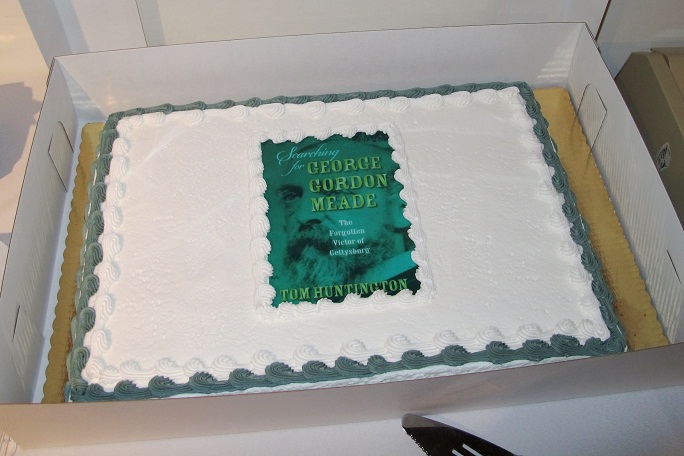
Every party needs cake! (Kyle Weaver photo.)

Every party needs cake! (Kyle Weaver photo.)


A large and enthusiastic crowd arrived for the book signing. (Kyle Weaver photo.)

A large and enthusiastic crowd arrived for the book signing. (Kyle Weaver photo.)

We had a successful launch of Searching for George Gordon Meade: The Forgotten Victor of Gettysburg. It took place at the National Civil War Museum in Harrisburg, Pennsylvania, on February 16, 2013. Author Tom Huntington (that’s me) signed copies of the book in the museum atrium from 10 a.m. until noon, for a large and enthusiastic crowd. Before the signing, Huntington (me again) did a talk for museum members on the Cast of Characters that appear in the book. Switching into the first person, I want to say what a great time I had at the event and I’d like to express my thanks to Wayne Motts and the museum staff for making it possible. Thanks also to Jim Schmick of Civil War and More in Mechanicsburg for ably handling the retail end. And to my wife, Beth Ann, for all her  support and for providing a great cake (above). And, of course, thanks to everyone who showed up, including family and friends.

Last week I recorded a program with Brian Lockman for the Pennsylvania Cable Network (PCN)’s PA Books show. It should air sometime in March. Watch this blog and the Searching for George Gordon Meade Facebook page for details as they become available.

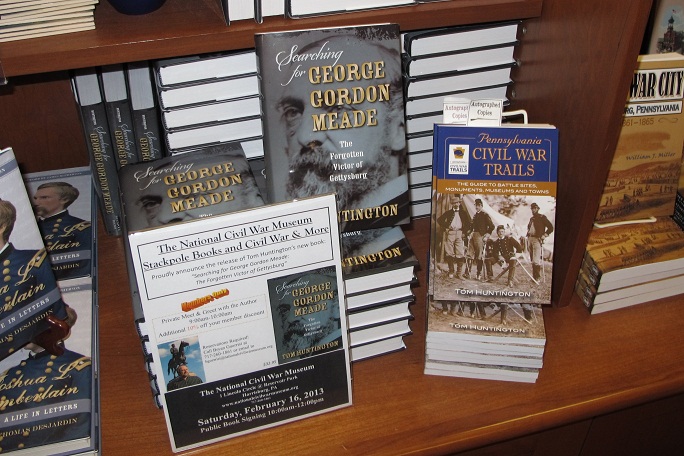
The National Civil War Museum had plenty of books on display in the bookstore. (Kyle Weaver photo.)

The National Civil War Museum had plenty of books on display in the bookstore. (Kyle Weaver photo.)

Welcome News (February 15, 1863)

After weeks of fruitlessly waiting for Hooker to give him permission to go home to Philadelphia on leave, Meade finally received the okay from Joseph Hooker to head north. That was good news for Meade but bad news for historians, as it means there is a gap in his correspondence until he returns to the army later in the month. I assume the General Morrell to whom Meade refers is Maj. Gen. George Morell, a New Yorker who commanded the 1st Division of the 5th Corps until he was replaced by Daniel Butterfield. Morell had been close to Maj. Gen. Fitz John Porter, one of George McClellan’s most loyal subordinates and the man Maj. Gen. John Porter had court martialed after Second Bull Run. This did not help Morell’s career.

I thought this afternoon I would not have to write to you, for I got a note from Hooker, saying he could spare me for seven days and telling me to apply. I immediately did so, sending in the same application which he had twice refused. At the same time I wrote to him, that I did not desire to go, if there was the slightest reason to believe I should be wanted. It will be too much happiness to get home for a few days and be with you and the dear children.

Maj. Gen. George Morell.

Maj. Gen. George Morell.

I have had an application from young [William] Jay, of New York, to come upon my staff, as an extra aide. He was appointed an additional aide-de-camp at the time the law authorized such appointments, and has been serving with General Morrell. That officer having been deprived of his command, Captain Jay has applied to me. I told him, if the War Department would assign him, I should be glad to have him.

Meade’s letter taken from The Life and Letters of George Gordon Meade, Major-General United States Army, Vol. 1, (New York: Charles Scribner’s Sons, 1913), pp. 354-355. Available via Google Books.

The Two Dans (February 13, 1863)

Major General George Stoneman and his staff, photographed in Falmouth, Virginia, sometime in February 1863.

Major General George Stoneman and his staff, photographed in Falmouth, Virginia, sometime in February 1863. (Library of Congress)

In this letter from February 13, 1863, General Meade expresses distaste for some fellow generals who would later pose major problems for him: the two Dans, Sickles and Butterfield. In his landmark book, Gettysburg: A Study in Command, Edward Coddington wrote, “There is something strange, if not uncanny, about the way Meade got into difficulty with those two cronies of Hooker, Generals Butterfield and Sickles.” Sickles was a political general with strong ties to New York City’s powerful Tammany Democratic machine. He had also gained a measure of renown when, as a New York congressman, he killed his wife’s lover in Washington, D.C.’s Lafayette Square, within sight of the White House. At this point he commanded the Army of the Potomac’s III Corps. Butterfield had commanded the V Corps until Meade rightly pointed out that he, Meade, had seniority.

The new cavalry head was George Stoneman. His tenure in that position did not last long following a lackluster effort before Chancellorsville. He later served as governor of California. The George whom Meade mentions is his son, who was serving in the cavalry. Pope is John Pope, who commanded the Army of Virginia during the disastrous Second Bull Run (Second Manassas to the South).

I have not seen General Hooker for several days, indeed his course towards me is so inexplicable in refusing me leave of absence, and not vouchsafing any reason for it, that I feel indisposed to see him. Besides, I do not like his entourage. Such gentlemen as Dan Sickles and Dan Butterfield are not the persons I should select as my intimates, however worthy and superior they may be. I rode over to George’s camp to-day and paid him a short visit. The regiment, since the breaking up of the grand divisions, has been placed under Stoneman, who has command of all the cavalry. This will give them a much better chance of seeing service than when attached to Headquarters, which is a lazy, loafing sort of duty. Have you read General Pope’s famous report? I see he says I did my duty in all fidelity to the Government, for which, of course, I am truly grateful.

Meade’s letter taken from The Life and Letters of George Gordon Meade, Major-General United States Army, Vol. 1, (New York: Charles Scribner’s Sons, 1913), p 354. Available via Google Books.

More Characters

I’ve added a few more people who play roles in Searching for George Gordon Meade: The Forgotten Victor of Gettysburg to the “Cast of Characters” page. They are all characters, in one way or another. These are the new additions:

BirneyDavid Bell Birney. As one of Meade’s aides described him, Birney “was a pale, Puritanical figure, with a demeanor of unmovable coldness; only he would smile politely when you spoke to him. He was spare in person, with a thin face, light-blue eye, and sandy hair.” He had been born in the South, but a hatred of slavery motivated his father to pack up the family and move north. Birney took up the law and was practicing in Philadelphia when war broke out. Meade and Birney had an encounter at Fredericksburg, when Meade requested reinforcements and Birney refused to send them, supposedly because he felt he had to wait until he received orders from corps commander John Reynolds first. This infuriated Meade. According to a bystander, when Meade rode over to confront Birney he used language strong enough to “almost make the stones creep.” He gained an enemy for life. Later in the war Birney cast his lot with Sickles and Butterfield to get either Hooker or Sickles in command of the army. When he realized he had backed the wrong horse Birney went to Meade, hat in hand, to make amends. He told Meade he had never entertained unfriendly feelings toward him and hoped to serve under him again. Meade listened with an icy silence, saying only that he had never heard that Birney had unfriendly feelings toward him. (“I am again on very pleasant terms with Gen. Meade,” Birney wrote to a friend. “He assured me of his high regard, and desire for me to remain.”) When Birney died in October 1864, Meade told his wife that he had never liked the man personally but admired his abilities on the field. “General Birney is undoubtedly a loss to the army,” Meade wrote. “He was a very good soldier, and very energetic in the performance of his duties. During the last campaign he had quite distinguished himself.”

LymanTheodore Lyman. Lyman was a Boston patrician and Harvard graduate who traveled among the best families and married well. He had first met Meade in Florida in 1856, when he was studying starfish and Meade was overseeing lighthouse construction. While in Europe during the war, a conflict that had already killed many in his circle, Lyman wrote to the general and asked about a staff position. He reached Meade’s side on September 3, 1863, and remained with him until Lee surrendered. Tall, bearded, and balding, Lyman was trained as a scientist and brought a scientist’s skill at observation to the journal and letters he wrote while with the Army of the Potomac. Although Lyman certainly viewed the war through the lens of a staff officer, he spent his share of time on or near the front lines, dodging shells and bullets and seeing the dead and wounded. His accounts offer incisive and often humorous portraits of the personalities he encountered and the petty grievances and unpredictable human interactions that sometimes gummed up the army’s works. His portrayals can be sympathetic or cutting. Of Judson Kilpatrick, Lyman noted, “His colorless eye, big nose, and narrow forehead, with an indescribable air between a vulgarian & a crack-brain, combine to render him almost laughable. He is pushing & managing in the extreme, but I don’t believe he is worth a fig as a general.” Of George Armstrong Custer, at one time the Union’s youngest general and still years away from the disaster at the Little Bighorn, Lyman wrote:  “This officer is one of the funniest looking beings you ever saw, and looks like a circus rider gone mad!” Lyman wrote. “He wears a huzzar jacket and tight trousers, of faded black velvet trimmed with tarnished gold lace. His head is decked with a little, gray felt hat; high boots and gilt spurs complete the costume, which is enhanced by the General’s coiffure, consisting in short, dry, flaxen ringlets! His aspect, though highly amusing, is also pleasing, as he has a very merry blue eye, and a devil-may-care style.” Lyman described John Buford as “a compactly built man of middle height, with a tawny moustache and a little, triangular gray eye, whose expression is determined, not to say sinister. His ancient corduroys are tucked into a pair of ordinary cowhide boots, and his blue blouse is ornamented with holes; from one pocket thereof peeps a huge pipe, while the other is fat with a tobacco pouch. Notwithstanding this get-up he is a very soldierly looking man. He is of a good-natured disposition, but not to be trifled with.” Although generally positive about Meade, Lyman was not blind to the general’s faults, especially that ungovernable temper. He called him “the great peppery.”

barlowFrancis C. Barlow. Like Lyman, Barlow was a Harvard man. He had practiced law before the war and looked more like a newsboy than a general, but Barlow had been wounded at Antietam and left for dead at Gettysburg. He carried an especially large sword—so that when he hit stragglers with it, he would hurt them, he told Lyman. Lyman called him “an eccentric officer.” At Cold Harbor one night Lyman found Barlow in a good mood. He had placed some stragglers—his bêtes noires—I n a field during the shelling, and two of them had been killed. After leaving Cold Harbor in the successful attempt to sweep around Lee to Petersburg, Barlow began marching his men so fast—with his provost guard spurring stragglers along at bayonet point—that Meade sent Lyman forward to tell him to slow down. Lyman found Barlow sitting, coatless, high up in the branches of a cherry tree. “By Jove!” came his voice from above Lyman’s head. “I knew I wouldn’t be here long before Meade’s staff would be up. How do you do, Theodore? Won’t you come up and take a few cherries?”

Good-bye, Baldy (February 6, 1863)

William F. "Baldy" Smith was a Meade friend who eventually turned enemy. (Library of Congress)

William F. “Baldy” Smith was a Meade friend who eventually turned enemy. (Library of Congress)

In this letter from February 6, 1863, Meade mentions General William “Baldy” Smith, another man with whom he would have unpleasant dealings later. Smith and Meade were friendly enough at this time. In fact, Smith was one of the generals Meade invited to share his champagne and celebrate his assumption to command of the V Corps on December 23. But Smith, who had commanded the VI Corps at Fredericksburg, had also been one of the generals undermining Ambrose Burnside. He had even visited Abraham Lincoln at the White House to complain about Burnside’s generalship. (William Franklin, whom Meade mentioned in his previous letter, went with Smith. Both generals were sent packing from the Army of the Potomac.) When Theodore Lyman, Meade’s observant aide, met Smith in 1864 he described him as “a short, quite portly man, with a light-brown imperial and shaggy mustache, a round, military head, and the look of a German officer, altogether.” He was not really bald, although his hair was thinning. He possessed “unusual powers of caustic criticism” and quarreled incessantly with his superior officers. The Sedgwick who replaced Baldy Smith at the head of the VI Corps was John Sedgwick. He was a Connecticut native who had graduated from West Point two years after Meade. A lifelong bachelor, he was “married” to the army and enjoyed passing the time playing long games of solitaire. War correspondent George W. Smalley called him “one of the best generals we had: a man of utterly transparent honesty, simplicity, and truth of character; trusted, beloved, ardently followed by his men; a commander who had done great things and was capable of greater.” His men loved him and called him “Uncle John.”

I assume the Frailey Meade mentions is James M. Frailey, a Philadelphian who commanded the USS Quaker City, a sidewheel steamer that served in the Union blockading fleet. Southern ironclads had attacked Union vessels outside Charleston on January 31, seriously damaging the Quaker City.

Major General John Sedgwick. His men called him "Uncle John." (Library of Congress)

Major General John Sedgwick. His men called him “Uncle John.” (Library of Congress)

To-day an order is issued abolishing grand divisions and returning to the system of corps. I am announced as in command of the Fifth Corps. This is what I expected and accords with my ideas of what is best for the efficiency of the army. Baldy Smith has been relieved of his command and Sedgwick takes his corps—cause unknown, but supposed to be his affiliation with Franklin, and the fear that he would not co-operate with Hooker. This, however, is mere surmise, I have not seen any one to know or hear what is going on.

Last evening I received orders to send out an expedition this morning, which I did; but it has been storming violently all day, and this afternoon I sent to recall it. The Ninth Corps, which came with Burnside from North Carolina, is not announced in the order published to-day, and I hear it is under orders to move—where it is going, not known, but the probability is that Burnside has asked to have it with him, in case he returns to North Carolina.

The news from Charleston looks very badly, I hope our friend Frailey will come out all right. Stellwagon of theMercedita,if you remember we met at Mrs. Frailey’s last summer, the evening I went in there. Our navy has hitherto been so successful, that it seems hard to realize a reverse.

I do not know what to make of the political condition of the country. One thing I do know, I have been long enough in the war to want to give them one thorough good licking before any peace is made, and to accomplish this I will go through a good deal.

Meade’s letter taken from The Life and Letters of George Gordon Meade, Major-General United States Army, Vol. 1, (New York: Charles Scribner’s Sons, 1913), pp. 353-354. Available via Google Books.

Morning at Gettysburg

Dawn StatueI was down at the Gettysburg battlefield the other day and I took this picture of the Meade statue beneath a dramatic morning sky. That’s all.

Searching for George Gordon Meade: The Forgotten Victor of Gettysburg is now available. Don’t be the last on your block to get a copy! Order it now!

Pennlive.com did a nice story about me and the book, which you can find here.

Family Ties (February 1, 1863)

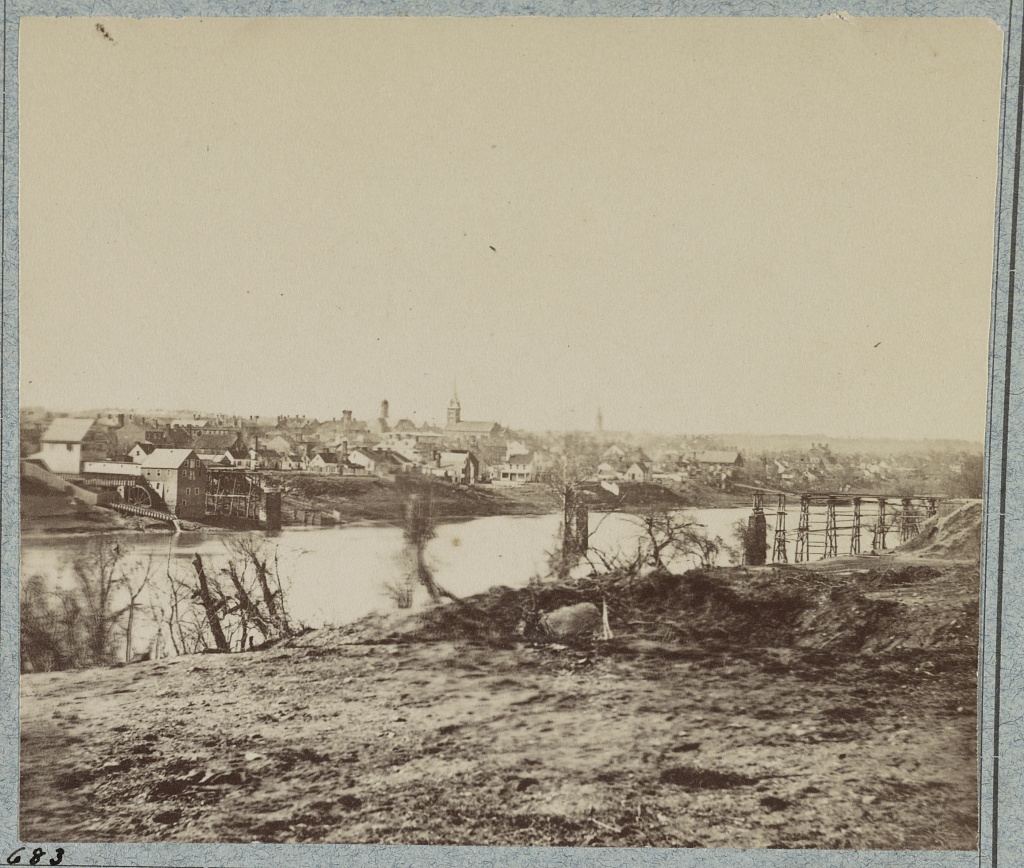
A view of Fredericksburg, taken in February 1863. So near, and yet so far.

A view of Fredericksburg, taken in February. So near, and yet so far. (Library of Congress)

The American Civil War is often characterized as being “brother against brother” and that was sometimes literally true. For example, General John Gibbon, whom Meade mentioned in his letter of January 28, had three brothers who fought for the Confederacy. Even under circumstances not quite so extreme, the conflict often divided families. Meade’s family is a case in point. His wife’s sister, Sarah, had married Henry Wise, who became governor of Virginia, signed John Brown’s death warrant, and served in the Army of Virginia under Robert E. Lee.

Meade’s own sister, Elizabeth, had married a Virginia planter named Alfred Ingraham and moved to Mississippi with him. She became an ardent rebel. In June 1863 Union forces reached her home, Ashwood, during the Vicksburg campaign and generals John McClernand and James McPherson made their headquarters there. It’s not clear whether she told them that her brother commanded the Army of the Potomac’s V Corps.

On July 23, 1863, Elizabeth wrote to her brother. “My dear George,” she began, “We have been despoiled of everything, our crops ruined, our home literally gutted, but the Federal soldiers under Gen’l Grant & McClernand, Gen’l McPherson being in my parlor during a portion of the time & to whom I applied personally without effect.” Among the possessions she said the soldiers had ruined was their father’s desk. She wanted to a permit to cross the Federal lines with what possessions she still had. “My sons are dead,” she said, “Edward murdered at Farmington [MS] after he had surrendered, he’s buried near Corinth. Frank, killed at Chancellorsville on 3rd May, the very day this house was despoiled, is buried on Mary’s Hite, without even a winding sheet, it being one of the barbarous usages of this cruel & unnatural war to strip the dead—God help me.”

But those tragedies still lay in the future when Meade wrote to his wife on February 1, 1863, to tell her he had received word from his doomed nephew Frank, who was with Lee’s army at Fredericksburg. (Ned was Frank’s brother, who had died in Mississippi and Apolline his sister.)

The Franklin that Meade mentions is Major General William Franklin. A native of York, Pennsylvania, Franklin had commanded the left wing of the Army of the Potomac, to which Meade’s brigade belonged, at the disastrous Battle of Fredericksburg in December. The Committee on the Conduct of the War now had Franklin in its sights.

Yesterday I received by the flag of truce, a note from Frank Ingraham, who says he is a private in the Twenty-first Mississippi Regiment, now at Fredericksburg. He says Ned was killed last spring, and that Apolline has lost her husband, who died from exposure in service; that his mother and the rest are all well, and wish to be remembered to his yankee relatives.

Major General William Franklin. After the Battle of Gettysburg he found himself the focus of Congressional attention. (Library of Congress)

Major General William Franklin. After the Battle of Gettysburg he found himself the focus of Congressional attention. (Library of Congress)

The weather continues most unfavorable, rain and mud are the order of the day, and in my judgment it will be some months before we can undertake operations of any magnitude. I am afraid, from what I see in the papers, that General Franklin is going to have trouble, for which I shall be truly sorry, for I really like Franklin.

Elizabeth’s letter is from Moore, Sue Burns, and Drake, Rebecca Blackwell, editors. Leaves: The Diary of Elizabeth Meade Ingraham, the Rebel Sister of General George Meade. Champion Hill Heritage Foundation, 2010.

Meade’s letter is taken from The Life and Letters of George Gordon Meade, Major-General United States Army, Vol. 1, (New York: Charles Scribner’s Sons, 1913), p. 353. Available via Google Books.

Nervousness (January 30, 1863)

When Meade wrote to his wife he expressed a strong streak  of paranoia. Of course, after all the Army of the Potomac had been through and the commanders that had come and gone, it’s no surprise that he felt a little uneasy. (General George McClellan, back in New Jersey, later became convinced that Secretary of War Edwin Stanton was having his mail opened, too.) In less than two months he would write to his wife, “I sometimes feel very nervous about my position, they are knocking over generals at such a rate.” Reading this letter from January 30, 1863, you get the sense that Meade was also writing for any unseen, secret readers in Washington.

A good deal of excitement exists in the army from a report prevailing that the provost marshal of Washington, or rather the head of the detective police in his department, is in the habit of systematically opening the letters received and written by officers. For my part I can hardly credit the statement, and so far as I am concerned am willing it should prove true, for I cannot see how information obtained in this manner can be used against one. I have endeavored to the best of my ability to do my duty, and I have never said a word to any one around me that the most hypercritical could find fault with. In writing to you, however, the wife of my bosom and the only confidential friend I have in the world, I have without doubt at times expressed opinions about men and things, that would not be considered orthodox, but I maintain no government in the world would take advantage of such confidential intercourse to find a man guilty, and I don’t believe that any of my letters have ever been opened.

Meade’s letters taken from The Life and Letters of George Gordon Meade, Major-General United States Army, Vol. 1, (New York: Charles Scribner’s Sons, 1913), p. 353.  Available via Google Books.

“Fighting Joe” Takes Charge (January 28, 1863)

What follows is a letter that Meade wrote to his wife on January 28, 1863. It’s another fascinating look at the rumor and speculation that swirled among the upper echelons of the Army of the Potomac at this tumultuous time. Major General Joseph Hooker had just replaced Ambrose Burnside as the army’s commander. The Gibbon whom Meade mentions is General John Gibbon; Humphreys is Andrew Atkinson Humphreys, who would serve as Meade’s chief of staff after Gettysburg.

hooker standing

A carte de visite taken of Major General Joseph Hooker sometime in 1862. (Library of Congress)

Your anxiety lest I should be placed in command of the army causes me to smile. Still, I must confess when such men as Gibbon say it is talked about, it really does look serious and alarming; yet, when I look back on the good fortune which has thus far attended my career, I cannot believe so sudden a change for the worse can occur as would happen if I were placed in command. I think, therefore, we may for the present dismiss our fears on that score. General Hooker has been two days in Washington. I am looking anxiously for his return to hear what will be the result. Before he was placed in command he was open-mouthed and constant in his assertions that he did not want to command, and that he would not command unless he was perfectly untrammeled and allowed in every respect to do exactly as he pleased. Now, I am quite confident no such conditions will be acceded to in Washington. Hence, either “Fighting Joe” will have to back down or some one else will be sent to take the command. From my knowledge of friend Hooker, I am inclined to surmise the former will be the case. But even supposing they give him carte-blanche, his position is anything but enviable. This army is in a false position, both as regards the enemy and the public. With respect to the enemy, we can literally do nothing, and our numbers are inadequate to the accomplishment of any result even if we go to the James River. On the other hand, the wise public are under the delusion that we are omnipotent, and that it is only necessary to go ahead to achieve unheard-of success. Of course, under such circumstances, neither Csesar, Napoleon nor any other mighty genius could fail to meet with condemnation, never mind what he did, and Hooker, I fancy, will find in time his fate in the fate of his predecessors, namely, undue and exaggerated praise before he does anything, and a total absence of reason and intelligence in the discussion of his acts when he does attempt anything, and a denial of even ordinary military qualifications unless he achieves impossibilities. Such being the case, he certainly is not to be envied. I think when his head is cut off, the Administration will try a general of their own kidney, either Fremont, Hunter or some other. Of course, so long as Hooker is absent, I continue in command of the Centre Grand Division, but I am more and more inclined to believe that his visit to Washington will result in the abolition of the grand-division system altogether, and the return to corps alone. I hope I shall retain the Fifth Corps, as it is one of the best, including as it does the regulars.

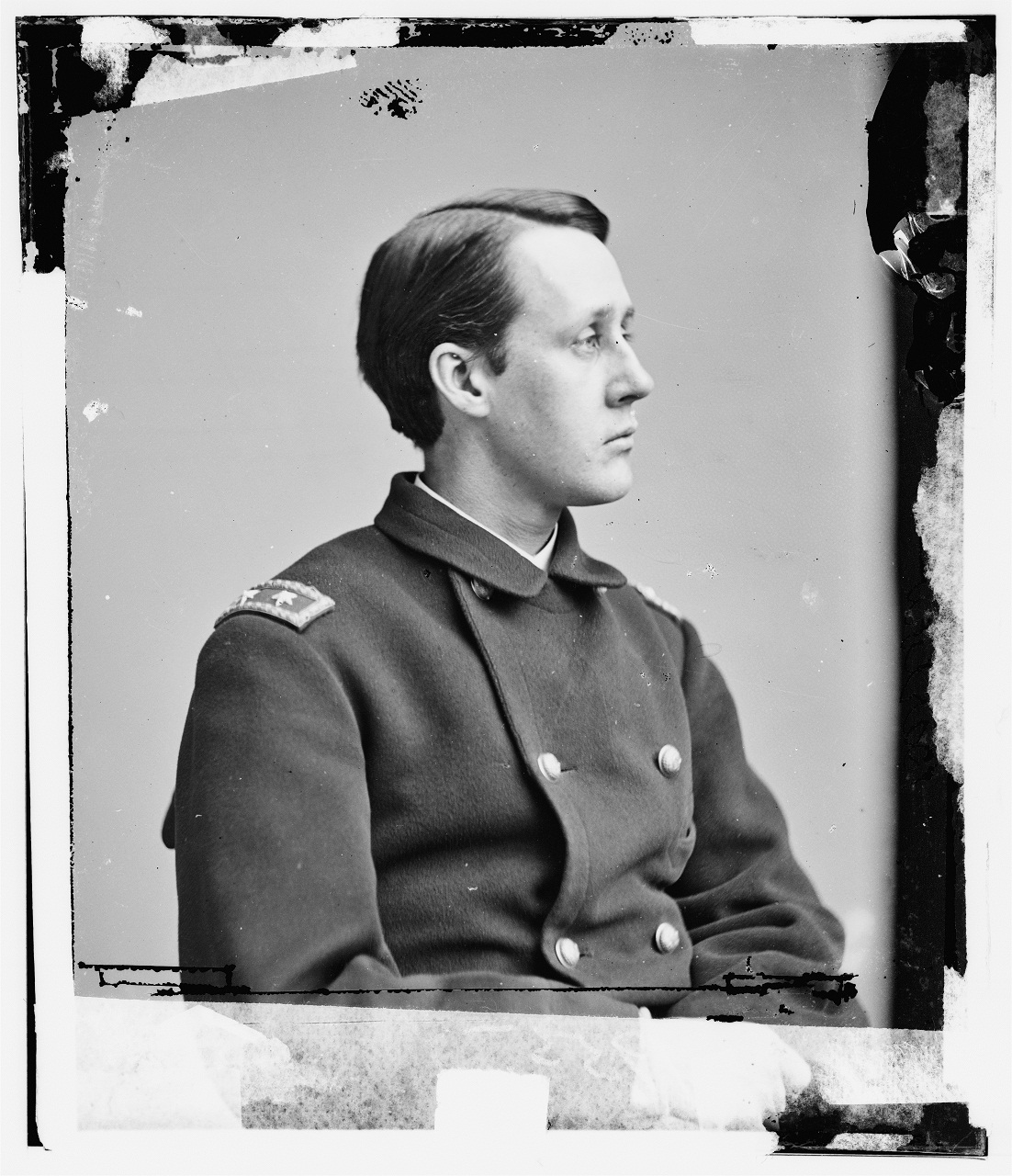
General Andrew Atkinson Humphreys. (Library of Congress)

General Andrew Atkinson Humphreys. (Library of Congress)

Humphreys has gone to Washington. I believe I wrote you he behaved with distinguished gallantry at Fredericksburg. It appears that soon after the battle, Burnside told him both the President and Secretary assured him solemnly that Humphreys should be immediately promoted. He now finds a long list sent to the Senate, including such names as Butterfield, Sickles, Berry and others, who have really done nothing, while his name is omitted, and he cannot hear that there is any record in the Department going to show he has ever even been thought of. Under these circumstances he is naturally very indignant. This is all entre nous. Just as I had gotten thus far, I heard Hooker had returned, and notwithstanding it is storming and snowing violently, I rode three miles to his headquarters to see him, and have just returned. He seemed in excellent spirits, said they had treated him “en prince” in Washington, and told him he had only to ask and he should have what he wanted. He did not tell me his plans, but intimated that as soon as the weather and the roads permitted he was prepared to try something.

Meade’s letters taken from The Life and Letters of George Gordon Meade, Major-General United States Army, Vol. 1, (New York: Charles Scribner’s Sons, 1913), pp. 351-353. Available via Google Books.

A Change in Command (January 26, 1863)

falmouth

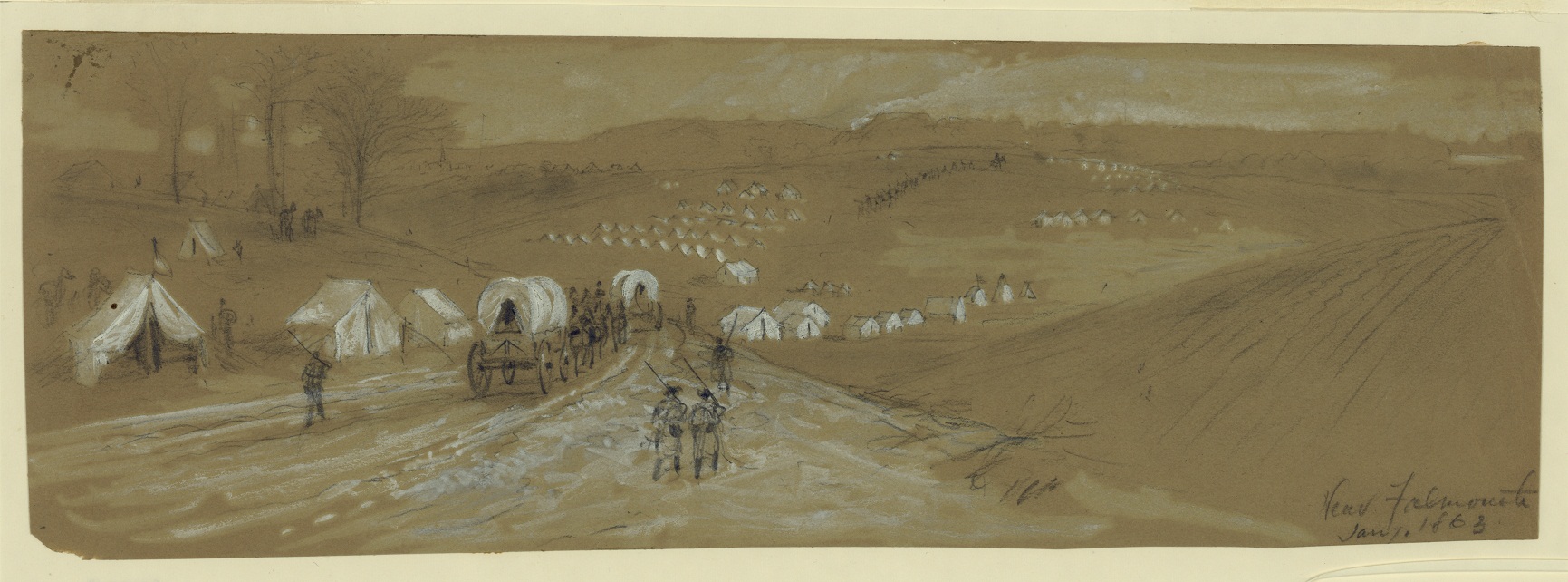
Alfred Waud’s impression of the Army of the Potomac near Falmouth, Virginia, in January 1863 (Library of Congress).
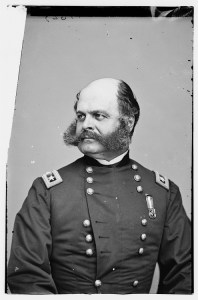
Ambrose Burnside.

Ambrose Burnside (Library of Congress).

Continuing the series of George Gordon Meade’s letters, posted here 150 years to the day after he wrote them. These were interesting times for the Army of the Potomac. Burnside’s “Mud March” had come to an ignominious conclusion and Ambrose Burnside’s days in command of the army seemed numbered. Meade wrote not one but two letters to his wife on January 26, 1863, to fill her in on what was happening.

We are much excited by rumors of what is going to be done. It is generally believed Burnside is in Washington, though when you go to see him, as I did yesterday, you are informed he is out riding.

This war will never be terminated until one side or the other has been well whipped, and this result cannot be brought about except by fighting. Hence, although I like fighting as little as any man, yet if it has to be done, and I don’t see how it can be avoided, I am of Shakespeare’s opinion, “if it were done, then ‘t were well it were done quickly.”

I send you three letters which I think you will be interested in reading, and which you may as well keep as mementoes of the war. The first is from Levi Richards, a private in the Pennsylvania Reserves, who was detailed as a teamster and drove my wagon while I was connected with the Reserves. His letter is spontaneous, he having nothing, as he says, to gain by it, as we are now separated, but it is gratifying to me as an evidence of the opinion entertained of me by the soldiers of my command. [For text of the letter, see below.]  The second is from Surgeon Pineo, one of the most accomplished officers of his department, who was under me, while I had command of the First Corps, as medical director. He asked me to recommend him for promotion, which I did, and his letter in reply shows what some officers think of me. The other is from Hon. William Wilkins, formerly judge in Pennsylvania, Senator and Secretary of War. He desires a favor for his grandson, but he is pleased to say I am powerful and in favor, hence his letter indicates in some measure public opinion in regard to me. I send them because, knowing how much you think of me, I know it will gratify you to know that others have a favorable opinion. This may be vanity, but I deem it pardonable in writing to one’s wife.

George [Meade’s son] gave me my spectacles, and the glasses suit exactly, and are truly welcome, for a day or two before we moved, I was on horseback, when a sudden puff of wind carried away the only pair of spectacles I had, and for a few minutes I was in despair, until fortunately my orderly found them. Now I am provided against such accidents.

(Meade wrote his second letter at 9:00 that night.)

Joseph Hooker (Library of Congress).

Joseph Hooker (Library of Congress).

I wrote you a long letter to-day, little thinking while I was quietly employed writing to you what momentous events were going on immediately around me. After writing to you, I went out to ride for exercise, and on my return at 6 P. M., found an order awaiting me, announcing Major General Hooker as in command of the Army of the Potomac and Major General Meade in command of the Centre Grand Division. I then learned for the first time that this news arrived this morning (Burnside having brought it down from Washington last night), and that he, Burnside, and all his staff had gone off this morning, and that Generals Sumner and Franklin had both been relieved and ordered to Washington. You can readily imagine my surprise at all this, although some such step had been talked about for some time back. As to my commanding a grand division, I consider it a mere temporary arrangement, as either some one of more rank will be sent, or, what is more likely, the grand division organization broken up altogether, as it was purely an invention of Burnside’s, and has not, I think, been considered a good one. You will, doubtless, be anxious to know what I think of these changes. With all my respect, and I may almost say affection, for Burnside—for he has been most kind and considerate towards me—I cannot shut my eyes to the fact that he was not equal to the command of so large an army. He had some very positive qualifications, such as determination and nerve, but he wanted knowledge and judgment, and was deficient in that enlarged mental capacity which is essential in a commander. Another drawback was a very general opinion among officers and men, brought about by his own assertions, that the command was too much for him. This greatly weakened his position. As to Hooker, you know my opinion of him, frequently expressed. I believe my opinion is more favorable than any other of the old regular officers, most of whom are decided in their hostility to him. I believe Hooker is a good soldier; the danger he runs is of subjecting himself to bad influences, such as Dan Butterfield and Dan Sickles, who, being intellectually more clever than Hooker, and leading him to believe they are very influential, will obtain an injurious ascendancy over him and insensibly affect his conduct. I may, however, in this be wrong; time will prove.

Here is an excerpt from the letter Meade mentions, written on January 9. The original is in the Meade papers.

To relieve my mind of things that I wish to make known to you I will take this opportunity. As I am a Private Soldier in the P.R. and as one sildier will express himself to another more readily than to an officer, I think I can tell you the feeling of this division. Towards you since the battle of the Peninsula I have never heard but two men that had anything to say against you and one of them was an officer. They all as a division loved you as a commander. They all appeared glad to hear of your Promotion but parted with you with Regret. Although strict they all told the same tale and that was that officers and men were used alike.

And as for myself I consider you have used me as a father would use his son although strict yet no more so than I think it Requires to make good soldiers and now am satisfied if a man does his duty with you it is all is required as I have been with you for almost one year . . . .

Meade’s letters taken from The Life and Letters of George Gordon Meade, Major-General United States Army, Vol. 1, (New York: Charles Scribner’s Sons, 1913), pp. 349-351. Available via Google Books.