The Mud March (January 23, 1863)

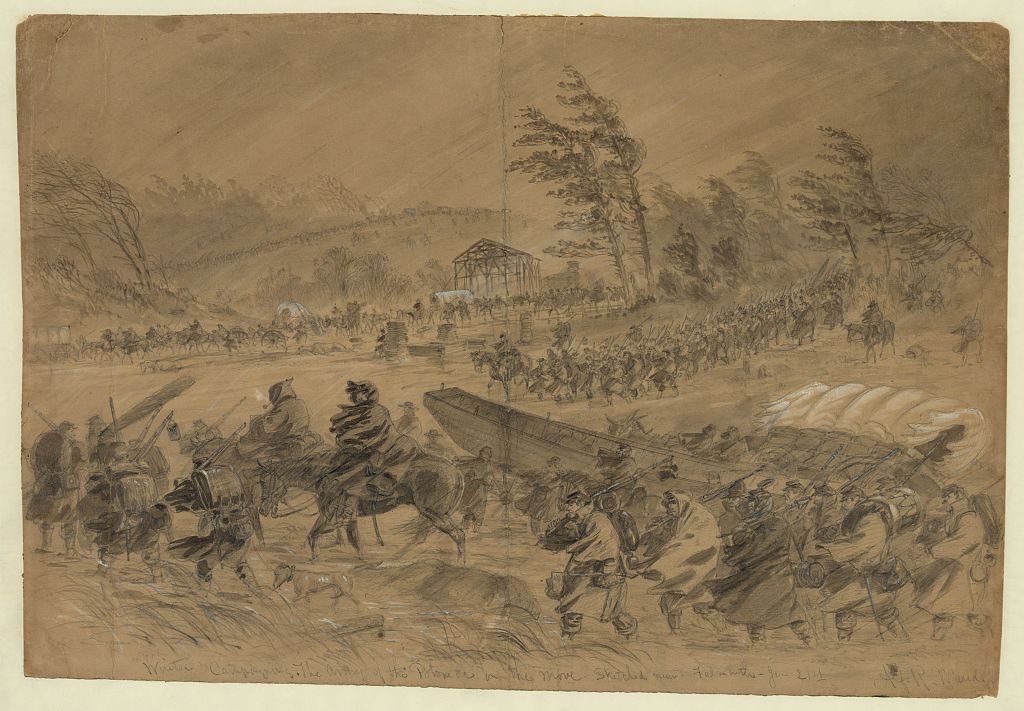
Alfred Waud sketched the Army of the Potomac on the disastrous "Mud March" in January 1863.

Alfred Waud sketched the Army of the Potomac during the disastrous “Mud March” in January 1863. Notice the pontoon boat in the foreground. (Library of Congress)

As we approach the 150th anniversary of the battle of Fredericksburg, I thought it would be interesting to post excerpts from the letters George Meade wrote exactly 150 years earlier. He wrote the following letter to his wife on January 23, 1863, from his army camp near Falmouth, Virginia, on the opposite shore of the Rappahannock River from Fredericksburg. The Army of the Potomac had suffered a disastrous defeat at Fredericksburg the previous month. Major General Ambrose Burnside remained in command, despite his officers’—and his own—growing doubt as to his abilities. After his defeat at Fredericksburg poor Burnside still had one more indignity to suffer, an event that would go down in history as the “Mud March.”

I have not written to you for several days, for the reasons that I have had no opportunity, and that I was aware all letters from the camp were stopped in Washington, so that there was no use in writing. On the 19th, in the night, we received orders to move the next day. On the 20th, the whole army moved from their camp to a position four miles up the river, where crossing places had previously been selected. Everything went off very well up to about 8 P. M. of the 20th. The army reached its position. The pontoons, artillery and all other accessories were up in time, and we all thought the next morning the bridges would be thrown over and we should be at it. But man proposes and God disposes. About 9 P. M. a terrific storm of wind and rain set in and continued all night. At once I saw the game was up. The next day the roads were almost impassable; the pontoons, in attempting to get them to the water’s edge, stuck on the bank, and a hundred men could not budge them. Instead of six bridges being thrown over by 8 A. M., it was found late in the day that the materials for one only could be got to the water’s edge. Burnside visited us, and soon saw the state of the case. Still in hopes something might happen, he directed we should remain in position. All that night, the 21st, and the next day, the 22d, it continued to rain, and the roads to get into such a condition, that early yesterday, the 22d, I had to turn out the whole of my corps, fifteen thousand men, and go to work and bridge with logs, or corduroy, as it is called, nearly the whole road from our camp to the crossing place, eight miles. The men worked cheerfully at this, which was accomplished by early this morning, and Burnside having recalled the army to its old camp, we have been all day getting our artillery back, and to-morrow the infantry will return, thus consuming two days to get back, when it took only a few hours to get there. I never felt so disappointed and sorry for any one in my life as I did for Burnside. He really seems to have even the elements against him. I told him warmly, when I saw him, how sorry I felt, and that I had almost rather have lost a limb than that the storm should have occurred. He seemed quite philosophical, said he could not resist the elements and perhaps it was as well, for that his movement had been most strongly opposed and some of his generals had told him he was leading the men to a slaughter pen; and I am sorry to say there were many men, and among them generals high in command, who openly rejoiced at the storm and the obstacle it presented. We were very much amused to see in the papers to-day, flaming accounts of our crossing, of the battle, and of Hooker being mortally wounded. I hope you did not attach any importance to these absurd reports, which, when I saw, I feared you might have been anxious. I presumed the truth had been telegraphed and that you would know the storm had frustrated our plans. The plan was based on the presumption that we would take the enemy unawares, at least so far as the place of crossing was concerned, and I believe, but for the storm, we should have succeeded in this. What will be done now I cannot imagine, the mud is at present several feet thick wherever any wagons pass over a road, and if the weather from this time, should at all resemble that of last year, it will effectually stop all operations for two months to come.

I did not see George [Meade’s son, who was serving with the cavalry] during our fiasco, though I was at one time bivouacked near a part of his regiment, but his company was not with that part.

[Abner] Doubleday has been assigned to the Reserves, which is a good thing for me, for now they will think a great deal more of me than before.

Taken from The Life and Letters of George Gordon Meade, Major-General United States Army, Vol. 1, (New York: Charles Scribner’s Sons, 1913), pp. 348-349. Available via Google Books.

Museum Pieces

Last week I visited the National Civil War Museum in Harrisburg to talk to CEO Wayne Motts and his staff about the upcoming book launch of Searching for George Gordon Meade: The Forgotten Victor of Gettysburg. (It will take place February 16, 2013, at the museum. Go here for full details.) After the meeting Wayne took me into another room, excited at the chance to show me some Meade-related items the museum will include in its new exhibit about the year 1863, which opened on January 17. tomorrow He had a bunch of items laid out on a table. Among them was a copy of the order Meade issued on June 30, 1863—two days after he received command of the Army of the Potomac and only one day before the fighting began at Gettysburg. It ended with this chilling note: “Corps and other commanders are authorized to order the instant death of any soldier who fails in his duty at this hour.”

There was also a copy of Meade’s General Orders No. 68. Issued over the name of assistant adjutant-general Seth Williams (like me, a native of Augusta, Maine) on July 4, 1863, it was a congratulatory message to his army and, innocuous as it might appear on the surface, it damaged Meade’s relationship with President Abraham Lincoln. The offending passage was this one: “Our task is not yet accomplished, and the commanding general looks to the army for greater efforts to drive from our soil every vestige of the presence of the invader.” When Lincoln saw that he exclaimed, “Great God! Is that all?” He complained to another listener, “Will our Generals never get that idea out of their heads? The whole country is our soil!”

A third item that will go on display is Meade’s own copy of a government-issued

Daniel Buttefield. In the words of early Gettysburg historian John Bachelder, he "has never lost the occasion to stab General Meade's reputation under the fifth rib."

Daniel Butterfield. In the words of early Gettysburg historian John Bachelder, he “has never lost the occasion to stab General Meade’s reputation under the fifth rib.”

booklet that listed all the army’s officers and their seniority. Meade’s signature is on the cover of the little blue publication. No doubt most of the army’s officers kept their own copies handy, because, in general, advancement in rank depended on seniority. Before the war the pace of advancement could be glacially slow as officers waited for those above them to die or retire. Even during the war ambitious officers—and Meade was certainly ambitious—kept a close eye on who got promoted and who had seniority. For example, when Ambrose Burnside promoted Daniel Butterfield to command of the V Corps shortly before the Battle of Fredericksburg, Meade was acutely aware that he had seniority over Butterfield yet still remained in command of only a division. After wrestling a bit with the best way to handle the matter, he decided to bring it up with Burnside. On November 23, 1862, he rode over to Burnside’s headquarters. Here’s what I write in Searching for Meade:

I have come to pick a crow with you,” he said as playfully as he could. Then he explained his feelings about Butterfield getting command of the V Corps. Burnside acted surprised. He said that he had no idea Meade ranked Butterfield and certainly had meant no disrespect. His intention was for Butterfield to command the corps only temporarily, perhaps until someone senior to both men—John Sedgwick, perhaps—could take over. Meade pronounced himself satisfied and rode back to his tent.

(On December 23, the debacle at Fredericksburg over, Burnside told Meade he was giving him command of the V Corps.)

 That left Meade with some tricky diplomatic work not only with Butterfield but also with Joe Hooker. Butterfield was a Hooker crony, and the V Corps belonged to Hooker’s Grand Division. Meade heard rumors that Hooker was not happy with the change of commanders. Nonetheless, the news called for a celebration. Meade obtained some champagne and invited his fellow generals, including Franklin, Reynolds, and William F. “Baldy” Smith, to share it with him. “Whereupon it was unanimously agreed that Congress ought to establish the grade of lieutenant general, and that they would all unite in having me made one, provided I would treat with such good wine,” Meade reported.

On the day before Christmas Meade rode to Hooker’s tent to officially report for duty. He found Hooker with Butterfield. After what must have been an awkward few minutes, Butterfield excused himself.

“I told Burnside, when he informed me of his intention, that there was no officer in the army I would prefer to you, were the corps without a commander and the question of selection open,” Hooker told Meade, “but Butterfield having been placed there and having discharged the duties to my satisfaction, particularly through the late battle, I deemed myself authorized to ask that he might be retained.” Hooker said it was nothing personal, and then he signed the order relieving Butterfield and giving Meade command.

Butterfield invited his successor to a Christmas dinner the next day, a handsome entertainment shared by all the brigade and division commanders. After everyone else had left, Meade remained behind to talk with Butterfield. He understood his feelings, Meade told him. “Poor Butterfield then opened his heart,” said Meade. Burnside had promised him that command of the V Corps was permanent, Butterfield complained. Meade sympathized but pointed out that the original injustice had been done when Butterfield was promoted over him. When he said good night to Butterfield, Meade felt that the situation was “definitely and satisfactorily settled.” He would have further unpleasant dealings with Butterfield in the future.

Book Launch!

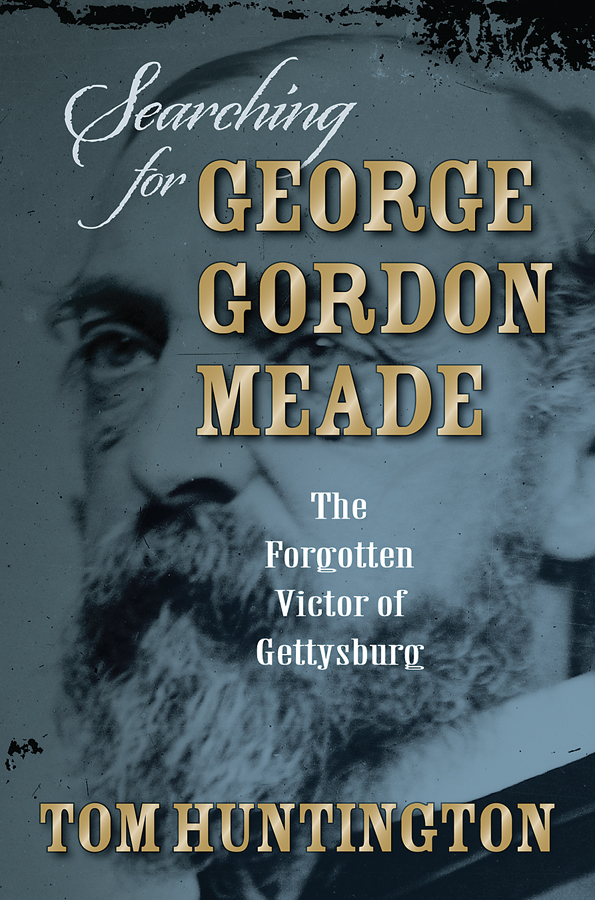
CoverI’m very excited to announce that the official book launch of Searching for George Gordon Meade: The Forgotten Victor of Gettysburg will take place on Saturday, February 16, 2013, at the National Civil War Museum in Harrisburg, Pennsylvania.

Tom Huntington (that’s me!) will sign books at the museum from 10 a.m. until noon in the museum’s rotunda and copies will be on sale for 10% off list price (15% for museum members). This is the museum’s United Concordia Dental Free Day, which means there is no charge for admission to the museum. If you haven’t had a chance to visit this beautiful facility, this is a great opportunity. Along with the book launch, the museum has scheduled special events throughout the day. It will also be a good chance to see the museum’s new exhibit about the year 1863, which opens to the public on January 16.

You can find directions to the Museum here.

I hope to see you there!

Happy Birthday!

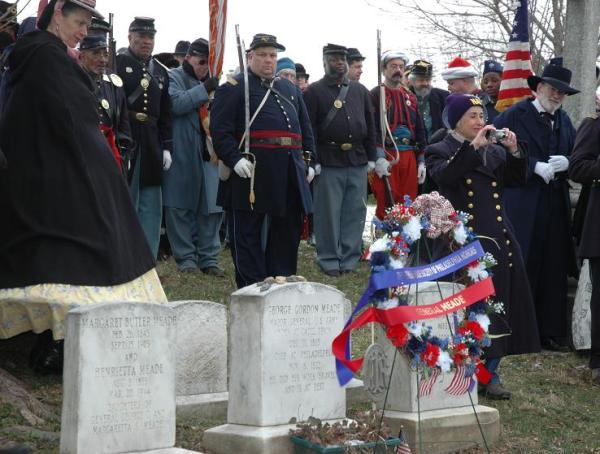
WreathYesterday (December 31, 2012) marked General George Gordon Meade’s 197th birthday and the General Meade Society of Philadelphia once again commemorated the event at Philadelphia’s Laurel Hill Cemetery, where Meade is buried. About 150 people braved the cold to march in a procession through the snowy cemetery to the general’s grave for the 22nd annual birthday celebration. Dr. Andy Waskie, the Meade Society’s founder and president, served as the event’s organizer and master of ceremonies. The commemoration led up to a champagne toast at the gravesite and then the somewhat numbed attendees returned to the cemetery gate house for a buffet luncheon, beer, wine and birthday cake.

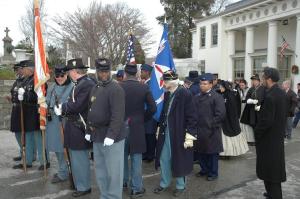
The procession forms up at the Laurel Hill Cemetery gatehouse for the march down to Meade's grave.

The procession forms up at the Laurel Hill Cemetery gatehouse for the march down to Meade’s grave.

In his talk, Waskie read a portion of a letter that Meade had written to his eldest son, John Sergeant, exactly 150 years earlier, on December 31, 1862. The Army of the Potomac had only recently suffered its terrible repulse at Fredericksburg. Meade wrote:

Your kind letter, dated Christmas, was received yesterday, and I am very much obliged to you for your affectionate remembrance of me. You say truly, we have a great deal to be thankful for, and when we consider the distress and mourning that is around us, our hearts ought to be filled with gratitude for the mercy that has been extended.

John is very much pleased at George’s being here, and takes great interest in all that relates to him. George has taken a great fancy to a little black mare I have, belonging to the Government, which he has given me various hints he thought I might buy and present to him, and in this little scheme to diminish my finances to the tune of one hundred and twenty dollars, he has the hearty co-operation of Master John, who regularly informs me every morning he thinks the boy ought to have the black mare.

I have sent George’s name to the President for appointment as one of my aides, with the rank of captain.

To-day is my wedding and birthday. To-day I enter on the forty-seventh year of my life and the twenty-third of my wedded existence. I had hoped to spend this day with your dear mother and my darling children, but my promotion to the Fifth Corps and the number of generals that have been sent to testify before the Porter and McDowell courts have prevented my getting away. Should it be decided the army is to go into winter quarters, I may yet have a chance, though I hardly have much hope.

The John whom Meade mentions was his servant. George was Meade’s son, who was serving with the 6th Pennsylvania Cavalry (Rush’s Lancers). The Porter and McDowell courts were those investigating the conduct of generals Fitz John Porter and Irvin McDowell at Second Bull Run. It’s just one sign of the dysfunction that plagued the Army of the Potomac only five months before Meade would take command.

Living historians prepare to fire a salute at Meade's gravesite.

Living historians prepare to fire a salute at Meade’s gravesite.

The cold weather kept me from taking any notes about what the other speakers said. I preferred to keep my hands in my pockets, especially when a wintry wind blew across the Schuylkill River and over the cemetery. Al Willis, one of the few African-American Marine veterans of World War II, made some brief remarks, leading to recognition of the living historians of the 3rd United States Colored Troops. Today (January 1) is the 150th anniversary of the day Abraham Lincoln’s Emancipation Proclamation went into effect and 2013 will mark the USCT’s 150th anniversary as well.

Ceremony

Dr. Andy Waskie speaks at the General Meade Society’s 22nd annual birthday celebration at Laurel Hill Cemetery.

The birthday commemoration is always a fun and memorable event and I salute those people who show up each year to pay tribute to George Gordon Meade, the victor of Gettysburg.

Taps

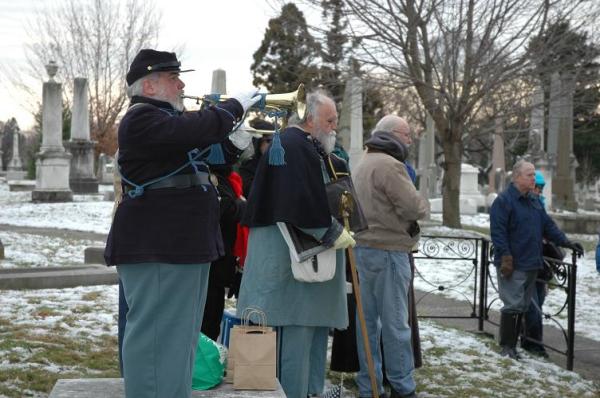
The playing of “Taps” (a bugle call written by Meade nemesis Daniel Butterfield) ends the graveside ceremony.

Written in Stone

In his official report on the Battle of Gettysburg, Brigadier General Alexander Hays said the history of his brigade was “written in blood.” He could easily have said that about the entire battlefield. In the years since, though, the battle’s history has been written in stone, bronze, and iron, set down via a remarkable collection of monuments, markers, and tablets that dot the woods, hills, and fields.

When Stackpole Books decided it wanted to create a phone app to help visitors understand the significance of this great profusion of battlefield monuments, they asked me to help put it together. At the time I was finishing up Searching for George Gordon Meade, and my research had sent me to Gettysburg many times. Still, I found it a daunting task. Every monument comes with a story–even a book–attached and trying to capture that story in a maximum of 75 words promised to be difficult. Fortunately, I was also going to provide photos of all the monuments. Since a picture is worth a thousand words, I guess that boosted my word limit to 1,075.

Mark Allison and Janelle Bender of Stackpole kicked off the project and I picked up where they left off. It meant spending a lot of time on the battlefield to photograph each monument and get its GPS coordinates, but I enjoyed the time I spent there, even on scorching summer days when I was baked by the sun and ended up picking ticks off my legs after tramping through fields to reach particularly inaccessible monuments. I also enjoyed my time poring through John Bachelder’s three volumes of battlefield correspondence, as well as the Official Records, regimental histories, and other sources about the fighting to get anecdotal material to help personalize each monument. It was truly a learning experience for me, yet I also understood that the more I learned, the more there was to discover. The Gettysburg battlefield contains multitudes.

At some point I suggested to Stackpole that the material I had gathered for the phone app would also translate into print. So I suggested they turn into in a field guide to Gettysburg monuments and they agreed to do that. The result is Guide to Gettysburg Battlefield Monuments, which Stackpole Books will publish in May, just in time for the battle’s 150th anniversary.You can purchase the app and the book through Stackpole Books, or you can get the book at Amazon.com or Barnes and Noble.

What follows is just a brief sample of the kind of material you will find in both the phone app and the book. (I took multiple photos of each monument and at this point I’m not sure which images will appear in the app and the book.) Click on each picture to see a larger version.

143rdPA

143rd Pennsylvania Infantry
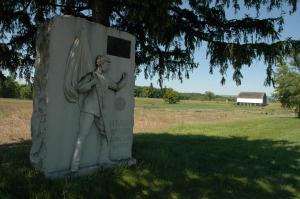
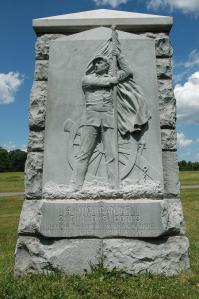
Captured in stone, Sergeant Ben Crippen, the 143rd Pennsylvania’s color bearer, permanently shakes his fist in the direction from which the Confederates advanced. Part of Doubleday’s division of the 1st Corps, the 143rd was falling back from the rebels on July 1 when Crippen expressed his defiance. He paid the ultimate price , falling to enemy bullets. The regiment saved its colors and retreated through Gettysburg and up to Cemetery Hill.

11thPA

11th Pennsylvania Infantry
The dog on the memorial to the 11th Pennsylvania is Sallie, the regiment’s mascot. Although separated from the men when they retreated to Cemetery Hill, the brindle bull terrier remained where they had fought with the dead and wounded and rejoined the 11th Pennsylvania after the battle. She remained with them until struck and killed by a bullet at the Battle of Hatcher’s Run in October 1864.

17th Maine

17th Maine Infantry
The 17th Maine made a stubborn resistance in the Wheatfield on July 2 by the stone wall here (as shown atop the monument). “The regiment took position just in time to receive the first and furious attack made by the enemy on that part of the line,” read a history. The fight became “a desperate struggle at close quarters” until, out of ammunition, the 17th Maine received orders to pull back.

4thMichigan

4th Michigan Infantry
During the fighting for the Wheatfield Colonel Harrison H. Jeffords of the 4th Michigan and two other soldiers attempted to rescue the regimental colors. “The Colonel secured the colors or at least had his hand on the staff,” recalled color bearer Henry S. Seage, “and in the act of fighting their way out, Col. Jeffords was killed, by bayonet thrust through the body.” The other two, one of them Seage’s brother, were wounded.

GettsyburgWomen

Gettysburg Women’s Memorial
Elizabeth Thorn was the wife of Evergreen Cemetery’s caretaker, who was in the army. After enduring an artillery barrage with 16 other people crammed into the basement, she was evicted from her home. She returned to find a wasteland. She then buried more than 100 soldiers. Thorn was six months pregnant at the time. (She named her daughter Rose Meade, after the victor of Gettysburg.)

11thMississippi

11th Mississippi Infantry
The monument to the 11th Mississippi, sculpted by William Beckwith, depicts William O’Brien, the color sergeant for Company C. Advancing on the left flank of the Confederate attack on July 3, the regiment suffered terribly, with 340 casualties among its 393 men. A marker off Hancock Avenue near the Brian Barn indicates the furthest point the regiment’s survivors reached on July 3.

Louisiana

Louisiana State Monument
The work of sculptor Donald DeLue, who also created the Mississippi and the Soldiers and Sailors of the Confederacy monuments, the Louisiana State Monument was dedicated in 1971. The dying soldier is from Louisiana’s Washington Artillery; the soaring figure is the Spirit of the Confederacy. Louisiana seceded from the Union on January 26, 1861, and contributed around 56,000 soldiers to the Confederate armies. Up to 7,000 of them died during the war.

Spielberg at Gettysburg

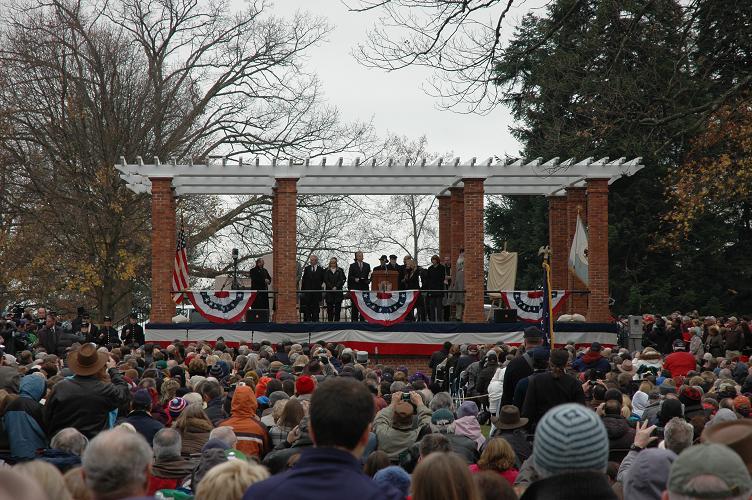
Each November 19 the town of Gettysburg commemorates the anniversary of the short speech that Abraham Lincoln made on that date in 1863 at the dedication of the Soldiers National Cemetery. At this year’s commemoration the keynote speaker was director Steven Spielberg, whose film Lincoln had just opened. I drove down to attend the ceremony with my wife, Beth Ann, and Kyle Weaver, my editor at Stackpole Books.

The 2012 Dedication Day program.

It was a cool, gray November morning when we reached Gettysburg, where we discovered we were not the only people who decided to show up today. A sizeable crowd was gathering around the rostrum in the National Cemetery, including a good number of school students. We headed down to the Soldiers National Monument, which is closer to the actual spot where Lincoln spoke, because the day’s events would begin there with a wreath-laying ceremony.

As people waited around the monument, the Federal City Brass Band performed some spirited Civil War-era tunes and patriotic airs. I was just happy I did not have to play a brass instrument on such a cold morning. Then a couple of black SUV’s rolled up with the guests of honor. I hurried over to get some photographs of director Spielberg and historian Doris Kearns Goodwin (whose book Team of Rivals provided the basis for much of the movie). They emerged from their car and were introduced to various people as I went into full paparazzi mode.

I can have mixed feelings about Spielberg. Sometimes he ladles on the sentimentality and he has an unfortunate weakness for the group hug. Yet there’s no denying that he is a master filmmaker and his movies have become an inextricable part of the public imagination over the past several decades. The man has an undeniable touch behind the camera and has compiled a pretty amazing body of work. His movies include Jaws, Close Encounters of the Third Kind, Raiders of the Last Ark, E.T., Schindler’s List, Saving Private Ryan, just to name a few. And now Lincoln.

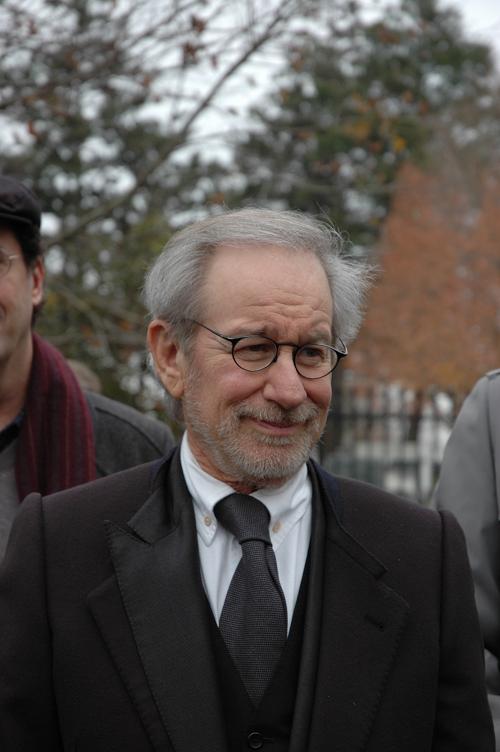
Director Steven Spielberg at Gettysburg for Dedication Day.

I had seen Lincoln the night before and came away impressed overall. There are times when John Williams’ score teeters on the edge of self-parody as it attempts to push emotional buttons, but there are no group hugs and the film often made me think, “Yes, it must have been something like that.” Daniel Day-Lewis inhabits the role of Lincoln, with all his humanity and frailties. He does not play the president as a plaster saint but as a man comfortable with himself yet willing to do whatever it takes—including buying off reluctant legislators—to pass the 13th Amendment to the Constitution and end slavery in the United States. It’s mostly a story of politics, not war. Ulysses S. Grant makes an appearance, but there’s no mention of George Gordon Meade.

No one mentioned Meade at the Gettysburg ceremony either. As I write in Searching for George Gordon Meade, “It’s safe to say that Lincoln’s speech is now more famous than the man who commanded the army that made the speech possible. ‘It is a commentary on the power of words that what Lincoln said at Gettysburg has eclipsed what Meade did there,” wrote a reviewer for The Dial magazine way back in 1913. ‘To be bowled over by an [sic] eulogy celebrating your own performance is a hard fate.’”

Indeed it is.

Chances are historians will little note nor long remember what Steven Spielberg said in his Gettysburg address but he delivered a thoughtful, heartfelt speech to a crowed estimated at 9,000 people (including, he noted, “a healthy percentage of the country’s entire population of Lincoln obsessives”). He admitted to feeling humbled to be speaking here. “More than any other name connected to the Civil War, except Lincoln’s, Gettysburg’s reverberates,” he said. “Even Americans who don’t know precisely what transpired on these fields know that all the glory and all the tragedy that we associate with the Civil War resides most palpably, most indelibly, here.” He talked about the importance of scholars and historians for preserving collective memory and the importance of memory itself, as well as the need to acknowledge death in order to truly embrace living. “As much as we need memory to live, we need an awareness of death to live,” he said. “Surely that’s what cemeteries like Gettysburg are for.” He talked about his desire as a filmmaker to waken Lincoln from his one and a half centuries, if only for the two and a half hours of a cinematic dream.

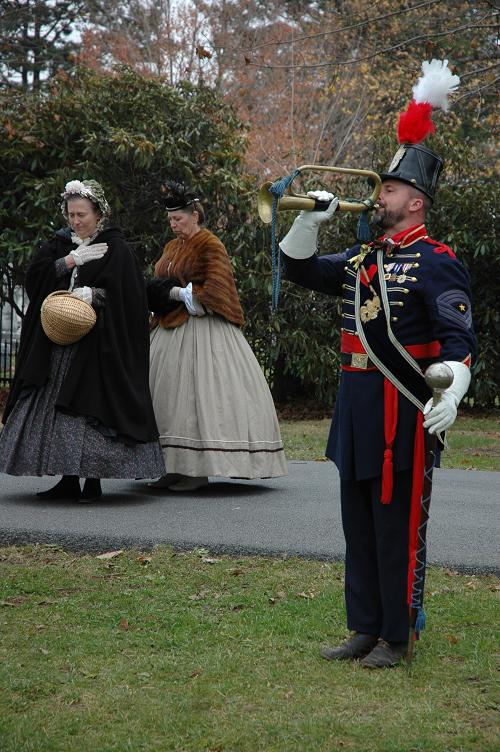
A bugler played “Taps” after the wreath-laying ceremony at the Soldiers National Monument.

After Spielberg finished, Jim Getty, who has been portraying Lincoln for years, stepped forward to deliver the short address that provided the basis for the whole ceremony, all 272 words of it. A soloist sang “The Battle Hymn of the Republic,” followed by a naturalization ceremony in which citizens from 12 different countries became citizens of the United States. In a little touch that would not have been out of place in a Steven Spielberg movie, by the end of the ceremony the gray clouds had broken up enough to allow some faint rays of sunshine to peek through. All it lacked was the self-consciously stirring notes of a John Williams score.

The 20th Maine

The story of Joshua Lawrence Chamberlain—the scholar-turned-general who led the 20th Maine at Gettysburg on July 2—is indeed a compelling one. The regiment’s main monument, on the spot where it made its stubborn defense on the right flank of Little Round Top, has become a pilgrimage site, with many people leaving notes and other tributes to the regiment’s men.

In Searching for George Gordon Meade: The Forgotten Victor of Gettysburg, I mention how it’s become somewhat fashionable to disparage Chamberlain and the 20th Maine. For example, in 2011 Gary Gallagher listed Chamberlain as one of the war’s five overrated officers. I guess you could call it a backlash. Michael Shaara’s novel The Killer Angels and then Gettysburg, the movie adaptation, propelled Chamberlain and his regiment to a new level of recognition and some people believe Chamberlain and his regiment now receive more credit than they deserve for the Union victory at Gettysburg.

I hail from Maine myself and for a time I lived across the street from Chamberlain’s residence in Brunswick, Maine. Far be it for me to say that anyone from Maine is overrated! But rather than defending Chamberlain’s reputation myself, I’ll let his division commander, Brigadier General James Barnes, do it for me. This is what Barnes wrote in his official report of the battle.

Joshua Lawrence Chamberlain (Library of Congress photo).

Colonel Chamberlain at once threw back his left wing, and extended his right wing by intervals toward the left, in order to avoid diminishing the extent of his front. The brigade of the enemy alluded to reaching a proper position, attacked him furiously on the left flank, advancing within 10 paces and rapidly firing. They were first checked and then repulsed by the left wing of the regiment, thrown back for that purpose.

A second, third, and fourth time the enemy renewed their attempt to break this line, and each time were they successfully repelled by that handful of men. Four times that little interval of 10 paces was the scene of a desperate conflict. The ground was strewed with dead and wounded men of both sides, promiscuously mingled. Their ammunition was exhausted; they replenished it from the cartridge boxes of the men lying around them, whether friends or foes, but even this resource soon failed them; the enemy in greatly superior numbers pressed hard; men and officers began to look to the rear for safety, but the gallant commander of the regiment ordered the bayonets to be fixed, and, at the command “Forward,” that wearied and worn body of men rushed onward with a shout. The enemy fell back. Pressing on, and wheeling to the right in open intervals, the left wing came again in line with the right wing, and then the whole regiment, deployed at intervals of 5 paces, followed up the advantage they had gained. The enemy threw down their arms and surrendered in large numbers; the others fled rapidly from the contest; 368 prisoners, including 1 colonel, 1 lieutenant-colonel, and a dozen other officers of lesser rank were sent to the rear; 50 of their dead lay upon the field, and large numbers of their wounded; 30 of this gallant regiment were killed, over 100 were wounded, but not one was taken a prisoner, and none were missing.

It was now nearly dark. A portion of the enemy appeared to have occupied the summit of the rocky hill to the left. The men of this brave regiment, exhausted by their labors, had thrown themselves upon the ground, and many of them sunk at once in sleep. Colonel Rice, now in command of the brigade, directed Colonel Chamberlain to drive the enemy from this height. The order was at once given. Roused again to action, and advancing with fixed bayonets and without firing, lest the smallness of their numbers might be suspected, they rushed up the hill.

Twenty-five more prisoners, including some staff officers, were added to the number previously taken, with a loss to the regiment of 1 officer mortally wounded and 1 man taken prisoner by the enemy. It was ascertained that these troops occupying the hill had been sent from Hood’s division, which was then massed a few hundred yards distant, and that their object was to reconnoiter the position as a preliminary to taking possession of the height.

In addition to the prisoners above mentioned as taken by this regiment, 300 stand of arms were also captured by them, it is due to this regiment and to its commander that their service should be thus recorded in some detail.

That was, in fact, a lot of detail for a division commander to include about one of his regiments. Barnes went on to say, “Colonel Chamberlain, of the Twentieth Maine Volunteers, whose service I have endeavored briefly to describe, deserves especial mention.”

Colonel James Rice, who took over the Third Brigade in Barnes’ division following the death of Colonel Strong Vincent, also dedicated space in his official report to the action of the 20th Maine on Little and Big Round Tops, and singled out Joshua Chamberlain and his brother Thomas for their actions on July 2. “Especially would I call the attention of the general commanding to the distinguished services rendered by Colonel Chamberlain throughout the entire struggle,” wrote Rice.

Barnes’ report appears in Official Records, Series I, Volume XXVII, Part 1, pages 599-605. Rice’s is in the same volume, pages 616-620.

Dedication

Living historians of the General Meade Society of Philadelphia pose in front of Alexander Calder’s statue on October 27, 2012. They had gathered to commemorate the 125th anniversary of the statue’s unveiling.

The General Meade Society of Philadelphia does not like to pass up an opportunity to celebrate its favorite general. Last weekend members of the society gathered to commemorate the 125th anniversary of the unveiling of Alexander Calder’s statue of Meade that stands in the city’s Fairmount Park. Dr. Anthony Waskie, the society’s founder and president, served as master of ceremonies for the commemoration. Waskie often appears at events as Meade, but since the general had been dead for some 15 years when his statue was dedicated on October 18, 1887, he appeared instead as Philadelphia mayor Edwin Fitler, who played a similar role 125 years earlier. Also present were representatives of the ladies of Philadelphia, members of the 3rd United States Colored Troops, the 98th Pennsylvania, and two colorfully garbed members of the 114th Pennsylvania. Also known as Collis’ Zouaves, the 114th PA served for a time as Meade’s headquarters guard. General John Gibbon, in the twenty-first century person of Bob Hanrahan, delivered the oration—all 7,300 words of it.

Here’s what I say about the original ceremony in the book:

Alexander Milne Calder's Meade Statue

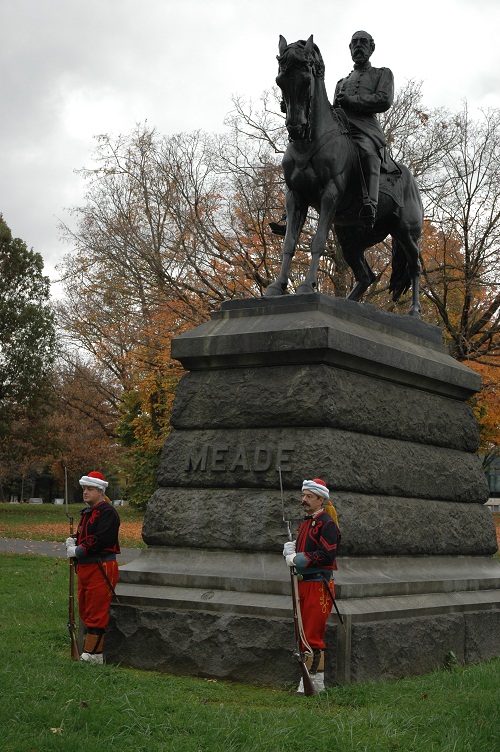
Two members of the 114th Pennsylvania Infantry (Collis’s Zouaves) flank Calder’s statue of Meade.

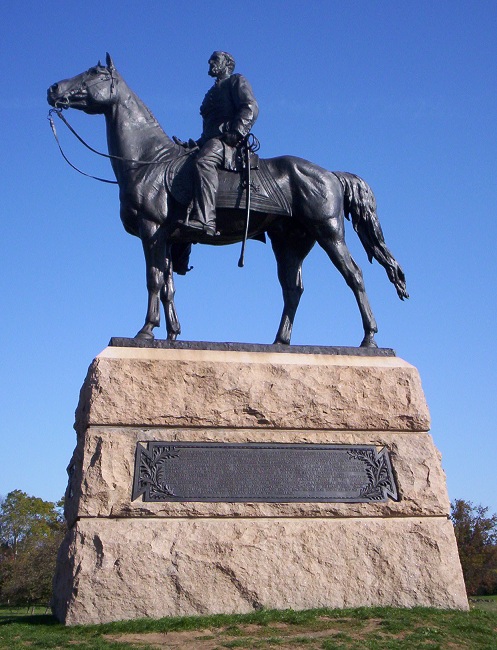
This Meade is an equestrian statue by Alexander Milne Calder, whose huge William Penn stands atop the masonry tower of Philadelphia’s City Hall. Calder’s Meade has a much lonelier posting behind a sprawling Beaux-Arts style building called Memorial Hall. Calder created this Meade for $30,000, raised by the Fairmount Park Art Association, and cast it with metal from captured Confederate cannons. “The design is a spirited one, and the execution all that could be desired,” wrote a reporter for the New York Times when the statue was unveiled at a gala ceremony on October 18, 1887. The general’s grandsons performed the actual unveiling “amid tumultuous cheering” from a crowd estimated at twenty thousand. John Gibbon was the featured speaker, and his listeners included Joshua Lawrence Chamberlain, now a former governor of Maine; Fitz John Porter, who had successfully challenged the court-martial over his actions at Second Bull Run; William Franklin, Meade’s superior at Fredericksburg; and a number of other aging soldiers who had fought with the Army of the Potomac.

The cheers and speeches, as well as the soldiers, have long since faded away, replaced now by the rush of traffic from nearby I-76. Meade sits on his horse, a spirited steed that has its head down as it bites at its bridle, and he gazes in the direction of his grave up the Schuylkill. I agree with the New York Times assessment that statue is a good likeness—better, I think, than the one at Gettysburg. Behind it a quiet and empty park stretches back to Memorial Hall, a behemoth constructed for the nation’s centennial in 1876. It now houses the Please Touch Museum.

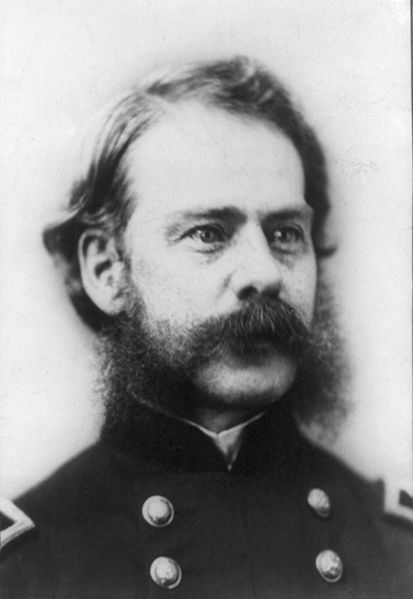
Brigadier General John Gibbon as he appeared during the war.

Gibbon was a close friend of Meade’s and delivered a detailed outline of his career.  “Nearly forty years ago the Seminole Indians broke out and commenced murdering the settlers in Florida,” he began. “Troops were sent into the country and a line of camps was established across the Peninsula. Into one of these camps, late one afternoon, rode a horseman attended by a single orderly. He was a gaunt, thin man, with a hatchet face and a prominent aquiline nose. He introduced himself as Lieutenant Meade, Topographical Engineers, just from a reconnaissance on the hostile border. He was wet, tired, and hungry. It was my good fortune to be able to offer dry clothes, food, and a bed of blankets to one whose name was destined fourteen years later to render famous the little town of Gettysburg, in the southern part of Pennsylvania.

“It was the first time I had met him,” Gibbon continued. “He was then about thirty-four years of age, had accompanied our army into Mexico, served in the war with that country in a subordinate position and without any especial notice. The next time we met he was a Brigadier-General of volunteers, commanding a brigade of the Pennsylvania Reserves in front of Washington in the fall of 1861.”

Bob Hanrahan, as General Gibbon, delivers the oration.

At the time, Meade’s reputation still suffered from the rumor that he had intended to retreat from Gettysburg, and Gibbon addressed that, too. “It is worth no man’s while to attempt to defend General Meade from a charge which came very near being made the pretext for depriving him of the command of the army,” he said. “Those who knew the character of the man will not hesitate to accept as conclusive his adjuration made before the Committee on the conduct of the war, and repeated in other places with the same earnestness. ‘I deny (he says), under the full solemnity and sanctity of my oath, and in the firm conviction that the day will come when the secrets of all men shall be known—I utterly deny ever having intended, or thought for one instant, to withdraw that army, unless the military contingencies, which the future should develop during the course of the day, might render it a matter of necessity that the army should be withdrawn.’

Members of the 3rd USCT serve as a color guard while members of the 98th Pennsylvania Infantry salute Meade with a volley.

“But, whilst not deeming it necessary to attempt any defense against this charge of an intended retreat, I believe the time has now come, and that this is a suitable occasion, to emphatically declare, no matter what errors or misconceptions may have existed in the minds of others, that there is not the slightest evidence tending to show any intention in the mind of General Meade to retreat from the field of Gettysburg on the morning of the 2d of July, or at any other time during the continuance of the battle.”

Andy Waskie appeared at the commemoration as Philadelphia’s Mayor Edwin H. Fitler. Like Meade, the real Fitler is buried at Laurel Hill Cemetery, but the mayor’s monument there is much more grandiose than Meade’s.

Time has marched on since the statue’s dedication and now this section of Fairmount Park is a bit of a backwater. That’s why Waskie and the General Meade Society have been trying to get the Meade statue relocated to a more prominent spot in Philadelphia. If you’d like to sign the petition, you can find it here.

If you’d like to read Gibbon’s entire oration, plus some other background on the original ceremony, you can find it on Google Books here.

Earwitness

Charles F. Benjamin wrote the account of Meade’s accension to command of the Army of the Potomac that appeared in Battles and Leaders of the Civil War. (You can find it in volume III, pages 239-243).

Several Rosengartens are buried in Laurel Hill Cemetery, not far from Meade’s grave. The grave of Major Adolph Rosengarten, who died at the Battle of Stones River, is in the foreground. The grave of his brother, Joseph, is in the background, also marked by a flag.

While doing research with the microfilmed version of Meade’s papers at the Army Heritage Center in Carlisle, I recently came across a typescript copy of a letter that this same Charles Benjamin had written on August 7, 1883 to Major Joseph G. Rosengarten of Philadelphia. Rosengarten had fought with the 121st Pennsylvania and later served on Major General John F. Reynolds’ staff. (Like George Meade, he was buried in Laurel Hill Cemetery. It’s a small world.) No doubt the Reynolds connection explains Rosengarten’s interest in the subject matter of Benjamin’s letter.

Benjamin had been serving under Major General Seth Williams in the days leading up to Gettysburg. (Like me, Williams was a native of Augusta, Maine. He was well liked and efficient and served as Meade’s assistant adjutant general.) This is what Benjamin wrote to Rosengarten:

At the time mentioned I was serving as a clerk at the general Head Quarters and was employed in close attendance upon Seth Williams, the Adjutant General of the Army of the Potomac.

Shortly after taking notice of Genl. Meade in front of his tent, with a group of visiting officers, together with Butterfield, Ingalls, Hunt, Williams and others of our staff about him, I went back in our own little office tent to continue some writing I was doing for General Williams. While so engaged the open tent flap was pushed further back, and Genl. Meade came in, ushering Genl. Reynolds. The first thing that struck me was the contrast between Meade, in soldiers trousers and blouse with the rim of a slouched hat turned down to screen his eyes, (or spectacles) from the sun, and the neat figure of Reynolds, who had a close fitting frock coat (I think it was—if a blouse it was dressy looking and tight fitting) and a kepi which he held in his hand during the conversation. When I saw who the visitors were I wanted to leave the tent, but being screened by the travelling desk which stood on the table between me and the door, I had not been perceived and Meade began so soon and talked so fast, that I concluded the best thing to do was to keep on writing and pay no attention to what was said. But Meade being a man of impetuous speech always and doubtless having in mind that Williams was at the Commanding General’s tent, made me a listener in spite of myself. He began immediately on getting inside, in language substantially as follows: “Reynolds, I have been very anxious to have a talk with you since I have been put in command – I assure you I never dreamed that the command was to be given to me. I had supposed, as everybody in the army did, that it would fall to you when a change was made. I never would have accepted it if there had been a choice left me, but it as put upon me as an imperative order and I had to take it. I wanted you to understand this, that I am not here by my will, and I count on you, above all others, for the support that I would have given you, if you had been placed in the situation that I am in.”

The reply of Reynolds, naturally, did not so much interest me, as what I had heard said by Meade, but I am (sure) that the following gives the spirit and substance if not the very words –“General in my opinion the command has fallen where it ought to fall. If it had come to me in the same way, I should have been obliged to take it, but I am glad that it did not. I understand the difficulties of your position and you may rely upon me to serve you faithfully.” They then entered upon a conversation, in which Meade explained the position of the troops en route; the nature of the communications he had received from Washington, and such information as had come in about the enemy. These were matters that did not at the moment interest me, as I knew them already and hence I have retained scarcely any recollection of the language used. But when Meade summed up the words I have quoted in “The Nation”, I was interested of course, as indicating where the battle was likely to be fought. I had heard so much of Pipe Creek as the probable site of the coming engagement during the last days of Hooker and the first days of Meade, that the mention of Gettysburg as a probably battle-field was a revelation to me and hence this part of the conversation was impressed upon me. Furthermore, when Meade’s failure to arrest Lee’s retreat led to charges which (in their ultimate form) alleged that Meade had never thought about Gettysburg at all, and that his surprise and ignorance of the ground were sufficient to explain his desire to retreat to Pipe Creek, I thought it proper to mention to Seth Williams what I had heard Meade say to Reynolds, as quoted in “The Nation.” Shortly afterwards, Williams went out and when he came back, he asked me to write out a careful memorandum of Meade’s exact words, as nearly as I could recall them – I did so, and am morally certain that the memorandum was for Meade himself, as anybody would be who knew the characteristics of Seth Williams.


Colonel James Hardie, the man Secretary of War Edwin Stanton sent to tell Meade he had been placed in command of the Army of the Potomac.

P.S. In my printed biographical sketch of the late Col. Hardie, who bore the order to Genl. Meade to take over command from Genl. Hooker, I mention Meade’s surprise at seeing Hardie in his tent with a message from Washington, his incredulity at the nature of the order and his excited demand to know why he was chosen instead of Reynolds. Hardie told the story in full; the anxiety of Secy. Stanton lest Hooker might evade compliance with the order till after the battle, if opportunities were given him; the extraordinary course of sending Hardie to privately to Meade and making Meade go immediately and take command before Hooker could now what was afloat and all the rest of the details of the unusual episode.

(You can find that biographical sketch here.)

The next week Benjamin wrote a follow-up to Rosengarten to fine-tune his recollections. The text is here. I have yet to find Benjamin’s letter in The Nation, but I assume it concerns his memory of Meade mentioning Gettysburg as a potential point of battle in his conversation with Reynolds.

Meade’s Report

The statue of George Gordon Meade atop Old Baldy at Gettysburg.

Since I’ve been quoting various Gettysburg reports from the Official Records, including some responses to Meade’s report on Gettysburg, I thought it would be helpful and informative to post Meade’s entire report here. I have eliminated some footnotes; otherwise this is what appeared in the Official Records, Series I, Volume XXVII, Part 1, pages 114-119.

Headquarters Army Of The Potomac,
October 1, 1863.

General: I have the honor to submit herewith a report of the operations of this army during the month of July last, including the details of the battle of Gettysburg, delayed by the failure to receive until now the reports of several corps and division commanders, who were severely wounded in the battle.

On June 28, I received the orders of the President of the United States placing me in command of the Army of the Potomac. The situation of affairs at that time was briefly as follows:

The Confederate army, commanded by General R. E. Lee, estimated at over 100,000 strong, of all arms, had crossed the Potomac River and advanced up the Cumberland Valley. Reliable intelligence placed his advance (Ewell’s corps) on the Susquehanna at Harrisburg and Columbia; Longstreet’s corps at Chambersburg, and Hill’s corps between that place and Cashtown. My own army, of which the most recent return showed an aggregate of a little over 100,000, was situated in and around Frederick, Md., extending from Harper’s Ferry to the mouth of the Monocacy, and from Middletown to Frederick.

June 28 was spent in ascertaining the position and strength of the different corps of the army, but principally in bringing up the cavalry, which had been covering the rear of the army in its passage over the Potomac, and to which a large increase had just been made from the forces previously attached to the Defenses of Washington. Orders were given on that day to Major-General French, commanding at Harper’s Ferry, to move with 7,000 men of his command to occupy Frederick and the line of the Baltimore and Ohio Railroad, and, with the balance of his force, estimated at 4,000, to remove and escort the public property to Washington.

On the 29th, the army was put in motion, and on the evening of that day was in position, the left at Emmitsburg and the right at New Windsor. Buford’s division of cavalry was on the left flank, with the advance at Gettysburg. Kilpatrick’s division was in the front at Hanover, where he encountered this day General Stuart’s Confederate cavalry, which had crossed the Potomac at Seneca Creek, and, passing our right flank, was making its way toward Carlisle, having escaped Gregg’s division, delayed in taking position on the right flank by the occupation of the roads by columns of infantry.

On the 30th, the right flank of the army was moved up to Manchester, the left still being at Emmitsburg, in the vicinity of which place three corps (the First, Eleventh, and Third) were collected, under the orders of Major-General Reynolds. General Buford having reported from Gettysburg the appearance of the enemy on the Cashtown road in some force, General Reynolds was directed to occupy Gettysburg.

On reaching that place on July 1, General Reynolds found Buford’s cavalry warmly engaged with the enemy, who had debouched his infantry through the mountains on the Cashtown road, but was being held in check in the most gallant manner by Buford’s cavalry. Major General Reynolds immediately moved around the town of Gettysburg, and advanced on the Cashtown road, and without a moment’s hesitation deployed his advanced division and attacked the enemy, at the same time sending orders for the Eleventh Corps (General Howard) to advance as promptly as possible. Soon after making his dispositions for the attack, Major-General Reynolds fell, mortally wounded, the command of the First Corps devolving on Major-General Doubleday, and the command of the field on Major-General Howard, who arrived about this time, 11.30 a. m., with the Eleventh Corps, then commanded by Major-General Schurz. Major-General Howard pushed forward two divisions of the Eleventh Corps to the support of the First Corps, now warmly engaged with the enemy on the ridge to the -north of the town, and posted his Third Division, with three batteries of artillery, on the Cemetery Ridge, on the south side of the town.

Up to this time the battle had been with the forces of the enemy debouching from the mountains on the Cashtown road, known to be Hill’s corps. In the early part of the action, success was on our side, Wadsworth’s division, of the First Corps, having driven the enemy back some distance, capturing numerous prisoners, among them General Archer, of the Confederate army. The arrival of re-enforcements for the enemy on the Cashtown road, and the junction of Ewell’s corps, coming on the York and Harrisburg roads, which occurred between 1 and 2 p. m., enabled the enemy to bring vastly superior forces against both the First and Eleventh Corps, outflanking our line of battle, and pressing it so severely that about 4 p. m. Major-General Howard deemed it prudent to withdraw these two corps to the Cemetery Ridge, on the south side of the town, which operation was successfully accomplished; not, however, without considerable loss in prisoners, arising from the confusion incident to portions of both corps passing through the town, and the men getting confused in the streets.

About the time of this withdrawal, Major-General Hancock arrived, whom I had dispatched to represent me on the field, on hearing of the death of General Reynolds. In conjunction with Major-General Howard, General Hancock proceeded to post the troops on the Cemetery Ridge, and to repel an attack that the enemy made on our right flank. This attack was not, however, very vigorous, and the enemy, seeing the strength of the position occupied, seemed to be satisfied with the success he had accomplished, desisting from any further attack this day.

About 7 p. m., Major-Generals Slocum and Sickles, with the Twelfth Corps and part of the Third, reached the ground, and took post on the right and left of the troops previously posted. Being satisfied from the reports received from the field that it was the intention of the enemy to support with his whole army the attack already made, and the reports from Major-Generals Hancock and Howard on the character of the position being favorable, I determined to give battle at this point; and, early in the evening of the 1st, issued orders to all the corps to concentrate at Gettysburg, directing all trains to be sent to the rear, at Westminster.

At 10 p. m. of the 1st, I broke up my headquarters, which until then had been at Taneytown, and proceeded to the field, arriving there at 1 a. in. of the 2d. So soon as it was light, I proceeded to inspect the position occupied, and to make arrangements for posting tip several corps as they should reach the ground.

By 7 a. m. the Second and Fifth Corps, with the rest of the Third, had reached the ground, and were posted as follows: The Eleventh Corps retained its position on the Cemetery Ridge, just opposite the town; the First Corps was posted on the right of the Eleventh, on an elevated knoll, connecting with a ridge extending to the south and east, on which the Twelfth Corps was placed, the right of the Twelfth Corps resting on a small stream at a point where it crossed the Baltimore pike, and which formed, on the right flank of the Twelfth, something of an obstacle. The Cemetery Ridge extended in a westerly and southerly direction, gradually diminishing in elevation until it came to a very prominent ridge called Round Top, running east and west. The Second and Third Corps were directed to occupy the continuation of the Cemetery Ridge on the left of the Eleventh Corps. The Fifth Corps, pending the arrival of the Sixth, was held in reserve.

While these dispositions were being made, the enemy was massing his troops on an exterior ridge, distant from the line occupied by us from 1 mile to l£ miles.

At 2 p. m. the Sixth Corps arrived, after a march of 32 miles, accomplished from 9 p. m. the day previous. On its arrival being reported, I immediately directed the Fifth Corps to move over to our extreme left, and the Sixth to occupy its place as a reserve for the right.

About 3 p. m. I rode out to the extreme left, to await the arrival of the Fifth Corps and to post it. when I found that Major-General Sickles, commanding the Third Corps, not fully apprehending the instructions in regard to the position to be occupied, had advanced, or rather was in the act of advancing, his corps some half a mile or three-quarters of a mile in front of the line of the Second Corps, on the prolongation of which it was designed his corps should rest. Having found Major-General Sickles, I was explaining to him that he was too far in advance, and discussing with him the propriety of withdrawing, when the enemy opened on him with several batteries in his front and on his flank, and immediately brought forward columns of infantry and made a most vigorous assault. The Third Corps sustained the shock most heroically. Troops from the Second Corps were immediately sent by Major-General Hancock to cover the right flank of the Third Corps, and soon after the assault commenced the Fifth Corps most fortunately arrived and took position on the left of the Third, Major-General Sykes, commanding, immediately sending a force to occupy the Round Top Ridge, where a most furious contest was maintained, the enemy making desperate but unsuccessful efforts to secure it.

Notwithstanding the stubborn resistance of the Third Corps, under Major-General Birney (Major-General Sickles having been wounded early in the action), the superiority of numbers of the enemy enabling him to outflank the corps in its advanced position, General Birney was compelled to fall back and reform behind the line originally designed to be held.

In the meantime, perceiving the great exertions of the enemy, the Sixth Corps, Major-General Sedgwick, and part of the First Corps (to the command of which I had assigned Major-General Newton), particularly Lockwood’s Maryland brigade, together with detachments from the Second Corps, were all brought up at different periods, and succeeded, together with the gallant resistance of the Fifth Corps, in checking and finally repulsing the assault of the enemy, who retired in confusion and disorder about sunset, and ceased any further efforts on the extreme left. An assault was, however, made about 8 p. m. on the Eleventh Corps from the left of the town, which was repelled, with the assistance of troops from the Second and First Corps.

During the heavy assault upon our extreme left, portions of the Twelfth Corps were sent as re-enforcements. During their absence, the line on the extreme right was held by a very much reduced force. This was taken advantage of by the enemy, who, during the absence of Geary’s division of the Twelfth Corps, advanced and occupied a part of his line.*

On the morning of the 3d, General Geary (having returned during the night) attacked at early dawn the enemy, and succeeded in driving him back and reoccupying his former position. A spirited contest was, however, maintained all the morning along this part of the line, General Geary, re-enforced by Wheaton’s brigade, Sixth Corps, maintaining his position, and inflicting very severe losses on the enemy.

With this exception, the quiet of the lines remained undisturbed till 1 p. m. on the 3a, when the enemy opened from over one hundred and twenty-five guns, playing upon our center and left. This cannonade continued for over two hours, when our guns, in obedience to my orders, failing to make any reply, the enemy ceased firing, and soon his masses of infantry became visible, forming for an assault on our left and left center. The assault was made with great firmness, directed principally against the point occupied by the Second Corps, and was repelled with equal firmness by the troops of that corps, supported by Doubleday’s division and Stannard’s brigade of the First Corps. During the assault, both Major-General Hancock, commanding the left center, and Brigadier-General Gibbon, commanding Second Corps, were severely wounded. This terminated the battle, the enemy retiring to his lines, leaving the field strewn with his dead and wounded, and numerous prisoners in our hands.

Buford’s division of cavalry, after its arduous service at Gettysburg on the 1st, was on the 3d sent to Westminster to refit and guard our trains. Kilpatrick’s division, that on the 29th, 30th, and 1st had been successfully engaging the enemy’s cavalry, was on the 3d sent on our extreme left, on the Emmitsburg road, where good service was rendered in assaulting the enemy’s line and occupying his attention. At the same time, General Gregg was engaged with the enemy on our extreme right, having passed across the Baltimore pike and Bonaughtown road, and boldly attacked the enemy’s left and rear.

On the morning of the 4th, reconnaissances developed that the enemy had drawn back his left flank, but maintained his position in front of our left, apparently assuming a new line parallel to the mountains.

On the morning of the 5th, it was ascertained the enemy was in full retreat by the Fairfield and Cashtown roads. The Sixth Corps was immediately sent in pursuit on the Fairfield road, and the cavalry on the Cashtown road and by the Emmitsburg and Monterey Passes.

July 5 and 6 were employed in succoring the wounded and burying the dead. Major-General Sedgwick, commanding the Sixth Corps, having pushed the pursuit of the enemy as far as the Fairfield Pass, in the mountains, and reporting that the pass was a very strong one, m which a small force of the enemy could hold in check and delay for a considerable time any pursuing force, I determined to follow the enemy by a flank movement, and, accordingly, leaving Mclntosh’s brigade of cavalry and Neill’s brigade of infantry to continue harassing the enemy, put the army in motion for Middletown, Md. Orders were immediately sent to Major-General French at Frederick to reoccupy Harper’s Ferry and send a force to occupy Turner’s Pass, in South Mountain. I subsequently ascertained Major-General French had not only anticipated these orders in part, but had pushed a cavalry force to Williamsport and Falling Waters, where they destroyed the enemy’s pontoon bridge and captured its guard. Buford was at the same time sent to Williamsport arid Hagerstown.

The duty above assigned to the cavalry was most successfully accomplished, the enemy being greatly harassed, his trains destroyed, and many captures of guns and prisoners made.

After halting a day at Middletown to procure necessary supplies and bring up the trains, the army moved through the South Mountain, and by July 12 was in front of the enemy, who occupied a strong position on the heights of Marsh Run, in advance of Williamsport. In taking this position, several skirmishes and affairs had been had with the enemy, principally by the cavalry and the Eleventh and Sixth Corps.

The 13th was occupied in reconnaissances of the enemy’s position and preparations for attack, but, on advancing on the morning of the 14th, it was ascertained he had retired the night previous by a bridge at Falling Waters and the ford at Williamsport. The cavalry in pursuit overtook the rear guard at Falling Waters, capturing two guns and numerous prisoners.

Previous to the retreat of the enemy, Gregg’s division of cavalry was crossed at Harper’s Ferry, and, coming up with the rear of the enemy at Charlestown and Shepherdstown, had a spirited contest, in which the enemy was driven to Martinsburg and Winchester and pressed and harassed in his retreat.

The pursuit was resumed by a flank movement, the army crossing the Potomac at Berlin and moving down the Loudoun Valley. The cavalry were immediately pushed into the several passes of the Blue Ridge, and, having learned from scouts the withdrawal of the Confederate army from the lower valley of the Shenandoah, the army, the Third Corps, Major-General French, in advance, was moved into the Manassas Gap, in the hope of being able to intercept a portion of the enemy.

The possession of the gap was disputed so successfully as to enable the rear guard to withdraw by way of Strasburg, the Confederate army retiring to the Rapidan. A position was taken with this army on the line of the Rappahannock, and the campaign terminated about the close of July.

The result of the campaign may be briefly stated in the defeat of the enemy at Gettysburg, his compulsory evacuation of Pennsylvania and Maryland, and withdrawal from the upper valley of the Shenandoah, and in the capture of 3 guns, 41 standards, and 13,021 prisoners; 24,978 small-arms were collected on the battle-field.

Our own losses were very severe, amounting, as will be seen by the accompanying return, to 2,834 killed, 13,709 [13,713] wounded, and 6,643 missing; in all, 23,186 [23,190].*

It is impossible in a report of this nature to enumerate all the instances of gallantry and good conduct which distinguished such a hard-fought field as Gettysburg. The reports of corps commanders and their subordinates, herewith submitted, will furnish all information upon this subject. I will only add my tribute to the heroic bravery of the whole army, officers and men, which, under the blessing of Divine Providence, enabled a crowning victory to be obtained, which I feel confident the country will never cease to bear in grateful remembrance.

It is my duty, as well as my pleasure, to call attention to the earnest efforts of co-operation on the part of Maj. Gen. D. N. Couch, commanding Department of the Susquehanna, and particularly to his advance, 4,000 men, under Brig. Gen. W. F. Smith, who joined me at Boonsborough just prior to the withdrawal of the Confederate army.

In conclusion, I desire to return my thanks to my staff, general and personal, to each and all of whom I was indebted for unremitting activity and most efficient assistance.

Very respectfully, your obedient servant,

GEO. G. MEADE, Major-General, Commanding.

*The numbers in brackets refer to a revised report on casualties.