Paper Battles

The official reports that officers submitted following a battle often created their own conflicts, wars of letters waged by their own comrades in arms. Other officers in the army scoured the reports to see what had been said about their units. Those who felt slighted often made their displeasure felt.

Brigadier General John Robinson’s division fought bravely at Gettysburg but the general was miffed to receive no mention in Meade’s official report.

If George Meade wasn’t aware of this before he submitted his report on the Battle of Gettysburg, he certainly was afterwards. One of officers his report ticked off was Brigadier General John C. Robinson, who commanded the Second Division of the I Corps during the battle but received no mention. He made his feelings known in a letter he wrote on November 15, 1863. “General,” wrote Robinson, “I feel it is my duty to inform you of the intense mortification and disappointment felt by my division in reading your report of the battle of Gettysburg.

“For nearly four hours on July 1 we were hotly engaged against overwhelming numbers, repulsed repeated attacks of the enemy, captured three flags and a very large number of prisoners, and were the last to leave the field.

“The division formed the right of the line of battle of the First Corps, and during the whole time had to fight the enemy in front and protect our right flank (the division of the Eleventh Corps being at no time less than half a mile in rear). We went into action with less than 2,500 men and lost considerably more than half our number.

We have been proud of our efforts on that day, and hoped that they would be recognized. It is but natural we should feel disappointed that we are not once referred to in the report of the commanding general.”
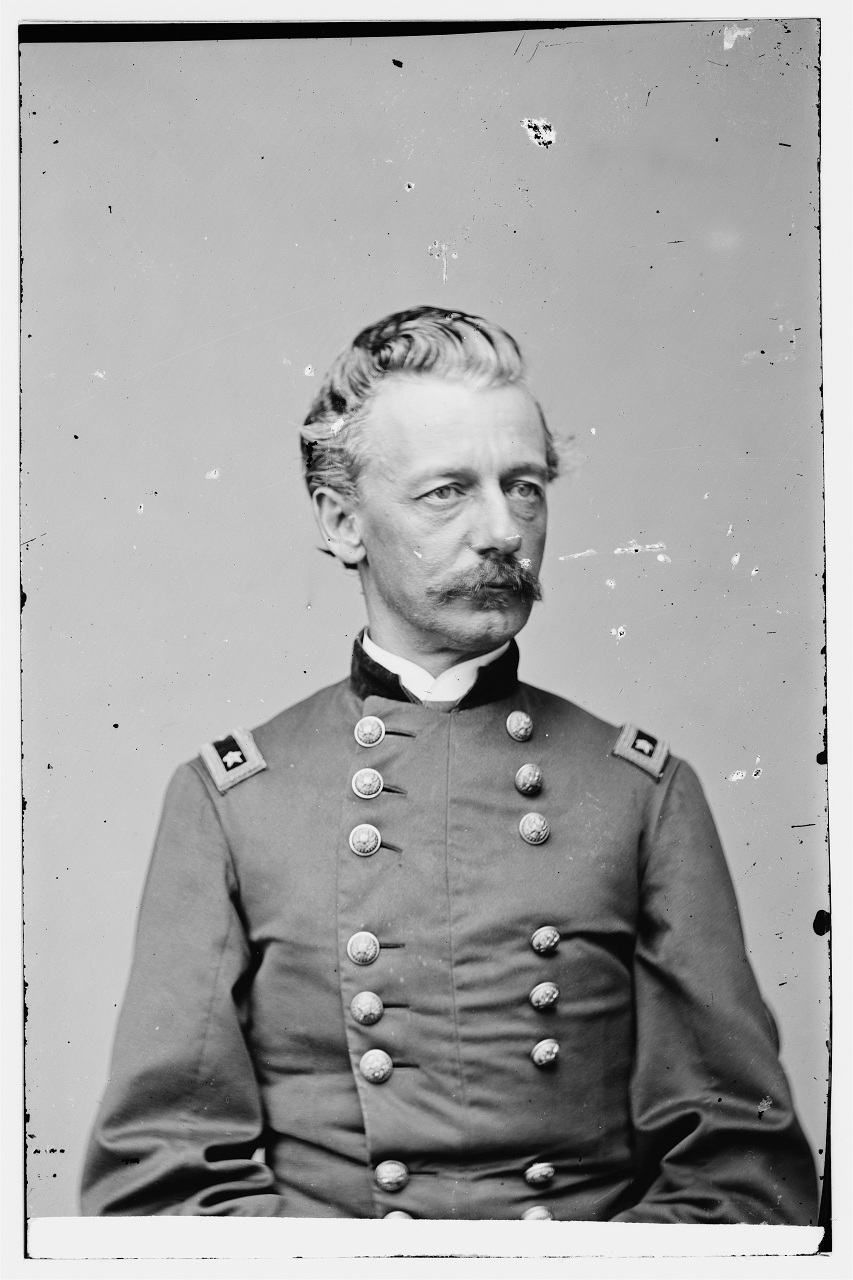
Nicknamed “Slow Come” for his supposedly dilatory behavior at Gettysburg, Henry Slocum did not like Meade’s report on the battle.

The commanders of the XII Corps were even angrier. Meade had lacked some reports from that corps when he wrote his report, which explains some of his oversights. But Henry Slocum was still incensed, particularly by Meade’s failure to mention that at one point Slocum had command of not just the XII Corps, but a wing of the army that also included the VI and the V. “I allude to this fact for the purpose of refreshing your memory on a subject which you had apparently entirely forgotten when you penned your report,” Slocum complained, “for you have not failed to notice the fact of General Schurz and others having held, even for a few hours, commands above that previously held by them.” Perhaps I am not alone in thinking that Slocum comes across as just a bit petty here.

Brigadier General  Alpheus S. Williams, a XII Corps division commander who had temporarily taken corps command when Slocum held the reins of the wing, wrote to Slocum with similar complaints on December 26, 1863. “I know General Meade to be a high-toned gentleman, and I believe him to be a commander of superior merit and of honest judgment, and I confess to have read that part of his official report relating to the Twelfth Corps with a mixed feeling of astonishment and regret,” said Williams.
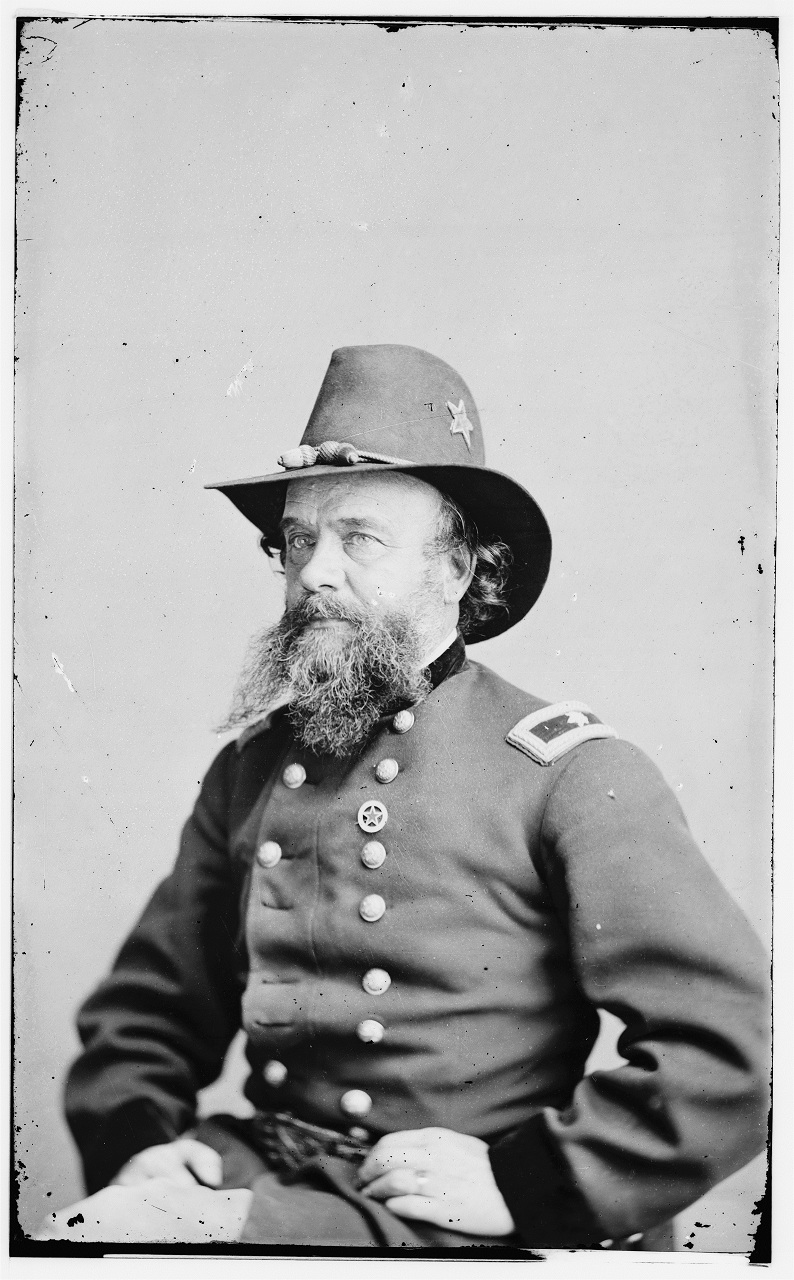
Alpheus Williams of the XII Corps shared Slocum’s displeasure.

Meade wrote to Slocum the next February, granting some points, disputing others. “I very much regret that any injustice should have been done in my official report of the battle of Gettysburg to any part of the Twelfth Corps or any officer in it,” he wrote. “I do assure you most sincerely that nothing was further from my intentions, and that what has occurred was the result of accident and not of design, the occurrence of which I will endeavor to explain.” He admitted to some mistakes but was not willing to take blame for some errors of omission. It was just not possible to credit every brigade and division, he explained. As for omitting George Greene’s stubborn defense of Culp’s Hill on July 2, Meade said, “I am willing to admit that, if my attention had been called to the services of Greene’s brigade in the pointed manner it now is, I would have given it credit for this special service.” In other words, if it was so important to you, why didn’t you say more in your official report? He had a point. While Slocum had praised Greene in his report, he hadn’t gone overboard. “Although General Greene handled his command with great skill, and although his men fought with gallantry never surpassed by any troops under my command, the enemy succeeded in gaining possession of a portion of our intrenchments,” Slocum had noted. “After a severe engagement of nearly three hours’ duration, General Greene remained in possession of the left of our line of works, while the right, which had previously been held by the First Division, was in possession of the enemy. During this engagement, General Greene was re-enforced by three regiments from the First Corps and three from the Eleventh Corps, all of which did good service.”

It wasn’t easy being command of the Army of the Potomac, even between the real battles.

 For the correspondence relating to these issues, see Official Records, Series I, Volume XXVII, Part 1, Meade’s report in on pages 114-119; Robinson’s complaint is on page 119; Slocum’s letter is on pages 763-765; Williams’ letter appears on pages 765-768, and Meade’s reply is on pages 769-770. The entire volume is available via Google Books here.

Fall Cleanup

Members of the General Meade Society of Philadelphia clean up around the Lydia Leister House on September 30, 2012.

Every fall members of the General Meade Society of Philadelphia troop over to Gettysburg and clean up around the Lydia Leister House, the little white building where General Meade established his headquarters for the battle. Last weeekend I went down to help out. There was a pretty good turnout, with more than a dozen people weeding, trimming, and cleaning in the little herb garden and around the house. I pitched in and trimmed the ugly flat bush that squats in between the house and Taneytown Road and, I must say, it looked a lot better when I was done.

Afterwards the whole crew went over to the Farnsworth House for lunch, a traditional part of the day. We ate pizza, drank beer and soda, toasted the general, and chatted. The Farnsworth House was standing here during the battle and still bears the battle scars to prove it. Inside a big glass case opposite the bar there’s a display of artifacts from the movie Gettysburg, including the hat that Richard Anderson wore as Meade. Truth be told, I can’t even remember Anderson in the movie (I’ll have to watch it again). To me he’ll always be Oscar Goldman, Steve Austin’s boss on The Six Million Dollar Man.

There should be another Meade appearing on screens sometime in 2013. A mini-series, formerly titled To Appomattox and now called Grant vs. Lee, should begin shooting late this year. Country singer Dwight Yoakam will play Meade. That’s . . . interesting casting. Yoakam has acted before, most notably in Sling Blade, so maybe he can carry it off. We’ll have to see. Rob Lowe will play Grant (again, the word for that is “interesting”) and the rest of the big cast includes a few other recognizable names. You can find out more at the official website,  or at the fan website.

After lunch at the Farnsworth House I headed off to the battlefield. I was determined to find the little marker that indicates the position that Company B of the 20th Maine held on July 2. After a little searching in the woods just east of the regiment’s main monument I found the small stone marker, up against a stone wall. It’s one of the more obscure monuments on the battlefield. Then I followed a trail around the east side of Little Round Top. Union regiments came rushing through these same woods on July 2, 1863, most notably Colonel Patrick O’Rorke’s 140th New York. General Gouverneur Warren had found O’Rorke’s men, who had served under Warren when he was a brigade commander earlier in the war, and sent them to the undefended Little Round Top. O’Rorke got there just in time and soon fell dead with a bullet in the neck.

I could almost sense the ghosts as I followed the path through the woods.  Eventually I emerged and headed back up Little Round Top on Sykes Road . I veered off to walk across the hill and stopped by the monument to the 146th New York Infantry, which stands on Round Top’s northern shoulder. Engraved on one side of the monument are these words: “From this position Maj. Gen. Meade observed the battle for a time on July 3d.”

The monument to the 146th New York on the north shoulder of Little Round Top.

That intrigued me. I know that after the repulse of Pickett’s Charge Meade rode along his lines down to Round Top, and I assume that’s what the monument is alluding to. After a little searching online I found the Google Books version of Campaigns of the One Hundred and Forty-sixth Regiment New York State Volunteers, Also Known as Halleck’s infantry, the Fifth Oneida, and Garrard’s Tigers (New York: G. P. Putnam’s Sons, 1915). It doesn’t say much about Meade’s presence on July 3, except for this passage (which I have read elsewhere) by Colonel David P. Jenkins about his musing as he stood on Little Round Top after the war:

“I have often thought I would give anything for an oil painting by a good artist of that scene which I shall never forget while life lasts. There was that high bluff, covered with rocky crags, among and on which our brave zouaves were disposed in every possible position. On the central rock was the signal flag telling the story of the battle. And there was Warren, the master mind, it seemed, of the field, with his neck patched up from the wounds received on that spot. There were Sykes and Bartlett and Garrard, as cool as if witnessing a review, while those rifled guns of Hazlett’s were within fifteen yards of the same place, and firing directly over their heads at the Rebel lines, which broke into confusion every time a shell was thrown. And then if the group of Meade and his staff, who came there later, were added, it seems to me it would make an excellent position to locate an historic picture of the battle.”

By then it was starting to spit rain, so I figured it was time to head home and leave the ghosts alone.

Quote from Brainard, Mary Genevie Green, Campaigns of the One hundred and forty-sixth regiment New York state volunteers, also known as Halleck’s infantry, the Fifth Oneida, and Garrard’s Tigers. New York: G. P. Putnam’s Sons, 1915. Available from Google Books here.

The Bloodiest Day

Dead soldiers litter the ground in front of the Dunker Church on the Antietam battlefield.

I’m writing this on the 150th anniversary of the Battle of Antietam, now (and hopefully forever) the record holder as America’s bloodiest day. The casualties on September 17, 1862, were staggering. The Union had lost 2,100 dead, 9,550 wounded and 750 missing, for a total of 12,400. Confederate losses were 1,550 dead, 7,750 wounded and 1,020 missing, for a total of 10,320. The field of battle looked like a landscape from hell, with shattered guns, abandoned equipment, severed limbs and dead bodies scattered about in heaps. One soldier recalled passing a spot where a soldier had lost a leg. “It was laying there with shoe and stocking on the foot, the bloody and ragged end of the thigh showing the terrible force of the missile,” he wrote.

Meade was at Antietam, of course. In fact, by the battle’s end he had taken over command of the I Corps. One soldier who observed Meade during the battle wrote, “General Meade, who succeeded to the command of our corps after General Hooker was wounded, rode up to the crest where we were stationed, and reconnoitred the position of the enemy’s batteries as coolly as if at a review. Already decorated with a bullet-hole in his cap as a trophy of today’s battle, his almost nonchalant manner, and the quiet way in which, amid the tornado of rebel wrath, he gave his orders to make ready for the storm, greatly impressed me.”

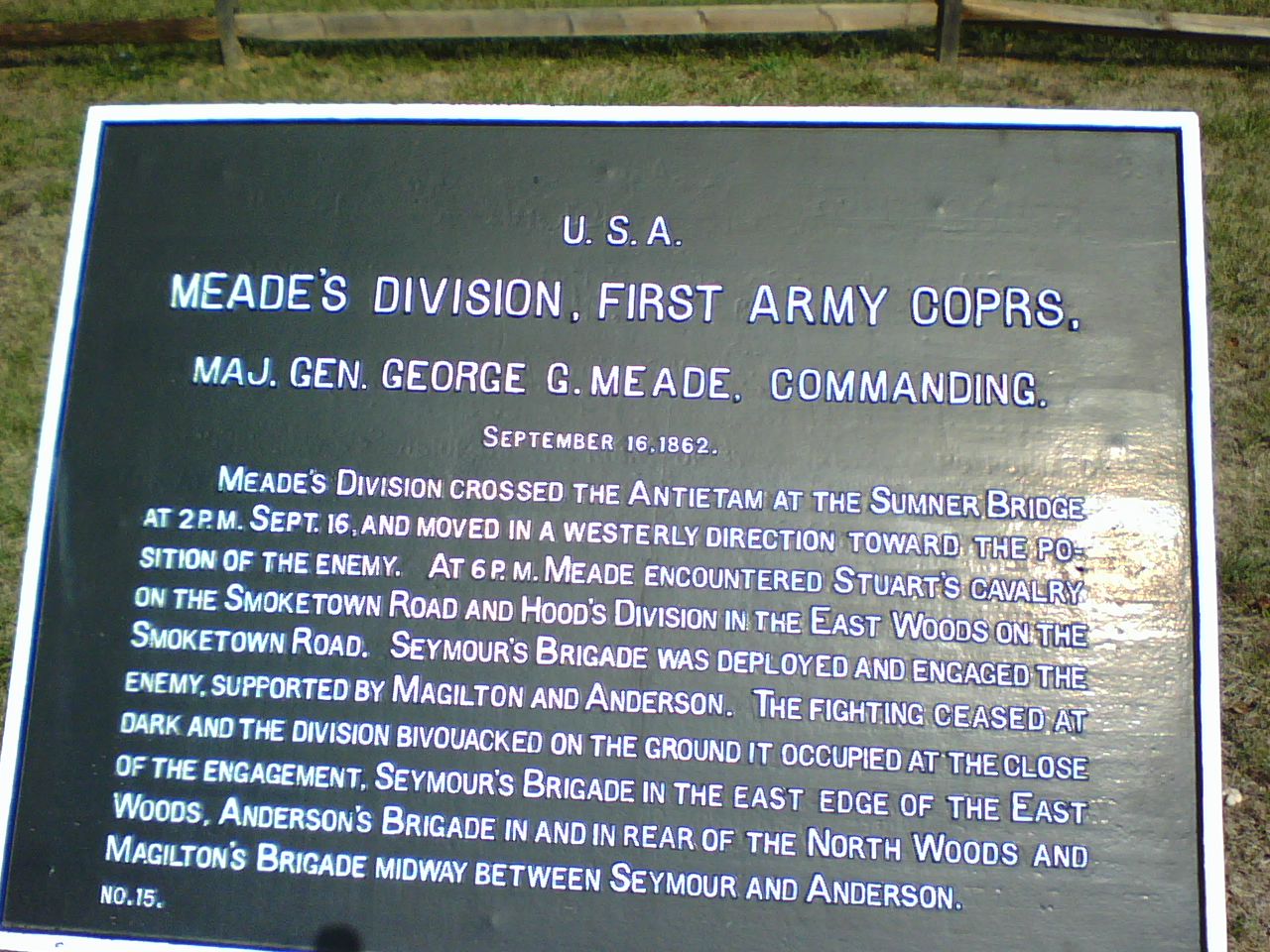
A marker on the Antietam battlefield.

Still, there’s not much about Meade on the battlefield today. At the start of the battle he was only a division commander and even though he was in command of the I Corps by the fighting’s end it was only a temporary assignment. It looked good on his resume, though. Meade continued to prove himself as a steady presence and a fighter.

In the book I include one eyewitness account from a soldier who watched Meade in action. He was a little less calm and collected here. Frank Holsinger was at Antietam with the 8th Pennsylvania Reserves and years later he recalled watching one of his comrades trying to hide behind a tree. “Get that man in the ranks!” Meade ordered a sergeant. Still the man refused. Holsinger watched as Meade pulled out his sword. “I’ll move him!” he cried and struck at the cowering soldier, who fell to the ground. “[W]ho he was I do not know,” Holsinger wrote. “The general has no time to tarry or make inquiries. A lesson to those witnessing the scene. . . . I felt at the time the action was cruel and needless on the part of the general. I changed my mind when I became an officer, when with sword and pistol drawn to enforce discipline by keeping my men in place when going into the conflict.” As another soldier recalled after the Battle of Fredericksburg, “Meade is a rough customer when under fire.”

Drawn from Life

One of the reasons for the enduring fascination people have for the Civil War, I think, is because it was captured in photographs. One hundred and fifty years later we still have haunting portraits of soldiers and civilians from that era, gazing at us from across the gulf of years. It adds a personal dimension to the war.

The photography of the 1860s had its limitations, however. Exposures needed to be long, meaning photographers couldn’t capture fast-moving subjects. The equipment was big and bulky, too, limiting its uses in the field.

That is why Civil War photography hadn’t eliminated the need for sketch artists, those men who captured their impressions of battles and events in drawings they sent back to their publications, where engravers copied them for the printing process.

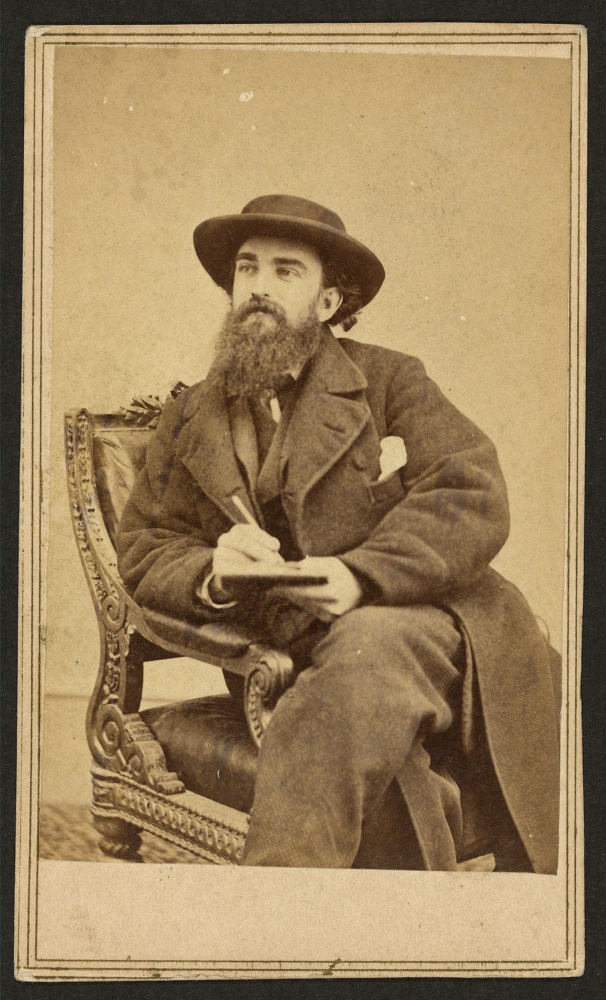
Alfred Waud, photographed by Timothy O’Sullivan in 1863.

One of the best sketch artists of the war was Alfred Waud. Born in England in 1828, Waud began capturing the Civil War on paper first for the New York Illustrated News in 1861 and for Harper’s Weekly later that year. Waud was at First Bull Run and remained with the Army of the Potomac through Appomattox. (David Lowe used a Ward caricature of Theodore Lyman, Meade’s always observant aide, on the cover of the book he edited of Lyman’s journals (highly recommended).

The Library of Congress has a number of Waud’s Meade-related sketches on its website, so I thought I’d post a few here on the blog. (You can click on the images here to see larger versions.)

The image at the top of the page is Waud’s sketch of the ceremony on August 27, 1863, when the Pennsylvania Reserves  presented Meade with a ceremonial sword to honor their former commander. The soldiers raised $1,500 for the elaborate weapon, which had a blade of Damascus steel and a scabbard of gold. Meade’s initials were engraved near the hilt and inlaid with enamel, gold and diamonds. Precious stones circled the handle. Engraved on the blade were the battles that Meade and the reserves had shared. “The more I examine my sword the more I am delighted with its beauty,” he wrote home. “It is really most chaste and artistic. It seems a pity, though, to waste so much money on an article that from its great value is actually rendered useless.”

Waud should have sketched the dinner that followed, which apparently turned into a drunken rout, with a friend of Pennsylvania governor Andrew Curtin standing on a table singing bawdy songs while privates hobnobbed with captains. I have no doubt that Meade excused himself before things descended to that level. The day did lead him into unwanted political controversies, though, when a newspaper reported that in his acceptance speech Meade endorsed Curtin’s reelection. He did no such thing, protested Meade, who always endeavored to avoid politics in his public life.

The second sketch (above) depicts the Battle of the Wilderness, with the figures of Meade and Grant visible in the foreground. The Lacy House—Ellwood—is visible in the background. This is where Fifth Corps commander Gouverneur Warren had his headquarters, and where Stonewall Jackson’s arm, amputated a year earlier, lay mouldering in the family cemetery. The house still stands and is open to the public, with a recreation of Warren’s headquarters in the front room. Another room has a large painting of Meade and Grant riding up to Ellwood to meet with Warren.

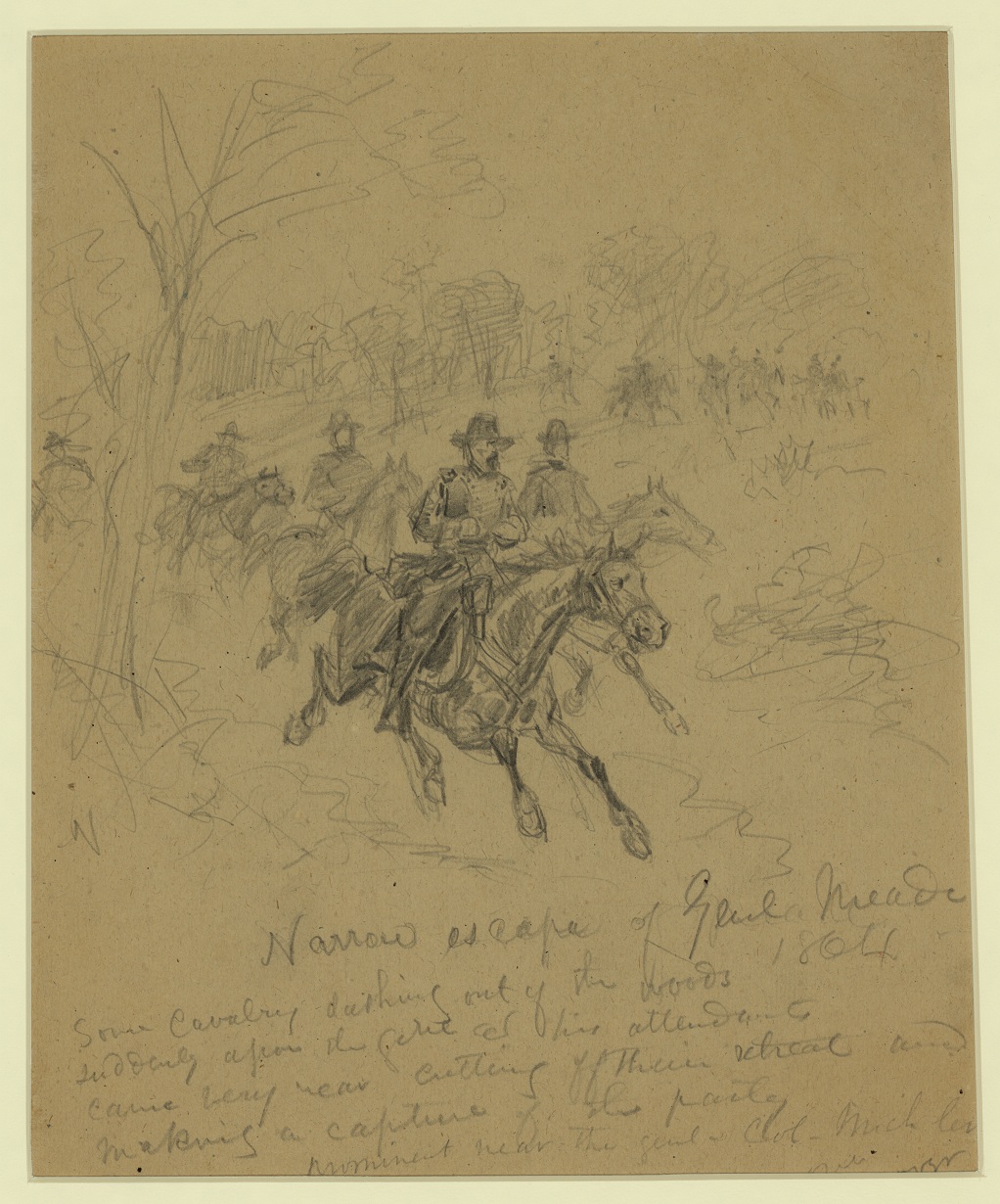
The third sketch (above) shows the “narrow escape of Genl. Meade,” which took place on Myer’s Hill near Spotsylvania, on May 14, 1864. The Union and Confederate armies had bloodied themselves terribly on May 12 and on the 14th Meade rode forward to observe the Union lines. He and the VI Corps’ Horatio Wright were talking in the Myer farmhouse when, as I write in Searching for Meade, “the rattle of muskets and the thud of bullets striking the building delivered unwelcome news: the Confederates were attacking. Meade had to move fast. He jumped on his horse and, guided by Capt. Nathaniel Michler, a topographical engineer with some knowledge of the terrain, hastily made his way back toward the Ni River. A Confederate major galloped over to intercept him and even grabbed Meade’s bridle before his headquarters guard intervened and captured the rebel. The only thing Meade lost, other than his dignity, was his glasses.” I can’t imagine Waud witnessed any of  this first-hand; more likely he drew this after hearing reports from others.

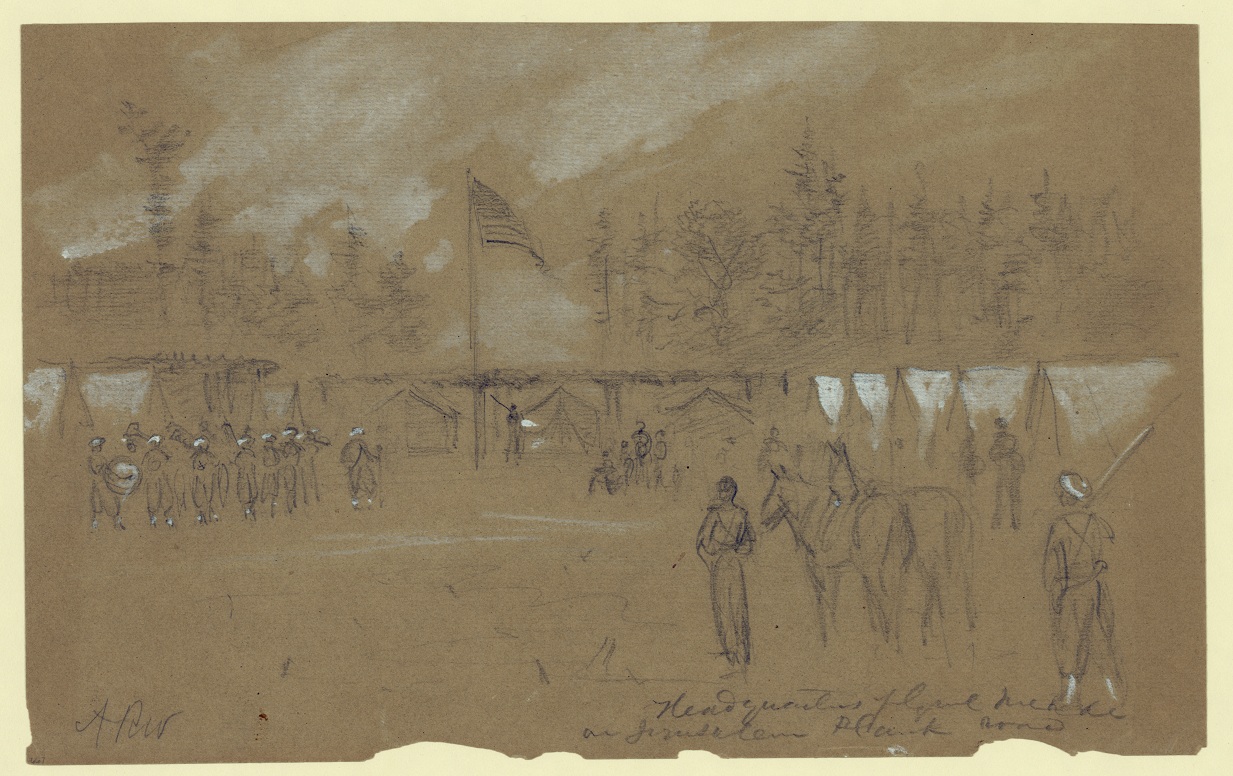
The final sketch here (above) is Waud’s depiction of Meade’s headquarters near the Jerusalem Plank Road outside Petersburg. The soldiers with the white coverings on their heads and lower legs are members of the 114th Pennsylvania (Collis’s Zouaves), the brightly garbed regiment that served as Meade’s headquarters guard.

After the war Waud continued to work as an illustrator and he died of a heart attack in Georgia in 1891.

Cover Story

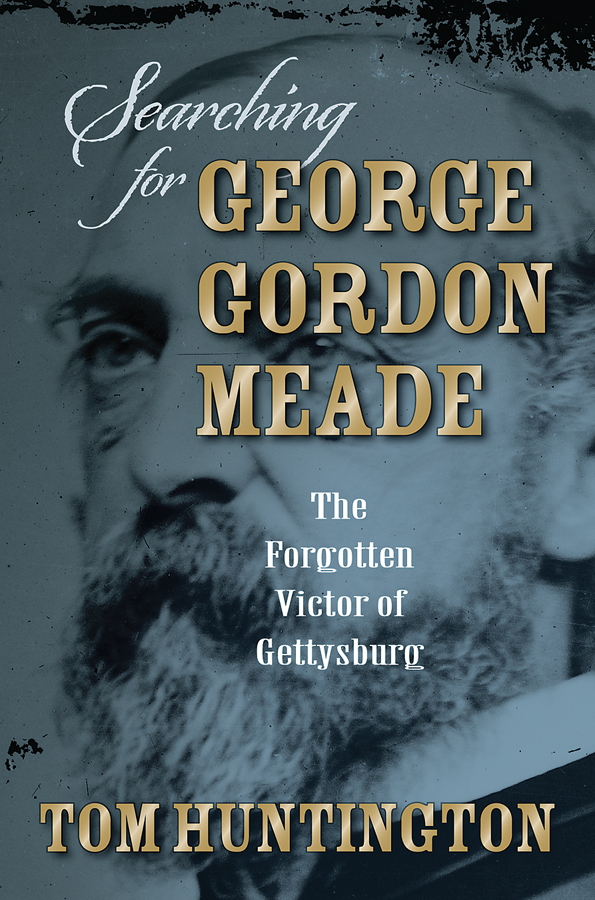
Searching for George Gordon Meade continues to make its way through the editing process, on track for publication in February 2013. We have just reached an important milestone along that course by completing the book’s cover. It was designed by Wendy Reynolds of Stackpole Books’ Creative Services Department and it looks pretty darned good, if you ask me.

So, without further ado, here it is:

Meade Cover

And the book is now available for pre-order through Amazon.com. Why wait?

Museum Visit

An artist’s conception of the sacking of Lawrence, Kansas, by William Quantrill and his men in August 1863. (Library of Congress.)

The other day I got to hold William Quantrill’s Colt revolver.

I was at the National Civil War Museum in Harrisburg, Pennsylvania, with Kyle Weaver, my editor at Stackpole Books. The museum’s new CEO, Wayne Motts, took us into the museum’s storage facility to show us the artifacts there. He was pointing out all sorts of cool stuff when he opened an old wooden box. The Colt was nestled inside its velvet confines. “Look at this,” Wayne said, and he pulled out an envelope tucked into a side pocket. Inside was a letter from the Colt company, verifying that this Colt was the gun purchased by Quantrill. Apparently the notorious rebel guerilla had dropped it when he and his band were sacking Lawrence, Kansas, in August 1863 and a young resident dashed out from hiding to pluck it from the dusty street.

Wayne had me pull on a pair of cotton gloves and he let me hold the gun. Now, I’m no fan of William Quantrill, who I consider to be a genuine bad guy, but I do like close encounters with history.

I first met Wayne several years ago when he was director of the Adams County Historical Society, with his office in Schmucker Hall at the former Lutheran Theological Seminary at Gettysburg. The building itself (currently being restored and refurbished to reopen as a museum in time for the battle’s 150th anniversary) has its own close connections with history. John Buford climbed into the cupola to survey the advancing Confederate forces on July 1 and John Reynolds met him there when he arrived in the advance of the I Corps later that day. I had gone down to interview Wayne for the book I was working on, Pennsylvania Civil War Trails. I had been listening to a taped Gettysburg tour on my way down without realizing that the narrator was Wayne Motts! (I had to laugh just the other day when I was walking down Sykes Avenue on Little Round Top. A motorist parking there opened the door of his car, and the voice I heard coming out of his speakers was Wayne’s.)

The National Civil War Musuem in Harrisburg.

I also wrote about the National Civil War Museum in Pennsylvania Civil War Trails. It’s a beautiful institution with a fabulous collection. For the book I interviewed Harrisburg’s then-mayor, Stephen Reed, who had founded the museum, using city funds to buy a huge collection of artifacts. The museum opened in February 2001. Now, with Harrisburg teetering on the edge of bankruptcy, some people look askance at Reed’s brainchild. (He also bought up a lot of Western artifacts for a planned museum of the west, but that was one museum too many and it never advanced beyond some initial planning. Some of the artifacts have been auctioned off and more will be at some point in the future.) Because of the museum’s origins, the National Civil War Museum gets buffeted about my local and state politics (and current economics) but that doesn’t change the fact that it’s well worth visiting.

Wayne is a man of seemingly inexhaustible energy and enthusiasm so I was very pleased to hear about his appointment to the museum’s top job. I hope Wayne can raise its public profile. In fact, we talked about some things the museum could do for Searching for Meade once the book comes out in February. Once those plans firm up I’ll announce them on this blog.

A Difficult Decision

Major General Gouverneur Kemble Warren

Major General Gouverneur Kemble Warren. During the Mine Run campaign he commanded the II Corps while Winfield Scott Hancock recovered from his Gettysburg wound. ( Library of Congress photo.)

Meade’s Mine Run Campaign, an attempt to turn Lee’s flank in November 1863, was undoubtedly a failure, but at least it was not a disaster. When General Gouverneur Warren, then in command of the II Corps, examined the position he was supposed to attack he decided his men had no possibility of making a successful assault. Although Meade was not happy that his subordinate took it upon himself to make such an important decision, when he studied the lines he conceded that Warren was right. He called off the attack and the Army of the Potomac withdrew to its winter quarters.

“Wherever the fault lies, I shall always be astonished at the extraordinary moral courage of General Meade, which enabled him to order a retreat, when his knowledge, as an engineer and a soldier, showed that an attack would be a blunder,” noted Theodore Lyman, who served on Meade’s staff. “The men and guns stood ready: he had only to snap his fingers, and that night would probably have seen ten thousand wretched, mangled creatures, lying on those long slopes, exposed to the bitter cold, and out of reach of all help! Then people would have said: ‘He was unsuccessful; but then he tried hard, and did not get out.’”

I recently came across a book by George H. Washburn called (take a breath) A Complete Military History and Record of the 108th Regiment N.Y. Vols. From 1862 to 1894 together with Roster, Letters, Rebel Oaths of Allegiance, Rebel Passes, Reminiscences, Life Sketches, Photographs, Etc., Etc. In it Washburn includes an interesting account of his experiences during the Mine Run Campaign and his opinions of Meade’s actions. The 108th New York, also called the Rochester Regiment, served in the second brigade, third division, II Corps.

 In that locality, Mine Run is a stream running hundreds of feet below the rising heights on each side of it, and as the distance across the canon was too far for effective musketry, the batteries on each side held frequent soirees, throwing shot and shells, requiring the boys to keep a sharp look out to hold their base, yet several were seriously hurt. A cold rain storm prevailed, the mud was deep and adhesive, all were drenched and shivering, and unanimously coincided that it was rough.

During the evening, Reynold’s battery, of Rochester, occupying a prominent point, espying a group of Confederates cooking far below them, gave them balls (not fish balls), for hasty dessert, spilling their coffee, and scattering fire and men so skillfully that the bravos were stentorian. Being relieved by the First Corps, we struck out the next morning (Sunday) for a walk through a sterile pine country to a point on the railroad to Orange C. H., which became the extreme left of our line. We arrived in the vicinity of the objective purpose in the afternoon as a cold snow storm set in. Trees and brush were at once cut down in our front, for protection against a surprise. It was rather demoralizing in efforts to eke out comfort from heat coaxed and sworn over from green brush. Early in the morning of the 30th (being bitter cold), orders were given to “fall in,” and we advanced about half a mile, when the work designed for our brigade was discovered. Getting through bushes, upon a rise of ground in front of us, could be seen a field two or three hundred yards across, to the railroad embankment, upon the other side of which it was evident there lurked a large quantity of shooting irons, with well backed power to use them effectively, and the bushy hillside beyond appeared adroitly adapted for masked batteries. The boys pronounced it another “Fredericksburg calamity trap,” and momentarily expecting the signal for advance, shook hands, bade one another good-bye, fully resolved to do their whole duty. The design was, that upon hearing the guns of the Second corps, a general assault was to be made along the whole line by our army. The signal for the first move was not given, and report was current that eight o’clock was the time ; as that hour drew near, there was another scene of good-byes, and “if any of you come out alive, tell my folks I fell doing my duty.” In the meantime Generals Meade and Warren were seen on an eminence in rear of us in anxious consultation, and the question, “Will the assault be made ?” was asked among the men. No signal came for it, and the men breathed more freely. The day waned along in efforts to keep warm. General Jeb Stuart of the Confederate cavalry was getting well around upon our left flank, and exchanging shots with one of our batteries. Soon after sunset orders came to pile up all the rails obtainable and fire them, and as the smoke therefrom began to rise densely, we fell back from our dreaded position, and striking a plank road in the wilderness began to pull away lively.

Artillery and wagon trains passing over the road during the rains had broken many of the planks, and the ends of them were standing at all angles frozen firmly in the mud. “Double quick” was the order, and we double quicked, until brought to a sudden halt by the artillery being snagged by an upright piece of plank. This sort of procedure occurred several times, and the halts in zero air, after double quick headway, strained the boys’ observance of faith inculcated from early piety much. To illuminate the occasion, the leaves by the sides of the road were fired, and we had a vivid illustration of the children of Israel moving through the wilderness by a cloud of fire. About eight o’clock on the morning of December 1st, we arrived at Germania Ford, on the Rapidan, fording the same. We were not out of sight when General Jeb Stuart appeared in hot pursuit. One of our batteries made ugly mouths at him, and he did not attempt to cross after us and give us the grip. It was said he captured our rearguard of one hundred and twenty men belonging to the 126th New York.

The five days of the Mine Run movement, with sharp skirmishes, rain, mud, zero weather, and the night retreat of fifteen miles through the wilderness, was a severe test of endurance, and when camp was reached at Stevensburg, there was rest of righteousness, and all were thankful that the work designed for us to do, and ready to do, and which did not occur was our salvation. Had we reached Orange C. H., and been sandwiched between Lee’s divisions as designed, or made the charge contemplated, we do not think there would have been boys enough of the 108th (in the movement) left for a corporal’s guard.

From Washburn, George H. A Complete Military History and Record of the 108th Regiment N.Y. Vols. From 1862 to 1894 together with Roster, Letters, Rebel Oaths of Allegiance, Rebel Passes, Reminiscences, Life Sketches, Photographs, Etc., Etc. Rochester, NY: E.R. Andrews, 1894. The entire book is available through Google Books.

“They Say He’s a Brick”

The 124th New York’s monument at Gettysburg stands above Devil’s Den. There’s also a smaller marker off Pleasonton Avenue.

I just came across another interesting reference to General Meade in a memoir written by a veteran of the 124th New York. Known as the Orange Blossoms because it hailed from the Empire State’s Orange County, the regiment saw hard fighting at Devil’s Den on July 2. This excerpt deals with the change of command from Joe Hooker to George Meade, which took place on June 28.

Just after muster, orders which announced a change of commanders and stated that Hooker had given place to General Meade, of the Fifth corps, were read at the head of each regiment. Now every intelligent soldier believed that we were on the eve of a great, if not a decisive battle, and at first quite a number shook their heads as if saying to themselves, “There is something wrong somewhere.” But the majority remembering that Hooker had been found wanting at Chancellorsville, expressed their feelings in regard to the change of commanders at that critical period, in such terms as the following, “I’m satisfied. It’s all right boys. That’s ‘Old Pennsylvania Reserves,’—they say he’s a brick.” These remarks came in whispered tones from the ranks behind me, just after the orders referred to had been read. Half an hour later a man in Company F, who had just finished boiling a cup of coffee, raised it toward his lips, and striking a sort of stage attitude, shouted “Soldiers of the army of the Potomac; take out your little Mammy Random books; I am neither a prophet, nor yet the son of a prophet, nevertheless, I am about to prophesy, so draw pencils, ready! aim! The traitor army of Northern Virginia, in the trackless forests of Virginia, surrounded on all sides by traitorous Virginians, and commanded by the arch traitors Lee and Jackson of Virginia, is one thing. But Lee and his army, without Jackson, on open northern soil, surrounded by loyal men, women and children of the north, is another thing. The next battle is on the free soil of old Pennsylvania, and Lee is whipped, no matter who commands us—do you hear me? shoulder pencils. Parade is dismissed.”

This bombastic semi-comical speech, in reality expressed the profound convictions of not only the man who uttered it, but of nineteen out of every twenty in the army of the Potomac; and when a Pennsylvanian standing near replied—“You are right, my boy,” and proposed “three cheers for the sentiment,” they were given with a will by all who heard him.

From History of the One Hundred and Twenty-fourth Regiment: N.Y.S.V. by Charles H. Weygant. Newburgh, New York, Journal Printing House, 1877. You can find the whole book online at Google Books here.

And you can find Weygant’s obituary here.

Connections

Detail of the monument to William Worth in New York City’s Worth Square.

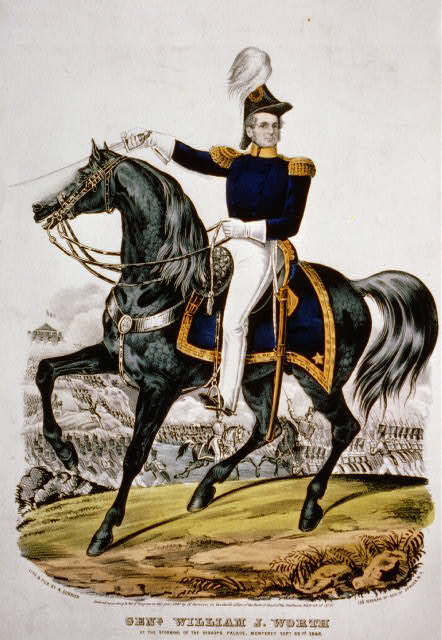
I was up in New York City the other day, and the visit made me wonder if the entire world has invisible connections  to George Meade, if only you know where to find them. While my wife visited foodie heaven of the Eataly in the Flatiron District, I wandered around the neighborhood where, much to my surprise, I discovered the granite obelisk that rises above the gravesite of Major General William Worth at the aptly named Worth Square.

The tall column bore the names of the various battles in which Worth fought, starting with the War of 1812’s battles of Lundy’s Lane and Chippawa. It also included the names of several battles from the Mexican-American War, including Monterrey. That’s why I knew Worth’s name—because George Meade fought with Worth during the Mexican-American War.

Like Meade, Worth served with Zachary Taylor’s army. During the long buildup to war Worth became involved in a testy fight over the status of his brevet rank. A brevet rank is purely honorary, the equivalent of the government’s pat on the back for a job well done. Meade once described a brevet as a “fictitious rank.” A colonel who gets a brevet promotion to general is technically still a colonel. Colonel Worth received the brevet rank of brigadier general for his service in the Seminole War in Florida. Colonel David Twiggs did not have a brevet rank but his rank as colonel predated Worth’s. Worth insisted his brevet made him senior to Twiggs. “The question then arose who would command in case of the death of General Taylor, and after much discussion and excitement, numerous petitions were sent to the President and Congress, and finally the President made a decision adverse to the brevet,” Meade explained in a letter to his wife. Worth resigned from the army in a huff and set off on the long trip back to Washington to complain.

General William Worth.

Meade believed Worth’s actions were “most ill-judged and unfortunate” and that he should have waited until all possibilities of conflict had passed before leaving. “There are many points in General Worth’s character that I admire exceedingly,” Meade wrote. “He is a gallant and brave soldier, but he wants ordinary judgment; he is irritable and deficient in self-command.” (One could apply those last complaints to Meade—and some people did.)

Fortunately for Worth, the war with Mexico unfolded very slowly. He managed to reach Washington, repent his decision, and return to Mexico before Taylor was ready to advance on Monterrey.  (He did, however miss the battles of Palo Alto and Resaca de la Palma.) Meade was assigned to accompany the general to build a depot at Seralvo, Mexico, on the route Taylor’s army would be taking from Camargo to Monterrey. He did not want to leave Taylor, but later admitted to his wife that he had been “agreeably disappointed in my service with General Worth, having been treated with all possible courtesy and kindness, and I hope I shall remain with him so long as he is in the advance.”

A depiction of Worth at the Battle of Monterrey. (Library of Congress)

In fact, Meade was back with Worth’s command during the fighting for Monterrey. Unlike Meade, who got sent home, Worth fought all the way to Mexico City. (He then fought with General Winfield Scott, with the two generals, once fast friends, filing charges and countercharges against each other.) Worth died in San Antonio in 1849 while commanding the army’s Department of Texas. His body was reinterred in New York City in 1857. The historical marker on the cast-iron fence informed me this is the city’s second oldest monument (the oldest being the George Washington  at Union Square). It is also one of only two monuments in the city that are also mausoleums, the other one being Ulysses S. Grant’s tomb. Meade, of course, served with both men.

When I rounded the corner in New York City and came face-to-face with this memorial to General Worth, I felt like I had suddenly bumped into an old acquaintance. I took out my camera phone and was snapping some photos when a white-bearded man, his face red from the sun and a large camera bag hanging from his shoulder, approached me. “So you’re interested in General Worth, are you?” he asked.

I told him I was actually more interested in George Meade and explained that Meade had known Worth during the Mexican War. We then had a nice chat about Worth and war and cannons and all sorts of things. Turns out my new friend was working on a history of the army’s Fort Slocum in New Rochelle, New York. “Ah! Named after one of Meade’s corps commanders!” I said.

“It’s all gone now,” he told me. Still, we agreed that history is all around us—you just need to know where to look. And when you find it, don’t be surprised if you also discover a connection to George Gordon Meade.

A Bullet to the Head

Like many people, I found Michael Shaara’s novel The Killer Angels to be pretty captivating. I read this fictionalized account of Gettysburg a long time ago but I still remember the strong sense of relief I felt as Shaara described Major General John Reynolds and the I Corps reaching the battlefield on July 1 to relieve John Buford’s beleaguered cavalry. And I remember the sense of shock that followed when (spoiler alert) Reynolds fell dead with a Confederate bullet to the back of his head.

Reynolds played a big role in George Meade’s Civil War career as they rose together in the Army of the Potomac. Reynolds was Meade’s commanding officer for a time, positions that were reversed for a very brief period starting on June 28, 1863, when Meade took command of the Army of the Potomac. Three days later Reynolds was dead.

One of the joys of writing a book like Searching for Meade is reading the various memoirs, letters and histories written by people who witnessed events first-hand. One account I used was War Diary and Letters of Stephen Minot Weld, 1861-1865, which was privately printed in 1912 (fortunately for me, it’s now available online at Archives.com. Otherwise I might have had some difficulty finding one of the 50 copies that were printed.) Weld was a Harvard graduate who had gone to war at the tender age of 20. He found a spot with Reynolds after he left the staff of General Henry Benham. Benham, an army engineer, had made a fool of himself at the start of the Chancellorsville campaign during the laying of the pontoon bridges across the Rappahannock when he arrived on the river banks loudly and obviously drunk. Wrote Weld:

I was asked by two officers, General Russell being one, whether General Benham was not drunk. I said he was not, as I knew he took wine only and not any liquors. Then, too, I was accustomed to his swearing, etc., and thought nothing of it. Pretty soon a captain came riding along on horseback, and General Benham opened on him, yelling out in a loud tone of voice and Goddamning him. This, too, right on the bank of the river and when he had just been cautioning every one to keep quiet. I said to the general, “Don’t call out so loud, sir, the enemy can hear you.” He still kept on, however. . . .  When I came back about 6 o’clock, I found General B. drunk as could be, with a bloody cut over his left eye, and the blood all over that side of his face and forming a disgusting sight altogether. He had fallen down and cut his face. Soon after he reeled in his saddle, and in trying to shake hands with General Pratt, he fell right off his horse on to the ground. I saw him do this. The soldiers picked him up, and he mounted again, and rode round among the men, swearing and trying to hurry matters, but only creating trouble and making himself the laughing-stock of the crowd. Finally three bridges were got across and then we started for the two lower bridges where an unsuccessful attempt had been made to cross in the morning. The general had got moderately sober by that time, and began to feel slightly ashamed of himself. I never in my life have been so mortified and ashamed as I was this morning. I shall leave his staff as soon as possible, and I don’t see how he can escape a court-martial and dismissal from the service. By sheer good luck we got the men across the river and built the bridges. General Benham’s being drunk delayed the laying of the bridges for four hours; his mismanagement all but ruined the whole plan. Every one there expected a disgraceful termination to the whole affair, and as I have said, good luck only saved us, for the rebels had two or three hours to prepare themselves, after we arrived on the ground, when they should have had but half an hour at the outside.  

Simply astonishing behavior. Weld followed through on his resolve to leave Benham’s staff and he got an appointment with Reynolds. In fact, as I mention in the book, it was Weld who delivered a message from Reynolds to Meade on July 1. He was on his way back to the battlefield when he met a messenger who told him Reynolds had been shot. He hoped it wasn’t true. A little further on he found undeniable proof that it was when he the encountered the wagon carrying the general’s body.

John Fulton Reynolds

“I felt very badly indeed about his death, as he had always treated me very kindly, and because he was the best general we had in our army,” Weld wrote. “Brave, kind-hearted, modest, somewhat rough and wanting polish, he was a type of the true soldier. I cannot realize that he is dead. The last time I saw him he was alive and well, and now to think of him as dead seems an impossibility. He had just been putting the Wisconsin brigade in position when the enemy opened a volley and the general was struck in the back of the neck, killing him almost instantly.”

Weld accompanied the general’s body to Reynolds’ home town of Lancaster, Pennsylvania, for the funeral. “We reached Lancaster about 12 m., and there found an immense crowd of women, men, and children waiting at the depot,” he wrote. “We got into some old wagons, and drove to the cemetery. Here a chapter of the Bible was read, and prayer delivered, and then poor General Reynolds disappeared from us for some time to come.”

Reynolds’ grave, Lancaster, Pennsylvania.

Last winter I visited Reynolds’ grave at Lancaster Cemetery. It was a dreary, gray afternoon and the cemetery was deserted. The few spots of color were the American flags fluttering in the weak winter breeze on veterans’ graves, and a colorful flourish from the bright green holly tree that stands in the Reynolds family plot. The general’s body was beneath a weathered white obelisk, its inscription nearly worn away. (In 1989 the Independent Battery of the First Pennsylvania Light Artillery and the Lancaster County Historical Society placed a more resilient granite stone at its base with a copy of the inscription.) An American flag and a wreath provided two more spots of color.

The years have not been kind to Reynolds’ monument. Big cracks marred its base. Some of them, in an example of symbolism in real life, extended through the word “Gettysburg.” The trappings of his office—a saber, a sword and a sash, decorated the obelisk’s face, but the elements had worn them smooth, too. Time is an implacable and relentless foe, as deadly as any bullet.