Butler (February 5, 1864)

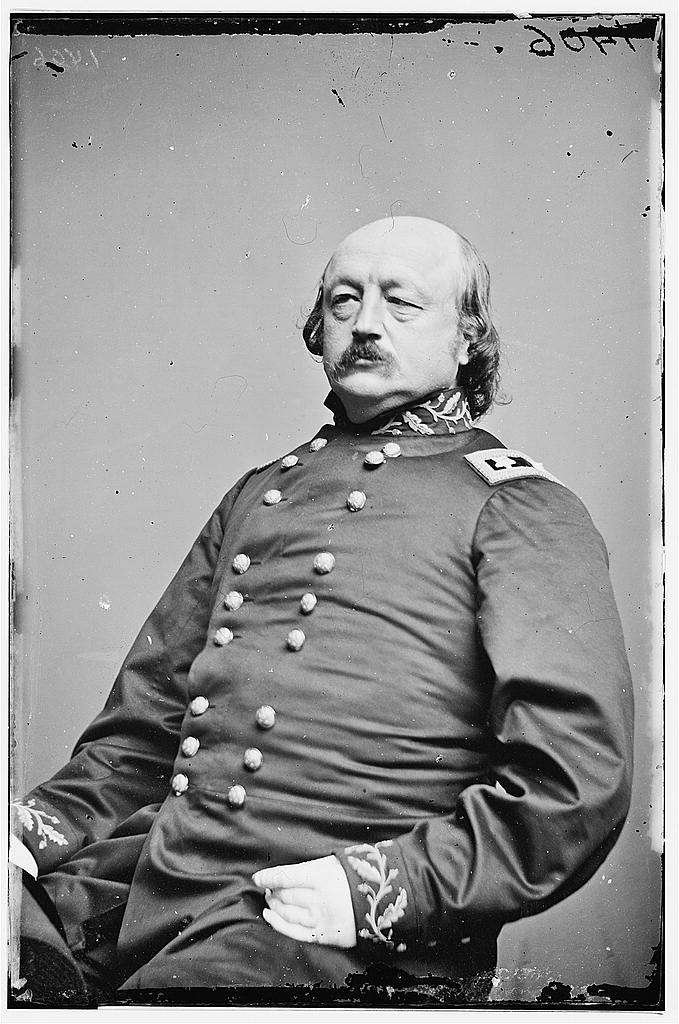
Another letter from Theodore Lyman, while Meade remains ill in Philadelphia. In this missive Lyman mentions Major General Benjamin Butler, who commanded the Army of the James. Butler was one of the Union’s political generals, promoted not because of military experience but because of his political influence. He had aroused Southern ire for his heavy-handed military rule in New Orleans (where he earned the nickname of “Spoons” for allegedly looting the town. Southerners also called him “Beast” Butler.) During Grant’s spring  campaign, the cockeyed Butler and his army were supposed to form one part of Grant’s multipronged campaign against the Confederacy. Instead, Butler had gotten his army bottled up at Bermuda Hundred with his back against the James River, where it remained, impotent and useless until it was too late for them to do any good. Here Lyman describes a plan by Butler and the opinions about it expressed by the non-political generals of the Army of the Potomac.

Benjamin Butler. He was a mediocre general but a wily politician (Library of Congress).

Benjamin Butler. He was a mediocre general but a wily politician (Library of Congress).

General [Andrew] Humphreys sent for me and showed me a cipher correspondence between Butler and [Henry] Halleck, and Halleck and [John] Sedgwick. B. telegraphed that large reinforcements had been sent from the Rapid Ann to North Carolina, and that he wished a demonstration to “draw their forces from Richmond.” S. replied that, with the exception of some two or three brigades, nobody had been sent to that place from the army in our front. B. then said he was going to move on Richmond, or something of the sort, and would like a demonstration not later than Saturday (to-morrow). S. said it was too short a time to make any great show and that it would spoil our chances for a surprise on their works, in future. H. then telegraphed to do, at any rate, what we could. So [Judson] Kilpatrick has been sent to their right via Mine Ford, and [Wesley] Merritt is to threaten Barnett’s Ford; and to threaten Raccoon Ford, while the 2d will make a stronger demonstration at Morton’s Ford. Old Sedgwick and General Humphreys are cross at the whole thing, looking on it as childish.

Theodore Lyman’s letter is from Meade’s Headquarters, 1863-1865: Letters of Colonel Theodore Lyman from the Wilderness to Appomattox, p. 68. Edited by George R. Agassiz. Boston, Massachusetts Historical Society, 1922. Available via Google Books.

Go back

Your message has been sent

Warning
Warning
Warning
Warning

Warning.

A Party of Ladies (January 29, 1864)

John Sedgwick and staff stand in front by the VI Corps headquarters near Culpeper. Taken in March 1864, this photo shows Sedgwick standing third from right (Library of Congress).

John Sedgwick and staff stand in front by the VI Corps headquarters near Culpeper. Taken in March 1864, this photo shows Sedgwick standing third from right (Library of Congress).

The business of war wasn’t always hell; there was frivolity, too, especially in winter camp. In this letter Theodore Lyman details some of the less-serious side of life in the Army of the Potomac. Humphreys, of course, is Meade’s chief of staff, Andrew Humphreys.

General Andrew Atkinson Humphreys. (Library of Congress)

General Andrew Atkinson Humphreys. (Library of Congress)

If you saw the style of officers’ wives that come here, I am sure you would wish to stay away. Quelle experience had I yesterday! I was nearly bored to death, and was two hours and a half late for my dinner. Oh, list to my harrowing tale. I was in my tent, with my coat off, neatly mending my maps with a little paste, when Captain [Adolphus] Cavada poked in his head (he was gorgeous in a new frockcoat). “Colonel,” said he, “General Humphreys desires that you will come and help entertain some ladies!” I held up my pasty hands in horror, and said,”What!” “Ladies!” quoth Cavada with a grin; “ a surprise party on horseback, thirteen ladies and about thirty officers.” There was no moyen; I washed my hands, put on the double-breaster, added a cravat, and proceeded, with a sweet smile, to the tent, whence came a sound of revelry and champagne corks. Such a set of feminine humans I have not seen often; it was Lowell factories broken loose and gone mad. They were all gotten up in some sort of long thing, to ride in. One had got a lot of orange tape and trimmed her jacket in the dragoon style; another had the badge of the Third Corps pinned all askew in her hat; a third had a major’s knot worked in tarnished lace on her sleeve; while a fourth had garnitured her chest by a cape of grey squirrel-skin. And there was General Humphreys, very red in the face, smiling like a basket of chips, and hopping round with a champagne bottle, with all the spring of a boy of sixteen. He spied me at once, and introduced me to a Mrs. M , who once married somebody who treated her very badly and afterwards fortunately went up; so Mrs. M seemed determined to make up lost time and be jolly in her liberty. She was quite bright; also quite warm and red in the face, with hard riding and, probably, champagne. Then they said they would go over to General [John] Sedgwick’s, and General Humphreys asked if I would not go, too, which invitation it was not the thing to refuse; so I climbed on my horse, with the malicious consolation that it would be fun to see poor, modest Uncle John with such a load!

Major General John Sedgwick. His men called him "Uncle John" (Library of Congress).

Major General John Sedgwick. His men called him “Uncle John” (Library of Congress).

But Uncle John, though blushing and overcome, evidently did not choose to be put upon; so, with great politeness, he offered them sherry, with naught to eat and no champagne. Then nothing would do but go to Headquarters of the 3d Corps, whither, to my horror, the gallant Humphreys would gang likewise. Talk about cavalry raids to break down horses! If you want to do that, put a parcel of women on them and set them going across the country. Such a Liitzow’s wild hunt hath not been seen since the day of the respected L. himself! Finally one lady’s horse ran away, and off went the brick, Humphreys, like a shot, to stop her. Seeing her going into a pine tree, he drove his horse between the tree and her; but, in so doing, encountered a hidden branch, which slapped the brisk old gent out of his saddle, like a shuttlecock! The Chief-of-Staff was up in a second, laughing at his mishap; while I galloped up, in serious alarm at his accident. To make short a long story, the persistent H. tagged after those womenfolk (and I tagged after him) first to Corps Headquarters, then to General Carr’s Headquarters, and finally to General Morris’s Headquarters, by which time it was dark! I was the only one that knew the nearest way home (we were four miles away) and didn’t I lead the eminent soldier through runs and mud-holes, the which he do hate!

To-day we have had a tremendous excitement: a detail of 250 men to “police” the camp, under charge of [James C.] Biddle, just appointed Camp Commandant. They have been sweeping, cutting down stumps, burning brush, and, in general, making the worst-looking camp in the army neat and respectable.

Theodore Lyman’s letter is from Meade’s Headquarters, 1863-1865: Letters of Colonel Theodore Lyman from the Wilderness to Appomattox, pp 65-7. Edited by George R. Agassiz. Boston, Massachusetts Historical Society, 1922. Available via Google Books.

Lyman Returns (January 23, 1864)

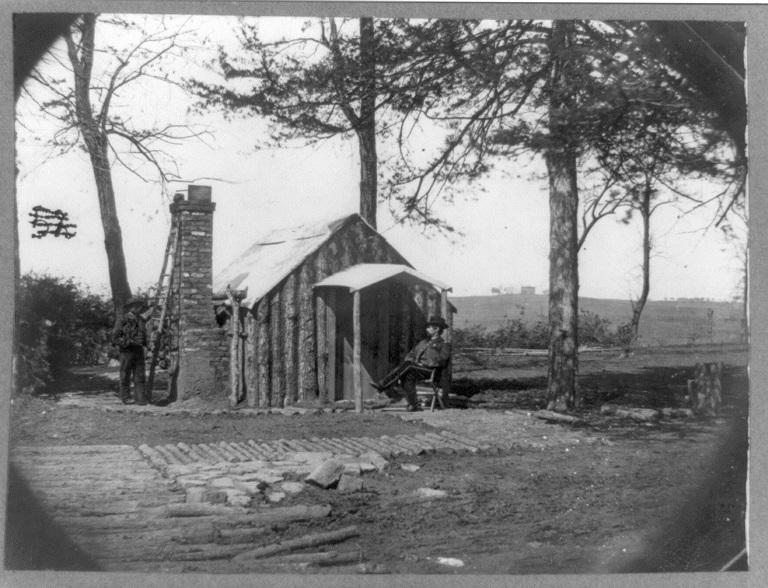
An officer of the Army of the Potomac lounges outside his winter quarters. No wonder soldiers sought to go home on leave (Library of Congress).

An officer of the Army of the Potomac lounges outside his winter quarters at Brandy Station. No wonder soldiers sought to go home on leave (Library of Congress).

George Gordon Meade and his aide, Theodore Lyman, both stopped writing letters when they departed for their respective homes while the Army of the Potomac established winter camp, thus depriving us of their observations on current affairs. But Lyman finally returns to the fold with a letter dated January 23. I include the editorial note included in Meade’s Headquarters, 1863-1865: Letters of Colonel Theodore Lyman from the Wilderness to Appomattox (1923). General Humphreys is Andrew Humphreys, Meade’s chief of staff.

[Toward the end of December, the army being then well settled in winter quarters, Lyman obtained leave of absence, passed Christmas at home, and returned to the army about the middle of January. He found Headquarters almost deserted, General Meade sick in Philadelphia with an attack of inflammation of the lungs, General Humphreys, and his tent-mate Rosencrantz, away on leave of absence, and Barstow sick and weak, with a cold on the lungs.]

Yesterday came General Humphreys, to my great content. His son, with Worth and myself, rode down to bid him welcome. Such a sea of mud round Brandy Station was enough to engulf the most hardy. There is no platform to get on; nothing but the driest spot in the mud. You should have seen the countenances of the unfortunate officers’ wives, as they surveyed, from the height of the platform, this broad expanse of pap! Then the husband would appear, in great excitement, and encourage them to descend, which they presently would do, and dab across to an ambulance, seeming mutely to say, that this wasn’t quite what they expected. The neat General (who left in hard weather) was entirely aghast, and said, in painful accents, “What! must I get down there? Oh, the deuce!” I do believe that officers will next be trying to bring down grand pianos. You needn’t talk of coming here with “small hoops.” I have too much respect for you to allow the shadow of such an idea. As Frank Palfrey sensibly observed: “I think I should consider some time before I brought my wife to a mud-hill.” . . . The whole country, besides the mud, is now ornamented with stumps, dead horses and mules, deserted camps, and thousands upon thousands of crows. The deserted camps (than which nothing more desolate) come from the fact that several divisions have lately changed position. General Meade has been seriously ill at home; but we have a telegraph that he is much better, and I have forwarded him, for his edification, a variety of letters, opened by me at General Williams’s request.

Theodore Lyman’s letter is from Meade’s Headquarters, 1863-1865: Letters of Colonel Theodore Lyman from the Wilderness to Appomattox, pp 64-5. Edited by George R. Agassiz. Boston, Massachusetts Historical Society, 1922. Available via Google Books.

Winter Leaves (December 10, 1863)

General Meade and General Sedgwick visit the Horse Artillery headquarters at Brandy Station. The Army of the Potomac established its winter quarters at Brandy Station in 1863 and remained there until the start of the Overland Campaign the next May.

General Meade and General Sedgwick visit the Horse Artillery headquarters at Brandy Station. The Army of the Potomac established its winter quarters at Brandy Station in 1863 and remained there until the start of the Overland Campaign the next May.

It appears that campaigning is over for the winter and attention turns to more mundane things: leaves and winter quarters. Theodore Lyman takes the pulse of the army and reports on the speculation about Meade’s replacement. Major Biddle is James C. Biddle of Meade’s staff. In Meade’s Army: the Private Notebooks of Lt. Col. Theodore Lyman, editor David Lowe reports that Biddle “came from a distinguished military family but did not always meet expectations. He could be something of a buffoon and was the target of much good-natured camp humor.”

All the officers are inclined to be petulant and touchy, for they think that winter quarters are coming and are all stretching out for “leaves,” which they know only a part can get. Major Biddle becomes quite irate over the subject. “Now there is General Webb has a ten-day leave,” says B. petulantly; “every corps is to give one general a ten-day leave. I don’t want any little ten-day leave; I want a decent leave; a sixty-day leave. I have been two years and a half in this army, and never had but seven days’ leave, except once when I was sick; and it isn’t any fun to be sick. If we are going into winter quarters, one third of this army can do what is necessary, just as well as the whole; and they might as well be liberal to us. It is too bad! really too bad!” Such discoveries of patriotic services as the officers now make, to back up their applications, are miraculous. They have all been in service since the First Bull Run (the Genesis of the Potomac Army); they have all been wounded six times; they have never been absent a single day; their wives are very sick; their mothers are not expected to live; and they can easily bring back fifty volunteers with them, to fill up their regiment! All of which General [Seth] Williams receives with the blandest smile, as if he had never before heard of so strong a case, and promises to refer it to General Meade, which indeed he does. Meanwhile the rattling of axes is heard on all sides, and villages of little log huts, with canvas roofs, spring into existence in a single night. General [Rufus] Ingalls asked if the troops could have permission to build huts: to which the Major-General commanding replied, with charming non-committal. “Build huts; certainly; why not? They can move from huts as well as from tents, can’t they?” I observe the papers continue to discuss the succession of the General. He himself thinks he will be relieved, but I doubt it. If for no other reason, because it is hard to find anyone for the post. General Sedgwick would, I think, refuse; General Warren is very young, and is, besides, under a cloud about his movement on our left. General Sickles, people would say, is too much of a Bowery boy. Generals French, Newton, and Sykes are out of the question. General Humphreys has no influence strong enough to put him up. Any subordinate general would have to be of great note to be lifted thus high; there is no such one. I think they would not try a western general, after Pope’s experience. The only one I can think of is Hancock, for a long while laid up by his Gettysburg wound, and not yet in the field. He belongs in this army, is popular, and has an excellent name. The New York Herald insists on General Pleasonton, which is an original idea. I heard of an officer who asserted that he had seen the order putting him in command; a rather unlikely assertion.

Theodore Lyman’s letter is from Meade’s Headquarters, 1863-1865: Letters of Colonel Theodore Lyman from the Wilderness to Appomattox, p 61. Edited by George R. Agassiz. Boston, Massachusetts Historical Society, 1922. Available via Google
Books
.

Moral Courage (November 30, 1863)

Alfred Waud titled this sketch "Rebel line on the left at the railroad cutting. Mine Run--opposite Warrens last position." Warren and then Meade both decided that Lee's entrenched position was too strong to attack. Click to enlarge (Library of Congress).

Alfred Waud titled this sketch “Rebel line on the left at the railroad cutting. Mine Run–opposite Warrens last position.” Warren and then Meade both decided that Lee’s entrenched position was too strong to attack. Click to enlarge (Library of Congress).

We continue with an account by Theodore Lyman as he details the climax—the anti-climax actually—of George Meade’s Mine Run campaign. As I write in Searching for George Gordon Meade: The Forgotten Victor of Gettysburg, Gouverneur Warren had planned to launch his offensive the next morning, with an artillery barrage signaling the start of the attack. Warren would go in at 8:00, and then John Sedgwick, on the opposite end of Robert E. Lee’s line, would begin his movement. The guns began roaring on time at 8:00, but at 8:50 Capt. Washington Roebling (of later Brooklyn Bridge fame) came galloping up to Meade’s headquarters with a message from Warren. Meade read it. “My God!” he exclaimed. “General Warren has half my army at his disposition!”

Warren had carefully surveyed the enemy position opposite his and decided, on his own authority, that the Confederates had strengthened it so much during the night that it was now much too strong to attack.

The Mine Run defenses did appear strong indeed. Chaplain Alexander Stewart of the 102nd Pennsylvania felt certain an attack on them would lead to a great loss of life. The men in his regiment agreed, and as the day passed they came to him and filled his pockets with all the mementos of the lives they expected would soon end—money, photographs, rings, watches. Some soldiers began pinning their names to their coats so their bodies could be identified. What impressed Stewart, though, was that despite the terrible odds, these soldiers were still willing to go into battle.

Lt. Col. Charles H. Morgan of the II Corps staff suspected that many officers shared their soldiers’ misgivings but kept their doubts to themselves. One picket from the 1st Minnesota, not realizing that Morgan was an officer, didn’t hide anything. He told Morgan the enemy position was “a damned sight worse than Fredericksburg” and added, “I am going as far as I can travel; but we can’t get more than two-thirds of the way up the hill.”

Pvt. Wilbur Fisk of the 2nd Vermont, at the other end of the Union line with Sedgwick’s VI Corps, studied the Confederate defenses with great interest because there seemed a pretty fair chance that he would soon be testing them personally. “There was a deep creek between us and the enemy, and the rebels had been busy digging rifle-pits and strengthening their position ever since we came up to them,” he wrote. “Both banks were abrupt and steep and difficult to get over, while on the rebel side they had added to these disadvantages by placing every conceivable obstacle in the way of our advance. Trees were felled, abattis made, breastworks were thrown up until they occupied a position that if we had occupied we should have considered impregnable against all the rebels in the universe.”

After consulting with Warren and examining the defenses for himself, Meade reluctantly agreed with his subordinate’s opinion—attacking Lee’s position here would be nothing more than a useless slaughter, another Fredericksburg. Meade suspected someone else would have to take the responsibility for renewing the war against the Army of Northern Virginia, because he expected to be removed from command for canceling his attack.

Meade and his corps commanders. Gouverneur Warren (II Corps) is seated at left; William French (III Corps) stands next to Warren. Then, left to right, are Meade, artillery chief Henry Hunt, and chief of staff Andrew Humphreys (Library of Congress).

Meade and his corps commanders. Gouverneur Warren (II Corps) is seated at left; William French (III Corps) stands next to Warren. Then, left to right, are Meade, artillery chief Henry Hunt, chief of staff Andrew Humphreys, and the V Corps’ George Sykes (Library of Congress).

Almost before daylight our waggons were loaded and away, for the Headquarters are only a few hundred yards in the rear of our heavy guns and directly on the road, so that we expected a nice lot of shells, say at 8.10 A.m. A little before that the General mounted and rode towards General [John] Newton’s quarters, and, while near there, bang! went a cannon on the right; then boom! boom! from the 32 pounders, and then, bang, boom, bang, pretty generally. In all the woods the troops were massed for the attack, waiting orders. We rode back to Headquarters, and, a moment after, Captain [Augustus] Roebling from General Warren’s Staff, galloped up. He is the most immovable of men, but had, at that moment, rather a troubled air. He handed a scrap of paper. General Meade opened it and his face changed. “My God!” he said, “General Warren has half my army at his disposition!” Roebling shrugged his shoulders. The note was to the effect that General Warren had made a careful examination of the enemy’s works, had altered his opinion of last evening, and considered an assault hopeless!!! Orders were at once issued to cease firing. We tried to take it all philosophically, but it was hard, very hard. Most of all to General Meade and General [Andrew] Humphreys, who really took it admirably, for both of them have excellent tempers of their own, which, on occasions, burst forth, like twelve-pounder spherical case. In a little while the General again rode away; this time to see General Warren, some four miles off. Two aides, besides myself, went with him. We rode along the rear of our batteries, which were still, from time to time, exchanging shots with those opposite; though not when I chanced to be passing, I am happy to say. General Warren had a sad face, as well he might. He drew aside, with the two other generals, and there they stood, in long consultation, over a fire which had been made for them, for the air was sharp. Then we started back again, stopping half-way at General [William] French’s, whom we found in a fuming passion, partly because two of his divisions had been, in some way, put under guidance of General Warren, and partly because he was all ready for the assault and had pushed his skirmish line to within 300 yards of the Rebel works, while the storming parties were in a great rage at not being led on. Alas! it was of no use; General Humphreys, with a heavy sigh, pronounced the opportunity (if it had ever existed) now past; and, when he cries no fight, you may be sure there is not much chance. At a meeting that evening, the other generals concurred. It was physically impossible to flank any more on either side, and the only thing that remained was:

The King of France with forty thousand men,
Marched up a hill; and then marched down again.

Wherever the fault lies, I shall always be astonished at the extraordinary moral courage of General Meade, which enabled him to order a retreat, when his knowledge, as an engineer and a soldier, showed that an attack would be a blunder. The men and guns stood ready: he had only to snap his fingers, and that night would probably have seen ten thousand wretched, mangled creatures, lying on those long slopes, exposed to the bitter cold, and out of reach of all help! Then people would have said: “He was unsuccessful; but then he tried hard, and did not get out.”

Theodore Lyman’s letter is from Meade’s Headquarters, 1863-1865: Letters of Colonel Theodore Lyman from the Wilderness to Appomattox, pp. 56-8. Edited by George R. Agassiz. Boston, Massachusetts Historical Society, 1922. Available via Google Books.

Payne’s Farm (November 27, 1863)

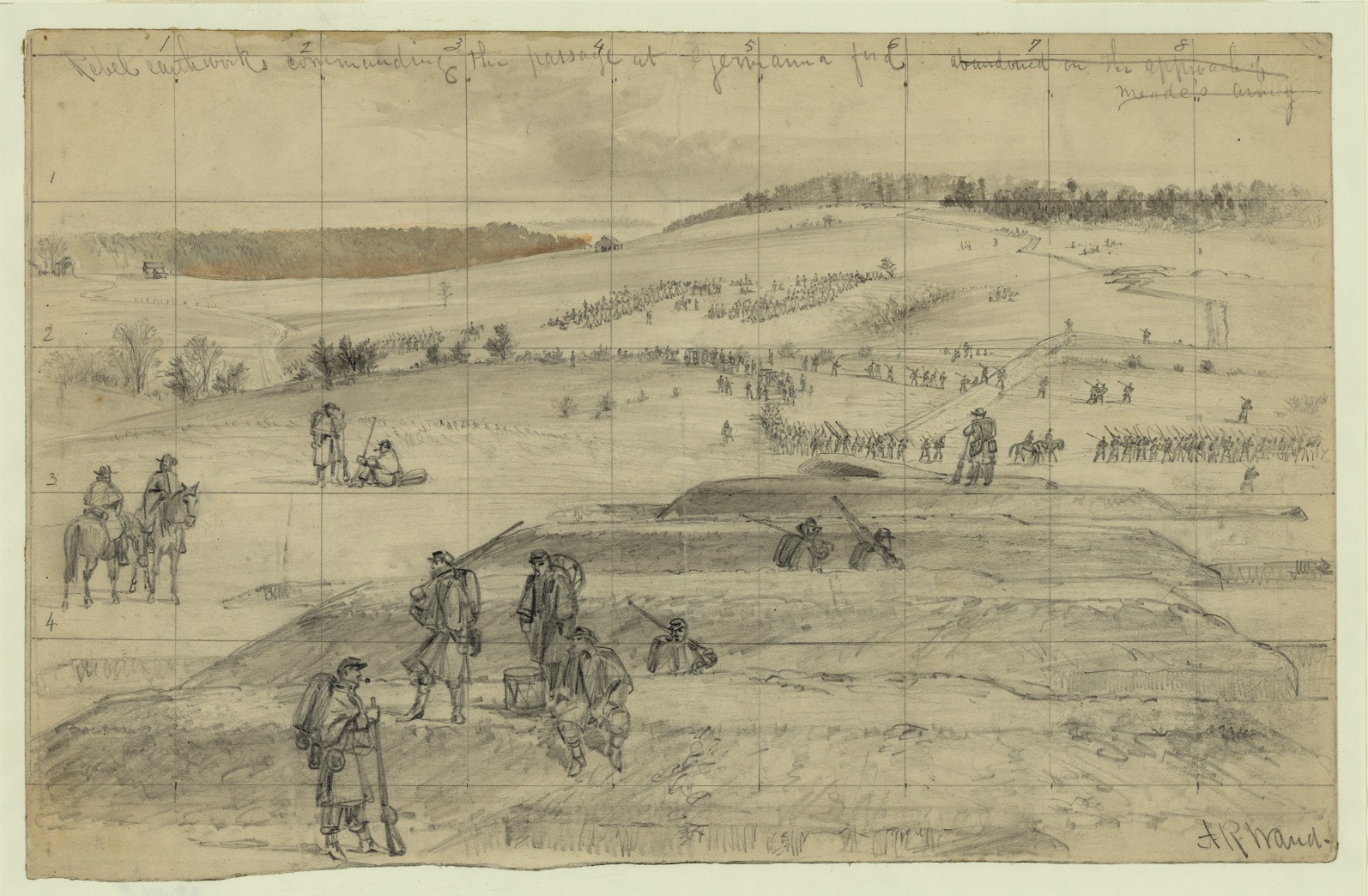
Artist Alfred Waud labeled this sketch "Rebel earthworks commanding the passage at Germanna ford, abandoned on the approach of Meade's army" (Library of Congress).

Artist Alfred Waud labeled this sketch “Rebel earthworks commanding the passage at Germanna ford, abandoned on the approach of Meade’s army” (Library of Congress). Click to enlarge.

In his letter of November 27, Theodore Lyman details the beginning of Meade’s Mine Run campaign. It was an inauspicious start, marked by delays and disappointments. Here’s how I described the situation in Searching for George Gordon Meade: The Forgotten Victor of Gettysburg:

Meade planned to cross his army at various fords along the Rapidan below Lee’s right and make a flanking attack instead of risking a frontal assault against his strong entrenchments. The III Corps would cross at Jacob’s Ford, with the VI Corps following, and then make its way through various woods roads to a place called Robertson’s Tavern. The roads the army had to follow were narrow and winding, as they still are today. The II Corps would cross at Germanna Ford, while the I and V Corps would use Culpeper Mine Ford. Cavalry would guard the flanks. “The plan promised brilliant success,” said chief of staff Andrew Humphreys; “to insure it required prompt, vigorous action, and intelligent compliance with the programme on the part of the corps and other commanders.”

 Therein lay the proverbial rub. Meade wanted his army to rumble into motion on November 24, but heavy rainfall delayed the movement until the twenty-sixth. Then [William] French and the III Corps were two hours late in reaching their ford. Two pontoon bridges turned out to be too short, forcing the engineers to do some time-consuming improvisation, and the banks on the opposite side of the river were steep and difficult to climb. Like many best-laid plans, Meade’s attempt to flank Lee began to unravel. Things slipped further and further behind schedule, giving the Confederates time to react to the Federals’ threatening move.

A native of Eastport, Maine, Henry Prince commanded a division of William French's III Corps (Library of Congress).

A native of Eastport, Maine, Henry Prince commanded a division of William French’s III Corps (Library of Congress).

[Gouverneur K.] Warren and the II Corps reached Robertson’s Tavern on November 27 and began “a brisk little contest” with the rebels there. But French’s III Corps was nowhere to be found. That’s because once the commander of French’s lead division, Brig. Gen. Henry Prince, managed to cross the river, he sat at a crossroads for a couple hours while he tried to determine which road to take; a historical marker stands at this crossroads now.

After driving around here I can understand how the generals became confused. I spend a lot of time stopped at crossroads myself as I peer at my directions and try to figure out which way to go. The stakes, though, were considerably higher for French and Prince. Around 11:30 headquarters finally received a message from French. He said he was waiting for Warren—who was already at Robertson’s Tavern skirmishing with the enemy. Steam must have been shooting out of Meade’s ears at this point. But before French could join Warren, he stumbled into battle on the land of a man named Payne.

The Battle of Payne’s Farm was the only serious fighting of the Mine Run Campaign—although I’m sure the skirmishers and other soldiers who had been killed and wounded in other actions would have said their fights had been serious enough. The Confederates here were commanded by Maj. Gen. Edward “Allegheny” Johnson, also known as “Clubby.” The thirty-two thousand men of the III Corp greatly outnumbered Johnson and his fifty-three hundred troops, but the Confederates fought stubbornly enough to delay French even longer.

Humphreys later complained that French’s tardiness and the holdup at Payne’s Farm essentially paralyzed the entire operation. By the time the army was in a position to attack on the twenty-eighth, Lee had moved his army to a strong position behind Mine Run, a line “crowned with intrenchments for infantry and artillery, strengthened by abates,” said Humphreys. Any frontal assault appeared doomed, but Warren thought he could shift his forces and, reinforced by a division of the VI Corps, attack Lee’s weak right flank. Meade later gave him two additional divisions from the III Corps. While the V and VI Corps made a diversionary attack on the enemy’s left, Warren would make the main attack on its right.

Here we are, camped south of the Rapid Ann, and I find a leisure moment to write you a letter, or rather to begin one. My last formal note, I believe, informed you we were to move “to-morrow” (26th). And, sure enough, yesterday we kept our Thanksgiving by marching, horse, foot, and artillery, as hard as we could paddle towards Germanna Ford.

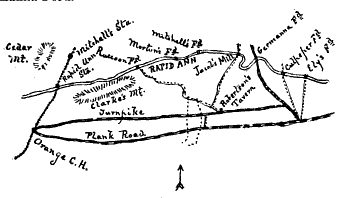
Lyman mapThe above rough map, with the other I sent when I wrote ;at Centreville, will sufficiently explain our moves. From Rapid Ann Station to Morton’s Ford, the Rebels have a strong line of entrenchments, but, beyond that, it is practicable to force a crossing, because the north bank commands the south. Our forces were encamped in a sort of semi-circle, of which one end rested on Kelly’s Ford on the Rappahannock, and the other (at the north) on a tributary of the same river; the centre being about at Brandy Station. . . . The artillery officers had placed two masked batteries, ready to open on the south bank. On the other side of the river there were extensive breastworks, which, however, seemed not occupied. Nevertheless, we could not tell that the woods were not full of them. As the main resistance might be offered here, it was necessary that all the corps should force the passage at the same time, if possible. It so happened that General French was much delayed by heavy roads and other causes, so we had to wait till past twelve before throwing the pontoons. When this was done, there was no opposition whatsoever; but the engineers were stupid enough not to have enough boats, and this made more delay. However, about two P.m. the troops and artillery began to cross, one division having already forded. The solemn and punctual Sykes crossed below, at twelve. But the 3d and 6th, being very large, did not all get over till night, and their artillery, by reason of bad roads, had to come over by Germanna Bridge, and was not over till five the next morning. We (Headquarters) camped on the north bank of the river, near the reserve artillery. It was a magnificent night, but cold. The trains came in after dark, and we had quite a time in finding tents and bedding. Everything is comparative: when I got my tent pitched, my roll of bedding in position, and a little end of a candle lighted, I felt as comfortable as if I came home to a nicely furnished house, with a good fire burning and the tea-table just set! I was up this morning a good deal before daylight. The moon shone very bright and the hoar frost glittered on the tents. … At an early hour the Staff crossed, passing on the steep bank crowds of ambulances and waggons, which of course made the General very mad. . . . Do you know the scrub oak woods above Hammond’s Pond, a sort of growth that is hard for even a single man to force his way through for any great distance? That is the growth of most of this country, minus the stones, and plus a great many ‘‘runs” and clay holes, where, in bad weather, vehicles sink to their axles. Along this region there are only two or three roads that can be counted on. These are the turnpike, the plank road south of it, and the plank road that runs from Germanna Ford. There are many narrow roads, winding and little known, that in good weather may serve for the slow passage of columns (though they are mere farmers’ or woodcutters’ thoroughfares); but a day’s rain will render them impassable for waggons and artillery. This whole region (which includes the field of Chancellorsville, a little to the east) is known as the “Wilderness.” Over much of it there is no chance to deploy troops, scarcely skirmishers, and no place for artillery. . . .

Somewhere about 10.30 we got to the turnpike and halted, say a mile before Robertson’s Tavern; where the 2d Corps had arrived and found the enemy in front; about eleven they had heavy skirmishing and drove the enemy back, getting also a few prisoners. They then formed line of battle and waited news from French on the right, and Sykes on the left, coming on the plank road. The day was raw and we stood near the road, over some fires we had built, waiting for news of French, to form a junction and attack at once; for Warren alone formed a weak centre and could not risk an engagement. Officer after officer was despatched to him, piloted by niggers who said they knew the country. The indefatigable Ludlow went in the opposite direction, and reported Sykes coming along all right. . . . At 12.30 we heard cannon on our extreme right, which seemed to announce French; still no authentic news, and the precious minutes fled rapidly. At last, late in the afternoon, came authentic despatches that General French’s advance had had a heavy fight with the Rebels, in force, and had driven them from the field; but had thus been greatly delayed, and besides had found no roads, or bad roads, and could not effect a junction that evening. And so there was Sedgwick’s Corps jammed up in the woods behind, and kept back also! So we pitched camp and waited for morning.

Theodore Lyman’s letter is from Meade’s Headquarters, 1863-1865: Letters of Colonel Theodore Lyman from the Wilderness to Appomattox, pp. 51-4. Edited by George R. Agassiz. Boston, Massachusetts Historical Society, 1922. Available via Google Books.

Don’t forget: Searching for George Gordon Meade: The Forgotten Victor of Gettysburg makes a superb Christmas present for the Civil War enthusiast on your list! You can order the book from Amazon or Barnes and Noble.

A Capital Visit (October 23, 1863)

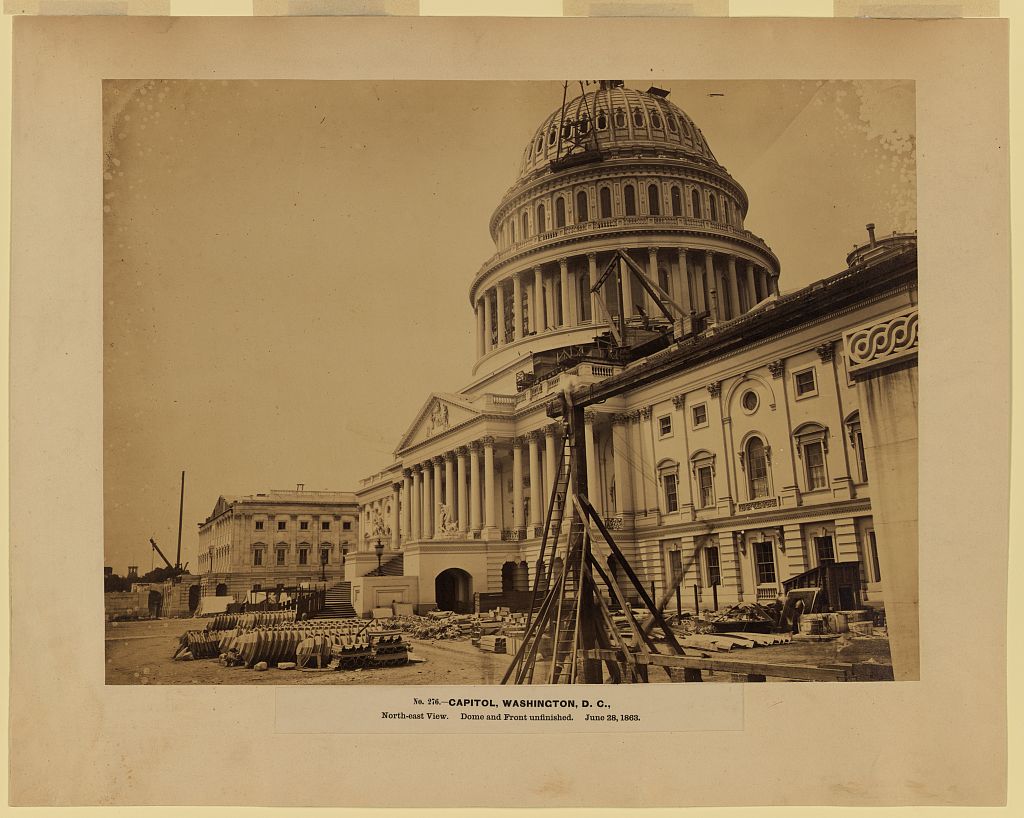
The United States Capitol as it appeared on June 28, 1863, coincidentally, the day that Meade received command of the Army of the Potomac. William Franklin, under whom Meade had served at Fredericksburg, had been the engineer in charge of the new dome construction before the war (Library of Congress).

The United States Capitol as it appeared on June 28, 1863, coincidentally, the day that Meade received command of the Army of the Potomac. William Franklin, under whom Meade had served at Fredericksburg, had been the engineer in charge of the new dome construction before the war (Library of Congress).

In which General Meade describes a summons to Washington. His laconic account in this letter to his wife is not terribly informative. Fortunately we have Theodore Lyman to fill in the details (and add, it must be said, a taste of the casual racism that would have been considered perfectly normal in the nineteenth century but grates against twenty-first century sensibilities). I’ve included Lyman’s letters from both October 23 and 24 here.

Yesterday I received an order to repair to Washington, to see the President. I arrived in Washington at 2 P. M., and expected to leave at 6 P. M., but was detained so late that I remained there all night, and left this morning, early. The President was, as he always is, very considerate and kind. He found no fault with my operations, although it was very evident he was disappointed that I had not got a battle out of Lee. He coincided with me that there was not much to be gained by any farther advance; but General Halleck was very urgent that something should be done, but what that something was he did not define. As the Secretary of War was absent in Tennessee, final action was postponed till his return.

Here’s Lyman’s much more expansive account:

Major General John Sedgwick. His men called him "Uncle John." (Library of Congress)

Major General John Sedgwick. His men called him “Uncle John.” (Library of Congress)

And where do you think I was all yesterday? I will tell you. Early, the orderly, poked his head into the tent saying: “Colonel Lyman, the General will have breakfast at seven” (which was an hour earlier than he had said the night before). As soon as I sat down, says the General: “I am going to Washington; would you like to go?” . . . Major-General Humphreys said he too would go, and the General’s son George completed the party. In much haste I ran, and crammed my best coat, pantaloons, shoes, sash, gauntlets, and brushes into my big saddle-bags, the which I entrusted to a mounted orderly. Thereupon we speedily got on horseback, and first rode to General Sedgwick (familiarly called “Uncle John”), to whom General Meade handed over the command, in his absence at Washington, to consult about the late moves and those consequent on them. Uncle John received the heavy honors in a smiling and broad-shouldered style, and wished us all a good journey, for he is a cheery soul. With little delay, we again mounted and rode twelve miles, briskly, to Gainesville, whither the railroad comes. The Chief stepped into a little room, used as a telegraph-office, and, quicker than winking, he stood, arrayed only in his undergarments; then, before, almost, I could get my coat off, he had put on a pair of shoes, a new coat, and an elegant pair of trousers! “Now then, Lyman, are you ready? Where’s Humphreys? Humphreys is always late! Come, come along, the train is going to start!” You should have seen the unfortunate Aide — his coat unbuttoned, his shoestrings loose; on one arm the saddle-bags, on the other, his sword, sash, etc., etc., and he hastening after the steam-engine Meade! However I completed my toilette in the car, which was all to ourselves; and flatter myself that my appearance was considerably peacock. We went rattling and bumping over a railroad that reminded me of the one from Civita Vecchia, to Manassas Junction, and thence to Washington, over a route I have already described to you when I came down. Only this time we came through Alexandria, and, instead of taking there a boat, kept on and went across the long bridge, going thus into the very city by the rail. There was a carriage from Willard’s awaiting us; the guardpost near by turned out in our honor, and we drove in great state to General Halleck’s office; where General Meade went in and held a solemn pow-wow; the two came forth presently and walked over to the White-House, where they held another pow-pow with the President. Captain George and I, meanwhile, studied the exterior architecture, and I observed a blind had been blown off and broken and allowed to lie outside. In fact they have a nigger negligence, to a considerable extent, in this half-cooked capital.

October 24, 1863

We went to Willard’s after the pow-pow and got a very good dinner; only poor General Meade was bored to death and driven out of all peace of mind, by dirty politicians who kept coming up and saying: “Ah, General Meade, I believe; perhaps you do not recollect meeting me in the year 1831, on a Mississippi steamboat? How do you do, sir? What move do you propose to execute next? Have you men enough, sir? What are the intentions of Lee, sir? How are the prospects of the rebellion, sir? Do you look upon it as essentially crushed, sir? Or do you think it may still rear its head against our noble Union, sir?” etc., etc. All of which the poor Chief (endeavoring to snatch a mouthful of chicken, the while) would answer with plaintive courtesy; while the obscure aides-de-camp were piling in all kinds of delicacies. . . . The papers say General Meade received imperative orders to give Lee battle; not a word of truth in it! You might as well give imperative orders to catch a sea-gull with a pinch of salt. Lee would perhaps have given us a chance; but the same storm that prevented our advance carried away the Rapidan bridge, and he could get nothing to eat. His forces were, I think, larger than supposed, especially in cavalry, which was very numerous.

Meade’s correspondence taken from The Life and Letters of George Gordon Meade, Major-General United States Army, Vol. 2, (New York: Charles Scribner’s Sons, 1913), p. 154. Available via Google Books.

Theodore Lyman’s letter is from Meade’s Headquarters, 1863-1865: Letters of Colonel Theodore Lyman from the Wilderness to Appomattox, pp. 36-8. Edited by George R. Agassiz. Boston, Massachusetts Historical Society, 1922. Available via Google Books.

 Have you read Searching for George Gordon Meade: The Forgotten Victor of Gettysburg yet? If not, you can buy it here!

Gifts (September 11, 1863)

Meade and Theodore Lyman both wrote home on September 11 and I include both letters. All was quiet on the eastern theater’s front. Regarding the cigars Meade received, Ulysses S. Grant, too, also began receiving shipments of cigars from admirers following his victories in the west and his attempt to smoke as many of them as possible quite likely led to the cancer that killed him.

Everything remains quiet and in status quo. Humphreys has gone to Philadelphia for a few days to see his wife, who is in the country, and will call to see you, and give you the latest news from camp. I wrote you in my last, of being the recipient of a bouquet from Wisconsin; but since then I have been honored with two very valuable presents. The first is a handsome scarf pin of gold and enamel. It is accompanied with a very flattering note stating it was made in England, and brought over by the donor to be presented in the name of himself and wife, as a tribute of admiration for my great services in saving the country. The note is signed W. H. Schenley, and I think the writer is a Captain Schenley, of the British navy, who many years since married Miss Croghan, of Pittsburgh. Captain Schenley says he intends visiting the army and making my acquaintance.

The second present is five hundred most delicious Havana cigars, sent to me by a Mr. Motley, of New York, whom I accidentally met at the sword presentation to General Sedgwick, and to whom I must have been particularly civil, or in some way made a great impression on him, to induce him to send me five hundred cigars. So you see there is some compensation for the misery we have to suffer.

Here’s Lyman’s letter:

The last two days have been most unusually quiet. I read a little in military books, write a few letters, look over the newspapers a little, talk to the Staff officers, and go to bed early. The conversation of the officers is extremely entertaining, as most of them have been in a good many battles. They say that General Meade is an extremely cool man. At Gettysburg he was in a little wooden house, when the hot fire began. The shells flew very thick and close, and his Staff, who were outside, got under the lee of the house and sat down on the grass. As they sat there, out came General Meade, who, seeing them under such a slender protection against cannon-balls, began to laugh, and said: “That now reminds me of a feller at the Battle of Buena Vista, who, having got behind a wagon, during a severe cannonade, was there found by General Taylor. ‘Wall Gin’ral,’ said he, looking rather sheepish, ‘this ain’t much protection, but it kinder feels as it was.'” As a point to the Chief’s anecdote, a spherical case came through the house at that instant, exploded in their circle and wounded Colonel Dickinson. . . .

The Lydia Leister house at Gettysburg, which Meade used as his headquarters during the battle. Notice the dead horses in the road. Lyman relates a story about Meade here on July 3, 1863 (Library of Congress).

The Lydia Leister house at Gettysburg, which Meade used as his headquarters during the battle. Notice the dead horses in the road. Lyman relates a story about Meade here on July 3, 1863 (Library of Congress).

I walked over and saw the Provost prisoners, the other evening. If you want to see degraded human nature, there was the chance. There was a bough covering, about forty feet square, guarded by sentries, and under it were grouped some fifty of the most miserable and depraved human beings I ever saw—deserters, stray Rebel soldiers, “bushwhackers” and camp-followers. They sleep on the bare ground with such covering as they may have, and get a ration of pork and biscuit every day. This is only a sort of temporary guardhouse, where they are put as they come in. War is a hard thing. This country, just here, was once all fenced in and planted; now there isn’t a rail left and the land is either covered with dried weeds or is turned into a dusty plain by the innumerable trains of horses, mules and waggons.

Meade’s correspondence taken from The Life and Letters of George Gordon Meade, Major-General United States Army, Vol. 2, (New York: Charles Scribner’s Sons, 1913), pp. 147-8. Available via Google Books.

Theodore Lyman’s letter is from Meade’s Headquarters, 1863-1865: Letters of Colonel Theodore Lyman from the Wilderness to Appomattox, pp. 12-13.Edited by George R. Agassiz. Boston, Massachusetts Historical Society, 1922. Available via Google Books.

Visiting (September 6, 1863)

There is no letter from General Meade on September 6, but Theodore Lyman does write home. He documents a visit to Maj. Gen. George Sykes, who had replaced Meade as the head of the V Corps when Meade received command of the Army of the Potomac. Humphreys is Andrew Humphreys, now serving as Meade’s chief of staff.

General George Sykes. (Library of Congress photo.)

General George Sykes. (Library of Congress photo.)

I promised to tell you how I invited General Meade to go with me and see General Sykes. If I didn’t know anything, I looked like a Commander-in-Chief, for I had the best horse and the best accoutrements, and as for clothes, General Meade was nowhere; besides which, he had no sword, while I had. The cavalry escort reminded me exactly of the Guides that go with the little Prince along the rue de Rivoli. No two of them had caps alike, none had their jackets buttoned; all were covered with half an inch of dust, and all eschewed straps to their pantaloons. Nevertheless, had the Rebs appeared, I should have preferred these informal cavaliers to the Guides. Each man had a sabre with a rusty scabbard, and a revolver hung at his belt. They all ride well, and would be handsome horsemen, if “got up.”

General Humphreys, with his usual bland smile, appeared on a small gray, which was of a contrary and rearing disposition; but the General remarked, with the air of an injured man, that he had had three valuable horses killed under him in battle, and now he should only get cheap ones. General Meade, whose saddle-flap was ornamented with a bullet-hole within an inch of his leg, was mounted on a small bay. And so we jingled off; sometimes in the road, sometimes in the open fields, sometimes in the woods and sometimes through creeks and mudholes. The Chief rides in a most aggravating way, neither at a walk nor a gallop, but at a sort of amble, which bumps you and makes you very uncomfortable. … In due season we got to the 5th Corps Headquarters, near the Rappahannock, which is a very narrow affair at this point, and not over four feet deep on the shallowest fords. General Sykes looks a little like the photograph of General Lyon and has a very thick head of hair, which stands up like Traddles’s. He is a mild, steady man, and very polite, like all the officers I have seen down here. Indeed, a more courteous set of men it would be hard to find. I have yet to meet a single gruffy one. They are of all sorts, some well educated, others highly Bowery, but all entirely civil. . . . The astute Sykes talked some time with the Chief, and then we rode to the Headquarters of General [John] Newton, who commands the 1st Corps, hard by. This chieftain had a very gorgeous tent, erected for the express accommodation of Mrs. Newton, who, however, was soon driven forth by the general order excluding all ladies from the lines; and the tent was all that remained to remind one of her presence. General Newton also has a thick head of hair, and is a tall and finely built man and “light complected.” He was in great glee over a tệte-de-pont he had erected, and hoped to decoy some unfortunate Rebels to within range of it. He produced a huge variety of liquids which I had to refuse. The drinks I have refused will be a burden on my conscience in time to come. They come from all sides and in great variety, even champagne! . . .

Theodore Lyman’s letter is from Meade’s Headquarters, 1863-1865: Letters of Colonel Theodore Lyman from the Wilderness to Appomattox, pp. 8-9.Edited by George R. Agassiz. Boston, Massachusetts Historical Society, 1922. Available via Google Books.

Bad Press (September 5, 1863)

Throughout his army career Meade disliked and distrusted the press. He complained about the newspaper coverage of the Mexican-American War when he was a young officer, and he complained even more vociferously during the Civil War. Things came to a head during the 1864 Overland Campaign when Meade had a reporter kicked out of the army’s camp, but that explosion was a long time coming, as his letter from September 5, 1863, attests. The Spirit of the Times was a New York weekly that was best known for its coverage of sports. George Wilkes had purchased it in 1861.

Have you seen a very bitter article in Wilkes’s Spirit of the Times, of August 29th [see below]? He says the victory of Gettysburg was due entirely to the strength of the position and the heroic bravery of the common soldiers, and was entirely independent of any strategy or military ability displayed by any general from the senior down. He then charges me with imbecility and timidity, and says the Army of the Potomac never can do anything so long as so many incompetent men are at the head of it. The only consolation I have, is that censure from such a source will in the eyes of all respectable people be praise. There is no doubt the position at Gettysburg was very strong, and that the victory was in a great measure due to this fact; and it is also equally true that if the men had not fought as well as they did, I should have been beaten; but I have yet to learn the existence in history of a general whose genius was equal to winning victory when all the advantages were against him, and his men would not fight.

Wilkes is a Hooker man; but whether his article was inspired by any of the friends of this officer, I am not prepared to say, and can hardly believe such to be the case.

This is the newspaper article that so infuriated Meade:

EXTRACT FROM NEWSPAPER ARTICLE, ATTACK ON GENERAL MEADE, MENTIONED IN LETTER OF SEPTEMBER 5, 1863.

(Wilkes’ Spirit of the Times of August 29, 1863)

SINGULAR REVELATIONS
In Regard To
The Army Of The Potomac

(The following letter comes from a distinguished military writer who has had much observation in the Army of the Potomac, and whose opinions we can assure the readers of the Spirit are well worth noting. It was written to a personal friend in this city, and from his hands we obtain it.)

Washington, August 16, 1863

My Dear Sir:

The Army of the Potomac—that army which has so often elevated men from mediocrity into greatness—that army which has marched, fought and bled to no purpose—now lies in sweet repose along the line of the Rappahannock, patiently waiting, as Micawber says, “for something to turn up.” The history of this army is one of barren toil, suffering and death. Its successes are magnified by venal letter-writers into great victories, and its defeats are represented as splendid strokes of strategy. It is thus that a confiding people have been humbugged from month to month, and year to year. History can furnish no instance that will even remotely compare with this army for gross ignorance and mismanagement. In no instance has success been followed up with vigorous and rapid blows; on the contrary, the enemy have been allowed to retreat without molestation, until they had time to rally their scattered forces and fortify themselves. The battle of Gettysburg was purely defensive, and our success was mainly due to the natural strength of our position, to our artillery, and the firmness of a portion of the troops, but in no degree to the strategy or ability displayed by any of the generals, from the senior down.

Here indeed, was an opportunity for a general to have shown the qualities of an able commander, if he possessed them. His troops, however decimated, had, by his own account, suffered far less than the enemy. But his army, flushed with victory, was not permitted to follow up and harass a beaten, dispirited and demoralized enemy, hampered with a vast amount of plunder, thousands of wounded, and an impassable river obstructing their retreat; and while letter-writers were announcing their hopelessness of its escape, Lee’s army was quickly making arrangements for crossing without the slightest interruption from Gen. Meade, or serious effort to penetrate his design. Suggestions were made and heard, to send a force above the rebel position, when by cutting trees and throwing them into the river, his pontoons or other bridges might be swept away. But Gen. Meade’s frequently declared belief was, that Lee could cross when he pleased; that he did not intend to cross, but meant to fight. The sequel shows how completely he was deceived. Had Gen. Meade possessed the activity of either Grant or Rosecrans, and, I may add, of Hooker, he could, by a cavalry reconnaissance on the south side of the Potomac, and a forced one on the Maryland side, have easily discovered Lee’s true intentions; and had he attacked him with his army divided by that river, he must have inevitably destroyed or captured one half of it. But blinded and deceived by Lee, timidity ruled the hour, and the golden opportunity, that is only to be seen and grasped by genius, was lost forever. Here, then, we have a commander but a few days previous magnified into a great general, for his success in a battle which he was forced, in defence, to fight; which was due alone to the natural strength of his position, and the courage of the rank and file, and not, as I have before said, to any display of his military abilities. And yet, when an occasion was subsequently presented for the exercise of his qualities as a commander, he tranquilly sits down before a hastily constructed gutter (miscalled entrenchments) for a week, and quietly permits the enemy to prepare for and cross a formidable stream that barred his retreat. Who can estimate the future sacrifice of life that must ensue from this terrible mistake?

The public must have news to feed upon. It matters not, it would seem, whether it be true or false; and hence they will hear before long of some remarkable things that are soon to take place, which they are not at liberty to reveal. But it may as well make up its mind that the Army of the Potomac will never accomplish anything. With some few exceptions, it is the worst handled body of men, so far as the general officers are concerned, that the world has ever seen. This is, in a great measure, due to the accursed political influence that has blighted and almost destroyed its energy and efficiency. It is due, also, to the many commanders outside the army proper, who have restrained and controlled its action on more than one important occasion, from the President down; and above all, it is due to the many ignorant and self-sufficient politicians who have been appointed to high commands, and the large infusion of foreign adventurers into the different staffs.

In the meantime, Theodore Lyman wrote home to continue the narrative about reaching the Army of the Potomac and its commander, under whom he was going to serve as a volunteer aide. The “female doctor” he describes is Mary Walker, who later won the Medal of Honor for her medical services during the war, only to have Congress revoke it a mere six days before her death in 1919. It was posthumously reinstated. The Grand Army of the Republic Museum and Library in Philadelphia, which displays the head of Meade’s horse, Old Baldy, also has Walker’s medical kit in its collections.

This is what Lyman wrote on September 5, 1863:
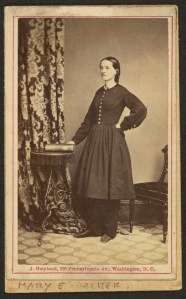
Mary E. Walker, the "female doctor" Lyman encountered on the train (Library of Congress).

Mary E. Walker, the “female doctor” Lyman encountered on the train (Library of Congress).

Our train consisted in a large number of freight cars, all marked “U. S. Military Railroads,” and of one passenger car containing its precious freight of officers, not to speak of the female doctor who knocked Zacksnifska out of all sight and knowledge. She was going down to get the son of an old lady, who (the said son) had had a sunstroke, and this female doctor had great confidence she could cure him. She was attired in a small straw hat with a cockade in front, a pair of blue pantaloons and a long frock coat, or sack. Over all she had a linen “duster”; and this, coupled with the fact that she had rips in her boots, gave her a trig appearance. She was liberal in her advice to all com ers and especially exhorted two newspaper boys to immediately wash their faces, in which remark she was clearly correct. . . .

At Warrenton Junction there was luckily an ambulance from headquarters; and as its owner was only a diminutive captain, I had no hesitation in asking him to carry me up, with my traps. … So off we set, on a road which went sometimes over stumps and sometimes through “runs” two or three feet deep. We passed any quantity of pickets and negroes and dragoons in twos and threes; till at last, looking off to the left (or rather right), I beheld what seemed a preparation for a gigantic picnic: a great number of side-tents, pitched along regular lines, or streets, and over them all a continuous bower of pine boughs. These were “Headquarters.” I put my best foot forward and advanced to the tent of the Commander-inChief, in front of which waved a big flag on a high staff. In my advance I was waylaid by a lieutenant, the officer of the day, who with much politeness said General Meade was out for a ride, but would I not walk into a tent and take some whiskey; which I accepted, all but the whiskey. He turned out to be a Swede, one Rosencrantz, and I rejoiced his soul by speaking of Stockholm. Presently there arrived the General himself, who cried out, “Hulloo, Lyman! how are you?” just as he used to. He was as kind as possible, and presently informed me I was to mess with him. As the Chief-of-Staff is the only other man who is allowed to do this, you may concede that my lines have fallen in pleasant places! The said Chief-of-Staff is General Humphreys, a very eminent engineer. He is an extremely neat man, and is continually washing himself and putting on paper dickeys. He has a great deal of knowledge, beyond his profession, and is an extremely gentlemanly man. As to the Assistant Adjutant-General, S. Barstow, he was most hospitable, and looked out for getting me a tent, etc. He really has a laborious and difficult position, the duties of which he seems to discharge with the offhand way of an old workman.

Now I will pull up. As to my riding forth yesterday and to-day, in martial array, beside the General, and with dragoons clattering behind, shall not the glories thereof be told in a future letter? Meanwhile, if you want to feel as if nobody ever was or could be killed, just come here! This is the effect, strange as it may seem. For your assurance I will state, that we yesterday rode seven miles directly towards the enemy, before we got to a spot whence their pickets may sometimes be seen! . . .

Meade’s correspondence taken from The Life and Letters of George Gordon Meade, Major-General United States Army, Vol. 2, (New York: Charles Scribner’s Sons, 1913), p. 147. Newspaper article from pp. 316-7. Available via Google Books.

Theodore Lyman’s letter is from Meade’s Headquarters, 1863-1865: Letters of Colonel Theodore Lyman from the Wilderness to Appomattox, pp. 5-7.Edited by George R. Agassiz. Boston, Massachusetts Historical Society, 1922. Available via Google Books.