
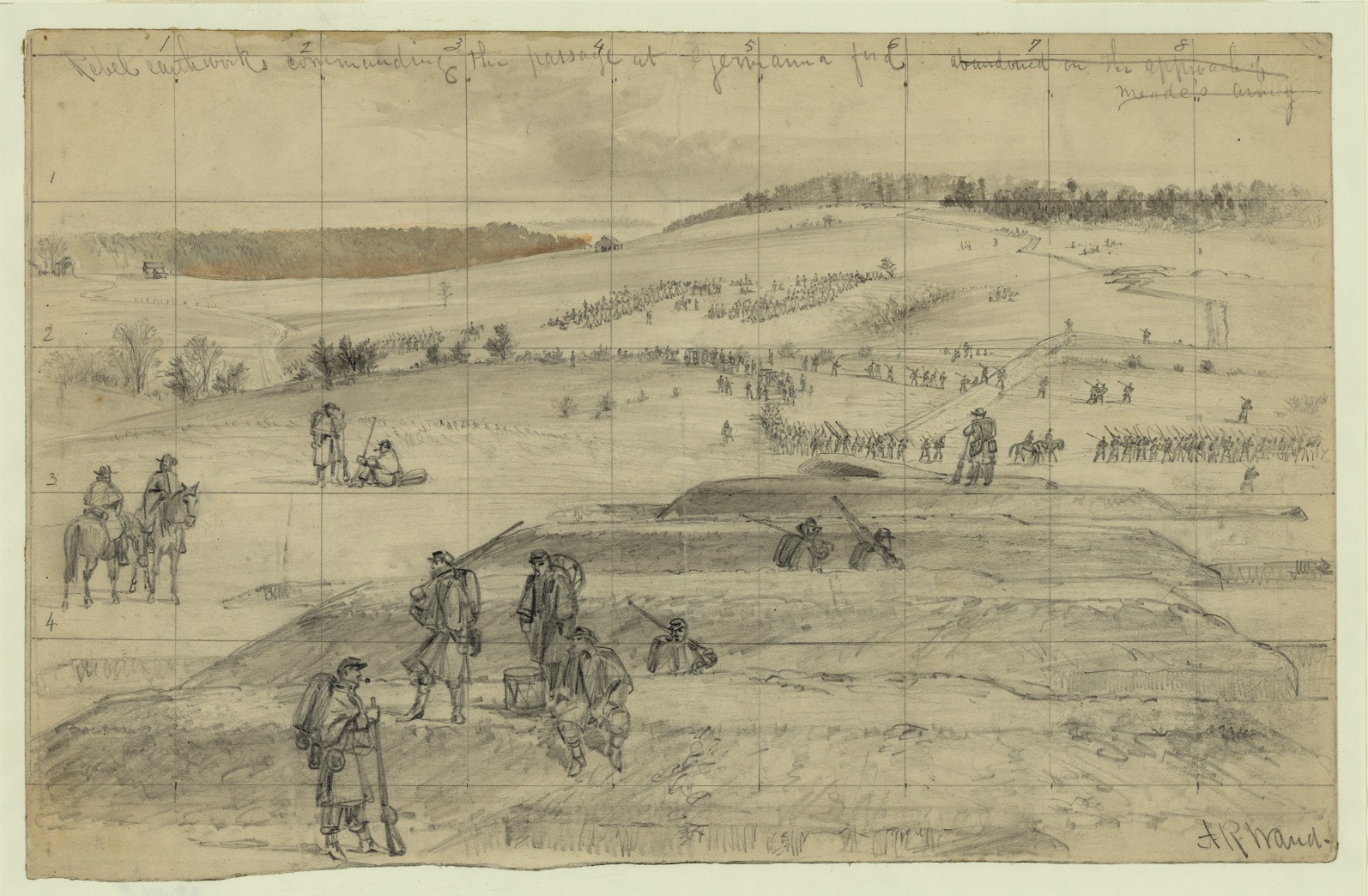
Artist Alfred Waud labeled this sketch “Rebel earthworks commanding the passage at Germanna ford, abandoned on the approach of Meade’s army” (Library of Congress). Click to enlarge.
In his letter of November 27, Theodore Lyman details the beginning of Meade’s Mine Run campaign. It was an inauspicious start, marked by delays and disappointments. Here’s how I described the situation in Searching for George Gordon Meade: The Forgotten Victor of Gettysburg:
Meade planned to cross his army at various fords along the Rapidan below Lee’s right and make a flanking attack instead of risking a frontal assault against his strong entrenchments. The III Corps would cross at Jacob’s Ford, with the VI Corps following, and then make its way through various woods roads to a place called Robertson’s Tavern. The roads the army had to follow were narrow and winding, as they still are today. The II Corps would cross at Germanna Ford, while the I and V Corps would use Culpeper Mine Ford. Cavalry would guard the flanks. “The plan promised brilliant success,” said chief of staff Andrew Humphreys; “to insure it required prompt, vigorous action, and intelligent compliance with the programme on the part of the corps and other commanders.”
Therein lay the proverbial rub. Meade wanted his army to rumble into motion on November 24, but heavy rainfall delayed the movement until the twenty-sixth. Then [William] French and the III Corps were two hours late in reaching their ford. Two pontoon bridges turned out to be too short, forcing the engineers to do some time-consuming improvisation, and the banks on the opposite side of the river were steep and difficult to climb. Like many best-laid plans, Meade’s attempt to flank Lee began to unravel. Things slipped further and further behind schedule, giving the Confederates time to react to the Federals’ threatening move.

A native of Eastport, Maine, Henry Prince commanded a division of William French’s III Corps (Library of Congress).
[Gouverneur K.] Warren and the II Corps reached Robertson’s Tavern on November 27 and began “a brisk little contest” with the rebels there. But French’s III Corps was nowhere to be found. That’s because once the commander of French’s lead division, Brig. Gen. Henry Prince, managed to cross the river, he sat at a crossroads for a couple hours while he tried to determine which road to take; a historical marker stands at this crossroads now.
After driving around here I can understand how the generals became confused. I spend a lot of time stopped at crossroads myself as I peer at my directions and try to figure out which way to go. The stakes, though, were considerably higher for French and Prince. Around 11:30 headquarters finally received a message from French. He said he was waiting for Warren—who was already at Robertson’s Tavern skirmishing with the enemy. Steam must have been shooting out of Meade’s ears at this point. But before French could join Warren, he stumbled into battle on the land of a man named Payne.
The Battle of Payne’s Farm was the only serious fighting of the Mine Run Campaign—although I’m sure the skirmishers and other soldiers who had been killed and wounded in other actions would have said their fights had been serious enough. The Confederates here were commanded by Maj. Gen. Edward “Allegheny” Johnson, also known as “Clubby.” The thirty-two thousand men of the III Corp greatly outnumbered Johnson and his fifty-three hundred troops, but the Confederates fought stubbornly enough to delay French even longer.
Humphreys later complained that French’s tardiness and the holdup at Payne’s Farm essentially paralyzed the entire operation. By the time the army was in a position to attack on the twenty-eighth, Lee had moved his army to a strong position behind Mine Run, a line “crowned with intrenchments for infantry and artillery, strengthened by abates,” said Humphreys. Any frontal assault appeared doomed, but Warren thought he could shift his forces and, reinforced by a division of the VI Corps, attack Lee’s weak right flank. Meade later gave him two additional divisions from the III Corps. While the V and VI Corps made a diversionary attack on the enemy’s left, Warren would make the main attack on its right.
Here we are, camped south of the Rapid Ann, and I find a leisure moment to write you a letter, or rather to begin one. My last formal note, I believe, informed you we were to move “to-morrow” (26th). And, sure enough, yesterday we kept our Thanksgiving by marching, horse, foot, and artillery, as hard as we could paddle towards Germanna Ford.
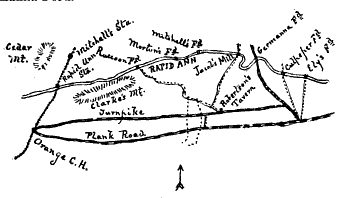
 The above rough map, with the other I sent when I wrote ;at Centreville, will sufficiently explain our moves. From Rapid Ann Station to Morton’s Ford, the Rebels have a strong line of entrenchments, but, beyond that, it is practicable to force a crossing, because the north bank commands the south. Our forces were encamped in a sort of semi-circle, of which one end rested on Kelly’s Ford on the Rappahannock, and the other (at the north) on a tributary of the same river; the centre being about at Brandy Station. . . . The artillery officers had placed two masked batteries, ready to open on the south bank. On the other side of the river there were extensive breastworks, which, however, seemed not occupied. Nevertheless, we could not tell that the woods were not full of them. As the main resistance might be offered here, it was necessary that all the corps should force the passage at the same time, if possible. It so happened that General French was much delayed by heavy roads and other causes, so we had to wait till past twelve before throwing the pontoons. When this was done, there was no opposition whatsoever; but the engineers were stupid enough not to have enough boats, and this made more delay. However, about two P.m. the troops and artillery began to cross, one division having already forded. The solemn and punctual Sykes crossed below, at twelve. But the 3d and 6th, being very large, did not all get over till night, and their artillery, by reason of bad roads, had to come over by Germanna Bridge, and was not over till five the next morning. We (Headquarters) camped on the north bank of the river, near the reserve artillery. It was a magnificent night, but cold. The trains came in after dark, and we had quite a time in finding tents and bedding. Everything is comparative: when I got my tent pitched, my roll of bedding in position, and a little end of a candle lighted, I felt as comfortable as if I came home to a nicely furnished house, with a good fire burning and the tea-table just set! I was up this morning a good deal before daylight. The moon shone very bright and the hoar frost glittered on the tents. … At an early hour the Staff crossed, passing on the steep bank crowds of ambulances and waggons, which of course made the General very mad. . . . Do you know the scrub oak woods above Hammond’s Pond, a sort of growth that is hard for even a single man to force his way through for any great distance? That is the growth of most of this country, minus the stones, and plus a great many ‘‘runs” and clay holes, where, in bad weather, vehicles sink to their axles. Along this region there are only two or three roads that can be counted on. These are the turnpike, the plank road south of it, and the plank road that runs from Germanna Ford. There are many narrow roads, winding and little known, that in good weather may serve for the slow passage of columns (though they are mere farmers’ or woodcutters’ thoroughfares); but a day’s rain will render them impassable for waggons and artillery. This whole region (which includes the field of Chancellorsville, a little to the east) is known as the “Wilderness.” Over much of it there is no chance to deploy troops, scarcely skirmishers, and no place for artillery. . . .
Somewhere about 10.30 we got to the turnpike and halted, say a mile before Robertson’s Tavern; where the 2d Corps had arrived and found the enemy in front; about eleven they had heavy skirmishing and drove the enemy back, getting also a few prisoners. They then formed line of battle and waited news from French on the right, and Sykes on the left, coming on the plank road. The day was raw and we stood near the road, over some fires we had built, waiting for news of French, to form a junction and attack at once; for Warren alone formed a weak centre and could not risk an engagement. Officer after officer was despatched to him, piloted by niggers who said they knew the country. The indefatigable Ludlow went in the opposite direction, and reported Sykes coming along all right. . . . At 12.30 we heard cannon on our extreme right, which seemed to announce French; still no authentic news, and the precious minutes fled rapidly. At last, late in the afternoon, came authentic despatches that General French’s advance had had a heavy fight with the Rebels, in force, and had driven them from the field; but had thus been greatly delayed, and besides had found no roads, or bad roads, and could not effect a junction that evening. And so there was Sedgwick’s Corps jammed up in the woods behind, and kept back also! So we pitched camp and waited for morning.
Theodore Lyman’s letter is from Meade’s Headquarters, 1863-1865: Letters of Colonel Theodore Lyman from the Wilderness to Appomattox, pp. 51-4. Edited by George R. Agassiz. Boston, Massachusetts Historical Society, 1922. Available via Google Books.
Don’t forget: Searching for George Gordon Meade: The Forgotten Victor of Gettysburg makes a superb Christmas present for the Civil War enthusiast on your list! You can order the book from Amazon or Barnes and Noble.



 Searching for GEORGE GORDON MEADE