Enough Human Weakness (September 22, 1884)

Philip Sheridan (Library of Congress).

Philip Sheridan (Library of Congress).

The victory of Sheridan’s to which Meade refers in this letter is Third Winchester, a.k.a. the Battle of Opequon Creek, in which Philip Sheridan and his men repulsed Jubal Early’s II Corps. In this letter Meade refers to Ulysses S. Grant’s indications that Grant was going to assign Meade to the command that he eventually gave to Sheridan. Meade and Sheridan had a mutual dislike that dated back to at least the Wilderness in May. During the Union army’s movement towards Spotsylvania Sheridan and Meade had held a heated conversation about the cavalry’s activities. Since then, Sheridan’s star—aided by Grant—had risen while Meade’s had, at best, remained static.

To-day we have Mr. Stanton’s despatch announcing Sheridan’s brilliant victory. I am very glad for the cause and glad for Sheridan’s sake; but I must confess to enough human weakness to regret this opportunity of distinction was denied me, who was, I think, from previous service and present position, entitled to it. It is all settled, however, now, as I see Mr. Stanton announces Sheridan has been permanently assigned to the Middle Military Division, and that he has been made a brigadier general in the regular army. This last piece of disingenuous news will be amusing to those who know he was appointed to this place six weeks ago, in advance of his present well-merited laurels. My time I suppose has passed, and I must now content myself with doing my duty unnoticed.

George and I both continue very well. I did not intend to alarm you about the health of the army. I only meant to say we were beginning to experience in a slight degree the effects of a residence in this not very healthy location. Still, taking all things into consideration, the health of the army is wonderful. The enemy predicted we would never be able to pass the summer here, and counted largely on the fevers of the country driving us away.

Meade’s correspondence taken from The Life and Letters of George Gordon Meade, Major-General United States Army, Vol. 2, (New York: Charles Scribner’s Sons, 1913), pp. 229-30. Available via Google Books.

Medals (September 15, 1864)

Medal of Honor

The Medal of Honor.

In his letter of September 15, 1864, George Meade mentions the presentation of the Medal of Honor to several soldiers of the V Corps. It appears these soldiers were Frederick C. Anderson, George W. Reed, and John Shilling, all three of whom earned their medals for their fighting at the Weldon Railroad. Anderson was a private in Co. A, 18th MA, and he captured the flag and the bearer of the 27th South Carolina. Reed, a private in Co. E, 11th PA, captured the 24th NC’s flag. Shilling, of Co. H, 3rd DE, also captured a flag.

General Grant went this morning to Harper’s Ferry to visit Sheridan. There were some indications of a movement on Lee’s part yesterday, but nothing occurring this morning, he went off. He is to be absent, I believe, some five or six days. What Grant meant by the rebels deserting at the rate of a regiment a day, referred, I presume, to their desertions in all parts of the field, and to the present diminished size of their regiments. This would make a daily desertion of about three hundred. I have no means of knowing what proportion of this amount is drawn from the returns of other armies; but, in the Army of the Potomac, ten a day would be a liberal estimate of the deserters who have come into our lines for some time past. I think Grant was a little hyperbolical in the expression he used. He is of a very sanguine temperament, and sees everything favorable in a strong light, and makes light of all obstacles. In some respects this is an admirable quality, if it is not carried to extremes.

I don’t think that I told you that, day before yesterday, I presented to some soldiers of the Fifth Corps medals of honor, conferred upon them for good conduct on the field of battle. There was a great ceremony on the occasion, and I made a few remarks, which I presume will appear in print. The weather, after being cool, has again become warm. Sickness is beginning to show itself.

Meade’s correspondence taken from The Life and Letters of George Gordon Meade, Major-General United States Army, Vol. 2, (New York: Charles Scribner’s Sons, 1913), pp. 227-28. Available via Google Books.

Leaves (August 28, 1864)

George Gordon Meade (Library of Congress).

George Gordon Meade (Library of Congress).

After today we won’t be hearing from George Meade for a little while. Our loss is the general’s gain, for, despite what he says in the last line of this letter, he does receive permission to go home on leave. He departs camp on September 1 and reaches Philadelphia two days later. He will begin his return trip on September 7, with a stop in Washington, D.C.

The court of inquiry to which he refers is the one regarding the Battle of the Crater.

I received this evening yours of the 26th. In it you acknowledge the receipt, per Mr. England, of my testimony before the court of inquiry. The sittings of the court have been interrupted by our recent movements, but to-morrow they are to be resumed, and I trust they will push matters to a close and come to some conclusion before they are again interrupted.

I have written you of the fighting that has been going on for a week past. It has been quiet for the last two days. The enemy having left us in undisturbed possession of the railroad so long, our position is strengthened to such a degree he could not now drive us away. This is a great point gained, and we are satisfied with its accomplishment, notwithstanding it entailed heavy losses on us, particularly in prisoners. Poor young Grossman belonged to the regulars, and was killed in the first day’s fight on the railroad. I understand he was shot in the head, being unconscious from the moment of receiving his wound till he expired, which occurred soon after. I believe he had not joined very long, and I was not aware of his being here. I sympathize most sincerely with his afflicted parents, but this is one of those dispensations that are almost daily taking place here.

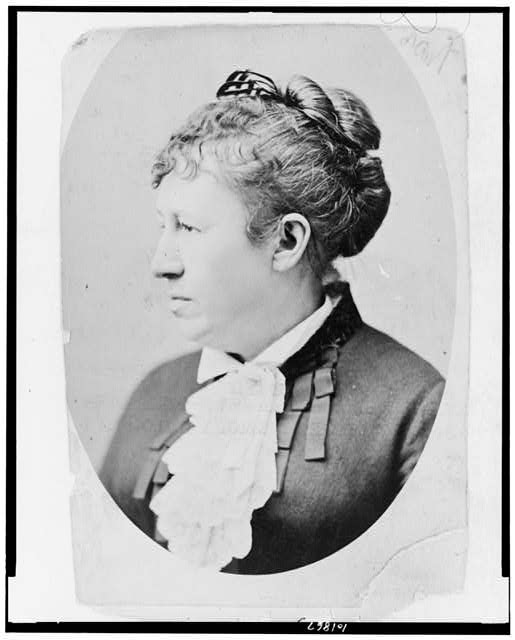
Julia Grant, in a photo taken after the war (Library of Congress).

Julia Grant, in a photo taken after the war (Library of Congress).

I understand General Grant has been to Fortress Monroe and returned to-day with his wife and children. He has one little girl, and either two or three boys. He seems very much attached to his children, and his wife is said to possess a great deal of good sense, and to have exercised a most salutary effect over him. I do not know why she has given up St. Louis, her native place, but Grant told me the other day he intended to keep his family in Philadelphia for the next few years, probably for the education of his children.

I think we shall be quiet for some time, unless the enemy attacks, which I hardly think probable. Butler is away now, but when he returns I shall make an effort to get off for a few days, to have a peep at you and the children; but don’t rely too much on my coming.

Theodore Lyman’s letter of August 27 is also the last we shall hear from him for a while. As the book of his letters explains, “The next day Lyman was surprised to have Meade say to him. ‘I think I must order you home to get me some cigars, mine are nearly out!’ But, as the former remarked, ‘It’s hard to surprise a man out of going home, after a five months’ campaign.’

“General [Seth] Williams gravely prepared a fifteen-day leave, and the aides tendered their congratulations. Lyman was bound for Richmond on secret service! So the Staff persuaded the inquisitive [James] Biddle, who talked about it all over camp, and got very mad when undeceived. He recovered, however, when tendered a cocktail as a peace offering.

“Lyman’s visit to the North proved longer than he expected. For, shortly after his arrival in Beverly, where Mrs. Lyman was passing the summer, he had an attack of malaria which kept him in bed for some time. According to the doctors, ‘The northern air, with the late cool change, had brought to the surface the malaria in the system.’ Consequently, he was not able to rejoin the army until the end of September.

“Meanwhile, the gloom was lifting, that had settled on the North after the failure to take Petersburg. For Sherman’s capture of Atlanta, and Sheridan’s victories over Early in the Shenandoah, had somewhat changed the situation, although the Army of the Potomac still lay before Petersburg, where it hovered for many weary months.”

Meade’s correspondence taken from The Life and Letters of George Gordon Meade, Major-General United States Army, Vol. 2, (New York: Charles Scribner’s Sons, 1913), pp. 225-26. Available via Google Books.

A Man of Character and Honor (August 24, 1864)

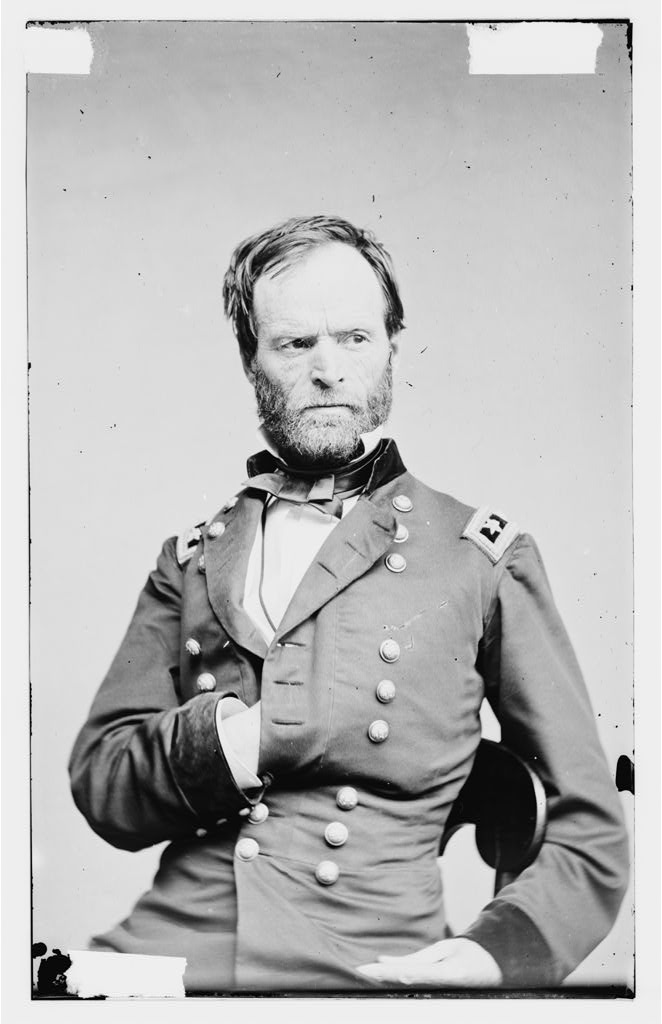
William T. Sherman (Library of Congress).

William T. Sherman (Library of Congress).

Winfield Scott Hancock (Library of Congress).

Winfield Scott Hancock (Library of Congress).

Philip Sheridan (Library of Congress).

Philip Sheridan (Library of Congress).

Meade receives what he perceives as a figurative slap in the face when he hear that William T. Sherman, Winfield Scott Hancock, and Phil Sheridan have all received promotions, while his own promised advancement to major general in the Regular Army remains stalled. He fumes about the slight and once again confronts Grant, as you can read in his letter of August 24.

I see you have heard of the promotion of Sherman, Hancock and Sheridan, and noted the absence of my name. I cannot tell you how I felt when I first heard this, but I determined to keep quiet till I could obtain some explanation from General Grant. To-day was the first time I have seen him since I learned the intelligence. On my asking him the reason of my name being omitted when those recommended at the same time had been appointed, he answered it was his act; that he had asked for the immediate appointment of the others, but had not asked for mine; and the reason he had not asked for mine was, that if Sherman and myself had been appointed on the same day, I would rank him, and he wished Sherman to rank me. That neither his opinion nor that of the President and Secretary had changed with regard to me; that it was still a settled thing that I was to have the vacancy; and that he proposed to have me appointed, when I should be assigned to the command of the Middle Division, which he said he would have done before now, but for the peculiar position Sheridan was placed in, having to fall back, and if superseded now, it would be construed into a disapproval of his course, which was not the case. Of course to all this I had nothing to say. My object was to ascertain whether any fault was found with me, or whether any change of opinion had taken place since the last time he had assured me I was to be appointed when the others were. As he had disclaimed any such reasons, I did not care to know why I had been left out. I never expected, nor did I much care about, the appointment except to prove to the ignorant public that they had been imposed upon by a lying press. Nothing more was said upon the subject. The whole substance of the explanation was that he desired to advance his favorites, Sherman and Sheridan. I was left out because it would interfere with Sherman’s rank to have me in, and Hancock was brought in because he could not appoint Sheridan before Hancock, not having recommended him when he did Hancock. Of course I could say nothing to this explanation. It would not do for me to claim promotion or express dissatisfaction at not receiving it. I had the right to ask why, after telling me I had been recommended, and would be appointed, I found I was not, but when the above explanation was made, however unjust I may have deemed such reasoning to be, I could take no notice of it, and could not with propriety complain. It is the same old story, an inability to appreciate the sensitiveness of a man of character and honor. Grant really thinks he is one of my best friends, and can’t conceive why I should complain of a little delay in giving me what he tells me I am certainly to have. It is rather hard to have denied me the vindication which the Government might give to my course, by conferring a promotion that I have the most positive evidence it, the Government, has acknowledged I merited and should have. However, I suppose this, like all else, must be borne with patience.

We have had some pretty hard fighting to secure our lodgment on the Weldon Railroad. Grant and Warren are the heroes of the affair. I must confess I do not envy either of them their laurels, although in the Weldon Railroad affair Grant was sixteen miles away, and knew nothing but what was reported to him by myself. We lost a good many men in killed and wounded, but principally in prisoners. Our army is becoming much weakened by these repeated losses, and our only hope is that the enemy suffers proportionately. Their papers acknowledge in their last affairs a loss of five general officers.

Theodore Lyman, in the meantime, takes a look at Meade’s record. When he says “those men are on the ground” I assume he means “in.”

What you say of Meade’s want of success is, as a fact, true; but what I don’t understand is, that the successes are Grant’s but the failures Meade’s. In point of reality the whole is Grant’s: he directs all, and his subordinates are only responsible as executive officers having more or less important functions. There have been cases where they might be said to act alone; for instance, the assault of the 18th of June, though under a general permission from Grant, was strictly an operation of Meade. He felt badly about that failure, “Because,” said he, “I should have taken Petersburg. I had reason to calculate on success. The enemy had no defences but what they had thrown up in a few hours; and I had 60,000 men to their 25,000.” All of which was true and the result showed the difference of morale. The men who stormed the Rappahannock redoubts in November ‘63 would have walked over the breastworks and driven Beauregard into the Appomattox; but those men are on the ground between here and the Rapid Ann, or fill the hospitals in the North. Put a man in a hole and a good battery on a hill behind him, and he will beat off three times his number, even if he is not a very good soldier.

Meade’s correspondence taken from The Life and Letters of George Gordon Meade, Major-General United States Army, Vol. 2, (New York: Charles Scribner’s Sons, 1913), pp. 223-24. Available via Google Books.

Theodore Lyman’s letter is from Meade’s Headquarters, 1863-1865: Letters of Colonel Theodore Lyman from the Wilderness to Appomattox, p. 224. Edited by George R. Agassiz. Boston, Massachusetts Historical Society, 1922. Available via Google Books.

A Simple Matter of Justice (August 13, 1864)

George Gordon Meade confronts General Grant about the question of who should command the new military division, and remains baffled by his superior officer.

Grant was here yesterday to transact some business. I immediately asked him, how, after his promise to me, that if a military division was organized, I should be assigned to the command, he has placed my junior, Sheridan, there. He said Sheridan had not been assigned to the division, that no one was yet assigned to it, and that Sheridan had only been put in command of the troops in the field belonging to the different departments. I referred him to the order constituting the division, and assigning Sheridan temporarily to the command, and observed that temporarily I supposed meant as long as there was anything to do, or any object in holding the position. I further remarked that I regretted it had not been deemed a simple matter of justice to me to place me in this independent command. To which he made no remark. I really am not able to ascertain what are his real views. Sometimes I take the dark side, and think they are intentionally adverse to me, and at others I try to make myself believe that such is not his purpose. In confirmation of the last theory, I am of the opinion that he does not look and has not looked upon the movement in Maryland and the Valley in the important light it deserves, and that he considers it merely a raid which a display of force on our part will soon dissipate, when Sheridan and the troops will soon return here. But in this he is greatly mistaken. Already we have positive news that Lee has sent large reinforcements into the Valley, and there is no doubt it is his purpose to transfer the principal scene of operations there, if it can be accomplished. To-morrow we are going to make a move to test his strength here, and endeavor to make him recall his troops. Should this fail, we will be obliged to go up there and leave Richmond.

The weather continues intensely hot.

The court of inquiry was going on, but this move will stop it, and I fear it will never come to an end. I have given my testimony, which I will send you to preserve as my record in the case. I have insisted on Burnside’s being relieved. Grant has let him go on a leave, but he will never return whilst I am here.

"Dutch Gap Canal, the commencement of the work" (Library of Congress).

“Dutch Gap Canal, the commencement of the work” (Library of Congress).

In his letter of August 13, Theodore Lyman remains bemused by African American soldiers. Stephen Weld of the 56th Massachusetts had been captured during the Battle of the Crater.

… I rode over to make some enquiry about Colonel Weld, of Loring, at Burnside’s Headquarters. As I drew near, I heard the sound as of minstrelsy and playing on the psaltry and upon the harp; to wit, a brass band, tooting away at a great rate. This was an unaccustomed noise, for Burnside is commonly not musical, and I was speculating on the subject when, on entering the circle of tents, I beheld a collection of Generals — not only Burnside, but also Potter, Willcox, and Ferrero. Speaking of this last, did you hear what the negro straggler remarked, when arrested by the Provost-Guard near City Point, on the day of the assault, and asked what he was doing there. “Well, saar, I will displain myself. You see, fus’ I was subjoined to Ginral Burnside; an’ den I was disseminated to Ginral Pharo. We wus advancing up towards der front, an’ I, as it might be, loitered a little. Presently I see some of our boys a-runnin’ back. ‘Ho, ho,’ sez I, ‘run is your word, is it?’ So I jes separates myself from my gun and I re-tires to dis spot.”

Well, there was “Ginral Pharo” taking a drink, and an appearance was about as of packing. Whereat I presently discovered, through the joyous Captain Pell (who asked me tauntingly if he could “do anything for me at Newport”), that Burnside and his Staff were all going on a thirty-day leave, which will extend itself, I fancy, indefinitely, so far as this army goes. On my return I found two fat civilians and a lean one. Fat number one was Mr. Otto, Assistant Secretary of the Interior; Fat number two, a Professor Matile, a Swiss of Neufchatel, and friend of Agassiz (you perhaps remember the delicious wine of that place). The lean was Mr. Falls, what I should call Mr. Otto’s “striker,” that being the name of an officer’s servant or hanger-on. Mr. Falls was very chatty and interrogative, following every sentence by “Is it not?” So that finally I felt obliged always to reply, “No, it isn’t.” I scared him very much by tales of the immense distances that missiles flew, rather implying that he might look for a pretty brisk shower of them, about the time he got fairly asleep. Professor Matile was bright enough to be one of those who engaged in the brilliant scheme of Pourtales Steiger to seize the chateau of Neufchatel on behalf of the King of Prussia. Consequently he since has retired to this country and has now a position as examiner at the Patent Office. Mr. Otto was really encouraging to look at. He did not chew tobacco, or talk politics, or use bad grammar; but was well educated and spake French and German. General Butler, having a luminous idea to get above the Howlett house batteries by cutting a ship canal across Dutch Gap, has called for volunteers, at an increased rate of pay. Whereupon the Rebel rams come down and shell the extra-pay volunteers, with their big guns; and we hear the distant booming very distinctly. I think when Butler gets his canal cleverly through, he will find fresh batteries, ready to rake it, and plenty more above it, on the river. The Richmond papers make merry, and say it will increase their commerce.

Meade’s correspondence taken from The Life and Letters of George Gordon Meade, Major-General United States Army, Vol. 2, (New York: Charles Scribner’s Sons, 1913), pp. 221-22. Available via Google Books.

Theodore Lyman’s letter is from Meade’s Headquarters, 1863-1865: Letters of Colonel Theodore Lyman from the Wilderness to Appomattox, pp. 211-13. Edited by George R. Agassiz. Boston, Massachusetts Historical Society, 1922. Available via Google Books.

More Sheridan (August 11, 1864)

Theodore Lyman follows up on the Meade-Sheridan situation. It is safe to say that Meade did not like this situation at all.

Sheridan has been appointed to command all the upper Potomac forces, which is saying that he is to command all the troops to drive Early out of the Shenandoah Valley. He is a Major-General, and is an energetic and very brave officer. This command, however, is a very large one, larger than he ever before had. I have little doubt, that, for field-service, he is superior to any officer there. Things are cooking, and the Rebels will find they must fag away still, as well as we. I do not exactly know if Meade likes this appointment: you see they have taken one of his corps, added much of his cavalry and many other troops to it, and then given the command to his Chief of Cavalry, while he [Meade] is left, with a reduced force, at this somewhat negative Petersburg business. I rode out just at dark, and from an “elevated position,” as Smith would say, watched the flashes of the sharpshooters, and the fires of the camp.

Theodore Lyman’s letter is from Meade’s Headquarters, 1863-1865: Letters of Colonel Theodore Lyman from the Wilderness to Appomattox, pp. 210-11. Edited by George R. Agassiz. Boston, Massachusetts Historical Society, 1922. Available via Google Books.

Sheridan (August 10, 1864)

Philip Sheridan, the bane of Meade's existence (Library of Congress).

Philip Sheridan, the bane of Meade’s existence (Library of Congress).

The Phil Sheridan situation moves from the back to the front burner and Meade simmers with indignation.

The Washington papers of yesterday announce Sheridan being temporarily assigned to the military division which Grant told me was intended for me. Grant has been back two days, and has not vouchsafed one word in explanation, and I have avoided going to see him, from a sense of self-respect, and from the fear I should not be able to restrain the indignation I hold to be natural at the duplicity some one has practiced. In my last conversation with General Grant he distinctly told me that if a military division was organized I should have the command, and that it was designed to give Sheridan only the command of that part of the Army of the Potomac temporarily detached. This order is not consistent with that statement.

To-day I got through with my evidence before the court of inquiry. Burnside, in his cross-examination, through a lawyer, undertook to impeach my testimony, though he disclaimed any such intention; but I gave him as good as he sent. I hear he was about apologizing to me for his disrespectful despatch, and was then going to resign; but on returning from Grant’s headquarters, where he expressed this intention, he found my charges and letter, saying I had applied to have him relieved. I feel sorry for Burnside, because I really believe the man half the time don’t know what he is about, and is hardly responsible for his acts.

Meade’s correspondence taken from The Life and Letters of George Gordon Meade, Major-General United States Army, Vol. 2, (New York: Charles Scribner’s Sons, 1913), pp. 220-21 Available via Google Books.

Rows (August 3, 1864)

Philip Sheridan (Library of Congress).

Philip Sheridan (Library of Congress).

Meade’s “row” with Burnside stems from the Battle of the Crater and will lead to Burnside’s departure from the army. Meade also had an ongoing row with Philip Sheridan, dating back to at least their peppery encounter at Todd’s Tavern back in May.

Meade and Sheridan were both ambitious men but they showed it in different ways. In his book Little Phil: A Reassessment of the Civil War Leadership of Gen. Philip H. Sheridan, historian Eric Wittenberg wrote, “Lying was just a part of his aggressive plan for advancing his own self-interest. He regularly lied to cover his mistakes at all costs. He seems to have been a congenital liar, and his perfidy often exposed him to public ridicule and criticism. Sheridan did not care. He lied anyway.” On this front Meade was clearly outmatched. But it did his cause no good to declare he was “indifferent” about Grant’s decision. Perhaps it would have helped if he had been upfront about his ambitions, although it is pretty obvious that Grant preferred the nakedly ambitious Sheridan. It appears that on this topic, at least, Grant was being less than completely honest with Meade.

I am in the midst of my row with Burnside. Our recent miserable failure will require an investigation, and authority has been asked of the President to appoint a court of inquiry. In the meantime I have preferred charges against Burnside, and asked he be relieved from duty with this army.

Yesterday, on General Grant’s return from Old Point, General Sheridan was ordered to Washington, to command that portion of the Army of the Potomac now detached for the defense of Maryland and the Capital. I at once went to Grant and told him, as he had thought proper to communicate to me that he had nominated me for a command in Washington, I demanded to know the reason I had not been accepted. He said the President expressed every willingness to have me, but not knowing my wishes on the subject, he feared my removal from the command of the Army of the Potomac might be misunderstood by the public and be construed into a disapprobation of my course, but if I desired the transfer, he would be very glad to have it made. General Grant said it was then concluded I should be sent, if any more troops should be detached; in the meantime, Sheridan was sent to command Wright’s Corps and the division of cavalry already sent. I am a little doubtful about this matter. I believe Grant is honest and would not deceive me, but I think there is something more than is acknowledged. However, as I am indifferent about the position, I am content, so long as finding any fault with me is disclaimed. Hancock, whose name was also mentioned, is quite put out, and thinks some political chicanery at the bottom of it, and that they are afraid in Washington to give us a chance to do anything that others cannot swallow up. I, however, am more charitable; at any rate, I intend to look on the affair in the most favorable light, particularly as I have got my hands full with the Burnside imbroglio, and must remain here to see to it.

Meade’s correspondence taken from The Life and Letters of George Gordon Meade, Major-General United States Army, Vol. 2, (New York: Charles Scribner’s Sons, 1913), pp. 218-9. Available via Google Books.

Two Heads (May 19, 1864)

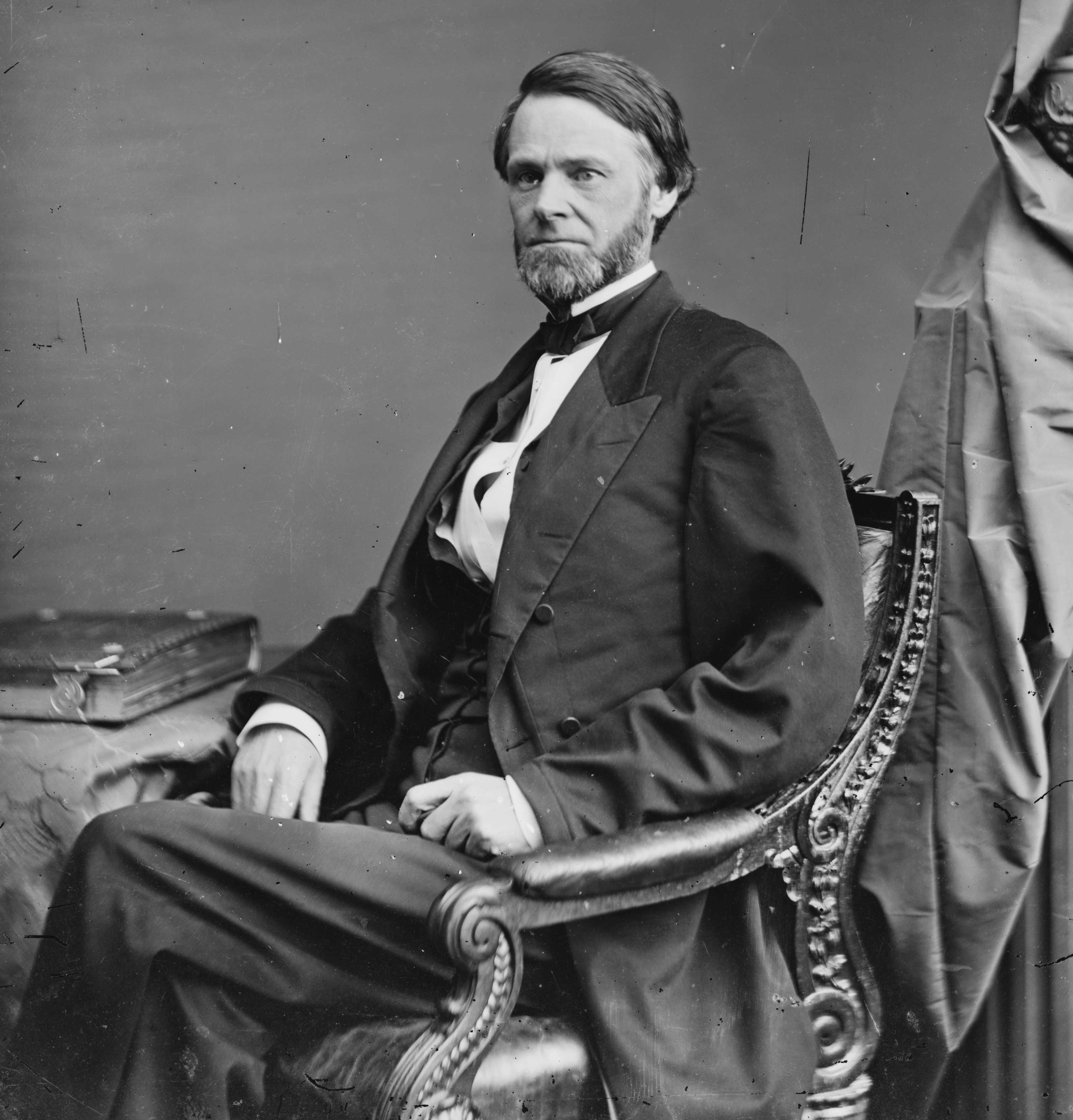
Senator John Sherman. His resemblance to his older brother, the general, is striking (via Wikipedia).

Senator John Sherman. His resemblance to his older brother, the general, is striking (via Wikipedia).

Another double-header today, with letters from both Meade and Theodore Lyman. I’m especially taken by the end of Meade’s letter. It’s an interesting analysis of his role under Grant. He does chafe at his subordinate role and will later become increasingly agitated over not receiving the recognition he feels he deserves, but here he accepts the situation for what it is. Of course, by the time the article he mentions appeared, Horatio Wright replaced John Sedgwick at the head of the VI Corps, and Sedgwick had joined the thousands of soldiers who lie moldering in the grave. The Coppée he mentions is Henry Coppée, a West Point graduate and Mexican War veteran who went on to become the first president of Leheigh University in Bethlehem, Pennsylvania. He also wrote biographies of Ulysses Grant and George Thomas. The magazine Meade cites is the United States Service Magazine.

Senator John Sherman was William T. Sherman’s younger brother. Senator William Sprague was also a former governor of Rhode Island.

All goes on well up to this time. We did not have the big battle which I expected yesterday, as, on advancing, we found the enemy so strongly entrenched that even Grant thought it useless to knock our heads against a brick wall, and directed a suspension of the attack. We shall now try to manoeuvre again, so as to draw the enemy out of his stronghold, and hope to have a fight with him before he can dig himself into an impregnable position.

We have recent Richmond papers containing Lee’s congratulatory address to his army, so you see both sides claim having gained the advantage. Lee, however, seems to think they have gained their point when they check us.

Yesterday I had a visit from Senators Sherman, of Ohio, and Sprague, of Rhode Island; both were very complimentary to me, and wished me to know that in Washington it was well understood these were my battles. I told them such was not the case; that at first I had manceuvered the army, but that gradually, and from the very nature of things, Grant had taken the control; and that it would be injurious to the army to have two heads. I see one of the newspaper men is puzzled to know what share we each have in the work, and settles it by saying Grant does the grand strategy, and I the grand tactics. Coppée in his Army Magazine says, “the Army of the Potomac, directed by Grant, commanded by Meade, and led by Hancock, Sedgwick and Warren,” which is a quite good distinction, and about hits the nail on the head.

In his letter from May 19, Theodore Lyman continues his account of the campaign so far. A journal entry added as a footnote to the letter mentions the altercation that occurred between Meade and Philip Sheridan at Todd’s Tavern.

To continue my history a little—I had struggled with much paper to the morning of the 8th. It proved a really hot day, dusty in the extreme and with a severe sun. We staid till the morning was well along, and then started for Piney Branch Church. On the way passed a cavalry hospital, I stopped and saw Major Starr, who had been shot directly through both cheeks in a cavalry fight the day before. He was in college with me, and when I first came to the army commanded the Headquarter escort, the same place [Charles Francis] Adams now has. . . .

Near Piney Branch Church we halted, pitched tents and had something cooked. Meanwhile there was firing towards Spotsylvania, an ill omen for us. The Rebels were there first and stood across the way. Warren attacked them, but his were troops that had marched and fought almost night and day for four days and they had not the full nerve for a vigorous attack. General Robinson’s division behaved badly. Robinson rode in among them, calling them to attack with the bayonet, when he was badly shot in the knee and carried from the field. They failed to carry the position and lost a golden opportunity, for Wilson’s cavalry had occupied Spotsylvania, but of course could not keep there unless the enemy were driven from our front. . . .

A little before two we moved Headquarters down the Piney Branch Church road, south, to near its junction with the Todd’s Tavern road. Meantime the 6th Corps had come up and formed on the left of Warren, the lines running in a general easterly and westerly direction, a mile and a half north of Spotsylvania. There was a high and curving ridge on which was placed our second line and batteries, then was a steep hollow, and, again, a very irregular ridge, or broken series of ridges, much of them heavily wooded, with cleared spaces here and there; along these latter crests ran the Rebel lines in irregular curves. Preparations were pushed to get the corps in position to attack, but it was plain that many of the men were jaded and I thought some of the generals were in a like case. About half-past four what should Generals Grant and Meade take it into their heads to do but, with their whole Staffs, ride into a piece of woods close to the front while heavy skirmishing was going on. We could not see a thing except our own men lying down; but there we sat on horseback while the bullets here and there came clicking among trunks and branches and an occasional shell added its discordant tone. I almost fancy Grant felt mad that things did not move faster, and so thought he would go and sit in an uncomfortable place. General Meade, not to be bluffed, stayed longer than Grant, but he told me to show the General the way to the new Headquarters. Oh! with what intense politeness did I show the shortest road! for I had picked out the camp and knew the way.

Hobart Ward (Library of Congress).

J. Hobart Ward. After the Wilderness, Winfield Scott Hancock had him relieved for being intoxicated in the face of the enemy (Library of Congress).

Well, they could not get their attack ready; but there was heavy skirmishing.* … I think there was more nervous prostration to-day among officers and men than on any day before or since, the result of extreme fatigue and excitement. General Ward was relieved from his command, for misbehavior and intoxication in presence of the enemy during the Battle of the Wilderness. I had always supposed him to be a brave but rough man. . . .

*”Sheridan now came to Headquarters—we were at dinner. Meade told him sharply that his cavalry was in the way, though he had sent him orders to leave the road clear. S. replied that he never got the order. Meade then apologized, but Sheridan was plainly full of suppressed anger, and Meade too was in ill temper. S. went on to say that he could see nothing to oppose the advance of the 5th Corps; that the behavior of the infantry was disgraceful, etc., etc. Maybe this was the beginning of his dislike of Warren and ill-feeling against Meade.”—Lyman’s Journal.

Meade’s correspondence taken from The Life and Letters of George Gordon Meade, Major-General United States Army, Vol. 2, (New York: Charles Scribner’s Sons, 1913), pp. 197-8. Available via Google Books.

Theodore Lyman’s letter is from Meade’s Headquarters, 1863-1865: Letters of Colonel Theodore Lyman from the Wilderness to Appomattox, pp 104-106. Edited by George R. Agassiz. Boston, Massachusetts Historical Society, 1922. Available via Google Books.

Sheridan (May 16, 1864)

Philip Sheridan and Meade developed a cantankerous relationship (Library of Congress).

Philip Sheridan and Meade developed a cantankerous relationship (Library of Congress).

Meade mentions cavalry commander Philip Sheridan in his letter to his wife from May 16. In the battle of Yellow Tavern on May 11, one of Sheridan’s men mortally wounded Jeb Stuart, a major blow to Lee’s army. Meade does not mention the unpleasant encounter he had had with Sheridan early in the morning on May 8 at a place called Todd’s Tavern. Meade had been angry that Sheridan’s men hadn’t cleared the road all the way to Spotsylvania. Sheridan, already chafing under Meade’s command, was incensed that Meade had felt it necessary to issue some orders directly to his cavalry. According to Horace Porter of Grant’s staff, Meade was in “a towering passion” while Sheridan was “equally fiery.” The two men argued and Sheridan said, “If I am permitted to cut loose from this army I’ll draw Stuart after me and whip him, too.” Meade reported Sheridan’s insubordination to Grant, and repeated what the cavalry commander had said about Stuart. “Did Sheridan say that?” replied Grant. “Well, he generally knows what he is talking about. Let him start right out and do it.” Meade issued the orders, no doubt irritated that Grant was rewarding Sheridan for his insubordination to a superior officer. Sheridan did kill Stuart, but he also deprived the Army of the Potomac of the eyes and ears of his cavalry during a vital part of the Overland Campaign.

The weather still continues unfavorable for military operations, so, unless the enemy attack us, we shall probably remain quiet to-day. Our cavalry, under Sheridan, have been heard from. He was sent to get in the enemy’s rear, destroy their communications and supplies, fight their cavalry, and when his forage was exhausted, make his way to [Benjamin] Butler, on the James River. He reports having executed his orders, and it is said that J. E. B. Stuart was killed in the battle with Sheridan.

In his letter of May 16, Lyman resumes his account of the fighting in the Wilderness, especially the struggle around the Brock Road and the arrival of James Longstreet’s corps. Fortunately for the Union, Longstreet’s flank attack faltered when its commander was accidentally shot by his own troops. Lyman writes about the death of Henry Abbott, his Harvard friend and the commander of the 20th Massachusetts Earlier Abbot had commented on how Meade and Grant worked together. He thought the combination was “the next best thing to having a man of real genius at the head.” Meade was “a good combiner and maneuverer” and “unquestionably a clever man intellectually,” while Grant had “force” and “character” and wasn’t “afraid to take the responsibility to the utmost.”

I will continue the letter of this morning, describing our first day’s fight. I had got as far as the death of General Hays and the wounding of Carroll. This was between five and six o’clock. Hays commanded one brigade of Birney’s division. He was a strong-built, rough sort of man, with red hair, and a tawny, full beard; a braver man never went into action, and the wonder only is that he was not killed before, as he always rode at the very head of his men, shouting to them and waving his sword. Mott’s division behaved badly (as you observed, it broke and came back). This is a curious instance of a change of morale. It is Hooker’s old fighting division, but has since been under two commanders of little merit or force of character; then there was some discontent about re-enlistments and about the breaking up of the old 3d Corps, to which it had belonged; and the result has been that most of this once crack division has conducted itself most discreditably, this campaign. However, the fresh troops saved the day, and, at dark, we occupied our old line (the dotted one along the Brock road). . . .

Major General Winfield Scott Hancock (Library of Congress).

Major General Winfield Scott Hancock (Library of Congress).

It was long after dark when I rode back, and, with some difficulty, found our camp, now pitched in a dusty, ploughed field. The fight of this day had been an attack by parts of our three corps against the Corps of Ewell on our right, and of Hill on our left. The fight had swayed back and forth and ended in a drawn battle, both sides holding their lines. General Grant ordered the attack all along the line, the next morning at 4.30; but put it off to 5 o’clock on the representation that Burnside could not get up in time. He was ordered to get in position by daylight and to go in on Hill’s left flank, where you see a dotted line nearly parallel to the Parker’s Store road. We were all up right early on that Friday the 6th of May, you may depend. “Lyman,” said the General, “I want you to take some orderlies and go to General Hancock and report how things go there during the day.” It was after five when I mounted, and already the spattering fire showed that the skirmishers were pushing out; as I rode down the crossroad, two or three crashing volleys rang through the woods, and then the whole front was alive with musketry. I found General Hancock at the crossing of the plank: he was wreathed with smiles. “We are driving them, sir; tell General Meade we are driving them most beautifully. Birney has gone in and he is just cleaning them out be-auti-fully!” This was quite apparent from the distance of the receding firing and the absence of those infernal minie balls. “I am ordered to tell you, sir, that only one division of General Burnside is up, but that he will go in as soon as he can be put in position.” Hancock’s face changed. “I knew it!” he said vehemently. “Just what I expected. If he could attack now, we would smash A. P. Hill all to pieces!” And very true were his words. Meantime, some hundreds of prisoners were brought in; all from Hill’s troops. Presently, however, the firing seemed to wake again with renewed fury; and in a little while a soldier came up to me and said: “I was ordered to report that this prisoner here belongs to Longstreet’s Corps.” “Do you belong to Longstreet?” I hastened to ask. “Ya-as, sir,” said grey-back, and was marched to the rear. It was too true! Longstreet, coming in all haste from Orange Court House, had fallen desperately on our advance; but he had uphill work. Birney’s and Getty’s men held fast and fought with fury, a couple of guns were put in the plank road and began to fire solid shot over the heads of our men, adding their roar to the other din. The streams of wounded came faster and faster back; here a field officer, reeling in the saddle; and there another, hastily carried past on a stretcher. I stood at the crossing and assisted in turning back stragglers or those who sought to go back, under pretext of helping the wounded. To some who were in great pain I gave some opium, as they were carried past me.

It was about seven o’clock, I think, that Webb’s brigade marched along the Brock road, and, wheeling into the pike, advanced to the support of Birney. Among them was the 20th Massachusetts. Abbot smiled and waved his sword towards me, as he rode by, and I called out to him wishing him good luck; and so he went on to his death, as gallant a fellow as fell that day; a man who could ride into the fight with a smile on his face. Just before eight o’clock came one brigade of Stevenson’s division (Burnside’s Corps) which had been sent to strengthen Hancock; the other brigade came later and was put on our left, where we were continually paralyzed by reports that the enemy was coming up the Brock road to take us in the flank. This prevented proper mobility of our left, and, after all, they turned out to be a division of Rebel cavalry, who were defeated later in the day by our men. Stevenson’s brigade was now put in to relieve the advanced lines that had long been under fire, and all other fresh troops were marched to the front. But Longstreet knew full well (they know everything, those Rebels) that Burnside was coming up with two divisions, on his flank; and knew too that he was late, very late. If Hancock could first be paralyzed, the day was safe from defeat, which now impended. Gathering all his forces, of both corps, he charged furiously. At a little after eleven Mott’s left gave way. On the right the brigade of Stevenson, consisting of three raw Massachusetts regiments miscalled “Veterans,” broke, on being brought under a tremendous fire. . . .The musketry now drew nearer to us, stragglers began to come back, and, in a little while, a crowd of men emerged from the thicket in full retreat. They were not running, nor pale, nor scared, nor had they thrown away their guns; but were just in the condition described by the Prince de Joinville, after Gaines’s Mill. They had fought all they meant to fight for the present, and there was an end of it! If there is anything that will make your heart sink and take all the backbone out of you, it is to see men in this condition! I drew my sword and rode in among them, trying to stop them at a little rifle-pit that ran along the road. I would get one squad to stop, but, as I turned to another, the first would quietly walk off. There was a German color-bearer, a stupid, scared man (who gave him the colors, the Lord only knows!), who said, “Jeneral Stavenzon, he telled me for to carry ze colors up ze road.” To which I replied I would run him through the body if he didn’t plant them on the rifle-pit. And so he did, but I guess he didn’t stick. Meanwhile there was no danger at all; the enemy did not follow up — not he. He was busy swinging round to oppose Burnside, and was getting his men once more in order. At half-past one I rode to General Meade and reported the state of affairs. The Provost-General went out at once and stopped and organized the stragglers. At two o’clock Burnside, who had been marching and countermarching, did attack. He made some impression, but it was too late, and he had not enough force to follow on. About this time I returned to General Hancock.* His men were rallied along the road; but regiments and brigades were all mixed up; and we were obliged to listen to Burnside’s fighting without any advance on our part. In our front all was quiet; and I got permission to go back to the 2d Corps hospital and look up the body of Major Abbot. Two miles back, in an open farm surrounded by woods, they had pitched the hospital tents. I will not trouble you with what I saw there, as I passed among the dead and dying. Abbot lay on a stretcher, quietly breathing his last — his eyes were fixed and the ashen color of death was on his face. Near by lay his Colonel, Macy, shot in the foot. I raised Macy and helped him to the side of Abbot, and we stood there till he died. It was a pitiful spectacle, but a common one on that day. I left in haste, after arranging for sending the remains home, for the sudden sound of heavy firing told of some new attack. The Rebels (unquenchable fellows they are!), seeing that Burnside had halted, once more swung round and charged furiously on Hancock in his very rifle-pits. I rode at once to General Meade, to ask that Burnside might attack also. This he did, without further orders and with excellent effect. When I got back to the cross-road, I was told the enemy had broken through on the plank and cut us in two; this turned out an exaggeration. They did get into a small part of a rifle-pit but were immediately driven out leaving near sixty dead in the trench at the point.

*The book includes this footnote, taken from Lyman’s journal: “1.15 (about). Back to Hancock. He alone, in rear of Brock road; and there he asked me to sit down under the trees, as he was very tired indeed. All his Staff were away to set in order the troops. They had now constructed a tolerable rifle-pit extending along the Brock and to the head of the cross-road. He said that his troops were rallied but very tired and mixed up, and not in a condition to advance. He had given orders to have the utmost exertions put forth in putting regiments in order, but many of the field officers were killed and wounded, and it was hard. At 2 P.m. Burnside, after going almost to Parker’s Store and again back, made a short attack with loud musketry. Ventured to urge Hancock (who was very pleasant and talkative) to try and attack too; but he said with much regret that it would be to hazard too much, though there was nothing in his immediate front, which had been swept by Stevenson’s other brigade, which marched from left to right.”

Meade’s correspondence taken from The Life and Letters of George Gordon Meade, Major-General United States Army, Vol. 2, (New York: Charles Scribner’s Sons, 1913), pp. 195-6. Available via Google Books.
Theodore Lyman’s letter is from Meade’s Headquarters, 1863-1865: Letters of Colonel Theodore Lyman from the Wilderness to Appomattox, pp 92-7. Edited by George R. Agassiz. Boston, Massachusetts Historical Society, 1922. Available via Google Books.