Aristocrats (May 1, 1864)

Republican Senator Thaddeus Stevens (Library of Congress).

Republican Senator Thaddeus Stevens (Library of Congress).

It’s surprising to hear of Thaddeus Stevens as a Meade supporter. Radical Republicans such as the Pennsylvania senator tended to eye men like Meade, perceived as being too close to George McClellan, with suspicion. As interesting as it is to hear a Radical Republican say something nice about Meade, it’s even more interesting to have Meade describe Philip Sheridan as “quite distinguished.” It will not be long before his opinion changes.

The Sypher Meade mentions is Josiah Sypher. Born in Liverpool, he studied law with Stevens and became a newspaper reporter/editor. After the war he wrote History of the Pennsylvania Reserve Corps: A Complete Record of the Organization ; and of the Different Companies, Regiments and Brigades ; Containing Descriptions of Expeditions, Marches, Skirmishes, and Battles ; Together with Biographical Sketches of Officers and Personal Records of Each Man During His Term of Service ; Compiled from Official Reports and Other Documents.

The Augur mentioned in this letter is General Christopher C. Augur. As commander of the Department of Washington, he was in a good position to acquire the photographs that Mrs. Meade desired.

I am sorry for your trouble about the generals. Augur happened to be in my tent when I received your letter, and I told him of your distress. He said if you would send him the names of those you wished, he thought he could get their photographs for you. I will ask Sheridan for his. He is our new cavalry commander, and quite distinguished.

I have to-night a note from a Mrs. Brown, 1113 Girard Street, on the Dry Goods Committee, asking for a lock of my hair, but I have been compelled to decline on the ground of the shortness of my locks.

The weather continues fine, and the time approaches for active operations. Some indications would lead to the belief that Lee will take the initiative, but I can hardly believe he will be so blind to the experience of the two past campaigns. The defensive policy is clearly the true one for him; still, he may not think so.

I don’t think I told you I had a visit from Mr. Sypher, formerly a correspondent of the Inquirer, but afterwards of the Tribune. He is a great friend of Thaddeus Stevens, and lives in the same house with him in Washington. He told me Mr. Stevens was a firm friend of mine, and recently, when some member was attacking me in conversation, he brought against me the charge that I was an aristocrat. Mr. Stevens laughed and said he knew all about my family, and he wished the country had more such aristocrats.

Meade’s correspondence taken from The Life and Letters of George Gordon Meade, Major-General United States Army, Vol. 2, (New York: Charles Scribner’s Sons, 1913), p. 192. Available via Google Books.

A Review (April 13, 1864)

The home of John Minor Botts, site of the II Corps review that Theodore Lyman writes about (Library of Congress).

The home of John Minor Botts, site of the II Corps review that Theodore Lyman writes about (Library of Congress).

Theodore Lyman writes home on April 13, 1864, and describes his first impressions of Winfield Scott Hancock and Philip Sheridan. We have encountered John Minor Botts before. David Birney now commands a division in Hancock’s II Corps. The brigade commanders are Hobart Ward and Alexander Hays.

Philip Sheridan was the army’s new head of cavalry. He and Meade will develop a rancorous relationship. “Little Phil” had commanded cavalry for a grand total of only about three months during his military career, but he had served under Grant in the West and the new general in chief liked his aggressive nature. “He was brusque, demanding, profane, and unforgiving,” wrote biographer Roy Morris Jr. “He was also hardworking, patriotic, uncomplaining, and brave.” He was a hard fighter on the battlefield and was equally aggressive at furthering his own reputation.

Philip Sheridan (Library of Congress).

Philip Sheridan (Library of Congress).

We went to a review of Birney’s Division near J. M. Bott’s house. The two brigades are under H. Ward and Alex. Hays. About 5000 men were actually on the ground. Here saw General Hancock for the first time. He is a tall, soldierly man, with light-brown hair and a military heavy jaw; and has the massive features and the heavy folds round the eye that often mark a man of ability. Then the officers were asked to take a little whiskey chez Botts. Talked there with his niece, a dwarfish little woman of middle age, who seems a great invalid. She was all of a tremor, poor woman, by the mere display of troops, being but nervous and associating them with the fighting she had seen round the very house. Then there was a refreshment at Birney’s Headquarters, where met Captain Briscoe (said to be the son of an Irish nobleman, etc., etc.); also Major Mitchell on General Hancock’s Staff. The Russ was delighted with the politeness and pleased with the troops. Introduced to General Sheridan, the new Chief of Cavalry — a small, broad-shouldered, squat man, with black hair and a square head. He is of Irish parents, but looks very like a Piedmontese. General Wilson, who is probably to have a division, is a slight person of a light complexion and with rather a pinched face. Sheridan makes everywhere a favorable impression.

Theodore Lyman’s letter is from Meade’s Headquarters, 1863-1865: Letters of Colonel Theodore Lyman from the Wilderness to Appomattox, pp 80-1. Edited by George R. Agassiz. Boston, Massachusetts Historical Society, 1922. Available via Google Books.

Better Than Jesus

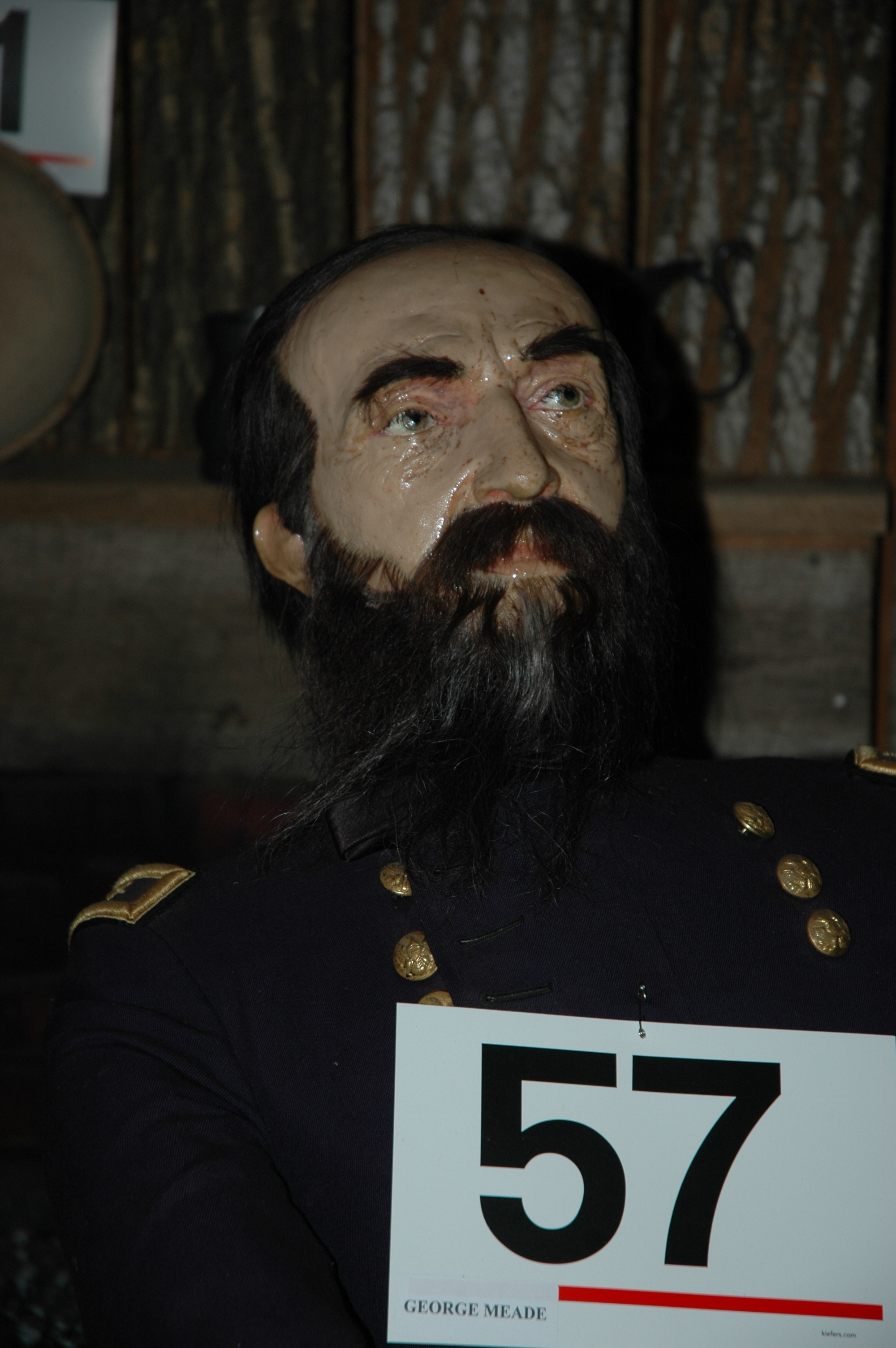
DSC_5752The George Meade figurine being auctioned at the American Civil War Wax Museum in Gettysburg sold for $1,100, far more than I could justify (or afford) paying. But I was glad to see Meade fetched a higher value than any of the other generals in his booth. George Armstrong Custer sold for $900 and Philip Sheridan–a thorn in the real Meade’s side–sold for a mere $500.

My wife and I hit a couple of brewpubs last night (Battlefield Brew Works and the new ABC in the Gateway complex off Route 15) so we were moving a tad slowly this morning and missed the auction of the first Robert E. Lee and General Grant. (Yes, the wax museum had more than one Lee.) So I can’t say what they sold for. But of all the figures we saw auctioned, Meade scored the highest, beating out Stonewall Jackson ($500), Nathan Bedford Forrest ($675), John Singleton Mosby ($600), Jubal Early ($450), George Pickett ($700), and James Longstreet ($750). The Lee figure from the museum’s front hallway tied with Meade, but the Old Goggle-eyed Snapping Turtle did beat the Jesus figure from the Jackson diorama. The Son of God went for $1,000.

The auction appeared to draw a pretty big crowd and it was standing-room only when we arrived around 9:15. We left when it became apparent that even the little stuff was selling for more than we were prepared to pay. The sign for the Northern Leaders booth, the one with Meade, went for $250–about 10 times what I was prepared to pay.

I did bid on one reproduction rifle but was immediately outbid. Although I would have liked to come home with something, my bank account feels a sense of relief.

The Storm Subsides (March 10, 1864)

Meade appears upbeat about his battles in Congress on March 10. At the end of the letter he mentions Grant’s arrival for a visit, which is even bigger news. This is how Grant himself recalled the meeting in his memoirs:
A sketch of Ulysses S. Grant by Alden Finney Brooks (Library of Congress).

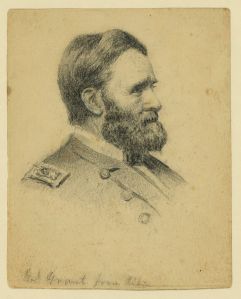
A sketch of Ulysses S. Grant by Alden Finney Brooks (Library of Congress).

My commission as lieutenant-general was given to me on the 9th of March, 1864. On the following day, as already stated, I visited General Meade, commanding the Army of the Potomac, at his headquarters at Brandy Station, north of the Rapidan. I had known General Meade slightly in the Mexican war, but had not met him since until this visit. I was a stranger to most of the Army of the Potomac, I might say to all except the officers of the regular army who had served in the Mexican war. There had been some changes ordered in the organization of that army before my promotion. One was the consolidation of five corps into three, thus throwing some officers of rank out of important commands. Meade evidently thought that I might want to make still one more change not yet ordered. He said to me that I might want an officer who had served with me in the West, mentioning Sherman specially, to take his place. If so, he begged me not to hesitate about making the change. He urged that the work before us was of such vast importance to the whole nation that the feeling or wishes of no one person should stand in the way of selecting the right men for all positions. For himself, he would serve to the best of his ability wherever placed. I assured him that I had no thought of substituting any one for him. As to Sherman, he could not be spared from the West.

This incident gave me even a more favorable opinion of Meade than did his great victory at Gettysburg the July before. It is men who wait to be selected, and not those who seek, from whom we may always expect the most efficient service.

Meade’s position afterwards proved embarrassing to me if not to him. He was commanding an army and, for nearly a year previous to my taking command of all the armies, was in supreme command of the Army of the Potomac—except from the authorities at Washington. All other general officers occupying similar positions were independent in their commands so far as any one present with them was concerned. I tried to make General Meade’s position as nearly as possible what it would have been if I had been in Washington or any other place away from his command. I therefore gave all orders for the movements of the Army of the Potomac to Meade to have them executed. To avoid the necessity of having to give orders direct, I established my headquarters near his, unless there were reasons for locating them elsewhere. This sometimes happened, and I had on occasions to give orders direct to the troops affected.

In that excerpt Grant mentions the changes in the Army of the Potomac. Meade had requested that the army be consolidated from five corps to three, and the War Department issued the official orders on March 23. The I and III Corps, both terribly battered at Gettysburg, were broken up, their units distributed to the II, V, and VI Corps. That meant the departures of John Newton and William French, moves that created little regret. George Sykes was also removed from command of the V Corps; prickly, perfectionistic Gouverneur Warren now filled that post. Alfred Pleasonton, the dapper self-promoter who commanded the cavalry, had departed, too. His replacement was the short, pugnacious, and eager-for-glory Philip Sheridan. The General Gibbon whom Meade mentions is John Gibbon, who commanded a division of the II Corps. Reverdy Johnson is the conservative Democratic Senator from Maryland.
Brigadier General John Gibbon as he appeared during the war.

Brigadier General John Gibbon as he appeared during the war.

The storm in which I have been involved seems to be subsiding, as I note the Tribune now says that no charges were preferred against me by General Sickles or Doubleday. Tell General Gibbon that I have received his letter, and am greatly obliged to him for his gallantry and daring in coming out so boldly in my defense; but I do not wish him to compromise himself, and affairs are becoming complicated.

I think I wrote you on my return from Washington I found a polite note from Reverdy Johnston, saying he had assumed the responsibility of denying Mr. Wilkinson’s statement, and asking me if he was not right. This act of courtesy I considered entitled to an acknowledgment, so I replied to Mr. Johnston, and explained to him wherein I thought Mr. Wilkinson had been misled. This letter, it appears, Mr. Johnston showed to his friends, and its receipt was announced in Forney’s Chronicle. To-day I got a sharp letter from the Secretary of War, asking by what authority I wrote to Senators on military operations. I have replied my note was private and not intended for publication or circulation, and that I was not aware I required any authority to write private letters defending myself from the false and slanderous reports with which the public press has been filled for a week, particularly as the military operations referred to took place nine months ago, and the official reports have been published. This may involve me in trouble with the Secretary, but I cannot help it; I will not yield my right to defend myself.

To-day Lieutenant General Grant arrived here. He has been very civil, and said nothing about superseding me.

I go to-morrow to Washington, and shall go again before the committee, to add to my testimony.

Meade’s correspondence taken from The Life and Letters of George Gordon Meade, Major-General United States Army, Vol. 2, (New York: Charles Scribner’s Sons, 1913), pp. 176-7. Available via Google Books.