Busy (September 19, 1863)

John Minor Botts and family pose for a photograph on the porch of their house in Culpeper. Meade and his staff were frequent visitors here (Library of Congress).

John Minor Botts and family pose for a photograph on the porch of their house in Culpeper. Meade and his staff were frequent visitors here (Library of Congress).

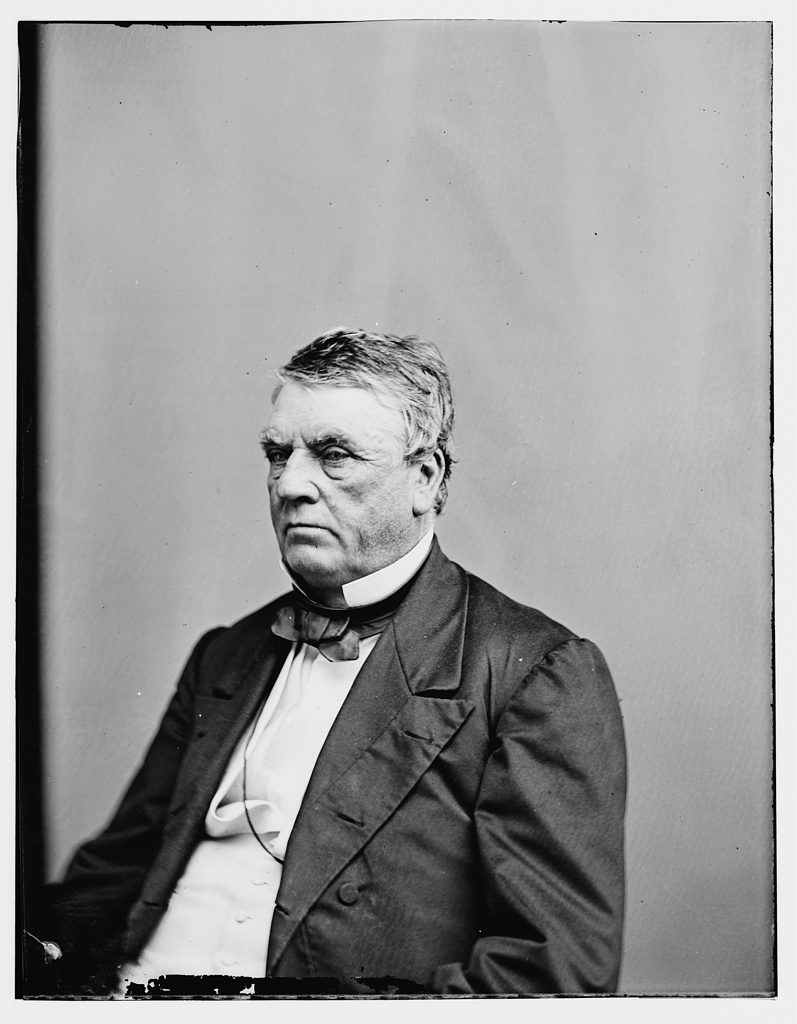
Meade mentions John Minor Botts in his letter of September 19, 1863. Theodore Lyman talks about Botts in his journal entry from the same day. Lyman said Botts was “a fat man, with a mild blue eye, and his clothing seemed to show the world had gone hard with him.” In fact, the world had gone somewhat hard with Botts, who was an island of Unionism on a sea of secession. A Virginia native, Botts was a Whig politician and former U.S. Congressman and had been briefly jailed by the Confederate authorities because of his staunch pro-Union position.

In his memoir, The Great Rebellion: Its Secret History, Rise, Progress, and Disastrous Failure (1866, and available via Google Books), Botts describes how he bought his house in Culpeper and the tribulations he suffered there. “I purchased in the fall of 1862, and moved to the county on the 8th of January, 1863; but I had hardly gotten comfortably warm in the house before General J. E. B. Stuart came in with his whole cavalry force, took possession of every part of my premises (of 2200 acres), except my house, yard, and garden, turned his horses loose to graze in every field, to the exclusion of my own stock, which was left at the mercy of his highly-incensed command, without any effort or desire on his part to restrain them. They killed my hogs, drove off portions of my cattle with their own whenever they moved, and stole from me $50,000 worth of horses, at Confederate prices, and in Confederate money. Daily and hourly I was subjected to all sorts of vexatious annoyances. I had neither peace nor rest, day nor night, from the time this cavalry force came upon me until the arrival of the Federal army under General Meade in the month of September, except during the battles of Chancellorsville and Gettysburg, from both of which they came immediately back to take care of me.

“General Meade moved into Culpepper on the 12th of September, 1863, and General Stuart moved back at double-quick across the Rapidan.”

Meade saw a fair amount of Botts until the army moved out on the Overland Campaign in May 1864. On one occasion Lyman said this about the Virginian: “Botts is a ready witted, clear headed man, and entertaining to hear.”

The Beckham Meade mentions is Robert F. Beckham, who had served under him on the survey of Lake Superior just before the war. Beckham threw in his lot with the Confederacy and commanded a battery of J.E.B. Stuart’s horse artillery. The Pendleton he mentions is probably Nathanael Greene Pendleton of Ohio, formerly a Whig Congressman. Meade’s wife’s father, John Sergeant, had also been a Whig politician. Pendleton’s son was Ohio Congressman George H. Pendleton, an anti-war Democrat who ran as George McClellan’s vice presidential candidate in the election of 1864.

The Botts family in Culpeper. Theodore Lyman described the Botts daughters as "pleasing, somewhat countryfied young ladies" (Library of Congress).

The Botts family in Culpeper. Theodore Lyman described the Botts daughters as “pleasing, somewhat countryfied young ladies” (Library of Congress).

At present I am very busy. I made the advance I did under the belief that Lee had sent away a large portion of his army, and would perhaps, if threatened, retire to Richmond. I find, however, he evinces no disposition to do so, but is, on the contrary, posted in a very strong position behind the Rapidan, where he can hold me in check, and render it very difficult to pierce his line or turn his position. Under these circumstances I have referred the question to Washington.

John Minor Botts (Library of Congress).

John Minor Botts (Library of Congress).

To-day John Minor Botts, who lives in this vicinity, came to see me and told me Beckham had been at his house a few days ago (before we advanced), and spoke in the most enthusiastic terms of me; so that Beckham is not changed. A Mr. Pendleton also, who was in Congress and knew your father, called, and spoke of Mr. Joseph R. Ingersoll, who had been at his house. Both these gentlemen are Union men.

Meade’s correspondence taken from The Life and Letters of George Gordon Meade, Major-General United States Army, Vol. 2, (New York: Charles Scribner’s Sons, 1913), p. 150. Available via Google Books.

Regards from Sheboygan (September 8, 1863)

Maj. Gen. William French, commander of the III Corps, poses with his staff outside Culpeper sometime in September 1863. French stands in the group's center, looking slightly to his right. Click on the image to see a larger version (Library of Congress).

Maj. Gen. William French, commander of the III Corps, poses with his staff outside Culpeper sometime in September 1863. French stands near the group’s center, looking slightly to his right. Click on the image to see a larger version (Library of Congress).

Meade’s letter from September 8, 1863, is fairly short and unexceptional. On the next day, however, Theodore Lyman wrote a letter home that proves much more informative. I include them both here, Meade’s first. The General French he refers to is William French, who had taken over the III Corps following the wounding if Daniel Sickles at Gettysburg.

I reviewed the Third Corps, commanded by General French. The day was pretty hot, and I had to ride six miles to the review and back the same distance. I received recently a very handsome bouquet from two ladies in Sheboygan, Wisconsin; I send you the note accompanying it. Likewise a curious letter written by a rebel refugee in Canada. I am in receipt of such curious documents all the time.

Lyman goes into much more detail about the review and other aspects of life with the Army of the Potomac. (Mause Headrigg, whom he mentions at the end, is a character from Sir Walter Scott’s Old Mortality.)

In my last I forwarded a landscape with Headquarters of the 3d Corps in the verdant background. In this, I will describe the Review, at which, as the Gauls say, “I assisted.” . . . Everybody got himself up in all available splendor. Those that had scarfs put them on, and those that had none, tried to make up in the shine of their boots and newness of their coats. General Meade burst forth in the glory of a new saddle-cloth, which the expressman had, in the nick of time, brought fresh from Washington. As for myself, did I not put on the Brimmer scarf, and white gloves, and patent-leather boots; whereby, shining like a lily of the field, was I not promoted to ride immediately behind the Chief, thereby happily avoiding the dust? Heure militaire, we all mounted, the escort presented arms, and the cavalcade jogged off, en route for the parade ground, six miles distant. The road lay through pine woods, and barren fields, and all sorts of places like most roads hereabouts, and the cloud of dust we raised must have been extremely pleasant to the escort in the rear! At length we got in sight of a big U. S. flag, and, immediately after, beheld a long slope of clear ground, quite black with the lines of infantry, while long artillery trains were moving across the fields to get into position. It looked very handsome and warlike, and the muskets, which had received an extra burnish, were flashing away at a great rate. The procession rode up to the house and dismounted midst great cries of “Orderly!” to come and hold their horses. Then advanced convenient Contrabands and dusted us down; which improved our aspect not a little. After which the Corps Commander, General French, came forth, with proper greetings. He looks precisely like one of those plethoric French colonels, who are so stout, and who look so red in the face, that one would suppose some one had tied a cord tightly round their necks. Mounted on a large and fine horse, his whole aspect was martial, not to say fierce. In a few minutes we again got on, and moved towards the field; whereupon there arose a great and dis tant shouting of “Bat-tal-ion! Shoulder! Her-r-rms!” and the long lines suddenly became very straight and stiff, and up went the muskets to a shoulder. We rode down the front and up the rear of each line (of which there were three, each of a division with the artillery on the left flank) amid a tremendous rolling of drums and presenting of arms and dropping flags; the bands playing “Hail to the Chief.” Miss Sturgis’s mare behaved very nicely and galloped along with her neck arched, minding nothing except the flags, and those not much. Even the cannon did not disturb her behaviour. . . .

After the artillery had in like manner been reviewed, the General took a station by a little flag, and then all three divisions marched past, followed by the artillery. It was a somewhat sad sight to look at these veterans, with their travel-stained uniforms and their battered canteens; many of the regiments had no more than 200 men, and their flags were so tattered that you could barely read such names as Fair Oaks, and Williamsburg, where so many of the missing 800 now lie. The men looked spare and brown and in good health; and also as if they would then and there fight French Zouaves or anybody else you chose to bring on. . . . Some divisions at Gettysburg marched thirty-six miles in one day; and then fought for two days after that, with scarcely anything to eat or to drink. Among the troops were the 11th and 16th Massachusetts regiments and the 10th battery, and certainly none of the soldiers looked better. . . . The artillery looked even more serviceable than the infantry; and, independent of the large number of guns, was well horsed and well manned. As a rule I am much pleased with the aspect of our officers, high and low. They are cleanly and have a firm, quiet bearing. You can often pick out those who have been through the thick of it, by their subdued and steady look. The dress of the soldiers is highly practical, more so even than the French. The knapsack is baggy and of a poor pattern, however. It is curious how everything has, by sheer hard service and necessity, been brought down to the lowest point of weight and complication. A dragoon tucks his trousers inside his boots, buckles on a belt, from which hang a sabre and revolver, gets on a horse with a McClellan saddle and curb bridle, and there he is, ready to ride fifty miles in one day and fight on top of it. . . . After the Review the generals were entertained in a bower, with champagne and other delicacies, while we of the Staff meekly had big sandwiches and buckets of punch. I tried a sandwich, but found it rather salt eating, and so confined myself to iced water, wherein I got ahead of winebibbers who arrived at home very cross and hot. The General, who is very moderate in his conviviality, soon broke up the meeting, and, amidst a most terrible clicking of spurs and rattling of sabres, we all mounted, and so home by a short cut which one of General French’s aides was kind enough to show us, and which entailed a considerable amount of rough riding; so that, with Mause Headrigg, I had occasion to remark, “By the help of the Lord I have luppen a ditch!”

Meade’s correspondence taken from The Life and Letters of George Gordon Meade, Major-General United States Army, Vol. 2, (New York: Charles Scribner’s Sons, 1913), p. 147. Available via Google Books.

Theodore Lyman’s letter is from Meade’s Headquarters, 1863-1865: Letters of Colonel Theodore Lyman from the Wilderness to Appomattox, pp. 9-12. Edited by George R. Agassiz. Boston, Massachusetts Historical Society, 1922. Available via Google Books.

Bad Press (September 5, 1863)

Throughout his army career Meade disliked and distrusted the press. He complained about the newspaper coverage of the Mexican-American War when he was a young officer, and he complained even more vociferously during the Civil War. Things came to a head during the 1864 Overland Campaign when Meade had a reporter kicked out of the army’s camp, but that explosion was a long time coming, as his letter from September 5, 1863, attests. The Spirit of the Times was a New York weekly that was best known for its coverage of sports. George Wilkes had purchased it in 1861.

Have you seen a very bitter article in Wilkes’s Spirit of the Times, of August 29th [see below]? He says the victory of Gettysburg was due entirely to the strength of the position and the heroic bravery of the common soldiers, and was entirely independent of any strategy or military ability displayed by any general from the senior down. He then charges me with imbecility and timidity, and says the Army of the Potomac never can do anything so long as so many incompetent men are at the head of it. The only consolation I have, is that censure from such a source will in the eyes of all respectable people be praise. There is no doubt the position at Gettysburg was very strong, and that the victory was in a great measure due to this fact; and it is also equally true that if the men had not fought as well as they did, I should have been beaten; but I have yet to learn the existence in history of a general whose genius was equal to winning victory when all the advantages were against him, and his men would not fight.

Wilkes is a Hooker man; but whether his article was inspired by any of the friends of this officer, I am not prepared to say, and can hardly believe such to be the case.

This is the newspaper article that so infuriated Meade:

EXTRACT FROM NEWSPAPER ARTICLE, ATTACK ON GENERAL MEADE, MENTIONED IN LETTER OF SEPTEMBER 5, 1863.

(Wilkes’ Spirit of the Times of August 29, 1863)

SINGULAR REVELATIONS
In Regard To
The Army Of The Potomac

(The following letter comes from a distinguished military writer who has had much observation in the Army of the Potomac, and whose opinions we can assure the readers of the Spirit are well worth noting. It was written to a personal friend in this city, and from his hands we obtain it.)

Washington, August 16, 1863

My Dear Sir:

The Army of the Potomac—that army which has so often elevated men from mediocrity into greatness—that army which has marched, fought and bled to no purpose—now lies in sweet repose along the line of the Rappahannock, patiently waiting, as Micawber says, “for something to turn up.” The history of this army is one of barren toil, suffering and death. Its successes are magnified by venal letter-writers into great victories, and its defeats are represented as splendid strokes of strategy. It is thus that a confiding people have been humbugged from month to month, and year to year. History can furnish no instance that will even remotely compare with this army for gross ignorance and mismanagement. In no instance has success been followed up with vigorous and rapid blows; on the contrary, the enemy have been allowed to retreat without molestation, until they had time to rally their scattered forces and fortify themselves. The battle of Gettysburg was purely defensive, and our success was mainly due to the natural strength of our position, to our artillery, and the firmness of a portion of the troops, but in no degree to the strategy or ability displayed by any of the generals, from the senior down.

Here indeed, was an opportunity for a general to have shown the qualities of an able commander, if he possessed them. His troops, however decimated, had, by his own account, suffered far less than the enemy. But his army, flushed with victory, was not permitted to follow up and harass a beaten, dispirited and demoralized enemy, hampered with a vast amount of plunder, thousands of wounded, and an impassable river obstructing their retreat; and while letter-writers were announcing their hopelessness of its escape, Lee’s army was quickly making arrangements for crossing without the slightest interruption from Gen. Meade, or serious effort to penetrate his design. Suggestions were made and heard, to send a force above the rebel position, when by cutting trees and throwing them into the river, his pontoons or other bridges might be swept away. But Gen. Meade’s frequently declared belief was, that Lee could cross when he pleased; that he did not intend to cross, but meant to fight. The sequel shows how completely he was deceived. Had Gen. Meade possessed the activity of either Grant or Rosecrans, and, I may add, of Hooker, he could, by a cavalry reconnaissance on the south side of the Potomac, and a forced one on the Maryland side, have easily discovered Lee’s true intentions; and had he attacked him with his army divided by that river, he must have inevitably destroyed or captured one half of it. But blinded and deceived by Lee, timidity ruled the hour, and the golden opportunity, that is only to be seen and grasped by genius, was lost forever. Here, then, we have a commander but a few days previous magnified into a great general, for his success in a battle which he was forced, in defence, to fight; which was due alone to the natural strength of his position, and the courage of the rank and file, and not, as I have before said, to any display of his military abilities. And yet, when an occasion was subsequently presented for the exercise of his qualities as a commander, he tranquilly sits down before a hastily constructed gutter (miscalled entrenchments) for a week, and quietly permits the enemy to prepare for and cross a formidable stream that barred his retreat. Who can estimate the future sacrifice of life that must ensue from this terrible mistake?

The public must have news to feed upon. It matters not, it would seem, whether it be true or false; and hence they will hear before long of some remarkable things that are soon to take place, which they are not at liberty to reveal. But it may as well make up its mind that the Army of the Potomac will never accomplish anything. With some few exceptions, it is the worst handled body of men, so far as the general officers are concerned, that the world has ever seen. This is, in a great measure, due to the accursed political influence that has blighted and almost destroyed its energy and efficiency. It is due, also, to the many commanders outside the army proper, who have restrained and controlled its action on more than one important occasion, from the President down; and above all, it is due to the many ignorant and self-sufficient politicians who have been appointed to high commands, and the large infusion of foreign adventurers into the different staffs.

In the meantime, Theodore Lyman wrote home to continue the narrative about reaching the Army of the Potomac and its commander, under whom he was going to serve as a volunteer aide. The “female doctor” he describes is Mary Walker, who later won the Medal of Honor for her medical services during the war, only to have Congress revoke it a mere six days before her death in 1919. It was posthumously reinstated. The Grand Army of the Republic Museum and Library in Philadelphia, which displays the head of Meade’s horse, Old Baldy, also has Walker’s medical kit in its collections.

This is what Lyman wrote on September 5, 1863:
Mary E. Walker, the "female doctor" Lyman encountered on the train (Library of Congress).

Mary E. Walker, the “female doctor” Lyman encountered on the train (Library of Congress).

Our train consisted in a large number of freight cars, all marked “U. S. Military Railroads,” and of one passenger car containing its precious freight of officers, not to speak of the female doctor who knocked Zacksnifska out of all sight and knowledge. She was going down to get the son of an old lady, who (the said son) had had a sunstroke, and this female doctor had great confidence she could cure him. She was attired in a small straw hat with a cockade in front, a pair of blue pantaloons and a long frock coat, or sack. Over all she had a linen “duster”; and this, coupled with the fact that she had rips in her boots, gave her a trig appearance. She was liberal in her advice to all com ers and especially exhorted two newspaper boys to immediately wash their faces, in which remark she was clearly correct. . . .

At Warrenton Junction there was luckily an ambulance from headquarters; and as its owner was only a diminutive captain, I had no hesitation in asking him to carry me up, with my traps. … So off we set, on a road which went sometimes over stumps and sometimes through “runs” two or three feet deep. We passed any quantity of pickets and negroes and dragoons in twos and threes; till at last, looking off to the left (or rather right), I beheld what seemed a preparation for a gigantic picnic: a great number of side-tents, pitched along regular lines, or streets, and over them all a continuous bower of pine boughs. These were “Headquarters.” I put my best foot forward and advanced to the tent of the Commander-inChief, in front of which waved a big flag on a high staff. In my advance I was waylaid by a lieutenant, the officer of the day, who with much politeness said General Meade was out for a ride, but would I not walk into a tent and take some whiskey; which I accepted, all but the whiskey. He turned out to be a Swede, one Rosencrantz, and I rejoiced his soul by speaking of Stockholm. Presently there arrived the General himself, who cried out, “Hulloo, Lyman! how are you?” just as he used to. He was as kind as possible, and presently informed me I was to mess with him. As the Chief-of-Staff is the only other man who is allowed to do this, you may concede that my lines have fallen in pleasant places! The said Chief-of-Staff is General Humphreys, a very eminent engineer. He is an extremely neat man, and is continually washing himself and putting on paper dickeys. He has a great deal of knowledge, beyond his profession, and is an extremely gentlemanly man. As to the Assistant Adjutant-General, S. Barstow, he was most hospitable, and looked out for getting me a tent, etc. He really has a laborious and difficult position, the duties of which he seems to discharge with the offhand way of an old workman.

Now I will pull up. As to my riding forth yesterday and to-day, in martial array, beside the General, and with dragoons clattering behind, shall not the glories thereof be told in a future letter? Meanwhile, if you want to feel as if nobody ever was or could be killed, just come here! This is the effect, strange as it may seem. For your assurance I will state, that we yesterday rode seven miles directly towards the enemy, before we got to a spot whence their pickets may sometimes be seen! . . .

Meade’s correspondence taken from The Life and Letters of George Gordon Meade, Major-General United States Army, Vol. 2, (New York: Charles Scribner’s Sons, 1913), p. 147. Newspaper article from pp. 316-7. Available via Google Books.

Theodore Lyman’s letter is from Meade’s Headquarters, 1863-1865: Letters of Colonel Theodore Lyman from the Wilderness to Appomattox, pp. 5-7.Edited by George R. Agassiz. Boston, Massachusetts Historical Society, 1922. Available via Google Books.

Worthless Material (August 9, 1863)

Samuel Crawford, the former army surgeon who became indignant when soldiers called him "Old Pills" (Library of Congress).

Samuel Crawford, the former army surgeon who became indignant when soldiers called him “Old Pills” (Library of Congress).

The long affair of the Pennsylvania Reserves’ presentation sword is finally approaching its end. (See the entry for April 5, 1863, for more about the saga.) General Crawford is Samuel Crawford, who began the war as an army surgeon at Fort Sumter when war began. He is buried in Philadelphia’s Laurel Hill Cemetery, not far from Meade. Theodore Lyman, who served as an aide to Meade later in the war and left behind richly detailed journals and letters, told an amusing story about Crawford, who, in Lyman’s words, had “some reputation for possessing a decided admiration of the looks and figure of his own self.” This is what Lyman had to say in a letter published in Meade’s Headquarters, 1863-1865: Letters of Lt. Col. Theodore Lyman from the Wilderness to Appomattox (edited by George R. Agassiz. Boston: Massachusetts Historical Society, 1922, available via Google Books):

There came to the army a young artist, who was under a certain monied person. The young artist was to make models for bronze medallions, and the monied person was to sell the same and take the profits, if any. He proposed to model the commander of the army, and each of the corps commanders, and General [Alexander] Webb, but no one else. As the artist was modelling away at General Webb, he asked: ‘Isn’t General Crawford rather an odd man?’ ‘What makes you ask that?’ says the Chief-of Staff? ‘Why, he waked me up in the middle of the night, and asked what I could make a statuette of him for! I told him $400 and he said he thought he would have it done!’ Webb, who is a cruel wag, said naught, but, the next time he met C, asked him if he had seen the young sculptor who had come down. ‘Seen him!’ quoth C. ‘My dear fellow, he has done nothing but follow me round, boring me to sit for a statuette!'”

General Crawford, commanding Pennsylvania Reserves, has notified me that the sword which they desire to present me with is ready, and asked me to allow an officer to go to Philadelphia to get it, and make the necessary arrangements, which I have done; so this affair of long standing will soon come off.

I note what you say reports as the secession talk of New York; the same thing has been said in the Times, Tribune and Herald; but I was ahead of all these gentlemen, as in the despatch I sent General Halleck, urging to be permitted to advance, I told him that in my judgment, reasoning from the past, and in view of the power hitherto exercised over the people of the Confederacy, and the fertility of resources exhibited by them, I was of the opinion delay would be more advantageous to the enemy than to us, and that Lee would be reinforced more rapidly than I would be. Every day confirms me in this view. Up to the present time they have taken from this army over twenty regiments, between eight and ten thousand men, and as yet have sent only one hundred and twenty miserable creatures, substitutes for drafted men, to a Pennsylvania regiment; a dozen of whom it is already ascertained were discharged from old regiments for physical disability; four of them had delirium tremens the day they joined, and several have already deserted. Such worthless material, as these men, are no addition to this army, but only a clog, and if the draft is not heartily responded to, the Government had better make up its mind to letting the South go. Don’t misunderstand me; I am nothing of a copperhead. I am for a vigorous prosecution of the war; but the war cannot be prosecuted with any hope of success, not only without men, but a great many willing men; men who have their hearts in the business and who are determined to fight and to conquer, or die. I have had [Gouverneur] Warren made a major general, and George’s friend, Colonel Ganard, a brigadier.

Meade’s correspondence taken from The Life and Letters of George Gordon Meade, Major-General United States Army, Vol. 2, (New York: Charles Scribner’s Sons, 1913), pp.142-3. Available via Google Books.

In Transit (February 26, 1863)

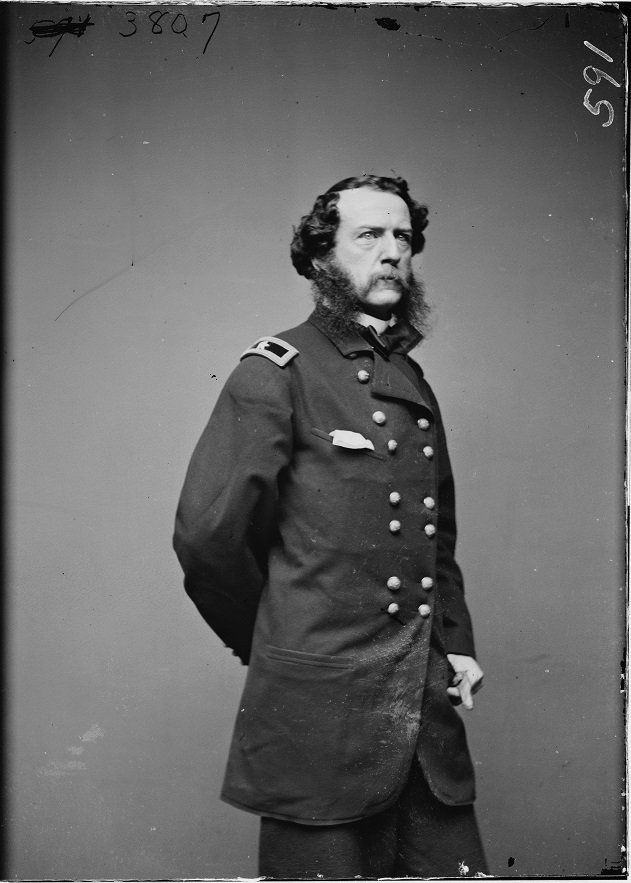
General George Sykes. (Library of Congress photo.)

General George Sykes. (Library of Congress photo.)

Although it seems churlish to resent Meade’s opportunity to obtain leave and spend some time with his family in Philadelphia, we do regret the absence of any correspondence with his wife during that period. The gap finally ends on February 26 when Meade wrote home to detail his travails attempting to return to his command. He wrote this letter from the Bureau of Topographical Engineers in Washington, D.C.

The Cram he mentions is Henry A. Cram, his wife’s brother-in-law. When Theodore Lyman met him in 1864 he said, “Cram is a queer man–never saw one exactly like him. He has a jerky, theatrical style that made me at first suppose he had had a toddy or two.” Sykes is Maj. Gen. George Sykes, who commanded a division of Meade’s V Corps . As I describe him in the book, “Sykes was yet another West Point graduate, a Delaware native who had been fighting since First Bull Run. He looked like a cartoon general, with a big beard that jutted out in front of his chin and a firm, determined nose like the prow of a ship.” His photo (right) will give you an idea of what I mean. When Meade took command of the Army of the Potomac Sykes replaced him at the head of the V Corps.

The train never reached this place until ten o’clock, instead of six-thirty as due. In consequence I missed the boat. As there is none till to-morrow morning at 8 A. M., thus detaining me here all day. This is annoying, because I wished to set the example of a prompt and punctual return within the time allowed me, whereas now I shall be one day behind time, and this is the more disagreeable because there is a report in town that the enemy’s cavalry have appeared in force this side of the Rappahannock. This is only a raid, as they cannot possibly be so foolish as to attempt any advance this side of the river, at this season of the year. The first person I met at the hotel was Cram, and I am going to dine with him to-day. I next met Sykes, who is up here on a court-martial. I am now writing a few lines to give you the news, am going to see Mrs. Turnbull and then shall dine with Cram.

Meade’s letter taken from The Life and Letters of George Gordon Meade, Major-General United States Army, Vol. 1, (New York: Charles Scribner’s Sons, 1913), p. 355. Available via Google Books.