Butlerdom (November 27, 1864)

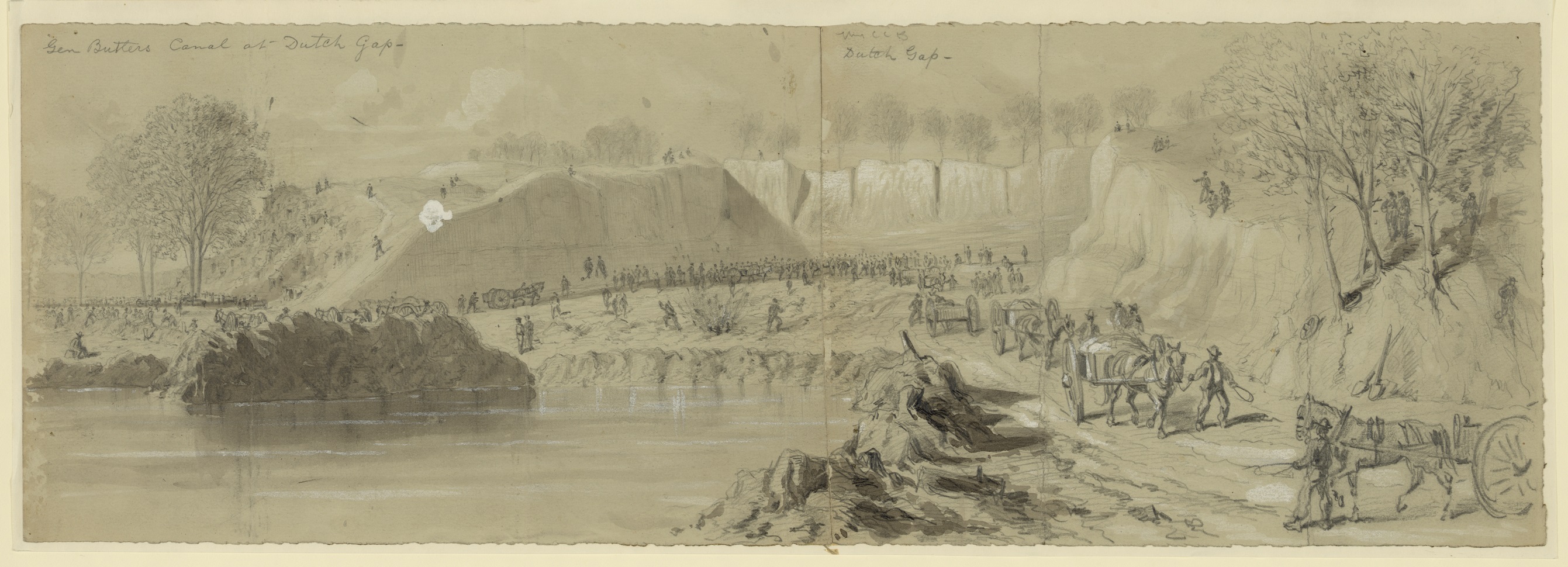
Artist William Waud sketched the activity at "Ben Butler's canal at Dutch Gap." Click to enlarge (Library of Congress).

Artist William Waud sketched the activity at “Ben Butler’s canal at Dutch Gap.” Click to enlarge (Library of Congress).

Both George Meade and Theodore Lyman write home about a visit to Maj. Gen. Benjamin Butler, commander of the Army of the James. Lyman, of course, provides the most detail. The Dutch Gap Canal was Butler’s ambitious scheme to foil the Confederate defense at Drewry’s Bluff on the James River by digging a canal across a neck of land and bypass them altogether. It was perfectly feasible on paper but a very difficult feat to accomplish. The canal was eventually completed, but not until after the war ended. Grant, who had attempted something similar against Vicksburg, seemed happy to let Butler occupy himself with canal digging.

Yesterday I accompanied General Grant on a visit to General Butler’s lines and the famous Dutch Gap Canal, which I had never seen. We had a very pleasant day, remaining with Butler till after dark to witness some experiments with the Greek fire, and getting home about 11 p.m.

I send you an extract from the Washington Chronicle, received to-day. It confirms what General Grant told me, and is designed to make people believe that I was already appointed when Sheridan was made. As Forney is closely allied with the powers that be, I take it for granted the above supposition is correct, and that he speaks by authority and for a purpose. I have no objection to this being arranged, so long as the essential point, justice to me, is conceded.

I had a visit this evening from Dr. McEuen who is here to take away his son Charles, who is major of the One Hundred and Ninety-eighth Pennsylvania, and who is now quite sick with fever. The doctor seems in good spirits and not much changed, except being considerable greyer than I used to see him years ago.

Lyman provides a characteristically entertaining account of the visit to “Butlerdom.” He also discusses a major change in the Army of the Potomac—the departure of Winfield Scott Hancock and his replacement at the head of the II Corps by Andrew Humphreys. The latter general, who had served as Meade’s chief of staff since just after Gettysburg, had long hungered for his own corps command—within limits. Back in July, Grant had suggested him for command of the X Corps in the Army of the James, which included African-American soldiers. Humphreys declined the offer because he did not want to command blacks, telling Grant, “I confess that while I have the kindliest feelings for the negro race and gladly see anything done that promises to ameliorate their condition, yet as they are not my own people, nor my own race, I could not feel towards negro troops as I have always felt towards the troops I have commanded, that their character, their reputation, their honor was a part of mine, that the two were so intimately connected that they could not be separated.”

Lyman provides an alternate account of the visit in his journal entry, which you can read in Meade’s Army: The Private Notebooks of Lt. Col. Theodore Lyman (edited by David W. Lowe, it is recommended reading). Lowe identifies “Pet” as Oliver Spencer Halsted, a New Jersey politician. He also describes Maj. Gen. John Gibbon’s reaction to Humphreys’ promotion to corps command. “Gibbon is mad, considering the appointment of Humphreys, to temporary command of the corps, a slight. He’s a fool! Gen. Meade has done everything for him, and now he sulks and asks to be relieved.”

Lyman’s almost Dickensian account of the visit will continue tomorrow.

General Andrew Atkinson Humphreys. (Library of Congress)

General Andrew Atkinson Humphreys. (Library of Congress)

I think I will occupy the remainder of this letter with an account of our picnic yesterday to Butlerdom. The day was further remarkable for the departure of my dear General Humphreys to take command of the 2d Army Corps. For Hancock has got a leave of absence, and will doubtless be put to recruiting fresh troops, while it is hoped that the President will permanently assign Humphreys to this Corps. He is in high glee at going, and will be in despair if a big fight is not got up for his special benefit. He was a great favorite and was escorted by some fifteen mounted officers of the Staff to his new quarters, at which compliment I think he was gratified. I regretted not to be with him, but had to go with the General, who started by the mail train, at 8 a.m., to be early at Grant’s Headquarters, whence they were to start. We took our horses on a freight car. In the train we found Generals [Gouverneur] Warren and [Samuel] Crawford, who were invited to be of the party. Arrived at City Point, we discovered that the Lieutenant-General was still in bed, whereat Meade did laugh, but the three stars soon appeared and went to breakfast. After which meal, our horses were put on the boat and we put ourselves on, and off we started. The party was a big one. There were Generals Grant, Meade, Warren, Crawford and [Rufus] Ingalls, and several Staff officers. There were then the bourgeois: to wit, a great many “Turkeys” (gentlemen who had come down to distribute those Thanksgiving fowls); two men who wanted to sell a steamer; one Senator, viz., [James] Nesmith of Oregon, and one political blackguard named H____, whose special business was to praise a certain Greek fire, of which more anon. This fellow’s name is usually prefixed by “Pet.” He has wild hair and beard and a face showing a certain ability; his distinguishing mark, I am told, is the absence of any sort of morality or principle. With him was his son, a small and old boy, of whom they said that, if papa could not get the best at a game of poker, son would come in and assist. Senator Nesmith is a child of the people, and was prepared for his congressional duties by a residence of twenty-five years among the Indians. When he first got to Washington, he had never before seen a railroad, a telegraph, or a gas-light. “Senator Fessenden asked me what I thought of things. ‘Well,’ says I, ‘when I first came along I was full of the dignity of the position to which I had been elected; but now all I want to know is, who in thunder ever sent you fellers here!’“ He has plenty of brains, this same, but is a very coarse man. The “Turkeys” were of various sorts: several of them were Club men, e.g., Mr. Benson, a gentleman who seemed a middle-aged beau, with much politeness and no particular brains. He kept bowing and smiling and backing into persons, and offering his chair to everyone, from orderlies up to General Grant. He requested to know whether in my opinion he could be properly considered as having been “under fire; because,” said he, “I stood on the Avery house and could see the shells explode in the air, you know!” All this motley crowd started at once for Deep Bottom; nor should I omit to say that we had also on board a Secesh bishop—Leigh of Georgia—who was going by flag of truce to Richmond. He had remained in Atlanta, and Sherman had told him if he wished to get back, he must go via Richmond. From him they got a good deal of entertaining conversation. His opinion of Sherman was very high and complimentary. “The old Book tells us,” he said, “that the race may not be to the swift, nor the battle to the strong, and we feel that Providence will not desert our righteous cause.” “Yes,” said General Meade, “but then we feel that Providence will not desert our cause; now how are you going to settle that question?” Whereat they both laughed. The bishop was a scholastic, quiet-looking man, and no great fire-eater, I fancy. The boat made fast at Aiken’s landing, halfway between Deep Bottom and Dutch Gap. A Staff officer was there to receive us and conduct us, two miles, to General Butler’s Headquarters. Some rode and some were in ambulances. The James Army people always take pretty good care of themselves, and here I found log houses, with board roofs, and high chimneys, for the accommodation of the gentlemen of the Staff. You might know it was Butler’s Headquarters by the fact that, instead of the common ensign, he had a captured Reb battle-flag stuck up! This chieftain asked in the general officers and we were left to the care of the Staff, who were not behindhand in their civility. . . . Presently Butler climbed on his horse and led the way to see Fort Harrison, which was captured in the movements at the end of September. It was well worth seeing, for on our side of the river we have no hills: it is pretty much one plain with gullies. But here was a regular hill, of some size, dominating the whole country about. How they took the place, I hardly see, for the land is often for a mile in front of it, and the Rebs had artillery in position and a regular infantry running quite to the river. . . .

Meade’s correspondence taken from The Life and Letters of George Gordon Meade, Major-General United States Army, Vol. 2, (New York: Charles Scribner’s Sons, 1913), p. 248. Available via Google Books.

Theodore Lyman’s letter is from Meade’s Headquarters, 1863-1865: Letters of Colonel Theodore Lyman from the Wilderness to Appomattox, pp. 279-82. Edited by George R. Agassiz. Boston, Massachusetts Historical Society, 1922. Available via Google Books.

The Best Man the War Has Yet Produced (November 24, 1864)

Ulysses S. Grant and his horse, Cincinnati. Click to enlarge  (Library of Congress).

Ulysses S. Grant and his horse, Cincinnati. Click to enlarge
(Library of Congress).

Anyone interested in the relationship between George Meade and Ulysses S. Grant should find this letter fascinating. In it, Meade writes to his brother-in-law, Henry A. Cram of New York, and analyzes his standing with the general in chief. Although irritated by the promotions of Sherman and (especially) Sheridan, Meade does not hold a grudge against Grant, believing he just doesn’t worry about such things. He also notes the fault in Grant that will later plague him as president: that he has a “a simple and guileless disposition, which is apt to put him, unknown to himself, under the influence of those who should not influence him, and desire to do so only for their own purposes.” All in all, this is a remarkably fair minded letter.

Following Meade’s letter, Theodore Lyman describes Thanksgiving with the Army of the Potomac.

I thank you most gratefully for your opinion that Time and History will do me justice, but I very much fear your kind feeling has caused the wish to be father to the thought. No man in this country will be appreciated who does not dazzle his fellow-citizens with continued brilliant success. Fortunately I knew so much of the fickleness and unreasonableness of public opinion, that when I was elevated to my present position I was prepared for the reaction and my fall; indeed, considering all things, I consider myself very fortunate in having retained my position so long as I have. However, I don’t want to inflict a letter of complaints on you. I have done and shall continue to do my duty to the best of my ability, and try to be contented under whatever it may please God to have happen to me. Adopting the philosophy of the Irishman who, when going into battle, said he would consider himself “kilt”; if he was, it would be no more than he expected; if he got through safe, it would be clear gain. So, expecting nothing, all acts of justice and kindness that fall to my lot I shall consider so much gain.

I am sorry to hear what you say of Grant, but it is in accordance with my theory and experience. Public expectation in his case, as in Sherman’s, having been wrought up to a false and unreasonable pitch, expecting impossibilities and miracles, visits on them the failure to do what only public imagination renders practicable. Both these men at one time were down. Sherman was pronounced crazy, and Grant was at one time deprived of command; and now, should success by any accident attend the efforts of either, their stars will be more in the ascendant than ever.

Grant is not a mighty genius, but he is a good soldier, of great force of character, honest and upright, of pure purposes, I think, without political aspirations, certainly not influenced by them. His prominent quality is unflinching tenacity of purpose, which blinds him to opposition and obstacles—certainly a great quality in a commander, when controlled by judgment, but a dangerous one otherwise. Grant is not without his faults and weaknesses. Among these is a want of sensibility, an almost too confident and sanguine disposition, and particularly a simple and guileless disposition, which is apt to put him, unknown to himself, under the influence of those who should not influence him, and desire to do so only for their own purposes. Take him all in all, he is, in my judgment, the best man the war has yet produced. When I say this, I refer more particularly to those I have come in contact with, and do not include Sherman, about whom I know nothing but what I see in the papers. I like Grant, and our relations have been very friendly. He has always in words expressed himself most kindly towards me, and I believe does feel so; but his acts, from causes alluded to above, have not been so; but I acquit him of any actual intention of injustice. His coming here has resulted virtually in setting me aside, almost as effectually as if I had been relieved. To be sure, I saw this plainly before he came. He did not see it then, and he don’t see it now; there is the difference between us. I over-sensitive, and he deficient in sensibility. There are many things in Grant that call for my warmest admiration, and but few that I feel called on to condemn. He has been greatly over-rated; but I should be really sorry to see him, through a reaction, under-estimated. Let all this be confidential between us. Grant will make use of me or any one else to carry out his views, but he will always do justice to others, though he may often be slow in doing so, and let slip opportunities presenting themselves, because he does not see they are opportunities. Early in the campaign he recommended me strongly for appointment as major general in the regular army, recommending Sherman at the same time. Yet he has not only had Sherman made, but has now permitted them to make Sheridan, who was not dreamed of at the time I was recommended. Still he did not appreciate that this was injustice to me; but when I called his attention to it, and explained how I thought it was unjust, he readily and frankly acknowledged I was right.

I am very glad to hear you propose to visit camp this winter. Unless we are much stronger than we are now, I see no prospect of taking Richmond. It is a pure question of numbers, requiring on our part great superiority, and even then it is not going to be a very easy task. If the good people will only turn out and fight with the unanimity they have voted to do so, we will soon bring the war to a close. There is no doubt the last dependence of the South is a divided North. The election has not dissipated this hope; but swelling our armies, promptly and cheerfully, with the bone and sinew of the country (not miserable foreigners and substitutes), who come to fight, and not for money, this, when it happens, will, in conjunction with hard fighting, open the eyes of the South and bring it to terms, if anything will.

In 1864, Thanksgiving meant turkey. Theodore Lyman writes home about the holiday.

This was Thanksgiving, which is sloppy and snowy and haily with us, as a general thing, but here was sunny and pleasant. All day the waggons were distributing turkeys to the patriots, of whom I believe all got some, sooner or later. Flint, having seen that his squadron had their poultry, called a sergeant and asked him how much it made to each man. “Well,” said the sergeant, “it makes about a quarter of a turkey, a piece of pie, and four apples.” “Oh!” said Flint, “quite a meal.” “Yes,” said the sergeant dubiously, “yes, a small meal; I could eat half a turkey myself!” The turkeys were ready cooked and were a great treat to our ragamuffins. I took a ride in some woody spots within the lines, and it was pleasant, in the warm hollows, to hear the wee birds twittering and warbling, visitors from a northern climate, that have left you some weeks ago. Then there was a pileated woodpecker (not known with us), a great fowl, as big as a crow; black, with white feathers in his wings, an ivory beak and a gay scarlet cockade. He thought himself of great account, and pompously hopped up and round the trunks of trees, making a loud, chattering noise, which quite drowned the wee birds, like a roaring man in a choir. The pompous old thing was very much scared when I approached, and flew away, but soon began his noise on a distant tree.

Meade’s correspondence taken from The Life and Letters of George Gordon Meade, Major-General United States Army, Vol. 2, (New York: Charles Scribner’s Sons, 1913), pp. 245-7. Available via Google Books.

Theodore Lyman’s letter is from Meade’s Headquarters, 1863-1865: Letters of Colonel Theodore Lyman from the Wilderness to Appomattox, pp. 278-9. Edited by George R. Agassiz. Boston, Massachusetts Historical Society, 1922. Available via Google Books.

The Only Exception (November 20, 1864)

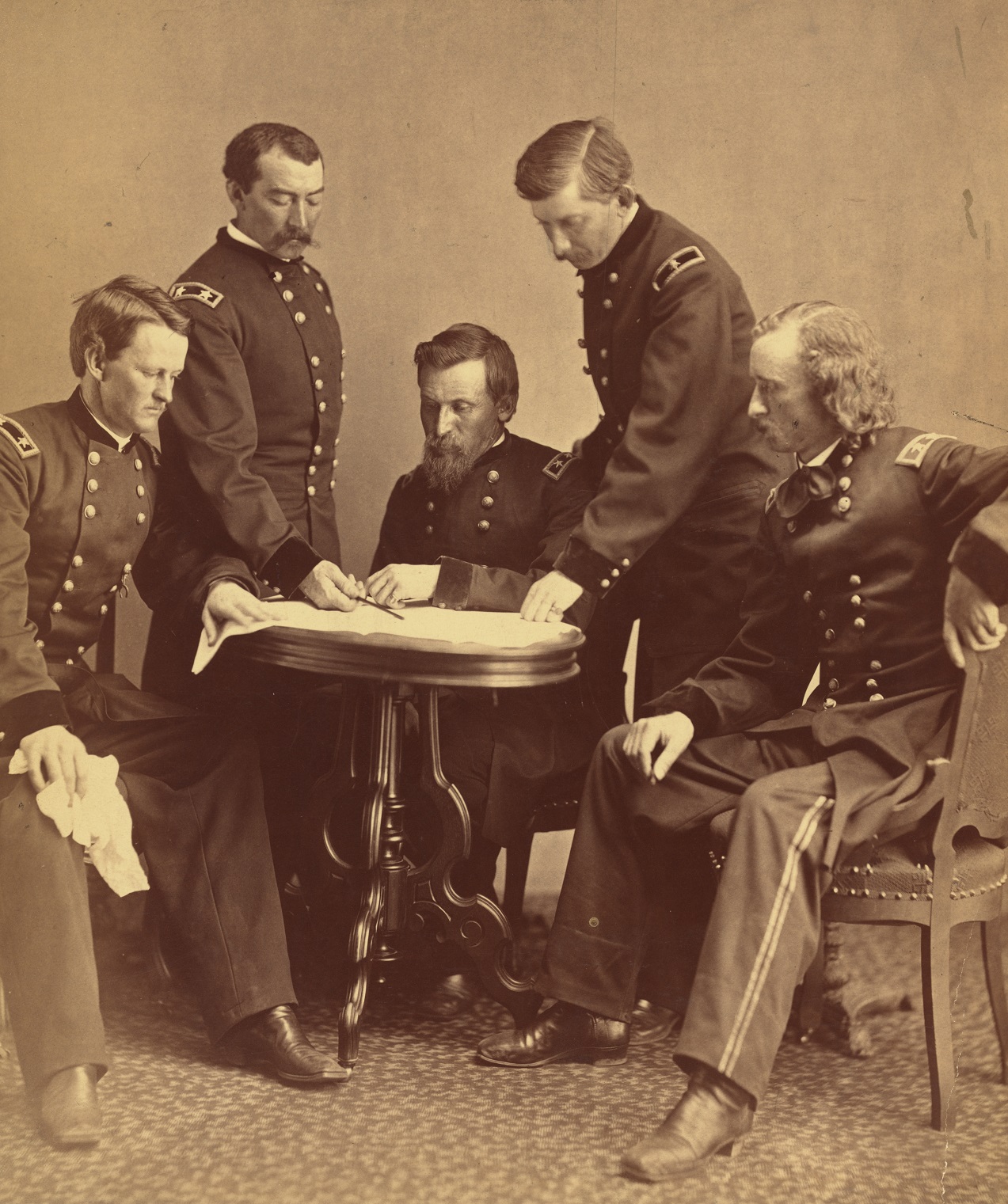
"Photograph showing Generals Wesley Merritt, Philip Sheridan, George Crook, James William Forsyth, and George Armstrong Custer around a table examining a document." Click to enlarge (Library of Congress).

“Photograph showing Generals Wesley Merritt, Philip Sheridan, George Crook, James William Forsyth, and George Armstrong Custer around a table examining a document.” Click to enlarge (Library of Congress).

Meade is steaming over Philip Sheridan’s promotion to major general in the regular army, and rightly so. Adding to his insecurity are his doubts about Grant role in this. Is the general-in-chief conniving against him? Is he being sincere? This issue will continue to gnaw at Meade.

General Grant promised me he would, when in Washington, use all his influence to have justice done to me, disclaimed any agency in Sheridan’s appointment, acknowledged I was entitled to it before, and ought now to be appointed his senior; and that if he found any difficulty in Washington (which he did not anticipate) he would have me relieved. He furthermore expressed regret at not having insisted on my appointment when Sherman was appointed, and assured me my not being assigned to the Middle Military Division was accidental, as he always intended I should go there, until it was too late. Finally, he assured me, on his word of honor, he had never entertained or expressed any but the strongest feeling in my favor, and that whenever speaking or writing of me, he had expressed his appreciation of my services. Now, I believe Grant, hence my eyes are not opened by Sheridan’s appointment. He was to return to Washington to-night, spend to-morrow and perhaps the next day there, and then return here. I shall await his return and hear what he has to say.

Every other officer in this army, except myself, who has been recommended for promotion for services in this campaign has been promoted. It is rather hard I am to be the only exception to this rule.

Meade’s correspondence taken from The Life and Letters of George Gordon Meade, Major-General United States Army, Vol. 2, (New York: Charles Scribner’s Sons, 1913), p. 244. Available via Google Books.

The Case for Meade (November 16, 1864)

Matthew Brady took this photograph of Meade at Cold Harbor on June 12, 1864. (Library of Congress).

Matthew Brady took this photograph of Meade at Cold Harbor on June 12, 1864. This is the cover image for the 2015 George Gordon Meade calendar, which you can order through Lulu.com  (Library of Congress).

News of Philip Sheridan’s promotion spurs Theodore Lyman to write a stirring defense of General Meade. True, he overestimates Lee’s numbers at Gettysburg, but still. This is a fair statement of the case for General Meade, without taking anything away from Sheridan.

They have made Sheridan a Major-General in the Regular Army. I think he deserves it for that remarkable battle of Cedar Creek. Those of Opequon and of Fisher’s Hill were joyous occasions; but he ought to have won those, because his forces were probably at least as two to one, and his cavalry immeasurably superior; but this last battle was the thing that brought out his high merit. The language of the order is not to be commended, as it makes Sheridan a cat’s-paw to give McClellan an insulting hit. It is hard on Meade, and I think he feels it; during a long campaign, in many respects unprecedented in military history for its difficulties and its grandeur, he has handled an army, which has at times considerably exceeded 100,000 men; and that too under circumstances very trying to a man who has had a chief command; that is to say, obliged to take the orders and tactics of a superior, but made responsible for all the trying and difficult performance, which indeed is more than one half the game of war. I undertake to say that his handling of his troops, when a mistake would be the destruction of the entire plan, has been a wonder: without exaggeration, a wonder. His movements and those of Lee are only to be compared to two exquisite swordsmen, each perfectly instructed, and never erring a hair in attack or in defence. Of course, it is idle to tell such facts to people at large; they don’t understand, or care, or believe anything about it. It is true, the army has played what seems its destined role, to kill and to be killed without decisive actions, until both sides pause from mere exhaustion; but do people reflect what a tremendous effect all this has on the Rebels? that by wearing ourselves, we have worn them down, until they are turning every teamster into the ranks and (of all things) are talking of arming the negroes. Suppose there had been no army capable of clinging thus for months in a death-grapple, and still clinging and meaning to cling; what would have become of Sherman and his great work? The record of General Meade is a remarkably clear one. He has risen from a brigadier of volunteers to all the higher commands, by hard fighting and an experience that dates from the first days of McClellan. He has done better with the Army of the Potomac than McClellan, Pope, Burnside, or Hooker; and—I will add boldly and without disparagement to the Lieutenant-General—better than Grant! and you would agree with me did you know what power and what men Grant has had to command. Meade’s great virtue is, that he knows when to fight, and when not to fight. Taking up an army on the march, he fought and won the greatest battle of this war—Gettysburg—100,000 men against 110,000—a battle that saved Baltimore, Washington, and Philadelphia, and nobody knows what besides. He wouldn’t fight (assault) Lee at Williamsport, and immediately he was “timid, timid, timid!” Now look here: we assaulted at Spotsylvania, at Cool Arbor, at Petersburg, and were repulsed with perfect slaughter; after all that, if Lee had assaulted us in position what would, what would have become of him? Why, we would have used him up so, that he wouldn’t have known himself. Just turn this about and apply it to Gettysburg and reflect how “the people” are frequently semi-idiotic! He followed Lee to the Rappahannock and got orders to stop. In September he was to move and attack Lee on the Rapid Ann; the day before this move they took 20,000 men from him and sent West: it couldn’t be done to Grant. Then Lee marched on Centreville; Meade beat him and got there first; Lee wouldn’t fight and retreated (he also knows when not to fight). It was in just such a move that Pope was smashed all to pieces and driven into Washington. Then Meade forced the Rappahannock, and drove Lee in haste over the Rapid Ann. The Mine Run expedition followed; we did not go fast enough—that was unfortunate; but it would have been more unfortunate to have left 10,000 men on the slopes there. If Meade had lacked the great moral courage to say “retreat,” after having been called “timid” by the papers, and having been hounded on by Halleck and Stanton to “do something,” he would not only have got a disastrous defeat, but would have destroyed the plan of re-enlistments by which we obtained the very backbone of our army for this campaign. His “timidity” lies in this, that he will not try to build a house without enough of tools and timber. Lately, they have turned round, 180 degrees, and now call him “butcher”; but that does just as well—blow hot, blow cold. This is a fair statement. I don’t say he is Napoleon, Caesar and Alexander in one; only that he can handle 100,000 men and do it easy—a rare gift! Also, as Sherman and Sheridan, commanding the two other great armies, have been made regular Major-Generals, he too, who is doing his part, and has fought more than both of them put together, ought to have equal rank. General Grant, as far as I can hear, thinks everything of General Meade, and it is said will have him promoted like the others. I believe it will turn out that Sherman is our first military genius, while Sheridan is most remarkable as a “field fighter,” when the battle is actually engaged. Bless my soul! quelle lecture on my commanding General! Never mind, variety is the spice of life.

Theodore Lyman’s letter is from Meade’s Headquarters, 1863-1865: Letters of Colonel Theodore Lyman from the Wilderness to Appomattox, pp. 270-3. Edited by George R. Agassiz. Boston, Massachusetts Historical Society, 1922. Available via Google Books.
“Unmistakable Evidences of Despondency” (November 13, 1864)

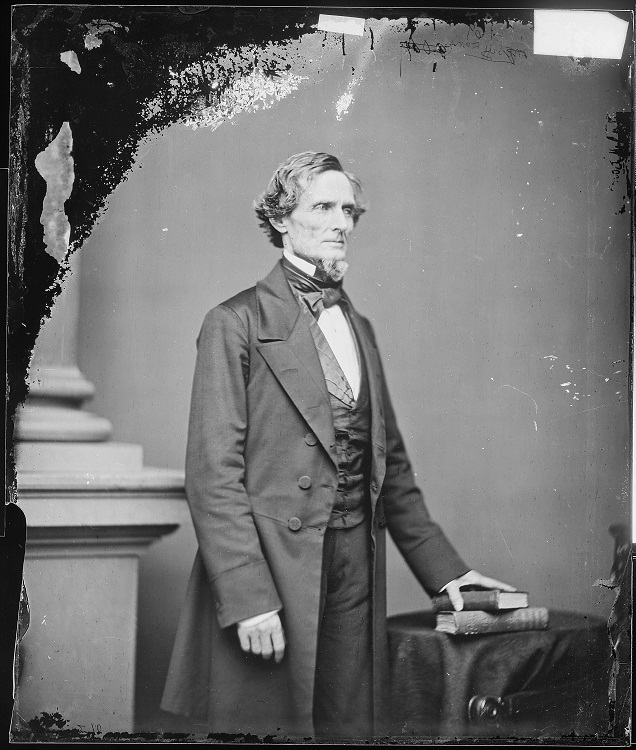
Confederate President Jefferson Davis (National Archives).

Confederate President Jefferson Davis (National Archives).

In his annual address to the Confederate Congress on November 7, 1864, President Jefferson Davis raised the troubling (for the South) question of arming slaves to aid in the war. He approached the subject delicately, suggesting that maybe 40,000 slaves could be used only as pioneers and engineers. “If the recommendation above made for the training of 40,000 negroes for the service indicated should meet your approval, it is certain that even this limited number, by their preparatory training in intermediate duties, would  form a more valuable reserve force, in case of urgency, than threefold their number  suddenly called from field labor, while a fresh levy could, to a certain extent, supply  their places in the special service for which they are now employed.” Meade was correct that this indicated a greater desperation on the part of the Confederacy. However, it wasn’t until March 1865 that the Confederate Congress approved the use of African-Americans as soldiers. By then it was too late.

See below for Theodore Lyman’s impression of the British visitor.

To-day I had a visit from a Colonel Coles, of the English Army, who is the Military Commandant of New Brunswick. He was quite a gentlemanly person. I took him around our lines and showed him all that was to be seen.

Grant has gone to-day to pay a visit to Admiral Porter, at Fortress Monroe, and as Butler is absent, this leaves me in command of all the forces operating against Richmond.

I suppose you have seen Mr. Davis’s Message to the Confederate Congress. Although a dignified and well-written document, to my mind it betrays unmistakable evidences of despondency. His proposition to arm and free forty thousand slaves, to make engineer soldiers, is most significant, for nothing but an acknowledged exhaustion of the white race could ever make him willing to free and arm the black race. The idea of limiting the number to forty thousand, and making them engineer soldiers, simply means that this is an experiment, the result of which is doubtful, and until the fidelity of the race is tested, it is better not to have too many. I think this is prudential on their part, for I cannot believe they will get the blacks to fight for them.

Gibbon was here to-day, the first time I have seen him since his return.

I judge from the tone of the Tribune, Washington Chronicle, and other Administration papers, that there is a disposition on the part of the successful party to be magnanimous and invite harmony among all the friends of the Union. I see it reported the President has declined McClellan’s resignation, and it is said is going to give him a command. I doubt the latter part, but think the former very probable. I have no means of hearing or knowing anything that is going on till it is made public. I never go to City Point, and Grant does not come here, so that I am not au courani des affaires.

In his letter today, George Meade mentioned the visit of Colonel Cole from the British Army, the latest European to show up and observe the Army of the Potomac. Meade doesn’t spend much time on the visit, so we must rely on Theodore Lyman for a more expansive (and typically comic) account. He also provides a snapshot of John Gibbon, who commanded a division in the II Corps.

We had a Lieutenant-Colonel C___, a Britisher, up for a visit; he is commander of the forces in that tropical climate of New Brunswick. In aspect Colonel C____ was not striking; he had done injustice to what good looks he had by a singularly shapeless suit of city clothing, which I judge must have been purchased ready made from a village tailor in New Brunswick. He had a sort of soft cloth hat, an overcoat of a grey-rhubarb tint and trousers which once might have had a pure color, but seemed to have become doubtful by hanging in the sun outside a shop. I don’t think the gallant Lieutenant-Colonel was much interested in matters military. Perhaps he had read out, perhaps he had no natural taste that way, or perhaps he felt cold and uncomfortable. At any rate he looked bored, and his only military remark did not indicate deep reflection. “This,” said I, “is what we call a corduroy road.” “Oh! ah! Indeed; yes, well, it’s very well now, you know, but what will you do when it comes wet weather?” I was too much overcome at this putting the cart before the horse, to inform him that the corduroy was built for no other purpose than for wet weather. After this I confined myself to considerations of the state of health of the Hon. Mr. Yorke (he who came back with us from Liverpool). He is under the command of the Colonel, it would appear, and afforded an innocent topic of conversation. Since then two other English officers have been entrusted to the fatherly care of Rosencrantz, and diligently shown round. When they got near the end, they said: “Now we are much pleased to find you are a foreigner, because we can frankly ask you, what you consider the general feeling towards the English in this country.” To which Rosie (who don’t like to miss a chance) replied: “Vell, I can tell you that, so far as I have observed, some Americans do just care nothing about you, and many others do say, that, when this war is over, they will immediately kick you very soon out from Canada!” When the horrified Bulls asked: “Aw, aw, aw; but why, why?” Rosie replied in the following highly explanatory style: “Be-cause they say you have made for the Rebs very many bullets.”

John Gibbon (Library of Congress).

John Gibbon (Library of Congress).

General Gibbon dined with us and was largely impressed by our having oysters on the shell, which he pitched into with the fervor of a Baltimorean long separated from his favorites. Gibbon is by birth a Pennsylvanian, but lived, since boyhood, in North Carolina. When the Rebellion broke out, two of his brothers went into the Rebel service, but he remained loyal. One of his sisters was in the South but could not escape, and it was only the other day that they allowed her to come on board the flag-of-truce boat and come down the river to our lines, where her brother met her and took her North. He had sent word to his younger brother to meet him on the same occasion, but the young gentleman sent word, “It would not be agreeable”; which shows they are pretty bitter, some of them. Gibbon has an Inspector named Summerhayes, who is of the 20th Massachusetts, and who has got so used to being shot at, that he seems not to be able to do without it, and so gallops along the picket line to rouse the foe to pop at him. Which reminds me of what Grant said (either by accident or on purpose). He had come out, with a great crowd of civilians, to ride round the lines. Someone proposed to go out and visit the pickets. “No,” said Grant, innocently, “no; if I take a crowd of civilians, the enemy may fire and some of the soldiers might get hurt!”

Meade’s correspondence taken from The Life and Letters of George Gordon Meade, Major-General United States Army, Vol. 2, (New York: Charles Scribner’s Sons, 1913), pp. 241-2. Available via Google Books.

Theodore Lyman’s letter is from Meade’s Headquarters, 1863-1865: Letters of Colonel Theodore Lyman from the Wilderness to Appomattox, pp. 267-9. Edited by George R. Agassiz. Boston, Massachusetts Historical Society, 1922. Available via Google Books.

Election Eve (November 7, 1864)

Secretary of War Edwin Stanton (Library of Congress).

Secretary of War Edwin Stanton (Library of Congress).

On the eve of the presidential election, which pitted Abraham Lincoln against George McClellan, George Meade writes his wife. He addresses the rumor that Lincoln will appoint Secretary of War Edwin Stanton to the Supreme Court. Instead, Lincoln ended up appointing his former treasury secretary, Salmon Chase, even though Chase had maneuvered behind the scenes to replace Lincoln as the Republican candidate for president.

I see you have taken the cue of the newspapers, and imagine the campaign is over, and that we are going into winter quarters; but you are greatly mistaken; I don’t believe active operations will cease this winter unless we should have the good luck to get into Richmond. There seems to be quite a talk of Mr. Stanton’s being made Chief Justice, and, were it not for the Senate, I should myself think it quite probable. I should, however, regret his leaving the War Department, for I do not know who there is to take his place, who would be as satisfactory. I should esteem it a great misfortune to see either Banks or Butler there. I have not seen General Grant since last Sunday week. I am, therefore, quite ignorant of what is going on; for being “out of the ring,” I never ask any questions.

To-morrow is election day. I hope it will pass off quietly, that all good citizens will submit to and abide by the result, and that, this question being settled, attention will be turned to filling our ranks and raising more troops, so that we can have the means of bringing this war to a close, which will never be over without much more hard fighting.

Meade’s correspondence taken from The Life and Letters of George Gordon Meade, Major-General United States Army, Vol. 2, (New York: Charles Scribner’s Sons, 1913), p. 239. Available via Google Books.

“A Judicious Helping Hand” (November 6, 1864)

African-American soldiers make coffee in the Petersburg entrenchments (Library of Congress).

African-American soldiers make coffee in the Petersburg entrenchments (Library of Congress).

In his letter today, Theodore Lyman makes some interesting remarks about Meade’s attitude towards African-American soldiers (although Lyman, nineteenth-century white man that he is, does not use that term). Lyman’s older sister had married into the Shaw family, which included “the best Bob,” a.k.a. Robert Gould Shaw. “The best Bob” had died while leading the first black regiment raised in the northern states, the 54th Massachusetts, in South Carolina.

Brevet promotions are honorary raises in rank. As an unpaid volunteer, Lyman was not eligible. “Cool Arbor” is what Lyman, somewhat perversely, insisted on calling Cold Harbor, “because it is so hideously inappropriate.”

I was remarking in my last, a week ago to-day, that General Meade spoke of being obliged to write his report. Yes! as you say, it is a pity he can’t have some signal success. The Shaws need not be against him on the negro-soldier question, for if he has a bias, it is towards and not against them, and indeed it would go to the heart of the best Bob to see the punctilious way in which he returns their salutes. I can say with certainty that there is not a General in this army from whom the nigs might expect a judicious helping hand more than from Meade. As to his being slow, it may be so; but I can’t see that Grant, on whom rests this entire campaign, is any faster; yet he is a man of unquestioned military talent. If you knew, as I do, the number of men killed and wounded in this campaign from the Potomac Army alone, you would think that a strong opposition from the enemy had as much as anything to do with the want of crowning success thus far. To show what sort of work we have been through: at the assault of June 3d, at Cool Arbor, we lost, in four or five hours, 6000 men, in killed and wounded only. That is a specimen. Even in our move to the left, the other day, which some would call a reconnaissance, and others heavy skirmishing, we had a list of killed and wounded of not less than 1200. In fact, we cannot stir without losing more men than would make a big battle in the West, and the Rebels, if we have any chance at them, lose as many.

Last Sunday, which I was just speaking of, was marked by the arrival of one Alden, a rather dull Captain of the Adjutant-General’s Department, who was however a welcome bird to the army, as he brought a large number of brevets for many deserving officers. … To my surprise there did appear, or reappear, Major Duane, who has taken to visiting me as usual. He is better, but not well. To celebrate his arrival, and to retaliate for our rush into the Mine, the Rebs made a dash on our picket line, gobbled up some fifty stupids, who (being recruits) thought it was the relief coming round, and were then driven back; upon which, of course, every man fired off his musket a few times, to show how alert he was, the artillery threw all the shells whose fuses happened to be ready cut, and then all went to sleep again.

Theodore Lyman’s letter is from Meade’s Headquarters, 1863-1865: Letters of Colonel Theodore Lyman from the Wilderness to Appomattox, pp. 256-8. Edited by George R. Agassiz. Boston, Massachusetts Historical Society, 1922. Available via Google Books.

Reassurances (October 31, 1864)

Henry Wise, the former governor of Virginia and George Meade's brother-in-law (Library of Congress).

Henry Wise, the former governor of Virginia and George Meade’s brother-in-law (Library of Congress).

Read Meade’s letters to his wife and you’ll get the impression that Mrs. Meade did not have a very good opinion of Ulysses S. Grant. While Meade himself had doubts about Grant’s opinion of his generalship, he often felt the need to reassure his wife of Grant’s good will. Part of the problem, as he points out in today’s letter, is Grant did not worry about public opinion the way Meade did.

Today Meade once again mentions his connection with the Wise family. Henry A. Wise, the former governor of Virginia, had married Margaretta Meade’s sister Sarah. (Sarah died in 1850.) Tully Wise was Henry Wise’s cousin; Peyton was Tully’s son. Meade often forwarded t his wife information he learned about the Wise family.

I have reason to believe you are in error in imputing any sympathy on the part of Grant with my detractors. It is true he has not exerted himself to silence or contradict them, but this arises from a very different cause. Grant is very phlegmatic, and holds in great contempt newspaper criticism, and thinks, as long as a man is sustained by his own conscience, his superiors, and the Government, that it is not worth his while to trouble himself about the newspapers. At the same time, he has always expressed himself in the manner in which he did in the telegram I sent you. Differently constituted, with more sensitiveness in his nature, I don’t doubt he would before now have taken some action, either in his official despatches, or in some other way given publicity to such opinions of my services as would set at rest these idle stories.

In our recent move we captured Peyton Wise, Lieutenant Colonel Forty-sixth Virginia Infantry. You may remember him as Mrs. Tully Wise’s bright boy, when we were first married. I did not see him, as he was taken to City Point before I knew of his capture, but I sent word to General Patrick, the Provost Marshal, to treat him as well as possible and furnish him with a little money. He wrote me a letter full of thanks, and expressing a great deal of very proper feeling. I understood if our men had gotten a little further into the enemy’s works, they would have captured General Wise, as he was not far from the place where Peyton was taken.

Grant has required me to make some kind of a report of the campaign, and I shall be very busy for some time.

Meade’s correspondence taken from The Life and Letters of George Gordon Meade, Major-General United States Army, Vol. 2, (New York: Charles Scribner’s Sons, 1913), pp. 238-9. Available via Google Books.

Homework (October 30, 1864)

Ulysses S. Grant gives General Meade an assignment, as reported by Theodore Lyman.

“Grant says I must write a report of the whole campaign,” says the General, in the discontented voice of a schoolboy who has been set a long exercise. “I can’t write a report of the whole campaign. I don’t remember anything about some of it. I ‘m all mixed up about the Tolopotomoy and the Pamunkey and the what-do-you-call-’em Creek.” Hence it came that I was requested to give him some extracts from my valuable archives, and I since have written a lot of notes for him, extending from May 4th to August 28th. He is very quick with his pen, is the General, and possesses a remarkable power of compressing a narrative and still making it clear and telling.

Theodore Lyman’s letter is from Meade’s Headquarters, 1863-1865: Letters of Colonel Theodore Lyman from the Wilderness to Appomattox, p. 256. Edited by George R. Agassiz. Boston, Massachusetts Historical Society, 1922. Available via Google Books.

A Tender Adieu (October 29, 1864)

General Meade continues to stew over the article in Henry Ward Beecher’s Independent, which said that Ulysses s. Grant desired to get rid of him. One gets the sense that Meade was less angry at the paper and more concerned that it might have hit on the truth about Grant’s feelings. It’s possible that Meade was more jittery than usual because of the impending presidential election. Lincoln had waited until after an election season to relieve George McClellan, and perhaps Meade worried the same thing was going to happen to him.

I had a conversation with Grant in reference to my letter about Beecher’s article, and told him I did not care about his despatches, but desired he would furnish me a few lines for publication, that would set at rest, as far as he was concerned, the wicked and malicious falsehoods which that article contained. This he said he would most cheerfully give me. At the same time I told him that, whilst I did not doubt the good feeling of the President and Secretary for me, yet I was satisfied of the existence of a bitter hostility towards me on the part of certain supporters of the President, and I did not desire to embarrass Mr. Lincoln, nor did I wish to retain command by mere sufferance; and that, unless some measures were taken to satisfy the public and silence the persistent clamor against me, I should prefer being relieved; that I was becoming disheartened, and my usefulness and influence with the army were being impaired. In all successful operations I was ignored, and the moment anything went wrong I was held wholly responsible, and rather than continue in this way, I would prefer retiring, and desired him to say this to the President.

General Régis Dénis de Keredern de Trobriand (Library of Congress).

General Régis Dénis de Keredern de Trobriand (Library of Congress).

Yesterday Theodore Lyman wrote about the arrival of two Frenchman who came to observe the Army of the Potomac. Such visitors were not a rarity, but the demands required of a gracious host could make them a nuisance. Here Lyman explains how he contrived to get rid of them. It makes sense that the visitors would want to visit General Régis Dénis de Keredern de Trobriand, for he was a countryman of theirs. De Trobriand had been born into wealth and privilege in France in 1816, married an American heiress, and moved to New York City in 1847. He volunteered for the army when war broke out and proved to be a capable officer, commanding a brigade in the III Corps at Gettysburg. At this point he commanded a brigade in Winfield Scott Hancock’s II Corps.

After the war de Trobriand wrote Quatre ans a l’armeé du Potomac. He had this to say about Hancock, whose tenure with the Army of the Potomac ended after the Battle of Burgess’s Mill: “General Hancock is one of the handsomest men in the United States army. He is tall in stature, robust in figure, with movements of easy dignity. His head, shaded by thick hair of a light chestnut color, strikes one favorably from the first by the regularity of his features and the engaging expression which is habitual to him. His manners are generally very polite. His voice is pleasant, and his speech as agreeable as his looks. Such is Hancock in repose. In action he is entirely different. Dignity gives way to activity; his features become animated, his voice loud, his eyes are on fire, his blood kindles, and his bearing is that of a man carried away by passion, —the character of his bravery. It is this, I think, which renders him much less fit for an independent command than to act under orders. We will see in the course of our narrative that, after having distinguished himself above all others at the head of a division or an army corps, he was much less fortunate in independent operations which were intrusted to him. Brilliant in the second rank, he did not shine so brightly when occupying the first. Was it a question of execution? he was admirable. If it was necessary to plan and direct, he was no longer equal to the occasion. This is often the case amongst soldiers.”

Having been seized with a powerful suspicion that the valiant Frenchmen would fain squat, to speak in Western phrase, at our Headquarters, I applied my entire mind to shipping them; for, as a travelled man, it was a matter of pride not to be put upon by a brace of such chaps. So I lay [in] wait till they said they would like to see General de Trobriand, and then I hastened to place them on horseback and give an orderly as a guide and tenderly shake hands with them, grieving I should not have the delight of seeing them again! There was a look about their intelligent countenances that seemed to say: “Ah, you are not so soft as we thought,” as they bid me a tender adieu.

Meade’s correspondence taken from The Life and Letters of George Gordon Meade, Major-General United States Army, Vol. 2, (New York: Charles Scribner’s Sons, 1913), pp. 237-8. Available via Google Books.

Theodore Lyman’s letter is from Meade’s Headquarters, 1863-1865: Letters of Colonel Theodore Lyman from the Wilderness to Appomattox, p. 256. Edited by George R. Agassiz. Boston, Massachusetts Historical Society, 1922. Available via Google Books.