Burgess’s Mill (October 27, 1864)

Armstrong's mills and rebel works on "Hatcher's Run, captured by the Second Corps, October 27, 1864 / sketched by C.H. Chapin," as it appeared in Harpers Weekly (Library of Congress).

“Armstrong’s mills and rebel works on Hatcher’s Run, captured by the Second Corps, October 27, 1864 / sketched by C.H. Chapin,” as it appeared in Harpers Weekly (Library of Congress).

George Gordon Meade doesn’t note it in his letter of October 27, but this movement of the Army of the Potomac and the fighting at Burgess’s Mill marked the end of active campaigning for 1864. Here’s how I describe the fighting in Searching for George Gordon Meade: The Forgotten Victor of Gettysburg:

Meade had another narrow escape later that month during the Battle of Burgess’s Mill on October 27. Once again Grant had Butler attack the Confederates north of the James, while Meade moved against the Confederate right in an attempt to capture the South Side Railroad. Hancock and the II Corps were to be the tip of the spear, supported by the V and IX Corps under Warren and Parke. Grant and Meade rode out to the front on the damp and dreary morning of October 27 to observe Hancock’s position. The II Corps faced the Confederate right near Hatcher’s Run at a spot called Burgess’s Mill on the Boydton Plank Road. The fighting here was brisk, and a shell exploded near Meade–so close that Horace Porter thought it must have killed him. But again Meade emerged unscathed. Grant also had a close brush with a bursting shell, and then his horse got one leg tangled in a fallen telegraph line. An aide had to carefully free the horse’s leg while Grant remained exposed to enemy fire.

By then it was apparent that the rebel entrenchments extended much farther to the west than anyone had anticipated, and Grant called off the attack. Hancock prepared to withdraw from his exposed position the next morning. The Confederates, as they often did, had different plans. Finding a weakness, William Mahone’s men made a stealthy passage through swamp and forest toward the Union right. Hancock had thought Samuel Crawford’s division was moving up to connect with him there; instead, the rebel forces swung around his flank and attacked. The Federals managed to recover from their surprise and force the Confederates back, but Hancock decided to withdraw his forces that night despite the rain and the darkness.
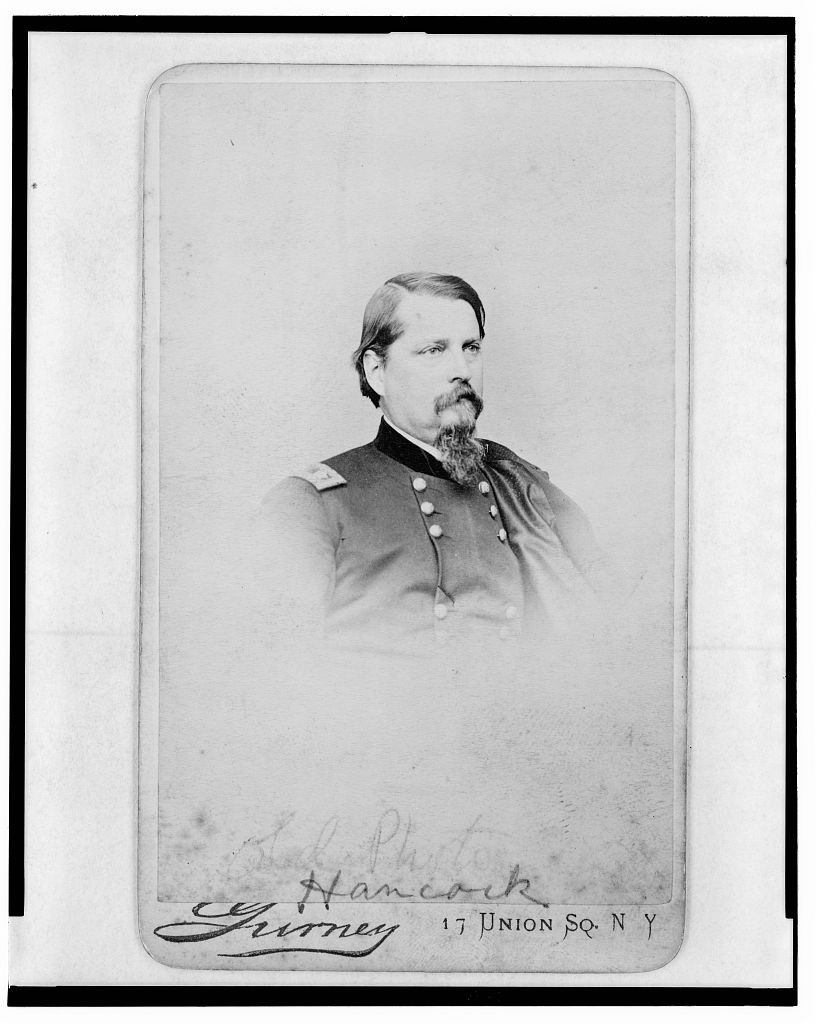
Winfield Scott Hancock (Library of Congress).

Winfield Scott Hancock (Library of Congress).

The Battle at Burgess’s Mill finished the active campaigning for 1864–and it marked the end of Winfield Scott Hancock’s time with the Army of the Potomac. He had been summoned back to Washington to raise a corps of veteran soldiers. The Petersburg Campaign had been one disappointment after another for Hancock, who seemingly had reached his own high-water mark at Gettysburg. One of his last actions was to make an official complaint to Meade about the reporting of Edward Crapsey, whom Meade had allowed to return to the army. Meade advised Hancock to write up charges and said he would have Crapsey tried by a commission.

I moved to-day with the greater portion of the Army of the Potomac, intending, if practicable, to make a lodgment on the Southside Railroad. We, however, found the enemy so strongly entrenched, and the character of the country was such, we were not able to accomplish reaching the road. We have had some quite sharp fighting, principally Hancock’s Corps on our side, in which we successfully resisted the attempts of the enemy to check our advance or dislodge us from positions taken. We shall, however, I think, be under the necessity of returning to our entrenched lines. General Grant has been on the field all day, sanctioning everything that was done. At one time both Grant and myself were under a heavy artillery fire, but luckily none of either of our large corteges were touched.

Theodore Lyman has been strangely quiet since his letter from October 17, but he finally breaks his silence today. Here’s his letter home about the day’s events. His pen will remain busy over the next few days.

I won’t write at length till I get a decent chance. I caught the greatest pelting with all sorts of artillery projectiles to-day, you ever saw, but no hurt therefrom. I could not help being amused, despite the uncomfortable situation, by the distinguished “queue” of gentlemen, behind a big oak! There was a civilian friend of Grant’s, and an aide-de-camp of General Barnard (a safe place to hold), and sundry other personages, all trying to giggle and all wishing themselves at City Point! As to yours truly, he wasn’t going to get behind trees, so long as old George G. stood out in front and took it. “Ah!” said Rosey, with the mild commendation of a master to a pupil: “oh! you did remember what I did say. I have look at you, and you did not doge!” It don’t do to dodge with Hancock’s Staff about; they would never forgive you. At length says the General: “This is pretty hot: it will kill some of our horses.” We came out on a big reconnaissance, which may be turned into a move or not, according to results. I rather fancy the enemy’s line is too long to be turned by what troops we have to dispose.

Meade’s correspondence taken from The Life and Letters of George Gordon Meade, Major-General United States Army, Vol. 2, (New York: Charles Scribner’s Sons, 1913), p. 237. Available via Google Books.

Theodore Lyman’s letter is from Meade’s Headquarters, 1863-1865: Letters of Colonel Theodore Lyman from the Wilderness to Appomattox, pp. 250-1. Edited by George R. Agassiz. Boston, Massachusetts Historical Society, 1922. Available via Google Books.

The Fiendish and Malicious Attack (October 25, 1864)

Ulysses S. Grant (Library of Congress).

Ulysses S. Grant (Library of Congress).

A couple of days ago George Meade was telling his wife that he found an article about him in the New York  Independent to be “amusing” and probably not worth noticing. Maybe he really felt that way initially. In any event, it really did bother him, mainly because it questioned his standing in the eyes of Ulysses S. Grant. What did Grant think of him? It was a question that never ceased to trouble Meade, and one that Grant never quite answered to Meade’s satisfaction.

When I last wrote I told you of the fiendish and malicious attack on me in the New York Independent, Henry Ward Beecher’s paper. I enclose you the article. I also send you a correspondence I have had with General Grant upon the subject, to whom I appealed for something that would set at rest these idle and malicious reports, based on the presumption I had failed to support him and that he was anxious to get rid of me. His reply, you will perceive, which was made by telegraph, while it expresses sympathy for the injustice acknowledged to be done me, proposes to furnish me with copies of the despatches he has written in which my name has been mentioned.

The number and character of these despatches I am ignorant of; nor do I know whether I would be authorized to publish General Grant’s official despatches; but I shall await their receipt before taking any further action. This matter has worried me more than such attacks usually do, because I see no chance for the truth being made public, as it should be. However, I will not make any further comments, but leave these papers to speak for themselves. I wish you to preserve them with the other papers relating to my services.

Telegram from Grant mentioned in last letter:

Grant to Meade:

City Point, Oct. 24, 1864.

Your note by the hand of Lieut. Dunn is received. I have felt as much pained as you at the constant stabs made at you by a portion of the public press. I know nothing better to give you to use in answer to these charges than copies of every dispatch sent to Washington by me in which your name is used.

These will show at least that I have never expressed dissatisfaction at any portion of your services.

Meade’s correspondence taken from The Life and Letters of George Gordon Meade, Major-General United States Army, Vol. 2, (New York: Charles Scribner’s Sons, 1913), pp. 236-7. Available via Google Books.

“Unmilitary Slovenliness” (October 23, 1864)

Henry Ward Beecher (Library of Congress).

Henry Ward Beecher (Library of Congress).

Is it any wonder that George Meade hated the press? Once again he’s attacked by a newspaper, and once again feigns indifference. The preacher Henry Ward Beecher, who served as editor of the Independent, was a prominent antislavery crusader. His sister was Harriet Beecher Stowe, whose Uncle Tom’s Cabin had done much to stir up antislavery passions before the war.

I have seen to-day for the first time a most virulent attack on me in Henry Ward Beecher’s paper, the Independent. The piece has been in camp, I find, for several days, and many officers have been talking about it, but purposely refrained from letting me see it. I heard of it accidentally this afternoon at Grant’s headquarters, where I was on business. I cannot imagine who is the instigator of this violent assault. The idea that I hang on Grant, like the Old Man of the Sea, and am retained in command in spite of that officer’s desire to be rid of me solely on the ground of “fancied political necessity,” is most amusing. I had not seen the article when I was with Grant, or I should have called his attention to it. After all, it is probably not worth while to notice it.

This is the article Meade mentioned:

(New York Independent, October 13, 1864)

THE WAR IN VIRGINIA

The military news of the week covers a wide field. Dispatches of considerable interest have been received from the James River, from the Shenandoah Valley, from Georgia, from Kentucky, and from Missouri. The operations in all quarters are important, but the public attention, as usual, is concentrated upon Virginia, and the movements near Richmond have again attracted that regard which the brilliancy of Sheridan’s victories for the moment diverted to the Shenandoah.

We are obliged to reverse the opinion of last week as to the operations of the Army of the Potomac under Gen. Meade, southwest of Petersburg. The twofold movement which Gen. Grant planned, and which ought to have been even a more complete success than we had reckoned it, now turns out to have failed from lack of generalship on the left wing. North of the James, Gen. Butler carried out his part of the programme promptly and thoroughly. South of it “somebody blundered”—Gen. Meade, to wit: and the Army of the Potomac, which he is still permitted to command, instead of carrying the Southside railroad, as was expected, gave up its great opportunity to the clumsiness of its leader. The old, old blunder was once more repeated. The Executive Officer of that army could not control its maneuvers. The Ninth Corps, proverbially tardy, was far behind when the Fifth, under Warren, had reached its appointed ground, and between the two occurred that fatal gap, into which the enemy again struck with all his force, rolled up an exposed division, captured a brigade or two, and then hurried off with his prizes. The advance was arrested, the whole movement interrupted, the safety of an army imperiled, the plans of the campaign frustrated—and all because one general, whose incompetence, indecision, half-heartedness in the war have again and again been demonstrated, is still unaccountably to hamper and hamstring the purposes of the lieutenant-general. Let us chasten our impatient hope of victory so long as Gen. Meade retains his hold on the gallant Army of the Potomac; but let us tell the truth of him.

He is the general who at Gettysburg bore off the laurels which belonged to Howard and to Hancock; who at Williamsport suffered a beaten army to escape him; who, when holding the line of the Rapidan, fled before Lee without a battle to the gates of the capital; who at Mine Run drew back in dismay from a conflict which he had invited and which his army longed to convert into triumph; who, in the campaign from the Rapidan to the James under Grant, annulled the genius of his chief by his own executive incapacity; who lost the prize of Petersburg by martinet delay on the south bank of the James; who lost it again in succeeding contests by tactical incompetence; who lost it again by inconceivable follies of military administration when the mine was exploded; who insulted his corps commanders and his army by attributing to them that inability to co-operate with each other which was traceable solely to the unmilitary slovenliness of their general; who, in a word, holds his place by virtue of no personal qualification, but in deference to a presumed, fictitious, perverted, political necessity, and who hangs upon the neck of Gen. Grant like an Old Man of the Sea whom he longs to be rid of, and whom he retains solely in deference to the weak complaisance of his constitutional Commander-in-Chief. Be other voices muzzled, if they must be, ours, at least, shall speak out on this question of enforced military subservience to political, to partisan, to personal requisitions. We, at least, if no other, may declare in the name of a wronged, baffled, indignant army, that its nominal commander is unfit, or unwilling, or incapable to lead it to victory, and we ask that Grant’s hands may be strengthened by the removal of Meade.

The dispatches of Gen. Butler, wholly confirmed by one from Gen. Grant, show that he has maintained the line heretofore gained on the north of the James. Lee assaulted in force on Friday last, and carried a picket defended only by cavalry, but was utterly repulsed and driven off with heavy loss in attempting to recover the position held by Butler’s infantry. The loss on our side was one-eighth that of the enemy, and the gain to us was greater than can be numerically stated; for the assault proves two things. First, that the line Butler has occupied is a severe loss to the enemy; and, second, that, although Lee is forced to assume the offensive with his attenuated army in order to regain this line, he cannot carry the coveted position. Butler is within four miles of Richmond. We privately hear the rebel works which he now holds described as more formidable than any before taken from them; and they are held in an iron grasp!

The truth is, Grant presses with irresistible steadiness toward the rebel capital. Richmond is undergoing a relentless siege. Attacks from our side and sallies from theirs meet with varying fortune, but the advance, the pressure, the average of advantage is wholly with Gen. Grant, and he has never once relinquished a foot of ground gained, nor even for a moment halted in his movement for the final capture of Richmond. And to-day he is nearer than ever to his goal; to-morrow he will have taken still another step.

We must add one word, to say that Gen. Sheridan has won another fight in the Shenandoah. He fell back from Harrisonburg to Strasburg, and, as the enemy’s cavalry under Rosser followed, Sheridan improved the opportunity to show that he had not forgotten his experience as a cavalry leader. He attacked Rosser, and drove him pell mell up the valley for 26 miles, with loss of 11 guns and 330 prisoners. “I thought I would delay one day to settle this new cavalry general,” says Phil. Sheridan.

Meade’s correspondence taken from The Life and Letters of George Gordon Meade, Major-General United States Army, Vol. 2, (New York: Charles Scribner’s Sons, 1913), p. 236. Newspaper article from pp. 341-3. . Available via Google Books.

The Death of Birney (October 19, 1864)

The "thin, pale, Puritanic face" of David Bell Birney.

The “thin, pale, Puritanic face” of David Bell Birney.

George Meade and David Bell Birney had never been friendly. It was a mutual dislike that dated back at least to Fredericksburg, when Meade sent messages asking Birney to send men to support his division, which had pierced Stonewall Jackson’s line. Birney refused, and in a face-to-face meeting on the battlefield, Meade’s language had been strong enough to “almost make the stones creep,” in the words on one bystander. Birney didn’t care for Meade., either. In a letter he wrote on October 28, 1863, Birney said that Meade, when commanding a brigade and a division, “was always badly beaten, troops flying in disorder and has no confidence in Soldiers of the volunteers.” Birney had castigated a number of his fellow generals in the same letter. George Sykes, he said, “was a disagreeable conceited selfish unpopular fellow”; John Newton was “a captain engineer with but little executive capacity, fond of whiskey, and will never distinguish himself although a pet of Meade.” William French, he said, “is drunk every afternoon, lately screeching drunk, jealous of every one in his command” and “hated by the corps.” Andrew Humphreys “is what we call an old granny, a charming, clever gentleman, fussy and [unclear] to troops.” Meade was perfectly aware that Birney had tried to get him replaced with either Joe Hooker or Daniel Sickles, as detailed here. So is it any wonder that when Birney died of typhoid on October 18 that Meade had said in a letter home to his wife that he had not liked Birney personally? (That remark, however, was edited out of the letter when it was printed in Meade’s Life and Letters.)

I am very glad you went to see Mrs. Birney. The telegraph to-day announces her husband’s decease. This has shocked every one here, for no one had any idea he was so ill. General Birney is undoubtedly a loss to the army. He was a very good soldier, and very energetic in the performance of his duties. During the last campaign he had quite distinguished himself. I feel greatly for his poor wife, who is thus so suddenly deprived of her husband and protector. When he left here he was said to be threatened with a serious attack, but it was hoped change of air and being at home would keep it off. He must have been much more sick than persons generally, or he himself, were aware of, because he was very reluctant to leave.

To-day I had a visit from the Rev. Dr. Pyne, of Washington, who has come to the army to visit a poor creature, a Frenchman, who deserted the service and then re-enlisted to get the large bounties. He was sentenced to be shot, but at the earnest solicitation of Dr. Pyne, and of his representations, I remitted the sentence to imprisonment at the Dry Tortugas.

I saw General Grant to-day, and we had a laugh over the ridiculous canard of my being relieved. He then told me he was asked in Washington if it was true, it being reported at the same time that he had resigned. These foolish reports were doubtless gotten up for political purposes and to affect the elections.

To-day Robert Meade [Meade’s nephew] went down the river in the flag-of-truce boat, having been exchanged. I saw a young navy officer who was captured at the same time and exchanged with Robert. He said Robert was well, but thin, as he had felt his captivity a good deal. His mother will be delighted to have him once more at home.

Meade’s correspondence taken from The Life and Letters of George Gordon Meade, Major-General United States Army, Vol. 2, (New York: Charles Scribner’s Sons, 1913), p. 235. Available via Google Books.

Petty Tyranny (October 17, 1864)

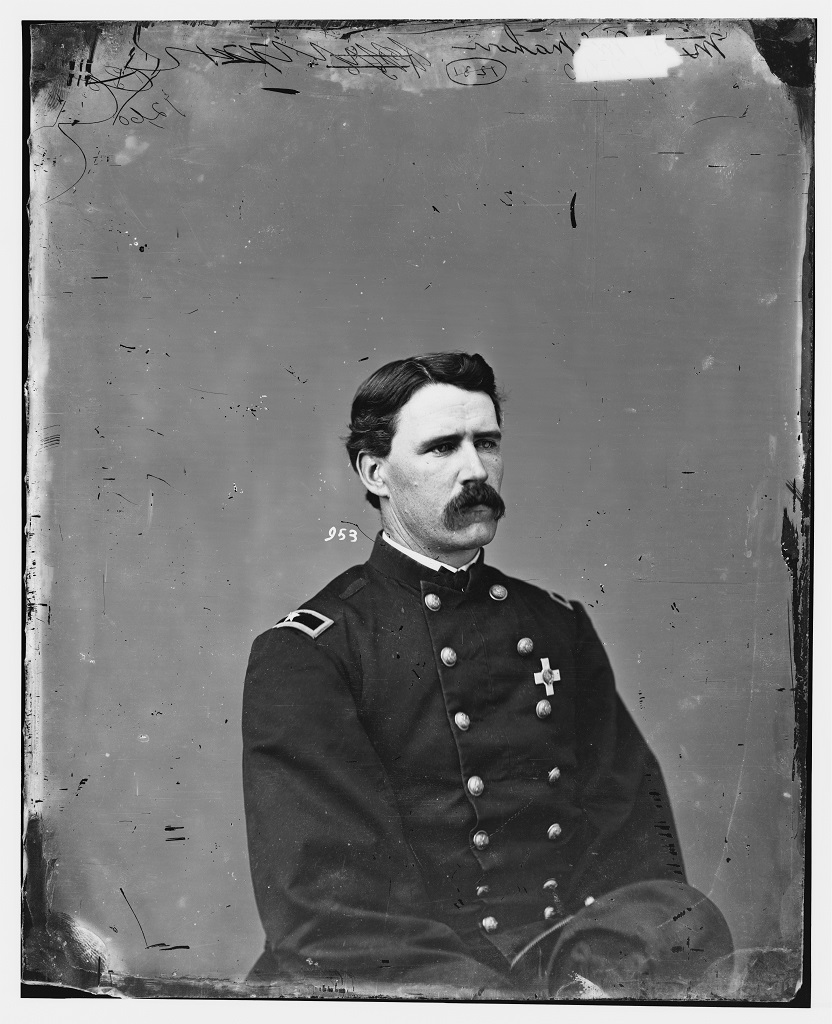
Col. Martin McMahon (Library of Congress).

Col. Martin McMahon (Library of Congress).

Theodore Lyman grumbles about what he sees as political favoritism and retribution within the Army of the Potomac. Colonel Collis was Charles Collis, who had commanded the 114th Pennsylvania, the zouave regiment that served as Meade’s headquarters guard. McMahon is Martin T. McMahon, whose brother James had, indeed, fallen at Cold Harbor (which Lyman insists on calling Cool Arbor). His other brother, John, died of wounds he received while in command of the 164th New York. The problem with Lyman’s story about Martin being dismissed from the army for his pro-McClellan talk, though, is that McMahon was not mustered out until February 1866. There’s an interesting article about the McMahon brothers here.

In his next letter Meade will mention the dignitaries who graced the army with their presence, but the general will not be nearly as amusing in his descriptions as Lyman. I particularly like Lyman’s remark that Secretary of War Edwin Stanton “looks like his photographs, only more so.” The Fessenden with the “Palmer leg” (an artificial limb that included a knee joint) was Francis,  the son of Maine senator William P. Fessenden, who had replaced Salmon Chase as Lincoln’s secretary of the treasury. Young Fessenden had lost the leg while commanding a brigade under Nathaniel Banks during the Red River Campaign. Once again Lyman provides an anecdote about hapless aide James C. Biddle.

It is indeed not difficult to get material for a grumble, if one will but look about in this world. You see I can’t be enthusiastic about such a government as Lincoln’s, when I see, under my nose, the petty tyranny and persecution they practise against subordinate officers. Now there is Colonel Collis, a petty, scheming political officer; he sends letters to newspapers and despatches to Mr. Stanton about the enthusiasm for Lincoln in the army, etc., etc. Nothing is said to him; that is all right; he has an opinion, as he ought to have. But there is Lieutenant-Colonel McMahon, lately Adjutant-General of the 6th Corps, an excellent soldier, whose brother fell at the head of a charge at Cool Arbor, and who himself had been in all the battles: he is a McClellan man, as was natural in one of General Sedgwick’s Staff. He talks very openly and strongly about his side, as he has a right to do. What is the consequence? He is, without any warning, mustered out of the service! That is to say, a soldier who don’t agree with the Administration must be got rid of; it is nothing in his favor that he has exposed his life in twenty different actions. You would scarcely credit the number of such cases as this, cases of petty spite, fitting rather to a bad-tempered child than to a great and dignified cabinet minister. They suffer chances of victory to pass, rather than take voters from states. They send down three brevets of brigadiers, only one of which has been recommended by General Meade; and all three are men from the much dreaded and uncertain state of Pennsylvania. Don’t think I am a grumbler; all this wickedness and smallness and selfishness is a part of humanity, and to be expected; but don’t ask me to be enthusiastic for such people. There were a parcel of them down here to-day; bah! the sight of them is enough!

Secretary of War Edwin Stanton (Library of Congress).

Secretary of War Edwin Stanton (Library of Congress).

Francis Fessenden (Library of Congress).

Francis Fessenden (Library of Congress).

As we sat at breakfast there came a despatch saying that Hon. Secretary Stanton, with a long tail, might be looked for, per rail, very presently. It is an historical fact that General Meade expressed his gratification at this deep honor, in the following terms: “The devil! I shan’t have time to smoke my cigar.” Immediately I got on my double-barreled coat, with a sash withal, and a pair of white cotton gloves; but there was plenty of time to smoke a cigar, for they didn’t get along for an hour or two, and then the greatest posse of large bugs! First, on horseback, Generals Grant, Meigs (Quartermaster-General), Barnard, Eaton (Commissary-General), Barnes (Surgeon-General), Fessenden (with a Palmer leg). Then, in ambulances, Fessenden’s papa, the Secretary of the Treasury, a sharp, keen, quiet-looking man; Hon. Secretary Stanton, who looks like his photographs, only more so; Hon. Sim. Draper and Mr. Barney, twin New York politicians. The former had a very large, long nose, and a very round and abrupt waistcoat, so that he resembled a good-natured pelican, just after a surfeit of sprats. General Meade received them with his usual high ceremony. He walked out of his tent, with his hands in his pockets, said, “Hullo, how are you?” and removed one hand, for the purpose of extending it to Grant, who lighted down from his horse, put his hands in his pockets, and sat down on a camp chair. The pelican came up and bobbed at the Meade, as did his friend. We carted them all to see Fort Wadsworth, where Rosencrantz swears that Mr. Stanton, on being informed that there was only a picket line between him and the enemy, pulled out his watch and said they really must be going back! which indeed they did. When the train started with its precious freight of military and diplomatic jewels, General Meade accompanied it, with Biddle, Mason and Rosencrantz. It would appear that they encountered, at City Point, Admiral Porter with Mrs. P. and another lady, who came, on their return, as far as Hancock’s Headquarters. The hospitable H. did thereat cause supper to be set forth, for it was now dark, and the General, with much talk and good humor, took root there; for he is death to hold on, when he gets talking and in company he likes. At nine o’clock came the galliant Generale, with his aides, whereof Rosencrantz and Mason were bursting to tell something good; whereas Biddle had a foolish and deprecatory air. It immediately was related, midst loud shouts, how, at City Point Grant had given General Meade a bunch of cigars to beguile the way of himself, Admiral Porter, and some other guests going to the front. The Chief handed them to Biddle, asking him to take charge of them for the present. Now B. has few equals in the power of turning things end for end; and so he at once and clearly understood that he [was] made a sort of almoner of tobacco, and proceeded to distribute the cigars in the most liberal manner, to everybody who would either smoke or pocket them! The Staff and bystanders asked no questions, but puffed away at Grant’s prime Havanas. Arrived at Hancock’s and supper done, the General said to Porter: “I think now is the moment to enjoy those good cigars!” Out comes “Shaw,” the faithful servitor. “Oh, if you please, Major, the Gen’ral sends his compliments, sir: and would like that bunch of cigars, sir.” Biddle immediately assumed the attitude indicated in the accompanying drawing! and the curtain dropped. . . .

Theodore Lyman’s letter is from Meade’s Headquarters, 1863-1865: Letters of Colonel Theodore Lyman from the Wilderness to Appomattox, pp. 247-50. Edited by George R. Agassiz. Boston, Massachusetts Historical Society, 1922. Available via Google Books.

Election Season (October 7, 1864)

President Abraham Lincoln (Library of Congress).

President Abraham Lincoln (Library of Congress).

In this letter Meade mentions the upcoming presidential election, which pitted President Abraham Lincoln against George McClellan, the former commander of the Army of the Potomac.

I was afraid you would be uneasy at not hearing from me during our recent operations, but my headquarters were some five or six miles from the scene of action, and it was always at midnight when I got back, tired out with the day’s work, and had to start early in the morning, so that I really did not have time to write.

I see the papers announce my narrow escape. It was a pretty close shave, as I have written you. You need not worry yourself; I am not going to commit the folly of foolish and unnecessary exposure. But there are times when it is my duty and it is proper I should take my chances. Let us hope Providence will always be as merciful and protecting as in this instance; for I take it, it was only God’s will that saved my leg and perhaps my life.

The enemy have allowed us to retain the ground acquired by our recent movement, and seem to be busy fortifying against another advance. We have been reinforced, but not to the extent imagined by the sanguine public; neither is Richmond so near its fall as you tell me people believe. However, these absurd alternations of exaggerated anticipations of successes and reverses seem to be chronic with our people, and no amount of experience will ever cure them of the folly.

I note all you say of politics, but in the army we take but little interest except earnestly to wish the election was over, as we see, until it is, nothing else will be thought of and no proper thought given to the war. It is generally believed here that McClellan has very little chance. I think he is very unfortunate in his friends and backers.

I see the Chronicle announces me as a supporter of Mr. Lincoln, and is pleased to class me among the ill-treated generals who have been driven into the opposition. Well, the one has as much authority for his assertion as the other, neither having anything on which to base his remarks.

Grant has gone to Washington, leaving Butler in command. To-day the enemy made a demonstration on Butler, and I thought we were going to have a grand time, but it passed off.

Theodore Lyman also wrote home on October 7. We have encountered Brig. Gen. Henry Washington Benham before. Channing Clapp was a classmate of Lyman’s at Harvard. Samuel Crawford, in temporary command of the V Corps in Gouverneur Warren’s absence, had been a surgeon at Fort Sumter. The Pennsylvania-born Crawford took command of Meade’s old division, the Pennsylvania Reserves, just before Gettysburg. Today he and Meade are neighbors in Philadelphia’s Laurel Hill Cemetery.

Brig. Gen. Henry Benham (Library of Congress).

Brig. Gen. Henry Benham (Library of Congress).

There is a certain General Benham, who commands the engineers at City Point, and was up about laying out some works. Channing Clapp is on his Staff. You ought to see this “Ginral.” He has the face and figure of Mr. Briggs and wears continually the expression of Mr. B. when his horse sat down at the band of music. When he had got through all the explanations, which were sufficient to have laid out a permanent work of the first class, the Meade rose with weariness, and eased his spirit by riding out and looking at my new camp-ground, and inspecting those everlasting redoubts. Now that the camp is arranged, the Meade is dubious about moving: that’s like him! When we got to the extreme left, he thought he would go out and take a peek at the picket line. First there was a little bunch of cavalry. They were of a jocose turn; they had found an old pair of wheels whereon they had mounted a keg, making a very good cannon, which pointed, in a threatening manner, down the road. Its ensemble was completed by a figure, closely resembling those that defend cornfields, and which was keeping steady guard with a small pole. A hundred yards beyond was the picket reserve, behind a barricade. Then, beyond, a couple of hundred yards more, the sentries, each standing and looking sharply to the front. The one in the road was a half-breed Indian, though he looked more like a Neapolitan. He had that taciturnity that clings to the last drop of blood. “Are you a picket here?” asked the General. “Yes.” “Is there anyone on your right and left?” “No.” “You are an Indian, are you not?” “Part.” All of which the red warrior delivered, without turning his gaze from the vista before him. Beyond this gentleman was a post of two cavalry videttes. From this place we could get a very good view of one of the Rebel lines of earthworks; but there seemed very few men behind it. I could only notice one or two. And so we rode back again past the perils of the keg cannon. General Warren has a short leave, and General Crawford commands the Corps, to the indignation, I presume, of old cocks like Griffin and Ayres; for C. was doctor in Fort Sumter, and thus got a star, and thus is an old brigadier, and thus ranks the regulars G. and A. General Grant was on a flying visit to Washington to-day. I like to have him down here: first, he gives a general balance and steadiness; then, what is most important, he can order—just order what groceries he pleases, and no questions asked behind the counter!

Meade’s correspondence taken from The Life and Letters of George Gordon Meade, Major-General United States Army, Vol. 2, (New York: Charles Scribner’s Sons, 1913), pp. 232-3. Available via Google Books.

Theodore Lyman’s letter is from Meade’s Headquarters, 1863-1865: Letters of Colonel Theodore Lyman from the Wilderness to Appomattox, pp. 241-3. Edited by George R. Agassiz. Boston, Massachusetts Historical Society, 1922. Available via Google Books.
Medals (September 15, 1864)

Medal of Honor

The Medal of Honor.

In his letter of September 15, 1864, George Meade mentions the presentation of the Medal of Honor to several soldiers of the V Corps. It appears these soldiers were Frederick C. Anderson, George W. Reed, and John Shilling, all three of whom earned their medals for their fighting at the Weldon Railroad. Anderson was a private in Co. A, 18th MA, and he captured the flag and the bearer of the 27th South Carolina. Reed, a private in Co. E, 11th PA, captured the 24th NC’s flag. Shilling, of Co. H, 3rd DE, also captured a flag.

General Grant went this morning to Harper’s Ferry to visit Sheridan. There were some indications of a movement on Lee’s part yesterday, but nothing occurring this morning, he went off. He is to be absent, I believe, some five or six days. What Grant meant by the rebels deserting at the rate of a regiment a day, referred, I presume, to their desertions in all parts of the field, and to the present diminished size of their regiments. This would make a daily desertion of about three hundred. I have no means of knowing what proportion of this amount is drawn from the returns of other armies; but, in the Army of the Potomac, ten a day would be a liberal estimate of the deserters who have come into our lines for some time past. I think Grant was a little hyperbolical in the expression he used. He is of a very sanguine temperament, and sees everything favorable in a strong light, and makes light of all obstacles. In some respects this is an admirable quality, if it is not carried to extremes.

I don’t think that I told you that, day before yesterday, I presented to some soldiers of the Fifth Corps medals of honor, conferred upon them for good conduct on the field of battle. There was a great ceremony on the occasion, and I made a few remarks, which I presume will appear in print. The weather, after being cool, has again become warm. Sickness is beginning to show itself.

Meade’s correspondence taken from The Life and Letters of George Gordon Meade, Major-General United States Army, Vol. 2, (New York: Charles Scribner’s Sons, 1913), pp. 227-28. Available via Google Books.

Back in Camp (September 10, 1864)

George Gordon Meade has returned to his army but his thoughts remain fixed on Philadelphia. In particular he is depressed about the health of his oldest son, John Sergeant. “Sargie” suffers from tuberculosis and his health is failing. The situation torments his parents.

The Secretary is Edwin Stanton, secretary of war.

I reached here about 4 p.m. to-day, very sad and dispirited, as I reflect on Sergeant’s ill health and your embarrassing position. I wrote you a few hurried lines from Washington by Willie Gerhard. I spent about half an hour with the President and some four hours with the Secretary. Both were very affable, apparently very glad to see me, and said many flattering things. The Secretary, particularly, kept me in his private room, to the exclusion of all other visitors, and was very sociable. I think I wrote you that when I told him of dear Sargie’s ill health, he at once said if I wanted to send him to Cuba or New Orleans, he would place at my disposition a Government steamer to take him out there, which I considered very handsome.

We left Washington at 6 p.m. in a special steamer, which, although quite comfortable, was a very slow one, and we did not reach City Point till 12 m. to-day, though the ordinary run would have brought us there at 6 p.m. yesterday. I saw Grant for a little while before coming here, and he told me he was near telegraphing me to come back on Monday, as on that day there were indications the enemy was going to attack; but they passed away, and he let me alone.

I have thought a great deal about you, and the more I think, the more I am puzzled. I really do not see anything that can be done except your accompanying Sergeant, and I think the best place to go is the Island of Madeira. This would not diminish our expenses any; still I don’t see what other arrangement can be made. If you could only hear of some kind friend who was going to Europe, who would take care of Sergeant, and thus render your going unnecessary, it would be a great relief, as your leaving the younger children is a very great disadvantage. Still, we must accommodate ourselves to things as they are, and not as we would have them, and yield everything in the hope that dear Sargie will be benefitted by the change of scene and air, and under the blessing of God his health restored. I dream about you all the time, and cannot dismiss you from my thoughts day or night.

Meade’s correspondence taken from The Life and Letters of George Gordon Meade, Major-General United States Army, Vol. 2, (New York: Charles Scribner’s Sons, 1913), pp. 226-27. Available via Google Books.

Leaves (August 28, 1864)

George Gordon Meade (Library of Congress).

George Gordon Meade (Library of Congress).

After today we won’t be hearing from George Meade for a little while. Our loss is the general’s gain, for, despite what he says in the last line of this letter, he does receive permission to go home on leave. He departs camp on September 1 and reaches Philadelphia two days later. He will begin his return trip on September 7, with a stop in Washington, D.C.

The court of inquiry to which he refers is the one regarding the Battle of the Crater.

I received this evening yours of the 26th. In it you acknowledge the receipt, per Mr. England, of my testimony before the court of inquiry. The sittings of the court have been interrupted by our recent movements, but to-morrow they are to be resumed, and I trust they will push matters to a close and come to some conclusion before they are again interrupted.

I have written you of the fighting that has been going on for a week past. It has been quiet for the last two days. The enemy having left us in undisturbed possession of the railroad so long, our position is strengthened to such a degree he could not now drive us away. This is a great point gained, and we are satisfied with its accomplishment, notwithstanding it entailed heavy losses on us, particularly in prisoners. Poor young Grossman belonged to the regulars, and was killed in the first day’s fight on the railroad. I understand he was shot in the head, being unconscious from the moment of receiving his wound till he expired, which occurred soon after. I believe he had not joined very long, and I was not aware of his being here. I sympathize most sincerely with his afflicted parents, but this is one of those dispensations that are almost daily taking place here.

Julia Grant, in a photo taken after the war (Library of Congress).

Julia Grant, in a photo taken after the war (Library of Congress).

I understand General Grant has been to Fortress Monroe and returned to-day with his wife and children. He has one little girl, and either two or three boys. He seems very much attached to his children, and his wife is said to possess a great deal of good sense, and to have exercised a most salutary effect over him. I do not know why she has given up St. Louis, her native place, but Grant told me the other day he intended to keep his family in Philadelphia for the next few years, probably for the education of his children.

I think we shall be quiet for some time, unless the enemy attacks, which I hardly think probable. Butler is away now, but when he returns I shall make an effort to get off for a few days, to have a peep at you and the children; but don’t rely too much on my coming.

Theodore Lyman’s letter of August 27 is also the last we shall hear from him for a while. As the book of his letters explains, “The next day Lyman was surprised to have Meade say to him. ‘I think I must order you home to get me some cigars, mine are nearly out!’ But, as the former remarked, ‘It’s hard to surprise a man out of going home, after a five months’ campaign.’

“General [Seth] Williams gravely prepared a fifteen-day leave, and the aides tendered their congratulations. Lyman was bound for Richmond on secret service! So the Staff persuaded the inquisitive [James] Biddle, who talked about it all over camp, and got very mad when undeceived. He recovered, however, when tendered a cocktail as a peace offering.

“Lyman’s visit to the North proved longer than he expected. For, shortly after his arrival in Beverly, where Mrs. Lyman was passing the summer, he had an attack of malaria which kept him in bed for some time. According to the doctors, ‘The northern air, with the late cool change, had brought to the surface the malaria in the system.’ Consequently, he was not able to rejoin the army until the end of September.

“Meanwhile, the gloom was lifting, that had settled on the North after the failure to take Petersburg. For Sherman’s capture of Atlanta, and Sheridan’s victories over Early in the Shenandoah, had somewhat changed the situation, although the Army of the Potomac still lay before Petersburg, where it hovered for many weary months.”

Meade’s correspondence taken from The Life and Letters of George Gordon Meade, Major-General United States Army, Vol. 2, (New York: Charles Scribner’s Sons, 1913), pp. 225-26. Available via Google Books.

Fussell’s Mill (August 16, 1864)

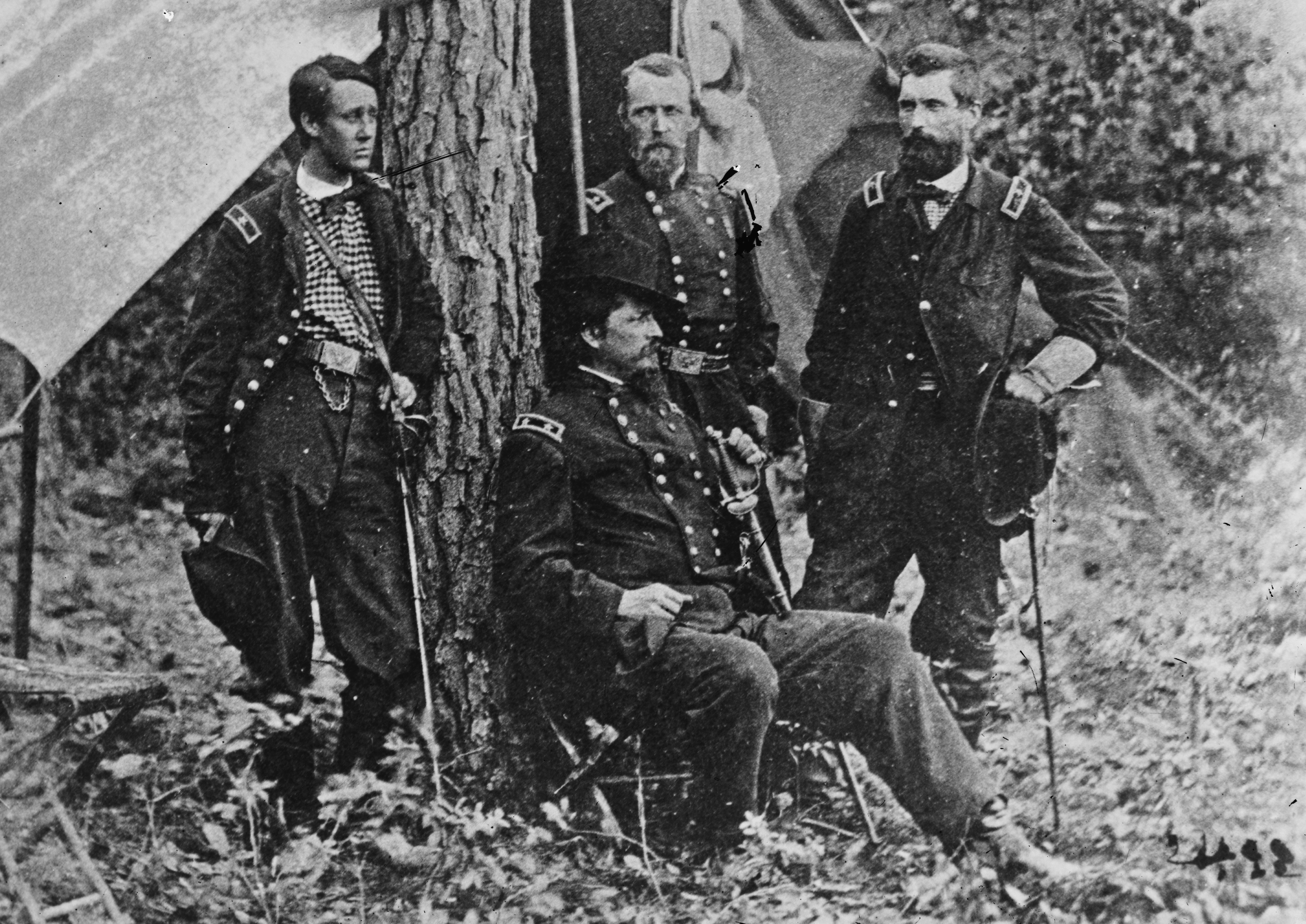
In this image taken at Cold Harbor in 1864, Winfield Scott Hancock (seated) poses with (left to right) Francis Barlow, David Birney, and John Gibbon (Library of Congress).

In this image taken at Cold Harbor in 1864, Winfield Scott Hancock (seated) poses with (left to right) Francis Barlow, David Birney, and John Gibbon (Library of Congress).

In their letters of August 16, both Meade and Lyman mention the fighting being done by Winfield Scott Hancock and the II and X Corps on the north bank of the James River. These references are to the second campaign of Deep Bottom and the battle known as Fussell’s Mill. Despite initial successes, the campaign was a failure. According to Francis Walker’s 1886 history of the II Corps, “Although it is freely confessed that the attack of the Second Corps near Fussell’s Mill was not made with the vigor fairly to be expected, nothing better could have resulted had the troops there displayed their pristine enterprise and resolution. The fact is, the expedition across the James had been undertaken upon erroneous information. General Grant believed that three divisions had been sent to reinforce Early. Only one, however (Kershaw’s), had actually gone. Field’s division of Longstreet’s corps had remained in the Deep Bottom and Bailey’s Creek intrenchments; Wilcox’s division of Hill’s corps was at Chapin’s Bluff, near at hand, ready to move down and reinforce Field; while Mahone’s division, also of Hill’s corps, with Hampton’s and W. H. F. Lee’s cavalry divisions, were, on the first intimation of Hancock’s movement, sent across the James to meet the impending attack.”

Walker continued, “General Grant had now ascertained that his information regarding the strength of the enemy had been erroneous; and he had therefore no thought of further pursuing the enterprise on the north bank of the James. Inasmuch, however, as he was now preparing a movement, with Warren’s corps, against the Weldon Railroad, on the extreme left, below Petersburg, he determined to retain Hancock’s troops in their position, threatening Richmond, a few days longer, to hold the enemy’s attention and occupy their forces.”

I am right glad the dear children are enjoying themselves. I wish I could be with you and them; but this is out of the question, and there is no use thinking about it. I have made up my mind to stick it out here, regardless of every consideration, except that of doing my duty at all hazards. They shall not say that any personal considerations caused me to turn my back upon the enemy.

Hancock has been fighting for two days across the James, and though he has met with success, yet he has not been able to break through the enemy’s lines, he finding them everywhere in strong force. His demonstration, however, has undoubtedly prevented the sending of reinforcements to Early, as we had reason to believe they designed doing. Hancock, with his usual luck, has captured some guns and colors.

Now for Lyman’s account of the events of the day. The assault he mentions is the Battle of the Crater. Lyman the Boston Brahmin looked down on those he considered to be below him, and that included Germans, Irish (“bog-trotters”) and blacks.

I have been well content to get your letter this afternoon. In regard to what you say for the troops for the assault, it is true that General Meade should have ordered in the best—and so he did. Express orders were given to put in the best troops and have the division generals lead them if necessary. General Meade made examinations in person of the enemy’s lines, and the orders drawn up by General Humphreys were more than usually elaborated. People have a vulgar belief that a General commanding a great army can, and ought to arrange in person every detail. This is not possible, nor is it desirable; the corps and division commanders would at once say: “Very well, if you have not enough confidence in me to let me carry on the ordinary business of my command, I ought to be relieved.” I see great discussion in the papers as to the conduct of the negroes. I say, as I always have, that you never, in the long run, can make negroes fight with success against white men. When the whole weight of history is on one side, you may be sure that side is the correct one. I told General Meade I had expressed myself strongly, at home, against the imported Dutchmen, to which he replied: “Yes, if they want to see us licked, they had better send along such fellers as those!” As I said before, the Pats will do: not so good as pure Yanks, but they will rush in and fight. There was a report at first that Colonel Macy of the 20th Massachusetts was mortally wounded, but I have since heard that it is not so. On Sunday, he had command of a brigade, and had his horse killed: he then came back, got another horse from Barlow and returned to the front. This horse either was shot or reared over with him, frightened by the firing, and crushed him badly. Let me see, I told you this before; never mind, you will be sure now to know it. Sometimes I get rather mixed because I write often a few words about a day, on the eve of the same, and then detail it more at length afterwards. The Rebels got well alarmed about Hancock and sent reinforcements, recalling troops that had started to help Early in the valley; an important point gained. Hancock had some hard fighting to-day, with considerable success, taking several hundred prisoners and driving the enemy. The Rebel General Chambliss was killed, and we found on him a valuable map containing the fortifications of Richmond. They also are said to have killed a General Gherrard; but I have an idea there is no such General in their service.* Perhaps he was a new appointment, or a colonel commanding a brigade. As to giving you an account of the engagement, it would be out of the question; as it is a perfect muddle to me. I only know that Gregg, with a cavalry division, went out on the Richmond road, to within six and one half miles of the city, and encountered a big crowd of infantry and had to come back. Barlow had to leave his division, sick, and go to friend Dalton, at City Point.

*It was Brig. Gen. Victor J. B. Girardey.

Meade’s correspondence taken from The Life and Letters of George Gordon Meade, Major-General United States Army, Vol. 2, (New York: Charles Scribner’s Sons, 1913), p. 222. Available via Google Books.

Theodore Lyman’s letter is from Meade’s Headquarters, 1863-1865: Letters of Colonel Theodore Lyman from the Wilderness to Appomattox, pp. 214-16. Edited by George R. Agassiz. Boston, Massachusetts Historical Society, 1922. Available via Google Books.