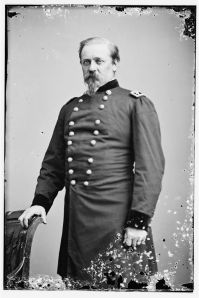
Sheridan (August 10, 1864)

Philip Sheridan, the bane of Meade's existence (Library of Congress).

Philip Sheridan, the bane of Meade’s existence (Library of Congress).

The Phil Sheridan situation moves from the back to the front burner and Meade simmers with indignation.

The Washington papers of yesterday announce Sheridan being temporarily assigned to the military division which Grant told me was intended for me. Grant has been back two days, and has not vouchsafed one word in explanation, and I have avoided going to see him, from a sense of self-respect, and from the fear I should not be able to restrain the indignation I hold to be natural at the duplicity some one has practiced. In my last conversation with General Grant he distinctly told me that if a military division was organized I should have the command, and that it was designed to give Sheridan only the command of that part of the Army of the Potomac temporarily detached. This order is not consistent with that statement.

To-day I got through with my evidence before the court of inquiry. Burnside, in his cross-examination, through a lawyer, undertook to impeach my testimony, though he disclaimed any such intention; but I gave him as good as he sent. I hear he was about apologizing to me for his disrespectful despatch, and was then going to resign; but on returning from Grant’s headquarters, where he expressed this intention, he found my charges and letter, saying I had applied to have him relieved. I feel sorry for Burnside, because I really believe the man half the time don’t know what he is about, and is hardly responsible for his acts.

Meade’s correspondence taken from The Life and Letters of George Gordon Meade, Major-General United States Army, Vol. 2, (New York: Charles Scribner’s Sons, 1913), pp. 220-21 Available via Google Books.

Sabotage! (August 9, 1864)

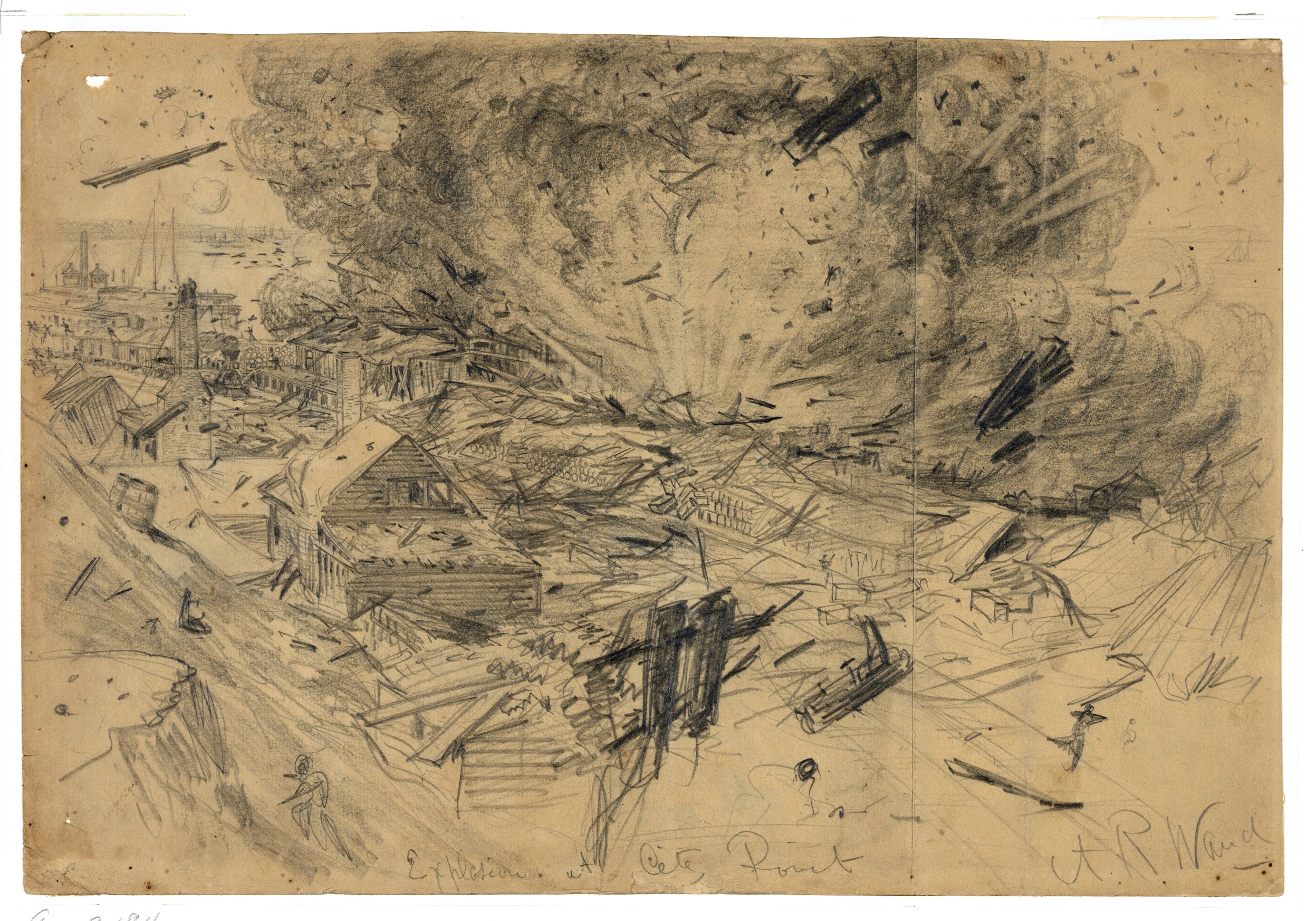
Alfred Waud depicted the explosion at City Point. Click to enlarge (Library of Congress).

Alfred Waud depicted the explosion at City Point. Click to enlarge (Library of Congress).

In their letters of August 9, both Meade and Theodore Lyman mention the explosion at the docks of City Point, not far from Grant’s headquarters. The war had completely transformed this formerly sleepy town at the confluence of the Appomattox and the James Rivers, about seven miles from Petersburg. Swarms of laborers began building docks, wharves, and warehouses, plus a hospital that could handle 6,000 patients. On August 9, 1864, a Confederate agent snuck an explosive aboard one of the ammunition barges at City Point. The resulting explosion killed 43 and injured 126 but did no major damage to the Union war effort.

It’s possible that Stanton’s opinion of Meade dated back to a letter Grant had written from Spotsylvania in May. “General Meade has more than met my most sanguine expectations,” he had written to Stanton. “He and Sherman are the fittest officers for large commands I have come in contact with.”

I am delighted to see your letter is written in such good spirits, and am truly rejoiced to hear I have so many and such warm friends. The attempt to implicate me in the recent fiasco was truly ridiculous; still, the public must in time be influenced by these repeated and constant attacks, however untrue and unjustifiable they may be. Have you ever thought that since the first week after Gettysburg, now more than a year, I have never been alluded to in public journals except to abuse and villify me? And why this is I have never been able to imagine.

I had a letter to-night from Cortlandt Parker, who has recently seen George Harding. He says Harding told him he had recently seen Stanton, who is an enthusiastic admirer of Grant, and that Stanton observed that Grant had a most exalted opinion of me, and told him, Stanton, that when he first came East he thought Sherman was the first soldier in the country, but now he believed I was his equal, if not superior. I send you this for what it is worth. I certainly think Grant has a queer way of showing his appreciation. Grant has not until recently seen Stanton, since we crossed the Rapidan, so could not have told him this; but Dana may have conveyed this information.

There was an awful explosion to-day at City Point of a powder and ammunition vessel. It is said sixty were killed and one hundred and fifty wounded.

I have been engaged for two days giving my testimony before the court of inquiry that is investigating the Petersburg disaster. It will take them a long time to get through, and I fancy active operations will interrupt their proceedings till such time that the witnesses will be scattered. Grant has not yet acted on my application to have Burnside relieved. The weather continues awfully hot, but the army is in good health.

Aftermath of the explosion (Library of Congress).

Aftermath of the explosion (Library of Congress).

Lyman’s entry is, a usual, much more descriptive and adds a fine note about Ulysses S. Grant.

In the forenoon, as we were sitting in camp, we heard a noise, like a quick, distant clap of thunder, but sharper. We concluded it must be an explosion, from the sound, and in a few minutes came a telegraph from Grant, at City Point, saying that an ordnance barge had blown up, with considerable loss of life. I think the number of killed will not exceed thirty-five; and, of the wounded, perhaps eighty; at first they thought there were many more. The greater part of the injured were negroes employed as wharf-laborers. To return to the explosion: Rosy, Worth, Cavada, and Cadwalader were at Grant’s Headquarters, and they said it perfectly rained shells, shot, bullets, pieces of timber, and saddles (of these latter there was a barge load near by). Two dragoons were killed, close to them, and a twelve-pounder solid shot went smash into a mess-chest in the tent. The only man who, at the first shock, ran towards the scene of terror was Lieutenant-General Grant, which shows his kind of character very well. We dined very pleasantly with Dalton. You should see his town of tents, with regular streets—accommodation easy for 8000 patients. Everything as neat as a pin. Steam-engine to pump water from the river; every patient of the 4000 on a cot; the best of food for all; and the most entire cleanliness. When Dalton heard the explosion, he jumped on his feet, and, true to his instincts, cried out: “Harness the ambulances!”

Meade’s correspondence taken from The Life and Letters of George Gordon Meade, Major-General United States Army, Vol. 2, (New York: Charles Scribner’s Sons, 1913), p. 220. Available via Google Books.

Theodore Lyman’s letter is from Meade’s Headquarters, 1863-1865: Letters of Colonel Theodore Lyman from the Wilderness to Appomattox, pp. 209-10. Edited by George R. Agassiz. Boston, Massachusetts Historical Society, 1922. Available via Google Books.

Rows (August 3, 1864)

Philip Sheridan (Library of Congress).

Philip Sheridan (Library of Congress).

Meade’s “row” with Burnside stems from the Battle of the Crater and will lead to Burnside’s departure from the army. Meade also had an ongoing row with Philip Sheridan, dating back to at least their peppery encounter at Todd’s Tavern back in May.

Meade and Sheridan were both ambitious men but they showed it in different ways. In his book Little Phil: A Reassessment of the Civil War Leadership of Gen. Philip H. Sheridan, historian Eric Wittenberg wrote, “Lying was just a part of his aggressive plan for advancing his own self-interest. He regularly lied to cover his mistakes at all costs. He seems to have been a congenital liar, and his perfidy often exposed him to public ridicule and criticism. Sheridan did not care. He lied anyway.” On this front Meade was clearly outmatched. But it did his cause no good to declare he was “indifferent” about Grant’s decision. Perhaps it would have helped if he had been upfront about his ambitions, although it is pretty obvious that Grant preferred the nakedly ambitious Sheridan. It appears that on this topic, at least, Grant was being less than completely honest with Meade.

I am in the midst of my row with Burnside. Our recent miserable failure will require an investigation, and authority has been asked of the President to appoint a court of inquiry. In the meantime I have preferred charges against Burnside, and asked he be relieved from duty with this army.

Yesterday, on General Grant’s return from Old Point, General Sheridan was ordered to Washington, to command that portion of the Army of the Potomac now detached for the defense of Maryland and the Capital. I at once went to Grant and told him, as he had thought proper to communicate to me that he had nominated me for a command in Washington, I demanded to know the reason I had not been accepted. He said the President expressed every willingness to have me, but not knowing my wishes on the subject, he feared my removal from the command of the Army of the Potomac might be misunderstood by the public and be construed into a disapprobation of my course, but if I desired the transfer, he would be very glad to have it made. General Grant said it was then concluded I should be sent, if any more troops should be detached; in the meantime, Sheridan was sent to command Wright’s Corps and the division of cavalry already sent. I am a little doubtful about this matter. I believe Grant is honest and would not deceive me, but I think there is something more than is acknowledged. However, as I am indifferent about the position, I am content, so long as finding any fault with me is disclaimed. Hancock, whose name was also mentioned, is quite put out, and thinks some political chicanery at the bottom of it, and that they are afraid in Washington to give us a chance to do anything that others cannot swallow up. I, however, am more charitable; at any rate, I intend to look on the affair in the most favorable light, particularly as I have got my hands full with the Burnside imbroglio, and must remain here to see to it.

Meade’s correspondence taken from The Life and Letters of George Gordon Meade, Major-General United States Army, Vol. 2, (New York: Charles Scribner’s Sons, 1913), pp. 218-9. Available via Google Books.

A Look at the Field (August 1, 1864)

Sometime in July or August 1864 Alfred Waud sketched a "covered way" used by the V Corps outside Petersburg (Library of Congress).

Sometime in July or August 1864 Alfred Waud sketched a “covered way” used by the V Corps outside Petersburg (Library of Congress).

Theodore Lyman provides an interesting description of Union fortifications at Petersburg and takes advantage of a truce to examine the aftermath of the mine explosion. He spares his wife a description of what he saw, but he included one in his journal (edited by David W. Lowe and published in 2007 as Meade’s Army: The Private Notebooks of Lt.Col. Theodore Lyman). “In the moderate space between us and the enemy—some 110 yards—lay perhaps 200 bodies,” he wrote. “The heat and intense sun of 48 hours had so swollen and blackened them that negroes were not to be told from whites, save by the hair! The faces and hands of many were actually white with a moving layer of maggots!”

I waked at about six in the morning and heard the General say, “Very well, then, let the truce be from five to nine.” Whereby I knew that Beauregard had agreed to a cessation of hostilities for the burial of the dead and relief of the wounded. After struggling awhile with my indolence, I tumbled out of bed, waked Rosencrantz and ordered my horse. We speedily got ready and sallied forth to look at the field. We rode into a piece of pine woods, at the corner of which I was during the assault of the 18th of June. Some of the advanced camps were here, the danger of their position being plainly marked by the banks of earth put up by each tent. Getting out of the wood, we came on an open tract, a good deal elevated. Here, on the left, and by the ruins of a house was a heavy battery, known as the Taylor house battery. And here too begins the “covered way.” Before I saw real operations I never could understand the management of cannon. On the principle of your battle on “the great white plain,” I had an idea that all the guns were put in the front line: else how could they hit anybody? But really there are often no cannon at all there, all being placed in a second or a third line, or in isolated batteries in these relative positions. One of our heavy siege guns would sometimes have to fire as many as 1700 yards to hit the enemy’s breastwork. You see that cannon-shot must rise high in the air to go any distance; so they fire over each other’s heads. In practice this system is not without its dangers, owing to the imperfections of shells. In spite of the great advances, much remains to be done in the fuses of shells; as it is, not a battle is fought that some of our men are not killed by shells exploding short and hitting our troops instead of the enemy’s, beyond. Sometimes it is the fuse that is imperfect, sometimes the artillerists lose their heads and make wrong estimates of distance. From these blunders very valuable officers have lost their lives. Prudent commanders, when there is any doubt, fire only solid shot,which do not explode, and do excellent service in bounding over the ground.

We got off our horses at the edge of the wood and took to the covered way (we might better have ridden). A covered way is singularly named, as it is open on top. It is simply a trench, about four feet wide, with the dirt thrown up on the side towards the enemy. It should be deep enough to cover a man standing upright. The great thing is, so to run it that the enemy cannot get a sight of it lengthwise, as they could then enfilade it. To this end the way is run zig-zag, and advantage is taken of every hollow, or knoll, that may afford shelter. I was not impressed with the first part of our covered way, as it could be shot into in many places, and was so shallow that it covered me no higher than the shoulders. Probably it was dug by a small officer who was spiteful against men of great inches. . . . We scrambled up the opposite steep bank and stood at the high breastwork of Burnside’s advanced salient. The parapet was crowded with troops, looking silently at the scene of the late struggle. We got also on the parapet and at once saw everything. Opposite, and a little above us, distant about 350 feet, was the rough edge of the crater, made by the mine. There were piles of gravel and of sand, and shapeless masses of hard clay, all tumbled on top of each other. Upon the ridge thus formed, and upon the remains of the breastwork, stood crowds of Rebel soldiers in their slouched hats and ghostly grey uniforms. Really they looked like malevolent spirits, towering to an unnatural height against the sky. Each party had a line of sentries close to his works, and, in the midst, stood an officer with a white flag, where the burial parties were at work.* I jumped down and passed towards the enemy’s line, where only officers were allowed to go, with the details for work. I do not make a practice of describing disagreeable spectacles, and will only say that I can never again see anything more horrible than this glacis before the mine. It did not take long to satisfy our curiosity, and we returned to camp, getting in just as the General was at breakfast. He takes his disappointments before Petersburg in an excellent spirit; and, when the “Herald” this morning said he was to be relieved and not to have another command, he laughed and said: “Oh, that’s bad; that’s very bad! I should have to go and live in that house in Philadelphia; ha! ha! ha!” The papers will tell you that Grant has gone to Washington. As I don’t know what for, I can make Yankee guesses. I presume our father Abraham looks on his election prospects as waning, and wants to know of Ulysses, the warrior, if some man or some plan can’t be got to do some thing. In one word he wants to know—WHY THE ARMY OF THE POTOMAC DON’T MOVE. A month since there was a talk of putting Hancock at the head: that is, losing the most brilliant of corps commanders and risking (there is always a risk) the making of a mediocre army commander!

*“The Rebels were meanly employing their negro prisoners in this work.”—Lyman’s Journal.

Theodore Lyman’s letter is from Meade’s Headquarters, 1863-1865: Letters of Colonel Theodore Lyman from the Wilderness to Appomattox, pp. 201-4. Edited by George R. Agassiz. Boston, Massachusetts Historical Society, 1922. Available via Google Books.


Very Bad Spirits (July 29, 1864)

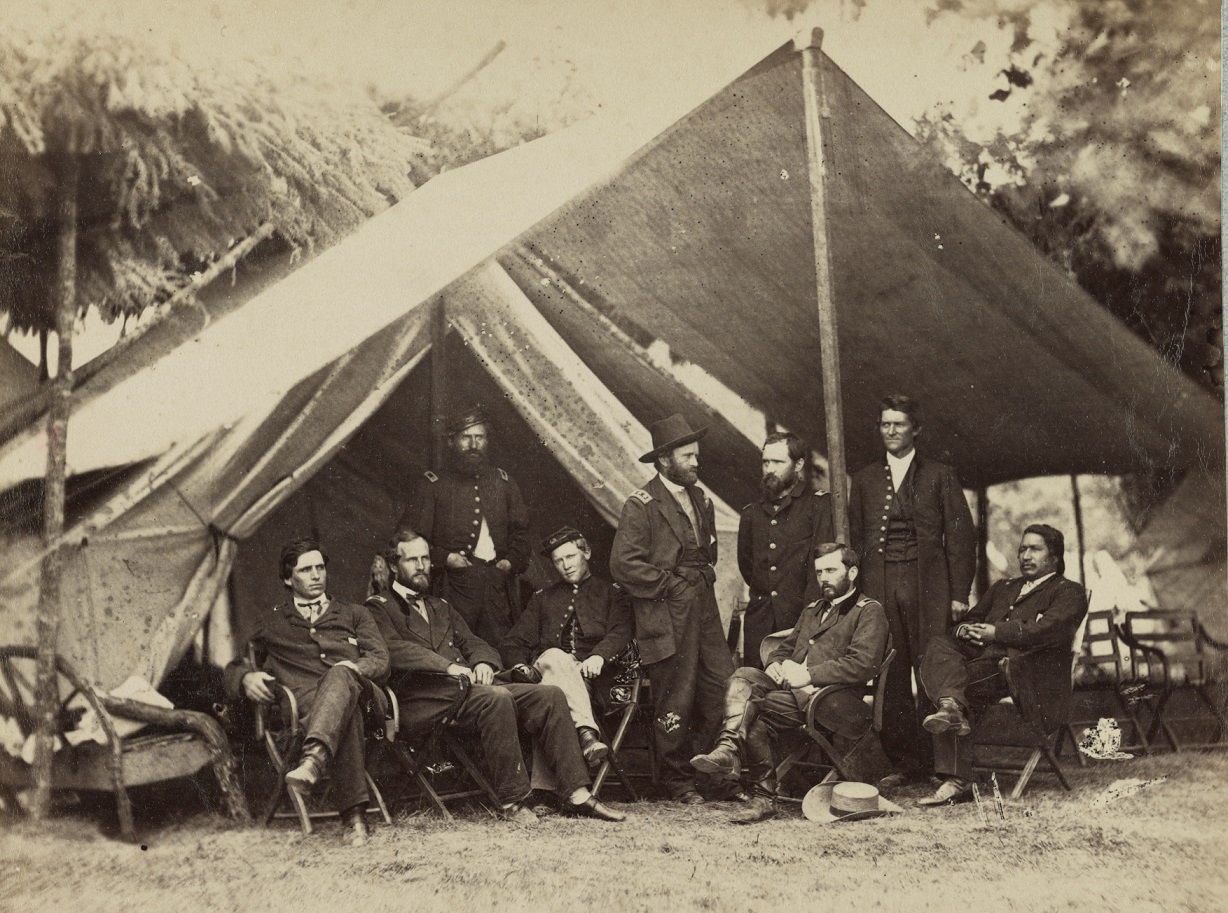
Ulysses S. Grant and his staff at City Point (Library of Congress).

Ulysses S. Grant and his staff at City Point (Library of Congress).

Intrigue and rumors continue to plague the Army of the Potomac. The Franklin that Grant wanted to command the new department is William Franklin, whose career had never really recovered after his maneuverings against Ambrose Burnside following Fredericksburg. The other refugees from the Army Meade mentions are Oliver O. Howard and Joe Hooker.

The upcoming attack that Meade mentions is the debacle we remember as the Battle of the Crater.

Your letters of the 24th and 27th arrived this evening. They are written in very bad spirits, and I am tempted to scold you for indulging in such. I want you to recover your original elasticity of spirits which characterized you in the early days of our married life, when you were always sure something was going to turn up. You must now try to look on the bright side and hope for the best. I think we have a great deal to be thankful for, and things might be much worse.

I had a visit yesterday from our old friend the Rev. Mr. Neill. He was very complimentary to me, and promised to call and see you on his return to Philadelphia. He was here as agent of the Christian Commission.

Yesterday I went to see General Grant at City Point. He said he wanted an officer to go to Washington to take command of the Department of West Virginia, Susquehanna, Baltimore and Washington. That not wishing to take any one from the field, he had suggested Franklin, but they had declined to have Franklin. He then suggested my name, to which he had received no reply, but a message from the President asking him to meet him at Fortress Monroe. I made no reply to Grant, except to say I was ready to obey any order that might be given me. So far as having an independent command, which the Army of the Potomac is not, I would like this change very well; but in other respects, to have to manage Couch, Hunter, Wallace and Augur, and to be managed by the President, Secretary and Halleck, will be a pretty trying position that no man in his senses could desire. I am quite indifferent how it turns out. I think the President will urge the appointment of Halleck; but Grant will not agree to this if he can help it.

Grant told me Sherman has assigned Howard to McPherson’s command. This had disgusted Joe Hooker, who had asked to be and had been relieved. To-morrow we make an attack on Petersburg. I am not sanguine of success, but hope for the best.

Meade’s correspondence taken from The Life and Letters of George Gordon Meade, Major-General United States Army, Vol. 2, (New York: Charles Scribner’s Sons, 1913), pp. 216-17 Available via Google Books.

The Last of Baldy Smith (July 20, 1864)

William F. "Baldy" Smith was a Meade friend who eventually turned enemy. (Library of Congress)

William F. “Baldy” Smith was a Meade friend who eventually turned enemy. (Library of Congress)

On July 20 both George Meade and Theodore Lyman note the departure of William F. “Baldy” Smith from the Army of the James. Smith, who had commanded the XVIII Corps, and Meade had once been friends but became “avowed antagonists” as time passed. Smith was adept at sowing friction. Over at the Army of the James, Smith, Ulysses S. Grant, and Army of the James commander Benjamin Butler became involved in a struggle for power. Grant longed to rid himself of Butler, a general who was much more skilled at politics than war. He contrived to have Smith take control of the Army of the James’s field operations while Butler remained behind the lines in a strictly administrative role. Butler would have none of it. When the dust settled, Butler remained firmly in charge while Grant had sent Smith to New York. Smith later claimed that Butler gained the upper hand by blackmailing Grant over his drinking. The more likely scenario was that with the presidential election looming, the administration realized that this was no time to turn the politically connected General Butler into an enemy.

For Smith’s explanation of the affair, see below. He printed the letter he wrote to Vermont’s Senator Solomon Foote in his book From Chattanooga to Petersburg Under Generals Grant and Butler: A Contribution to the History of the War, and a Personal Vindication (Boston and New York, Houghton, Mifflin, and Company, 1893). It’s quite an interesting account and does a good amount of score settling.

I am a good deal amused at your fear that I will become entangled with politicians. You may make your mind easy on that point, as, with the exception of what you write, I have never heard a word breathed on the subject. I rather fancy I should be considered too independent and too intractable for the purposes of any of these gentlemen.

Much excitement was created to-day by the announcement that General W. F. Smith, who returned last evening from his sick leave, was this morning relieved from his command of the Eighteenth Corps and ordered to New York. It was only the other day he was assigned by the President to this command, and Butler sent to Fortress Monroe. It appears now the tables are turned—Butler remains and Smith goes.

We have had a little rain, which has added greatly to our comfort and allayed somewhat the dust which has been such an annoyance. We are waiting the return of the Sixth Corps, sent to relieve Washington, after which I suppose we shall begin anew.

Here’s Theodore Lyman’s take on things. If anyone was born to serve Lyman as an object for description, it was Ben Butler.

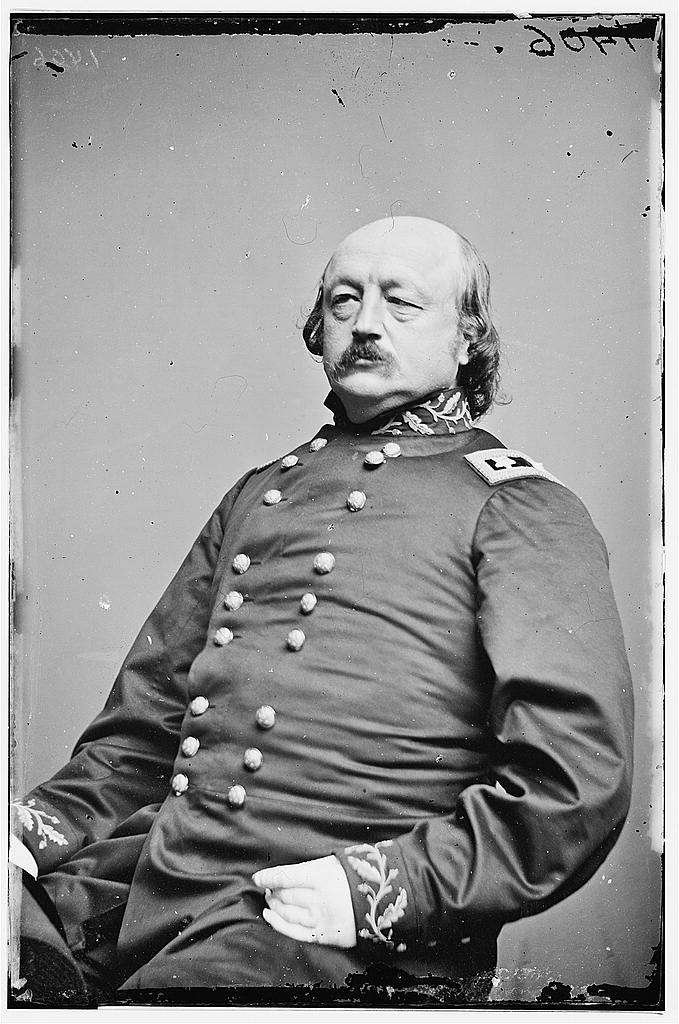
Benjamin Butler. He was a mediocre general but a wily politician (Library of Congress).

Benjamin Butler. He was a mediocre general but a wily politician (Library of Congress).

Our camp was this morning taken by assault by a cavalcade which turned out to be Major-General Ben F. Butler and a portion of his Staff. He is the strangest sight on a horse you ever saw: it is hard to keep your eyes off him. With his head set immediately on a stout shapeless body, his very squinting eyes, and a set of legs and arms that look as if made for somebody else, and hastily glued to him by mistake, he presents a combination of Victor Emmanuel, Aesop, and Richard III, which is very confusing to the mind. Add to this a horse with a kind of rapid, ambling trot that shakes about the arms, legs, etc., till you don’t feel quite sure whether it is a centaur, or what it is, and you have a picture of this celebrated General. Celebrated he surely is, and a man of untiring industry and activity. Woe to those who stand up against him in the way of diplomacy! Let the history of “Baldy” Smith be a warning to all such. It is an instructive one, and according to camp rumor, runs thus. It was said that Smith, relying on his reputation with Grant, had great ideas of shelving Butler, and Fame even reported that he had ideas also of giving Meade a tilt overboard. So what do we see but an order stating that Major-General Smith was to command the “forces of the field” of the Department, while Major-General Butler would continue to command the Department, with his “Headquarters at Fortress Monroe.” Next day everybody says: “So, Butler has gone.” Not exactly. Butler was still there, precisely as before. “As long as I command the Department, I command its troops; therefore, Headquarters where I please. I please here.” Off goes Smith to Washington, mysteriously. Down pounces Butler on City Point. Long confab with General Grant. Back comes Smith comfortably and is confronted by an order to “proceed at once to New York and await further orders!” Thus did Smith the Bald try the Macchiavelli against Butler the cross-eyed, and got floored at the first round! “Why did he do so?” asked Butler, with the easy air of a strong man. “I had no military ambition; he might have had all that. I have more important things in view!” Speaking of Butler’s visit, he had sent him an aide without consulting him, and Benjamin thought it a good chance to hit Halleck over the aide’s head. “Aide-de-camp, sir! Ordered on my Staff, sir! I’m sure I do not know what you are to do. I have really nothing for you. All the positions are filled. Now there is General Halleck, what has he to do? At a moment when every true man is laboring to his utmost, when the days ought to be forty hours long, General Halleck is translating French books at nine cents a page; and, sir, if you should put those nine cents in a box and shake them up, you would form a clear idea of General Halleck’s soul!”

Meade’s correspondence taken from The Life and Letters of George Gordon Meade, Major-General United States Army, Vol. 2, (New York: Charles Scribner’s Sons, 1913), pp. 214-15. Available via Google Books.

Theodore Lyman’s letter is from Meade’s Headquarters, 1863-1865: Letters of Colonel Theodore Lyman from the Wilderness to Appomattox, pp. 192-3. Edited by George R. Agassiz. Boston, Massachusetts Historical Society, 1922. Available via Google Books.

Now it’s time to give William F. “Baldy” Smith time for his defense. He does go down swinging in this letter to Senator Foote. (The correctionto the date was provided by Smith himself in his book).

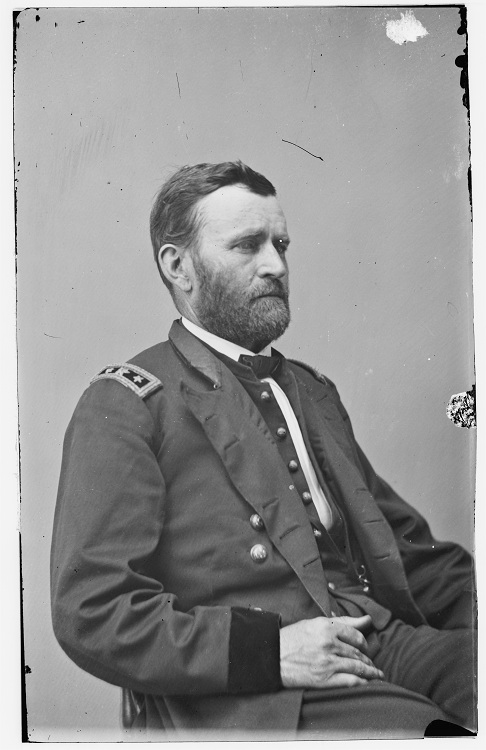
Ulysses S. Grant. Questions about his drinking are still debated today  (Library of Congress).

Ulysses S. Grant. Questions about his drinking are still debated today (Library of Congress).

I am extremely anxious that my friends in my native state should not think that the reason of General Grant’s relieving me from duty was brought about by any misconduct of mine, and therefore, I write to put you in possession of such facts in the case as I am aware of, and think will throw light upon the subject. About the very last of June, or the first of July, Generals Grant and Butler came to my headquarters, and shortly after their arrival General Grant turned to General Butler, and said: “That drink of whiskey I took has done me good.” And then, directly afterwards, asked me for a drink. My servant opened a bottle for him, and he drank of it, when the bottle was corked and put away.

I was aware at this time that General Grant had within six months pledged himself to drink nothing intoxicating, but did not feel it would better matters to decline to give it upon his request in General Butler’s presence.

After the lapse of an hour or less, the general asked for another drink, which he took. Shortly after, his voice showed plainly that the liquor had affected him, and after a little time he left. I went to see him upon his horse, and as soon as I returned to my tent I said to a staff officer of mine who had witnessed his departure, “General Grant has gone away drunk. General Butler has seen it, and will never fail to use the weapon which has been put into his hands.” Two or three days after that I applied for a leave of absence for the benefit of my health, and General Grant sent word to me not to go, if it were possible to stay, and I replied in a private note warranted by our former relations, a copy of which note I will send you in a few days. The next day, the Assistant Secretary of War, Mr. Dana, came to tell me that he had been sent by General Grant to say what it becomes necessary to repeat in view of subsequent events, to wit: That he, General G., had written a letter the day before, to ask that General Butler might be relieved from that department, July 2, and I placed in command of it, giving as a reason that he could not trust General Butler with the command of troops in the movements about to be made, and saying also, that, next to General Sherman, he had more confidence in my ability than in that of any general in the field. The order from Washington, dated July 7, sent General Butler to Fortress Monroe, and placed me in command of the troops then under him; and General Grant said he would make the changes necessary to give me the troops in the field belonging to that department. I had only asked that I should not be commanded in battle by a man that could not give an order on the field, and I had recommended General Franklin or General Wright for the command of the department. I was at the headquarters of General Grant on Sunday, July 10 [actually, July 9] and there saw General B., but had no conversation with him. After General B. had left, I had a confidential conversation with General Grant about changes he was going to make. In this connection it is proper to state that our personal relations were of the most friendly character. He had listened to and acted upon suggestions made by me upon more than one important occasion. I then thought, and still think (whatever General Butler’s letter writers may say to the contrary), that he knew that any suggestion I might make for his consideration would be dictated solely by an intense desire to put down this rebellion, and not from any considerations personal to myself, and that no personal friendships had stood in the way of what I considered my duty with regard to military management, a course not likely to be pursued by a man ambitious of advancement. In this confidential conversation with General Grant, I tried to show him the blunders of the late campaign of the Army of the Potomac and the terrible waste of life that had resulted from what I had considered a want of generalship in its present commander. Among other instances, I referred to the fearful slaughter at Cold Harbor, on the 3d of June. General Grant went into the discussion, defending General Meade stoutly, but finally acknowledged, to use his own words, “that there had been a butchery at Cold Harbor, but that he had said nothing about it because it could do no good.” Not a word was said as to my right to criticise General Meade then, and I left without a suspicion that General Grant had taken it in any other way than it was meant, and I do not think he did misunderstand me.

On my return from a short leave of absence on the 19th of July, General Grant sent for me to report to him, and then told me that he “ could not relieve General Butler,” and that as I had so severely criticised General Meade, he had determined to relieve me from the command of the 18th Corps and order me to New York City to await orders. The next morning the general gave some other reasons, such as an article in the “Tribune” reflecting on General Hancock, which I had nothing in the world to do with, and two letters, which I had written before the campaign began, to two of General Grant’s most devoted friends, urging upon them to try and prevent him from making the campaign he had just made. These letters, sent to General Grant’s nearest friends and intended for his eye, necessarily sprang from an earnest desire to serve the man upon whom the country had been depending, and these warnings ought to have been my highest justification in his opinion, and indeed would have been, but that it had become necessary to make out a case against me. All these matters, moreover, were known to the general before he asked that I might be put in command of the Department of Virginia and North Carolina, and therefore they formed no excuse for relieving me from the command I held.

I also submit to you that if it had been proven to him that I was unfitted for the command I then held, that that in nowise changed the case with reference to General Butler and his incompetency, and did not furnish a reason why he should not go where the President had ordered him at the request of General Grant; and that as General Grant did, immediately after an interview with General Butler, suspend the order and announce his intention of relieving me from duty there, other reasons must be sought, different from any assigned, for this sudden change of views and action. Since I have been in New York, I have heard from two different sources (one being from General Grant’s headquarters and one a staff officer of a general on intimate official relations with General Butler), that General Butler went to General Grant and threatened to expose his intoxication, if the order was not revoked. I also learned that General Butler had threatened to make public something that would prevent the President’s re-election. General Grant told me (when I asked him about General Butler’s threat of crushing me), that he had heard that General Butler had made some threat with reference to the Chicago convention, which he (Butler) said, he “had in his breeches pocket,” but General Grant was not clear in expressing what the threat was. I refer to this simply because I feel convinced that the change was not made for any of the reasons that have been assigned; and whether General Butler has threatened General Grant with his opposition to Mr. Lincoln at the coming election, or has appealed to any political aspirations which General Grant may entertain, I do not know; but one thing is certain, I was not guilty of any acts of insubordination between my appointment and my suspension, for I was absent all those days on leave of absence from General Grant. I only hope that this long story will not tire you, and that it will convince you that I have done nothing to deserve a loss of the confidence which was reposed in me.

Yours very truly, Wm. F. Smith, Major-General.

P. S. I have not referred to the state of things existing at headquarters when I left, and to the fact that General Grant was then in the habit of getting liquor in a surreptitious manner, because it was not relevant to my case; but if you think, at any time, the matter may be of importance to the country, I will give it to you. Should you wish to write to me, please address, care of S. E. Lyon, Jauncy Court, 39 Wall Street, New York.


An Attack in the Times (July 17, 1864)

Once again, the press irritates General Meade. On July 6 he had issued an order banning two reporters from the army. “Mr. William Swinton, a duly registered correspondent with this army for the New York Times, and Mr. Kent, a correspondent for the New York Tribune, have, by direction of the lieutenant-general commanding the armies in the field, been ordered to leave the lines for having abused he privileges conferred upon them by forwarding for publication incorrect statements respecting the operations of the troops, and they have been warned not to return,” the order read. The attack in the Times to which Meade alludes read in part, “Gen. MEADE must have a very vague idea of the duties of a correspondent, and of the difficulties which attend their performance, if he requires perfect and exact accuracy in regard to all the details of army operations, as the condition of remaining within his lines. He has not always found it easy to be thus exact in his own official reports, even after he had taken weeks to compile and prepare them. Possibly he may, at some future day, condescend to specify the particular default which has led to Mr. SWINTON’s exclusion from the limits of his army,–though it is, after all, a matter of very little consequence. Judging from Gen. MEADE’s previous action in similar cases, and from the general temper he exhibits toward the press, Mr. SWINTON is quite as likely to have been excluded for being too accurate as for any other offence.” (You can read the full article here.) The Times attack does not mention that Swinton had been caught eavesdropping outside a tent while Grant and Meade conversed inside, and that he had tried to bribe a telegraph operator to give him some classified material.  

I had a visit to-day from General Grant, who was the first to tell me of the attack in the Times, based on my order expelling two correspondents. Grant expressed himself very much annoyed at the injustice done me, which he said was glaring, because my order distinctly states that it was by his direction these men were prohibited remaining with the army. He acknowledged there was an evident intention to hold me accountable for all that was condemned, and to praise him for all that was considered commendable.

As to these two correspondents, the facts are, that Grant sent me an order to send Swinton, of the Times, out of the lines of my army. Swinton was in Washington, and he was accordingly notified not to return. In regard to the other, Kent, of the Tribune, Hancock wrote me an official letter, enclosing the Tribune, and complaining of the misstatements of Kent. As Kent was a correspondent with General Butler’s command, and not under my jurisdiction, I simply forwarded Hancock’s letter to General Grant, asking that proper action should be taken in the case. He replied that, on reference to General Butler, it was found Kent had gone off, but that he, Grant, had prohibited his return. I therefore issued my order, stating these men were by General Grant’s directions excluded from the army, and directing, if they returned, they should be arrested and turned over to the Provost Marshal General. They might just as well attack General Patrick, the Provost Marshal, because he is ordered to execute the order, as to attack me, who merely gave publicity to General Grant’s order.

We are quite on the qui-vive to-night, from the reports of deserters, who say we are to be attacked to-morrow. Their story is that Johnston is so pressed by Sherman that if he is not reinforced, he will have to succumb, and that he cannot be reinforced until we are driven back. We consider this great news, and are most anxiously and impatiently awaiting the attack, feeling confident we can whip twice our numbers if they have the hardihood to attack us.

Franklin’s escape has delighted every one, and we all hope his luck has now turned.

Meade’s correspondence taken from The Life and Letters of George Gordon Meade, Major-General United States Army, Vol. 2, (New York: Charles Scribner’s Sons, 1913), pp. 213-14. Available via Google Books.

Great Excitement and Idle Talk (July 15, 1864)

Jubal Early’s raid to the outskirts of Washington continues to create excitement. In his letter of July 15, Meade also mentions the latest in what will become a series of meetings with Ulysses S. Grant regarding his future with the Army of the Potomac. In his letter of July 12 Meade had written about rumors that Meade was going to be replaced as commander of the Army of the Potomac by Winfield Scott Hancock. From this point on Meade and Grant will have what must have been increasingly uncomfortable conversations about Meade’s status with the army.

General William Franklin. An engineer like Meade, Franklin had been overseeing construction of the U.S. Capitol's new dome when war broke out  (Library of Congress).

General William Franklin. An engineer like Meade, Franklin had been overseeing construction of the U.S. Capitol’s new dome when war broke out (Library of Congress).

In this letter Meade also mentions General William Franklin. At the Battle of Fredericksburg Franklin had commanded the Left Grand Division of Ambrose Burnside’s army, in which Meade commanded his division of the Pennsylvania Reserves. After the battle Franklin had criticized Burnside, who had him removed from the army and sent west. Franklin’s bad luck continued when he was wounded during the Red River campaign under General Nathaniel Banks. Bad luck followed him back east, too. In this letter Meade refers to an incident in which Confederate partisans under Harry Gilmore attacked Franklin’s train during a raid into Maryland and captured the general. The rumors Meade hears of Franklin’s escape will turn out  to be true

I suppose you are in a great state of excitement on account of the rebel invasion. I wrote you in my last that I thought it was a serious affair, and subsequent developments prove it to be so. Day before yesterday I went down to City Point to see General Grant, having heard a rumor that I was to be sent to Washington. I found Grant quite serious, but calm. He seemed to think that with the Sixth Corps from this army, and the Nineteenth from Louisiana, there would be troops enough, with Hunter’s, Couch’s and Augur’s commands, not only to defeat the rebels, but to bag them. He said he had not contemplated sending me to Washington, but if another corps had to go, he would send me with it. I do not think the position a desirable one, as the difficulty will be to get the various commands together and harmonize such conflicting elements. If, however, I am ordered, I will do the best I can. I think Grant should either have gone himself or sent me earlier. He has given the supreme command to Wright, who is an excellent officer. I expect that after the rebels find Washington too strong for them, and they have done all the plundering they can, they will quietly slip across the Potomac and rush down here to reinforce Lee, who will then try to throw himself on us before our troops can get back.

I spoke to Grant about the report that I was to be relieved, and he said he had never heard a word of it, and did not believe there was any foundation for it, as he would most certainly have been consulted. I have therefore dismissed the matter as some idle talk from some person with whom the wish was father to the thought.

Lee has not sent away any of his army, and is doubtless disappointed that his diversion has not produced a greater weakening of Grant’s army. He confidently expected to transfer the seat of war to Maryland, and thought his menace of Washington would induce the Government to order Grant back there with his army.

I was very sorry to hear of Franklin’s capture, for his health is not good, owing to a wound he received in Louisiana, and I fear, if they send him to Charleston, his health may give way under the confinement in that climate, or be permanently injured.

Whilst I was writing we have a telegram reporting the withdrawal of the enemy across the Potomac, Wright in pursuit. Just as I expected. It also states there is a rumor that Franklin has made his escape, which I earnestly hope may prove true.

Meade’s correspondence taken from The Life and Letters of George Gordon Meade, Major-General United States Army, Vol. 2, (New York: Charles Scribner’s Sons, 1913), pp. 212-13. Available via Google Books.

Too Darned Hot (June 25, 1864)

Both Meade and Lyman mention the hot, dry weather that made the Petersburg front miserable for both armies. In addition, Meade mentions the Crapsey or Cropsey affair and how it has helped erase his presence in the newspapers. The wound of Hancock’s he mentions is the one the general received on the third day at Gettysburg. David Bell Birney has been in command of the II Corps while Hancock recovers. Gibbon is John Gibbon, one of Hancock’s division commanders.

Francis Markoe Bache, Meade's nephew (Library of Congress).

Francis Markoe Bache, Meade’s nephew (Library of Congress).

Francis Markoe Bache was Meade’s nephew and had joined his uncle’s staff from the 16th U.S. Infantry. When Lyman first met him, he called Bache “a remarkably empty-headed and ill-bred young man.” The two aides did not speak to each other for several months, until Bache finally apologized for his rudeness. General Meade had served under Bache’s father—who had married one of his sister’s—building lighthouses before the war.

We have had for ten days past most intensely hot weather, and in consequence have desisted from carrying on any more active operations than were absolutely necessary. Grant being at City Point, some eight miles distant, I see but little of him. He paid me a visit of an hour or two day before yesterday.

I received a few days ago a very kind letter from Cortlandt Parker, expressing much consideration for me in my present position, and saying it was well known how much of the work I was doing, and how little of the credit I was getting. Among other matters he alluded to the Cropsey affair, and said he was at George Harding’s when his brother came in with the news. Both the Hardings, he said, were quite excited, George the less so of the two; and Cortlandt thought he convinced him I was right, and advised me to write to him to endeavor to smooth it over. This I do not see how I can very well do, because I got Markoe Bache to write to him when the affair occurred, and to send him Cropsey’s confession, which he made, hoping by its publication in the Inquirer to get off. I asked Markoe to tell Mr. Harding that, as I could not let Cropsey off, he was at liberty to do as he pleased about the letter, though in my judgment the cause of truth and justice demanded its publication. The letter was never published, and the public are to this day ignorant of the real character of Cropsey’s offense.

Hancock’s wound discharged a big piece of bone the other day, and since then he has rapidly improved, and expects in a day or two to return to duty. In the meantime Birney has done very well.

Gibbon, whom I suppose you know I have finally succeeded in getting promoted, has been under the weather, but was about to-day.

And now Lyman, who remains busy serving as tour guide for the army’s two French guests.

I can only say that I have “sweltered” to-day—that is the word; not only has it been remarkably broiling, but this region is so beclouded with dust and smoke of burning forests, and so unrelieved by any green grass, or water, that the heat is doubled. We have had no drop of rain for twenty days, and but a stray shower for over a month. It is hardly necessary to say that neither army is what it was: the loss of a large proportion of the best officers, the nervous prostration of the men, the immense destruction of life, all tend to injure the morale and discipline and skill of both parties. As to the next step, I do not know; Grant is as calm and as apparently sure as ever. I have got from the region of fighting now, to the realm of lying idle, and it will not be so easy to fill a daily sheet. General Meade asked me to show the Gauls somewhat about; so I clapped them on their two horses, which they had from General Grant, and took them by easy stages to General Wright near by. The good General was comfortably in the woods. I say comfortably, because everything is relative. I mean he had his tents pitched and had iced water, two important elements. He speaks no French—De Chanal no English—so they smiled sweetly at each other. Old D. C. ought to be ashamed of himself. He married an American wife, but, like a true Gaul, utterly refused to learn a word of English. It is ever a part of a Frenchman’s religion to speak no language but his own. Little grasshopper Guzman chirped away and made up for two. Then Colonel Kent rode out with us, as a matter of politeness (for I knew that part of the line as well as he), and we showed them how our men made breastworks of rails, logs, and earth; how they lived and cooked; and all sorts of things. After which I took them out towards the picket line and showed them the country, and a tract of dense, young pines, through which our men advanced in double lines—a feat which I can never understand, but which is performed nevertheless. By this time, both distinguished foreigners being powdered a la marquise, I took them home, only showing them, before coming in, one more thing, only too characteristic of our war—the peculiar graves of our soldiers, marked each by a piece of cracker-box, with the man’s name in pencil, or hastily cut with a knife. I recollect sitting on the high bank of the Rapid Ann, at Germanna Ford, and watching the 5th and 6th Corps as they marched up from the pontoon bridges; and I remember thinking how strange it would be if each man who was destined to fall in the campaign had some large badge on! There would have been Generals Sedgwick, Wadsworth, and Rice, and what crowds of subordinate officers and of privates, all marching gaily along, unconscious, happily, of their fate.

Meade’s correspondence taken from The Life and Letters of George Gordon Meade, Major-General United States Army, Vol. 2, (New York: Charles Scribner’s Sons, 1913), pp. 208-9. Available via Google Books.

Theodore Lyman’s letter is from Meade’s Headquarters, 1863-1865: Letters of Colonel Theodore Lyman from the Wilderness to Appomattox, p. 178-80. Edited by George R. Agassiz. Boston, Massachusetts Historical Society, 1922. Available via Google Books.

The Great Peppery (June 24, 1864)

We begin our accounts of June 24, 1864, with General Meade’s report home to his wife. It is a very clear-eyed letter, explaining the pressures the army has been operating under and what the commanding general feels will be necessary for the Union to obtain victory. And victory is Meade’s goal here.

Following the general’s letter is one from Theodore Lyman as he examines the behavior of “the Great Peppery.” Lyman, for the most part, maintains a positive view of Both men write about the army’s need for more men.his boss but he is not unwilling to write about his various personal shortcomings, especially the legendary temper.

Both men write about the army’s need for more men.

In his book of Lyman’s journals, David W. Lowe identifies the two Frenchmen as Lt. Col. François De Chanal and Capt. Pierre Guzman, sent by Napoleon III as observers.

Our operations here for the last few days, though not so heavy as prior to the 18th, have still been very active. We have been extending our lines around Petersburg, and have encountered considerable opposition from the enemy, which has somewhat checked the rapidity of our progress.

I am sorry to see the feeling you report as existing with certain persons. Despondency is never going to get us through this war, and although this army has not accomplished all that ignorant people anticipated, it has really done more than could reasonably have been counted on. Our losses, it is true, have been large, but not larger than is incidental to operations of the character of ours, being offensive, and conducted on so grand a scale, with such numbers. Fifty days’ constant marching and fighting has undoubtedly had its influence on the army, and its condition is not what it was when we first crossed the Rapidan.

On the 18th I assaulted several times the enemy’s positions, deliberately, and with the expectation of carrying them, because I had positive information the enemy had not occupied them more than twelve hours, and that no digging had been done on the lines prior to their occupation. Nevertheless, I failed, and met with serious loss, principally owing to the moral condition of the army; for I am satisfied, had these assaults been made on the 5th and 6th of May, we should have succeeded with half the loss we met.

Another inconvenience we suffer from is in the loss of superior and other officers. Hancock’s Corps has lost twenty brigade commanders, and the rest of the army is similarly situated. We cannot replace the officers lost with experienced men, and there is no time for reorganization or careful selection. At the same time you must remember the enemy labors under like disadvantages. I conversed with some prisoners yesterday, who said they were completely exhausted, having had no rest or sleep for days, and being compelled to be all the time marching. I said to one of them, “Well, we will treat you well,” and he replied, “Oh, sir, you cannot treat us worse than we are treated on the other side.” In flags of truce, and on all occasions that we meet the rebel officers, they always begin conversation by asking when the war is going to be over, and expressing themselves as most heartily tired and anxious for peace. I believe these two armies would fraternize and make peace in an hour, if the matter rested with them; not on terms to suit politicians on either side, but such as the world at large would acknowledge as honorable, and which would be satisfactory to the mass of people on both sides. But while I ardently desire peace, and think a settlement not impracticable, I am opposed to any cessation of our efforts so long as the war has to be continued, and I regret to see symptoms of a discontent which, if persisted in, must paralyze our cause. Again, it is impossible for me personally to avoid my share of the odium, if any is to be cast on this army. I complain, and I think justly, that the press and the Government despatches fail to acknowledge my services, but I cannot reasonably do this, and expect to be shielded from complaints, if any are made of the operations.

You know I have never shut my eyes to the obstacles we have to encounter, and have always appreciated the difficulties to be overcome. The campaign, thus far, has been pretty much what I expected; if anything, rather greater obstacles than I anticipated. I still believe, with the liberal supply of men and means which our superior resources ought to furnish, we will win in the long run; but it is a question of tenacity and nerve, and it won’t do to look behind, or to calculate the cost in blood and treasure; if we do we are lost and our enemies succeed. You may remember I told the good people of Philadelphia, that what we wanted was men, fighting men; that the war could only be closed by desperate and bloody fighting; and the sooner the people realize this, and give evidence of their appreciation by coming forward to fight, the better.

I am well and seem to improve on hard work. I have had only three hours’ sleep for several nights past.

Here’s Lyman’s report, also from June 24. It provides some more close up views of “the Great Peppery” in action:

James C. Biddle, one of Meade's aides. He came from a good Philadelphia family but, as David W. Lowe notes in his book of Lyman's journals, "He could be something of a buffoon and was the target of much good-natured camp humor" (Library of Congress).

James C. Biddle, one of Meade’s aides. He came from a good Philadelphia family but, as David W. Lowe notes in his book of Lyman’s journals, “He could be something of a buffoon and was the target of much good-natured camp humor” (Library of Congress).

It is praise not to be pitched into by the Great Peppery: and he is very kind to me. To be sure, I watch him, as one would a big trout on a small hook, and those who don’t, catch volleys at all hours! Poor [James] Biddle, for instance, an excellent, bettyish sort of man, with no fragment of tact, when the General is full of anxiety for something that is not going right, is sure to come in, in his stuttering way, with “Ah, aw, hem, aw, General, they are going to pitch camp in a very sandy, bad place, sir; you will not be at all comfortable, and there is a nice grassy—” “Major Biddle!!!”—and then follows the volley. Sometimes it is very effective to contradict the General, provided you stick to it and are successful. I came in last night, feeling cross and not at all caring for commanders of armies or other great ones of this earth. “Well, Lyman, you’re back, are you?” “Yes, sir: I reported that the enemy were moving along our rear, but they got no further than—” “Rear! not at all! they were moving along the front.” “No, sir, they were not, they were moving along our rear.” “What do you mean by that? There is Russell, and there is Ricketts, and here is Wheaton; now of course that’s your front.” “Russell isn’t in such a position, sir, nor Wheaton either. They face so (dabs with a pencil), so that is our rear and can’t be anything else.” Whereupon the good chief graciously said no more. I do not know that he ever said anything pleasant about me except the day after the Wilderness battles, when I heard Hancock say that “Colonel Lyman had been useful to him, the day before.” To which the General replied: “Yes, Lyman is a clear-headed man.” I have heard him volunteer several favorable things about Captain Sanders; also he has remarked that Old Rosey (my tent-mate) [Frederick Rosenkrantz] was good at finding roads; and that is pretty much all of his praises, whereof no man is more sparing. By the way, old Rosey has his commission as captain. One thing I do not like—it is serious—and that is, that three years of bitter experience have failed to show our home people that, to an army on active campaign (or rather furious campaign), there must be supplied a constant stream of fresh men—by thousands. What do we see? Everyone trying to persuade himself that his town has furnished its “quota.” But where are they? We have large armies, but nothing compared with the paper statements. No! The few produced by drafts in good part run away; so too many of the “volunteers”—miserable fellows bought with money. None are shot—that is unmerciful—but the Powers that Be will let brave, high-toned men, who scorn to shirk their duty, be torn with canister and swept away with musketry, and that is inevitable.

This morning appeared General Grant with two French officers, who since have taken up their quarters with us and mess with us. They are two artillery officers, the elder a Colonel de Chanal, the other a Captain Guzman, both sent as a commission to observe the progress of the campaign. The Colonel is a perfect specimen of an old Frenchman, who has spent most of his life in provincial garrisons, in the study of all sorts of things, from antiquities down to rifled projectiles. He has those extraordinary, nervous legs, which only middle-aged Frenchmen can get, and is full of various anecdotes. Many years he has lived in Toulouse. The other is young and little and looks like a black-eyed and much astonished grasshopper. He is very bright, speaks several languages, and was on the Chinese expedition. General Grant staid some time in council, and took dinner with us. I was amused at him, for, the day being warm, he began taking off his coat before he got to the tent; and by the time he had said, “How are you, Meade?” he was in his shirt-sleeves, in which state he remained till dinner-time. He attempted no foreign conversation with the Gauls, simply observing; “If I could have turned the class the other end to, I should have graduated at West Point, very high in French”!

Meade’s correspondence taken from The Life and Letters of George Gordon Meade, Major-General United States Army, Vol. 2, (New York: Charles Scribner’s Sons, 1913), pp. 206-8. Available via Google Books.

Theodore Lyman’s letter is from Meade’s Headquarters, 1863-1865: Letters of Colonel Theodore Lyman from the Wilderness to Appomattox, p. 176-8. Edited by George R. Agassiz. Boston, Massachusetts Historical Society, 1922. Available via Google Books.