Ignored (June 21, 1864)

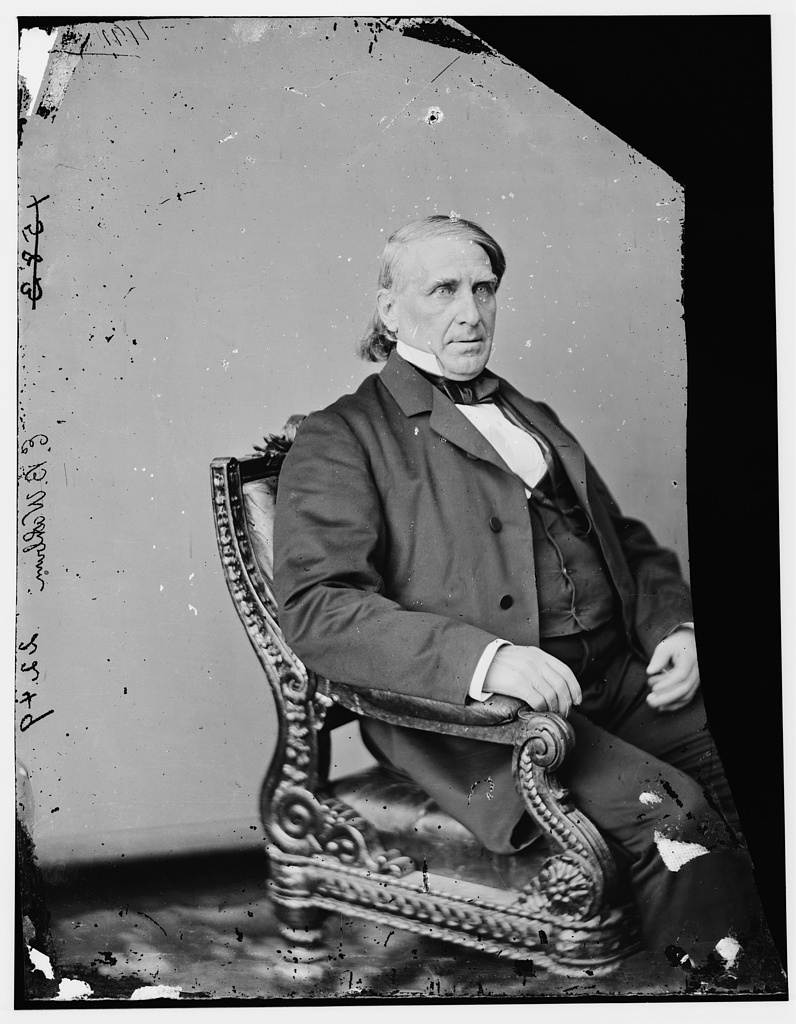
Secretary of War Edwin Stanton (Library of Congress).

Secretary of War Edwin Stanton (Library of Congress).

George Meade’s letter of June 21, 1864, includes one of his persistent complaints about being ignored, this time in the dispatches of Secretary of War Edwin Stanton. Meade craved affirmation, a need that seemed motivated by some basic insecurity. Of course, commander of the Army of the Potomac was a position that naturally bred a sense of insecurity—just ask George McClellan, Joe Hooker, or Ambrose Burnside. But Meade seemed to need some kind of official “vindication” and validation that he had performed well. Despite his repeated claims to his wife that he was “indifferent” to such things, he wanted an official seal of approval that always seemed to evade him. Perhaps Meade would have had more success in advancing his cause if he had more nakedly lusted for glory and aggressively sought fame. He was more than willing to carp about the situation in his letters to his wife, but his son and grandson edited most of those complaints out of the letters for publication. Publicly, though, Meade had an almost naïve–or perhaps idealistic is a better word–belief that true honors would come to those who deserved them. Of course, it didn’t help that the correspondents traveling with the army had agreed to leave Meade out of their reports in revenge for the Crapsey incident.

Meade mentions in passing President Lincoln’s visit to the army. Horace Porter, Grant’s aide, included a long account of the visit in his book, Campaigning with Grant. Lincoln was especially eager to see the black soldiers of the XVIII Corps who had taken a portion of the Petersburg defenses. “When we wanted every able-bodied man who could be spared to go to the front, and my opposers kept objecting to the negroes, I used to tell them that at such times it was just as well to be a little color-blind,” the president said. The black soldiers gave the president a rapturous reception, which affected him deeply. “The President rode with bared head; the tears had started to his eyes, and his voice was so broken by emotion that he could scarcely articulate the words of thanks and congratulation which he tried to speak to the humble and devoted men through whose ranks he rode,” wrote Porter.

President Abraham Lincoln (Library of Congress).

President Abraham Lincoln (Library of Congress).

In the evening the president relaxed with Grant and his staff and indulged himself in one of his favorite pastimes, telling humerous stories. “He did not tell a story merely for the sake of the anecdote, but to point a moral or to clench a fact,” Porter noted. “So far as our experience went, his anecdotes possessed the true geometric requisite of excellence: they were neither too broad nor too long. He seemed to recollect every incident in his experience and to weave it into material for his stories. One evening a sentinel whose post was near enough to enable him to catch most of the President’s remarks was heard to say, ‘Well, that man’s got a powerful memory and a mighty poor forgettery.’

“He seldom indulged even in a smile until he reached the climax of a humorous narration; then he joined heartily with the listeners in the laugh which followed. He usually sat on a low camp-chair, and wound his legs around each other as if in an effort to get them out of the way, and with his long arms he accompanied what he said with all sorts of odd gestures. An officer once made the remark that he would rather have a single photograph of one of Mr. Lincoln’s jokes than own the negative of any other man’s.

My last letter was written on the 17th, during the battle of Petersburg, which lasted off and on from 4 o’clock on the afternoon of the 16th to dark of the 18th, day and night, during which time we drove the enemy more than a mile and a half, taking from them two strong lines of works, capturing over twenty guns, four colors and nearly seven hundred prisoners. In all this fighting and these operations I had exclusive command, Grant being all the time at City Point, and coming on the field for only half an hour on the 17th, and yet in Mr. Stanton’s official despatch he quotes General Grant’s account, and my name is not even mentioned. I cannot imagine why I am thus ignored.

I think I wrote you on the 17th that I was fighting Mr. Wise. Since then I have seen a Petersburg paper, announcing the wounding severely of George D. Wise, his nephew and aide, also of Peyton Wise, another nephew and aide-de-camp.

On the 18th we found the enemy had retired to an inner line, which I had reason to believe was not strongly fortified. I followed them and immediately attacked them with my whole force, but could not break through their lines. Our losses in the three-days’ fight under my command amount to nine thousand five hundred, killed, wounded and missing. As I did not have over sixty thousand men, this loss is severe, and shows how hard the fighting was.

Your accounts of the fair are quite amusing. Hancock and myself have much fun over the sword contest, and are both quite sorry to see we stand no chance for the five thousand dollar vase.

Mr. Lincoln honored the army with his presence this afternoon, and was so gracious as to say he had seen you in Philadelphia, etc., etc.

We have been very quiet for two days, having given up the idea of taking Petersburg by assault. Indeed, the army is exhausted with forty-nine days of continued marching and fighting, and absolutely requires rest to prevent its morale being impaired.

Meade’s correspondence taken from The Life and Letters of George Gordon Meade, Major-General United States Army, Vol. 2, (New York: Charles Scribner’s Sons, 1913), pp. 205-6. Available via Google Books.
A Wounded Hand (June 18, 1864)

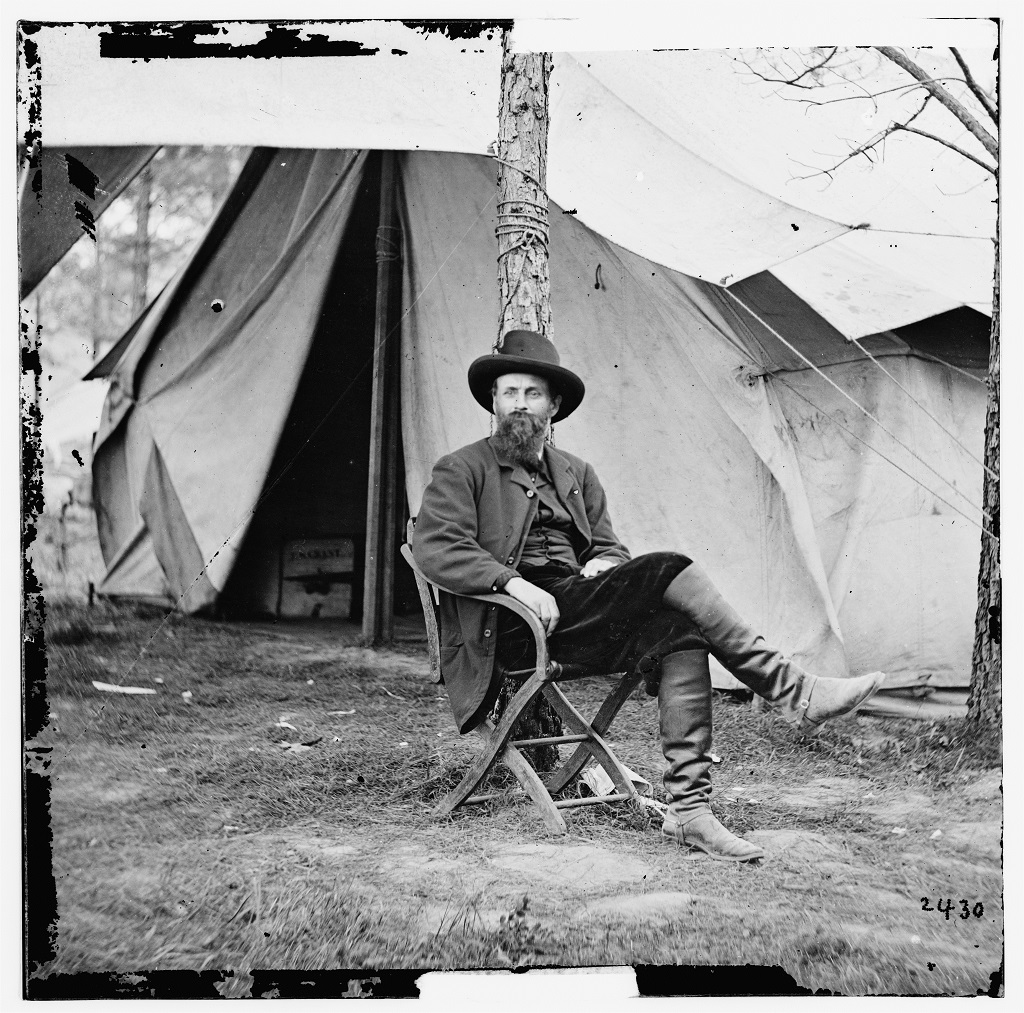
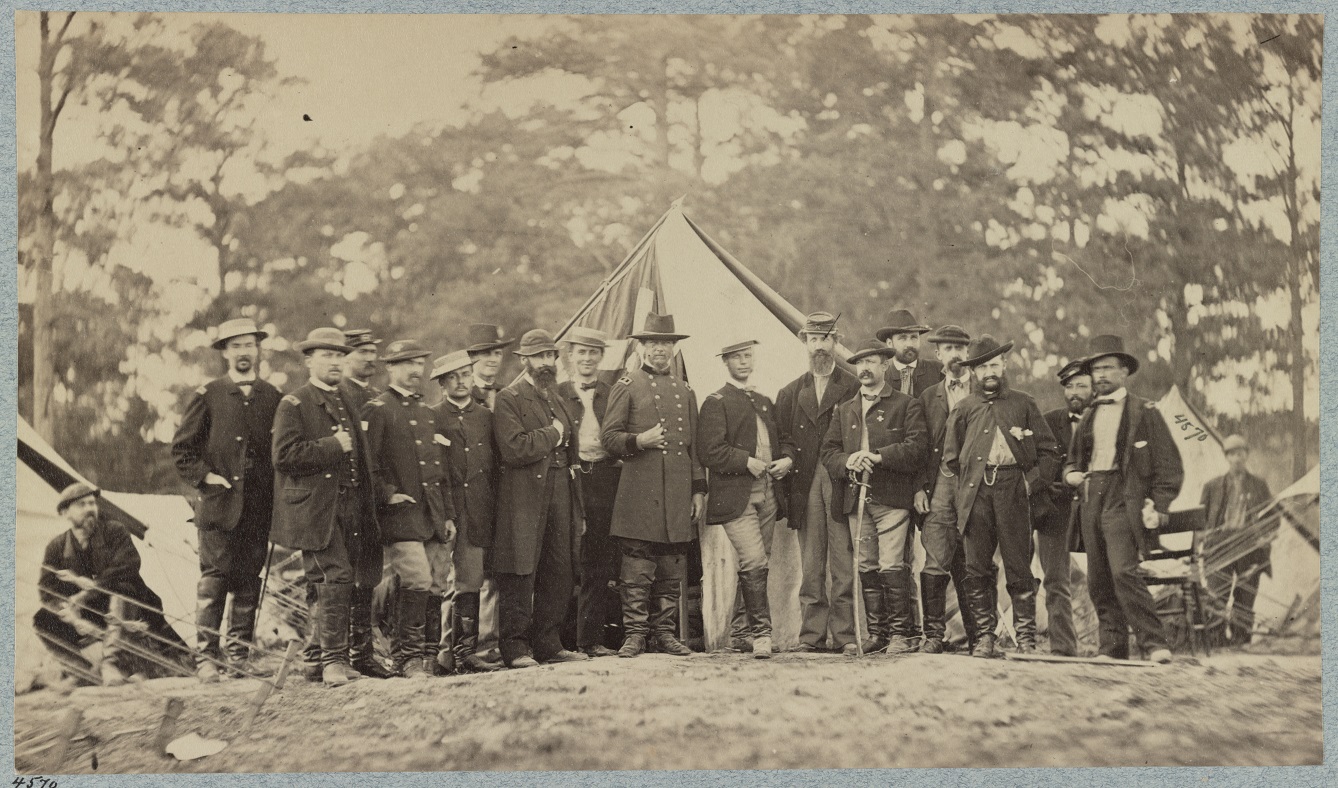
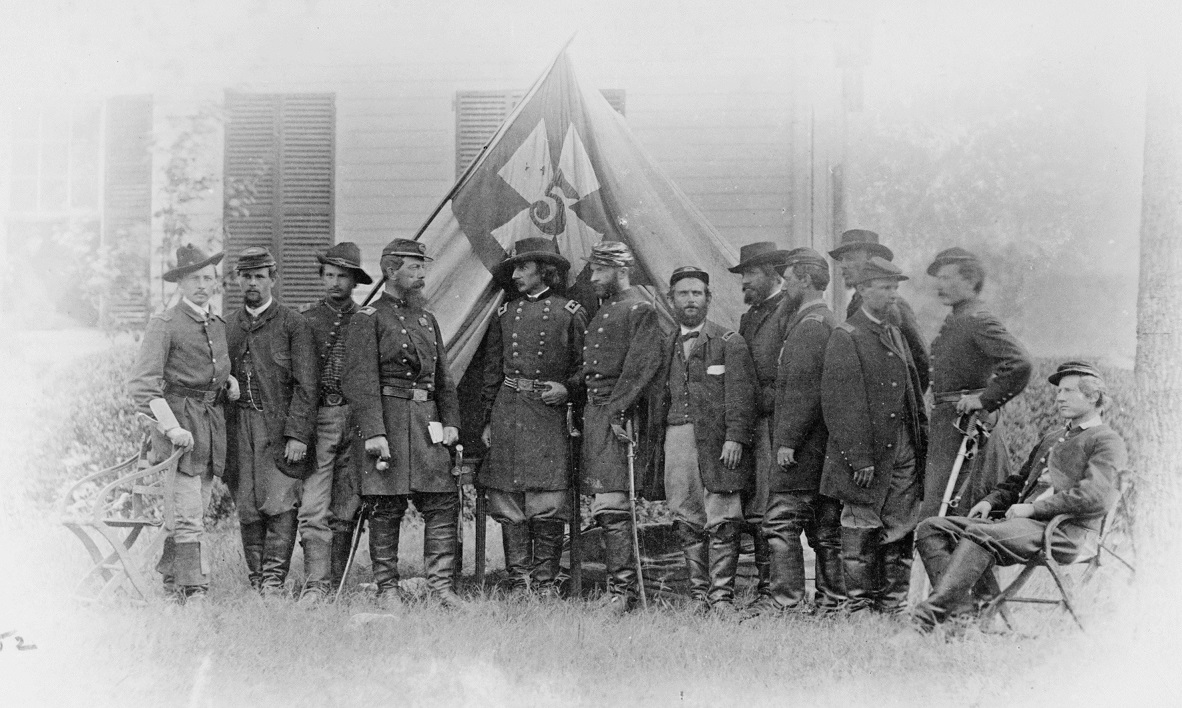
V Corps commander Gouverneur K. Warren and staff, photographed by Mathew Brady outside Petersburg on June 21. Warren had escaped Brady's attentions at Cold Harbor (Library of Congress).

V Corps commander Gouverneur K. Warren and staff, photographed by Mathew Brady outside Petersburg on June 21. Warren had escaped Brady’s attentions at Cold Harbor (Library of Congress).

More from Theodore Lyman, in which he describes the Army of the Potomac’s ineffectual attacks before Petersburg on June 18 and provides some examples of General Meade in his “great peppery” mode. At this point, after more than a month of hard marching and even harder fighting, the army was almost a spent weapon. As Lyman writes, “You cannot strike a full blow with a wounded hand.” On June 18 Grant decided that headlong assaults against Petersburg’s defenses would result only in useless bloodshed. He prepared to lay siege. “I am perfectly satisfied that all has been done that could be done, and that the assaults to-day were called for by all the appearances and information that could be obtained,” he wrote in a message to Meade. “Now we will rest the men and use the spade for their protection until a new vein can be struck.”

The Major Roebling whom Lyman mentions is Washington Augustus Roebling. After the war his father, John, designed the Brooklyn Bridge and Washington took over the project after the death of his father. Roebling married Gouverneur Warren’s sister, Emily, in January 1865.

Following Lyman’s account I include a portion of Horace Porter’s Campaigning with Grant in which he describes the attacks of June 18 and Meade’s actions.

A general attack was planned for an early hour, so Headquarters, which had lain down late, had scarce a chance to turn over once before it was routed out again, just at daylight. The General was in a tearing humor. (I don’t think anybody felt any too pleasant.) “Lyman, you are behind time!” I had the satisfaction of stepping out, all dressed, and saying shortly: “No, sir, I am ready.” Presently: “Colonel Lyman, take two or three orderlies and go to General Warren and report to me by telegraph promptly and frequently.” I did not admire this duty, as there was to be an assault; but everybody must do his share, and I started immediately. The General started with me. “Do you know the way to General Hancock’s?” “Yes, sir!” In a few moments: “This is not the short cut to Hancock’s.” “I did not say I knew the short cut, General.” “Well, but I wanted the short cut! What’s the use of the road; of course I knew the road!” Whereupon I suggested I would gallop ahead, not to lose time; which I did and left my chief to attack Biddle, who was late and was coming up very red in the face!

It was half-past four when I got to Headquarters of the 5th Corps, which consisted of a couple of tents, pitched by a solitary tree. Warren, with all his clothes on, was catching a little sleep on a camp bed. Burnside* was there also, sitting under the tree, and there was a telegraph operator with his little portable instrument. Our lines were advancing, and there was an inexplicable silence along the skirmish line. … At 6.50 came an order for all the line to advance and to attack the enemy if found. … A little later, after seven, Major Roebling came in and reported he had discovered the enemy’s new line of works, that ran along a high ground beyond the railroad, and that they were all there, with batteries in position. Soon after General Warren mounted, and we all rode to the front, over a wide oat-field past the works captured last evening, from which we were afterwards driven. In these there was one part where we seemed to have had an enfilade fire, for the Rebel dead lay there, one on top of the other. . . . We stopped under a hollow oak, just at a point of woods and at the juncture of two country roads. Some movement of our troops attracted the enemy, who immediately sent two or three round shot to enfilade the road, and which of course came about our ears in a most uncomfortable way. Ill luck would have it that the fire of two or three batteries just crossed at that point. So not a gun could open but that we got a reminder. To which may be added that stray bullets from Crawford’s front came zip! tzizl to add their small voices. We had it intermittently all day long from eight o’clock till dark. New batteries soon came up, under charge of Captain Phillips (Appleton’s commander). “I want you to go in there with your guns,” said General [Charles] Griffin, “but you will be under fire there.” “Well,” said Phillips, “I have been in those places before”; and rode on, followed by his pieces. Later, his First Lieutenant, Blake, was carried by me, dead, shot with a minie ball through the forehead. . . .

After much difficulty in advancing the different divisions, we at last drove the enemy from the railroad cut and a gully beyond, and got in, to about 200 yards of their works. At 3.30 in the afternoon the first assault took place. We rode out on an open field to watch it. In front was a broad expanse, quite flat; then the railroad cut with a fringe of bushes, and then a gradual rise crowned by the Rebel rifle-pits and batteries, which were distant perhaps half a mile. Close to us, on each side, were our batteries, firing as fast as they could, and the rebels were sending back shot, shell, and shrapnel as hard as possible. Half a mile is no good with minie rifles; and, as soon as we attacked, the balls came tolerably numerous, cutting up little puffs of sand on the dry field. I sat up straight on my horse, comme les avires, but I can’t say it was pleasant, though it is a help to have others cool and brave. It was as I expected—forty-five days of constant marching, assaulting and trenching are a poor preparation for a rush! The men went in, but not with spirit; received by a withering fire, they sullenly fell back a few paces to a slight crest and lay down, as much as to say, “We can’t assault but we won’t run.” The slopes covered with dead and wounded bore testimony that they were willing to give proof of courage even in circumstances that they deemed desperate. Another attack at six resulted no better, save that the lines were at all points pressed close in on those of the enemy. Birney, during the day, made a grand attack with no better success, on the right. I returned after dark, feeling pretty sad. General Meade was much disappointed, but took it cheerfully as he does every matter which affects him personally. The whole thing resulted just as I expected. You cannot strike a full blow with a wounded hand.

*”Everyone was near the breaking-point. He, Burnside, complained of the heavy artillery detailed to his corps. ‘They are worthless,’ said he; ‘they didn’t enlist to fight and it is unreasonable to expect it from them. In the attack last night I couldn’t find thirty of them!’ He afterwards said of Meade (to one of his Staff): ‘He is irascible; but he is a magnanimous man.’ Presently up comes Griffin, in one of his peculiar blusters! and all about a commissary who, he maintains, didn’t follow orders. Griffin stormed and swore. ‘Now! now!’said Warren (who can be very judicious when he chooses), ‘let us all try to keep our tempers more, and not swear so much. I know I give way myself; but it is unworthy.’” —Lyman’s Journal.

Here’s Horace Porter’s account. This is from Campaigning with Grant, pages 208-10. Like Lyman, Porter comments on Meade’s notorious temper but notes how it served a purpose in combat.

At daylight on the 18th Meade’s troops advanced to the assault which had been ordered, but made the discovery that the enemy’s line of the day before had been abandoned. By the time new formations could be made Lee’s army had arrived in large force, great activity had been displayed in strengthening the fortifications, and the difficulties of the attacking party had been greatly increased. The Second Corps was temporarily commanded by D. B. Birney, as Hancock’s Gettysburg wound had broken out afresh the day before, entirely disabling him. Gallant assaults were repeatedly made by Burnside, Warren, and Birney; and while they did not succeed in the object of carrying the enemy’s main line of fortifications, positions were gained closer to his works, and these were held and strongly intrenched. Both of the opposing lines on this part of the ground were now strengthened, and remained substantially the same in position from that time until the capture of Petersburg.

General Grant realized the nature of the ground and the circumstances that prevented the troops from accomplishing more than had been done, and he complimented Meade upon the promptness and vigor with which he had handled his army on this day of active operations. Indeed, Meade had shown brilliant qualities as commander of a large army, and under the general directions given him had made all the dispositions and issued all the detailed orders. Grant felt it necessary to remain at City Point in order to be in communication with both Meade and Butler, as Lee’s troops were that day moving rapidly south past Butler’s front.

My duties kept me on Meade’s front a large part of the day. He showed himself the personification of earnest, vigorous action in rousing his subordinate commanders to superior exertions. Even his fits of anger and his resort to intemperate language stood him at times in good stead in spurring on every one upon that active field. He sent ringing despatches to all points of the line, and paced up and down upon the field in his nervous, restless manner, as he watched the progress of the operations and made running comments on the actions of his subordinates. His aquiline nose and piercing eyes gave him something of the eagle’s look, and added to the interest of his personality. He had much to try him upon this occasion, and if he was severe in his reprimands and showed faults of temper, he certainly displayed no faults as a commander. When the battle was over no one was more ready to make amends for the instances in which he felt that he might have done injustice to his subordinates. He said to them: “Sorry to hear you cannot carry the works. Get the best line you can and be prepared to hold it. I suppose you cannot make any more attacks, and I feel satisfied all has been done that can be done.” Lee himself did not arrive at Petersburg until noon that day.

Theodore Lyman’s letter is from Meade’s Headquarters, 1863-1865: Letters of Colonel Theodore Lyman from the Wilderness to Appomattox, p. 167-70. Edited by George R. Agassiz. Boston, Massachusetts Historical Society, 1922. Available via Google Books.

A Most Striking Sight (June 16, 1864)

Wilcox's landing on the James River. Before the war it had been established as a shipping point for tobacco (Library of Congress).

Wilcox’s landing on the James River. Before the war it had been established as a shipping point for tobacco (Library of Congress).

Theodore Lyman describes the events of June 16, 1864. His journals, edited by David W. Lowe and published as Meade’s Army: The Private Notebooks of Lt. Col. Theodore Lyman, make great companion reading for his letters. In his journals Lyman adds to his account of touring the former Confederate ironclad Atlanta. “This ‘Atlanta’ is just like a great, iron turtle, with an angular back, in which there are narrow ports for three or four big rifled cannon, which are handled with surprising ease by a few ropes and pulleys,” he wrote. “The inside was like a low attic. We saw where a number of bolt-heads were knocked off by one of our 15-inch shot, when we took her. The not nevertheless, did not go through.” Lyman was correct that the Union guns did not penetrate the ironclad’s armor, but several of her crewmen had been wounded by wood fragments and bolts sent flying by the impacts.

The wounded Hal whom Lyman visits was Henry Sturgis Russell, his wife’s brother. He will recover. Russell had joined the 5th Massachusetts Cavalry, an African-American unit. At the time Lyman expressed some outrage. “The Negro cannot change his nature; thus hath God made him,” Lyman wrote in this journal on December 11, 1863. “As a rule he cannot fight against the White. This is leaning on a broken reed. There is no general historical precedence for their being efficient troops.” Lyman was certainly not in the minority here but, as he noted the day before, the black soldiers had acquitted themselves well in the fight for the Dimmock Line outside Petersburg.

Horace Porter (Library of Congress).

Horace Porter (Library of Congress).

Horace Porter of Grant’s staff also described the fighting on June 16 in his book Campaigning with Grant. He wrote, “I found Meade standing near the edge of a piece of woods, surrounded by some of his staff, and actively engaged in superintending the attack, which was then in progress. His usual nervous energy was displayed in the intensity of his manner and the rapid and animated style of his conversation. He assured me that no additional orders could be given which could add to the vigor of the attack. He was acting with great earnestness, and doing his utmost to carry out the instructions which he had received. He had arrived at the front about two o’clock, and his plans had been as well matured as possible for the movement. Three redans, as well as a line of earthworks connecting them, were captured. The enemy felt the loss keenly, and made several desperate attempts during the night to recover the ground, but in this he did not succeed.”

At four in the morning they began to ferry over the 5th Corps; of this, two divisions were loaded from Wilcox’s wharf and two from a wharf near the bridge; the bridge itself being in constant use for the passage of the main train. The 5th Corps would then march on Petersburg and take position on the left of the 9th. . . . Our information was that part of Lee’s army, quitting Malvern Hill, had crossed at Drury’s Bluff and was moving on Petersburg. About nine o’clock the General, with Sanders and myself, went on board the ironclad Atlanta. The Captain sent a boat ashore and took us out in state. How sailor-like the Americans look, with their blue shirts and flat caps! And these poor infantry, artillery, and cavalry of ours, why, the more they serve, the less they look like soldiers and the more they resemble day-laborers who have bought second-hand military clothes. I have so come to associate good troops with dusty, faded suits, that I look with suspicion on anyone who has a stray bit of lace or other martial finery. . . .

At 10.30 General Humphreys and General Meade, taking only Sanders and myself, embarked on a boat with General Ingalls, for City Point. The boat started up the river with us, and we found it an hour’s trip to City Point. The river is very pretty, or rather fine, with banks that remind one of Narragansett Bay, going to Newport, only they are, I think, higher. . . . City Point is a jut of land at the junction of the Appomattox and the James. It must once have been a quite pretty place, and consisted of a large number of scattered private houses, several of them very good ones; especially that near which General Grant had his camp, which is just on the river. . . . Grant had gone to the front, some seven miles away, and we presently rode out on the Petersburg road, and met Grant returning,1 a couple of miles from the Point. It was on going out of the place that it occurred to me that someone had said that Hal’s regiment was there; so, as I passed a shipshape-looking camp, I asked, “What regiment is that?” “Fifth Massachusetts Cavalry,” said the darkie. “Is Colonel Russell there?” “No, sa-ar. He’s in der hospital. He was wounded yesterday!” I felt a quite cold perspiration, as I asked if he were badly hurt. The man thought not, but said he was hit in two places. It was tough to ride right past him so, but the General had but two aides; we were expecting a fight, and I had no business to stop in a road where I could not again find him. Meeting Colonel Rowley, however, I asked him to see that Hal had everything and to say that I would be in that night to see him. We rode on along an almost deserted road, till we crossed the rail, when we came on Burnside’s column, moving wearily along. The men had done awful marching in a dry country, with a hot sun and midst a stifling dust. I hate to see troops so used up. Passing through some woods, we again got to an open country, then went a little way more in woods, and came full on an open space in front of the captured line of works. . . . Just here Hancock had his flag and General Meade was soon busy consulting about an assault, which finally was ordered for six p.m. … From the place we then stood I could see two or three spires of the town. Of this attack I saw more than of most previous fights, or rather of the cannonade. The line of our batteries was in plain sight, a little in front of where General Meade took his stand, because the Rebels had long since cut down a wide zone of timber in their front, to get a good field of fire. It was a most striking sight! The air, hazy with dust, gave a copper-red color to the declining sun, which was soon heightened by the powder-smoke that rose from the batteries. The firing was very heavy and there was the continual whiz of our shells or those of the enemy. It is curious, but the scene reminded me of one of those stiff but faithful engravings of Napoleon’s battles that one sees in European collections; especially the artillerists loading and discharging their pieces. The musketry was pretty heavy too. Birney and part of the others carried the first line, but the assault was not a success such as we wanted; however, General Meade ordered a column of 5000 men to be prepared for a moonlight attack, which, as you will learn, took place at daylight next morning. The General had a quite narrow escape, as we stood watching; for a round shot came bounding over the country and hopped right in front of him and General Humphreys. The attack over, I asked leave to go in and see Harry, and the General told me I could have stopped when we came through had I asked then. So I got a fresh horse and two men and started. It was an elegant night, with a fine moon—quite perfect indeed. You could never have supposed yourself near a great army, after getting past the railroad. There was scarcely a soul on the route. As I got near the village there were some waggons going out to Butler, but these were pretty much all. Nobody halted me, though I rode past a picket guard and through the breastworks. It was not till I drew near Hal’s camp that his sentry roared out in a military voice, indicating much study of phonetics: “Halt! Who goes there?” Then came a corporal of the guard in due style. … I ascended the stairs of what had been a private house. It was about ten at night when I got in. There were a number of cots arranged in a large upper room, each occupied by a wounded officer. On the mantelpiece were medicine bottles, a pitcher of lemonade and a candle; and this was a ward. Master Hal lay fast asleep on one of the cots, quite unconscious of dusty brothers-in-law. . . . He was mightily glad to see me, and we talked some time, in a low voice, not to disturb others. I remember there was a wounded lieutenant next us, a good deal under morphine, who had a great fancy that Lee had captured our whole supply train. Finally I departed with a humble gift of two oranges and some tea, which I had brought in my holsters. . . .

Some of the works in front of Petersburg captured by the XVIII Corps Library of Congress).

Some of the works in front of Petersburg captured by the XVIII Corps Library of Congress).

Then to Headquarters and found General Grant just going to bed. He sat on the edge of his cot, in shirt and drawers, and listened to my report. I told him the General would put in a column of 5000 men of the 9th Corps, by moonlight. He smiled, like one who had done a clever thing, and said, “I think it is pretty well to get across a great river, and come up here and attack Lee in his rear before he is ready for us!” He prepared a despatch to General Meade, which I took back.

Theodore Lyman’s letter is from Meade’s Headquarters, 1863-1865: Letters of Colonel Theodore Lyman from the Wilderness to Appomattox, p. 163-6. Edited by George R. Agassiz. Boston, Massachusetts Historical Society, 1922. Available via Google Books.

A Flank March (June 12, 1864)

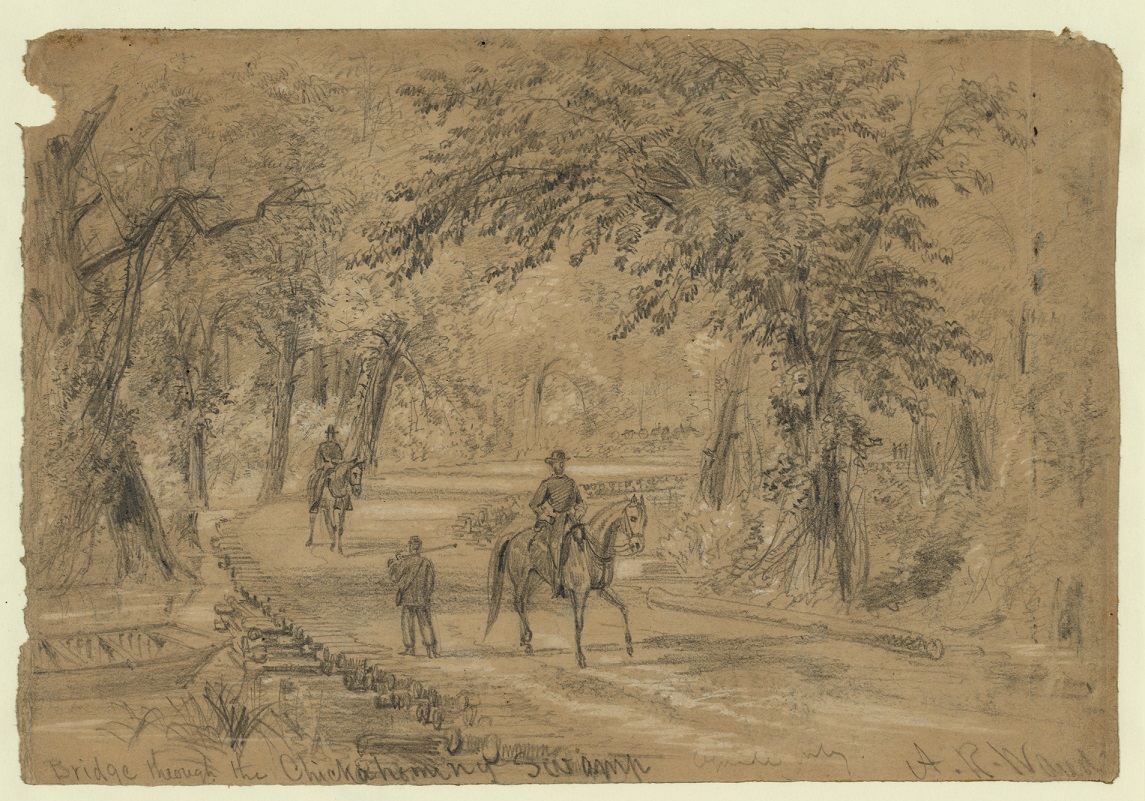
"Bridge Through the Chickahominy Swamp" by Alfred Waud depicts the landscape the Army of the Potomac would have to cross on its flanking movement (Library of Congress).

“Bridge Through the Chickahominy Swamp” by Alfred Waud depicts the landscape the Army of the Potomac would have to cross during its flanking movement (Library of Congress).

We have encountered Assistant Secretary of War Charles Dana before, most notably when he insisted on reading a telegram from William Sherman out loud in front of Meade. The telegram said that the Union would certainly win if Grant could make the Army of the Potomac do its part. Meade was not amused. The big news in his letter from June 12 is that the Army of the Potomac is about to disengage from Cold Harbor and make its great flanking movement around Lee and down to the James River.

I assume the “great women’s movement about dress” to which Meade refers has something to do with the Victorian Dress Reform movement, in which concerned people sought changes in women’s constrictive garments.

Assistant Secretary of War Charles Dana (Library of Congress).

Assistant Secretary of War Charles Dana (Library of Congress).

In my last letter I gave you an account of a wicked and malicious falsehood which I found had been extensively circulated all through the North, and the first intimation of which was a reference to it in the Inquirer of the 2d inst. Since writing, I have received the enclosed message from the Secretary of War, to which I sent the accompanying note. I do not remember whether I ever told you that we were honored with the presence of Mr. Dana, the Assistant Secretary of War, who accompanies this army, as a kind of staff officer of the Secretary, and who keeps the Secretary advised by daily telegrams of the progress and condition of affairs. It is from Mr. Dana’s telegrams that Mr. Stanton’s despatches to General Dix are made up. This I learned accidentally, yesterday, in a conversation with Grant, in which I commented on some of Mr. Stanton’s despatches. Grant agreed fully with me in my views, and then told me he had never sent a despatch to Mr. Stanton since crossing the Rapidan, the few despatches he had sent being directed to General Halleck. I was glad to hear this, because it removed from my mind a prejudice I had imbibed, on the supposition that Mr. Stanton was quoting Grant, and arising from the fact I have mentioned, that in all Mr. Stanton’s despatches from Grant’s headquarters my name was never alluded to; for which I had held Grant responsible, without cause.

I believe I have saved you some annoyance by informing an officer, who applied to me in the name of Mrs. Judge Daly, of New York, to know if you would not unite in the great woman’s movement about dress, that, practically, you had been engaged in that movement ever since your marriage, and that at present your domestic duties were, from your large family, so absorbing, you really had no time to devote to public matters, even as important as the great woman’s movement.

To-day we commence a flank march, to unite with Butler on the James. If it is successful, as I think it will be, it will bring us to the last act of the Richmond drama, which I trust will have but few scenes in it, and will end fortunately and victoriously for us.

Both George and myself are quite well, though the heat, hard service, bad water, and swampy regions are beginning to tell on the health of the army.

I send you an excellent picture of Sedgwick.

And now a report from Theodore Lyman:

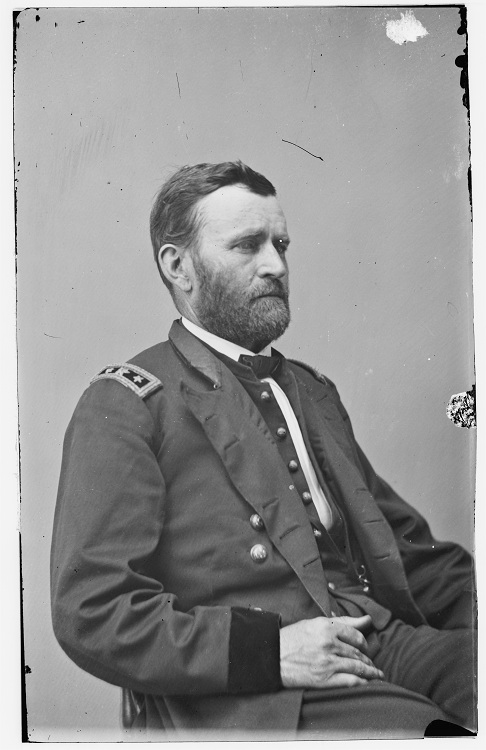
Ulysses S. Grant (Library of Congress).

Ulysses S. Grant (Library of Congress).

General Grant has appeared with his moustache and beard trimmed close, giving him a very mild air—and indeed he is a mild man really. He is an odd combination; there is one good thing, at any rate—he is the concentration of all that is American. He talks bad grammar, but he talks it naturally, as much as to say, “I was so brought up and, if I try fine phrases, I shall only appear silly.” Then his writing, though very terse and well expressed, is full of horrible spelling. In fact, he has such an easy and straightforward way that you almost think that he must be right and you wrong, in these little matters of elegance. … At 3 p.m. tents were struck and we all rode to Despatch Station, where we turned up to the left and went as far as Moody’s house. . . . We halted in a field hard by and waited for the train, an operation that required much patience: for the waggons undertook to go over a sort of mill-dam, and tumbled down a bank and had many mishaps, so that they arrived only at ten. General Grant, however, had made a big fire, got a piece of board, lain down on it, with a bag under his head, and was fast asleep. At eleven, before getting to bed, we had news that Wilson’s cavalry had forced the passage of the Chickahominy at Long’s Bridge (the bridge was long since burnt) and that the pontoon was going down for the passage of the 5th Corps. Fain would I write more, but I am so stupid and sleepy that I am not equal to it.

Meade’s correspondence taken from The Life and Letters of George Gordon Meade, Major-General United States Army, Vol. 2, (New York: Charles Scribner’s Sons, 1913), pp. 203-4. Available via Google Books.

Theodore Lyman’s letter is from Meade’s Headquarters, 1863-1865: Letters of Colonel Theodore Lyman from the Wilderness to Appomattox, p. 156. Edited by George R. Agassiz. Boston, Massachusetts Historical Society, 1922. Available via Google Books.

Photo Sessions (June 1864)

Writing in his journal on June 11, Theodore Lyman noted, “In the leisure of these last few days we have had the apparition of Brady, who photographed the General & whole staff.” Photographer Mathew Brady and his men were very busy around June 11 and 12, 1864. Before the Army of the Potomac embarked on its ambitious flanking movement down to the James River, Brady set out to photograph various Union generals, from Ulysses S. Grant on down. He managed to get Grant, Meade, Hancock (II Corps), Wright (VI Corps), Burnside (IX Corps), and “Baldy” Smith (XVIII Corps) but had to wait to arrange a session with Gouverneur Warren (V Corps). Below are the photographs the Brady team took that day. The illustrated papers of the day used photographs as the basis for their engravings, and I’ve posted some examples of those here as well. (All images from the Library of Congress. Click to enlarge any image).

Grant

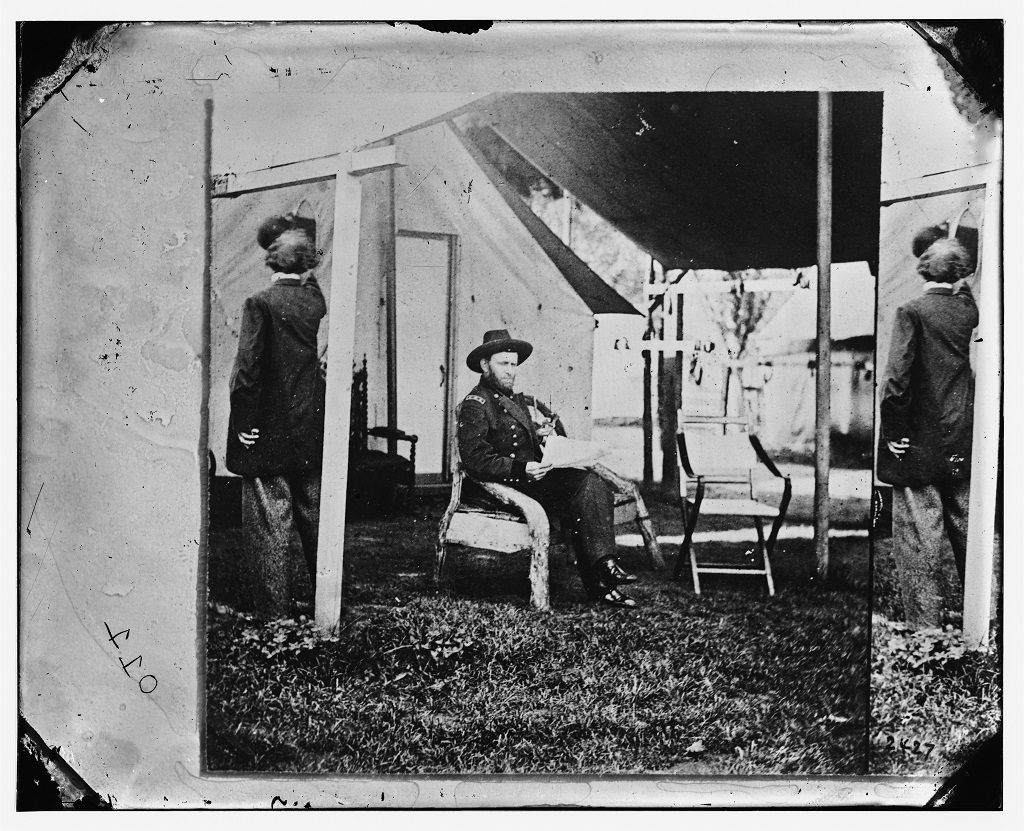
An iconic image of Ulysses S. Grant in front of his headquarters tent at Cold Harbor.


Grant along, with photographer Brady appearing at the edges. This appears to be half of a stereo image.

Grant along, with photographer Brady appearing at the edges.


Grant and his staff.

Grant and his staff.


Assistant Secretary of War Charles Dana.

Assistant Secretary of War Charles Dana.


George Meade at Cold Harbor.

George Meade at Cold Harbor.


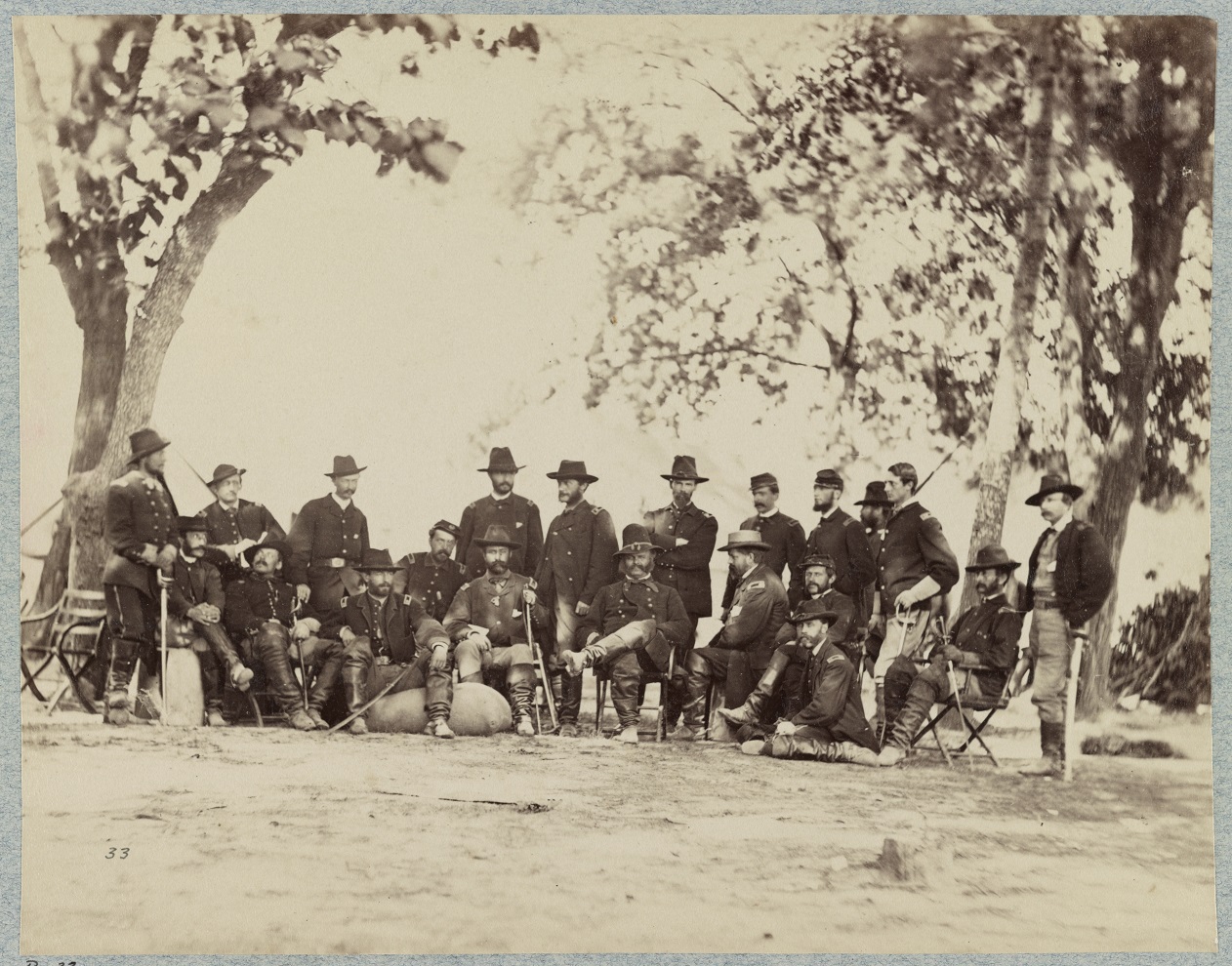
General Meade and his staff. Provost Marshall Marsena Patrick (the man with the white beard seated next to Andrew Humphreys) had grumbled in a letter, "I doubt it will [prove] a good picture," but Meade was delighted, thinking it "the best picture I ever saw; each face being so distinct."

General Meade and his staff. Provost Marshall Marsena Patrick (the man with the white beard seated next to Andrew Humphreys) had grumbled in a letter, “I doubt it will [prove] a good picture,” but Meade was delighted, thinking it “the best picture I ever saw; each face being so distinct.” Quartermaster Rufus Ingalls stands to the right of Meade. Theodore Lyman is in the rear behind Ingalls, looking to the side with his hat at a jaunty angle.

The image of Meade and his staff as translated into a Harper's engraving.

The image of Meade and his staff as translated into a Harper’s engraving.


Winfield Scott Hancock and staff.

Winfield Scott Hancock of the II Corps with his staff and division commanders.


The above image as it appeared in Harper's.

The above image as it appeared in Harper’s.


VIC Corps commander Horatio Wright and staff.

VI Corps commander Horatio Wright and staff.


IX Corps commander Ambrose Burnside and staff.

IX Corps commander Ambrose Burnside and staff.


The above image in Harper's.

The above image in Harper’s.


Ambrose Burnside (reading paper) and staff members at Cold Harbor, 1864. That's photographer Mathew Brady in the straw hat.

Ambrose Burnside (reading paper) and staff members at Cold Harbor, 1864. That’s photographer Mathew Brady in the straw hat.


William F. "Baldy" Smith of the XVIII Corps and his staff.

William F. “Baldy” Smith of the XVIII Corps and his staff.

The Crapsey Incident (June 9, 1864)

This Thomas Nast illustration from Harper's Weekly salutes the correspondents in the field (Library of Congress).

This Thomas Nast illustration from Harper’s Weekly salutes the correspondents in the field (Library of Congress).

On June 2, 1864, the Philadelphia Inquirer ran a short article that would have some big repercussions for George Gordon Meade’s reputation. This is what it said:

MEADE’S POSITION

He is as much the commander of the Army of the Potomac as he ever was. Grant plans and exercises a supervisory control over the army, but to Meade belongs everything of detail. He is entitled to great credit for the magnificent movements of the army since we left Brandy, for they have been dictated by him. In battle he puts troops in action and controls their movements; in a word, he commands the army. General Grant is here only because he deems the present campaign the vital one of the war, and wishes to decide on the spot all questions that would be referred to him as General-in-Chief.

History will record, but newspapers cannot, that on one eventful night during the present campaign Grant’s presence saved the army, and the nation too; not that General Meade was on the point to commit a blunder unwittingly, but his devotion to his country made him loth to risk her last army on what he deemed a chance. Grant assumed the responsibility and we are still

ON TO RICHMOND

Overall, not a bad notice for Meade. But he bristled at the implication that he had intended to retreat following the battle in the Wilderness.

The article was the work of one Edward Crapsey (often spelled Cropsey). As a correspondent for Cincinnati papers, he had reported on Grant’s successful Vicksburg Campaign and the fighting for Knoxville, Tennessee. By the time the Overland Campaign lurched into motion, he was reporting for the Inquirer. He had even been captured briefly by rebel cavalry near Rappahannock Station with two other reporters. The three newspapermen managed to escape when their captors got into a skirmish with some Union cavalrymen.

The accusation that Meade wanted to retreat stung, especially with the stories circulating in Washington that Meade had intended to retreat from Gettysburg, the sense that Grant had to be present to keep the Army of the Potomac fighting, and the feeling that the newspapers—as well as Grant and the politicians in Washington—were unwilling to give Meade his due. Meade also worried that the article could cause his soldiers to lose confidence in their commander. This story in a paper from his hometown proved to be the last straw. He decided to make an example of Crapsey. He ordered the reporter to be placed backward on a mule while wearing a sign around his neck that read, “Libeler of the press.” Thus humiliated, Crapsey was drummed out of camp to the tune of the “Rogue’s March.”

This was not a wise media strategy.

Congressman Eli Washburne of Illinois, a great supporter of Ulysses S. Grant (Library of Congress).

Congressman Eli Washburne of Illinois, a great supporter of Ulysses S. Grant (Library of Congress).

Grant and Charles Dana both tried to reassure Meade that the authorities in Washington would not believe the accusation. Dana even telegraphed Secretary of War Edwin Stanton about it. Stanton wired back, “Please say to General Meade that the lying report alluded to in your telegram was not even for a moment believed by the President or myself. We have the most perfect confidence in him. He could not wish a more exalted estimation of his ability, his firmness, and every quality of a commanding general than is entertained for him.” By then, though, it was too late.Meade probably felt he should take the soothing words of politicians with a grain of salt—especially when he heard rumors that the real source for Crapsey’s story had been Congressman Eli Washburne, Grant’s political mentor, who had been traveling with the army. If Meade got evidence to prove that charge, he told Margaret, he planned to show the congressman “no quarter.” (The references to Washburne’s involvement were edited out of Meade’s letters when they were published.)

The newspaper reporters with the army reacted to Crapsey’s punishment with outrage. “Major Gen. Meade may have the physical courage which bulls & bull dogs have; but he is as leprous with moral cowardice as the brute that kicks a helpless cripple in the street, or beats his wife at home,” wrote Whitelaw Reid, the reporter who had written about Meade at Taneytown and Gettysburg.

Sylvanus Cadwallader, then with the Chicago Times, was something of a favorite with Grant—or at least Grant was canny enough to make Cadwallader feel as if he were a favorite. “Every newspaper reporter in the Army of the Potomac, and in Washington City, had first an implied, and afterward an expressed understanding, to ignore Gen. Meade in every possible way and manner,” Cadwallader reported. “The publishers shared their feelings to a considerable extent, and it was soon noticed that Gen. Meade’s name never appeared in any army correspondence if it could be omitted.” He became as forgotten, Cadwallader said, “as any dead hero of antiquity.”

However, the press had been overlooking Meade even before the incident with Crapsey. On June 5, three days before Crapsey’s humiliation, Charles Wainwright noted, “The newspaper correspondents speak of Grant doing this and that, hardly ever mentioning Meade’s name. Here we see nothing of General Grant; I hardly heard his name mentioned.”

I fully enter into all your feelings of annoyance at the manner in which I have been treated, but I do not see that I can do anything but bear patiently till it pleases God to let the truth be known and matters set right. I have noticed what you say about the Inquirer, but, as you observe, it is no worse than the other papers. Even Coppée, in the June number of his magazine, shows he, too, is demoralized, he having a flaming editorial notice of the wonderful genius of Grant.* Now, to tell the truth, the latter has greatly disappointed me, and since this campaign I really begin to think I am something of a general.

I don’t know whether you saw an article in the Inquirer of the 2d inst. on me, which the writer intended to be very complimentary. At the close of it he refers to an eventful occasion when Grant saved the life of the nation, when I desired to destroy it. I could not make out what in the world this meant; but fortunately I found the author, one Edward Cropsey, and having sent for him, he explained that he had heard that on the night of the second day’s battle of the Wilderness I had urged on General Grant the withdrawal of the army across the Rapidan, but Grant had firmly resisted all my intercessions, and thus the country was saved the disgrace of a retreat. I asked his authority; he said it was the talk of the camp. I told him it was a base and wicked lie, and that I would make an example of him, which should not only serve to deter others from committing like offenses, but would give publicity to his lie and the truth. I accordingly issued an order denouncing the falsehood, and ordering the offender to be paraded through the lines of the army with a placard bearing the inscription, “Libeler of the Press,” and then that he should be put beyond the lines and not allowed to return. This sentence was duly executed, much to the delight of the whole army, for the race of newspaper correspondents is universally despised by the soldiers.

General Grant happened to be present when I was making out the order, and fully approved of it, although he said he knew the offender, and that his family was a respectable one in Illinois. After the man had been turned out and the affair had become public, then I learned to my surprise that this malicious falsehood had been circulated all over the country.

We find Lee’s position again too strong for us, and will have to make another movement, the particulars of which I cannot disclose.

Meade’s correspondence taken from The Life and Letters of George Gordon Meade, Major-General United States Army, Vol. 2, (New York: Charles Scribner’s Sons, 1913), pp. 202-3. The newspaper article is on p. 341. Available via Google Books.

*Henry Coppée edited the United States Service Magazine. Meade has mentioned him before. Here’s what Coppée had to say about Grant in his June issue. You can get an idea why Meade found this irritating:

Grant is a brave man; not only fearless in all necessary exposure of his person in battle, but cool, calculating, and clearly administrative in danger. A splendid horseman, and of great physical endurance, perhaps he is seen to best advantage on the field of battle directing the movements.

He is a true man; true in his aims, and in his adherence to them; true in speech and in act. He has no tortuous policy, no subterranean movements. He does not parade his thoughts, indeed, but he does not mean one thing and say another. He has no talking gift, and he cultivates silence, which, if speech be human, the philosopher has declared to be divine. He is no boaster, no temporizer, no dreamer; he builds no Arcadian castles. He is simply a straightforward actor; between his thoughts, words, and deeds there is an exact accordance; and very often the thought and deed dispense with words,—always, when possible.

He is a man of strong will and great mental endurance; not disheartened by disaster; always ready to repair and retrieve it. Vicksburg in especial demonstrated this. Repulsed at the north, he tried the cut-off. When that would not do, he landed on the south. Threatened by the rebel armies gathering in his rear, he besieged the town. Repulsed in his attempts to storm the works, he pushed forward the siege; and at length Vicksburg fell, because Grant adhered to his purpose.

He is a generous man; ready to give full credit to his coworkers and subordinates. He scorns to receive praise which is their due, and tells of the invaluable aid and co-operation of Sherman, McPherson, and others, with no stinted eulogium. With such a general, men can work; for such a chief they will do all in their power.

He is an unambitious man. This needs a word of explanation. Ambitious men seek, as the great end of their labors, self-exaltation. Grant has thus far worked for the good of the country. Each battle has been fought without ulterior view. If God sends honest fame as the reward, he does not disdain it; but it must be a sequel, not an aim. Heaven preserve him long from this “last infirmity of noble minds”! It ruins all it touches. It has already paralyzed some of our best men.

In a concluding word, he is a strong, iron, living, busy, honest, capable, self-sustained commander, who will plan wisely, fight terribly, follow up his victories, and leave the rest to Providence,—in whom, after all, must be our trust. He has large and varied talents. He has, what Guizot calls, “the genius of common sense,” and with that the power and determination to “go ahead;” which we have lacked more than any thing else in this war. As to his personal appearance, we can only refer our readers to the fine engraving which appears as a vignette to this number, with the remark that it is as much like him as an engraving can be.

Aftermath (June 4, 1864)

The assault at Cold Harbor on June 3 had been a disaster. In Grant’s initial message to Halleck, sent at 2:15 in the afternoon on June 3—when he must have known better—he wrote that the army’s loss was “not severe.” Later, he would come to regret having ordered the attack at Cold Harbor. According to Horace Porter, Grant’s officers soon learned not to bring up the battle in conversation.

Our men have, in many instances, been foolishly and wantonly sacrificed,” Emory Upton wrote bitterly to his sister. “Thousands of lives might have been spared by the exercise of a little skill; but, as it is, the courage of the poor men is expected to obviate all difficulties.”

There’s no doubt that the Union attack at Cold Harbor was a miserable failure. So was the Confederate attack on the third day at Gettysburg. James McPherson, the Pulitzer Prize–winning Civil War historian, expressed bewilderment at how differently people remember the two failed attacks. At Cold Harbor, “Fifty thousand Union soldiers suffered seven thousand casualties, most of them in less than half an hour,” wrote McPherson in Hallowed Ground: A Walk at Gettysburg, “For this mistake, which he admitted, Grant has been branded a ‘butcher’ careless of lives of his men, and Cold Harbor has become a symbol of mule-headed futility.” McPherson points out that Lee’s army also suffered around seven thousand casualties on July 3. “Yet this attack is perceived as an example of great courage and honor. This contrast speaks volumes about the comparative image of Grant and Lee, North and South, Union and Confederacy.”

I doubt Meade perceived much glory in either attack. In fact, by this point he believed Grant’s relentless hammering at Lee had not worked and was becoming increasingly irritated by the way the general in chief eclipsed Meade’s role in the campaign. Some of that frustration appears in his letter of June 4.

I have only time to write you that we had a big battle yesterday, on the field of the old Gaines’s Mill battle-ground, with the positions of the contending forces reversed. The battle ended without any decided results, we repulsing all attacks of the enemy and they doing the same; losses estimated about equal on both sides; ours roughly estimated at seven thousand five hundred in all.

I had immediate and entire command on the field all day, the Lieutenant General honoring the field with his presence only about one hour in the middle of the day. The papers will, however, undoubtedly inform you of all his doings, and I will therefore confine myself to mine.

George, myself, and all your friends, are well and unhurt. The enemy, as usual, were strongly fortified, and we have pretty well entrenched ourselves. How long this game is to be played it is impossible to tell; but in the long run, we ought to succeed, because it is in our power more promptly to fill the gaps in men and material which this constant fighting produces.

Baldy Smith’s corps has joined, and he is placed under my orders.

As usual, Lyman has a great deal more to add, whether commenting on the relationships among the generals or discussing the way various pieces of ordnance return to earth.

William F. "Baldy" Smith and his staff at Cold Harbor (Library of Congress).

William F. “Baldy” Smith and his staff at Cold Harbor (Library of Congress).

Although there was no battle to-day, both sides were as sensitive as Hotspur when he was “all smarting from my wounds being cold.” The slightest movement would provoke a volley, and any unusual stir would open a battery. This is characteristic of troops in a new position. When they have remained awhile, they begin to be more quiet, the skirmishers fire less and less, and finally cease entirely. The General took three or four of us and went on a sort of tour to his Generals; after a brief visit to General Hancock (who had a battery roaring away close to his Headquarters) and a few words with General Wright, we paid a long visit to “Baldy” Smith, whose tents were pitched between the Woody house and the line of battle. His tent was much better than General Meade’s and he displayed, for his benefit, a lunch with champagne, etc., that quite astonished us. Whether it was the lunch, or Baldy, or “Bully” Brooks (a General of that name), I do not know, but the Commander staid there several hours, talking and smoking.

Let me see, I left the party sitting, as it appeared to me, an unnecessarily long time at Baldy Smith’s. I say “unnecessarily,” first, because it was several hours, and General Meade had nothing to discuss of any moment; and, secondly, because a round-shot would, every now and then, crash through the neighboring trees, or go hoppity-hop along the open field on the edge of which the tents were. You ought to see them skip! It would be odd, if it were not so dangerous. When they have gone some distance and are going slower, you can see them very plainly, provided you are in front of, or behind them. They pass with a great whish, hit the ground, make a great hop, and so go skip, skip, skip, till they get exhausted, and then tumble —flouf— raising a puff of sand. That is the reason round-shot are more dangerous than conical, which strike perhaps once, vault into the air with a noise like a Catherine’s wheel, topple over and over, and drop without further trouble. … At last the General’s confab was broken up by the arrival of Burnside,* who, in Fredericksburg days, had a furious quarrel with Baldy and Brooks—or they with him. So they don’t speak now; and we enjoyed the military icicle in great perfection! All the day there was sharpshooting and cannonading along our front.

*”Burnside has a short, military jacket, and, with his bell-crowned felt hat, the brim turned down, presents an odd figure, the fat man!” —Lyman’s Journal.

Meade’s correspondence taken from The Life and Letters of George Gordon Meade, Major-General United States Army, Vol. 2, (New York: Charles Scribner’s Sons, 1913), pp. 200-1. Available via Google Books.

Theodore Lyman’s letter is from Meade’s Headquarters, 1863-1865: Letters of Colonel Theodore Lyman from the Wilderness to Appomattox, pp.148-9. Edited by George R. Agassiz. Boston, Massachusetts Historical Society, 1922. Available via Google Books.

Pegging Away (June 1, 1864)

Artist William Waud sketched the arrival of "Baldy" Smith and the XVIII Corps at White House landing on the Pamunkey on May 18. On the front Waud wrote, "Ruins of the White House; the scene of Washington's courtship & marriage; the tent by Pilchard." This White House belonged to Rooney Lee, son of Robert E. George Washington had indeed courted Martha here. On the back Waud wrote, "This is only a small portion of the force shown here as there were many large vessels employed such as the John Brooks, the George Leary, the Escort, the Metamone[sic]-all similar to the Hudson river & sound boats but which I have not the opportunity of sketching if Mr Parsons has drawings of these vessels if the view is thought interesting enough they might be introduced covered with troops hanging on like bees. For description see the letters of Mr. Winser in the Times. W.W." Harpers published an engraving on June 18. Click to enlarge (Library of Congress).

Artist William Waud sketched the arrival of “Baldy” Smith and the XVIII Corps at White House landing on the Pamunkey on May 18. On the front Waud wrote, “Ruins of the White House; the scene of Washington’s courtship & marriage; the tent by Pilchard.” This White House belonged to Rooney Lee, son of Robert E. George Washington had indeed courted Martha here. On the back Waud wrote, “This is only a small portion of the force shown here as there were many large vessels employed such as the John Brooks, the George Leary, the Escort, the Metamone[sic]-all similar to the Hudson river & sound boats but which I have not the opportunity of sketching if Mr Parsons has drawings of these vessels if the view is thought interesting enough they might be introduced covered with troops hanging on like bees. For description see the letters of Mr. Winser in the Times. W.W.” Harpers published an engraving on June 18. Click to enlarge (Library of Congress).

On June 1 Meade, in a throw-away line at the end of his letter, mentions two things that will irritate him more and more throughout the campaign: the press and the way that Grant was receiving credit for the Army of the Potomac’s successes. His resentments against the press will explode in a few days, with serious repercussions for his reputation. His resentment against Grant will continue to fester, although Meade, a good soldier, discharges his duties to the best of his ability.

We are pegging away here, and gradually getting nearer and nearer to Richmond, although its capture is yet far off. Our advance is within two miles of Mechanicsville, which, if you remember, is the place where the fighting commenced in the Seven Days. The rebs keep taking up strong positions and entrenching themselves. This compels us to move around their flank, after trying to find some weak point to attack. This operation has now occurred four times, namely, crossing the Rapidan, at Old Wilderness, at Spottsylvania Court House, and recently at North Anna. We shall have to do it once more before we get them into their defenses at Richmond, and then will begin the tedious process of a quasi-siege, like that at Sebastopol; which will last as long, unless we can get hold of their railroads and cut off their supplies, when they must come out and fight.

Whilst I am writing the cannon and musketry are rattling all along our lines, over five miles in extent, but we have become so accustomed to these sounds that we hardly notice them.

The weather is beginning to be hot, but I keep in the saddle during the day, and sleep soundly at night.

The papers are giving Grant all the credit of what they call successes; I hope they will remember this if anything goes wrong.

William F. "Baldy" Smith was a Meade friend who eventually turned enemy. (Library of Congress)

William F. “Baldy” Smith was a Meade friend who eventually turned enemy. (Library of Congress)

Theodore Lyman’s letter from July 1 goes into more detail about the arrival of William F. “Baldy” Smith and the XVIII Corps, sent from Ben Butler’s Army of the James to reinforce the Army of the Potomac. Meade and Smith went back a ways. When Meade received command of the V Corps back in December 1862 after the Battle of Fredericksburg, Smith was one of the generals who shared his celebratory champagne. Smith, who possessed “unusual powers of caustic criticism” and quarreled incessantly with his superior officers, led the VI Corps at Fredericksburg but became so disillusioned by army commander Ambrose Burnside he went to the White House with William Franklin to express his misgivings to President Lincoln. Burnside was dismissed from command but Smith was sent out west. He had redeemed himself, in Grant’s eyes, at least, by performing capably in the campaign to break the siege of Chattanooga. He then accompanied Grant back east, amid rumors that Smith would replace Meade at the head of the Army of the Potomac. However, Grant assigned him to the Army of the James under Maj. Gen. Benjamin Butler, the most political of political generals. The cockeyed Butler and his army were supposed to form one of the prongs in Grant’s multipronged campaign against the Confederacy. Instead, Butler had gotten his army bottled up at Bermuda Hundred with his back against the James River, where they remained, impotent and useless.

At 1.30 last night, General Wright with the 6th Corps passed round our left flank and marched on Cool Arbor, which already was occupied by our cavalry last night. They would have fallen back, in view of the advance of the enemy’s infantry, but General Meade sent an order to hold it, which they did; and had a very heavy fight early this morning, remarkable from the fact that our cavalry threw up breastworks and fought behind them, repulsing the enemy till Wright could arrive. Baldy Smith too was marching from Whitehouse and came up during the day, forming on the right of the 6th Corps. Meantime, of course, the enemy was marching to his own right, in all haste, and formed so as to cover the roads leading to Mechanicsville and also to continue his line on his right. . . . There was a desperate charge on Smith and Wright at Cool Arbor and the sound of musketry was extremely heavy long after dark, but the Rebels could not do it and had to go back again. Nor did the right of the line escape where they attacked Birney, and were driven back just the same way. . . . Smith had orders to report to General Meade and so became part of the Army of the Potomac. General Meade was in one of his irascible fits to-night, which are always founded in good reason though they spread themselves over a good deal of ground that is not always in the limits of the question. First he blamed Warren for pushing out without orders; then he said each corps ought to act for itself and not always be leaning on him. Then he called Wright slow (a very true proposition as a general one). In the midst of these night-thoughts, comes here from General Smith bright, active, self-sufficient Engineer-Lieutenant Farquhar, who reports that his superior had arrived, fought, etc., etc., but that he had brought little ammunition, no transportation and that “he considered his position precarious.” “Then, why in Hell did he come at all for?” roared the exasperated Meade, with an oath that was rare with him.

Lyman added a footnote to his journal entry. Farquhar reported Meade’s outburst to Smith, Lyman noted. “Smith never forgave him and put that sentence, in large letters, in his report, which appeared many months after and amused Meade, for Smith had dished himself then and was nobody.”

Meade’s correspondence taken from The Life and Letters of George Gordon Meade, Major-General United States Army, Vol. 2, (New York: Charles Scribner’s Sons, 1913), p. 200. Available via Google Books.

Theodore Lyman’s letter is from Meade’s Headquarters, 1863-1865: Letters of Colonel Theodore Lyman from the Wilderness to Appomattox, pp.137-8. Edited by George R. Agassiz. Boston, Massachusetts Historical Society, 1922. Available via Google Books.

18 Miles from Richmond (May 29, 1864)

Just a short note from George Meade today. It is cautiously optimistic. General Grant was feeling even more confident. On May 26 he had written to Henry Halleck, ““Lee’s army is really whipped. The prisoners we now take show it, and the action of his army shows it unmistakably. A battle with them outside of intrenchments cannot be had. Our men feel that they have gained the morale over the enemy and attack with confidence. I may be mistaken, but I feel that our success over Lee’s army is already insured.”

We have crossed the Pamunkey, and are now within eighteen miles of Richmond. Lee has fallen back from the North Anna, and is somewhere between us and Richmond. We shall move forward to-day to feel for him. We are getting on very well, and I am in hopes will continue to manoeuvre till we compel Lee to retire into the defense of Richmond, when the grand decisive fight will come off, which I trust will bring the war to a close, and that it will be victory for us.

Meade’s correspondence taken from The Life and Letters of George Gordon Meade, Major-General United States Army, Vol. 2, (New York: Charles Scribner’s Sons, 1913), p. 199. Available via Google Books.

A Tender-hearted Man (May 27, 1864)

Theodore Lyman shows us two sides of General Meade. One is the hot-tempered snapping turtle, the other a man who would give a southern family his lunch and five dollars.

David A. Russell of the VI Corps, photographed when he was the colonel of the 7th Massachusetts (Library of Congress).

David A. Russell of the VI Corps, photographed when he was the colonel of the 7th Massachusetts (Library of Congress).

Last night Russell’s trusty division of the 6th Corps set out on a very long march, as our advanced guard in a flank movement to the Chickahominy. . . . This necessitated our early “getting out of that,” for we were on the bank of the river, and the Rebel skirmishers would be sure to follow right down with the first daylight to the opposite side. Indeed, a little while after we were gone they did come down and fired into the telegraph waggon, wounding the side of the same. By four we had taken our breakfast and were in the saddle. Wonderful how promptly all the servants pack the things and strike the tents when they expect to be shot at! We rode first to Burnside, into whom the General pitched for cutting the march of General Warren and not sending up the brigades to hold the fords; and B. rather proved that he was right and Warren wrong. I can tell you aquafortis is mild to the Major-General commanding when he gets put out; which is quite not at all unfrequently; but I have seen him in no such fits as in the falling back from Culpeper to Centreville. Here he can lean upon Grant more or less, though he does all the work; so much so that Grant’s Staff really do nothing, with the exception of two or three engineer officers. Then we passed by the gushing Hancock, who explained what he was going to do, in his usual flowing style. At Chesterfield Station we found two divisions of the 6th Corps massed, and just then beginning to march out. They were issuing rations, to each man his bit of beef and his “hard tack.” We got ahead of the infantry and kept on the way, sending some cavalry ahead in case of wandering Rebels. The road was strown with dead horses, worn out and shot by the cavalry, when they came this way from their raid. Really whenever I may see civilized parts again, it will seem strange to see no deceased chargers by the roadside. We made a halt to let the column get up, at a poor house by the way. There were a lot of little children who were crying, and the mother too, for that matter — a thin ill-dressed common-looking woman. They said they had been stripped of nearly everything by the cavalry and expected to starve. So the soft-hearted General, who thought of his own small children, gave them his lunch, and five dollars also; for he is a tender-hearted man. We kept on, through a very poor and sandy country, scantily watered; for this was the ridge and there was no water except springs. At 9.30 we dismounted again at an exceptionally good farm, where dwelt one Jeter, . . . who was of a mild and weak-minded turn. He said he was pleased to see such well-dressed gentlemen, and so well-mannered; for that some others, who had been there two days since, had been quite rude and were very dusty; whereby he referred to the cavalry, who, I fear, had helped themselves. . . . About one o’clock, having ridden some twenty-two miles in all, we stopped at the house of one Thompson and, that afternoon, camped near by, just close to Mangohick Church. . . . I discovered to-day that the Lieutenant-General has sick-headaches periodically — one now, for example, for which he put some chloroform on his head.

Theodore Lyman’s letter is from Meade’s Headquarters, 1863-1865: Letters of Colonel Theodore Lyman from the Wilderness to Appomattox, pp.128-30. Edited by George R. Agassiz. Boston, Massachusetts Historical Society, 1922. Available via Google Books.