Turning Operation (May 23, 1864)

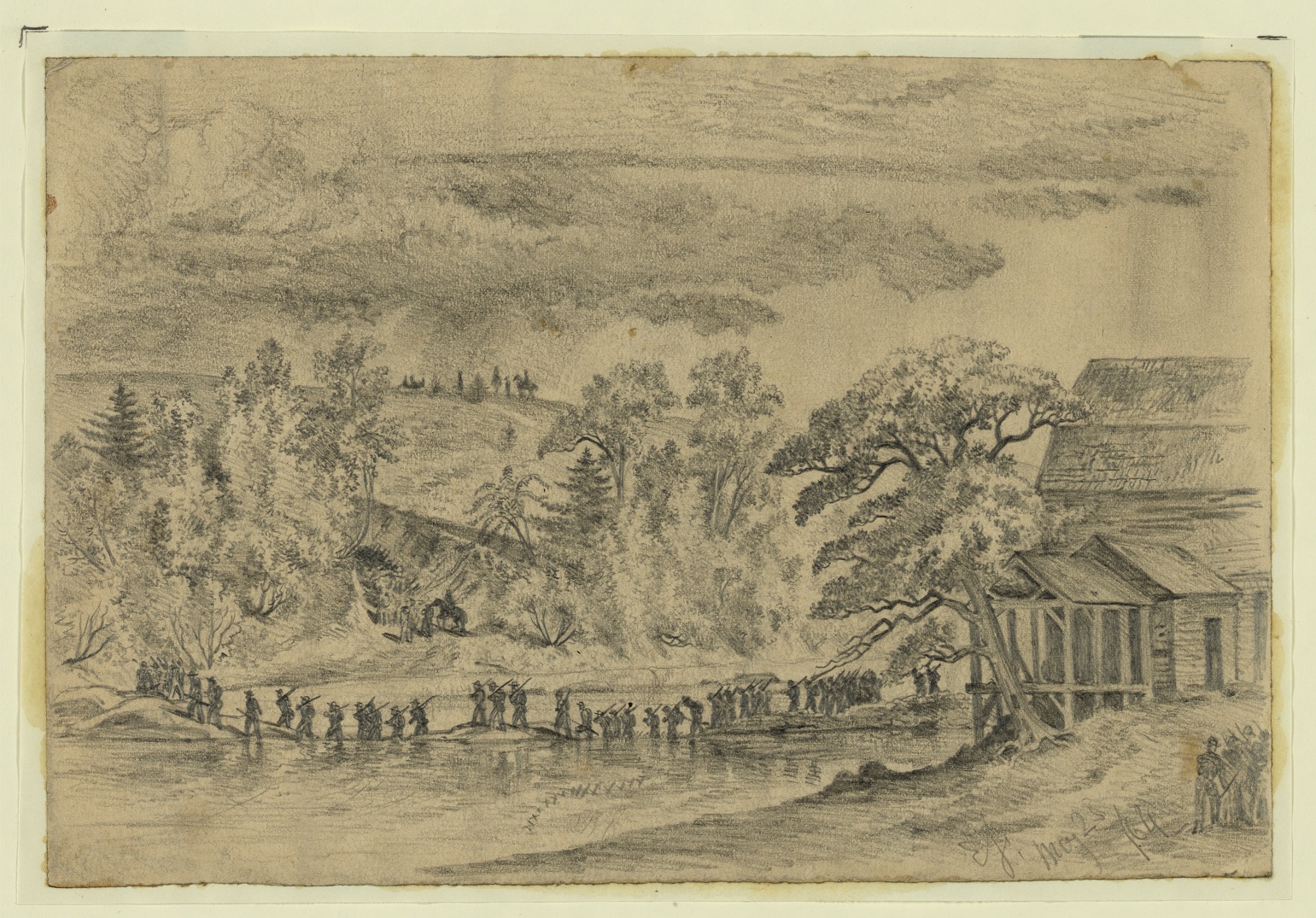
Edwin Forbes titled this sketch from May 23 "The Army of the Potomac (5th Corps) crossing the North Anna, at Jerico Ford." Click to enlarge  (Library of Congress).

Edwin Forbes titled this sketch from May 23 “The Army of the Potomac (5th Corps) crossing the North Anna, at Jerico [sic] Ford.” Click to enlarge (Library of Congress).

Lee entrenches south of the North Anna River and the Army of the Potomac prepares to attack. Meade’s prediction in his letter of May 23 is correct in general, but the turning operations will continue until Lee is in Petersburg, south of Richmond.

Apparently Mrs. Meade does not think too highly of General Grant.

We expected yesterday to have another battle, but the enemy refuses to fight unless attacked in strong entrenchments; hence, when we moved on his flank, instead of coming out of his works and attacking us, he has fallen back from Spottsylvania Court House, and taken up a new position behind the North Anna River; in other words, performed the same operation which I did last fall, when I fell back from Culpeper, and for which I was ridiculed; that is to say, refusing to fight on my adversary’s terms. I suppose now we will have to repeat this turning operation, and continue to do so, till Lee gets into Richmond.

I am sorry you will not change your opinion of Grant. I think you expect too much of him. I don’t think he is a very magnanimous man, but I believe he is above any littleness, and whatever injustice is done me, and it is idle to deny that my position is a very unjust one, I believe is not intentional on his part, but arises from the force of circumstances, and from that weakness inherent in human nature which compels a man to look to his own interests.

Theodore Lyman picks up his account of the Overland Campaign where he left off. Here he resumes his account of May 12 and the terrible fighting at the Mule Shoe salient of Lee’s line at Spotsylvania. Meade has sent him to find Horatio Wright, the commander of the VI Corps.

Horatio Wright took command of the VI Corps following the death of John Sedgwick (Library of Congress).

Horatio Wright took command of the VI Corps following the death of John Sedgwick (Library of Congress).

… I asked on all sides for General Wright. One said he had gone this way; another that he had gone that; so finally I just stood still, getting on the edge of the woods, on a ridge, where I dismounted and wrote a short despatch to General Meade, midst a heavy rain that now began to come down. Just before me was a very large field with several undulations, close to me was a battery firing, and in the wood beyond the field was the fighting. I stood there a short time, while the second line was deployed and advanced in support of the first. The Rebels were firing a great many explosive bullets, which I never saw before. When they strike they explode, like a fire-cracker, and make a bad wound; but I do not suppose, after all, that they are worse than the others. Presently there came along Captain Arthur McClellan (brother of the General and a very nice fellow). He said he would show me where General Wright was, which proved to be not far off, in a little hollow place. There was the stout-hearted General, seated with his aides, on the ground. He had just been hit on the leg by a great piece of shell, but was smiling away, despite his bruises. A sterling soldier he is! I soon found that the hollow did not exclude missiles, which fly in curves, confound them! There came a great selection of bullets about our ears, in the first of it. By-and-by a Rebel battery began to suspect that, from the number of horses, there must be a general about that place, and so, whing! smash, bang! came a shell, striking in the woods just beyond. “My friend,” said calm Colonel Tompkins, addressing the invisible gunner, “if you want to hit us you must cut your fuses shorter” — which indeed he did do, and sent all sorts of explosives everywhere except in our little group, which was only reached by a fragment or two. None of us got hurt, but one horse was wounded and another killed. There I staid for five hours (very long ones), and pelted all the time, but most of the balls flew too high, and, as is well known, shells make a horrid noise, but hurt comparatively few.

All this time the enemy was rolling up his fresh troops and frantically endeavoring to regain that salient. He made as many as five desperate charges with the bayonet, but in vain. At one place called the “Corner” the lines stood within fifty feet of each other, for hours!* The breastwork made a ridge between, and any living thing that showed above that line fell dead. The next day the bodies of friend and foe covered the ground. Some wounded men were then taken out from under three or four dead ones. One body, that lay exposed to the fire, had eighty bullets in it. At 12.30 I rode back to General Meade, to tell him our extreme right was hard pressed; and he sent me back to say that the whole 5th Corps had been moved to the left and that Griffin’s division could go to Wright’s support. I found that Wright had been fairly shelled out of his little hollow, and had retired to the Landron house. We clung to the salient, and that night the Rebels fell back from that part of their lines, leaving twenty-two guns, eighteen colors, and 3500 prisoners in our hands. . . . That night our Headquarters were at the Armstrong house. It was a day of general battle, for Warren attacked on the right and Burnside on the left, which kept the enemy from sending reinforcements. You will notice that the army was gradually shifting to the left, having now given up the Po River and Todd’s Tavern road.

*This footnote was taken from Lyman’s journal: “The great historical fight of this day extended over a front of only 1000 to 1500 yards, along the faces of the salient, or the ‘Death-angle,’ as it was afterwards called. Within that narrow field two corps were piled up to assault and in support. Indeed we had too many troops, as the generals justly said. The lines got mixed and jammed together and were hard to handle. The amount of bullets fired may be known from the fact that a red oak, twenty-three inches in diameter, was reduced, about six feet from the ground, to a fibrous structure and blew down that night! Bodies that lay between the lines were shot to pieces and could only be raised in a blanket! The result was damaging to the enemy—very—but the army of Lee was not cut in two—an issue clearly looked for by Rawlins and some others of Grant’s Staff, but not so confidently assumed by those who knew a little more.”—Lyman’s Journal.

May 16 Mott’s division, that had hitherto behaved so badly, was broken up and put with Birney—a sad record for Hooker’s fighting men! Napoleon said that food, clothing, discipline, and arms were one quarter, and morale the other three quarters. You cannot be long midst hard fighting without having this brought home to you. This day was a marked one, for being fine, nearly the whole of it; we have been having a quantity of rain and a fine bit was quite a wonder. There did appear a singular specimen to behold, at my tent, a J. Bull —a Fusileer—a doctor. Think of an English fusileer surgeon—what a combination! He walked on the tips of his toes, with his knees bent, was dressed in full uniform, and had a smirk on his face as much as to say: “Now I know a good deal; and I am coming to see; and I am not going to be put off.” Poor Medical Director McParlin was horribly bored with him; but finally got him to the 6th Corps hospital, where I afterwards saw him, running round with some large instrument. I hope they didn’t let him do much to the wounded. We were honored at dinner by the company of Governor Sprague and Sherman of the Senate. The Governor is a brisk, sparrowy little man with perky black eyes, which were shaded by an enormous straw hat. He is very courageous, and went riding about in various exposed spots. Sherman is the tallest and flattest of mortals—I mean physically. He is so flat you wonder where his lungs and other vitals may be placed. He seems a very moderate and sensible man.

Tuesday, May 17

Our Headquarters were moved to the left, and back of the Anderson house. We rode, in the morning, over, and staid some time at the house, one of the best I have seen in Virginia. It was a quite large place, built with a nest of out-houses in the southern style. They have a queer way of building on one thing after another, the great point being to have a separate shed or out-house for every purpose, and then a lot more sheds and outhouses for the negroes. You will find a carpenter’s shop, tool-room, coach-shed, pig-house, stable, out-kitchen, two or three barns, and half-a-dozen negro huts, besides the main house, where the family lives. Of the larger houses, perhaps a quarter are of brick, the rest of wood. They are plain, rarely with any ornament; in fact, these “mansions” are only farmhouses of a better class. Anderson was reputed a rich man, but he had carpets on very few rooms; most were floored with hard pine. Round these houses are usually handsome trees, often locusts, with oaks and, perhaps, some flowering shrubs. Often there is a small corner with a glass front, to serve as a greenhouse in winter. It is hard to judge what this country once was; but I can see that each house of the better class had some sort of a flower-garden; also, there are a great number of orchards in this part of the country and plenty of peach trees. Nothing gives such an air of desolation as a neglected flower-patch! There are the perennial plants that start each spring, all in disorder and struggling with weeds; and you are brought to think how some woman once took an interest in the flowers, and saw that they were properly kept. These little things appeal more pointedly to you than great ones, because they are so easily understood. In the few days’ fighting I have seen, I have come to be entirely unmoved by the appearance of the horrible forms of wounds or death; but to-day I had quite a romantic twinge at finding in a garden a queer leaf, with scallops on it, just like one I found in Bologna and put in your scrapbook. . . .
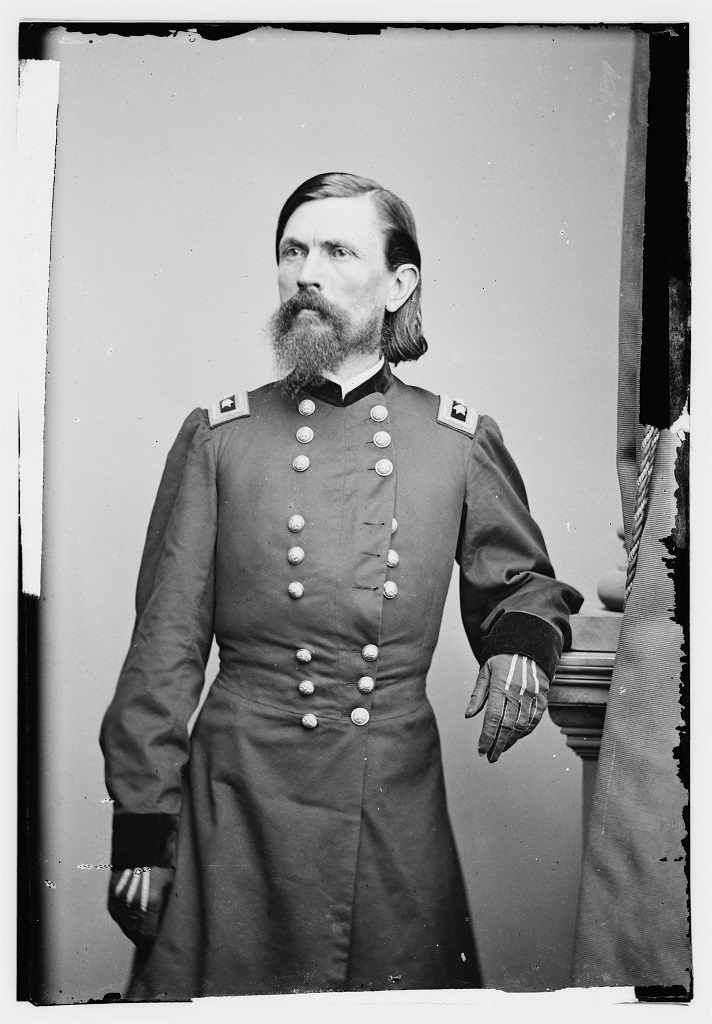
General Thomas Crittenden was not long with the Army of the Potomac, resigning in June over a question of rank (Library of Congress).

General Thomas Crittenden was not long with the Army of the Potomac, resigning in June over a question of rank (Library of Congress).

At Anderson’s I saw quite a galaxy of generals, among others the successor of General Stevenson, Major-General Crittenden. He is the queerest-looking party you ever saw, with a thin, staring face, and hair hanging to his coat collar — a very wild-appearing major-general, but quite a kindly man in conversation, despite his terrible looks. . . . The waggoners and train rabble and stragglers have committed great outrages in the rear of this army. Some of the generals, particularly Birney and Barlow, have punished pillagers in a way they will not forget; and they will be shot if they do not stop outrages on the inhabitants. The proper way to stop the grosser acts is to hang the perpetrators by the road where the troops pass, and put a placard on their breasts. I think I would do it myself, if I caught any of them. All this proceeds from one thing—the uncertainty of the death penalty through the false merciful policy of the President. It came to be a notorious thing that no one could be executed but poor friendless wretches, who had none to intercede for them; so that the blood of deserters that was shed was all in vain—there was no certainty in punishment, and certainty is the essence of all punishment. Now we reap the disadvantage in a new form. People must learn that war is a thing of life or death: if a man won’t go to the front he must be shot; but our people can’t make up their minds to it; it is repulsive to the forms of thought, even of most of the officers, who willingly expose their own lives, but will shrink from shooting down a skulker.

And now here’s a letter from Lyman from May 23, which picks up his narrative from the day before.

It was with regret that early this morning we left the fine clover field of Dame Tyler, and wended our way towards the North Anna. We crossed the Mat (or what is called South River, I am not sure which, at any rate a mere brook), and kept straight on for Garrett’s Tavern. Grant, mounted on the purloined black pony, ambled along at a great pace, but General Meade, who got his pride up at Grant’s rapidity, set off at a rate that soon raised a cloud of dust and left the Lieutenant-General far behind; whereat George G. was much pleased, and his aides much the contrary, as they had to scramble after. About ten we got to a side road, leading to the right, and here we turned off the 9th Corps, so as to keep the telegraph road open for the passage of the 5th. Then we took a bend to the left again and came out by the Moncure house, crossing the Polecat Creek by the way — a pleasant stream running over stones, and with the trees quite growing into it. There, I knew, Biddle and Mason “straggled” and took a bath. We passed also a house where dwelt four women, all alone; we left them a guard, to stay till next morning. A hazardous position for these people, with all the stragglers and camp scoundrels about! Old Ma’am Moncure was a perfect old railer, and said: “They should soon see us coming back on the double-quick.” However, they (the family) were amazing sharp and eager in selling us sheep, and took our greenbacks with avidity. A gold dollar now is worth about $30 in Confederate money! This afternoon Warren crossed the North Anna at Jericho Bridge, and was fiercely attacked on the other side by Longstreet; but he repulsed him with heavy loss, after a sharp fight. Hancock coming along more to the left, stormed the rifle-pits near Chesterfield station and seized the bridge, ready to cross. I have been lately up at three and four in the morning and I am so sleepy I must stop.

Meade’s correspondence taken from The Life and Letters of George Gordon Meade, Major-General United States Army, Vol. 2, (New York: Charles Scribner’s Sons, 1913), p. 198. Available via Google Books.

Theodore Lyman’s letters are from Meade’s Headquarters, 1863-1865: Letters of Colonel Theodore Lyman from the Wilderness to Appomattox, pp 112-117 and 121-2. Edited by George R. Agassiz. Boston, Massachusetts Historical Society, 1922. Available via Google Books.


At Church (May 22, 1864)

Timothy O'Sullivan took those photograph of New Bethel Church on May 23, 1864. Click to enlarge (Library of Congress).

Timothy O’Sullivan took those photograph of New Bethel Church on May 23, 1864. Burnside had departed earlier that morning. Click to enlarge (Library of Congress).

Theodore Lyman takes up his pen on a warm Sunday evening and writes home about the war. In his journal entry for today Lyman wrote, “Reviewing the progress of the campaign, Gen. Meade said to me at breakfast: ‘I am afraid the rebellion cannot be crushed this summer!'”

New Bethel Church today (Tom Huntington photo).

New Bethel Church today (Tom Huntington photo).

I don’t know when I have felt so peaceful — everything goes by contrast. We are camped, this lovely evening, in a great clover field, close to a large, old-fashioned house, built of bricks brought from England in ante-revolutionary times. The band is playing “Ever of Thee I’m Fondly Dreaming”—so true and appropriate—and I have just returned from a long talk with two ultra-Secessionist ladies who live in the house. Don’t be horrified! You would pity them to see them. One, an old lady, lost her only son at Antietam; the other, a comparatively young person, is plainly soon to augment the race of Rebels. Poor creature! Our cavalry raced through here yesterday and scared her almost to death. Her eyes were red with crying, and it was long before she fully appreciated the fact that General Meade would not order her to instant death. To-night she has two sentries over her property and is lost in surprise. Have I not thence obtained the following supplies: five eggs, a pitcher of milk, two loaves of corn bread, and a basket of lettuce—all of which I duly paid for. I feel well to-night on other accounts. If reports from the front speak true, we have made Lee let go his hold and fall back some miles. If true, it is a point gained and a respite from fighting. Hancock had got away down by Milford. Warren had crossed at Guinea Bridge and was marching to strike the telegraph road, on which the 6th Corps was already moving in his rear. The 9th Corps would cross at Guinea Bridge, last, and follow nearly after the 2d Corps. We started ourselves not before noon, and crossed the shaky little bridge over the Po-Ny (as I suppose it should be called), and so we kept on towards Madison’s Ordinary, crossing, a little before, the Ta, a nice, large, clear brook. An “Ordinary” in Virginia seems to be what we should call a fancy variety store, back in the country. Madison’s is a wooden building, just at cross-roads, and was all shut, barred, and deserted; and, strange to say, had not been broken open. On the grass were strewn a quantity of old orders, which people had sent by their negroes, to get—well, to get every conceivable thing. I saved one or two, as curiosities, wherein people ask for quarts of molasses, hymn-books, blue cotton, and Jaynes’s pills! The 5th Corps was passing along, as we stood there. After a while we went across the country, by a wood road, to the church you will see south of Mrs. Tyler’s. Close to Madison’s Ordinary was one of those breastworks by which this country is now intersected. A revival of the Roman castrum, with which the troops of both sides protect their exposed points every night. This particular one was made by the heavy artillery, whose greenness I have already spoken of. When they put it up the enemy threw some shells. Whereupon an officer rode back in all haste to General Hancock, and said: “General, our breastwork is only bullet-proof and the Rebels are shelling us!” “Killed anybody?” asked the calm commander. “Not yet, sir,” quoth the officer. “Well, you can tell them to take it comfortably. The Rebels often throw shells, and I am sure I cannot prevent them.” We passed, on the wood road, some of the finest oak woods I have seen; nothing could be finer than the foliage, for the size, fairness, and rich, polished green of the leaves. The soil, notwithstanding, is extremely sandy and peculiarly unfavorable to a good sod. At the church (do I call it Salem? I am too lazy to hunt after my map; no, it is New Bethel), the 9th Corps was marching past, and Burnside was sitting, like a comfortable abbot, in one of the pews, surrounded by his buckish Staff whose appearance is the reverse of clerical. Nothing can be queerer (rather touching, somehow or other) than to see half a dozen men, of unmistakable New York bon ton, arrayed in soldier clothes, midst this desolated country. I am glad to see that such men have the energy to be here. They are brave and willing, though, like your hub, their military education has been rather neglected.

And this leads me to remark that it is a crying mistake to think, as many do, that an aide is a sort of mounted messenger—an orderly in shoulder-straps. An aide should be a first-rate military man; and, at least, a man of more than average intelligence and education. It is very difficult, particularly in this kind of country, to deliver an order verbally, in a proper and intelligent way; then you must be able to report positions and relative directions, also roads, etc.; and in these matters you at once see how deficient some men are, and how others have a natural turn for them. To be a good officer requires a good man. Not one man in ten thousand is fit to command a brigade; he should be one who would be marked anywhere as a person (in that respect) of superior talent. Of good corps commanders I do not suppose there are ten in this country, after our three-years’ war. Of army commanders, two or three. When we had seen enough of the 9th Corps and had found out that Hancock had mistaken Birney’s line of battle (down by Milford) for that of the enemy,—whereat there was a laugh on the chivalric H.,—we departed for the Tyler house. In one of Burnside’s regiments are a lot of Indian sharpshooters, some full, some halfbreeds. They looked as if they would like to be out of the scrape, and I don’t blame them. . . .

Ambrose Burnside (reading paper) and staff at Cold Harbor, June 11 or 12, 1864. That's photographer Matthew Brady in the straw hat (Library of Congress).

Ambrose Burnside (reading paper) and staff at Cold Harbor, June 11 or 12, 1864. That’s photographer Mathew Brady in the straw hat (Library of Congress).

Grant’s aide Horace Porter also wrote about his encounter with the Tylers and published it in his book Campaigning with Grant. It’s an interesting tale. I quote it (from pages 137-9 in Porter’s book).

Early in the afternoon General Grant decided to halt for a couple of hours, to be in easy communication with the troops that were following. He selected for the halt a plantation which was beautifully situated on high ground, commanding a charming view of the valley of the Mattapony. A very comfortable house stood not far from the road along which Burnside’s corps was marching. In making halts of this kind a house was usually selected, for the reason that good water was easily obtainable, and facilities were afforded for looking at maps and conducting correspondence. General Grant never entered any of the houses, as they were usually occupied by ladies, and he did not wish to appear to invade their dwellings; he generally sat on the porch. When we reached this plantation, the escort and the junior staff-officers lounged about the grounds in the shade of the trees, while General Grant, accompanied by two or three of us who were riding with him, dismounted, and ascended the steps of the porch. A very gentle and prepossessing-looking lady standing in the doorway was soon joined by an older woman. General Grant bowed courteously and said, “With your permission, I will spend a few hours here.” The younger lady replied very civilly, “Certainly, sir.” The older one exclaimed abruptly, “I do hope you will not let your soldiers ruin our place and carry away our property.” The general answered politely, “I will order a guard to keep the men out of your place, and see that you are amply protected”; and at once gave the necessary instructions. The ladies, seeing that the officer with whom they were conversing was evidently one of superior rank, became anxious to know who he was, and the older one stepped up to me, and in a whisper asked his name. Upon being told that he was General Grant, she seemed greatly surprised, and in a rather excited manner informed the other lady of the fact. The younger lady, whose name was Mrs. Tyler, said that she was the wife of a colonel in the Confederate army, who was serving with General Joe Johnston in the West; but she had not heard from him for some time, and she was very anxious to learn through General Grant what news he had from that quarter. The general said, “Sherman is advancing upon Rome, and ought to have reached that place by this time.” Thereupon the older lady, who proved to be the mother-in-law of the younger one, said very sharply: “General Sherman will never capture that place. I know all about that country, and you haven’t an army that will ever take it. We all know very well that Sherman is making no headway against General Johnston’s army.”

We could see that she was entertaining views which everywhere prevailed in the South. The authorities naturally put the best face upon matters, and the newspapers tried to buoy up the people with false hopes. It was not surprising that the inhabitants of the remote parts of the country were in ignorance of the true progress of the war. General Grant replied in a quiet way: “General Sherman is certainly advancing rapidly in that direction; and while I do not wish to be the communicator of news which may be unpleasant to you, I have every reason to believe that Rome is by this time in his possession.” The older lady then assumed a bantering tone, and became somewhat excited and defiant in her manner; and the younger one joined with her in scouting the idea that Rome could ever be taken. Just then a courier rode up with despatches from Washington containing a telegram from Sherman. General Grant glanced over it, and then read it to the staff. It announced that Sherman had just captured Rome. The ladies had caught the purport of the communication, although it was not intended that they should hear it. The wife burst into tears, and the mother-in-law was much affected by the news, which was of course sad tidings to both of them.

The mother then began to talk with great rapidity and with no little asperity, saying: “I came from Richmond not long ago, where I lived in a house on the James River which overlooks Belle Isle; and I had the satisfaction of looking down every day on the Yankee prisoners. I saw thousands and thousands of them, and before this campaign is over I want to see the whole of the Yankee army in Southern prisons.”

Just then Burnside rode into the yard, dismounted, and joined our party on the porch. He was a man of great gallantry and elegance of manner, and was always excessively polite to the gentler sex. He raised his hat, made a profound bow to the ladies, and, as he looked at his corps filing by on the road, said to the older one, who was standing near him, “I don’t suppose, madam, that you ever saw so many Yankee soldiers before.” She replied instantly: “Not at liberty, sir.” This was such a good shot that every one was greatly amused, and General Grant joined heartily in the laugh that followed at Burnside’s expense.

Theodore Lyman’s letter is from Meade’s Headquarters, 1863-1865: Letters of Colonel Theodore Lyman from the Wilderness to Appomattox, pp 118-21. Edited by George R. Agassiz. Boston, Massachusetts Historical Society, 1922. Available via Google Books.

Massaponax Church (May 21, 1864)

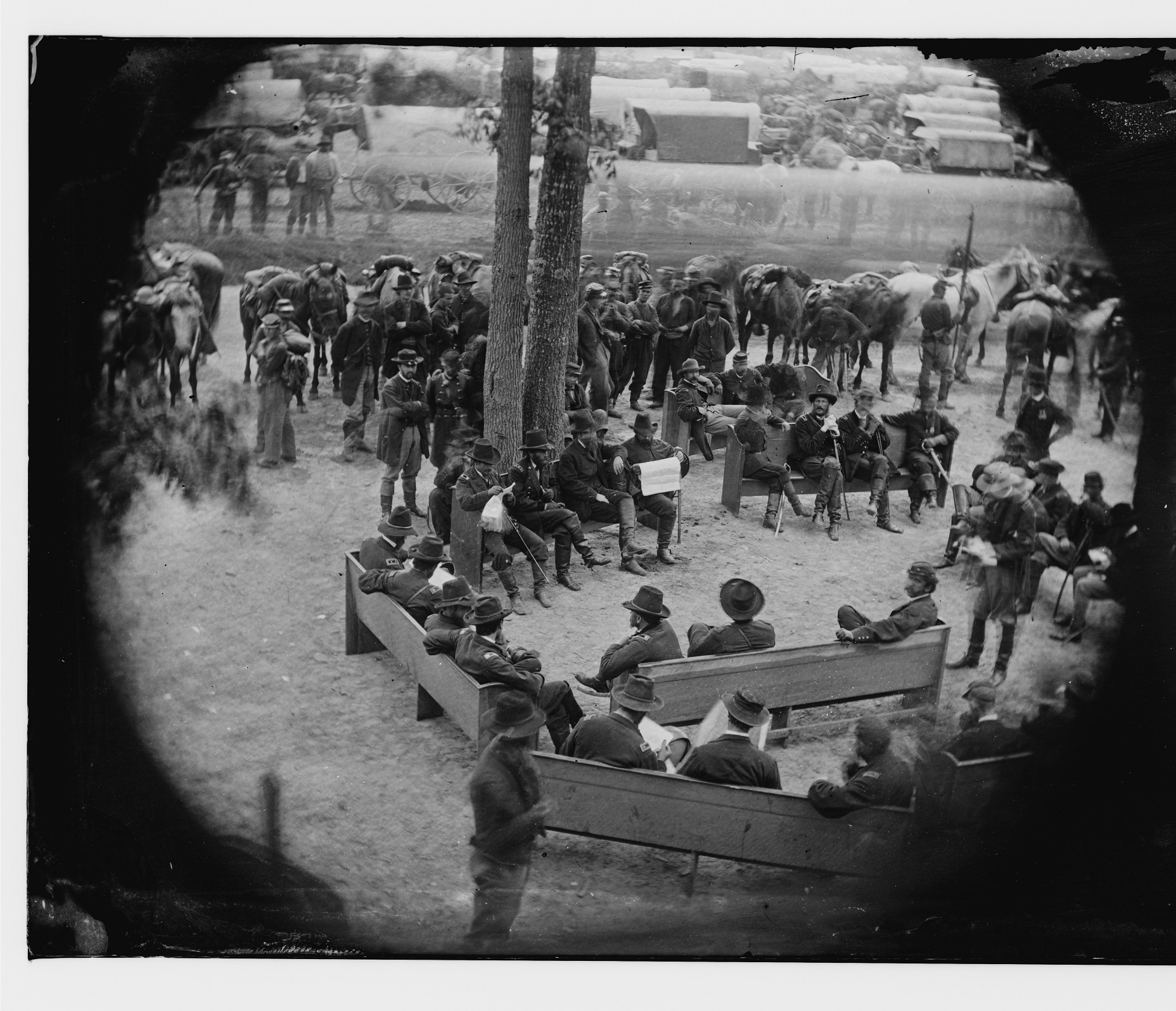
massaponnox croppedToday is the 150th anniversary of one of the most famous photographs from the Civil War. It was exactly a century and a half ago when Timothy O’Sullivan lugged his camera equipment up to the second floor of a little brick building called Massaponax Church and captured an image of Union officers, among them Grant and Meade, sitting outside on pews their staffs had hauled outside. They are tremendous photos. In this one you can see Meade at the end of the pew to the left, looking at a map. Theodore Lyman sits next to him. Andrew Humphreys sits at the end of the adjacent pew, reading a paper. Grant sits next to him, puffing on one of his ever-present cigars. After the long, bloody stalemate at Spotsylvania Court House, the Army of the Potomac was on the move, shifting to the left to pass by Lee’s flank and head south. The wagons of the V Corps are in the background in the photo. (This image is from the Library of Congress; click to enlarge).

Charles A. Dana (Library of Congress).

Charles A. Dana (Library of Congress).

Sitting next to Grant is Charles Dana, the assistant secretary of war. Lyman described him as “a combination of scholar and newspaper editor, with a dab of amiability, a large dab of conceit, and another large dab of ultraism.” Dana had accompanied Grant during the Vicksburg Campaign, and Lincoln dispatched him from Washington to report from Virginia. In a memoir Dana recounted his rather critical impressions of Meade. “He was a tall, thin man, rather dyspeptic, I should suppose from the fits of nervous irritation to which he was subject,” Dana said. “He was totally lacking in cordiality toward those with whom he had business, and in consequence was generally disliked by his subordinates. With General Grant Meade got along always perfectly, because he had the first virtue of a soldier–that is, obedience to orders. He was an intellectual man, and agreeable to talk with when his mind was free, but silent and indifferent to everybody when he was occupied with that which interested him.”

Massaponax Church as it appears today (Tom Huntington photo).

Massaponax Church as it appears today (Tom Huntington photo).

Below is an engraved version based on O’Sullivan’s image. The population of generals has increased substantially! If you read the caption to the print, you’ll also see the artist has added the presence of generals who were nowhere near–not only Winfield Scott Hancock, who had moved with the II Corps ahead of the army, but also General William T. Sherman, who was making his way through Georgia at the time, Daniel Sickles, George Thomas, and James Garfield.

Here's an artist's conception of that scene. He has allowed his imagination some free play. If you read the caption to the print, you'll also see that has added the presence of generals who were nowhere near--not only Hancock, who had moved with the II Corps ahead of the army, but also General Sherman, who was making his way through Georgia at the time, and General Sickles.

Here’s an artist’s conception of that scene. He has allowed his imagination some free play (Library of Congress. Click to enlarge).

Two Heads (May 19, 1864)

Senator John Sherman. His resemblance to his older brother, the general, is striking (via Wikipedia).

Senator John Sherman. His resemblance to his older brother, the general, is striking (via Wikipedia).

Another double-header today, with letters from both Meade and Theodore Lyman. I’m especially taken by the end of Meade’s letter. It’s an interesting analysis of his role under Grant. He does chafe at his subordinate role and will later become increasingly agitated over not receiving the recognition he feels he deserves, but here he accepts the situation for what it is. Of course, by the time the article he mentions appeared, Horatio Wright replaced John Sedgwick at the head of the VI Corps, and Sedgwick had joined the thousands of soldiers who lie moldering in the grave. The Coppée he mentions is Henry Coppée, a West Point graduate and Mexican War veteran who went on to become the first president of Leheigh University in Bethlehem, Pennsylvania. He also wrote biographies of Ulysses Grant and George Thomas. The magazine Meade cites is the United States Service Magazine.

Senator John Sherman was William T. Sherman’s younger brother. Senator William Sprague was also a former governor of Rhode Island.

All goes on well up to this time. We did not have the big battle which I expected yesterday, as, on advancing, we found the enemy so strongly entrenched that even Grant thought it useless to knock our heads against a brick wall, and directed a suspension of the attack. We shall now try to manoeuvre again, so as to draw the enemy out of his stronghold, and hope to have a fight with him before he can dig himself into an impregnable position.

We have recent Richmond papers containing Lee’s congratulatory address to his army, so you see both sides claim having gained the advantage. Lee, however, seems to think they have gained their point when they check us.

Yesterday I had a visit from Senators Sherman, of Ohio, and Sprague, of Rhode Island; both were very complimentary to me, and wished me to know that in Washington it was well understood these were my battles. I told them such was not the case; that at first I had manceuvered the army, but that gradually, and from the very nature of things, Grant had taken the control; and that it would be injurious to the army to have two heads. I see one of the newspaper men is puzzled to know what share we each have in the work, and settles it by saying Grant does the grand strategy, and I the grand tactics. Coppée in his Army Magazine says, “the Army of the Potomac, directed by Grant, commanded by Meade, and led by Hancock, Sedgwick and Warren,” which is a quite good distinction, and about hits the nail on the head.

In his letter from May 19, Theodore Lyman continues his account of the campaign so far. A journal entry added as a footnote to the letter mentions the altercation that occurred between Meade and Philip Sheridan at Todd’s Tavern.

To continue my history a little—I had struggled with much paper to the morning of the 8th. It proved a really hot day, dusty in the extreme and with a severe sun. We staid till the morning was well along, and then started for Piney Branch Church. On the way passed a cavalry hospital, I stopped and saw Major Starr, who had been shot directly through both cheeks in a cavalry fight the day before. He was in college with me, and when I first came to the army commanded the Headquarter escort, the same place [Charles Francis] Adams now has. . . .

Near Piney Branch Church we halted, pitched tents and had something cooked. Meanwhile there was firing towards Spotsylvania, an ill omen for us. The Rebels were there first and stood across the way. Warren attacked them, but his were troops that had marched and fought almost night and day for four days and they had not the full nerve for a vigorous attack. General Robinson’s division behaved badly. Robinson rode in among them, calling them to attack with the bayonet, when he was badly shot in the knee and carried from the field. They failed to carry the position and lost a golden opportunity, for Wilson’s cavalry had occupied Spotsylvania, but of course could not keep there unless the enemy were driven from our front. . . .

A little before two we moved Headquarters down the Piney Branch Church road, south, to near its junction with the Todd’s Tavern road. Meantime the 6th Corps had come up and formed on the left of Warren, the lines running in a general easterly and westerly direction, a mile and a half north of Spotsylvania. There was a high and curving ridge on which was placed our second line and batteries, then was a steep hollow, and, again, a very irregular ridge, or broken series of ridges, much of them heavily wooded, with cleared spaces here and there; along these latter crests ran the Rebel lines in irregular curves. Preparations were pushed to get the corps in position to attack, but it was plain that many of the men were jaded and I thought some of the generals were in a like case. About half-past four what should Generals Grant and Meade take it into their heads to do but, with their whole Staffs, ride into a piece of woods close to the front while heavy skirmishing was going on. We could not see a thing except our own men lying down; but there we sat on horseback while the bullets here and there came clicking among trunks and branches and an occasional shell added its discordant tone. I almost fancy Grant felt mad that things did not move faster, and so thought he would go and sit in an uncomfortable place. General Meade, not to be bluffed, stayed longer than Grant, but he told me to show the General the way to the new Headquarters. Oh! with what intense politeness did I show the shortest road! for I had picked out the camp and knew the way.

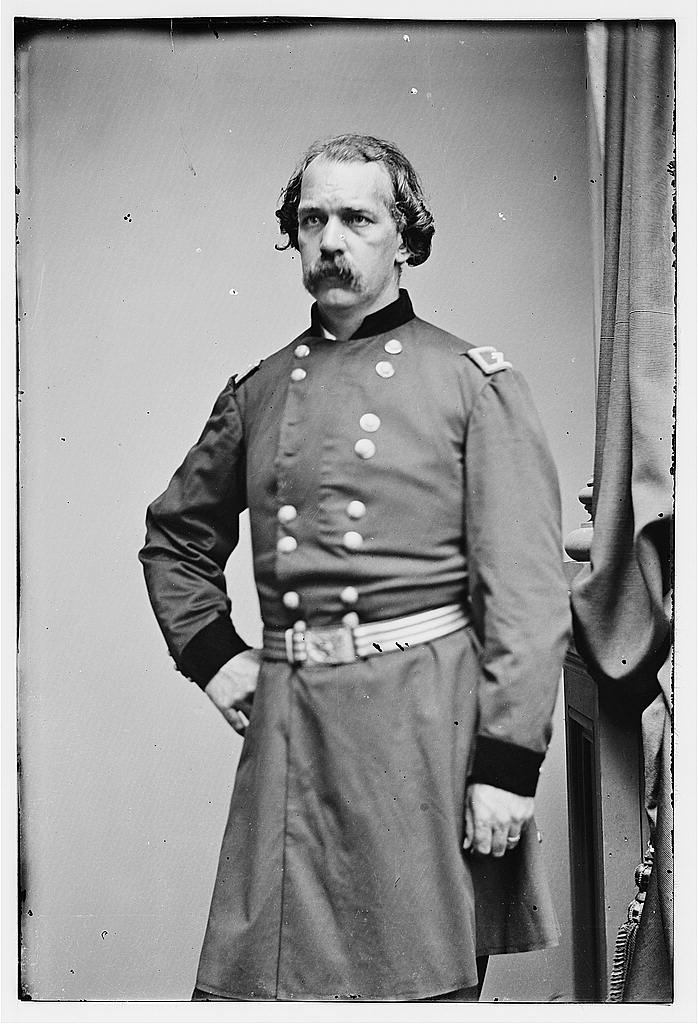
Hobart Ward (Library of Congress).

J. Hobart Ward. After the Wilderness, Winfield Scott Hancock had him relieved for being intoxicated in the face of the enemy (Library of Congress).

Well, they could not get their attack ready; but there was heavy skirmishing.* … I think there was more nervous prostration to-day among officers and men than on any day before or since, the result of extreme fatigue and excitement. General Ward was relieved from his command, for misbehavior and intoxication in presence of the enemy during the Battle of the Wilderness. I had always supposed him to be a brave but rough man. . . .

*”Sheridan now came to Headquarters—we were at dinner. Meade told him sharply that his cavalry was in the way, though he had sent him orders to leave the road clear. S. replied that he never got the order. Meade then apologized, but Sheridan was plainly full of suppressed anger, and Meade too was in ill temper. S. went on to say that he could see nothing to oppose the advance of the 5th Corps; that the behavior of the infantry was disgraceful, etc., etc. Maybe this was the beginning of his dislike of Warren and ill-feeling against Meade.”—Lyman’s Journal.

Meade’s correspondence taken from The Life and Letters of George Gordon Meade, Major-General United States Army, Vol. 2, (New York: Charles Scribner’s Sons, 1913), pp. 197-8. Available via Google Books.

Theodore Lyman’s letter is from Meade’s Headquarters, 1863-1865: Letters of Colonel Theodore Lyman from the Wilderness to Appomattox, pp 104-106. Edited by George R. Agassiz. Boston, Massachusetts Historical Society, 1922. Available via Google Books.
USCT (May 18, 1864)

You can suffer from chronological whiplash when reading Meade’s Headquarters, 1863-1865: Letters of Colonel Theodore Lyman from the Wilderness to Appomattox. For instance, the opening of the letter he wrote on May 18 (150 years ago today), opens with interesting observations about the recent fighting in general he noted during a lull at Spotsylvania. It includes some especially interesting observations about the use of breastworks. He then jumps back to May 7 to continue his narrative of the Overland Campaign.

"Make Way for Liberty!" by illustrator Henry Louis Stephens, circa 1863 (Library of Congress).

“Make Way for Liberty!” by illustrator Henry Louis Stephens, circa 1863 (Library of Congress).

Lyman’s comments on the use of African-American soldiers are also interesting, if less insightful. Lyman was certainly not alone in wondering if black soldiers could fight. When he issued the Emancipation Proclamation President Lincoln also opened the door for black men to fight for the Union, but many white soldiers did not accept the new arrivals with open arms. Lyman either was unaware of the irony in his words or refused to acknowledge that Lincoln had transformed the war into more than a crusade to restore the Union. It was now a war to end slavery as well. By the end of the war Lyman had gained a grudging respect for the African-American soldiers, but he never abandoned his conservative views on race.

When I was researching Searching for George Gordon Meade: The Forgotten Victor of Gettysburg I spent a day exploring Spotsylvania with historian John Cummings. He had recently started a reenactment group to commemorate the 23rd United States Colored Troops, a regiment from Brig. Gen. Edward Ferrero’s division that fought here on May 15. These were some of the black soldiers that so distressed Lyman. “By 2014 I think it’s vitally important to do something to commemorate the first time that black troops actually fired on the Army of Northern Virginia,” Cummings told me then. I’m pleased to say he helped make that happen, as you can read here.

I have no right to complain: I have less hardship, more ease, and less exposure than most officers, and, if I must be with the army in the field, I have as good a place as one can well expect. I did hope (though there was no proper ground for it) that we might have the great blessing of an overwhelming victory. Such things you read of in books, but they do not happen often, particularly with such armies to oppose as those of the Rebels. . . .

The great feature of this campaign is the extraordinary use made of earthworks. When we arrive on the ground, it takes of course a considerable time to put troops in position for attack, in a wooded country; then skirmishers must be thrown forward and an examination made for the point of attack, and to see if there be any impassable obstacles, such as streams or swamps. Meantime what does the enemy? Hastily forming a line of battle, they then collect rails from fences, stones, logs and all other materials, and pile them along the line; bayonets with a few picks and shovels, in the hands of men who work for their lives, soon suffice to cover this frame with earth and sods; and within one hour, there is a shelter against bullets, high enough to cover a man kneeling, and extending often for a mile or two. When our line advances, there is the line of the enemy, nothing showing but the bayonets, and the battle-flags stuck on the top of the work. It is a rule that, when the Rebels halt, the first day gives them a good rifle-pit; the second, a regular infantry parapet with artillery in position; and the third a parapet with an abattis in front and entrenched batteries behind. Sometimes they put this three days’ work into the first twenty-four hours. Our men can, and do, do the same; but remember, our object is offense—to advance. You would be amazed to see how this country is intersected with field-works, extending for miles and miles in different directions and marking the different strategic lines taken up by the two armies, as they warily move about each other.

The newspapers would be comic in their comments, were not the whole thing so tragic. More absurd statements could not be. Lee is not retreating: he is a brave and skilful soldier and he will fight while he has a division or a day’s rations left. These Rebels are not half-starved and ready to give up — a more sinewy, tawny, formidable-looking set of men could not be. In education they are certainly inferior to our native-born people; but they are usually very quick-witted within their own sphere of comprehension; and they know enough to handle weapons with terrible effect. Their great characteristic is their stoical manliness; they never beg, or whimper, or complain; but look you straight in the face, with as little animosity as if they had never heard a gun.

Now I will continue the history a little. But first I will remark that I had taken part in two great battles, and heard the bullets whistle both days, and yet I had scarcely seen a Rebel save killed, wounded, or prisoners! I remember how even line officers, who were at the battle of Chancellorsville, said: “Why, we never saw any Rebels where we were; only smoke and bushes, and lots of our men tumbling about”; and now I appreciate this most fully. The great art is to conceal men; for the moment they show, bang, bang, go a dozen cannon, the artillerists only too pleased to get a fair mark. Your typical “great white plain,” with long lines advancing and manoeuvring, led on by generals in cocked hats and by bands of music, exist not for us. Here it is, as I said: “Left face—prime—forward!”—and then wrang, wr-r-rang, for three or four hours, or for all day, and the poor, bleeding wounded streaming to the rear. That is a great battle in America. Well! to our next day.

Saturday, May 7

Brig. Gen. Edward Ferrero. A former dancing instructor, he commanded a division of African American soldiers (Library of Congress).

Brig. Gen. Edward Ferrero. A former dancing instructor, he commanded a division of African-American soldiers (Library of Congress).

At daylight it would be hard to say what opinion was most held in regard to the enemy, whether they would attack, or stand still; whether they were on our flanks, or trying to get in our rear, or simply in our front. However, it was not long before they were reported as fallen back — a good deal back from the left and right and somewhat from our centre on the pike. Reconnaissances were at once thrown out; and the General sent me to the front, on the pike, to learn how matters stood; where I found, on the most undoubted evidence, that we were throwing solid shot and shell at the rebels, and they were throwing solid shot and shells at us. . . . There was heavy skirmishing, with some artillery, all that morning, until we determined that the enemy had swung back both wings; and shortened and straightened his line. There lay both armies, each behind its breastworks, panting and exhausted, and scowling at each other. At five this morning a novel sight was presented to the Potomac Army. A division of black troops, under General Ferrero, and belonging to the 9th Corps, marched up and massed in a hollow near by. As I looked at them, my soul was troubled and I would gladly have seen them marched back to Washington. Can we not fight our own battles, without calling on these humble hewers of wood and drawers of water, to be bayonetted by the unsparing Southerners? We do not dare trust them in the line of battle. Ah, you may make speeches at home, but here, where it is life or death, we dare not risk it. They have been put to guard the trains and have repulsed one or two little cavalry attacks in a creditable manner; but God help them if the grey-backed infantry attack them! . . .

As General Grant sat under a pine tree, stoically smoking his briarwood pipe, I heard him say: “To-night Lee will be retreating south.”* Ah! General, Robert Lee is not Pemberton; he will retreat south, but only far enough to get across your path, and then he will retreat no more, if he can help it. In fact, orders were out for the whole army to move at dark on Spotsylvania Court House. But Lee knew it all: he could see the waggons moving, and had scouts besides. As night fell, his troops left their works and were crowding down the Parker’s Store road, towards Spotsylvania—each moment worth untold gold to them! Grant had no longer a Pemberton! “His best friend,” as he calls him. And we marched also. . . .

We [Headquarters] did not start till nearly nine o’clock. … It was a sultry night—no rain for many days; the horses’ hoofs raised intolerable clouds of dust, which, in this sandy region, is fine almost like flour. I never saw—nobody could well see—a more striking spectacle than that road as we passed slowly along. All the way was a continuous low breastwork behind which lay crowded the sleeping infantry. They were so close as almost to be on top of each other; every man with his loaded musket in his hand, or lying at his side. A few yards outside stood a line of sentries, their muskets cocked, and others sat on top of the breastwork. Few of the officers allowed themselves any rest, but paced up and down, in their great coats and slouched hats, looking sharply after the sentries. That looked like war, I do assure you. By the roadside was Gibbon, and a tower of strength he is, cool as a steel knife, always, and unmoved by anything and everything. There we lay down, literally in the dust, after a drink of iced water (for all the farms have ice-houses in this region, which our men are not slow to hunt out), and then we waited for General Meade, who had waited behind to speak with Hancock. By and by he came, with more clouds of dust, and then on again, past more sleeping men, and batteries in position, losing the road, finding it again, tearing our clothes among trees and bushes, then coming to cavalry pickets and finally to Todd’s Tavern, where General Gregg had his Headquarters, with his division of cavalry camped about there. . . . There was a porch in front with a dirt floor, and there I lay down, with my head on a timber, and got some sleep. On Sunday morning, May 8th,—it was not much like a Sabbath,—we were all staring sleepily about us, forlorn with dust and dirt. The road was full of the infantry, passing at a rapid rate; in light order they were, many without knapsacks, or coats: most had thrown away all baggage but a blanket and haversack. Then came batteries, then more infantry, all of the 5th Corps; the Second had not yet begun to pass. An old nigger made us some coffee and hoe-cake — very acceptable. . . .

*In a footnote taken from his journal entry of May 6, Lyman noted that on the day before, “Grant told Meade that Joe Johnston would have retreated after two such days’ punishment. He recognized the difference of the Western Rebel fighting.”

Theodore Lyman’s letters are from Meade’s Headquarters, 1863-1865: Letters of Colonel Theodore Lyman from the Wilderness to Appomattox, pp 99-104 . Edited by George R. Agassiz. Boston, Massachusetts Historical Society, 1922. Available via Google Books.


A Gift (May 17, 1864)

A view of the Meade house on Delancey Place in Philadelphia today (Tom Huntington photo).

A view of the Meade house on Delancey Place in Philadelphia today (Tom Huntington photo).

Meade writes on May 17 on the eve of a renewed attack against Lee’s Spotsylvania lines. After the terrible fighting against the Mule Shoe salient, the Confederates had withdrawn to a new position, one the Federals hope will be more susceptible to assault.

The Gerhard Meade mentions is his wife’s brother-in-law. In the end Mrs. Meade will get her way regarding the house on Delancey Place in Philadelphia and the Meades will receive the home as a gift from their friends. The General died in the house in 1872. The building still stands and you can see the word “Meade” carved on one of the lintels.

To-morrow we shall begin fighting again, with, I trust, some decided result, for it is hardly natural to expect men to maintain without limit the exhaustion of such a protracted struggle as we have been carrying on.

The last few days have given our men rest, and the arrival of reinforcements has put them in good spirits. There is a determination on all sides to fight it out, and have an end put to the war; a result which I think will most certainly be accomplished if we can overcome the army before us.

I received to-day a kind letter from Mr. Gerhard, written from his sick room, and informing me of the generosity of kind friends in Philadelphia, who had subscribed to pay for your house in DeLancey Place. I have replied to Mr. Gerhard, and whilst I have tried to express my sense of the generosity of my friends, I have declined the gift, believing that, under existing circumstances, it would not be proper in me to accept. At the same time I have said if it should be God’s will that I should fall in this war, then anything to assist you and my orphans would be most gratefully and thankfully received. I hope you will approve of my course, and that my feelings will be understood. It would not do to lose our independence, and I don’t think we would be comfortable in a house bought with our friends’ money.

I have been riding all day, getting ready for to-morrow’s battle. I shall now retire to rest, earnestly praying God to protect us, and give victory to our side.

On May 17 Theodore Lyman resumes his account of the fighting in the Wilderness. Here he talks about Confederate General John B. Gordon’s flank attack on the Union right late in the day on May 6. As I write in Searching for George Gordon Meade: The Forgotten Victor of Gettysburg:

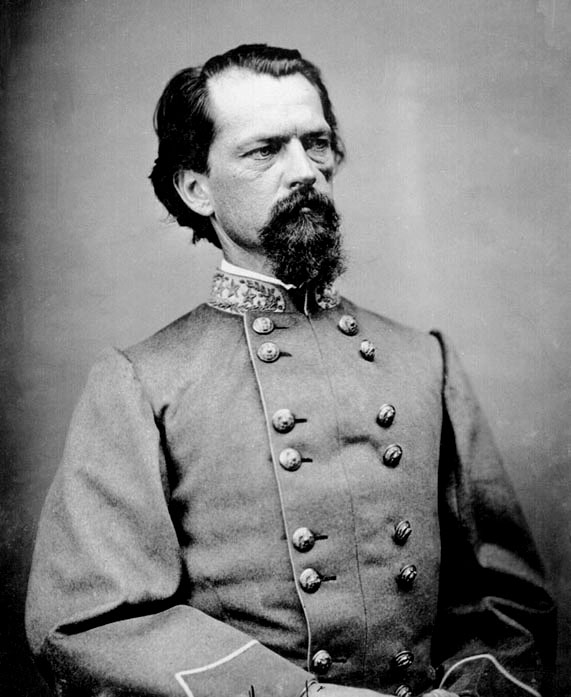
Confederate General John B. Gordon (National Archives).

Confederate General John B. Gordon (National Archives).

The attackers were under Brig. Gen. John Gordon, a hard-fighting Georgian. The first troops the screaming rebels hit were brigades under the command of Brigadier Generals Alexander Shaler and Truman Seymour. It was the continuation of a string of bad luck for Seymour, the general Meade had suspected of sucking up to Reynolds back in 1862. Since then Seymour had been disastrously defeated at the Battle of Olustree in Florida and seriously injured leading an attack on Battery Wagner outside Charleston, South Carolina. Now his bad luck continued. His troops broke for the rear. The Confederates captured both Seymour and Shaler.

The men of the VI Corps fell back against Warren’s V Corps to their right. “Suddenly there was a wild, fearful yell, a terrific crash, and the tide of battle rolled backward,” remembered Pvt. Theodore Gerrish of the 20th Maine. “A portion of the Sixth corps had given way, and the enemy followed up the advantage thus gained, until they had completely turned our flank, and the firing was almost in our rear. Some of the regiments in our brigade showed signs of alarm at this situation, but the sons of Maine were determined to hold their position, even if they were surrounded and destroyed in so doing. The enemy’s advance on our right was finally checked, and our line was re-established.”

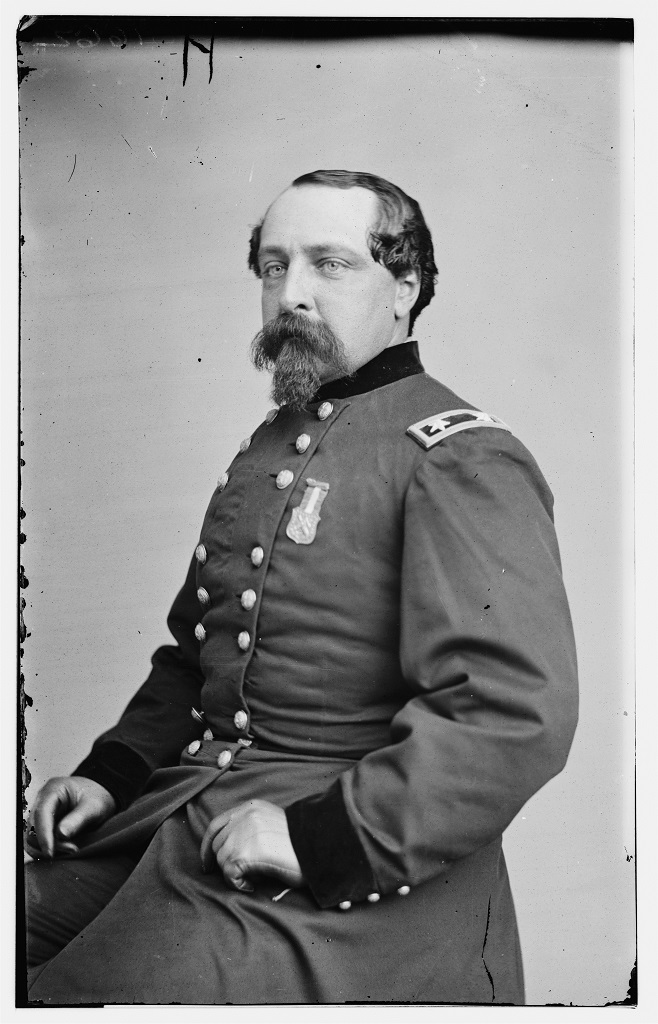
Alexander Shaler, who was taken prisoner in the Wilderness. He received the Medal of Honor for his actions during the Battle of Chancellorsville (Library of Congress).

Alexander Shaler, who was taken prisoner in the Wilderness. He received the Medal of Honor for his actions during the Battle of Chancellorsville (Library of Congress).

When Meade received reports that another Confederate flank attack had routed a portion of the Army of the Potomac in the Wilderness, he appeared less concerned about it than Grant did. Fixing a cold eye on the panicked courier who had reported the VI Corps’ destruction, he demanded sarcastically, “Do you mean to tell me that the Sixth Corps is to do no more fighting this campaign?” In fact, Sedgwick had ridden to the front to help rally his demoralized men and soon had things under control.

Things did look bad for a time. Horace Porter reported an incident in which a general whom he did not identify reached Grant’s headquarters and expressed his fears that Lee would seek to get between the Union army and the Rapidan, cutting off the line of communications. “I know Lee’s methods well by past experience,” the officer declared with some self-importance. The normally unflappable general in chief reacted with uncharacteristic temper. He stood up and yanked the cigar from his mouth. “Oh, I am heartily tired of hearing about what Lee is going to do,” Grant barked. “Some of you always seem to think he is suddenly going to turn a double somersault, and land in our rear and on both of our flanks at the same time. Go back to your command, and try to think what we are going to do ourselves, instead of what Lee is going to do.”

Meade and Grant were right not to worry. Gordon’s flank attack was the last major action of the Battle of the Wilderness. It had been two days of bloody and confused conflict, “a battle fought with the ear, and not with the eye,” according to Horace Porter. “All circumstances seemed to combine to make the scene one of unutterable horror. At times the wind howled through the tree-tops, mingling its moans with the groans of the dying, and heavy branches were cut off by the fire of the artillery, and fell crashing upon the heads of the men, adding a new terror to battle. Forest fires raged; ammunition-trains exploded; the dead were roasted in the conflagration; the wounded, roused by its hot breath, dragged themselves along, with their torn and mangled limbs, in the mad energy of despair, to escape the ravages of the flames; and every bush seemed hung with shreds of blood-stained clothing. It was as though Christian men had turned to fiends, and hell itself had usurped the place of earth.”

Here’s how Lyman wrote about it:

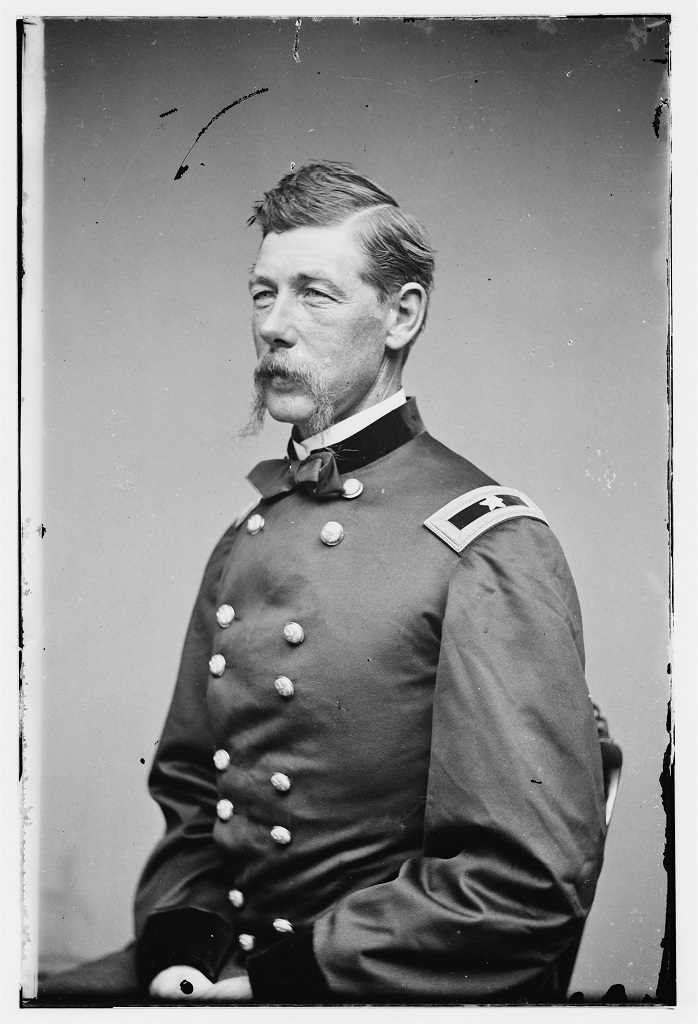
Truman Seymour (Library of Congress).

Truman Seymour (Library of Congress).

. . . Just at dark there occurred a most disgraceful stampede in the 6th Corps — a thing that has been much exaggerated in the papers, by scared correspondents. You will remember I told you that we had two dubious divisions in the army: one, the Pennsylvania Reserves, has done finely and proved excellent; but the other, General Ricketts’s division of the 6th Corps, composed of troops from Winchester, known as “Milroy’s weary boys,” never has done well. They ran on the Mine Run campaign, and they have run ever since. Now, just at dark, the Rebels made a sort of sortie, with a rush and a yell, and as ill-luck would have it, they just hit these bad troops, who ran for it, helterskelter. General Seymour rode in among them, had his horse shot, and was taken. General Shaler’s brigade had its flank turned and Shaler also was taken. Well, suddenly up dashed two Staff officers, one after the other, all excited, and said the whole 6th Corps was routed; it was they that were routed, for Wright’s division stood firm, and never budged; but for a time there were all sorts of rumors, including one that Generals Sedgwick and Wright were captured. In a great hurry the Pennsylvania Reserves were sent to the rescue, and just found all the enemy again retired. A good force of them did get round, by a circuit, to the Germanna plank, where they captured several correspondents who were retreating to Washington! Gradually the truth came out, and then we shortened the right by drawing back the 5th and 6th Corps, so as to run along the interior dotted line, one end of which ends on the Germanna plank.

General Meade was in favor of swinging back both wings still more, which should have been done, for then our next move would have been more rapid and easy.

The result of this great Battle of the Wilderness was a drawn fight, but strategically it was a success, because Lee marched out to stop our advance on Richmond, which, at this point, he did not succeed in doing. We lost a couple of guns and took some colors. On the right we made no impression; but, on the left, Hancock punished the enemy so fearfully that they, that night, fell back entirely from his front and shortened their own line, as we shortened ours, leaving their dead unburied and many of their wounded on the ground. The Rebels had a very superior knowledge of the country and had marched shorter distances. Also I consider them more daring and sudden in their movements; and I fancy their discipline on essential points is more severe than our own — that is, I fancy they shoot a man when he ought to be shot, and we do not. As to fighting, when two people fight without cessation for the best part of two days, and then come out about even, it is hard to determine.

Meade’s correspondence taken from The Life and Letters of George Gordon Meade, Major-General United States Army, Vol. 2, (New York: Charles Scribner’s Sons, 1913), pp. 196-7. Available via Google Books.

Theodore Lyman’s letter is from Meade’s Headquarters, 1863-1865: Letters of Colonel Theodore Lyman from the Wilderness to Appomattox, pp 97-9. Edited by George R. Agassiz. Boston, Massachusetts Historical Society, 1922. Available via Google Books.

Sheridan (May 16, 1864)

Philip Sheridan and Meade developed a cantankerous relationship (Library of Congress).

Philip Sheridan and Meade developed a cantankerous relationship (Library of Congress).

Meade mentions cavalry commander Philip Sheridan in his letter to his wife from May 16. In the battle of Yellow Tavern on May 11, one of Sheridan’s men mortally wounded Jeb Stuart, a major blow to Lee’s army. Meade does not mention the unpleasant encounter he had had with Sheridan early in the morning on May 8 at a place called Todd’s Tavern. Meade had been angry that Sheridan’s men hadn’t cleared the road all the way to Spotsylvania. Sheridan, already chafing under Meade’s command, was incensed that Meade had felt it necessary to issue some orders directly to his cavalry. According to Horace Porter of Grant’s staff, Meade was in “a towering passion” while Sheridan was “equally fiery.” The two men argued and Sheridan said, “If I am permitted to cut loose from this army I’ll draw Stuart after me and whip him, too.” Meade reported Sheridan’s insubordination to Grant, and repeated what the cavalry commander had said about Stuart. “Did Sheridan say that?” replied Grant. “Well, he generally knows what he is talking about. Let him start right out and do it.” Meade issued the orders, no doubt irritated that Grant was rewarding Sheridan for his insubordination to a superior officer. Sheridan did kill Stuart, but he also deprived the Army of the Potomac of the eyes and ears of his cavalry during a vital part of the Overland Campaign.

The weather still continues unfavorable for military operations, so, unless the enemy attack us, we shall probably remain quiet to-day. Our cavalry, under Sheridan, have been heard from. He was sent to get in the enemy’s rear, destroy their communications and supplies, fight their cavalry, and when his forage was exhausted, make his way to [Benjamin] Butler, on the James River. He reports having executed his orders, and it is said that J. E. B. Stuart was killed in the battle with Sheridan.

In his letter of May 16, Lyman resumes his account of the fighting in the Wilderness, especially the struggle around the Brock Road and the arrival of James Longstreet’s corps. Fortunately for the Union, Longstreet’s flank attack faltered when its commander was accidentally shot by his own troops. Lyman writes about the death of Henry Abbott, his Harvard friend and the commander of the 20th Massachusetts Earlier Abbot had commented on how Meade and Grant worked together. He thought the combination was “the next best thing to having a man of real genius at the head.” Meade was “a good combiner and maneuverer” and “unquestionably a clever man intellectually,” while Grant had “force” and “character” and wasn’t “afraid to take the responsibility to the utmost.”

I will continue the letter of this morning, describing our first day’s fight. I had got as far as the death of General Hays and the wounding of Carroll. This was between five and six o’clock. Hays commanded one brigade of Birney’s division. He was a strong-built, rough sort of man, with red hair, and a tawny, full beard; a braver man never went into action, and the wonder only is that he was not killed before, as he always rode at the very head of his men, shouting to them and waving his sword. Mott’s division behaved badly (as you observed, it broke and came back). This is a curious instance of a change of morale. It is Hooker’s old fighting division, but has since been under two commanders of little merit or force of character; then there was some discontent about re-enlistments and about the breaking up of the old 3d Corps, to which it had belonged; and the result has been that most of this once crack division has conducted itself most discreditably, this campaign. However, the fresh troops saved the day, and, at dark, we occupied our old line (the dotted one along the Brock road). . . .

Major General Winfield Scott Hancock (Library of Congress).

Major General Winfield Scott Hancock (Library of Congress).

It was long after dark when I rode back, and, with some difficulty, found our camp, now pitched in a dusty, ploughed field. The fight of this day had been an attack by parts of our three corps against the Corps of Ewell on our right, and of Hill on our left. The fight had swayed back and forth and ended in a drawn battle, both sides holding their lines. General Grant ordered the attack all along the line, the next morning at 4.30; but put it off to 5 o’clock on the representation that Burnside could not get up in time. He was ordered to get in position by daylight and to go in on Hill’s left flank, where you see a dotted line nearly parallel to the Parker’s Store road. We were all up right early on that Friday the 6th of May, you may depend. “Lyman,” said the General, “I want you to take some orderlies and go to General Hancock and report how things go there during the day.” It was after five when I mounted, and already the spattering fire showed that the skirmishers were pushing out; as I rode down the crossroad, two or three crashing volleys rang through the woods, and then the whole front was alive with musketry. I found General Hancock at the crossing of the plank: he was wreathed with smiles. “We are driving them, sir; tell General Meade we are driving them most beautifully. Birney has gone in and he is just cleaning them out be-auti-fully!” This was quite apparent from the distance of the receding firing and the absence of those infernal minie balls. “I am ordered to tell you, sir, that only one division of General Burnside is up, but that he will go in as soon as he can be put in position.” Hancock’s face changed. “I knew it!” he said vehemently. “Just what I expected. If he could attack now, we would smash A. P. Hill all to pieces!” And very true were his words. Meantime, some hundreds of prisoners were brought in; all from Hill’s troops. Presently, however, the firing seemed to wake again with renewed fury; and in a little while a soldier came up to me and said: “I was ordered to report that this prisoner here belongs to Longstreet’s Corps.” “Do you belong to Longstreet?” I hastened to ask. “Ya-as, sir,” said grey-back, and was marched to the rear. It was too true! Longstreet, coming in all haste from Orange Court House, had fallen desperately on our advance; but he had uphill work. Birney’s and Getty’s men held fast and fought with fury, a couple of guns were put in the plank road and began to fire solid shot over the heads of our men, adding their roar to the other din. The streams of wounded came faster and faster back; here a field officer, reeling in the saddle; and there another, hastily carried past on a stretcher. I stood at the crossing and assisted in turning back stragglers or those who sought to go back, under pretext of helping the wounded. To some who were in great pain I gave some opium, as they were carried past me.

It was about seven o’clock, I think, that Webb’s brigade marched along the Brock road, and, wheeling into the pike, advanced to the support of Birney. Among them was the 20th Massachusetts. Abbot smiled and waved his sword towards me, as he rode by, and I called out to him wishing him good luck; and so he went on to his death, as gallant a fellow as fell that day; a man who could ride into the fight with a smile on his face. Just before eight o’clock came one brigade of Stevenson’s division (Burnside’s Corps) which had been sent to strengthen Hancock; the other brigade came later and was put on our left, where we were continually paralyzed by reports that the enemy was coming up the Brock road to take us in the flank. This prevented proper mobility of our left, and, after all, they turned out to be a division of Rebel cavalry, who were defeated later in the day by our men. Stevenson’s brigade was now put in to relieve the advanced lines that had long been under fire, and all other fresh troops were marched to the front. But Longstreet knew full well (they know everything, those Rebels) that Burnside was coming up with two divisions, on his flank; and knew too that he was late, very late. If Hancock could first be paralyzed, the day was safe from defeat, which now impended. Gathering all his forces, of both corps, he charged furiously. At a little after eleven Mott’s left gave way. On the right the brigade of Stevenson, consisting of three raw Massachusetts regiments miscalled “Veterans,” broke, on being brought under a tremendous fire. . . .The musketry now drew nearer to us, stragglers began to come back, and, in a little while, a crowd of men emerged from the thicket in full retreat. They were not running, nor pale, nor scared, nor had they thrown away their guns; but were just in the condition described by the Prince de Joinville, after Gaines’s Mill. They had fought all they meant to fight for the present, and there was an end of it! If there is anything that will make your heart sink and take all the backbone out of you, it is to see men in this condition! I drew my sword and rode in among them, trying to stop them at a little rifle-pit that ran along the road. I would get one squad to stop, but, as I turned to another, the first would quietly walk off. There was a German color-bearer, a stupid, scared man (who gave him the colors, the Lord only knows!), who said, “Jeneral Stavenzon, he telled me for to carry ze colors up ze road.” To which I replied I would run him through the body if he didn’t plant them on the rifle-pit. And so he did, but I guess he didn’t stick. Meanwhile there was no danger at all; the enemy did not follow up — not he. He was busy swinging round to oppose Burnside, and was getting his men once more in order. At half-past one I rode to General Meade and reported the state of affairs. The Provost-General went out at once and stopped and organized the stragglers. At two o’clock Burnside, who had been marching and countermarching, did attack. He made some impression, but it was too late, and he had not enough force to follow on. About this time I returned to General Hancock.* His men were rallied along the road; but regiments and brigades were all mixed up; and we were obliged to listen to Burnside’s fighting without any advance on our part. In our front all was quiet; and I got permission to go back to the 2d Corps hospital and look up the body of Major Abbot. Two miles back, in an open farm surrounded by woods, they had pitched the hospital tents. I will not trouble you with what I saw there, as I passed among the dead and dying. Abbot lay on a stretcher, quietly breathing his last — his eyes were fixed and the ashen color of death was on his face. Near by lay his Colonel, Macy, shot in the foot. I raised Macy and helped him to the side of Abbot, and we stood there till he died. It was a pitiful spectacle, but a common one on that day. I left in haste, after arranging for sending the remains home, for the sudden sound of heavy firing told of some new attack. The Rebels (unquenchable fellows they are!), seeing that Burnside had halted, once more swung round and charged furiously on Hancock in his very rifle-pits. I rode at once to General Meade, to ask that Burnside might attack also. This he did, without further orders and with excellent effect. When I got back to the cross-road, I was told the enemy had broken through on the plank and cut us in two; this turned out an exaggeration. They did get into a small part of a rifle-pit but were immediately driven out leaving near sixty dead in the trench at the point.

*The book includes this footnote, taken from Lyman’s journal: “1.15 (about). Back to Hancock. He alone, in rear of Brock road; and there he asked me to sit down under the trees, as he was very tired indeed. All his Staff were away to set in order the troops. They had now constructed a tolerable rifle-pit extending along the Brock and to the head of the cross-road. He said that his troops were rallied but very tired and mixed up, and not in a condition to advance. He had given orders to have the utmost exertions put forth in putting regiments in order, but many of the field officers were killed and wounded, and it was hard. At 2 P.m. Burnside, after going almost to Parker’s Store and again back, made a short attack with loud musketry. Ventured to urge Hancock (who was very pleasant and talkative) to try and attack too; but he said with much regret that it would be to hazard too much, though there was nothing in his immediate front, which had been swept by Stevenson’s other brigade, which marched from left to right.”

Meade’s correspondence taken from The Life and Letters of George Gordon Meade, Major-General United States Army, Vol. 2, (New York: Charles Scribner’s Sons, 1913), pp. 195-6. Available via Google Books.

Theodore Lyman’s letter is from Meade’s Headquarters, 1863-1865: Letters of Colonel Theodore Lyman from the Wilderness to Appomattox, pp 92-7. Edited by George R. Agassiz. Boston, Massachusetts Historical Society, 1922. Available via Google Books.

May 4, 1864

Elements of the Army of the Potomac cross the Rapidan River at Germanna Ford on May 4, 1864 (Library of Congress).

Elements of the Army of the Potomac cross the Rapidan River at Germanna Ford on May 4, 1864 (Library of Congress).

We will not hear from George Meade for a little while. He has much to command his attention at this point. Same with Theodore Lyman. In the meantime, here’s a short excerpt from Searching for George Gordon Meade: The Forgotten Victor of Gettysburg explaining the events of May 4, 1864. (If you do not have the book already, shame on you! It is available via Amazon, Barnes and Noble, and quality bookstores.)

The army began moving at midnight. “There is a kind of weird excitement in this starting at midnight,” noted Col. Charles Wainwright, now handling artillery for the V Corps. “The senses seemed doubly awake to every impression–the batteries gathering around my quarters in the darkness; the moving of lanterns, and the hailing of the men; then the distant sound of the hoofs of the aid’s horse who brings the final order to start. Sleepy as I always am at such times, I have a certain amount of enjoyment in it all.”

The plan for the campaign had the II Corps crossing the Rapidan at Ely’s Ford and the V and VI Corps farther upstream at Germanna Ford. Meade and his staff left their winter camp at 5:25 a.m. on their way to Germanna Ford. The sun rose at the start of a beautiful spring day and illuminated a mighty host on the move. “As far as the eye could reach the troops were wending their way to the front,” wrote Horace Porter. “Their war banners, bullet-riddled and battle-stained, floated proudly in the morning breeze. The roads resounded to the measured tread of the advancing columns, and the deep forests were lighted by the glitter of their steel.”

Meade soon found an occasion for an outburst of temper. At 7:00 he encountered a cavalry wagon train blocking the road, one of his pet peeves. The general gave the quartermaster a tongue-lashing and ordered him to move his wagons out of the way. An hour later he reached the ford, the same spot where his men had camped during the withdrawal from Mine Run. It had been bitter cold then and the army had been disheartened; now spring was bursting out in all its glory and the Union soldiers felt confident. “The troops were very light-hearted, almost as joyous as schoolboys; and over and over again as we rode by them, it was observed by members of the staff that they had never seen them so happy and buoyant,” recalled a staff member.

Congressman Eli Washburne of Illinois, a great supporter of Ulysses S. Grant (Library of Congress).

Congressman Eli Washburne of Illinois, a great supporter of Ulysses S. Grant (Library of Congress).

Meade and his staff crossed the river at 9:30. Grant and his staff, accompanied by Congressman Eli Washburne, joined them shortly afterward. Lyman noted that some of Grant’s staff talked “flippantly” about Lee and his army and regarded the war as nearly won. Grant established his headquarters at an old farmhouse overlooking the Rapidan. Meade dropped by that evening and took a camp chair by a blazing fire of fence rails. Grant offered him a cigar and helped him light it. The two generals sat by the cheery fire, smoking their cigars and talking over their plans for the next day. The move across the Rapidan had gone off without a hitch. “This I regarded as a great success,” said Grant, “and it removed from my mind the most serious apprehensions I had entertained: that of crossing the river in the face of an active, large, well-appointed, and ably commanded army, and how so large a train was to be carried through a hostile country and protected.”

As Grant and Meade talked, messengers brought telegrams informing Grant that the other armies under his command—Ben Butler’s on the James River, Fritz Sigel’s in the Valley, and Sherman’s in Georgia—were advancing according to his plan to apply pressure all over the Confederacy. The Army of the Potomac appeared to be playing its own part in Grant’s grand design. So far, so good. But the army had yet to emerge from the Wilderness.

And So It Begins (May 3, 1864)

Alexander Gardner called this photograph "Breaking Camp.: It shows General George H. Sharpe's deserted headquarters at Brandy Station. Sharpe headed the army's Bureau of Military Information. Winter camp is over; the army is on the move (Library of Congress).

Alexander Gardner called this photograph “Breaking Camp.: It shows General George H. Sharpe’s deserted headquarters at Brandy Station. Sharpe headed the army’s Bureau of Military Information. Winter camp is over; the army is on the move (Library of Congress).

We are now on the very eve of the Overland Campaign, a bloody, protracted slugging match between the Army of the Potomac under Meade (accompanied by Grant) and Robert E. Lee’s Army of Northern Virginia. At the start of the campaign Grant warned Meade that he did not intend to fight by “maneuvering for position.” Meade must have seen that as a critique of the army’s campaigns from the previous fall. He replied, “General Grant, you are opposed by a general of consummate ability, and you will find that you will have to maneuver for position.” Meade will be right. Throughout the Overland Campaign Grant will attempt to overwhelm the Confederates with direct assaults, and then order Meade’s army on wide, sweeping maneuvers in attempts to outflank Lee.

The letter from Lee that Meade mentions here is the one the Confederate general sent demanding to know the truth about Ulric Dahlgren’s orders for his ill-fated raid on Richmond. Papers found on his body indicated he intended to kill Jefferson Davis and his cabinet and burn Richmond. Meade had denied that anyone had issued such orders. Pennie is Meade’s son Spencer.

I send herewith original letter recently received from General Lee, which you can give to Pennie, as it has General Lee’s autograph, and on the envelope an original endorsement by Jeb Stuart, the great reb. cavalry general.

I also enclose you a printed copy of an address issued to-day by me to the army. To-morrow we move. I hope and trust we will be successful, and so decidedly successful as to bring about a termination of this war. If hard fighting will do it, I am sure I can rely on my men. They are in fine condition and in most excellent spirits, and will do all that men can do to accomplish the object. The enemy have had time, I expect, to bring up all available reinforcements. This is all the better for us, if we succeed, as it will make the battle and victory more decisive. The telegraph will convey to you the first intelligence, though I shall endeavor to keep you posted. I beg of you to be calm and resigned, to place full trust in the mercy of our heavenly Father, who has up to this time so signally favored us, and the continuance of whose blessing we should earnestly pray for. Do not fret, but be cheerful, and go about and do just as if nothing was going on, and above all things don’t anticipate evil; it will come time enough. Give my love to all the dear children. I shall think a great deal of you and them, notwithstanding the excitement of my duties. I feel quiet and determined, satisfied I have ever striven to do my duty to the best of my ability, and believing that in time posterity will do justice to my career. Good-by! God bless and protect us all!

“Address” mentioned in last letter:

Head-quarters, Army Of The Potomac, May 4, 1864.

Soldiers!

Again you are called upon to advance on the enemies of your country. The time and the occasion are deemed opportune by your Commanding General to address you a few words of confidence and caution.

You have been re-organized, strengthened and fully equipped in every respect. You form a part of the several armies of your country, the whole under the direction of an able and distinguished General, who enjoys the confidence of the government, the people and the army. Your movement being in co-operation with others, it is of the utmost importance that no effort should be left unspared to make it successful.

Soldiers! the eyes of the whole country are looking with anxious hope to the blow you are about to strike in the most sacred cause that ever called men to arms.

Remember your homes, your wives and children, and bear in mind that the sooner your enemies are overcome, the sooner you will be returned to enjoy the benefits and blessings of peace. Bear with patience the hardships and sacrifices yon will be called upon to endure. Have confidence in your officers and in each other. Keep your ranks on the march and on the battlefield, and let each man earnestly implore God’s blessing and endeavor by his thoughts and actions to render himself worthy of the favor he seeks. With clear consciences and strong arms, actuated by a high sense of duty, fighting to preserve the Government and the institutions handed down to us by our forefathers—if true to ourselves—victory, under God’s blessing, must and will attend our efforts.

Geo. G. Meade,
Official: Major General Commanding

Here’s what Theodore Lyman wrote home on the same day. Lyman wrote detailed and fascinating letters home about the fighting during the Overland Campaign and I will post them here on the appropriate days.

At last the order of march, for to-morrow at 5 a.m.! Of it more when it is over — if I am here to write. Only spring waggons go for our little mess kits and baggage; other things go with the main train. May God bless the undertaking at last and give an end to this war! I have made all preparations for the campaign.

Meade’s correspondence taken from The Life and Letters of George Gordon Meade, Major-General United States Army, Vol. 2, (New York: Charles Scribner’s Sons, 1913), pp. 192-4. Available via Google Books.

Theodore Lyman’s letter is from Meade’s Headquarters, 1863-1865: Letters of Colonel Theodore Lyman from the Wilderness to Appomattox, p. 84. Edited by George R. Agassiz. Boston, Massachusetts Historical Society, 1922. Available via Google Books.
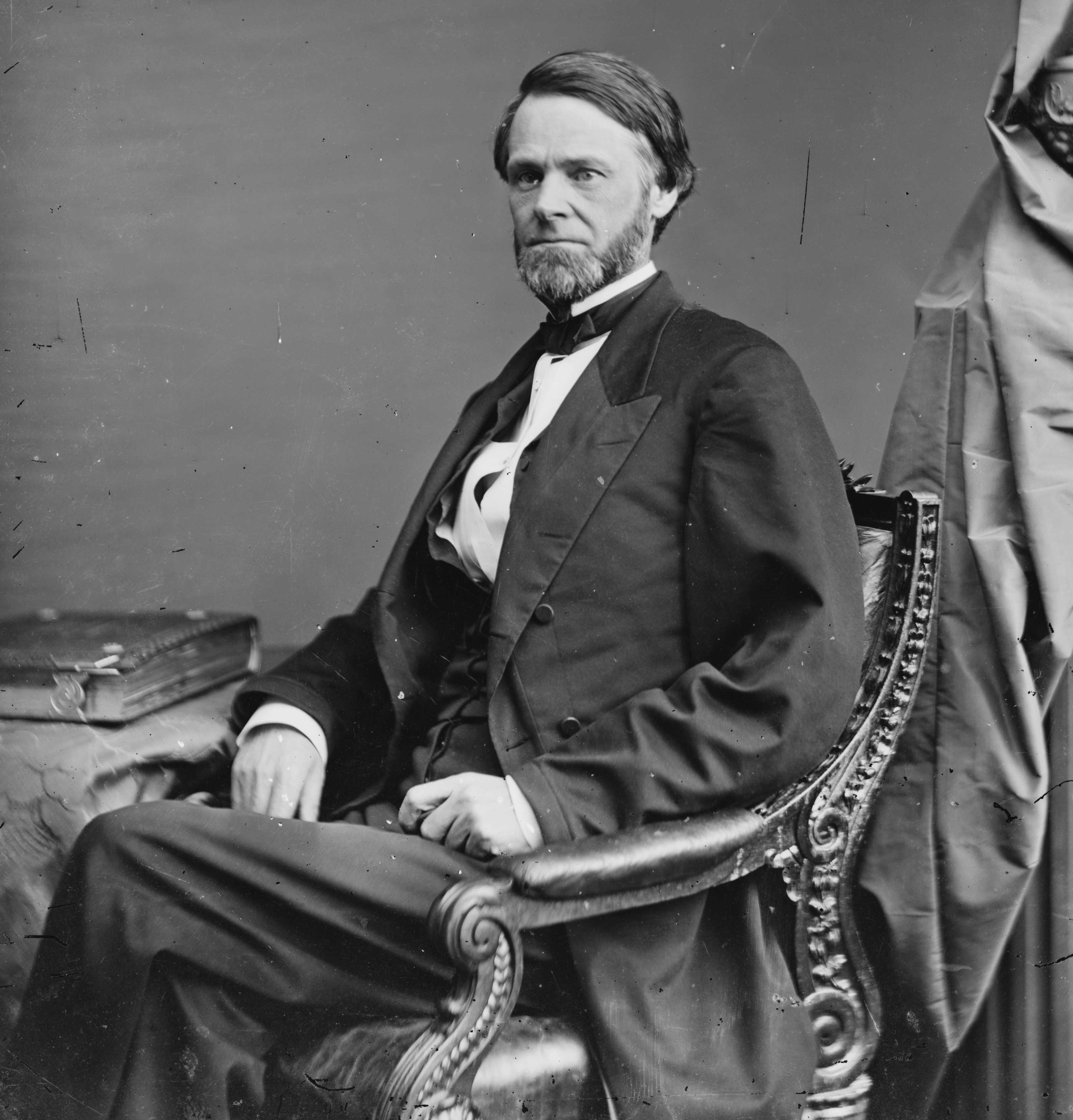
Friendly and Confidential (April 26, 1864)

Meade’s friends head home. The Overland Campaign approaches.

I have had a very satisfactory time with Cram, and am sorry he and Cadwalader are going back. I have sent by Mr. Cadwalader, who will stop in Philadelphia and give it to you, a copy of my testimony before the committee. You must keep this private and sacred. If anything should happen to me, you will have the means of showing to the world what my defense was.

My relations with Grant continue friendly and confidential, and I see no disposition on his part to take advantage of his position.

Meade’s correspondence taken from The Life and Letters of George Gordon Meade, Major-General United States Army, Vol. 2, (New York: Charles Scribner’s Sons, 1913), pp. 191-2. Available via Google Books.