Disputing Every Inch of Ground (May 30, 1864)

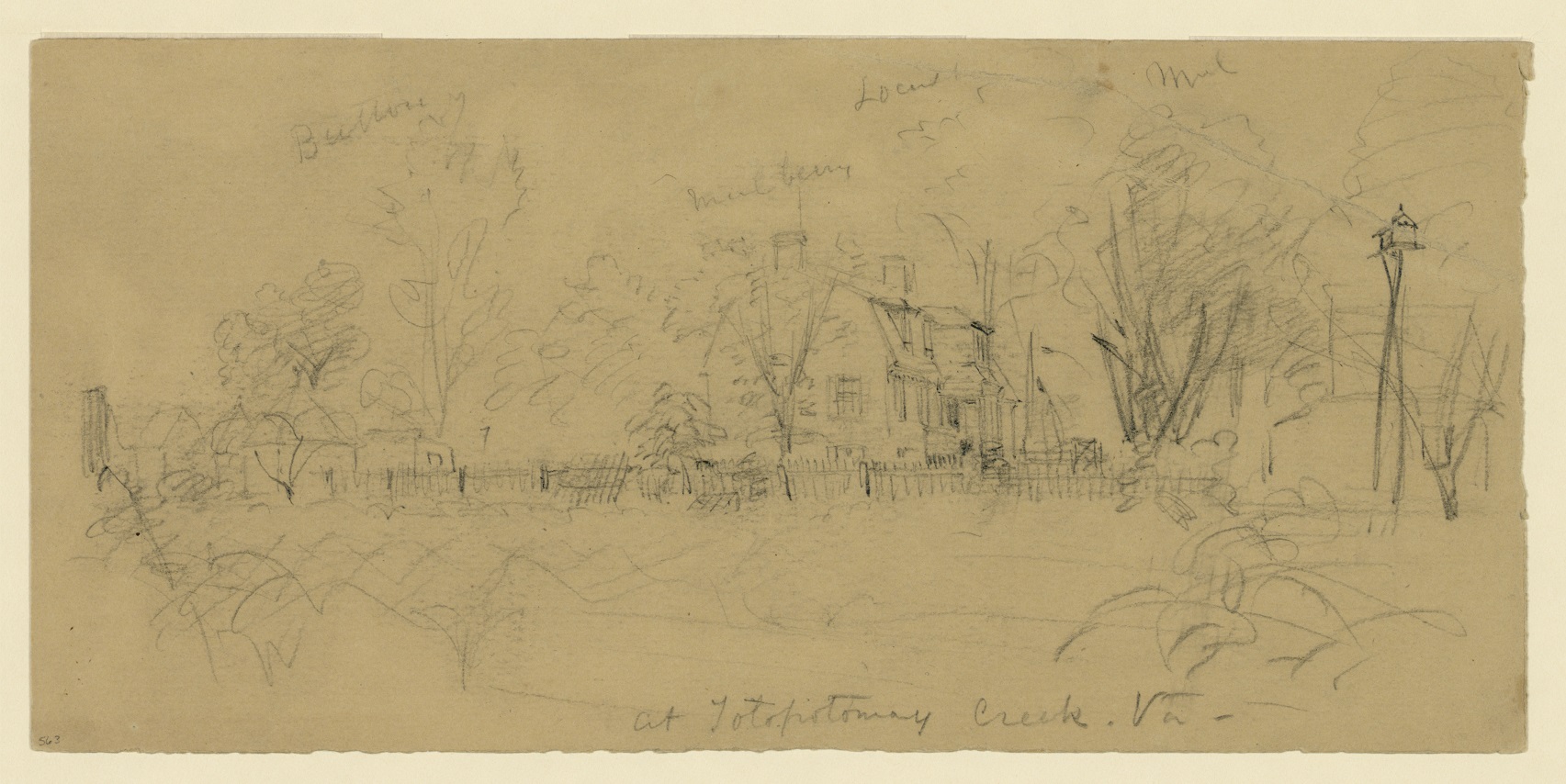
"At Totopotomoy Creek," a drawing Alfred Waud did around this time 150 years ago. Click to enlarge (Library of Congress).

“At Totopotomoy Creek,” a drawing Alfred Waud did around this time 150 years ago. Click to enlarge (Library of Congress).

I get the sense of George Meade tossing off quick notes to reassure his wife while his attention and energies are engaged in the huge task of moving his army through Virginia. Theodore Lyman, on the other hand, finds time to pen another long, detailed account of life in a blighted country.  Meade first.

We are within sixteen miles of Richmond, working our way along slowly but surely. I expect we shall be a long while getting in, but I trust through the blessing of God we will at last succeed, and if we do, I think, from the tone of the Southern press, and the talk of the prisoners, that they will be sensible enough to give it up. They are now fighting cautiously, but desperately, disputing every inch of ground, but confining themselves exclusively to the defensive.

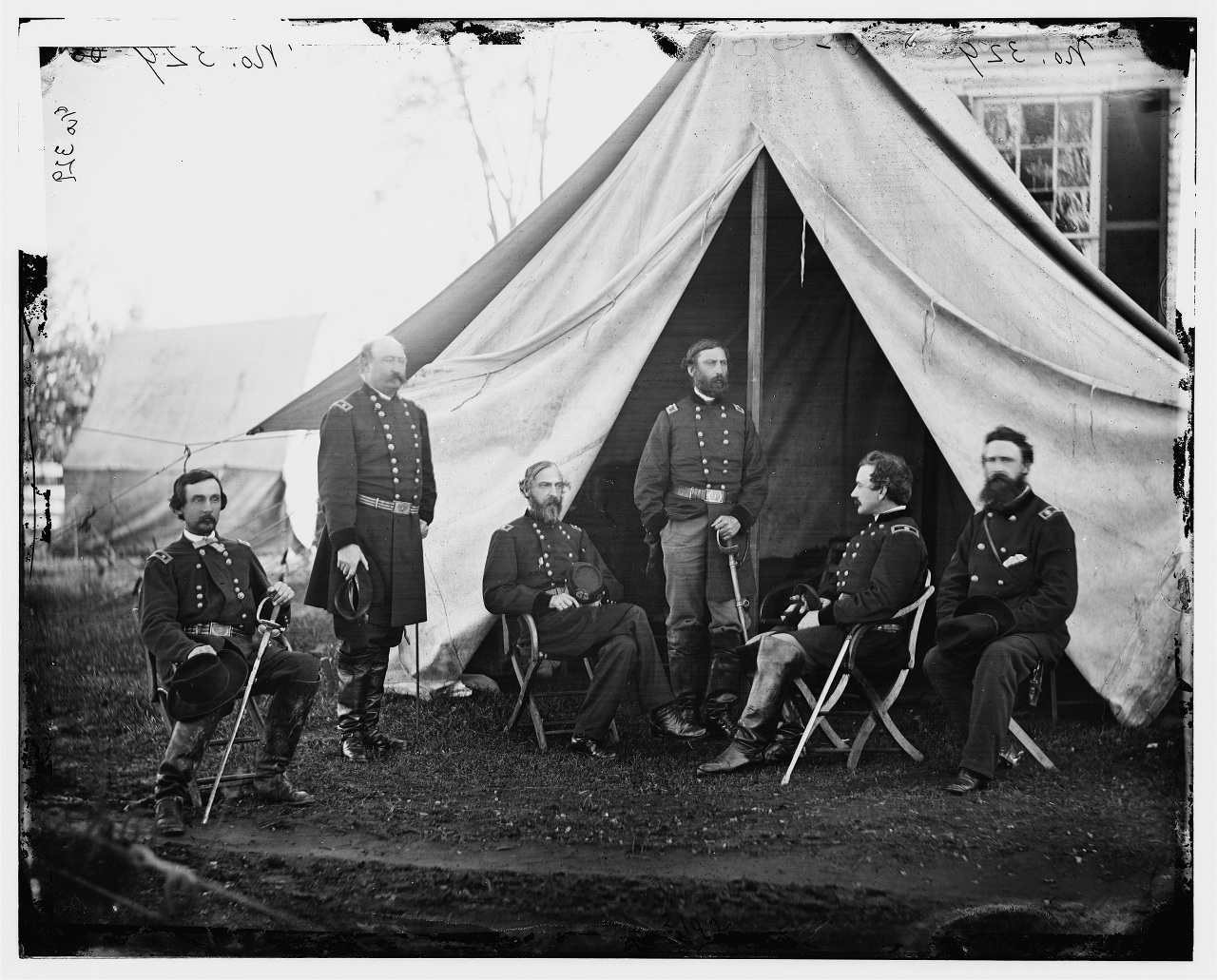
Mathew Brady took this photo of Winfield Scott Hancock with his staff and division commanders. Click to enlarge (Library of Congress).

Mathew Brady took this photo of Winfield Scott Hancock with his staff and division commanders. Click to enlarge (Library of Congress).

Theodore Lyman goes into much, much more detail in his letter of May 30. His journal entry for the same day ends with these ominous words: “The cavalry have reached Cold Harbor.”

It has been a tolerably quiet day, though there was a quite sharp fight at evening on our left — the Rebels badly used up. The people in Richmond must hear plainly the booming of our cannon: they scarcely can feel easy, for we are closing in on the old ground of McClellan. Fair Oaks was two years ago this very day. What armies have since been destroyed and rebuilt! What marchings and countermarchings, from the James to the Susquehanna! Still we cling to them — that is the best feature. There is, and can be, no doubt of the straits to which these people are now reduced; particularly, of course, in this distracted region; there is nothing in modern history to compare with the conscription they have. They have swept this part of the country of all persons under 50, who could not steal away. I have just seen a man of 48, very much crippled with rheumatism, who said he was enrolled two days ago. He told them he had thirteen persons dependent on him, including three grandchildren (his son-in-law had been taken some time since); but they said that made no difference; he was on his way to the rendezvous, when our cavalry crossed the river, and he hid in the bushes, till they came up. I offered him money for some of his small vegetables; but he said: “If you have any bread, I would rather have it. Your cavalry have taken all the corn I had left, and, as for meat, I have not tasted a mouthful for six weeks.” If you had seen his eyes glisten when I gave him a piece of salt pork, you would have believed his story. He looked like a man who had come into a fortune. “Why,” said he, “that must weigh four pounds — that would cost me forty dollars in Richmond! They told us they would feed the families of those that were taken; and so they did for two months, and then they said they had no more meal.” What is even more extraordinary than their extreme suffering, is the incomprehensible philosophy and endurance of these people. Here was a man, of poor health, with a family that it would be hard to support in peacetimes, stripped to the bone by Rebel and Union, with no hope from any side, and yet he almost laughed when he described his position, and presently came back with a smile to tell me that the only two cows he had, had strayed off, got into a Government herd, and “gone up the road” — that’s the last of them. In Europe, a man so situated would be on his knees, tearing out handfuls of hair, and calling on the Virgin and on several saints. There were neighbors at his house; and one asked me if I supposed our people would burn his tenement? “What did you leave it for?” I asked. To which he replied, in a concise way that told the whole: “Because there was right smart of bullets over thaar!” The poorest people seem usually more or less indifferent or adverse to the war, but their bitterness increases in direct ratio to their social position. Find a well-dressed lady, and you find one whose hatred will end only with death — it is unmistakable, though they treat you with more or less courtesy. Nor is it extraordinary: there is black everywhere; here is one that has lost an only son; and here another that has had her husband killed. People of this class are very proud and spirited; you can easily see it; and it is the officers that they supply who give the strong framework to their army. They have that military and irascible nature so often seen among an aristocracy that was once rich and is now poor; for you must remember that, before the war, most of these landowners had ceased to hold the position they had at the beginning of this century. There, that is enough of philosophizing; the plain fact being that General Robert Lee is entrenched within cannon range, in a sort of way that says, “I will fight you to my last gun and my last battalion!” We had not well got our tents pitched before the restless General, taking two or three of us, posted off to General Hancock. That is his custom, to take two or three aides and as many orderlies and go ambling over the country, confabbing with the generals and spying round the country roads. There, of course, was Hancock, in a white shirt (his man Shaw must have a hard time of it washing those shirts and sheets) and with a cheery smile. His much persecuted aides-de-camp were enjoying a noon-tide sleep, after their fatigues. The indefatigable [William] Mitchell remarked that there were many wood-ticks eating him, but that he had not strength to fight them! The firing was so heavy that, despite the late hour, General Meade ordered Hancock and Burnside to advance, so as to relieve Warren. Only Gibbon had time to form for an attack, and he drove back their front line and had a brief engagement, while the other commands opened more or less with artillery; and so the affair ended with the advantage on our side. — The swamp magnolias are in flower and the azaleas, looking very pretty and making a strong fragrance.

Meade’s correspondence taken from The Life and Letters of George Gordon Meade, Major-General United States Army, Vol. 2, (New York: Charles Scribner’s Sons, 1913), p. 199. Available via Google Books.

Theodore Lyman’s letter is from Meade’s Headquarters, 1863-1865: Letters of Colonel Theodore Lyman from the Wilderness to Appomattox, pp.132-4. Edited by George R. Agassiz. Boston, Massachusetts Historical Society, 1922. Available via Google Books.

A Tender-hearted Man (May 27, 1864)

Theodore Lyman shows us two sides of General Meade. One is the hot-tempered snapping turtle, the other a man who would give a southern family his lunch and five dollars.

David A. Russell of the VI Corps, photographed when he was the colonel of the 7th Massachusetts (Library of Congress).

David A. Russell of the VI Corps, photographed when he was the colonel of the 7th Massachusetts (Library of Congress).

Last night Russell’s trusty division of the 6th Corps set out on a very long march, as our advanced guard in a flank movement to the Chickahominy. . . . This necessitated our early “getting out of that,” for we were on the bank of the river, and the Rebel skirmishers would be sure to follow right down with the first daylight to the opposite side. Indeed, a little while after we were gone they did come down and fired into the telegraph waggon, wounding the side of the same. By four we had taken our breakfast and were in the saddle. Wonderful how promptly all the servants pack the things and strike the tents when they expect to be shot at! We rode first to Burnside, into whom the General pitched for cutting the march of General Warren and not sending up the brigades to hold the fords; and B. rather proved that he was right and Warren wrong. I can tell you aquafortis is mild to the Major-General commanding when he gets put out; which is quite not at all unfrequently; but I have seen him in no such fits as in the falling back from Culpeper to Centreville. Here he can lean upon Grant more or less, though he does all the work; so much so that Grant’s Staff really do nothing, with the exception of two or three engineer officers. Then we passed by the gushing Hancock, who explained what he was going to do, in his usual flowing style. At Chesterfield Station we found two divisions of the 6th Corps massed, and just then beginning to march out. They were issuing rations, to each man his bit of beef and his “hard tack.” We got ahead of the infantry and kept on the way, sending some cavalry ahead in case of wandering Rebels. The road was strown with dead horses, worn out and shot by the cavalry, when they came this way from their raid. Really whenever I may see civilized parts again, it will seem strange to see no deceased chargers by the roadside. We made a halt to let the column get up, at a poor house by the way. There were a lot of little children who were crying, and the mother too, for that matter — a thin ill-dressed common-looking woman. They said they had been stripped of nearly everything by the cavalry and expected to starve. So the soft-hearted General, who thought of his own small children, gave them his lunch, and five dollars also; for he is a tender-hearted man. We kept on, through a very poor and sandy country, scantily watered; for this was the ridge and there was no water except springs. At 9.30 we dismounted again at an exceptionally good farm, where dwelt one Jeter, . . . who was of a mild and weak-minded turn. He said he was pleased to see such well-dressed gentlemen, and so well-mannered; for that some others, who had been there two days since, had been quite rude and were very dusty; whereby he referred to the cavalry, who, I fear, had helped themselves. . . . About one o’clock, having ridden some twenty-two miles in all, we stopped at the house of one Thompson and, that afternoon, camped near by, just close to Mangohick Church. . . . I discovered to-day that the Lieutenant-General has sick-headaches periodically — one now, for example, for which he put some chloroform on his head.

Theodore Lyman’s letter is from Meade’s Headquarters, 1863-1865: Letters of Colonel Theodore Lyman from the Wilderness to Appomattox, pp.128-30. Edited by George R. Agassiz. Boston, Massachusetts Historical Society, 1922. Available via Google Books.

Generals (May 20, 1864)

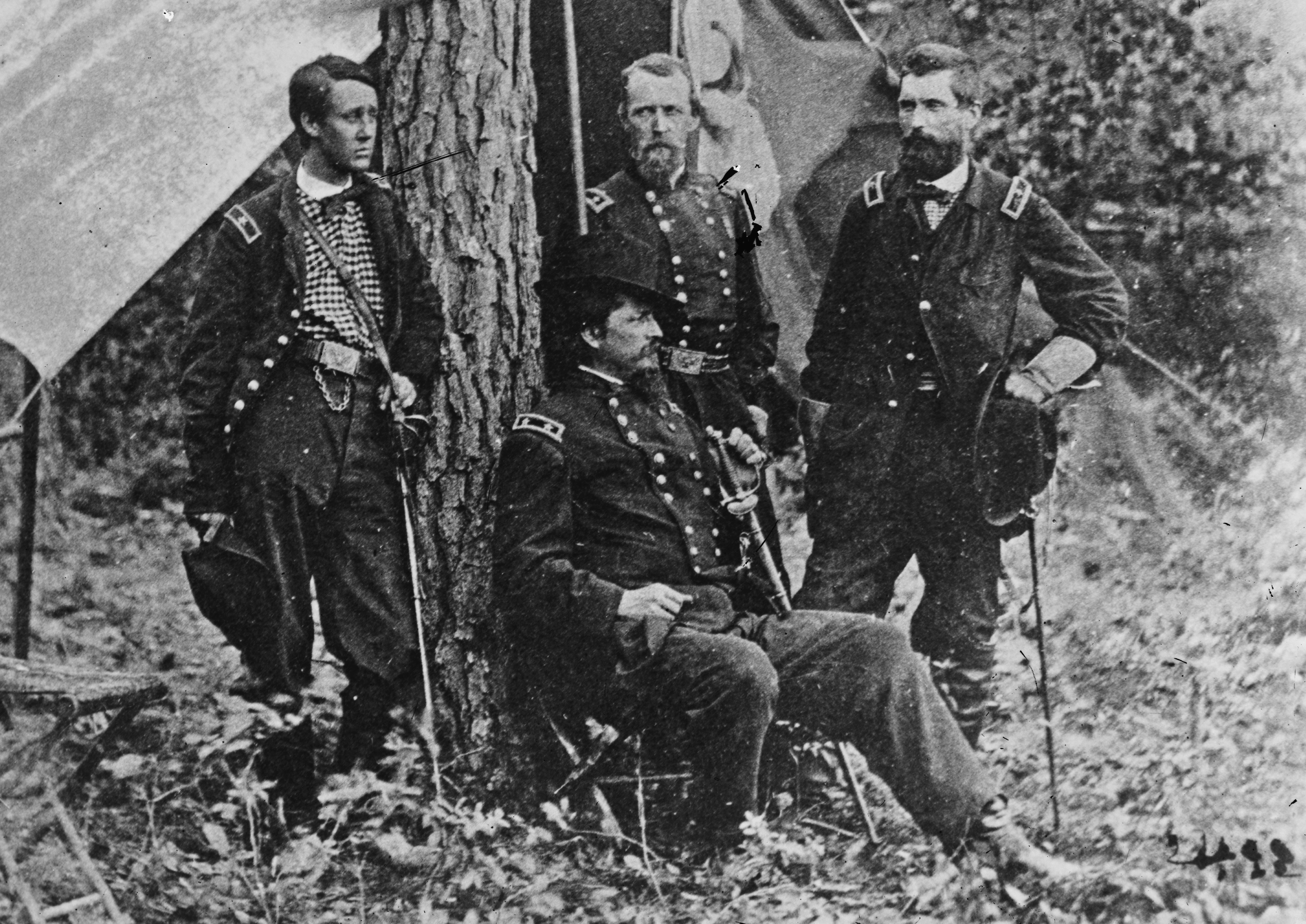
In this image taken at Cold Harbor in 1864, Winfield Scott Hancock (seated) poses with (left to right) Francis Barlow, David Birney, and John Gibbon. Lyman mentions all four generals in his letter of May 20, 1864 (Library of Congress).

In this image taken at Cold Harbor in 1864, Winfield Scott Hancock (seated) poses with (left to right) Francis Barlow, David Birney, and John Gibbon. Lyman mentions all four generals in his letter of May 20, 1864 (Library of Congress).

There’s no letter from Meade on May 20, but Theodore Lyman contributes another detailed report. One of the people he mentions is Francis Barlow. Like Lyman, Barlow was a Harvard man. He had practiced law before the war and looked more like a newsboy than a general, but Barlow had been wounded at Antietam and left for dead at Gettysburg (after posting his XI Corps division in a too-extended position). He carried an especially large sword—so that when he hit stragglers with it, he would hurt them, he told Lyman. Lyman called him “an eccentric officer.”

Lyman also writes about the death of Maj. Gen. John Sedgwick. Col. Martin McMahon, the officer who informed Lyman of General John Sedgwick’s death, wrote an account of the incident that appeared in Battles and Leaders of the Civil War (Vol IV, p. 175). Here’s what he wrote:

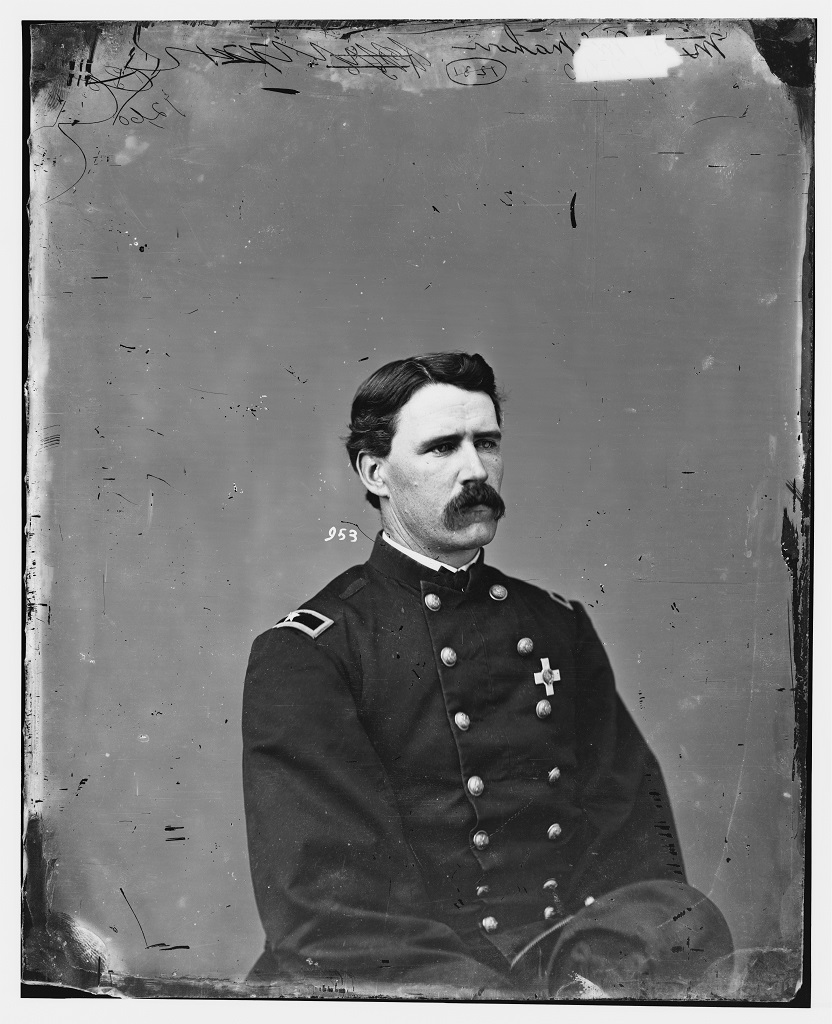
Col. Martin McMahon (Library of Congress).

Col. Martin McMahon (Library of Congress).

I gave the necessary order to move the troops to the right, and as they rose to execute the movement the enemy opened a sprinkling fire, partly from sharp-shooters. As the bullets whistled by, some of the men dodged. The general said laughingly, “What! what! men, dodging this way for single bullets! What will you do when they open fire along the whole line? I am ashamed of you. They couldn’t hit an elephant at this distance.” A few seconds after, a man who had been separated from his regiment passed directly in front of the general, and at the same moment a sharp-shooter’s bullet passed with a long shrill whistle very close, and the soldier, who was then just in front of the general, dodged to the ground. The general touched him gently with his foot, and said, “Why, my man, I am ashamed of you, dodging that way,” and repeated the remark, “They couldn’t hit an elephant at this distance.” The man rose and saluted, and said good-naturedly, “General, I dodged a shell once, and if I hadn’t, it would have taken my head off. I believe in dodging.” The general laughed and replied, “All right, my man; go to your place.”

For a third time the same shrill whistle, closing with a dull, heavy stroke, interrupted our talk, when, as I was about to resume, the general’s face turned slowly to me, the blood spurting from his left cheek under the eye in a steady stream. He fell in my direction; I was so close to him that my effort to support him failed, and I fell with him.

Colonel Charles H. Tompkins, chief of the artillery, standing a few feet away, heard my exclamation as the general fell, and, turning, shouted to his brigade-surgeon, Dr. Ohlenschlager. Major Charles A. Whittier, Major T. W. Hyde, and Lieutenant-Colonel Kent, who had been grouped near by, surrounded the general as he lay. A smile remained upon his lips but he did not speak. The doctor poured water from a canteen over the general’s face. The blood still poured upward in a little fountain. The men in the long line of rifle-pits, retaining their places from force of discipline, were all kneeling with heads raised and faces turned toward the scene; for the news had already passed along the line.

I was recalled to a sense of duty by General Ricketts, next in command, who had arrived on the spot, and informed me, as chief-of-staff, that he declined to assume command of the corps, inasmuch as he knew that it was General Sedgwick’s desire, if anything should happen to him, that General Horatio G. Wright, of the Third Division, should succeed him. General Ricketts, therefore, suggested that I communicate at once with General Meade, in order that the necessary order should bo issued. When I found General Meade he had already heard the sad intelligence, and had issued the order placing General Wright in command. Returning I met the ambulance bringing the dead general’s body, followed by his sorrowing staff. The body was taken back to General Meade’s headquarters, and not into any house. A bower was built for it of evergreens, where, upon a rustic bier, it lay until nightfall, mourned over by officers and soldiers. The interment was at Cornwall Hollow, Connecticut.

Now let’s see what Lyman had to say on May 20, 1864.

To-day has been entirely quiet, our pickets deliberately exchanging papers, despite orders to the contrary. These men are incomprehensible— now standing from daylight to dark killing and wounding each other by thousands, and now making jokes and exchanging newspapers! You see them lying side by side in the hospitals, talking together in that serious prosaic way that characterizes Americans. The great staples of conversation are the size and quality of rations, the marches they have made, and the regiments they have fought against. All sense of personal spite is sunk in the immensity of the contest.

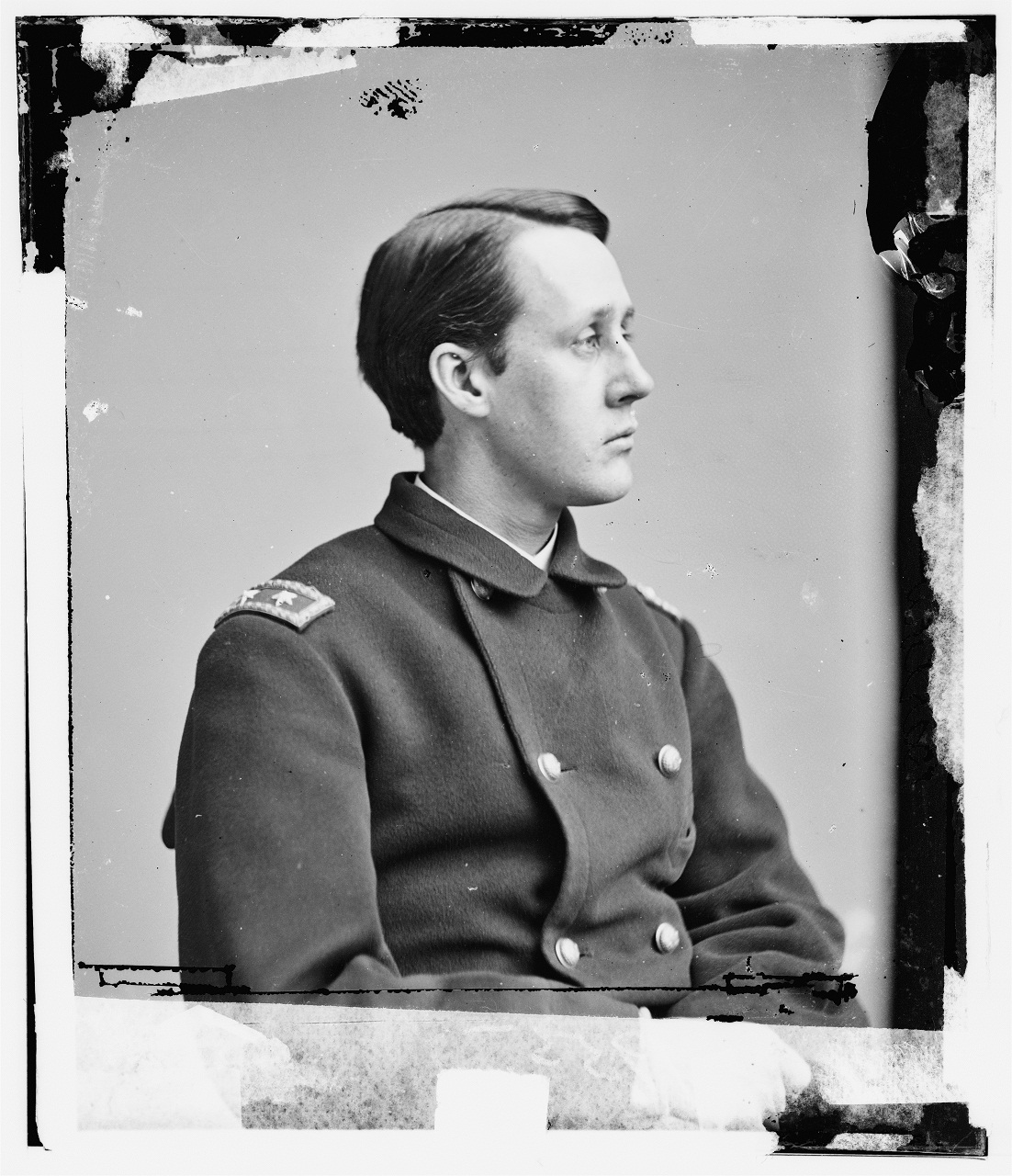
Francis C. Barlow (Library of Congress).

Francis C. Barlow (Library of Congress).

In my letter of yesterday I got you as far as the evening of Sunday the 8th. On Monday, the 9th, early, Burnside was to come down the Spotsylvania and Fredericksburg road to the “Gate,” thus approaching on the extreme left; Sedgwick and Warren respectively occupied the left and right centre, while Hancock, in the neighborhood of Todd’s Tavern, covered the right flank; for you will remember that the Rebel columns were still moving down the Parker’s Store road to Spotsylvania, and we could not be sure they would not come in on our right flank and rear. Betimes in the morning General Meade, with three aides, rode back to General Hancock, and had a consultation with him. The day was again hot and the dust thicker and thicker. As we stood there under a big cherry tree, a strange figure approached; he looked like a highly independent mounted newsboy; he was attired in a flannel checked shirt; a threadbare pair of trousers, and an old blue kepi; from his waist hung a big cavalry sabre; his features wore a familiar sarcastic smile. It was General Barlow, commanding the 1st division of the 2d Corps, a division that for fine fighting cannot be exceeded in the army. There, too, was General Birney, also in checked flannel, but much more tippy than Barlow, and stout General Hancock, who always wears a clean white shirt (where he gets them nobody knows); and thither came steel-cold General Gibbon, the most American of Americans, with his sharp nose and up-and-down manner of telling the truth, no matter whom it hurts. . . .

Major General John Sedgwick. His men called him "Uncle John" (Library of Congress).

Major General John Sedgwick. His men called him “Uncle John” (Library of Congress).

It was about ten o’clock, and I was trotting down the Piney Branch road, when I met Colonel McMahon, Adjutant-General of the 6th Corps; I was seriously alarmed at the expression of his face, as he hurriedly asked where General Meade was. I said, “What is the matter?” He seemed entirely unnerved as he replied: “They have hit General Sedgwick just here under the eye, and, my God, I am afraid he is killed!” It was even so: General Sedgwick, with a carelessness of consequences for which he was well known, had put his Headquarters close on the line of battle and in range of the sharpshooters. As he sat there, he noticed a soldier dodging the bullets as they came over. Rising from the grass, he went up to the man, and, laying his hand on his shoulder, said, “Why, what are you dodging for? They could not hit an elephant at that distance.” As he spoke the last word, he fell, shot through the brain by a ball from a telescopic rifle. . . . The dismay of General Sedgwick’s Staff was a personal feeling; he was like a kind father to them, and they loved him really like sons. So fell “good Uncle John,” a pure and great-hearted man, a brave and skilful soldier. From the commander to the lowest private he had no enemy in this army. . . .

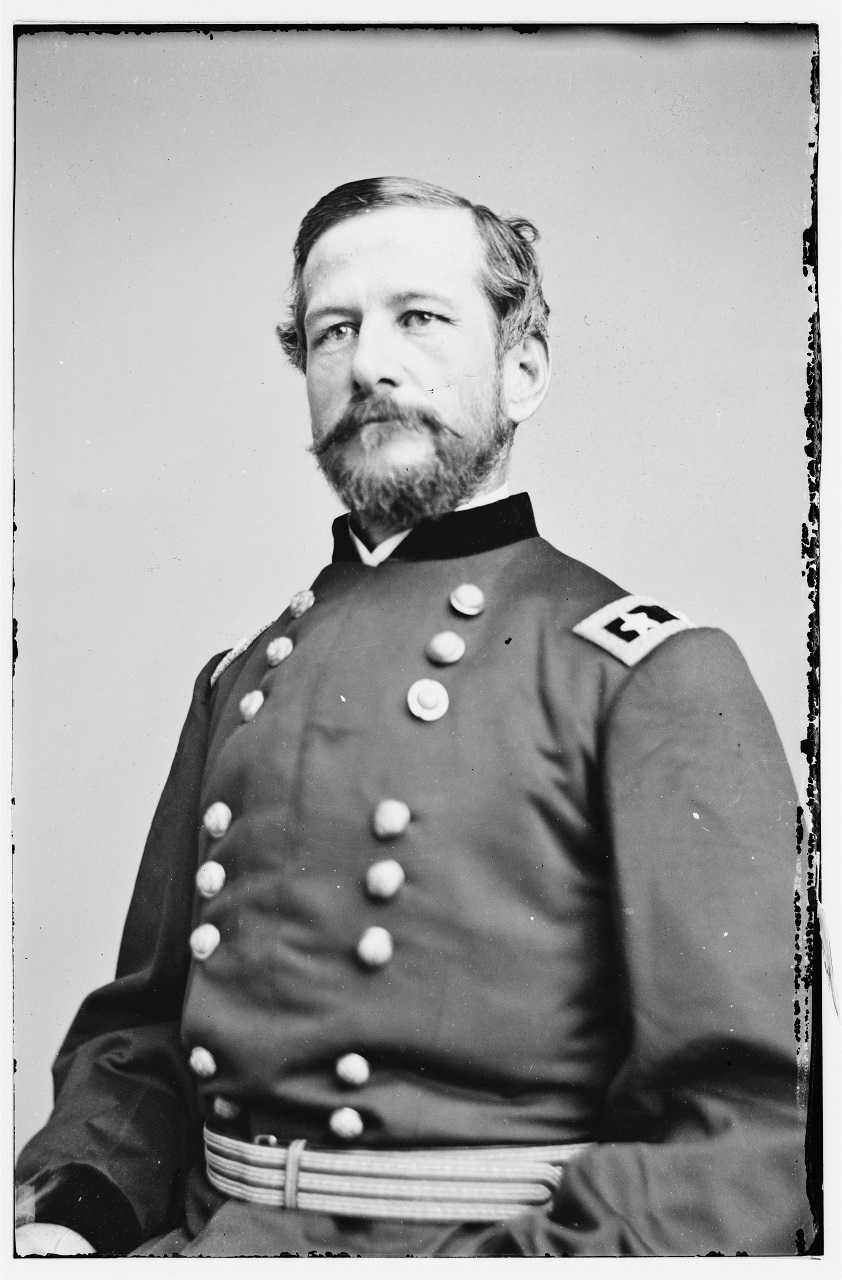
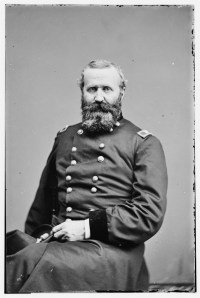
General Andrew Atkinson Humphreys. (Library of Congress)

General Andrew Atkinson Humphreys. (Library of Congress)

I found General Meade with Generals Wright, Warren, and Humphreys consulting together in the same spot where Grant sat yesterday among the bullets, for no apparent reason. You never saw such an old bird as General Humphreys! I do like to see a brave man; but when a man goes out for the express purpose of getting shot at, he seems to me in the way of a maniac. … In the afternoon there was some fighting on the right centre, without result; Burnside pushed down on the left, driving the enemy before him; and so the day closed, our army crowding in on Lee and he standing at bay and throwing up breastworks.

Theodore Lyman’s letter is from Meade’s Headquarters, 1863-1865: Letters of Colonel Theodore Lyman from the Wilderness to Appomattox, pp 106-108. Edited by George R. Agassiz. Boston, Massachusetts Historical Society, 1922. Available via Google Books.

A Few Lines (May 15, 1864)

On the night of May 15, 1864, both George Meade and Theodore Lyman sat down to put pen to paper and write letters home. Meade’s is short. As he often is, the general is concerned with how others think of his work. He has reason to feel good about it. The letter from Secretary of War Edwin Stanton read in part, “This department congratulates you and your heroic Army and returns its cordial thanks for their gallant achievements during the last seven days, and hopes that the valor and skill thus far manifested will be crowned with the fruits of ultimate and decisive victory.” The dispatch from Grant is quoted here.

One thing Meade does not mention is how close he came to being captured on the previous day, May 14. Here’s what I wrote in Searching for George Gordon Meade: The Forgotten Victor of Gettysburg:

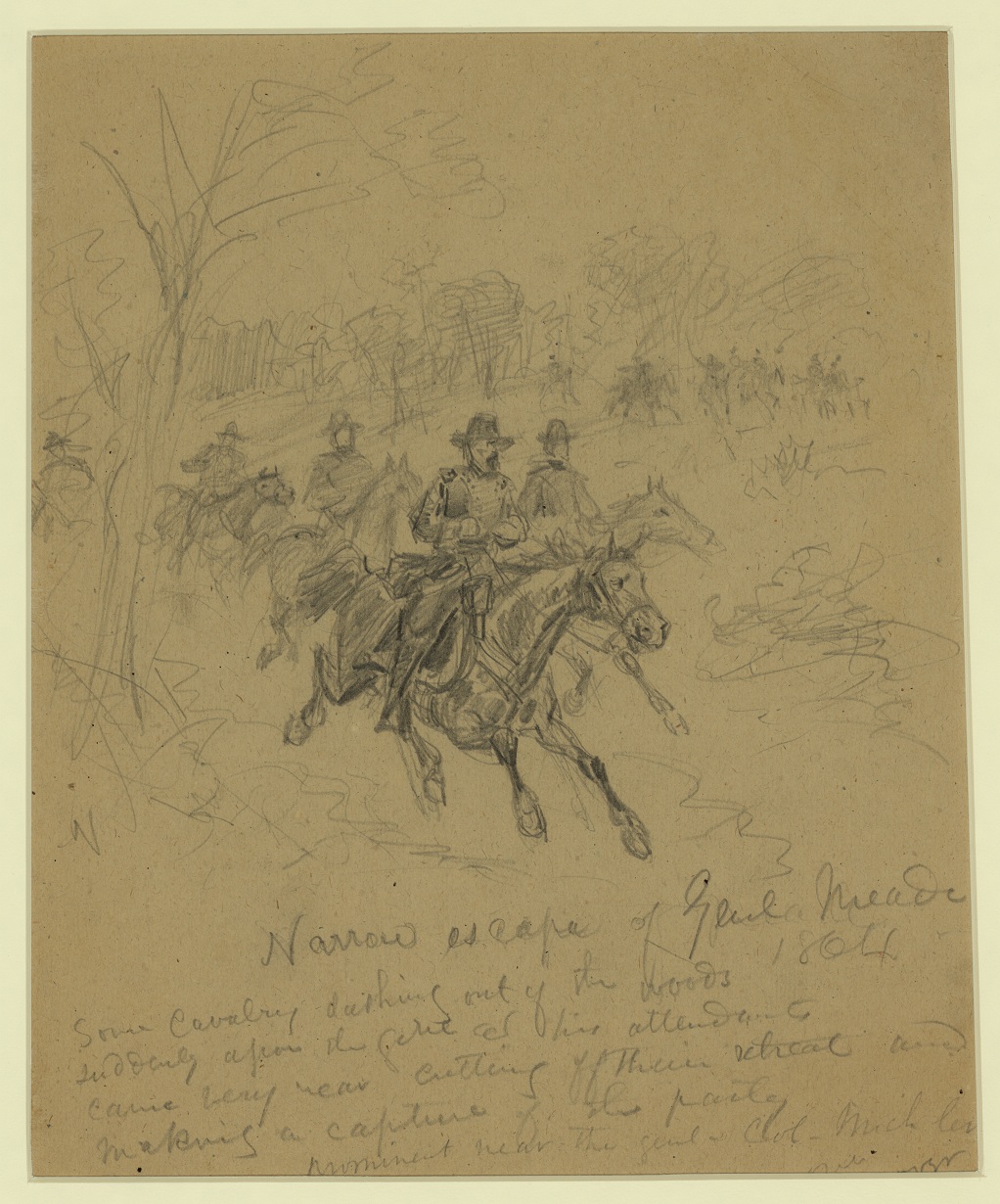
Artist Alfred Waud made a sketch of Meade's near capture by the Confederates on May 14 (Library of Congress).

Artist Alfred Waud made a sketch of Meade’s near capture by the Confederates on May 14 (Library of Congress).

On May 14 Meade almost fell into enemy hands when he rode forward to observe the Union position on Myer’s Hill . . . . Upton’s brigade was holding this forward position when Meade and Horatio Wright rode forward to examine the ground. The generals were conferring inside the house when the rattle of muskets and the thud of bullets striking the building delivered unwelcome news: the Confederates were attacking. Meade had to move fast. He jumped on his horse and, guided by Capt. Nathaniel Michler, a topographical engineer with some knowledge of the terrain, hastily made his way back toward the Ni River. A Confederate major galloped over to intercept him and even grabbed Meade’s bridle before his headquarters guard intervened and captured the rebel. The only thing Meade lost, other than his dignity, was his glasses.
Charles Griffin. Like Meade, he had an explosive temper (Library of Congress).

Charles Griffin. Like Meade, he had an explosive temper (Library of Congress).

Theodore Lyman’s account of the fighting is much more detailed, the start of a fascinating and detailed account of the Overland Campaign. His letter of May 15 covers only the first day of fighting in the Wilderness. In it he mentions how General Charles Griffin rode up to headquarters and complained that Horatio Wright and the VI Corps had not protected the right of Griffin’s V Corps division. A footnote in the collection of Lyman’s letters includes a further description from Lyman’s journal. He wrote, “2.45. Griffin comes in, followed by his mustering officer, Geo. Barnard. He is stern and angry. Says in a loud voice that he drove back the enemy, Ewell, ¾ of a mile, but got no support on the flanks, and had to retreat—the regulars much cut up. Implies censure on Wright, and apparently also on his corps commander, Warren. Wadsworth also driven back. Rawlins got very angry, considered the language mutinous, and wished him put in arrest. Grant seemed of the same mind and asked Meade: ‘Who is this General Gregg? You ought to arrest him!’ Meade said: ‘It’s Griffin, not Gregg; and it’s only his way of talking.’” 

I have often read a little coda to that incident and I tracked it down to The Wilderness Campaign by Edward Steere, a book my publisher, Stackpole Books (then the Stackpole Company), issued way back in 1960. In Steere’s account, Grant stood up and began fastening the buttons of his blouse and as Meade spoke, “seeking as it were to placate an angry child with soothing words,” he helped Grant with his buttons. “Grant fastened the middle button without further comment,” Steere continued. “Resuming his seat, he lit a fresh cigar and lapsed into meditation.”

I always found this odd and out of character. I couldn’t imagine George Meade helping Grant button his shirt, picturesque as that image may be. Surely Lyman would have mentioned something so unusual. Then I read Steere’s footnote. “The author admits to a slight embellishment of Lyman’s account,” he wrote. “Lyman abruptly concludes with Meade’s remark: ‘And it’s only his way of talking.’ While a reasonable presumption, there is no documentary evidence that Grant lit a fresh cigar.” Or that Meade helped him with his clothing. While I’m glad Steere pointed out his fabrication, I wonder why he made that stuff up in the first place. It may be okay for historical fiction, but it’s not good history.

Spottsylvania Court House Battle-field, May 15, 9 p.m.

A lull in the roar of battle enables me to write you a few lines. It has been raining hard, both yesterday and to-day, putting the roads in such condition as to compel both armies to keep still—a rest that the men on both sides were glad to have. I do not see the papers, and therefore cannot tell how true their accounts are, and I have not time to give you any details. I think we have gained decided advantages over the enemy; nevertheless, he confronts us still, and, owing to the strong position he occupies, and the works he is all the time throwing up, the task of overcoming him is a very difficult one, taxing all our energies. I send you a letter received from the Secretary of War, for safe keeping, as it shows I am not utterly ignored by the Department. General Grant showed me a despatch he had written to the War Department, speaking in complimentary terms of my services, and asking I be made a major general in the regular army. I told him I was obliged to him for his good opinion, but that I asked and expected nothing from the Government, and that I did not myself attach any importance to being in the regular army, so long as I held an equal rank in the volunteer service. What the result will be I cannot tell.

Here is Lyman’s account of the first day’s fight in the Wilderness:

Well, to be more or less under fire, for six days out of seven, is not very good for the nerves, or very pleasant. But now that there is a quiet day, I thought I would make a beginning of describing to you the sad, bloody work we have been at. I will write enough to make a letter and so go on in future letters, only writing what can now be of no importance to the enemy. The morning of Wednesday the 4th of May (or rather the night, for we were up by starlight) was clear and warm. By daylight we had our breakfast, and all was in a hurry with breaking up our winter camp. To think of it to-night makes it seem a half-year ago; but it is only eleven days. About 5.30 A.m. we turned our backs on what had been our little village for six months.

Already the whole army had been some hours in motion. The 5th Corps, followed by the 6th, was to cross at Germanna Ford, and march towards the Orange pike. The 2d Corps to march on Chancellorsville, crossing at Ely’s Ford; each corps was preceded by a division of cavalry, to picket the roads and scour the country. The main wagon train rested on the north side at Richardsville. So you see the first steps were much like the Mine Run campaign. I have drawn a little map to help you in understanding; not very exact in proportions, but still enough so.

Lyman mapThe roads were hard and excellent, full of waggons and black with troops; as we got past Stevensburg and went through a more wooded country, there were the little green leaves just opening, and purple violets, in great plenty, by the wayside. As the sun got fairly up, it grew much warmer, as one could see by the extra blankets and overcoats that our men threw away, whenever they halted. By 8 a.m. we drew near the Ford, and halted at a familiar spot, where we had our camp on the Mine Run campaign. How bitterly cold it was then! And now there was green grass all about, and wild flowers. Griffin’s division was already over, and the others were following steadily on. At 9.30 we went over ourselves, and, for a long time, I sat on the high bank, some seventy feet above the river, watching the steady stream of men and cannon and trains pouring over the pontoons. It was towards six in the evening before the last were across; and then one bridge was left for Burnside to cross by; for he was marching in all haste, from Rappahannock station. Meantime the head of the 5th Corps had reached the Orange pike, and that of the 2d, Chancellorsville. The Headquarters pitched their now reduced tents on the bank of the river that night, and I went down and took a slight bath in the stream, by way of celebrating our advance. General Grant came up betimes in the morning and had his tents near ours. He has several very sensible officers on his Staff, and several very foolish ones, who talked and laughed flippantly about Lee and his army. But they have changed their note now, and you hear no more of their facetiousness. The more experienced officers were sober, like men who knew what work was ahead. Our first grief was a ludicrous one. Our cook, a small Gaul, had mysteriously disappeared, and all we had left to cook for us was a waiter lad, who however rose with the occasion and was very conspicuous for activity. It turned out after, that the cook was arrested as a suspicious person, despite his violent protestations. . . .

We were off betimes the next morning (Thursday, May 5th), and about 7 o’clock got to the junction of the plank and pike, the troops meantime marching past us, as we stood waiting news from the front. Presently Griffin (5th Corps), who was two miles out on the pike (going west), reported the enemy in his front; while the cavalry, thrown out on the plank road, towards Parker’s Store, sent to say that the Rebel infantry were marching down in force, driving them in. General Wright’s division of the 6th Corps was turned off the Germanna plank to the right and ordered to march down the cross-road you see on the map, leading to the pike; and he and Griffin were directed to press the enemy and try to make a junction by their wings. At 10.40 A.m. General Getty’s division (6th Corps) was sent to hold the Orange plank road. It marched down the Germanna plank and took the little cross-road where the dotted line is, and got to the Orange plank just in time to stop the advance of A. P. Hill’s Corps. Meantime the rest of the 5th Corps was ordered into position on the left of, or in support of, General Griffin, about parallel to the most westerly dotted line, crossing the pike. Word was sent to 2d Corps, near Chancellorsville, that the Rebels were moving on us, and ordering Hancock to at once bring his men across to the Brock road and so take position on the left in support of General Getty. At noon, I was sent to General Getty, to tell him the disposition of the various troops and to direct him to feel along to his right, and find roads to communicate with the left of the 5th Corps, where, you will see, there was a considerable gap. Our Headquarters were on a piney knoll near the join of the Germanna plank and the pike. I rode down the dotted cross-road and came immediately on General Eustis, just putting his brigade into the woods, on Getty’s right. I stopped and directed him to throw out well to the right and to try to find Crawford, or a road to him.

Here it is proper to say something of the nature of this country, whereof I have already spoken somewhat during Mine Run times. A very large part of this region, extending east and west along the plank and pike, and the south, nearly to Spotsylvania, is called “The Wilderness,” a most appropriate term—a land of an exhausted, sandy soil, supporting a more or less dense growth of pine or of oak. There are some cleared spaces, especially near Germanna plank, where our Headquarters are marked. The very worst of it is parallel with Orange plank and upper part of the Brock road. Here it is mostly a low, continuous, thick growth of small saplings, fifteen to thirty feet high and seldom larger than one’s arm. The half-grown leaves added to the natural obscurity, and there were many places where a line of troops could with difficulty be seen at fifty yards. This was the terrain on which we were called to manoeuvre a great army. I found General Getty at the plank road (a spot I shall remember for some years) and gave him instructions. He told me the whole of Hill’s Corps was in his front and the skirmishers only 300 yards from us. For all I could see they might have been in Florida, but the occasional wounded men who limped by, and the sorry spectacle of two or three dead, wrapped in their blankets, showed that some fighting had already taken place. I got back and reported a little before one o’clock, and had scarcely got there when B-r-r-r-r wrong went the musketry, in front of Griffin and of Wright, which for the next hour and a half was continuous—not by volley, for that is impossible in such woods; but a continuous crackle, now swelling and now abating, and interspersed with occasional cannon. Very soon the ambulances began to go forward for their mournful freight. A little before two, I was sent with an order to a cavalry regiment, close by. The pike was a sad spectacle indeed; it was really obstructed with trains of ambulances and with the wounded on foot; all had the same question, over and over again; “How far to the 5th Corps’ hospital?” As I returned, I saw, coming towards me, a mounted officer—his face was covered with blood and he was kept in the saddle only by an officer who rode beside him and his servant who walked on the other side. “Hullo, Lyman!” he cried, in a wild way that showed he was wandering; “here I am; hurt a little; not much; I am going to lie down a few minutes, and then I am going back again! Oh, you ought to have seen how we drove ’em—I had the first line!” It was my classmate, Colonel Hayes, of the 18th Massachusetts; as fearless a soldier as ever went into action. There we were, three of us together, for the officer who supported him was Dr. Dalton. Three classmates together, down in the Virginia Wilderness, and a great fight going on in front. I was afraid Hayes was mortally hurt, but I am told since, he will recover. I trust so.
Alexander Hays was killed in the Wilderness (Library of Congress).

Alexander Hays was killed in the Wilderness (Library of Congress).

Gradually the musketry died away; and, at a quarter before three, General Griffin rode up —his face was stern and flushed, as it well might be. He said he had attacked and driven Ewell’s troops three quarters of a mile, but that Wright had made no join on his right and Wadsworth had been forced back on his left, so that with both flanks exposed he had been obliged to fall back to his former position. Meantime we got word that the head of Hancock’s column had moved up the Brock road and made a junction with Getty. At 3.15 I was sent with an order to General Getty to attack at once, and to explain to him that Hancock would join also. He is a cool man, is Getty, quite a wonder; as I saw then and after. “Go to General Eustis and General Wheaton,” he said to his aides, “and tell them to prepare to advance at once.” And so we were getting into it! And everybody had been ordered up, including Burnside, who had crossed that very morning at Germanna Ford. General Grant had his station with us (or we with him); there he took his seat on the grass, and smoked his briarwood pipe, looking sleepy and stern and indifferent. His face, however, may wear a most pleasing smile, and I believe he is a thoroughly amiable man. That he believes in his star and takes a bright view of things is evident. At 4.15 P.m. General Meade ordered me to take some orderlies, go to General Hancock (whose musketry we could now hear on the left) and send him back reports, staying there till dark. Delightful! At the crossing of the dotted cross-road with the plank sat Hancock, on his fine horse—the preux chevalier of this campaign—a glorious soldier, indeed! The musketry was crashing in the woods in our front, and stray balls—too many to be pleasant—were coming about. It’s all very well for novels, but I don’t like such places and go there only when ordered. “Report to General Meade,” said Hancock, “that it is very hard to bring up troops in this wood, and that only a part of my Corps is up, but I will do as well as I can.” Up rides an officer: “Sir! General Getty is hard pressed and nearly out of ammunition!” “Tell him to hold on and General Gibbon will be up to help him.” Another officer: “General Mott’s division has broken, sir, and is coming back.” “Tell him to stop them, sir!!” roared Hancock in a voice of a trumpet. As he spoke, a crowd of troops came from the woods and fell back into the Brock road. Hancock dashed among them. “Halt here! halt here! Form behind this rifle-pit. Major Mitchell, go to Gibbon and tell him to come up on the double-quick!” It was a welcome sight to see Carroll’s brigade coming along that Brock road, he riding at their head as calm as a May morning. “Left face—prime—forward,” and the line disappeared in the woods to waken the musketry with double violence. Carroll was brought back wounded. Up came Hays’s brigade, disappeared in the woods, and, in a few minutes, General Hays was carried past me, covered with blood, shot through the head.

Meade’s correspondence taken from The Life and Letters of George Gordon Meade, Major-General United States Army, Vol. 2, (New York: Charles Scribner’s Sons, 1913), p. 195. Available via Google Books.

Theodore Lyman’s correspondence is from Meade’s Headquarters, 1863-1865: Letters of Colonel Theodore Lyman from the Wilderness to Appomattox, pp. 85-92. Edited by George R. Agassiz. Boston, Massachusetts Historical Society, 1922. Available via Google Books.

Letters from the Front (May 11-13, 1864)

Alfred Waud called this sketch "The toughest fight yet. The fight for the salient" (Library of Congress. Click to enlarge).

Alfred Waud called this sketch of the fighting for the Mule Shoe at Spotsylvania “The toughest fight yet. The fight for the salient” (Library of Congress. Click to enlarge).

Since the last time George Meade wrote home to his wife his army had undergone some serious punishment—and did some punishing itself. First came the two bloody days in the Wilderness and then the horrible, terrible fighting at Spotsylvania. The fighting for the bulge—the salient—in Lee’s lines that came to be called the Mule Shoe (and a portion of that was baptized the “Bloody Angle”) had ended with the Confederates pulling back to a second line. Although this appeared to be a victory for the Union forces, it merely moved the fighting to a new position. As I write in Searching for George Gordon Meade: The Forgotten Victor of Gettysburg, “After the rebels retreated, Rufus Dawes and his men from the 6th Wisconsin moved forward to occupy their entrenchments. They found a scene from hell. Dead and wounded men lay everywhere in the mud and filth. Dawes saw one corpse propped up in the corner, the head missing and the neck and shoulders badly burned. Dawes presumed it was the work of a Union mortar.

“Horace Porter surveyed the result of the fighting the next day and found it ‘harrowing in the extreme. Our own killed were scattered over a large space near the “angle,” while in front of the captured breastworks the enemy’s dead, vastly more numerous than our own, were piled upon each other in some places four layers deep, exhibiting every ghastly phase of mutilation. Below the mass of fast-decaying corpses, the convulsive twitching of limbs and the writhing of bodies showed that there were wounded men still alive and struggling to extricate themselves from their horrid entombment.’ Another soldier who witnessed the devastation called it ‘the most horrible sight I had ever witnessed.’

“That same day Grant wrote to Stanton: ‘General Meade has more than met my most sanguine expectations. He and Sherman are the fittest officers for large commands I have come in contact with. If their services can be rewarded by promotion to the ranks of major-generals in the regular army the honor would be worthily bestowed, and I would feel personally gratified. I would not like to see one of these promotions at this time without seeing both.’”

Battle-field, Spottyslvania Court House, May 11—9 a.m.

I have only time to tell you we are all safe—that is, George and myself—and as far as I know, all your friends, except General Wadsworth, who fell into the hands of the enemy, mortally wounded, without hopes of life.

We have been fighting continuously for six days, and have gotten, I think, decidedly the better of the enemy, though their resistance is most stubborn.

Return thanks to the Almighty for the gracious protection extended to us, and let us try to deserve its continuance.

I am quite well and in good spirits, and hope we shall continue to be successful and bring this unhappy war to an honorable close.

May 12, 1864—2 o’clock, p.m.

A severe battle is raging, with the advantages thus far on our side. We have captured to-day over thirty guns, four thousand prisoners, including three generals. The enemy are strongly posted and entrenched, which, with their desperation, makes the struggle stubborn.

8 a.m., May 13, 1864.

By the blessing of God I am able to announce not only the safety of George and myself, but a decided victory over the enemy, he having abandoned last night the position he so tenaciously held yesterday. Eight days of continuous fighting have thus resulted with the loss to the enemy of over thirty guns and eight thousand prisoners. Our losses have been frightful; I do not like to estimate them. Those of the enemy fully as great. Our work is not over, but we have the prestige of success, which is everything, and I trust our final success will be assured. I have not time to write much. God’s blessing be with you and the dear children! Pray earnestly for our success.

Here are Theodore Lyman’s accounts of the same period. His regular letters actually resume on May 15, but throughout this time he took up the habit of writing about the events of each day at a later point. I have taken these post-dated accounts and posted them here.

May 10, 1864

General Gersham Mott (Library of Congress).

General Gershom Mott (Library of Congress).

[Tuesday] there was sharp fighting all along the line. General Mott’s division of the 2d Corps was put on the left of the 6th Corps, with the idea of making a connection with Burnside and then swinging our left to take the enemy in flank. I was ordered early to go to General Wright and explain to him, then to General Mott and direct him to demonstrate along his front and feel on the left for Burnside. General Wright had moved his Headquarters and had put them a little back and on one side, being moved thereto by the fact that the first selection was a focus for shells. Then I rode along the lines to General Mott and got his position as well as I could, and gave him the order. Coming back to General Wright, I had a sharp corner to go through. A battery was firing at one of ours and the shells coming over struck right among our infantry. They cut the pine trees about me in a manner I didn’t like, and one burst close by, throwing the pieces round just as you see them in French battle pictures. All day there was firing. About eleven came General Meade and told me to go out at once to Mott and to get a written report from him, which I did; and a sharpshooter shot at me, which I hate — it is so personal. More by token, poor General Rice, a Massachusetts man and very daring, was to-day killed by a sharpshooter. The ball broke his thigh, and, when they amputated his leg, he never rallied. As he lay on the stretcher, he called out to General Meade: “Don’t you give up this fight! I am willing to lose my life, if it is to be; but don’t you give up this fight!” All day we were trying to select places for an assault. Barlow crossed the Po on the right, but was afterwards ordered back, and had a brilliant rear-guard fight in which he punished the enemy. From five to six p.m. there was heavy cannonading, the battalions firing by volley. At 6.30 Upton, with a heavy column of picked men, made a most brilliant assault with the bayonet, at the left of the Sixth Corps. The men rushed on, without firing a shot, carried the breastworks in the face of cannon and musketry, and took 900 prisoners. Some of the men, who faltered, were run through the body by their comrades! But Mott’s men on the left behaved shamefully, and so Upton was obliged again to fall back, bringing his prisoners with him.* . . .

*11 p.m. Grant in consultation with Meade. Wright came up also; he uttered no complaints, but said quietly and firmly to Meade: ‘General, I don’t want Mott’s men on my left; they are not a support; I would rather have no troops there!’ Warren is not up to a corps command. As in the Mine Run move, so here, he cannot spread himself over three divisions. He cannot do it, and the result is partial and ill-concerted and dilatory movements.” — Lyman’s Journal. 

May 12, 1864

This was the date of one of the most fearful combats, which lasted along one limited line, and in one spot, more than fourteen hours, without cessation. I fancy this war has furnished no parallel to the desperation shown here by both parties. It must be called, I suppose, the taking of the Salient.

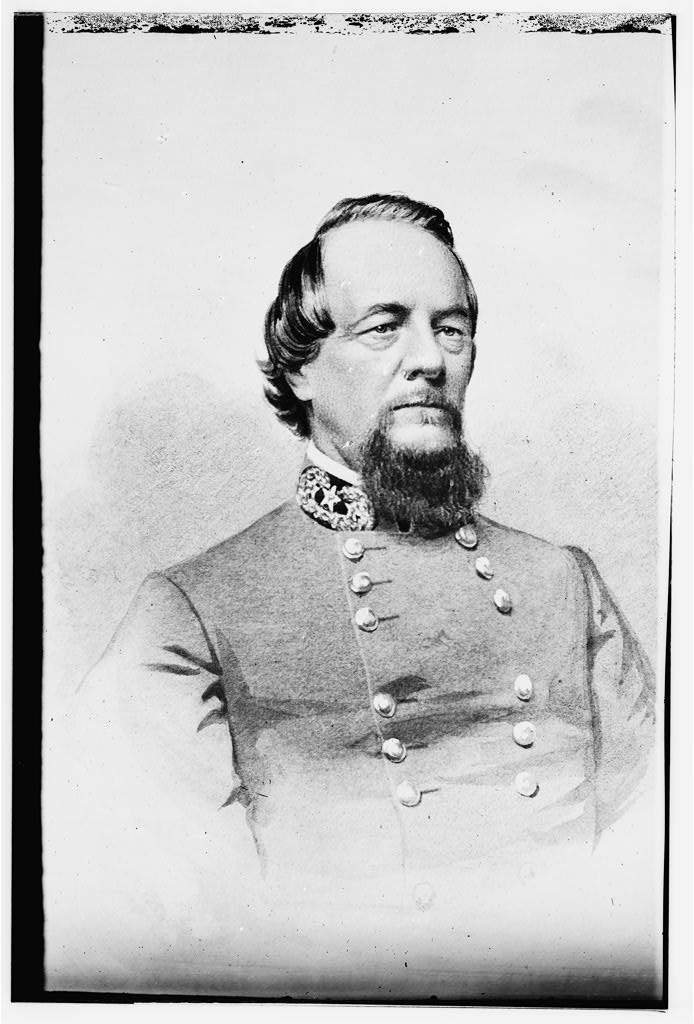
Confederate General Edward Johnson, also known as "Allegheny" or "Clubby" (Library of Congress).

Confederate General Edward Johnson, also known as “Allegheny” or “Clubby” (Library of Congress).

Hancock was ordered to attack with his corps as soon after four in the morning as possible and Burnside was to follow the example. A little after daylight we were all gathered round General Grant’s tent, all waiting for news of importance. The field telegraph was laid to all corps Headquarters and there we could hear from all parts. At a little after five o’clock, General Williams approached from the telegraph tent; a smile was on his face: Hancock had carried the first line! Thirty minutes after, another despatch: he had taken the main line with guns, prisoners and two generals! Great rejoicings now burst forth. Some of Grant’s Staff were absurdly confident and were sure Lee was entirely beaten. My own experiences taught me a little more scepticism. Hancock presently sent to ask for a vigorous attack on his right, to cover and support his right flank. General Wright was accordingly ordered to attack with a part of the 6th Corps. As I stood there waiting, I heard someone say, “Sir, this is General Johnson.” I turned round and there was the captured Major-General, walking slowly up. He was a strongly built man of a stern and rather bad face, and was dressed in a double-breasted blue-grey coat, high riding boots and a very bad felt hat. He was most horribly mortified at being taken, and kept coughing to hide his emotion. Generals Meade and Grant shook hands with him, and good General Williams bore him off to breakfast. His demeanor was dignified and proper. Not so a little creature, General Steuart, who insulted everybody who came near him, and was rewarded by being sent on foot to Fredericksburg, where there was plenty of mud and one stream up to his waist. Our attack was a surprise: the assaulting columns rushed over the breastworks without firing a shot, and General Johnson, running out to see the reason of the noise, found himself surrounded by blue blouses. I was now sent by General Meade to see how far General Wright’s column of attack was prepared. I found the columns going into the woods south of the Brown house; the enemy had seen them and the shells were crashing through the thick pines. When I came back and reported, the General said: “Well, now you can take some orderlies and go to General Wright and send me back intelligence from time to time.” There are some duties that are more honorable than pleasant! As I turned into the pines, the musketry began, a good way in front of me. I pressed past the column that was advancing. Presently the bullets began to come through the pine trees. Then came back a Staff officer, yelling: “Bring up that brigade! Bring it up at the double-quick!” “Doublequick,” shouted the officers, and the column started on a run.

Meade’s correspondence taken from The Life and Letters of George Gordon Meade, Major-General United States Army, Vol. 2, (New York: Charles Scribner’s Sons, 1913), pp. 194-5. Available via Google Books.

Theodore Lyman’s correspondence is from Meade’s Headquarters, 1863-1865: Letters of Colonel Theodore Lyman from the Wilderness to Appomattox, pp. 108-11. Edited by George R. Agassiz. Boston, Massachusetts Historical Society, 1922. Available via Google Books.

The Wilderness, Day Two

Artist Alfred Waud labeled this drawing "Rebel advance through the smoke, and seizure of a part of the breastworks on Brock road. The logs had caught fire." It depicted fighing that took place later in the day on May 6. Click to enlarge (Library of Congress).

Artist Alfred Waud labeled this drawing “Rebel advance through the smoke, and seizure of a part of the breastworks on Brock road. The logs had caught fire.” It depicted fighing that took place later in the day on May 6. Click to enlarge (Library of Congress).

Here’s another short excerpt from Searching for George Gordon Meade: The Forgotten Victor of Gettysburg. This one is about the start of the fighting on May 6, 1864, the second day of the bloody struggle in the Wilderness.  The book is available via Amazon, Barnes and Noble, and at quality bookstores.

Fighting resumed bright and early on May 6. Grant had wanted the army to move at 4:30 a.m., but Meade, thinking that was too early for the exhausted and disorganized men–and perhaps because he suspected Burnside and the IX Corps would be late as usual–suggested 6:00. Grant said he would delay things by half an hour. Near dawn Meade and Lyman rode out to the Germanna Plank Road to find Burnside, who was supposed to move his men into the gap between the forces on the plank road and the turnpike. Burnside was late, however, delayed in part because the roads were clogged with artillery. One of his aides arrived and told Meade that if the general authorized the clearing of the roads, he would go back and hurry Burnside along. “No, Sir, I have no command over General Burnside,” Meade replied. The IX Corps was not under his control–that was Grant’s responsibility.

Back at headquarters the general ordered Lyman to report on Hancock’s progress down by the Brock Road intersection. Lyman mounted his horse at around 5:00 in the morning. Already he could hear musket fire from skirmishers, followed by the loud, crashing volleys that meant major fighting had erupted.

He found Hancock in a good mood. “We are driving them, sir; tell General Meade we are driving them most beautifully,” he said. But Hancock’s mood darkened when Lyman informed him of Burnside’s delay. “Just what I expected,” Hancock snapped. “If we could attack now, we would smash A. P. Hill all to pieces!”

The Union forces were doing a pretty good job of it even without Burnside’s help. The situation was looking increasingly desperate for Lee’s army. But then, as a blood red sun rose higher in the sky, its light diffused by the smoke of battle, James Longstreet and the I Corps arrived, moving east down the Orange Plank Road toward the fighting.

A historical marker on the Wilderness battlefield driving tour details an incident that occurred as Longstreet’s men came up and prepared to counterattack. It took place near the Widow Tapp farm, where Lee had his headquarters. As the Texas Brigade, under the command of Brig. Gen. John Gregg began to advance, Lee rode along with it, swept up in the excitement of battle. But Gregg’s men refused to let him risk his life with them. “Lee to the rear! Lee to the rear!” they yelled, some of them tugging on his bridle, until the general reluctantly turned back.

“Lee to the rear!” is a stirring story, even to a dyed-in-the-wool Yankee like me. It has entered the treasury of great Civil War tales. But as I read the story on the marker I think about Meade at Gettysburg on day two, sitting atop his horse on Cemetery Ridge, sword unsheathed, aides nervously arrayed behind him, with nothing between him and the advancing enemy. No markers recount that moment. No one after the war sought to add the patina of glory that would elevate the incident into legend. True, Meade lacked Lee’s charisma. He had been in command of his army for mere days at that point. His men hardly knew him. Yet it is also a great story and one that deserves to be told.

But perhaps Union soldiers felt less need to repeat such tales of glory. After all, Meade’s army had won the war. Lee’s veterans had to find solace in something other than victory.

Excerpt from Searching for George Gordon Meade: The Forgotten Victor of Gettysburg by Tom Huntington, pp. 259-60. Copyright © 2013 by Stackpole Books.

More Reviews (April 16, 1864)

The headquarters of Joseph B. Carr in Culpeper, Virginia. Carr commanded the 3rd division of the III Corps but was transferred to the Army of the James just before the Overland Campaign began (Library of Congress).

The headquarters of Joseph B. Carr in Culpeper, Virginia. Carr commanded the 3rd division of the III Corps but was transferred to the Army of the James just before the Overland Campaign began. You can read more about this building and its fate here (Library of Congress).

General Grant returned yesterday. The papers will tell you I was present the other day when [Winfield Scott] Hancock reviewed Birney’s division, and the next day, when he reviewed [Joseph B.] Carr’s and [John] Gibbon’s divisions. These troops all looked splendidly, and seemed, officers and men, in fine spirits.

The reorganization, now that it is over, meets with universal approbation, and I believe I have gained great credit for the manner in which so disagreeable an operation was made acceptable to those concerned. Even General [David] Birney, of the smashed up Third Corps, is, I believe, reconciled.

How much I should like to see you all. At times I feel very despondent about the termination of this war and the prospect of my return, but I try to keep up my spirits and hope for the best.

Meade’s correspondence taken from The Life and Letters of George Gordon Meade, Major-General United States Army, Vol. 2, (New York: Charles Scribner’s Sons, 1913), p. 190. Available via Google Books.

A Review (April 13, 1864)

The home of John Minor Botts, site of the II Corps review that Theodore Lyman writes about (Library of Congress).

The home of John Minor Botts, site of the II Corps review that Theodore Lyman writes about (Library of Congress).

Theodore Lyman writes home on April 13, 1864, and describes his first impressions of Winfield Scott Hancock and Philip Sheridan. We have encountered John Minor Botts before. David Birney now commands a division in Hancock’s II Corps. The brigade commanders are Hobart Ward and Alexander Hays.

Philip Sheridan was the army’s new head of cavalry. He and Meade will develop a rancorous relationship. “Little Phil” had commanded cavalry for a grand total of only about three months during his military career, but he had served under Grant in the West and the new general in chief liked his aggressive nature. “He was brusque, demanding, profane, and unforgiving,” wrote biographer Roy Morris Jr. “He was also hardworking, patriotic, uncomplaining, and brave.” He was a hard fighter on the battlefield and was equally aggressive at furthering his own reputation.

Philip Sheridan (Library of Congress).

Philip Sheridan (Library of Congress).

We went to a review of Birney’s Division near J. M. Bott’s house. The two brigades are under H. Ward and Alex. Hays. About 5000 men were actually on the ground. Here saw General Hancock for the first time. He is a tall, soldierly man, with light-brown hair and a military heavy jaw; and has the massive features and the heavy folds round the eye that often mark a man of ability. Then the officers were asked to take a little whiskey chez Botts. Talked there with his niece, a dwarfish little woman of middle age, who seems a great invalid. She was all of a tremor, poor woman, by the mere display of troops, being but nervous and associating them with the fighting she had seen round the very house. Then there was a refreshment at Birney’s Headquarters, where met Captain Briscoe (said to be the son of an Irish nobleman, etc., etc.); also Major Mitchell on General Hancock’s Staff. The Russ was delighted with the politeness and pleased with the troops. Introduced to General Sheridan, the new Chief of Cavalry — a small, broad-shouldered, squat man, with black hair and a square head. He is of Irish parents, but looks very like a Piedmontese. General Wilson, who is probably to have a division, is a slight person of a light complexion and with rather a pinched face. Sheridan makes everywhere a favorable impression.

Theodore Lyman’s letter is from Meade’s Headquarters, 1863-1865: Letters of Colonel Theodore Lyman from the Wilderness to Appomattox, pp 80-1. Edited by George R. Agassiz. Boston, Massachusetts Historical Society, 1922. Available via Google Books.

Birney (April 11, 1864)

David Bell Birney.

David Bell Birney.

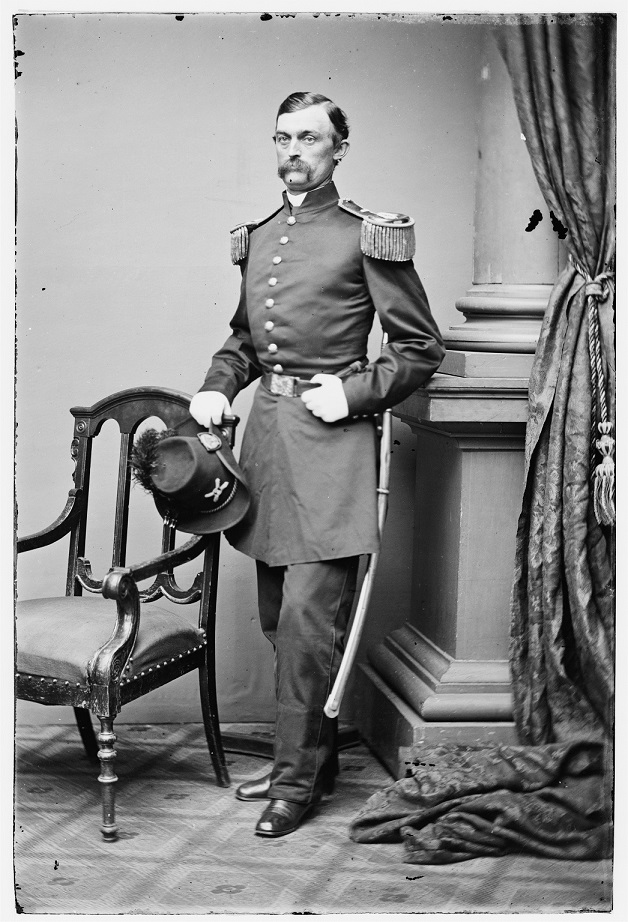
David Bell Birney was not a Meade ally. He had been born in the South, but a hatred of slavery motivated his father to pack up the family and move north. Birney took up the law and was practicing in Philadelphia when war broke out. As Theodore Lyman wrote, Birney “was a pale, Puritanical figure, with a demeanor of unmovable coldness; only he would smile politely when you spoke to him. He was spare in person, with a thin face, light-blue eye, and sandy hair.”

The bad blood between Meade and Birney stretched back to Fredericksburg, at least. When Meade’s brigade broke through the southern lines south of town, Meade sent to Birney for support. Birney replied that he could not move forward until he received word from John Reynolds to do so. This outraged Meade. He sent another officer to Birney with another demand for reinforcements. Birney again refused. Now Meade galloped over himself. He had his recent commission as a major-general in his pocket, and that meant he outranked Birney. “General, I assume the authority of ordering you up to the support of my men,” he said, according to one account. According to another, Meade said much more, in language strong enough to “almost make the stones creep.”

Birney later testified before Congress that he received only one message from Meade and in his official report he said he responded “immediately.” However, in a letter to a friend that Birney wrote shortly after the battle, he said that when a reporter from the New York Herald urged him to send some of his artillery to help Meade, “I told him the Reserves might run and be damned, that not a gun should leave my Division.”

Birney led a division of the III Corps at Gettysburg and took corps command after Daniel Sickles was wounded.

To help speed Meade’s departure from the army, Birney decided to cast his lot with Hooker and Sickles. “Meade is a fraud,” he had written to a friend in March. “We must have Hooker back to this army and I believe he will be sent to us!” he wrote. He also had great hopes for the future of Dan Sickles. “Sickles will I think command this army and in time will be President,” he had predicted back in October. So when Birney testified before the committee, he claimed that on July 5 he had wanted to attack the retreating Confederates but received an order not to do so. That was just the kind of example of timidity the congressmen were seeking. No matter that such an order never appeared in any official record, nor had Birney mentioned this incident in his official report.

Following elimination of the III Corps, Birney received a division in the II Corps under Hancock. He realized he had backed the wrong horse. “Grant killed the demonstration for Hooker, that was assuming shape, and would have ended in the decapitation of Meade,” he noted in a letter on April 5.

There is no doubt General Birney is scared at the turn things have taken in the Sickles matter, for I received a note from Hancock, the other day, saying Birney had been to see him, disclaiming being a partisan of Sickles, and saying he would like to come and see me to explain matters, but did not like to do so without some intimation on my part that it would be agreeable. I replied to Hancock that I was not aware of there being any occasion for explanation on the part of General Birney, as I had heard nothing except what I had seen in the papers about his testimony, and that he had denied in writing. At the same time I was always ready to see General Birney whenever he chose to do me the honor to call.

Meade’s correspondence taken from The Life and Letters of George Gordon Meade, Major-General United States Army, Vol. 2, (New York: Charles Scribner’s Sons, 1913), p. 189. Available via Google Books.
Reorganizing (March 24, 1865)

Taken in September 1863 outside Culpeper, this image shows Meade with his corps commanders. From left to right we have Gouverneur Warren, then in command of the II Corps, William French (III Corps), Meade, artillery chief Henry Hunt, chief of staff Andrew Humphreys, and George Skyes (V Corps).

Taken in September 1863 outside Culpeper, this image shows Meade with his corps commanders. From left to right we have Gouverneur Warren, then in command of the II Corps, William French (III Corps), Meade, artillery chief Henry Hunt, chief of staff Andrew Humphreys, and George Skyes (V Corps). Now French and Sykes are out and Warren has command of the V Corps (Library of Congress).

Alfred Pleasonton headed the cavalry corps for the Army of the Potomac (Library of Congress).

Alfred Pleasonton headed the cavalry corps for the Army of the Potomac (Library of Congress).

I have been very busy to-day. The much-talked-of order for reorganizing the Army of the Potomac has at last appeared. Sykes, French and Newton are relieved. Sedgwick, Hancock and Warren command the three corps. This evening an order has arrived relieving General Pleasanton, which, although I did not originate it, yet was, I presume, brought about by my telling the Secretary that the opposition I had hitherto made to his removal I no longer should make. As the Secretary has been desirous of relieving him ever since I have had command, and I have been objecting, he has taken the first chance to remove him as soon as my objections were withdrawn.

Grant arrived to-day. I met him at the depot near my headquarters and accompanied him to Culpeper, where I spent several hours and returned. He was as affable as ever, and seems not at all disposed to interfere with my army in any details.

I hear Butterfield is in Washington, and is going to swear that I told him to prepare an order to retreat, and from what Gibbon writes me, it is evident he did prepare such an order; but I trust by the concurrent testimony of every other officer on the field, the documentary evidence in the shape of orders at different periods of the day, and my own sworn statement, to prove that the preparation of this order was not authorized by me, and that it was due to Butterfield’s own fears. I understand the Secretary is very indignant at his coming to Washington, and has ordered him back to his post.

Get the last number of the Spirit of the Times, in which there is a scathing article on Grant, Sherman, McPherson, Schofield and myself, and lauding, as usual, Joe Hooker.

Meade’s correspondence taken from The Life and Letters of George Gordon Meade, Major-General United States Army, Vol. 2, (New York: Charles Scribner’s Sons, 1913), pp. 182-3. Available via Google Books.