Tolerably Able (November 10, 1864)

President Abraham Lincoln (Library of Congress).

President Abraham Lincoln (Library of Congress).

The editor of Theodore Lyman’s letters. George R. Agassiz, thought the entry for November 10, 1864, was so unusual it required a bit of a disclaimer. “Some parts of the following letter make curious reading now,” he wrote. “They are, however, interesting, not merely as an individual opinion at that time, but as reflecting the contemporary sentiments of a large body of intelligent men.” I assume Agassiz felt compelled to add his note because of Lyman’s qualified praise for Lincoln. Today Lincoln is lionized as one of America’s greatest presidents, comparable only to Washington. During the Civil War, however, Lincoln had yet to acquire his veneer of greatness. For many, calling him “tolerably able,” as Lyman does in this letter, was giving him more credit than he was due. Lyman and Meade were both politically conservative and would have had doubts about Lincoln. Lyman’s conservatism explains his condescending reference to Theodore Parker, a noted transcendentalist and abolitionist. Parker’s grandfather had led the Minutemen at the Battle of Lexington. In this letter Lyman also notes an incident of “acoustic shadow,” in which atmospheric conditions mask the sounds of battle.

They have been singularly niggardly to us about election returns; but we have reliable intelligence to-night that Lincoln is re-elected, the coarse, honest, good-natured, tolerably able man! It is very well as it is; for the certainty of pushing this war to its righteous end must now swallow up all other considerations. I am still more content that there has been a powerful opposition to him, even from respectable men, an opposition strong enough to carry several states. This will caution him, or better, his party, to proceed cautiously and to make no fanatical experiments, such as we too often have seen, but to proceed firmly, and according to rule and law. Lincoln has some men of ability about him—pre-eminent, Mr. Seward, whom the ultras have thrown over, but whom I think the strong man of the cabinet. Mr. Fessenden is said to be a very superior person, and his face is certainly a bright one, very. There is another important advantage in keeping on as we are: the machine is in running order and it is always a drawback to change midst a season of public trial. And again we have done with Lincoln what the Rebels have successfully done with their generals, let him learn from his own misfortunes and mistakes; not a bad school for a sensible man. So you see, I am inclined to make the best of what I deem is the best, albeit not very good. . . .

Have you read an article from Fraser, in Littells, called “Concord Transcendentalists.” It is a singular production, rather entertaining some of it, and interspersed with the weakest, sweetened warm milk and water. The place where it says that Theodore Parker hid two slaves in his study, and nightly sat writing at the door of it, with several pistols and the gun that had belonged to his grandfather, would be a funny passage at any time, but, written so gravely in these war days, it is quite irresistible! If you see any number, in future, containing the tale of Tony Butler, you might send it to me, though it is no great matter. I have read a number or two, the last chapter being in this very number where the Transcends flourish. Which reminds me of what a West Point professor said, according to the solemn Duane. He was hearing a recitation in philosophy, and would fain illustrate how the body might slowly change, yet the individual remain the same. “Now,”said he,” if I have a knife and lose a blade and get it replaced, it is still the same knife.” “Well,” said a stupid-looking cadet, “and suppose you lose the other blades, one after another, and get them replaced, is it the same knife?” “Certainly,” replied the Professor. “And suppose the handle should get rather ricketty and you replaced that?” “Yes, it would be the same knife.” “Well, now,” cried the stupid one, suddenly brightening up amazingly, “suppose you took the old handle, and found the old blades, and put ‘em all together, what would you call that, hey?” Poor Major Duane! he can’t do much but talk and tell stories, for he is quite miserably yet and is not fit for duty, though he is improving. . . .

Last night, with a mild south wind, we had a singular example of the stopping of sound. Our batteries near the plank road, some three miles off, may usually be heard with perfect distinctness; not only the guns, but the explosion of the shells; and the replies of the Rebels also. At night we can see the shells going over, by the burning fuse, that looks like a flying spark. The deception is very singular in the dark, for, though the shell may be passing at the rate of 1200 feet a second, in the distance the fuse seems to go slowly and in a stately curve. This is because 1200 feet looks very small, three miles away, and the eye gets an idea of rapidity by the space travelled over in a given time. Well, last night, they opened a somewhat brisk discharge of mortar shells from both sides; but though we could see them go through the sky and burst below, not the faintest sound reached the ear! At other times these same guns will sound quite close to us. I could cite many such contrasts.

I rode forth with good Duke Humphrey, to see the dress-parade in the 9th Corps. That and the 5th, not being in the immediate presence of the enemy, have a good chance for drill. The 9th Corps, in particular, have gone into the evolutions to an alarming extent, an exercise which, like Wistar’s balsam of wild cherry, can’t do harm and may do good. Around General Parke’s Headquarters there is a chronic beating of drums and fifing of fifes and playing of bands. We sat some time and watched the drilling; it was quite fun to see them double-quicking here, and marching there, and turning up in unexpected positions. At last the gallant Colonel McLaughlen, after many intricate manoeuvres, charged and took a sutler’s tent, and the brigade was then marched to its quarters. As we returned, there was a nig brigade, having its dress parade in fine style. They looked extremely well and marched in good style. The band was a great feature. There was a man with the bass drum (the same I believe that so amused De Chanal) who felt a ruat-coelum-fiat-big-drum sentiment in his deepest heart! No man ever felt more that the success of great things lay in the whacking of that sheepskin with vigor and precision! Te-de-bung, de-de-bung, bung, bung! could be heard, far and near. . . . The nigs are getting quite brisk at their evolutions. If their intellects don’t work, the officers occasionally refresh them by applying the flats of their swords to their skins. There was a Swede here, who had passed General Casey’s board for a negro commission. He was greatly enraged by a remark of the distinguished Casey, who asked him what Gustavus Adolphus did, meaning what great improvements he introduced in the art of war. To which the furriner replied: “He was commander-in-chief of the Swedish army.” “Oh, pooh!” said Casey, “that’s nothing!” Which the Swede interpreted to mean that Gustavus was small potatoes, or that the Swedish army was so. Really, most foreign officers among us are but scapegraces from abroad. The other day the Belgian Minister Sanford sent a letter asking for promotion for private Guatineau, whose pa had rendered us great service by writing in the French press. The matter being referred to his commander, the reply was: “This man deserted to the enemy from the picket line.”

Theodore Lyman’s letter is from Meade’s Headquarters, 1863-1865: Letters of Colonel Theodore Lyman from the Wilderness to Appomattox, pp. 259-62. Edited by George R. Agassiz. Boston, Massachusetts Historical Society, 1922. Available via Google Books.

Lincoln Wins! (November 9, 1864)

President Abraham LIncoln (Library of Congress).

President Abraham LIncoln (Library of Congress).

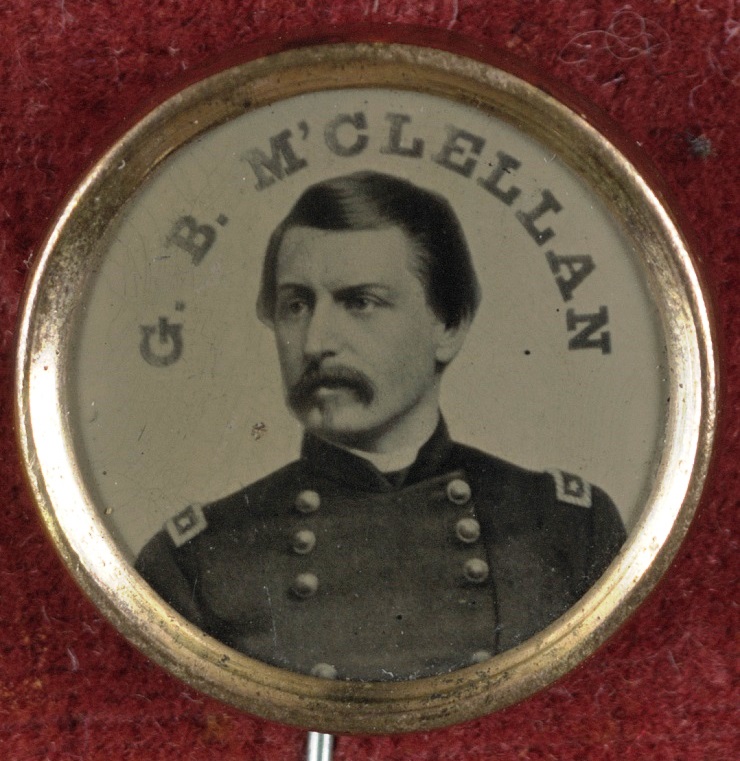
Meade comments on the election, in which Abraham Lincoln handily beat George McClellan. The Army of the Potomac voted solidly for Lincoln. In the case of suspected voter fraud he describes, Meade had one Jeremiah McKibbin arrested for supposedly distributing incorrect ballots in the hopes of disqualifying Republican votes. This is what Meade reported to Edwin Stanton (as it appears in the Official Records):Yesterday I was informed by Mr. Bonham, Republican agent of the State of Pennsylvania, that altered poll-books had distributed in this army by Mr. Jeremiah McKibbin, Democratic agent of the State of Pennsylvania. I immediately directed the commanding officers of Pennsylvania regiments to put the soldiers and others on their guard, and ordered the provost-marshal to detain Mr. McKibbin for examination. During the day two individuals, named Miles and Carrigan, Democratic agents, were arrested in the Second Corps, charged with circulating these altered poll-books. The alterations consist in the improper spelling of names, and in the tally lists the omission of a name. I have placed the whole matter in the hands of the judge-advocate of this army, with directions to investigate the affair and report whether any fraud has been committed or was intended, and whether the evidence justified the detention and trial of the person above named. There is, however, great difficulty in settling these important questions from the ignorance in this army, particularly on my part, not only of the machinery of elections, but of the laws of Pennsylvania and their bearing on the case in point. In this point of view I desire the instruction of the department, and would respectfully suggest whether justice to all parties would not best be subserved by turning these persons, with all the evidence, over to the authorities of the State of Pennsylvania to have tried by the courts of that State the questions that may arise, or whether I shall send these individuals to the Department at Washington, to be third by the military commission now sitting in Washington and trying analogous cases relating to New York soldiers. This proposition in not made with a view to avoid any duty which properly devolves on me, but with an earnest desire to have a proper and through investigation made, which, under the circumstances, I fear cannot be made by a commission organized in this army.”

A McClellan campaign pin (Library of Congress).

A McClellan campaign pin (Library of Congress).

The election passed off very quietly yesterday. About nineteen thousand votes, of which thirteen thousand five hundred were for Lincoln, and five thousand five hundred for McClellan, giving Lincoln a majority in this army of about eight thousand votes. Of these, three thousand five hundred were the majority of the Pennsylvania soldiers. During the day, much to my horror, one of the Republican agents reported the distribution of spurious or altered poll books, and charged certain Democratic agents as the parties guilty of the act. I had no other course to pursue than to arrest the parties complained against, until an investigation could be had. To-day we have been examining the matter, and there appears to be no doubt that poll books were brought here and distributed, having names of Republican electors misspelled and some omitted. The Democrats declare it is only a typographical error, and does not vitiate the use of the books, whereas the Republicans charge that it is a grave and studied effort to cheat the soldiers of their vote. In this dilemma I have applied to the Secretary of War, and asked for authority to send the parties either to Pennsylvania, to be tried by the courts there, or to Washington, to be disposed of by the Department and Doubleday’s Commission, now trying the New York agent. This affair has bothered me very much. All these people are citizens of Philadelphia, and are said to be respectable. I had, however, but one course to pursue, and was compelled to notice the complaints presented to me. We have no news from the elections outside of the army, except that they passed off quietly with you and in New York; in the latter place, doubtless, owing to the presence and order of Major General Butler. Well, the election is over, with the result I expected, and now I hope no time will be lost in regulating the army.

I trust, now the election is over, measures will be taken to raise men to fill our ranks, and no time should be lost, as I don’t think we can count on more than a month of good weather. To-be-sure, we can and doubtless will stay here all winter; and being so near each other, may manage to keep fighting on. But I don’t think any operations involving any movement can be had after the beginning of December.

Meade’s correspondence taken from The Life and Letters of George Gordon Meade, Major-General United States Army, Vol. 2, (New York: Charles Scribner’s Sons, 1913), pp. 239-40. Available via Google Books.

Election Eve (November 7, 1864)

Secretary of War Edwin Stanton (Library of Congress).

Secretary of War Edwin Stanton (Library of Congress).

On the eve of the presidential election, which pitted Abraham Lincoln against George McClellan, George Meade writes his wife. He addresses the rumor that Lincoln will appoint Secretary of War Edwin Stanton to the Supreme Court. Instead, Lincoln ended up appointing his former treasury secretary, Salmon Chase, even though Chase had maneuvered behind the scenes to replace Lincoln as the Republican candidate for president.

I see you have taken the cue of the newspapers, and imagine the campaign is over, and that we are going into winter quarters; but you are greatly mistaken; I don’t believe active operations will cease this winter unless we should have the good luck to get into Richmond. There seems to be quite a talk of Mr. Stanton’s being made Chief Justice, and, were it not for the Senate, I should myself think it quite probable. I should, however, regret his leaving the War Department, for I do not know who there is to take his place, who would be as satisfactory. I should esteem it a great misfortune to see either Banks or Butler there. I have not seen General Grant since last Sunday week. I am, therefore, quite ignorant of what is going on; for being “out of the ring,” I never ask any questions.

To-morrow is election day. I hope it will pass off quietly, that all good citizens will submit to and abide by the result, and that, this question being settled, attention will be turned to filling our ranks and raising more troops, so that we can have the means of bringing this war to a close, which will never be over without much more hard fighting.

Meade’s correspondence taken from The Life and Letters of George Gordon Meade, Major-General United States Army, Vol. 2, (New York: Charles Scribner’s Sons, 1913), p. 239. Available via Google Books.

“A Judicious Helping Hand” (November 6, 1864)

African-American soldiers make coffee in the Petersburg entrenchments (Library of Congress).

African-American soldiers make coffee in the Petersburg entrenchments (Library of Congress).

In his letter today, Theodore Lyman makes some interesting remarks about Meade’s attitude towards African-American soldiers (although Lyman, nineteenth-century white man that he is, does not use that term). Lyman’s older sister had married into the Shaw family, which included “the best Bob,” a.k.a. Robert Gould Shaw. “The best Bob” had died while leading the first black regiment raised in the northern states, the 54th Massachusetts, in South Carolina.

Brevet promotions are honorary raises in rank. As an unpaid volunteer, Lyman was not eligible. “Cool Arbor” is what Lyman, somewhat perversely, insisted on calling Cold Harbor, “because it is so hideously inappropriate.”

I was remarking in my last, a week ago to-day, that General Meade spoke of being obliged to write his report. Yes! as you say, it is a pity he can’t have some signal success. The Shaws need not be against him on the negro-soldier question, for if he has a bias, it is towards and not against them, and indeed it would go to the heart of the best Bob to see the punctilious way in which he returns their salutes. I can say with certainty that there is not a General in this army from whom the nigs might expect a judicious helping hand more than from Meade. As to his being slow, it may be so; but I can’t see that Grant, on whom rests this entire campaign, is any faster; yet he is a man of unquestioned military talent. If you knew, as I do, the number of men killed and wounded in this campaign from the Potomac Army alone, you would think that a strong opposition from the enemy had as much as anything to do with the want of crowning success thus far. To show what sort of work we have been through: at the assault of June 3d, at Cool Arbor, we lost, in four or five hours, 6000 men, in killed and wounded only. That is a specimen. Even in our move to the left, the other day, which some would call a reconnaissance, and others heavy skirmishing, we had a list of killed and wounded of not less than 1200. In fact, we cannot stir without losing more men than would make a big battle in the West, and the Rebels, if we have any chance at them, lose as many.

Last Sunday, which I was just speaking of, was marked by the arrival of one Alden, a rather dull Captain of the Adjutant-General’s Department, who was however a welcome bird to the army, as he brought a large number of brevets for many deserving officers. … To my surprise there did appear, or reappear, Major Duane, who has taken to visiting me as usual. He is better, but not well. To celebrate his arrival, and to retaliate for our rush into the Mine, the Rebs made a dash on our picket line, gobbled up some fifty stupids, who (being recruits) thought it was the relief coming round, and were then driven back; upon which, of course, every man fired off his musket a few times, to show how alert he was, the artillery threw all the shells whose fuses happened to be ready cut, and then all went to sleep again.

Theodore Lyman’s letter is from Meade’s Headquarters, 1863-1865: Letters of Colonel Theodore Lyman from the Wilderness to Appomattox, pp. 256-8. Edited by George R. Agassiz. Boston, Massachusetts Historical Society, 1922. Available via Google Books.

Assignment Complete (November 5, 1864)

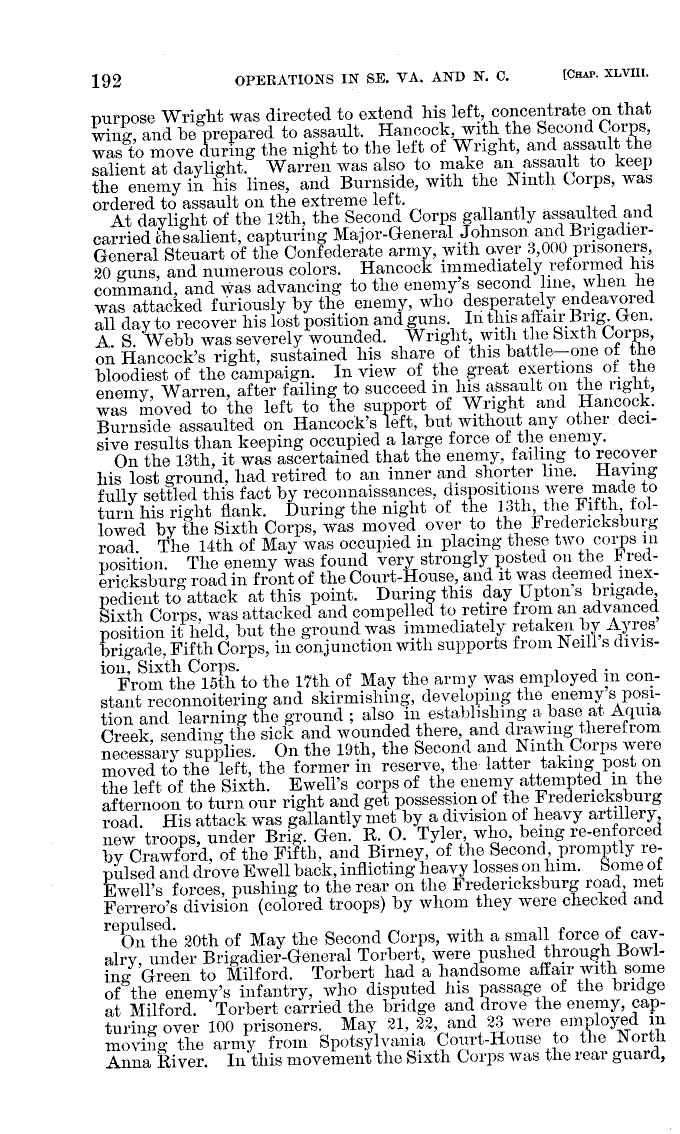
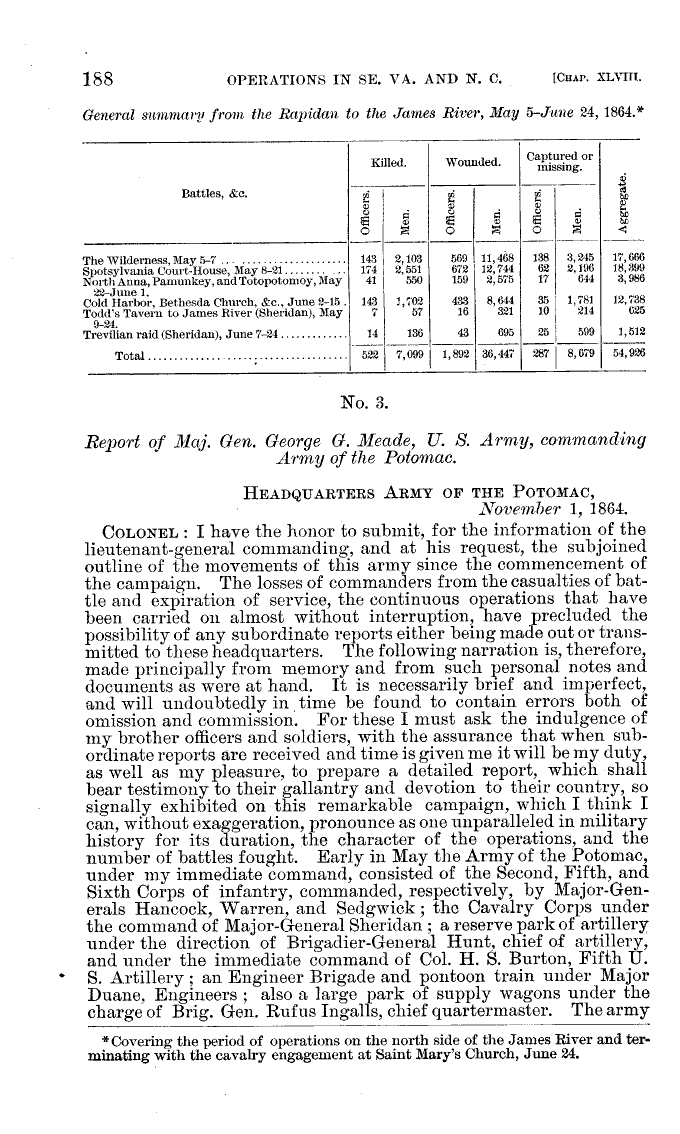
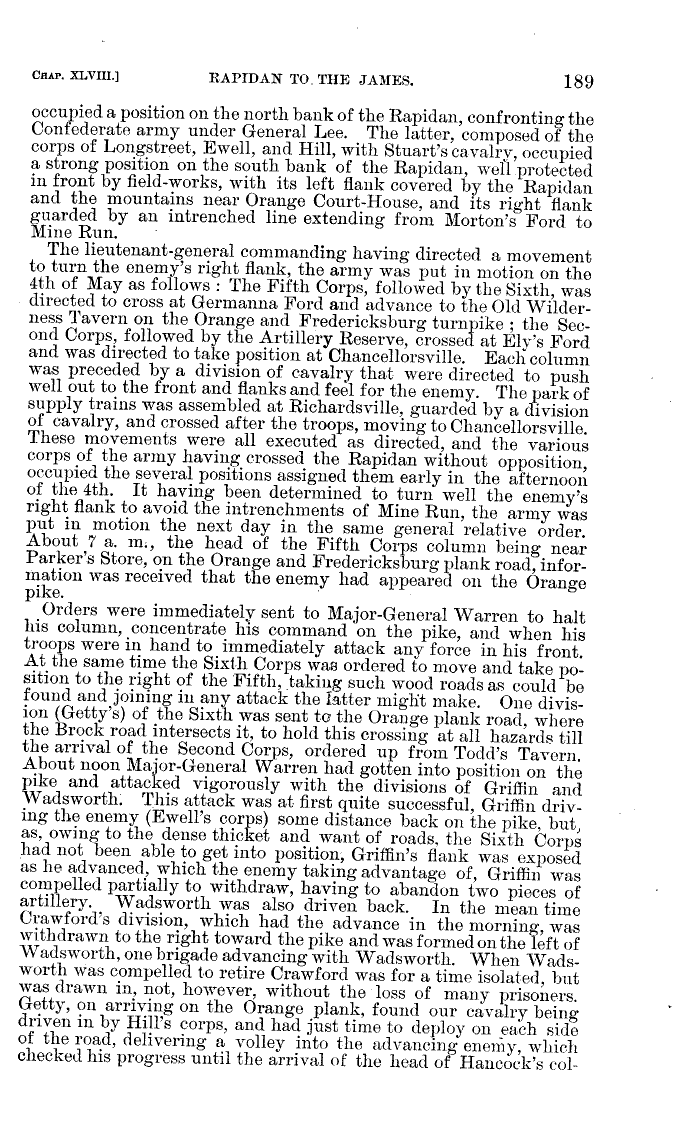
George Meade has finished his homework assignment. I have posted the pages of his report on the Overland Campaign below. (The report appears in the Official Records, Ser. 1, Vol. XXXVI, Pt. 1, pp. 188-195.) He had a reason for feeling “a little nervous” about the result. His report on the Battle of Gettysburg had aroused the ire of several generals who felt Meade had overlooked their contributions, as recounted here.

I have at length finished my report of the campaign. It was a pretty difficult task, to recount the operations of this army for the past six months, to do anything like justice, and at the same time avoid tedious and unnecessary details. I feel a little nervous about the result, as I do not see how I am to avoid errors and giving cause for offense, particularly if I tell the truth. I have confined myself, however, to a brief narrative of the actual movements, with as few comments as possible.

Meade’s correspondence taken from The Life and Letters of George Gordon Meade, Major-General United States Army, Vol. 2, (New York: Charles Scribner’s Sons, 1913), p. 239. Available via Google Books.

Here are the pages of Meade’s report. Click (and then click again) to get to readable size.

Meade's report, page 1.

Meade’s report, page 1.

Meade's report, page 2.

Meade’s report, page 2.

Meade's report, page 3.

Meade’s report, page 3.

Meade's report, page 4.

Meade’s report, page 4.

Meade's report, page 5.

Meade’s report, page 5.

Meade's report, page 6.

Meade’s report, page 6.

Meade's report, page 7.

Meade’s report, page 7.

Meade's report, page 8.

Meade’s report, page 8.

Reassurances (October 31, 1864)

Henry Wise, the former governor of Virginia and George Meade's brother-in-law (Library of Congress).

Henry Wise, the former governor of Virginia and George Meade’s brother-in-law (Library of Congress).

Read Meade’s letters to his wife and you’ll get the impression that Mrs. Meade did not have a very good opinion of Ulysses S. Grant. While Meade himself had doubts about Grant’s opinion of his generalship, he often felt the need to reassure his wife of Grant’s good will. Part of the problem, as he points out in today’s letter, is Grant did not worry about public opinion the way Meade did.

Today Meade once again mentions his connection with the Wise family. Henry A. Wise, the former governor of Virginia, had married Margaretta Meade’s sister Sarah. (Sarah died in 1850.) Tully Wise was Henry Wise’s cousin; Peyton was Tully’s son. Meade often forwarded t his wife information he learned about the Wise family.

I have reason to believe you are in error in imputing any sympathy on the part of Grant with my detractors. It is true he has not exerted himself to silence or contradict them, but this arises from a very different cause. Grant is very phlegmatic, and holds in great contempt newspaper criticism, and thinks, as long as a man is sustained by his own conscience, his superiors, and the Government, that it is not worth his while to trouble himself about the newspapers. At the same time, he has always expressed himself in the manner in which he did in the telegram I sent you. Differently constituted, with more sensitiveness in his nature, I don’t doubt he would before now have taken some action, either in his official despatches, or in some other way given publicity to such opinions of my services as would set at rest these idle stories.

In our recent move we captured Peyton Wise, Lieutenant Colonel Forty-sixth Virginia Infantry. You may remember him as Mrs. Tully Wise’s bright boy, when we were first married. I did not see him, as he was taken to City Point before I knew of his capture, but I sent word to General Patrick, the Provost Marshal, to treat him as well as possible and furnish him with a little money. He wrote me a letter full of thanks, and expressing a great deal of very proper feeling. I understood if our men had gotten a little further into the enemy’s works, they would have captured General Wise, as he was not far from the place where Peyton was taken.

Grant has required me to make some kind of a report of the campaign, and I shall be very busy for some time.

Meade’s correspondence taken from The Life and Letters of George Gordon Meade, Major-General United States Army, Vol. 2, (New York: Charles Scribner’s Sons, 1913), pp. 238-9. Available via Google Books.

Homework (October 30, 1864)

Ulysses S. Grant gives General Meade an assignment, as reported by Theodore Lyman.

“Grant says I must write a report of the whole campaign,” says the General, in the discontented voice of a schoolboy who has been set a long exercise. “I can’t write a report of the whole campaign. I don’t remember anything about some of it. I ‘m all mixed up about the Tolopotomoy and the Pamunkey and the what-do-you-call-’em Creek.” Hence it came that I was requested to give him some extracts from my valuable archives, and I since have written a lot of notes for him, extending from May 4th to August 28th. He is very quick with his pen, is the General, and possesses a remarkable power of compressing a narrative and still making it clear and telling.

Theodore Lyman’s letter is from Meade’s Headquarters, 1863-1865: Letters of Colonel Theodore Lyman from the Wilderness to Appomattox, p. 256. Edited by George R. Agassiz. Boston, Massachusetts Historical Society, 1922. Available via Google Books.

A Tender Adieu (October 29, 1864)

General Meade continues to stew over the article in Henry Ward Beecher’s Independent, which said that Ulysses s. Grant desired to get rid of him. One gets the sense that Meade was less angry at the paper and more concerned that it might have hit on the truth about Grant’s feelings. It’s possible that Meade was more jittery than usual because of the impending presidential election. Lincoln had waited until after an election season to relieve George McClellan, and perhaps Meade worried the same thing was going to happen to him.

I had a conversation with Grant in reference to my letter about Beecher’s article, and told him I did not care about his despatches, but desired he would furnish me a few lines for publication, that would set at rest, as far as he was concerned, the wicked and malicious falsehoods which that article contained. This he said he would most cheerfully give me. At the same time I told him that, whilst I did not doubt the good feeling of the President and Secretary for me, yet I was satisfied of the existence of a bitter hostility towards me on the part of certain supporters of the President, and I did not desire to embarrass Mr. Lincoln, nor did I wish to retain command by mere sufferance; and that, unless some measures were taken to satisfy the public and silence the persistent clamor against me, I should prefer being relieved; that I was becoming disheartened, and my usefulness and influence with the army were being impaired. In all successful operations I was ignored, and the moment anything went wrong I was held wholly responsible, and rather than continue in this way, I would prefer retiring, and desired him to say this to the President.

General Régis Dénis de Keredern de Trobriand (Library of Congress).

General Régis Dénis de Keredern de Trobriand (Library of Congress).

Yesterday Theodore Lyman wrote about the arrival of two Frenchman who came to observe the Army of the Potomac. Such visitors were not a rarity, but the demands required of a gracious host could make them a nuisance. Here Lyman explains how he contrived to get rid of them. It makes sense that the visitors would want to visit General Régis Dénis de Keredern de Trobriand, for he was a countryman of theirs. De Trobriand had been born into wealth and privilege in France in 1816, married an American heiress, and moved to New York City in 1847. He volunteered for the army when war broke out and proved to be a capable officer, commanding a brigade in the III Corps at Gettysburg. At this point he commanded a brigade in Winfield Scott Hancock’s II Corps.

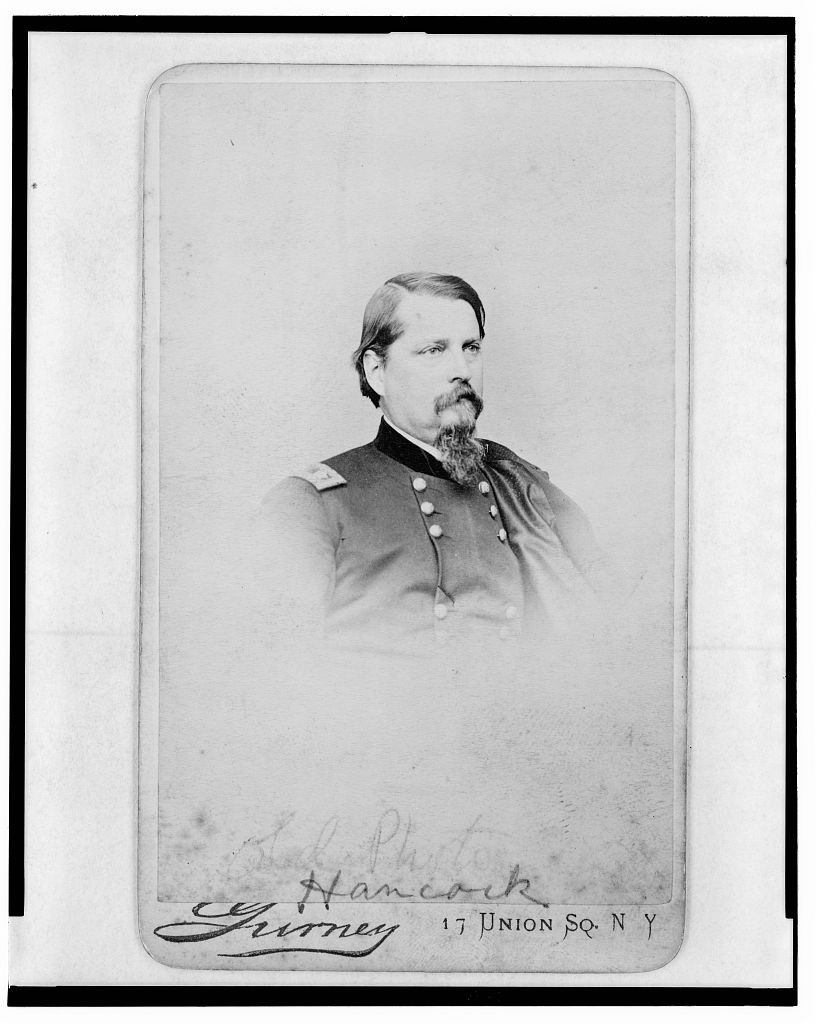
After the war de Trobriand wrote Quatre ans a l’armeé du Potomac. He had this to say about Hancock, whose tenure with the Army of the Potomac ended after the Battle of Burgess’s Mill: “General Hancock is one of the handsomest men in the United States army. He is tall in stature, robust in figure, with movements of easy dignity. His head, shaded by thick hair of a light chestnut color, strikes one favorably from the first by the regularity of his features and the engaging expression which is habitual to him. His manners are generally very polite. His voice is pleasant, and his speech as agreeable as his looks. Such is Hancock in repose. In action he is entirely different. Dignity gives way to activity; his features become animated, his voice loud, his eyes are on fire, his blood kindles, and his bearing is that of a man carried away by passion, —the character of his bravery. It is this, I think, which renders him much less fit for an independent command than to act under orders. We will see in the course of our narrative that, after having distinguished himself above all others at the head of a division or an army corps, he was much less fortunate in independent operations which were intrusted to him. Brilliant in the second rank, he did not shine so brightly when occupying the first. Was it a question of execution? he was admirable. If it was necessary to plan and direct, he was no longer equal to the occasion. This is often the case amongst soldiers.”

Having been seized with a powerful suspicion that the valiant Frenchmen would fain squat, to speak in Western phrase, at our Headquarters, I applied my entire mind to shipping them; for, as a travelled man, it was a matter of pride not to be put upon by a brace of such chaps. So I lay [in] wait till they said they would like to see General de Trobriand, and then I hastened to place them on horseback and give an orderly as a guide and tenderly shake hands with them, grieving I should not have the delight of seeing them again! There was a look about their intelligent countenances that seemed to say: “Ah, you are not so soft as we thought,” as they bid me a tender adieu.

Meade’s correspondence taken from The Life and Letters of George Gordon Meade, Major-General United States Army, Vol. 2, (New York: Charles Scribner’s Sons, 1913), pp. 237-8. Available via Google Books.

Theodore Lyman’s letter is from Meade’s Headquarters, 1863-1865: Letters of Colonel Theodore Lyman from the Wilderness to Appomattox, p. 256. Edited by George R. Agassiz. Boston, Massachusetts Historical Society, 1922. Available via Google Books.
A Well-Conducted Fizzle (October 28, 1864)

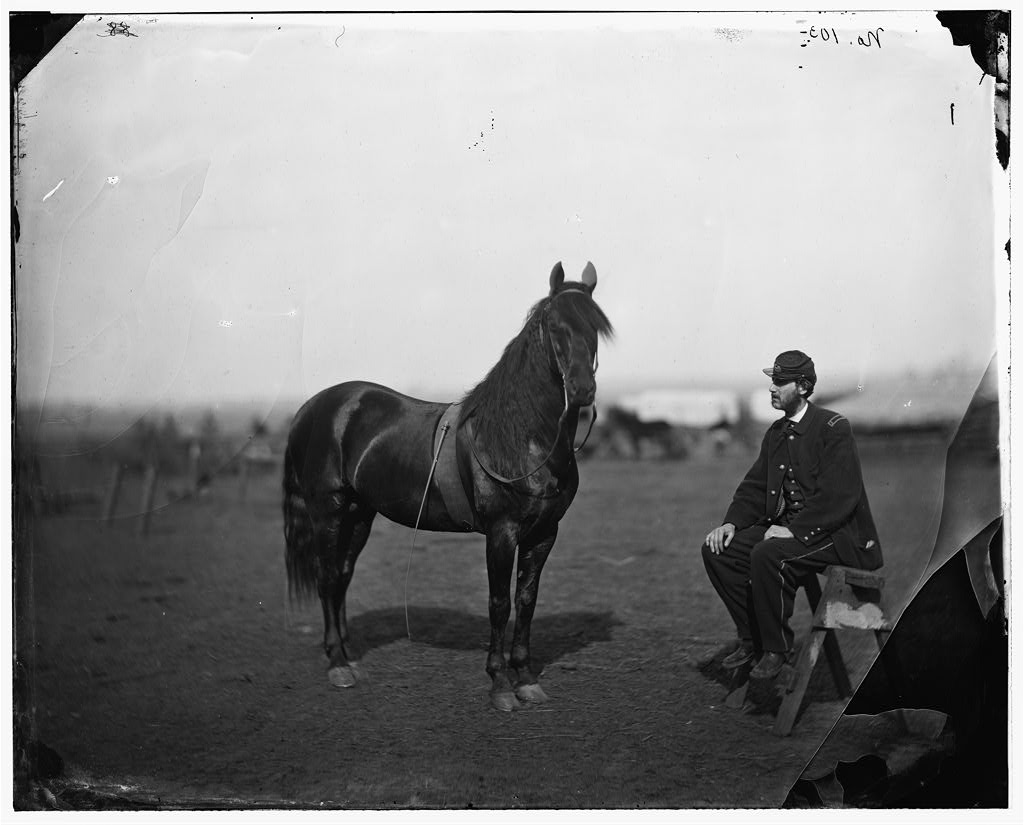
Lt. Charles W. Woolsey, the aide to Seth Williams who made a daring escape from the rebels (Library of Congress; accessed via CivilWarTalk.com).

Lt. Charles W. Woolsey, the aide to Seth Williams who made a daring escape from the rebels (Library of Congress; accessed via CivilWarTalk.com).

In his letter of October 28, Theodore Lyman describes the frustrating experiences of the fighting at Burgess’s Mill and captures the sense of confusion that ruled the battlefield. The fighting had been done by the II, V, and IX Corps under Winfield Scott Hancock, Gouverneur Warren, and Charles Parke, with cavalry commanded by David McMurtrie Gregg. Charles Woolsey, whose escape from capture Lyman describes, served as an aide to Seth Williams, the army’s assistant adjutant-general.

Where do you think I am? Why, right by my dear chimney! All camped just where we were! I called our movement a grand reconnaissance in force; it would be more fair to call it an “attempt,” whose success depended on the enemy not having certain advantages of position. But they were found to have these advantages, and so here we are back again, nobody having fought much but Hancock, who had a most mixed-up and really severe action, on the extreme left, in which the Rebels got rather the worst of it; but Grant ordered Hancock to withdraw during the night, or early in the morning, by which he was compelled to leave some of his wounded in a house on the field. Warren would fain fight it out there, for the name of the thing; but that would have been bad strategy, though I do confess that (albeit not a fire-eater) I would sooner have seen it through the next day, by reinforcing the left. This, however, is a mere matter of sentiment; certainly I don’t set up my wisdom. As the Mine was to be termed an ill-conducted fizzle, so this attempt may be called a well-conducted fizzle. The Rebs are good engineers and had thrown up dirt scientifically, I can tell you. We got a pretty good handful of prisoners; I dare say 800 or so, and lost, including stragglers, I fancy as many, though they say we did not. The killed and wounded about equal; perhaps the enemy lost rather more than we; but the honors of the left lie with the enemy, for we abandoned the field in the night. To-day we marched back scientifically (we are hard to beat on a retreat I can tell you). The 9th and 5th Corps withdrew by successive lines of battle, one behind the other, and alternately marching to the rear, the front line passing through that behind. A very handsome manoeuvre; and the enemy, with relief, said good riddance. I do not feel anywise down in spirits, for we gave blow for blow, and came back when we saw the positions would not admit of the plan proposed. There was no blunder or disaster, but it was soldier-like. The General kept a good temper throughout, so that it was quite pleasant all round.

[In writing some days later, Lyman thus describes the country over which this engagement was fought:] The tract marked “dense wood” on my map beggars description. It is a wood, with a tangled, thick undergrowth that almost stops the passage of a man. The rest of the country is also much wooded, but wherever you see a house, there is a farm of greater or less size. [After a more detailed description of the fighting, he continues:] Mott’s men give way, the Rebels yell and their batteries open a cross-fire, and the enemy the other side of the run make as if to attack the 2d division in front. But the valiant Egan faces his line to the rear and charges the flank of the Rebels rushing from the woods; they are in turn smashed up and run back again, and a grand mixed-up fight takes place, in the midst of which Hampton’s cavalry falls furiously upon Gregg, who falls furiously upon him, and won’t budge an inch. The most singular things happened here; for, as the woods were full of broken bands of both parties, everybody captured everybody else, and was in turn captured! A good many parties of Rebels, carrying our prisoners to the rear, took wrong direction and fell into the open maw of Crawford. Lieutenant Woolsey, General Williams’s aide, in such an affair, showed a valor little to be looked for in so mild a youth. He was going along a wood road and came directly upon twelve Rebel cavalry; all cried “Halt! surrender!” to him, and two fired their carbines at him; Woolsey snapped his pistol at them, when one seized him round the waist; whereat W. hit him a back-handed blow on the bridge of his nose, put in the spurs, and actually broke away from the whole of them! When I asked him why he didn’t give up, he replied in a simple manner: “Why, I thought my mother would be much distressed if I was taken prisoner, so I thought it would perhaps be better not to surrender.” General Williams was in the greatest state of chuckle over his aide’s conduct, and kept asking unwary persons: “Do you know how Mr. Woolsey escaped from guerillas?” and, being answered “No,” would say:”Why, thus!” at the same time giving the unwary one a punch in the stomach, with his elbow. Then Major Roebling rode into a Rebel line of battle and had his orderly killed in his escape; Major Bingham was captured, but scared his guard so by telling him he was within our lines, that the man took to the bushes and left him. Lieutenant Dresser rode into the midst of a Rebel brigade, thinking they were prisoners. “Where is the Provost Guard?” asked D., who luckily had a gray rubber coat on. “Hain’t got none.” “What troops are these?” “Fourth Alabama.” “Oh, all right,” says Dresser, with presence of mind, and rides off, very slow at first, and very fast as soon as out of sight! The best feat was that of Major Mitchell (he always does perform feats). He rode into the woods, saw 200 Rebel infantry who had got lost, and were drawn up in line; came back, got a regiment, went out again and gobbled them all up. . . .

[The letter finishes with a lively description of some curious visitors to Headquarters.]

I had got safely to the Peeble house and was watching the columns as they marched in. I was still watching when suddenly there appeared a new comico-military procession: to wit, a venerable Brigadier, of a diluted visage, followed by two or three officers, and by two beings calculated to astonish the uninitiated. The first was simply gorgeous, not of dubious character, but evidently an officer of one of those theatrical French indigene regiments. He was tightly done up in a black jacket, all over which five hundred yards of fine black braid had gone into spasmodic convulsions; then black trousers with a wide scarlet stripe, morocco knee-boots, and a light blue kepi. To complete his costume, a row of medals stretched from his central buttonhole to the point of his shoulder! The second stranger was utterly incomprehensible. He had on a pair of red, military trousers, a red fez with a blue tassel, and a black dresscoat! In order to mark this simple costume, he had, with admirable taste, suspended a small stiletto from the lower buttonhole of his waistcoat. The kepi was presented as Chef-de-bataillon de Boissac; the fez as Vicomte de Montbarthe. Upon which, to myself within myself said I: strike out the “de” and Boissac is correct; strike out “Vicomte” and substitute “Corporal” and we shall be pretty near Mr. Fez. He was one of the vulgarest of vulgar Frenchmen, and a fool into the bargain. De Boissac was a type, and I fancy the real thing; a regular, chatty, boastful, conceited, bright little Gaul, who had been in China, the Crimea, Italy, Japan, and Africa, and had worn the hair off his little bullet head with serving in various climes. “I was promoted to be Chef-de-bataillon,” said kepi (just as if I had asked anything about it), “for having planted the flag, alone, on the rampart! My comrades cry to me, ‘Descend! descend!’ I reply, ‘Non! j’y suis!’“ “And I,” chimed in fez, “received the cross for repelling, with forty men, four hundred Austrians: wounded twice in the leg, I lay on the field and the Emperor himself pinned the cross on my breast!” I could not help thinking what a pity it was that the wounds had not been higher up, whereby the Emperor would have been saved the expense of a cross, and I the trouble of listening to his stories. These two brave bucks were travelling on their good looks, having got down, the Lord knows how, with no letters to anybody; yet they dined with General Meade, and passed the night in camp; passed another night at General Davies’, and, the last I heard of them, were pledging General Hancock in the national whiskey! … I omitted to mention a third ornament to military life, a gent with eagles on his shoulders, who, on enquiry, turned out to be a brother militia man, and a great credit to the service, as he perilled his life daily, in the state of New York, as General Sanford’s aide (commanding state militia), and now was visiting the army to see that justice was done to deserving non-commissioned officers in the way of promotion. Et puis?—thought T. L. Yes, that was to electioneer the regiments in favor of the Republican candidate for governor, in case of whose election, he, Colonel D , was to be Quartermaster-General! He had not only cheek enough for this, but enough to spare to come and stay all night at Headquarters, and take his meals there, without the breath of an invitation!

Theodore Lyman’s letter is from Meade’s Headquarters, 1863-1865: Letters of Colonel Theodore Lyman from the Wilderness to Appomattox, pp. 251-5. Edited by George R. Agassiz. Boston, Massachusetts Historical Society, 1922. Available via Google Books.
Burgess’s Mill (October 27, 1864)

Armstrong's mills and rebel works on "Hatcher's Run, captured by the Second Corps, October 27, 1864 / sketched by C.H. Chapin," as it appeared in Harpers Weekly (Library of Congress).

“Armstrong’s mills and rebel works on Hatcher’s Run, captured by the Second Corps, October 27, 1864 / sketched by C.H. Chapin,” as it appeared in Harpers Weekly (Library of Congress).

George Gordon Meade doesn’t note it in his letter of October 27, but this movement of the Army of the Potomac and the fighting at Burgess’s Mill marked the end of active campaigning for 1864. Here’s how I describe the fighting in Searching for George Gordon Meade: The Forgotten Victor of Gettysburg:

Meade had another narrow escape later that month during the Battle of Burgess’s Mill on October 27. Once again Grant had Butler attack the Confederates north of the James, while Meade moved against the Confederate right in an attempt to capture the South Side Railroad. Hancock and the II Corps were to be the tip of the spear, supported by the V and IX Corps under Warren and Parke. Grant and Meade rode out to the front on the damp and dreary morning of October 27 to observe Hancock’s position. The II Corps faced the Confederate right near Hatcher’s Run at a spot called Burgess’s Mill on the Boydton Plank Road. The fighting here was brisk, and a shell exploded near Meade–so close that Horace Porter thought it must have killed him. But again Meade emerged unscathed. Grant also had a close brush with a bursting shell, and then his horse got one leg tangled in a fallen telegraph line. An aide had to carefully free the horse’s leg while Grant remained exposed to enemy fire.

By then it was apparent that the rebel entrenchments extended much farther to the west than anyone had anticipated, and Grant called off the attack. Hancock prepared to withdraw from his exposed position the next morning. The Confederates, as they often did, had different plans. Finding a weakness, William Mahone’s men made a stealthy passage through swamp and forest toward the Union right. Hancock had thought Samuel Crawford’s division was moving up to connect with him there; instead, the rebel forces swung around his flank and attacked. The Federals managed to recover from their surprise and force the Confederates back, but Hancock decided to withdraw his forces that night despite the rain and the darkness.

Winfield Scott Hancock (Library of Congress).

Winfield Scott Hancock (Library of Congress).

The Battle at Burgess’s Mill finished the active campaigning for 1864–and it marked the end of Winfield Scott Hancock’s time with the Army of the Potomac. He had been summoned back to Washington to raise a corps of veteran soldiers. The Petersburg Campaign had been one disappointment after another for Hancock, who seemingly had reached his own high-water mark at Gettysburg. One of his last actions was to make an official complaint to Meade about the reporting of Edward Crapsey, whom Meade had allowed to return to the army. Meade advised Hancock to write up charges and said he would have Crapsey tried by a commission.

I moved to-day with the greater portion of the Army of the Potomac, intending, if practicable, to make a lodgment on the Southside Railroad. We, however, found the enemy so strongly entrenched, and the character of the country was such, we were not able to accomplish reaching the road. We have had some quite sharp fighting, principally Hancock’s Corps on our side, in which we successfully resisted the attempts of the enemy to check our advance or dislodge us from positions taken. We shall, however, I think, be under the necessity of returning to our entrenched lines. General Grant has been on the field all day, sanctioning everything that was done. At one time both Grant and myself were under a heavy artillery fire, but luckily none of either of our large corteges were touched.

Theodore Lyman has been strangely quiet since his letter from October 17, but he finally breaks his silence today. Here’s his letter home about the day’s events. His pen will remain busy over the next few days.

I won’t write at length till I get a decent chance. I caught the greatest pelting with all sorts of artillery projectiles to-day, you ever saw, but no hurt therefrom. I could not help being amused, despite the uncomfortable situation, by the distinguished “queue” of gentlemen, behind a big oak! There was a civilian friend of Grant’s, and an aide-de-camp of General Barnard (a safe place to hold), and sundry other personages, all trying to giggle and all wishing themselves at City Point! As to yours truly, he wasn’t going to get behind trees, so long as old George G. stood out in front and took it. “Ah!” said Rosey, with the mild commendation of a master to a pupil: “oh! you did remember what I did say. I have look at you, and you did not doge!” It don’t do to dodge with Hancock’s Staff about; they would never forgive you. At length says the General: “This is pretty hot: it will kill some of our horses.” We came out on a big reconnaissance, which may be turned into a move or not, according to results. I rather fancy the enemy’s line is too long to be turned by what troops we have to dispose.

Meade’s correspondence taken from The Life and Letters of George Gordon Meade, Major-General United States Army, Vol. 2, (New York: Charles Scribner’s Sons, 1913), p. 237. Available via Google Books.

Theodore Lyman’s letter is from Meade’s Headquarters, 1863-1865: Letters of Colonel Theodore Lyman from the Wilderness to Appomattox, pp. 250-1. Edited by George R. Agassiz. Boston, Massachusetts Historical Society, 1922. Available via Google Books.