Settled? (August 8, 1864)

Meade continues to speculate on whether or not Grant will assign him to a new command.

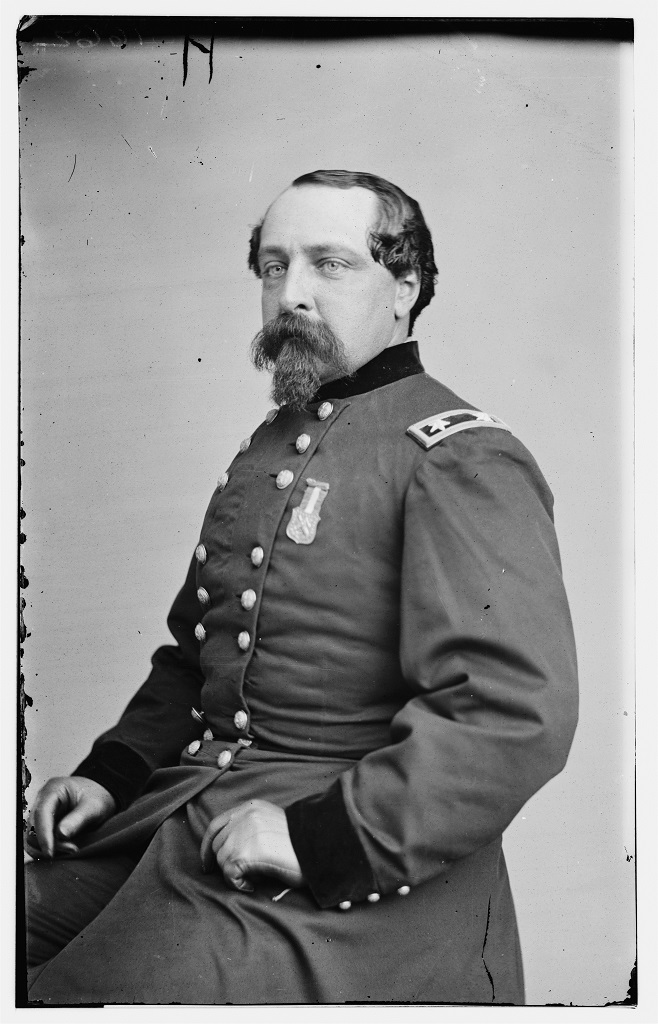
grant cropped

Meade croppedGrant has not yet returned from Washington. It is reported he has gone to Harper’s Ferry to see for himself how matters stand. This, and his not telegraphing for me, I think settle the question about my being transferred.


Meade’s correspondence taken from The Life and Letters of George Gordon Meade, Major-General United States Army, Vol. 2, (New York: Charles Scribner’s Sons, 1913), p. 219. Available via Google Books.

Walks on the Beach (August 6, 1863)

Meade indulges his sentimental side as he pines for a weekend at Cape May with his family, while he continues to wait to see if he will receive command of the new department in the Shenandoah Valley, an assignment that will never come through for him. It appears that this issue, more than any other, soured the relationship between him and Grant. Despite his avowals that he remained “indifferent” to the prospect, it’s apparent that Meade wanted the new assignment and was angered when he did not get it.

The court of inquiry he mentions is the one that will consider the crater debacle.

Samuel Wilkeson was indeed at Gettysburg, as a war correspondent for the New York Times. His son, 19-year-old Lt. Bayard Wilkeson, was there too, in command of battery G of the 4th U.S. Artillery. When a shell nearly tore off his leg, young Wilkeson finished the amputation with a pocket knife and then died. “Who can write the history of a battle whose eyes are immovably fastened upon a central figure of transcendingly absorbing interest–the dead body of an oldest born son, crushed by a shell in a position where a battery should never have been sent, and abandoned to death in a building where surgeons dared not to stay,” wrote Wilkeson, in an article that appeared in the Times on July 6, 1863. (You can find the entire article here.)

Grant has not yet returned from Washington; no telegrams have been received from him since he left, so I presume the project of sending me to take command has fallen through. I feel quite easy and indifferent to what course they may think proper to take. My conscience is clear. I have done my duty to the best of my ability, and shall continue to do so, regardless of newspaper abuse, and without any effort at reply thereto.

A court of inquiry, at my request, has been appointed, with Hancock as President. The whole affair of the 30th will be ventilated.

I had to-day a visit from Mr. Sam. Wilkeson, one of the editors of the Tribune, and one of my most bitter villifiers last spring. This individual called to make the amende honorable—to say he had been deceived, and to express the most friendly feelings for me. As I had never seen him before, but once on the field of Gettysburg, and had never exchanged a word with him, or given him any cause of offense, I received his apologies as if nothing had ever taken place, and he left me quite pleased.

I hope the dear children will enjoy themselves at Cape May. I should be so happy if I could only be there with you, to indulge in those splendid sea baths and take our old walks on the beach. Well, let us keep up our spirits, have brave hearts, trust in God’s mercy and goodness, and believe that so long as we try to do our duty all will be well in time.

In the meantime, Theodore Lyman examines the Army of the Potomac’s soldiers, and finds them wanting.

I took a limited ride along our flank defences, where I discovered a patriotic sentry, sitting with his back to where the enemy might be supposed to come, and reading a novel! He belonged to the 7th Indiana. “What are your instructions?” say I. “Han’t got none,” replies the peruser of novels. “Then what are you here for?” “Well, I am a kind of an alarm sentinel,” said this literary militaire. “Call the corporal of the guard,” said I, feeling much disposed to laugh. The sentry looked about a little and then singling out a friend, called out: “Oh, Jim, why, won’t you just ask Jeremiah Miles to step this way?” After some delay, Jeremiah appeared. He was in a pleasing state of ignorance. Did not know the sentry’s instructions, did not know who the officer of the guard was, did not know much of anything. “Well,” said I, “now suppose you go and find the sergeant of the guard.” This he did with great alacrity. The sergeant, as became his office, knew more than the corporal. He was clear that the sentry should not read a book; also that his conduct in sitting down was eccentric; but, when it came to who was the officer of the guard, his naturally fine mind broke down. He knew the officer if he saw him, but could not remember his name. This he would say, the officer was a lieutenant. “Suppose you should try to find him,” suggested I. Of course that he could do; and soon the “Loo-tenant” appeared. To him I talked like a father; almost like a grandfather, in fact; showed him the man’s musket was rusty and that he was no good whatsoever. Loo-tenant had not much to say; indeed, so to speak, nothing; and I left him with a strong impression that you can’t make a silk purse from a sow’s ear. It is not ludicrous, but sad, to see such soldiers in this Army of the Potomac, after three years of experience. The man could not have been better: tall, strong, respectful, and docile; but no one had ever taught him. It was a clear case of waste of fine material, left in all its crudity instead of being worked up. And this is the grand characteristic of this war—waste. We waste arms, clothing, ammunition, and subsistence; but, above all, men. We don’t make them go far enough, because we have no military or social caste to make officers from. Regiments that have been officered by gentlemen of education have invariably done well, like the 2d, 20th, and 24th Massachusetts, and the 1st Massachusetts Cavalry. Even the 44th and the 45th, nine-monthers, behaved with credit; though there was this drawback in them, that the privates were too familiar with the officers, having known them before. However, perfection does not exist anywhere, and we should be thankful for the manifold virtues our soldiers do pre-eminently possess. I see much to make me more contented in reading Napier, before referred to. After the taking of Badajos, the English allowed their own wounded to lie two days in the breach, without an attempt to carry them off. This is the nation that now gives us very good lectures on humanity. As to old Wellington, I suspect he was about as savage an old brute as would be easy to find.

Meade’s correspondence taken from The Life and Letters of George Gordon Meade, Major-General United States Army, Vol. 2, (New York: Charles Scribner’s Sons, 1913), p. 219. Available via Google Books.

Theodore Lyman’s letter is from Meade’s Headquarters, 1863-1865: Letters of Colonel Theodore Lyman from the Wilderness to Appomattox, pp. 206-7. Edited by George R. Agassiz. Boston, Massachusetts Historical Society, 1922. Available via Google Books.

Boating with the Beast (August 4, 1864)

Benjamin Butler, photographed at Bermuda Landing in late July or early August, 1864 (Library of Congress).

Benjamin Butler, photographed at Bermuda Landing in late July or early August, 1864 (Library of Congress).

Theodore Lyman accompanies General Meade, staff members, and the French observers on a boat trip with General Butler. Butler was one of the war’s great characters. An influential Democratic politician from Massachusetts, he had voted 57 consecutive times to nominate Jefferson Davis for president at the Democratic convention in 1860. As one of Lincoln’s “political generals,” he had helped keep Baltimore pacified at the beginning of the war and later established a reputation as the (perhaps) corrupt and (certainly) hated administrator of New Orleans. Southerners called him “Beast” or “Spoons,” the latter nickname for his supposed tendency to steal everything he could, including silverware. Perhaps his greatest impact on the war took place when he was in command of Fort Monroe in Virginia and allowed escaped slaves to enter his lines as so-called “contrabands of war,” an early step towards Union policies to end slavery. He proved fairly inept as commander of the Army of the James but, as we saw earlier, Grant failed in his attempt to replace him with William F. “Baldy” Smith as field commander.

Detail of a sketch Alfred Waud made of Benjamin Butler (Library of Congress).

Detail of a sketch Alfred Waud made of Benjamin Butler. Perhaps this defensive posture could be considered “an attitude of fence” (Library of Congress).

This was quite a festal day for us. The General, accompanied by the Frenchies, Rosencrantz, Bache, Biddle and myself, paid a grand visit to Butler. Butler was in high feather. He is as proud of all his “fixin’s” as a farmer over a prime potato patch. We first got on the Greyhound, an elegant steamer (Butler believes in making himself comfortable), and proceeded down the Appomattox, past City Point, and then bore up the James, passing Bermuda Hundred, with its flotilla of schooners and steamers. . . . We had got a good bit above Bermuda Hundred and were paddling along bravely when we came in sight of two gunboats; that is, common steamers with some heavy guns on board. There are many in the river and they go up and down to keep it clear. As we drew near, I saw the men were at quarters and the guns run out. We passed between the first boat and the high wooded bank, when I beheld the gunboat captain dancing up and down on the paddle-box and roaring to us: “The left bank is lined with sh-a-a-rpshooters!” It would have edified you to have seen the swift dignity with which General Meade and his gallant Staff stepped from the open, upper deck to the shady seclusion of the cabin! Our skipper jingled “Stop her,” with his engine-room bell, and stop she did. Here was a chance for war-god Butler. “Hey? What? Sharpshooters? Pshaw! Fiddledeedee! Stop her! Who said stop her? Mr. DeRay, tell the Captain to go on, instantly!” And Butler danced out on the open deck and stood, like George II at Dettingen, in “an attitude of fence.” I, who looked for a brisk volley of musketry, fully expected to see him get a bullet in his extensive stomach. Meanwhile the Captain went on, and, as soon as we were clear, the naval party in the rear (or “astern,” we ought to say) let go one big gun, with a tremendous whang! and sent a projectile about the size of a flour barrel on shore, severely wounding a great many bushes and trees. The other gunboat went ahead of us and kept up a little marine combat, all on her own hook. Whether there really were sharpshooters, I know not: I only think, if there were, it would be difficult to say which party was the more scared. . . .

Finally we went on shore where our horses were waiting, for this is not over three and a half miles from the Appomattox, though it is fifteen or sixteen miles round by the river. From the top of the cliff we had a splendid view of the cultivated country towards Richmond. And so, after inspecting more of Benjamin’s apple-pie batteries, we went home.

Theodore Lyman’s letter is from Meade’s Headquarters, 1863-1865: Letters of Colonel Theodore Lyman from the Wilderness to Appomattox, pp. 204-6. Edited by George R. Agassiz. Boston, Massachusetts Historical Society, 1922. Available via Google Books.

Rows (August 3, 1864)

Philip Sheridan (Library of Congress).

Philip Sheridan (Library of Congress).

Meade’s “row” with Burnside stems from the Battle of the Crater and will lead to Burnside’s departure from the army. Meade also had an ongoing row with Philip Sheridan, dating back to at least their peppery encounter at Todd’s Tavern back in May.

Meade and Sheridan were both ambitious men but they showed it in different ways. In his book Little Phil: A Reassessment of the Civil War Leadership of Gen. Philip H. Sheridan, historian Eric Wittenberg wrote, “Lying was just a part of his aggressive plan for advancing his own self-interest. He regularly lied to cover his mistakes at all costs. He seems to have been a congenital liar, and his perfidy often exposed him to public ridicule and criticism. Sheridan did not care. He lied anyway.” On this front Meade was clearly outmatched. But it did his cause no good to declare he was “indifferent” about Grant’s decision. Perhaps it would have helped if he had been upfront about his ambitions, although it is pretty obvious that Grant preferred the nakedly ambitious Sheridan. It appears that on this topic, at least, Grant was being less than completely honest with Meade.

I am in the midst of my row with Burnside. Our recent miserable failure will require an investigation, and authority has been asked of the President to appoint a court of inquiry. In the meantime I have preferred charges against Burnside, and asked he be relieved from duty with this army.

Yesterday, on General Grant’s return from Old Point, General Sheridan was ordered to Washington, to command that portion of the Army of the Potomac now detached for the defense of Maryland and the Capital. I at once went to Grant and told him, as he had thought proper to communicate to me that he had nominated me for a command in Washington, I demanded to know the reason I had not been accepted. He said the President expressed every willingness to have me, but not knowing my wishes on the subject, he feared my removal from the command of the Army of the Potomac might be misunderstood by the public and be construed into a disapprobation of my course, but if I desired the transfer, he would be very glad to have it made. General Grant said it was then concluded I should be sent, if any more troops should be detached; in the meantime, Sheridan was sent to command Wright’s Corps and the division of cavalry already sent. I am a little doubtful about this matter. I believe Grant is honest and would not deceive me, but I think there is something more than is acknowledged. However, as I am indifferent about the position, I am content, so long as finding any fault with me is disclaimed. Hancock, whose name was also mentioned, is quite put out, and thinks some political chicanery at the bottom of it, and that they are afraid in Washington to give us a chance to do anything that others cannot swallow up. I, however, am more charitable; at any rate, I intend to look on the affair in the most favorable light, particularly as I have got my hands full with the Burnside imbroglio, and must remain here to see to it.

Meade’s correspondence taken from The Life and Letters of George Gordon Meade, Major-General United States Army, Vol. 2, (New York: Charles Scribner’s Sons, 1913), pp. 218-9. Available via Google Books.

A Look at the Field (August 1, 1864)

Sometime in July or August 1864 Alfred Waud sketched a "covered way" used by the V Corps outside Petersburg (Library of Congress).

Sometime in July or August 1864 Alfred Waud sketched a “covered way” used by the V Corps outside Petersburg (Library of Congress).

Theodore Lyman provides an interesting description of Union fortifications at Petersburg and takes advantage of a truce to examine the aftermath of the mine explosion. He spares his wife a description of what he saw, but he included one in his journal (edited by David W. Lowe and published in 2007 as Meade’s Army: The Private Notebooks of Lt.Col. Theodore Lyman). “In the moderate space between us and the enemy—some 110 yards—lay perhaps 200 bodies,” he wrote. “The heat and intense sun of 48 hours had so swollen and blackened them that negroes were not to be told from whites, save by the hair! The faces and hands of many were actually white with a moving layer of maggots!”

I waked at about six in the morning and heard the General say, “Very well, then, let the truce be from five to nine.” Whereby I knew that Beauregard had agreed to a cessation of hostilities for the burial of the dead and relief of the wounded. After struggling awhile with my indolence, I tumbled out of bed, waked Rosencrantz and ordered my horse. We speedily got ready and sallied forth to look at the field. We rode into a piece of pine woods, at the corner of which I was during the assault of the 18th of June. Some of the advanced camps were here, the danger of their position being plainly marked by the banks of earth put up by each tent. Getting out of the wood, we came on an open tract, a good deal elevated. Here, on the left, and by the ruins of a house was a heavy battery, known as the Taylor house battery. And here too begins the “covered way.” Before I saw real operations I never could understand the management of cannon. On the principle of your battle on “the great white plain,” I had an idea that all the guns were put in the front line: else how could they hit anybody? But really there are often no cannon at all there, all being placed in a second or a third line, or in isolated batteries in these relative positions. One of our heavy siege guns would sometimes have to fire as many as 1700 yards to hit the enemy’s breastwork. You see that cannon-shot must rise high in the air to go any distance; so they fire over each other’s heads. In practice this system is not without its dangers, owing to the imperfections of shells. In spite of the great advances, much remains to be done in the fuses of shells; as it is, not a battle is fought that some of our men are not killed by shells exploding short and hitting our troops instead of the enemy’s, beyond. Sometimes it is the fuse that is imperfect, sometimes the artillerists lose their heads and make wrong estimates of distance. From these blunders very valuable officers have lost their lives. Prudent commanders, when there is any doubt, fire only solid shot,which do not explode, and do excellent service in bounding over the ground.

We got off our horses at the edge of the wood and took to the covered way (we might better have ridden). A covered way is singularly named, as it is open on top. It is simply a trench, about four feet wide, with the dirt thrown up on the side towards the enemy. It should be deep enough to cover a man standing upright. The great thing is, so to run it that the enemy cannot get a sight of it lengthwise, as they could then enfilade it. To this end the way is run zig-zag, and advantage is taken of every hollow, or knoll, that may afford shelter. I was not impressed with the first part of our covered way, as it could be shot into in many places, and was so shallow that it covered me no higher than the shoulders. Probably it was dug by a small officer who was spiteful against men of great inches. . . . We scrambled up the opposite steep bank and stood at the high breastwork of Burnside’s advanced salient. The parapet was crowded with troops, looking silently at the scene of the late struggle. We got also on the parapet and at once saw everything. Opposite, and a little above us, distant about 350 feet, was the rough edge of the crater, made by the mine. There were piles of gravel and of sand, and shapeless masses of hard clay, all tumbled on top of each other. Upon the ridge thus formed, and upon the remains of the breastwork, stood crowds of Rebel soldiers in their slouched hats and ghostly grey uniforms. Really they looked like malevolent spirits, towering to an unnatural height against the sky. Each party had a line of sentries close to his works, and, in the midst, stood an officer with a white flag, where the burial parties were at work.* I jumped down and passed towards the enemy’s line, where only officers were allowed to go, with the details for work. I do not make a practice of describing disagreeable spectacles, and will only say that I can never again see anything more horrible than this glacis before the mine. It did not take long to satisfy our curiosity, and we returned to camp, getting in just as the General was at breakfast. He takes his disappointments before Petersburg in an excellent spirit; and, when the “Herald” this morning said he was to be relieved and not to have another command, he laughed and said: “Oh, that’s bad; that’s very bad! I should have to go and live in that house in Philadelphia; ha! ha! ha!” The papers will tell you that Grant has gone to Washington. As I don’t know what for, I can make Yankee guesses. I presume our father Abraham looks on his election prospects as waning, and wants to know of Ulysses, the warrior, if some man or some plan can’t be got to do some thing. In one word he wants to know—WHY THE ARMY OF THE POTOMAC DON’T MOVE. A month since there was a talk of putting Hancock at the head: that is, losing the most brilliant of corps commanders and risking (there is always a risk) the making of a mediocre army commander!

*“The Rebels were meanly employing their negro prisoners in this work.”—Lyman’s Journal.

Theodore Lyman’s letter is from Meade’s Headquarters, 1863-1865: Letters of Colonel Theodore Lyman from the Wilderness to Appomattox, pp. 201-4. Edited by George R. Agassiz. Boston, Massachusetts Historical Society, 1922. Available via Google Books.


Aftermath (July 31, 1864)

Artist Alfred Waud’s description of his drawing: Explosion of the mine under the Confederate works at Petersburg July 30th 1864. The spires in the distance mark the location of the city; along the crest, in front of them are the defensive works, it was an angle of these that was blown up, with its guns & defenders. The explosion was the signal for the simultaneous opening of the artillery and musketry of the Union lines. The pickets are seen running in from their pits & shelters on the front, to the outer line of attack. In the middle distance, are the magnificent 8 & 10 inch Mortar batteries, built and commanded by Col. Abbott. Nearer is a line of abandoned rifle pits, and in the foreground is the covered way, a sunken road for communication with the siege works and the conveyance of supplies and ammunition to the forts. The chief Engineer of the A. of P. is standing upon the embankment watching progress throw [sic] a field glass (Library of Congress).

Artist Alfred Waud’s description of his drawing: Explosion of the mine under the Confederate works at Petersburg July 30th 1864. The spires in the distance mark the location of the city; along the crest, in front of them are the defensive works, it was an angle of these that was blown up, with its guns & defenders. The explosion was the signal for the simultaneous opening of the artillery and musketry of the Union lines. The pickets are seen running in from their pits & shelters on the front, to the outer line of attack. In the middle distance, are the magnificent 8 & 10 inch Mortar batteries, built and commanded by Col. Abbott. Nearer is a line of abandoned rifle pits, and in the foreground is the covered way, a sunken road for communication with the siege works and the conveyance of supplies and ammunition to the forts. The chief Engineer of the A. of P. is standing upon the embankment watching progress throw [sic] a field glass (Library of Congress).

George Meade and Theodore Lyman write home about the explosion of the mine and the failed attack afterwards.

But first, here’s another excerpt from Searching for George Gordon Meade: The Forgotten Victor of Gettysburg, relating the aftermath. Meade’s account follows, and then Lyman’s.

The attack had been a fiasco. Union casualties numbered around thirty-eight hundred, mostly from the IX Corps. Meade requested that Grant relieve Burnside from command. Grant did just that following a court of inquiry that parceled out the blame to Burnside, Ledlie, Ferrero, and others.

Ambrose Burnside left the Army of the Potomac on August 13. Officially he was on furlough, but his active role in the war was over. He later became the governor of Rhode Island and served in the U.S. Senate. Maj. Gen. John Parke, like Meade a Philadelphian and a West Point-trained engineer, took over command of the IX Corps.

There was plenty of blame to go around for the fiasco. Some must be attributed to Meade for interfering with Burnside’s preparations at the last minute. Apparently he realized that. According to Col. Joshua Sigfried, “Had the original plan been adhered to, I am PERFECTLY satisfied Petersburg would have been in our possession before 10 o’clock. Generals Grant and Meade both admitted that to me afterwards.”

Why did Meade order Burnside to replace Ferraro’s division? Was it because of their inexperience or their race? Lyman once noted that if Meade had a bias regarding black soldiers, “it is towards and not against them, and indeed it would go to the heart of the best Bob to see the punctilious way in which he returns their salutes.” “The best Bob” referred to Lyman’s Harvard friend Robert Gould Shaw, who took command of the 54th Massachusetts and died with the regiment’s African American soldiers fighting to capture Battery Wagner outside Charleston. Matthew Broderick portrayed him in the 1989 movie Glory. “I can say with certainty,” Lyman continued, “that there is not a General in this army from whom the nigs might expect a judicious helping hand more than from Meade.”

In a letter dated February 1863 Meade told his wife about a somewhat ambiguous encounter he had had in Washington. He had dropped by George McClellan’s after dinner and found the ex-commander of the Army of the Potomac dining with a number of politicians and soldiers. One of them was Andrew Porter, a general who had served on McClellan’s staff. For some reason he and Meade did not get along. Porter, apparently miffed over Meade’s recent promotion to major general, decided to needle him. He said he had heard that Meade would receive command of “an Army Corps of Niggers,” as Meade related it. “I laughingly replied I had not been informed of the honor awaiting me, but one thing I begged to assure Porter, that if the niggers were going into the field and really could be brought heartily to fight, I was ready to command them, and should prefer such duty to others that might be assigned to me.”<+>48 It was a polite thrust and parry, no doubt conducted behind tight smiles and with icy cordiality. We may find the language offensive today, but it was common parlance in 1863. Still, there is a mystery at the heart of this encounter. As a McClellanite, Porter certainly would have been opposed to waging a war of “servile insurrection,” much less arming black soldiers. Meade was certainly no abolitionist, so I’m not sure whether he was expressing his real opinions or just saying something he knew would irritate Porter.

Meade was essentially conservative, as were many in the army, especially the officers who owed their positions to McClellan. It’s probably not surprising that two of the generals with whom Meade had bad relationships were Birney and Doubleday, two men who sided with the abolitionists. Certainly he was not the only Union general who doubted the black soldiers’ fighting abilities. H. Seymour Hall, who had served on the staff of the abolitionist Emory Upton before leaving to take command of the 43rd United States Colored Troops, noted that there was a “strong prejudice” against the use of African American soldiers. Said one general to Hall, “I am sorry to have you leave my command, and still more sorry that you are going to serve with negroes. I think it’s a disgrace to the Army to make soldiers of them.”

Such attitudes were probably more common than otherwise. In July 1864 Grant suggested Andrew Humphreys for command of the X Corps in the Army of the James, which included African American soldiers. Although Humphreys was eager to receive a corps command, he declined this offer because he did not want to command blacks, telling Grant, “I confess that while I have the kindliest feelings for the negro race and gladly see anything done that promises to ameliorate their condition, yet as they are not my own people, nor my own race, I could not feel towards negro troops as I have always felt towards the troops I have commanded, that their character, their reputation, their honor was a part of mine, that the two were so intimately connected that they could not be separated.” And Lyman wrote, “I say, as I always have, that you never, in the long run, can make negroes fight with success against white men.”

By the end of the war, more than 186,000 African American men had joined the army to fight for the Union in a war that had started because of slavery and that Lincoln had turned into a war to end slavery. Great men rise above the accepted wisdom. When it came to the role of African American soldiers in his army, Meade, along with many of his fellow generals, fell short of greatness.

Here’s Meade’s letter:

Our attack yesterday, although made under the most advantageous circumstances, was a failure. By a movement to the north bank of the James, Lee was completely deceived, and thinking it was a movement of the whole army against Richmond, he rushed over there with the greater portion of his army, leaving his works in our front held by only three out of the eight divisions of his army. When this was ascertained, it was determined to spring a mine which had been dug under one of the enemy’s batteries on their line, assault the breach, and push the whole army through to the Appomattox River. The mine had been dug by a Pennsylvania regiment of coal miners in Burnside’s Corps, and to this officer was entrusted the assault. At 5 A. M. yesterday the mine was most successfully exploded, throwing into the air, and subsequently burying, four guns and a South Carolina regiment. Our column immediately took possession of the crater and the adjacent part of the enemy’s first line; but instead of immediately pushing on and crowning the hill in front, which was the key to the whole of the enemy’s position, our men crouched in the crater and could not be got forward. Burnside and myself had a dispute, he not being willing to admit his men would not advance; at the same time it was evident to all no progress was being made. In this manner, after a delay of five hours, finding it impossible to get an advance, the thing was given up and Burnside ordered to withdraw. In the meantime the enemy, seeing we did not come forward, rallied, and massing on the point held by our troops, drove them back, with confusion and the loss of a number of prisoners.

The affair was very badly managed by Burnside, and has produced a great deal of irritation and bad feeling, and I have applied to have him relieved. In one of my despatches I asked if the difficulty was the refusal of his officers and men to obey his orders to advance, and I said I wanted to know the truth, and to have an immediate answer. This he chose to construe into an imputation on his veracity, and replied that the charge on my part was unofficer-like and ungentlemanly. Of course this has brought matters to a focus, and either he or I has got to go. It was a real misfortune, because we can hardly expect again to have such a good chance, and a failure at this time is most unfortunate. Grant was on the field with me all the time, and assented to all I did. I am afraid our failure will have a most unfavorable influence on the public mind, prone as it is to despondency. I was not much in favor of the plan, but it being determined on, I wanted to try everything for success.

Grant went last night to see the President. What the result will be I cannot tell; but what with the re-advance of the enemy into Pennsylvania, and the failure to accomplish anything here, matters are becoming complicated.

Theodore Lyman continues his account of the Battle of the Crater, which he started on July 30:

I will continue now my letter that broke off last night, and confide to you in all honesty, that I went fast to sleep on the bed and never woke till it was too late for more writing! The fact is, it was a day of extraordinary heat, and remarkably close also. I had been up at half-past two that morning, and I felt a great deal depressed by the day’s work. Well, I had got my fuse to the mouth of the gallery. You must know that all the time they were putting in the powder they could hear the enemy digging pretty near them, over their heads; for they had suspected we were mining, and had begun digging, to try to find it: they sunk a “shaft” or well inside their bastion, and then ran a gallery outside, from which they dug each way, to cut our gallery. But they did not go deep enough and so missed their object. The enemy had lately sent a large part of their force to head off Hancock at Deep Bottom, across the James, a movement that had seriously alarmed them. So the forces in our front were much weakened and the moment was favorable. . . .

On the 29th Hancock was ordered to withdraw, hold two divisions in reserve, and relieve the 18th Corps on the line with the third. The 18th Corps was then to move up in the night, and take position to support the 9th Corps in the assault. The 5th Corps was to be held in readiness on its part of the line, and to open with musketry as soon as the mine was sprung, in order to keep down the enemy’s fire on the assaulting column. New batteries of heavy mortars and siege guns were put in position and the whole artillery was ordered to open on the enemy’s batteries, the moment the mine was blown up. The 9th Corps was arranged to make a rush to the gap, the moment the explosion took place, and then one column was to keep on, and occupy the crest beyond (the key of the whole position), and others were to look out for an attack on either flank. The hour for springing the mine was 3.30 A.m.

General Hunt had been everywhere and arranged his artillery like clockwork; each chief of piece knew his distances and his directions to an inch. We were all up and horses saddled by 2.30. . . . We were to go to Burnside’s Headquarters to wait — an arrangement that I regretted, as you can see nothing from there. It was near half-past three when we got there, and only a faint suspicion of daylight was yet to be noticed. It was an anxious time — eight thousand pounds of gunpowder to go into the air at once! I had considered all I had read about explosions and had concluded it would make little noise and be very circumscribed in its effects. Others, however, thought it might be a sort of earthquake, overturn trees, etc., which idea was founded on the fact that even a dozen pounds confined would pretty nearly blow a house down. However, we were something like a mile away and would not be likely to get the worst of it. General Burnside with his Staff had gone to the front. Presently General Grant arrived, I think after four o’clock. He said, “What is the matter with the mine?” General Meade shrugged his shoulders and said, “I don’t know—guess the fuse has gone out.” Which was a true guess. Where the fuse was spliced, it stopped burning; upon which Colonel Pleasants coolly went into the gallery and fired the new end! At ten minutes before five there was a distant, dull-sounding explosion, like a heavy gun, far away; and, in an instant, as if by magic, the whole line of batteries burst forth in one roar, and there was nothing but the banging of the guns and the distant hum of the shells! My back was turned at the moment, but those that had a good view say that a mass of earth about 50 feet wide and 120 long was thrown some 130 feet in the air, looking like the picture of the Iceland geysers. The explosion made a crater some 120 feet long, 50 feet wide, and 25 deep (so it was described to me). The mine blew up about under the bastion and rather on one side of it.

[The description of what followed, is copied from Lyman’s “Journal.”]
Elisha G. Marshall commanded a brigade in Ledlie's division (Library of Congress).

Elisha G. Marshall commanded a brigade in Ledlie’s division (Library of Congress).

So astounded was the enemy and so covered was their position by our augmented artillery, that their reply was weak indeed and was soon almost silenced. Meantime, after incomprehensible delay (usually described as at least twenty minutes), the assaulting column moved forward, in a loose manner. This was ]Elisha G.]Marshall’s brigade of Ledlie’s division, a brigade composed of dismounted cavalry and demoralized heavy artillery (!), the whole good for nothing, over which Marshall, a severe, courageous man, had been put, in the vain hope of beating in some discipline! Burnside, with inconceivable fatuity, allowed the troops for leading the assault to be selected by lot! The Corps was enough run down to make it hard to get a good forlorn hope with the most careful picking. Then no gap had been made in the parapet, which, next the mine, was at least eight feet high — all in disobedience to orders. All this time there was more or less cannon and musketry. Orders were sent to take the crest: to push on at once! But plainly there was a hitch! Colonel de Chanal, who was standing with me, was frantic over this loss of precious moments. “Mais, cette perte de temps!” he kept saying. In fact Marshall’s brigade had gone into the crater and had filled it, and now were utterly immovable and sullen! The supports, brought up by the flank in bad order, crowded into the crater and the neighboring bomb-proofs and covered ways. There was some fighting, and the Rebel breastworks for 200 or 300 yards were taken, with a few prisoners; but advance to the crest the men would not. Our own covered ways were jammed with supporting troops that could do no good to anyone. 7 A.m. A lull. At a few minutes after 8 A.m. the troops of the 18th Corps and the black division of the 9th attempted a charge. Sanders, who saw it, said the troops would not go up with any spirit at all. The negroes came back in confusion, all mixed with the whites in and about the crater. Their officers behaved with distinguished courage, and the blacks seem to have done as well as whites — which is faint praise. This attack was over three hours after the springing of the mine. Meanwhile, of course, the enemy had strained every nerve to hold their remaining works and had made all preparations to retake the lost ground. They got guns in position whence they could play on the assailants without fear of getting silenced; and they brought a heavy musketry to bear in the same direction. The space between our line and the crater now was swept by a heavy fire, and made the transit hazardous. 9.15 A.m. or thereabouts; a charge by a brigade of the 18th Corps and a regiment of blacks; a part of one white regiment got to, or nearly to, the crest, but of course could not stay. During the morning a despatch had come, by mistake, to General Meade. It was from Lieutenant-Colonel C. G. Loring, Inspector of 9th Corps, who reported that the troops jammed in the crater and could not be made to advance. Loring had himself gone into the crater. This was the first news from the spot that showed Meade the hitch in affairs; because Burnside’s despatches had been of a general and a favorable character. Hereupon Meade telegraphed Burnside that he wanted the full state of the case, which B. took to mean that he had not told the truth! and at once flew into one of his singular fits of rage. Grant mounted his horse and rode down towards the Taylor Battery to try and see something. Meade remained, receiving despatches and sending orders. Grant is very desirous always of seeing, and quite regardless of his own exposure. 10.30 A.m. Burnside and Ord came in. The former, much flushed, walked up to General Meade and used extremely insubordinate language. He afterwards said he could advance, and wished of all things to persist; but could not show how he would do it! Ord was opposed to further attempts. Meade ordered the attack suspended. As Ord and Burnside passed me, the latter said something like: “You have 15,000 men concentrated on one point. It is strange if you cannot do something with them.” Ord replied angrily, flourishing his arms: “You can fight if you have an opportunity; but, if you are held by the throat, how can you do anything?” Meaning, I suppose, that things were so placed that troops could not be used. Burnside said to one of his Staff officers: “Well, tell them to connect, and hold it.” Which was easy to say, but they seem to have had no provision of tools, and, at any rate, did not connect with the old line. Poor Burnside remarked, quite calmly: “I certainly fully expected this morning to go into Petersburg!”1 At 11.30 A.m. Headquarters mounted and rode sadly to camp. 3.30 P.m. Harwood, of the Engineers, said to me: “They have retaken that point and captured a brigade of our people!” Indeed, the Rebels had made a bold charge upon the huddled mass of demoralized men and retaken the crater, killing some, driving back others, and capturing most. And so ended this woeful affair! If you ask what was the cause of this failure to avail of one of the best chances a besieging army could ask for, I could answer with many reasons from many officers. But I can give you one reason that includes and over-rides every other—the men did not fight hard enough.

Meade’s correspondence taken from The Life and Letters of George Gordon Meade, Major-General United States Army, Vol. 2, (New York: Charles Scribner’s Sons, 1913), pp. 217-18. Available via Google Books.

Theodore Lyman’s letter is from Meade’s Headquarters, 1863-1865: Letters of Colonel Theodore Lyman from the Wilderness to Appomattox, pp. 196-201. Edited by George R. Agassiz. Boston, Massachusetts Historical Society, 1922. Available via Google Books.

The Mine (July 30, 1864)

A depiction of the Battle of the Crater by Alfred Waud (Library of Congress).

A depiction of the Battle of the Crater by Alfred Waud (Library of Congress).

Today marks the 150th anniversary of the Battle of the Crater. The attack started with one heck of a bang when the Union exploded 8,000 tons of gunpowder at the end of a tunnel dug beneath the Confederate defenses. Things went downhill from there. Ulysses S. Grant called  the end result “the saddest affair I have witnessed in the war.”

Here’s a rather lengthy excerpt from Searching for George Gordon Meade: the Forgotten Victor of Gettysburg (If you don’t have the book already, you can buy it here). Following that is the letter Theodore Lyman wrote on July 30.

Gen. Robert Potter. His men came up with the idea for the Petersburg mine (Library of Congress).

Gen. Robert Potter. His men came up with the idea for the Petersburg mine (Library of Congress).

The plan behind the crater was the brainchild of Lt. Col. Henry Pleasants of the IX Corps’ 48th Pennsylvania. Like Meade, Pleasants had cosmopolitan origins, born in Buenos Aires of a Philadelphia Quaker and his Spanish bride. His regiment included many miners from Pennsylvania’s coal country, men who knew a thing or two about digging. Some of them told Pleasants they could dig a tunnel beneath the Confederate breastworks, stuff it full of gunpowder, and blow a huge gap in the rebel defenses. Pleasants told his division commander, Brig. Gen. Robert B. Potter, about the idea. Potter told corps commander Ambrose Burnside, who approved the scheme.

Meade entertained no great hopes for the idea; according to Pleasants, Meade told Burnside “it was all clap-trap and nonsense” and predicted that the tunnel would collapse or the men would suffocate. He also was not happy about the location, which would expose attackers to fire from the flank and rear as they moved forward. Meade could not summon any more enthusiasm when he summarized the plan for Grant. “I am not prepared to say the attempt would be hopeless” was the best he could manage. Still, he allowed it to move forward, although Pleasants complained about the lack of support he received.

After scrounging what equipment they could, the Pennsylvania miners set to work on June 25. Over the next few weeks they dug a tunnel that stretched more than five hundred feet to a point beneath a Confederate fort in front of Burnside’s position. At the end they dug two shorter tunnels to each side, one thirty-seven feet long and the other thirty-eight. The coal miners drew on all their experience not only to dig shafts to provide air to the men inside, but also to hide the dirt they removed so the Confederates would not suspect that something was going on beneath their feet. In fact, the rebels did suspect something but could not determine the tunnel’s location. At the battlefield today you can still see the shallow depressions left behind by the countermines they dug.

Edward Ferrero (Library of Congress).

Edward Ferrero (Library of Congress).

Excitement grew as it became more apparent that Pleasants’s crackpot scheme might actually work. Grant had already made plans to have Hancock attack the Confederates north of the James River, and he decided that movement would also provide a perfect way to draw troops from the site of the mine explosion. Burnside, in the meantime, prepared a plan of attack. He assigned Brig. Gen. Edward Ferrero’s division of African American troops the mission of leading the assault on the enemy’s lines after the explosion. Ferrero’s men began training for their role.

Burnside preferred Ferrero’s soldiers because, unlike the rest of the IX Corps, they had not seen any serious fighting, so they remained fresh. At the last minute, Meade decided that having the black soldiers lead the attack was not wise. He advised Grant that this was not a good time to give untested troops their first combat experience. Furthermore, Meade continued, if the attack should fail, it would be said “that we were shoving these people ahead to get killed because we did not care anything about them.” Grant agreed. On the day before the mine explosion, Meade told Burnside to pick a different division to lead the attack.

Brig. Gen. James Ledlie (Library of Congress).

Brig. Gen. James Ledlie (Library of Congress).

Rather than choosing the second-best men available, Burnside had his division commanders draw straws. The winner–or loser, depending on how you look at it–was Brig. Gen. James Ledlie. This was the same Ledlie who had been visibly intoxicated at the North Anna. (“Ledlie was a wretched, incapable drunkard, not fit to command a company, and was the ruin of his division,” said Lyman.) Meade also interfered with Burnside’s tactics. Burnside wanted the first wave of attacking soldiers to swing left and right to roll up the Confederate lines on each side of the crater. Meade overruled him. He wanted the first troops to charge forward and take the high ground occupied by Blandford Cemetery, about four hundred yards away and off to the right. The divisions following would then turn to the sides to cover the leaders’ flanks, with Ferrero’s 4th Division taking up the rear. Ord’s XVIII and Warren’s V Corps would wait in support.

Soldiers quietly lugged bags of powder down the long, cramped tunnel and placed them in galleries along the lateral extensions at the end. Pleasants had planned to use twelve thousand pounds, but after consultation with his engineers, Meade decreed that eight thousand pounds would be sufficient. The miners strung a long, spliced-together fuse down the tunnel. The schedule called for the explosion to happen at 3:30 a.m. on July 30. In the predawn darkness Ledlie’s division quietly filed down protected trenches to the front lines, and then they waited. The fuse was lit; time ticked by; the sky began lightening in the east; nerves were on edge as all ears strained for the sound of the explosion . . . and nothing happened.

Artist Alfred Waud’s description of his drawing: Carrying powder into the mine. The soldiers detailed for this duty carried the power a keg in either end of a grain bag thrown across the shoulder. A portion of the c̀overed way' along which they had to pass, was exposed to the enemies fire. At the dangerous points they would watch their oppartunity[sic] and dash over the exposed ground into comparative safety (Library of Congress).

Artist Alfred Waud’s description of his drawing: Carrying powder into the mine. The soldiers detailed for this duty carried the power a keg in either end of a grain bag thrown across the shoulder. A portion of the c̀overed way’ along which they had to pass, was exposed to the enemies fire. At the dangerous points they would watch their oppartunity[sic] and dash over the exposed ground into comparative safety (Library of Congress).

Meade waited impatiently at IX Corps headquarters. Burnside had gone forward to observe from a gun battery, later named Fort Morton, but remained in communication with Meade by telegraph wire.

Grant arrived around 4:00. “What’s the matter with the Mine?” he asked.

“Don’t know,” said Meade, but he figured rightly that the fuse had gone out. Sgt. Henry Rees took on the unnerving duty of going into the tunnel to determine the problem and set things right. He found that the fuse had indeed been extinguished at one of the splices. With the help of Lt. Jacob Douty, he fixed the splice, relit the fuse, and hightailed it out of the tunnel.

The result was everything its planners hoped it would be. “The explosion was the grandest spectacle I ever saw,” wrote Stephen Weld of the 56th Massachusetts, part of Ledlie’s division. “The first I knew of it, was feeling the earth shaking. I looked up and saw a huge mass of earth and flame rising some 50 or 60 feet in the air, almost slowly and majestically, as if a volcano had just opened, followed by an immense volume of smoke rolling out in every direction.” It looked as though the debris would rain down on the Union soldiers, and some of them broke and ran. It required twenty minutes or so to re-form the lines for the attack. (Imagine what would have happened had the mine used the full twelve thousand pounds of powder.) Then the men had to clamber over entrenchments and through abatis, further delaying them.

The explosion had created a crater indeed, one that was 60 feet wide, 170 feet long, and 30 feet deep. When Weld and his men reached the pit, he recalled, “The scene inside was horrible. Men were found half buried; some dead, some alive, some with their legs kicking in the air, some with the arms only exposed, and some with every bone in their bodies apparently broken.”

The Confederates had been surprised by the explosion, which wiped out some 150 feet of their defensive line. But the attacking troops seemed equally stunned. With Ledlie taking shelter behind the lines in a bombproof, drunk, there was no one in authority to spur the Union soldiers forward. The men moved into the crater and milled about in confusion as the defenders began to recover from the initial shock and turn to the business of killing their attackers. Back at IX Corps headquarters, Meade intercepted a message intended for Burnside that said the men would not advance. He telegraphed Burnside and demanded information. “I wish to know the truth and desire an immediate answer,” he said.

Ambrose Burnside (Library of Congress).

Ambrose Burnside (Library of Congress).

Meade’s implication enraged Burnside. “I have never in any report said anything different from what I conceived to be the truth,” he telegraphed back. “Were it not insubordinate I would say that the latter remark of your note was unofficerlike and ungentlemanly.”

Meanwhile, the situation at the front was going from bad to worse. At 6:00 Meade told Burnside to push his entire command forward. Burnside interpreted that to mean he should order Ferrero’s men to the crater, even though it was already crowded with soldiers who would not move forward. “It was a perfect pandemonium,” Weld recalled. “The negroes charged into the mine, and we were packed in there like sardines in a box. I literally could not raise my arms from my side.” Some of the black soldiers did advance beyond the crater, but the intense Confederate fire soon drove them back in disorder.

The attack had clearly failed. Sometime before 10:00 Meade ordered Burnside to recall his men. Burnside rode over to protest in person. He said his men could still take the hill. At the very least, he did not want to withdraw them until nightfall. Horace Porter described the encounter as “peppery” and said it “went far toward confirming one’s believe in the wealth and flexibility of the English language as a medium of personal dispute.” Meade repeated his order for a withdrawal, but it remained unclear how the men could leave without being gunned down during the retreat. For hours the Union soldiers remained trapped within the crater under a sweltering sun, enemy fire making it impossible to move forward or backward. “It was a sickening sight,” recalled one soldier: “men were dead and dying all around us; blood was streaming down the sides of the crater to the bottom, where it gathered in pools for a time before being absorbed by the hard red clay.”

Confederates under Brig. Gen. William Mahone finally charged to retake their lines. “Over the crest and into the crater they poured, and a hand-to-hand conflict ensued,” recounted Maj. William H. Powell. “It was of short duration, however; crowded as our troops were, and without organization, resistance was vain.” Some of the Confederates were enraged to see the black soldiers and slaughtered them without mercy when they tried to surrender. Weld was standing next to a black soldier when they both were captured. “Shoot the nigger, but don’t kill the white man,” one of their captors yelled, and the rebels gunned down the black man. As Weld climbed out of the crater, rebels shot another black man in front of him, killing the man after three shots. Afterward A. P. Hill had the Union prisoners, white and black, marched through Petersburg so the residents could jeer and abuse them.

Theodore Lyman began a letter about the crater debacle on July 30. I will print that letter today and then continue with letters from both Meade and Lyman tomorrow.

My spirits to-night are not very high; our project of attack, which in the beginning promised well, has not been a success in the result. You must know that there has always been a point on Burnside’s line that was quite near that of the enemy, say 250 feet. A mine was begun there over a month since, and has been quite finished for a week. It was at first rather an amateur affair, for the policy of the future operations had not then been fixed. However, it was steadily pushed, being in charge of Colonel Pleasants, who has a regiment of Pennsylvania coal-miners. He first ran a subterranean gallery, straight out to the enemy’s bastion, where they had four guns. Then three lateral passages were made, each terminating in a chamber, to be filled with gunpowder. These chambers or magazines were about twenty feet underground. The final springing of the mine was delayed, in order to build heavy batteries and get the guns and mortars in. A couple of days ago orders were given to charge the chambers with 8000 pounds of gunpowder (four tons).* The powder was laboriously carried in in kegs (the gallery was so low, the men were forced to double themselves over in passing), and the kegs were packed in, after removing their heads. When a chamber was charged, loose powder was poured over the whole. The magazines were connected by a wooden casing filled with powder, and this was also run along the gallery for some distance, where it was connected to a fuse which ran to the mouth of the gallery. To-morrow I will continue, but now it is rather late.

*”[James] Duane had sent for the mining records before Sebastopol and got me to read them to learn the proper charge; for, what with malaria, and sunstroke, and quinine, whiskey, and arsenic, he can hardly see, but clings to duty to the last! Finding nothing there, he said the book was a humbug, and determined on 8000 lbs. The charge was tamped with twenty-five feet of sand bags.” — Lyman’s Journal [Note: Major Duane was the army’s chief engineer.]

Theodore Lyman’s letter is from Meade’s Headquarters, 1863-1865: Letters of Colonel Theodore Lyman from the Wilderness to Appomattox, pp. 195-6. Edited by George R. Agassiz. Boston, Massachusetts Historical Society, 1922. Available via Google Books.

Very Bad Spirits (July 29, 1864)

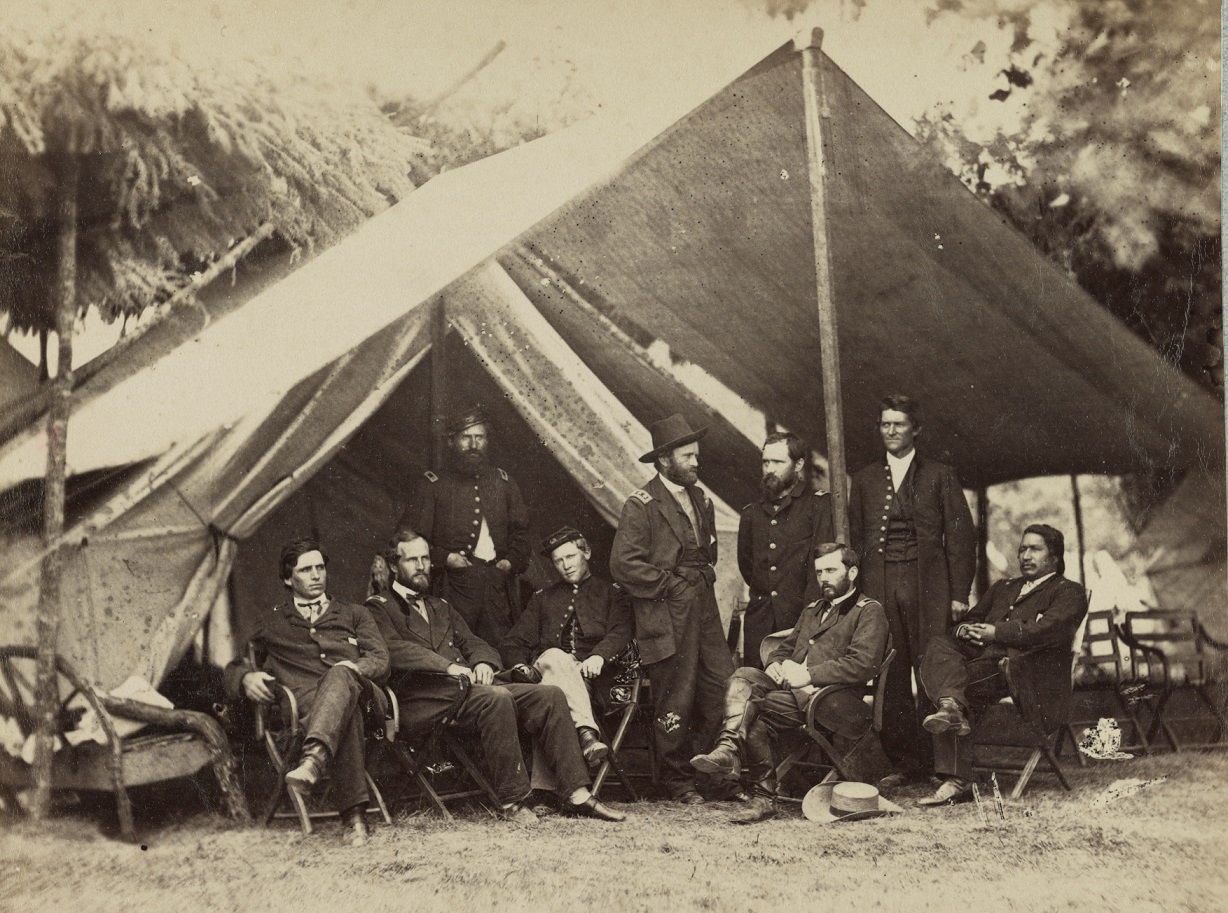
Ulysses S. Grant and his staff at City Point (Library of Congress).

Ulysses S. Grant and his staff at City Point (Library of Congress).

Intrigue and rumors continue to plague the Army of the Potomac. The Franklin that Grant wanted to command the new department is William Franklin, whose career had never really recovered after his maneuverings against Ambrose Burnside following Fredericksburg. The other refugees from the Army Meade mentions are Oliver O. Howard and Joe Hooker.

The upcoming attack that Meade mentions is the debacle we remember as the Battle of the Crater.

Your letters of the 24th and 27th arrived this evening. They are written in very bad spirits, and I am tempted to scold you for indulging in such. I want you to recover your original elasticity of spirits which characterized you in the early days of our married life, when you were always sure something was going to turn up. You must now try to look on the bright side and hope for the best. I think we have a great deal to be thankful for, and things might be much worse.

I had a visit yesterday from our old friend the Rev. Mr. Neill. He was very complimentary to me, and promised to call and see you on his return to Philadelphia. He was here as agent of the Christian Commission.

Yesterday I went to see General Grant at City Point. He said he wanted an officer to go to Washington to take command of the Department of West Virginia, Susquehanna, Baltimore and Washington. That not wishing to take any one from the field, he had suggested Franklin, but they had declined to have Franklin. He then suggested my name, to which he had received no reply, but a message from the President asking him to meet him at Fortress Monroe. I made no reply to Grant, except to say I was ready to obey any order that might be given me. So far as having an independent command, which the Army of the Potomac is not, I would like this change very well; but in other respects, to have to manage Couch, Hunter, Wallace and Augur, and to be managed by the President, Secretary and Halleck, will be a pretty trying position that no man in his senses could desire. I am quite indifferent how it turns out. I think the President will urge the appointment of Halleck; but Grant will not agree to this if he can help it.

Grant told me Sherman has assigned Howard to McPherson’s command. This had disgusted Joe Hooker, who had asked to be and had been relieved. To-morrow we make an attack on Petersburg. I am not sanguine of success, but hope for the best.

Meade’s correspondence taken from The Life and Letters of George Gordon Meade, Major-General United States Army, Vol. 2, (New York: Charles Scribner’s Sons, 1913), pp. 216-17 Available via Google Books.

Abandonment of Slavery (July 26, 1864)

Horace Greeley (Library of Congress).

Horace Greeley (Library of Congress).

Meade returns to the subject of Horace Greeley’s peace conference at Niagara Falls. The general was essentially conservative. While never as outspoken as George McClellan about not turning the war into one of “servile insurrection,” we can assume Meade agreed with those sentiments. By this time, though, there was no turning back. Lincoln would not (and could not) reverse course on the subject of slavery. Once the president issued the Emancipation Proclamation the North’s war had changed from one to restore the Union to one to restore the Union without slavery.

Lincoln knew perfectly well that the Confederates would reject the terms he offered in the“To Whom It May Concern” letter he sent with Greeley (and had published in northern newspapers). He feared that simply demanding the restoration of the Union might lead to a cease-fire that could ultimately scuttle the Union’s war efforts. But his insistence on the abolition of slavery emboldened his critics. Wrote David Herbert Donald in Lincoln, “The New York Herald announced the publication of the President’s ‘To Whom It May Concern’ letter ‘sealed Lincoln’s fate in the coming Presidential campaign.’ . . . ‘All he has a right to require of the South is submission to the Constitution,’ Democratic editors announced. They were sure that ‘the people of the loyal states will teach him, they will not supply men and treasure to prosecute a war in the interest of the black race.’”

I consider the peace movement in Canada, and the share Horace Greeley had in it, as most significant. The New York Times of the 23d has a most important article on the President’s “To whom it may concern” proclamation, in which it is argued that Mr. Lincoln was right to make the integrity of the Union a sine qua non, but not to make the abandonment of slavery; that this last is a question for discussion and mutual arrangement, and should not be interposed as a bar to peace negotiations.

It is a pity Mr. Lincoln employed the term “abandonment of slavery,” as it implies its immediate abolition or extinction, to which the South will never agree; at least, not until our military successes have been greater than they have hitherto been, or than they now seem likely to be. Whereas had he said the final adjustment of the slavery question, leaving the door open to gradual emancipation, I really believe the South would listen and agree to terms. But when a man like Horace Greeley declares a peace is not so distant or improbable as he had thought, and when a Republican paper, like the Times, asserts the people are yearning for peace, and will not permit the slavery question to interpose towards its negotiations, I think we may conclude we see the beginning of the end. God grant it may be so, and that it will not be long before this terrible war is brought to a close.

The camp is full of rumors of intrigues and reports of all kinds, but I keep myself free from them all, ask no questions, mind my own business, and stand prepared to obey orders and do my duty.

Meade’s correspondence taken from The Life and Letters of George Gordon Meade, Major-General United States Army, Vol. 2, (New York: Charles Scribner’s Sons, 1913), pp. 215-16. Available via Google Books.

Tree Lover (July 24, 1864)

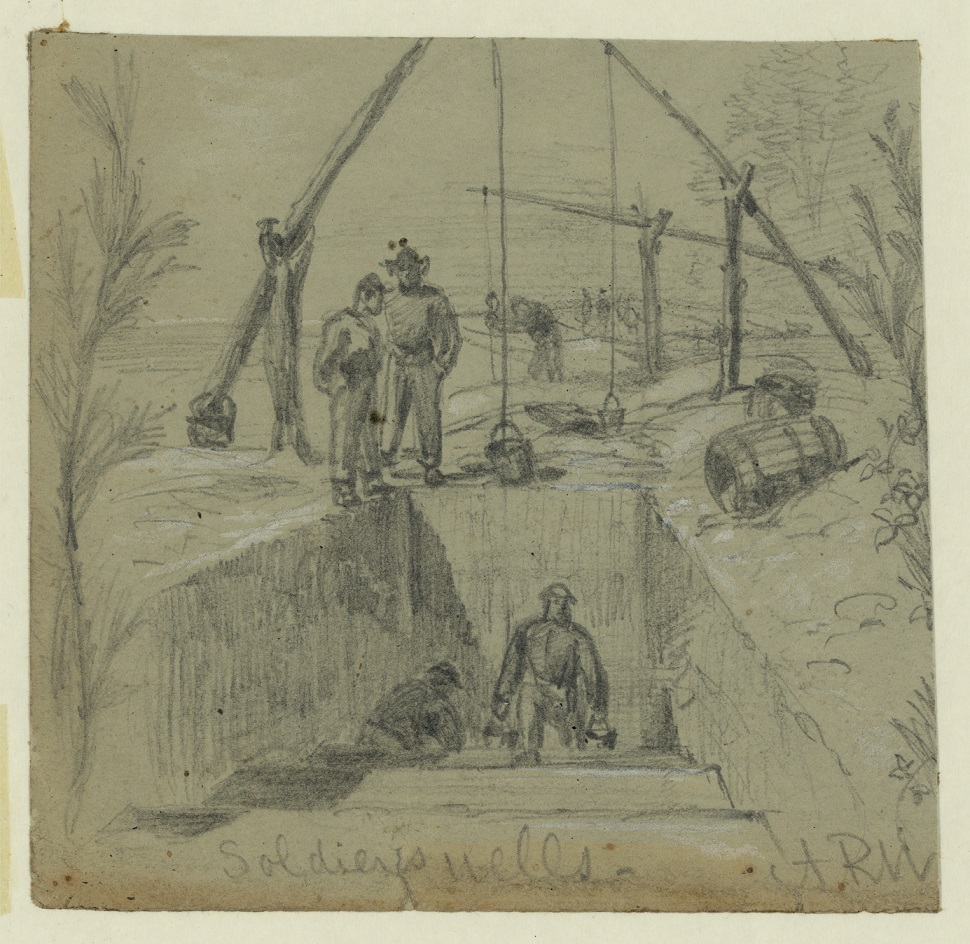
Soldiers dig wells in front of Petersburg in an illustration by Alfred Waud (Library of Congress).

Soldiers dig wells in front of Petersburg in an illustration by Alfred Waud (Library of Congress).

Theodore Lyman continues in his duty as escort to the French observers with the Army of the Potomac. The Agassiz to whom he refers is his old professor at Harvard, Jean Louis Rodolphe Agassiz. Lyman had studied starfish under him. In fact, it was while on a scientific expedition to Florida in 1856 to study starfish that young Lyman first met Lt. George Gordon Meade, who was building lighthouses there.

All appears quiet on the Petersburg front for now, but that will change dramatically in less than a week.

The appearance of the sky is what the sailors term “greasy,” though whether that betokens rain or not I don’t venture to guess. Mayhap we will have a storm, which indeed would serve to lay the dust, which already begins to return, in force. This drought has been in one respect beneficial: it has kept the soldiers from using surface water and forced them to dig wells, whence healthy water may be got. One well near this was productive of scientific results, as they got from it a quantity of shells which I shall send to Agassiz. All this country is underlain more or less by “marl beds,” which are old sea-bottoms full of a good many different shells. The good Colonel de Chanal took a ride with me. He is so funny, with his sentimental French ways. He, with a true French appreciation of wood, looks with honest horror on the felling of a tree. As we rode along, there was a teamster, cutting down an oak for some trivial purpose. “Ah,” cried De Chanal, “Ah! encore un chene; encore un beau chene!” If you tell him twenty men have been killed in the trenches, he is not interested; but actually he notices each tree that falls. “Ah,” he says, “when I think what labor I have been at, on the little place I have at home, to plant, only for my grandchildren, such trees as you cut down without reason!” As he has always lived in the South of France, where greenery is scarce, he is not offended by the bareness of the soil; but when riding through a dreary pine wood, will suddenly break out: “Oh, que c’est beau, que c’est beau!”

Theodore Lyman’s letter is from Meade’s Headquarters, 1863-1865: Letters of Colonel Theodore Lyman from the Wilderness to Appomattox, pp. 194-5. Edited by George R. Agassiz. Boston, Massachusetts Historical Society, 1922. Available via Google Books.