More Historicus (March 22, 1865)

In this print, titled "Grant and his Generals," George Meade does make an appearance off to Grant's right (Library of Congress).

George Meade does appear in this print, titled “Grant and his Generals,” off to Grant’s right, next to William Sherman (Library of Congress).

In this letter Meade mentions the newspaper article by “Historicus” and the replies by a V Corps staff officer and General James Barnes. You can read those items here.

Grant is emphatically an executive man, whose only place is in the field. One object in coming here is to avoid Washington and its entourage. I intend to give him heartiest co-operation, and so far as I am able do just the same when he is present that I would do were he absent.

[Winfield Scott] Hancock is in Washington and will be down to-morrow. He was before the committee to-day. [Andrew] Humphreys has returned, having been before the committee, where he gave testimony about Gettysburg. Have you seen the article in the Herald, signed “Staff Officer, Fifth Corps,”  and one in Monday’s (yesterday’s) paper signed by General Barnes? I think Historicus after awhile will be sick of his only true and authentic account of the battle.

Meade’s correspondence taken from The Life and Letters of George Gordon Meade, Major-General United States Army, Vol. 2, (New York: Charles Scribner’s Sons, 1913), p. 182. Available via Google Books.

Butterfield (March 20, 1864)

Daniel Buttefield. In the words of early Gettysburg historian John Bachelder, he "has never lost the occasion to stab General Meade's reputation under the fifth rib" (Library of Congress).

Daniel Butterfield. In the words of early Gettysburg historian John Bachelder, he “has never lost the occasion to stab General Meade’s reputation under the fifth rib” (Library of Congress).

No one can deny that George Meade had a knack for making enemies. One of them was Daniel Butterfield. Back in 1862 Ambrose Burnside appointed Butterfield to command the V Corps. Meade pointed out that he outranked Butterfield and the position should have been his. Burnside agreed, and Meade took over from Butterfield. He thought he and Butterfield smoothed things over afterwards, but apparently not. Joe Hooker later appointed Butterfield his chief of staff. “I believe Hooker is a good soldier,” Meade wrote to his wife back then; “the danger he runs is of subjecting himself to bad influences, such as Dan Butterfield and Dan Sickles, who, being intellectually more clever than Hooker, and leading him to believe they are very influential, will obtain an injurious ascendancy over him and insensibly affect his conduct.” Once Meade took command of the Army of the Potomac he tried to find someone to replace Butterfield as chief of staff, but he could not find anyone willing to take the job. When John Sedgwick heard that Butterfield would keep his position, the VI Corps commander “looked solemn and said he regretted it, that he knew Butterfield well, that he was a bold bad man and that Meade would live to regret it.” Sedgwick was right. When the Joint Committee on the Conduct of the War began investigating Meade and Gettysburg, Butterfield, who had been sent west, traveled to Washington without leave to provide damaging testimony. He said that on July 2 Meade had told him to prepare an order directing the Army of the Potomac to retreat from the battlefield, a charge Meade vehemently denied.

I have received a letter from [John] Gibbon which has worried me a great deal. It is now evident that Butterfield, either intentionally or otherwise, misconstrued something that I said to him on the 2d of July into instructions to prepare an order to withdraw the army. To-be-sure, this order was never issued; it is also certain I never intended it to be prepared, much less issued. Nevertheless, the fact that he did prepare it, and, as he will swear, was ordered to do so, notwithstanding it was never issued, will operate against me, as people disposed to find fault will say I was all the time anticipating defeat, and hampered accordingly. God knows my conscience is clear that I never for a moment thought of retreating, although I presume I held in view the contingency that the enemy might compel me so to do, and I may have told Butterfield to familiarize himself with the roads, etc., so that if it became necessary we would be prepared to do it promptly and in good order. Out of this he has manufactured the lie that I intended at the time to do so. The falsehoods that have been uttered against me, and the evidence of a regular conspiracy which has been organizing almost since the date of the battle, make me heartsick. I believe now that Butterfield commenced deliberately, from the time I assumed command, to treasure up incidents, remarks and papers to pervert and distort in the future to my injury. How otherwise to account for his having a copy of this pretended order? Not only is no such order or paper found among the records of the Adjutant General’s Office, but the clerks and others have no recollection of any order.

It is hard that I am to suffer from the malice of such men as Sickles and Butterfield.

Grant is expected here next Wednesday. He spoke very fairly when here last, and from all I can hear of what he has said of me to others, I ought to be satisfied, as I understand he expressed every confidence in me, and said no change would be made in the command, as far as he was concerned. Still, he undoubtedly will have the power, and will exercise it, of bringing here such a force as will effect results that hitherto I have been unable to effect, and this will by the ignorant public be set down to his superior merit and quoted against me. However, I shall do my duty to the best of my ability, and trust to Providence.

Meade’s correspondence taken from The Life and Letters of George Gordon Meade, Major-General United States Army, Vol. 2, (New York: Charles Scribner’s Sons, 1913), p. 181-2. Available via Google Books.*

“Almost a Farce” (March 18, 1863)

I see General Grant’s assuming command and announcing that his headquarters will be with the Army of the Potomac, is in the public journals, and by to-morrow will be known in Richmond. Of course this will notify the rebels where to look for active operations, and they will prepare accordingly.

You need not think I apprehend any trouble about my being relieved. I don’t think I have at any time been in any danger. It would be almost a farce to relieve the man who fought the battle of Gettysburg, nine months after the battle, not for retreating, not for ordering a retreat, but for preparing an order, which was never issued; for such is the last and most serious charge against me.

Meade’s correspondence taken from The Life and Letters of George Gordon Meade, Major-General United States Army, Vol. 2, (New York: Charles Scribner’s Sons, 1913), p. 181. Available via Google Books.

No Ordinary Man (March 16, 1864)

Meade’s battles have shifted from Congress to the press, specifically an article, signed “Historicus,” that appeared in the New York Herald. You can read the Historicus article and its follow-ups here.


Daniel Sickles (Library of Congress).

Daniel Sickles (Library of Congress).

My Gettysburg fight is at present in statu quo, except that I have enclosed to the War Department the letter from the New York Herald, of the 12th, signed Historicus, saying I believed it was written, or dictated, by General Sickles, and that I desire he may be called on to state whether he authorized it, or endorses it; and should he reply in the affirmative, I then ask for a court of inquiry. If the department is not disposed to accede to this, I then ask permission to make public such official documents as I deem necessary to my defense.

George has gone to a ball to-night, given in the Fifth Corps. I thought I had better keep quiet at home, and not expose myself, as my cold, though better, still hangs about me. These balls were always against my judgment, and I see they are beginning to be animadverted on by those who are unfriendly to this army, and who are ready to catch at anything to find fault with.

As I told you, I was much pleased with Grant, and most agreeably disappointed in his evidence of mind and character. You may rest assured he is not an ordinary man.

Meade’s correspondence taken from The Life and Letters of George Gordon Meade, Major-General United States Army, Vol. 2, (New York: Charles Scribner’s Sons, 1913), pp. 180-1. Available via Google Books.

Better Than Jesus

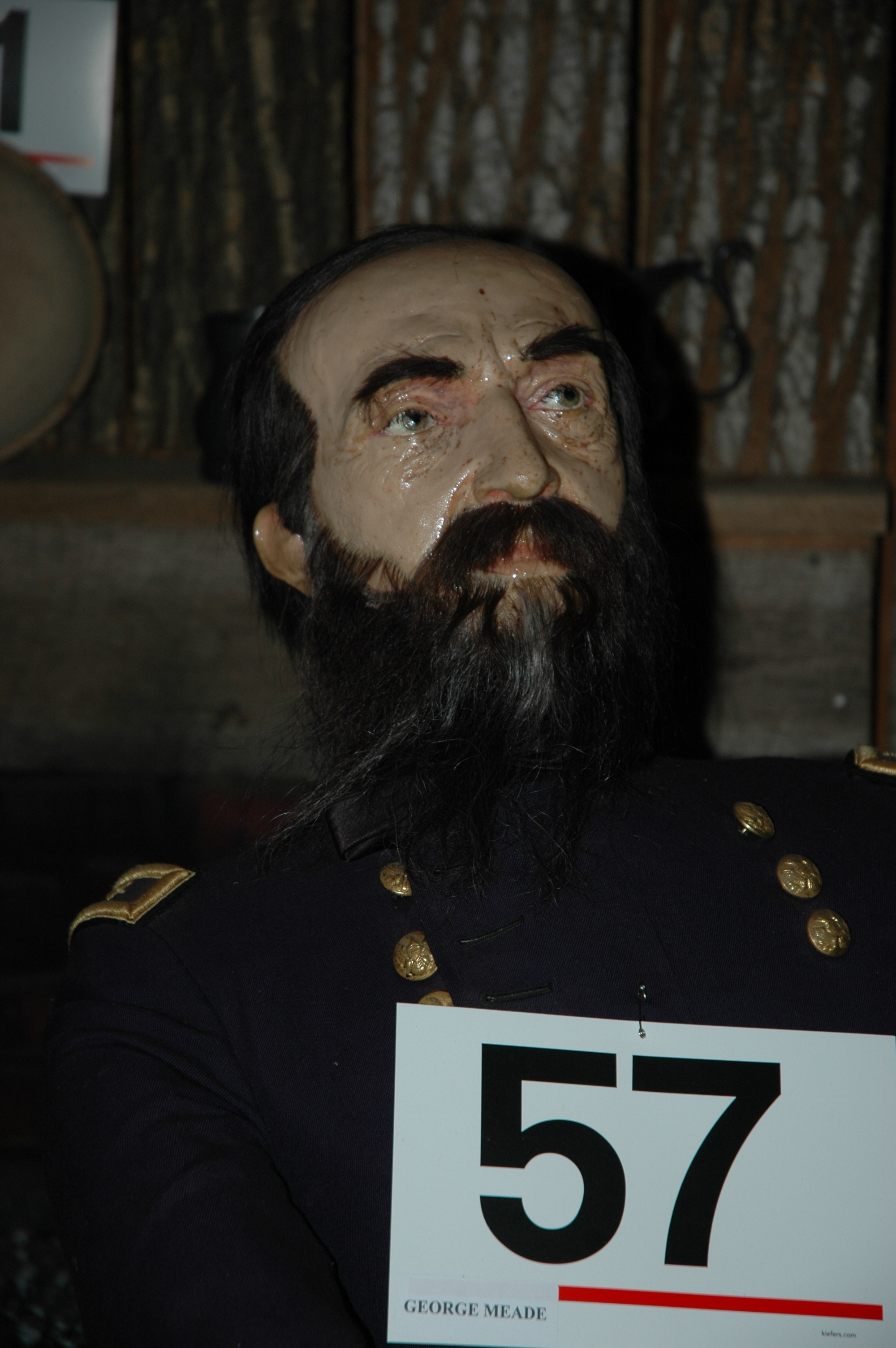
DSC_5752The George Meade figurine being auctioned at the American Civil War Wax Museum in Gettysburg sold for $1,100, far more than I could justify (or afford) paying. But I was glad to see Meade fetched a higher value than any of the other generals in his booth. George Armstrong Custer sold for $900 and Philip Sheridan–a thorn in the real Meade’s side–sold for a mere $500.

My wife and I hit a couple of brewpubs last night (Battlefield Brew Works and the new ABC in the Gateway complex off Route 15) so we were moving a tad slowly this morning and missed the auction of the first Robert E. Lee and General Grant. (Yes, the wax museum had more than one Lee.) So I can’t say what they sold for. But of all the figures we saw auctioned, Meade scored the highest, beating out Stonewall Jackson ($500), Nathan Bedford Forrest ($675), John Singleton Mosby ($600), Jubal Early ($450), George Pickett ($700), and James Longstreet ($750). The Lee figure from the museum’s front hallway tied with Meade, but the Old Goggle-eyed Snapping Turtle did beat the Jesus figure from the Jackson diorama. The Son of God went for $1,000.

The auction appeared to draw a pretty big crowd and it was standing-room only when we arrived around 9:15. We left when it became apparent that even the little stuff was selling for more than we were prepared to pay. The sign for the Northern Leaders booth, the one with Meade, went for $250–about 10 times what I was prepared to pay.

I did bid on one reproduction rifle but was immediately outbid. Although I would have liked to come home with something, my bank account feels a sense of relief.

A Prudent General (March 15, 1864)

Meade was often very revealing in his letters to Henry A. Cram, his wife’s brother-in law. Here he discusses his recent tribulations with Congress, and provides a pretty good sense of his immediate future and his place in history: “I expect to retain my place, but I am anxious about my reputation.”

I received your note in due course of mail, but was so busy at the time I could not reply. It was hardly necessary for you to write that you would do anything in my defense, because I shall always fully count on you in this way. I was glad to have your sympathy, because I am free to confess the suddenness of this attack, its injurious combination of several interests against me, that really have no particular cause of complaint, has in reality astounded me and for awhile I was embarrassed what to do. I believe now, however, I have produced a reaction in my behalf, simply by exposing the character and motives of my assailants. I feared the Committee on the Conduct of the War was against me, and that their examination would be ex-parte; to which their organization, the absence of myself or counsel, the ignorance I am under of what is testified against me, all combine to give great power for injury, if abused. Fortunately my friend Mr. Odell is on this committee, and although hitherto a great friend of my principal adversary, he is most indignant at the course pursued, and has entered heart and soul into the determination to see justice done. Now this is all I ask, a thorough investigation of the whole matter and the bringing out the truth.

The ingenuity of my enemies, in the theory of their attack, is worthy of admiration. They acknowledge the battle of Gettysburg as one of the greatest victories the world has ever seen; but they expect to prove that it was fought in opposition to all the plans I had formed; that I was all the time expecting disaster and issuing orders to retreat; in fine, that had I not been there, great as was the battle, it would have been far greater. Now, although I can tear away all this flimsy framework of argument in this operation, I shall have to expose that as a prudent general, whilst my orders were always looking to fighting, I did at times, in discussions, councils, preparatory orders, etc., hold in view the contingency of a reverse and endeavor to be prepared for it. This is the sum and substance of my offense, and I regret to say that, among a certain class of my fellow-countrymen, this will be an offense and indicative of what they call too much caution, and being paralyzed by contingent reverses, proving that I did not have the dash and blundering audacity of others.

My enemies consist of certain politicians who wish me removed to restore Hooker; then of certain subordinates, whose military reputations are involved in the destruction of mine; finally, a class of vultures who in Hooker’s day preyed upon the army, and who sigh for a return of those glorious days. I expect to retain my place, but I am anxious about my reputation.

A very good article has been sent to me in the new paper in your city called the Round Table. [See below.] I wish, if you know the editors, you would, in my name, thank them for their generous interposition in my behalf. I am of the opinion that the characters and motives of my assailants have been of immense benefit, in staying public judgment before I could reply. I should like to see that article republished over the country, also one from the Times, which was no more personal, but discussed temperately the destruction of all subordination and discipline in an army where the inferior generals were spies and critics of their commanding general.

I think my testimony will pull the lion’s skin off of some of my disguised foes, and that they will perhaps, before the thing is over, repent they ever meddled with it. Already the liars have disclaimed any intention to attack me, and in evidence produce the article in the Herald signed Historicus, which you have doubtless read, and which is filled with false and perverted statements, which have astonished even myself, and those around me, who have great respect for the capacity, adroitness and skill in this respect of my opponents.

Give my love to Kate, and tell her I shall come out of this last battle of Gettysburg with flying colors.

Here’s the Round Table article that Meade mentions:

OUGHT GENERAL MEADE TO BE REMOVED?

This question is now absorbing the attention of the authorities at Washington, and soon will be, if it is not already, decided. The fatality that has attached to every commander of the brave Army of the Potomac has affixed itself to General Meade. The movement against him, at first only whispered among a few discontented subordinates in the army, has at last reached the capital, and has attained the dignity—if dignity it be—of an open opposition. The main movers appear to be General Daniel E’ Sickles and the new Committee on the Conduct of the War. It is urged that General Meade is too slow; that but for the dash of some of his division commanders the victory at Gettysburg would have been a cowardly retreat; that he erred in not following up Lee immediately after that battle; and that since that time he has let slip more than one opportunity of adding new laurels to those of which the Army of the Potomac cherish an honorable pride. Such, in brief, are the charges against General Meade.

It is well known that, in his report of the battle of Gettysburg, General Meade indirectly censured General Sickles for advancing farther than he had authority to do by virtue of his orders, and so not only subjected his corps to severe loss, but rendered the extrication of it from the difficulty in which it was thereby involved no easy task. Whether General Sickles intentionally disobeyed or unintentionally misinterpreted his orders, was not distinctly stated. But one thing is certain, that the fact that General Sickles lost a leg in the engagement saved him from removal from the army. We honor General Sickles for the devotion to the cause of his country; we honor him for the untiring energy and personal bravery he has displayed in its defense; and when the war shall be ended and the roll of honor made out, we shall not be the last to claim for General Sickles no mean place on it. But we cannot blink the fact that General Sickles is quite as much a politician as a soldier. We know that he has accomplished more by personal address, adroitness, and cunning management of newspaper correspondents, than by actual display of military ability. * * * He is not a man to forget a fancied slight or to lose an opportunity of resenting it. In view of this, we are at no loss to account for his hostility to General Meade. As to the Committee on the Conduct of the War, the less that is said of it the better. So much for General Meade’s accusers.

Concerning General Meade, we presume no one will deny that he is a high-minded gentleman and a thorough soldier. All his dispatches and reports show that he has the instincts of a gentleman; and since he has been in the command of the Army of the Potomac he has won one great battle, has obtained several smaller successes, and has suffered no great disaster. As regards the battle of Gettysburg, the fate of Philadelphia, Baltimore, and Washington, and perhaps of the nation itself, depended upon him, and with this in mind he had no business to take any risks. We see now how a pursuit of Lee immediately after the battle might have proved advantageous; but General Meade could not feel sure of it then, and under the circumstances he ought not to have undertaken the pursuit unless he was certain of its proving successful.

As a strategist and a tactician, General Meade has displayed no ordinary military ability. His disposition of his troops at Gettysburg has yet to be questioned, while the various movements he has planned since then, though not ending in the results which were hoped for, have stamped him as an able general. His retreat in the valley of the Shenandoah, when outflanked by Lee, was more than redeemed by the fact that he captured a number of rebel prisoners, which is, we believe, the only instance in the war in which a retreating force not only saved itself, but captured no small portion of its pursuers. Indeed, the rebels acknowledge this. The retreat from Mine Run, though it was to be regretted, reflected but little on General Meade, for his plan of the movement was proved to have been good, despite the failure in its execution.

Besides, the present is not a time for the removal of a general in command of so important an army, unless his faults be much greater than any that can be proved of General Meade. The spring campaign is about to open—who is better fitted to lead the Army of the Potomac than he who led it to victory at Gettysburg, and has since kept its honor bright? We have changed commanders too often; with the exception of General Meade, each change has been for the worse. We tried Burnside, Pope, Hooker, and found each of them wanting. There was no victory between those of Antietam and Gettysburg. It is due to the general who won the latter that he should have a chance to share the honors of the triumphs which we hope are awaiting our armies in the coming campaign. This is no time for experiments. And so long as we have got a good commander—one, too, who has proved himself such—we should stand by him; certainly we should not remove him to gratify the pique of any man or any set of men. General Grant was given a fair trial after the disaster at Belmont and Shiloh. Shall not as much be granted to General Meade, who as yet has met with no disaster?

Meade’s correspondence taken from The Life and Letters of George Gordon Meade, Major-General United States Army, Vol. 2, (New York: Charles Scribner’s Sons, 1913), pp. 178-80. The Round Table article appears on pp. 321-3. Available via Google Books.

Who Was That Waxed Man?

One of these figures does not belong. (Hint: It's the one that does not have a number.) That's Meade reclining in front of me.

One of these figures does not belong. (Hint: It’s the one that does not have a number.) That’s Meade reclining in front of me.

Last summer I did a book signing at the Gettysburg Civil War Wax Museum, also known as the National Civil War Wax Museum and the American Civil War Museum. I’m not sure what its real name is, really. Truth be told, I never went through the exhibition area. I never saw all its wax figures in their life-size dioramas recreating historic tableaux from the Civil War era.

At least not until yesterday.

The museum, which dates back to 1962 and claims to have hosted up to 9 million visitors over its history, has changed ownership and is radically revamping its exhibits. This weekend it will hold an auction to sell off the wax (actually plastic) figures as well as all the props, furniture, paintings, and other artifacts that brought the Civil War to life. Or at least something that resembled–if you squinted and suspended a reasonable quantity of disbelief–this thing called life.

Horrors of the wax museum! This is General Meade as some 9 million visitors to the National Civil War Wax Museum knew him.

Horrors of the wax museum! This is General Meade as some 9 million visitors to the National Civil War Wax Museum knew him.

Among the artifacts to be auctioned off is a life-size George Gordon Meade.

I had to check it out. So yesterday my wife and I jumped in the car and headed south to Gettysburg for an auction preview. It was like getting a free ticket to the Wax Museum, except this time they let visitors go into the dioramas. And all the historical figures wore numbers, as though they had escaped from Civil War wax jail.

It was all a little creepy, but I guess a good wax museum should be. And it was tremendously old-fashioned, the kind of family entertainment that went out of style with coonskin caps and Ovaltine.  I have to admit, though, there is something endearing about these earnest displays and their somewhat grotesque inhabitants and I feel a little guilty when I poke fun at them. If it had stuck around longer maybe the museum would have become retro-chic and found a new audience. I know that for people who grew up around Gettysburg the wax museum–like the old Electric Map–was part of their childhoods. Time passes on; ways change. I suspect today’s youth would not find the exhibits to be particularly compelling.

In any event, I’m heading back down for the auction. It’s not every day you get to bid on a life-size Meade.

To be continued.

The Wax Museum answered the oft-asked question, "What would the surrender at Appomattox have looked like it enacted by zombies?

The Wax Museum answered the oft-asked question, “What would the surrender at Appomattox have looked like it enacted by zombies?

If two heads are better than one, what is this better than?

If two heads are better than one, what is this better than?

Stonewall Jackson lies mortally wounded in the Wilderness. He still has enough presence of mind to have the commander of the famed "Jesus Brigade" arrested for allowing too much straggling.

Stonewall Jackson lies mortally wounded in the Wilderness. He still has enough presence of mind to have the commander of the famed “Jesus Brigade” arrested for allowing too much straggling.

Weighing Grant (March 14, 1864)

This print, titled "Lincoln and His Generals," shows the president with Admirals Porter and Farragut and Generals Sherman, Thomas, Grant and Sheridan. In typical fashion, Meade is not included (Library of Congress).

This print, titled “Lincoln and His Generals,” shows the president with Admirals Porter and Farragut and Generals Sherman, Thomas, Grant and Sheridan. In typical fashion, Meade is not included (Library of Congress).

As of March 14 George Meade may think the tempest raised by the Joint Committee on the Conduct of the War is over, but there are more storm clouds ahead, including repercussions from an account of Gettysburg published on March 12 in the New York Herald by an anonymous correspondent calling himself Historicus. In a broader sense, though, Meade was correct that his position was secure, but that was due less to his own forceful testimony than to the fact that Ulysses S. Grant had become general-in-chief. Grant’s presence essentially derailed the efforts to get either Joe Hooker or Dan Sickles assigned as Meade’s replacement. As David Bell Birney, one of the generals backing Hooker, will write in a letter on April 5, “Grant killed the demonstration for Hooker, that was assuming shape, and would have ended in the decapitation of Meade.” In this letter Meade also continues the story of his letter to Senator Reverdy Johnson, which me mentioned in his letter of March 10.

I wrote you, I think, on the evening of the 10th, the day Grant was here. It rained all that day, and as he could not see anything, he determined to return to Washington the next day. The President having invited both General Grant and myself to dinner on Saturday, the 12th, I had of course to go up to Washington, and as I wanted to add to my testimony to the committee, I concluded to go up with General Grant. When I arrived, I immediately went before the committee and filed documentary evidence to prove the correctness of my previous assertion that I never for an instant had any idea of fighting anywhere but at Gettysburg, as soon as I learned of Reynolds’s collision and obtained information that the ground was suitable. Mr. Wade was the only member present. He took great pains to endeavor to convince me the committee were not responsible for the newspaper attacks on me, and I might rest assured there was no disposition on their part to do me injustice. Afterwards I saw Mr. Stanton, who told me Mr. Wade had been to see him, and said my testimony was the clearest statement that had ever been made to the committee, and that, as far as he could see, it was perfectly satisfactory in explanation of all charges against me. I soon found the tide had turned in my favor, and that Sickles had overreached himself. I also ascertained that Chandler and Wilkinson were my foes on the committee, that Wade was rather friendly, and that Harding, of the Senate, Gooch and Odell, of the House, were my warm friends.

I think I wrote to you that the Secretary had officially inquired of me by what authority I had written to Hon. Reverdy Johnston, a Senator, about military affairs, and that I had replied to him I did not require any authority to write a private letter to a friend, defending myself from slanders. When I saw Mr. Stanton I referred to this matter, when he told me his letter had been written in my interest; that I had made a great mistake in writing to Mr. Johnston, who was showing it to everybody, and making it appear he was my chosen champion; and that his political status was such that any identification with him could not fail to damage me and my cause. He said he was aware of how I had been led into the step, and all he wanted was just such a reply as I had made, which he would now show to Senators and Representatives when they called on him to know what my relations were with Reverdy Johnston. I fortunately met Mr. Johnston in the street, begged him to consider my letter strictly private, and borrowed it to copy for file in the War Department.

I think I told you I was very much pleased with General Grant. In the views he expressed to me he showed much more capacity and character than I had expected. I spoke to him very plainly about my position, offered to vacate the command of the Army of the Potomac, in case he had a preference for any other. This he declined in a complimentary speech, but indicated to me his intention, when in this part of the country, of being with my army. So that you may look now for the Army of the Potomac putting laurels on the brows of another rather than your husband.

Meade’s correspondence taken from The Life and Letters of George Gordon Meade, Major-General United States Army, Vol. 2, (New York: Charles Scribner’s Sons, 1913), pp. 177-8. Available via Google Books.

The Storm Subsides (March 10, 1864)

Meade appears upbeat about his battles in Congress on March 10. At the end of the letter he mentions Grant’s arrival for a visit, which is even bigger news. This is how Grant himself recalled the meeting in his memoirs:

A sketch of Ulysses S. Grant by Alden Finney Brooks (Library of Congress).

A sketch of Ulysses S. Grant by Alden Finney Brooks (Library of Congress).

My commission as lieutenant-general was given to me on the 9th of March, 1864. On the following day, as already stated, I visited General Meade, commanding the Army of the Potomac, at his headquarters at Brandy Station, north of the Rapidan. I had known General Meade slightly in the Mexican war, but had not met him since until this visit. I was a stranger to most of the Army of the Potomac, I might say to all except the officers of the regular army who had served in the Mexican war. There had been some changes ordered in the organization of that army before my promotion. One was the consolidation of five corps into three, thus throwing some officers of rank out of important commands. Meade evidently thought that I might want to make still one more change not yet ordered. He said to me that I might want an officer who had served with me in the West, mentioning Sherman specially, to take his place. If so, he begged me not to hesitate about making the change. He urged that the work before us was of such vast importance to the whole nation that the feeling or wishes of no one person should stand in the way of selecting the right men for all positions. For himself, he would serve to the best of his ability wherever placed. I assured him that I had no thought of substituting any one for him. As to Sherman, he could not be spared from the West.

This incident gave me even a more favorable opinion of Meade than did his great victory at Gettysburg the July before. It is men who wait to be selected, and not those who seek, from whom we may always expect the most efficient service.

Meade’s position afterwards proved embarrassing to me if not to him. He was commanding an army and, for nearly a year previous to my taking command of all the armies, was in supreme command of the Army of the Potomac—except from the authorities at Washington. All other general officers occupying similar positions were independent in their commands so far as any one present with them was concerned. I tried to make General Meade’s position as nearly as possible what it would have been if I had been in Washington or any other place away from his command. I therefore gave all orders for the movements of the Army of the Potomac to Meade to have them executed. To avoid the necessity of having to give orders direct, I established my headquarters near his, unless there were reasons for locating them elsewhere. This sometimes happened, and I had on occasions to give orders direct to the troops affected.

In that excerpt Grant mentions the changes in the Army of the Potomac. Meade had requested that the army be consolidated from five corps to three, and the War Department issued the official orders on March 23. The I and III Corps, both terribly battered at Gettysburg, were broken up, their units distributed to the II, V, and VI Corps. That meant the departures of John Newton and William French, moves that created little regret. George Sykes was also removed from command of the V Corps; prickly, perfectionistic Gouverneur Warren now filled that post. Alfred Pleasonton, the dapper self-promoter who commanded the cavalry, had departed, too. His replacement was the short, pugnacious, and eager-for-glory Philip Sheridan. The General Gibbon whom Meade mentions is John Gibbon, who commanded a division of the II Corps. Reverdy Johnson is the conservative Democratic Senator from Maryland.

Brigadier General John Gibbon as he appeared during the war.

Brigadier General John Gibbon as he appeared during the war.

The storm in which I have been involved seems to be subsiding, as I note the Tribune now says that no charges were preferred against me by General Sickles or Doubleday. Tell General Gibbon that I have received his letter, and am greatly obliged to him for his gallantry and daring in coming out so boldly in my defense; but I do not wish him to compromise himself, and affairs are becoming complicated.

I think I wrote you on my return from Washington I found a polite note from Reverdy Johnston, saying he had assumed the responsibility of denying Mr. Wilkinson’s statement, and asking me if he was not right. This act of courtesy I considered entitled to an acknowledgment, so I replied to Mr. Johnston, and explained to him wherein I thought Mr. Wilkinson had been misled. This letter, it appears, Mr. Johnston showed to his friends, and its receipt was announced in Forney’s Chronicle. To-day I got a sharp letter from the Secretary of War, asking by what authority I wrote to Senators on military operations. I have replied my note was private and not intended for publication or circulation, and that I was not aware I required any authority to write private letters defending myself from the false and slanderous reports with which the public press has been filled for a week, particularly as the military operations referred to took place nine months ago, and the official reports have been published. This may involve me in trouble with the Secretary, but I cannot help it; I will not yield my right to defend myself.

To-day Lieutenant General Grant arrived here. He has been very civil, and said nothing about superseding me.

I go to-morrow to Washington, and shall go again before the committee, to add to my testimony.

Meade’s correspondence taken from The Life and Letters of George Gordon Meade, Major-General United States Army, Vol. 2, (New York: Charles Scribner’s Sons, 1913), pp. 176-7. Available via Google Books.

A Violent Attack (March 9, 1864)

David Bell Birney was not a Meade ally. He had commanded the III at Gettysburg following the wounding of Daniel Sickles.

David Bell Birney was not a Meade ally. He had commanded the III Corps at Gettysburg following the wounding of Daniel Sickles.

Meade’s travails with the Joint Committee on the Conduct of the War continue. He has learned that Generals David Bell Birney and Alfred Pleasonton have testified against him. As I write in Searching for George Gordon Meade: The Forgotten Victor of Gettysburg:

As the head of the Army of the Potomac’s cavalry corps, Pleasonton had embarrassed Jeb Stuart at Brandy Station just before Lee’s push north into Pennsylvania, but he had a less-than-sterling reputation. One cavalry officer said Pleasonton owed his position to “systematic lying,” and another called him “the greatest humbug of the war.” According to Pleasonton’s testimony he was with Meade following the repulse of Pickett’s Charge on July 3 and “urged him to order a general advance of his whole army in pursuit of the enemy.” Instead, Meade sent him to determine whether the enemy was retreating. A year later Pleasonton will remember even more about his dealings with Meade. This time he recollects that on the afternoon of July 2, Meade had ordered him to prepare his cavalry to cover the army’s retreat, and he had spent the entire remainder of July 2, until around midnight, doing just that. Apparently this had all slipped his memory when he first testified.

David Birney testified the same day as Pleasonton. He had his own ax to grind with Meade following their unpleasant encounter at Fredericksburg. “Meade is a fraud,” he had written to a friend in March. To help speed Meade’s departure from the army, Birney decided to cast his lot with Hooker and Sickles. “We must have Hooker back to this army and I believe he will be sent to us!” he wrote. He also had great hopes for the future of Dan Sickles. “Sickles will I think command this army and in time will be President,” he had predicted back in October. So when Birney testified before the committee, he claimed that on July 5 he had wanted to attack the retreating Confederates but received an order not to do so. That was just the kind of example of timidity the congressmen were seeking. No matter that such an order never appeared in any official record, nor had Birney mentioned this incident in his official report.

Alfred Pleasonton headed the cavalry corps for the Army of the Potomac (Library of Congress).

Alfred Pleasonton headed the cavalry corps for the Army of the Potomac (Library of Congress).

I have answered Mr. Harding’s note, likewise one from Cortlandt Parker, and numerous others I have received from sympathizing friends. To prepare a statement and furnish it to all my friends who are desirous of defending me would take too much time. Besides, I intend to await the action of the committee, give them a chance to do me justice, failing which I will publish a pamphlet giving my side of the question. Yesterday’s Tribune has a most violent attack on me, full of the basest and most malicious slanders, in which, not satisfied with attacking my military reputation, they impugn my loyalty and attribute expressions to me I never dreamed of using. [For the article, see below.]

Birney and Pleasanton have appeared in the hostile ranks. The latter’s course is the meanest and blackest ingratitude; for I can prove, but for my intercession he would have been relieved long since.

Here’s the Tribune article that so incensed Meade:

GEN. MEADE AND THE BATTLE OF GETTYSBURG

The points made before the War Investigating Committee against Gen. Meade, who is substantially on trial before this congressional Commission, by the testimony of Gens. Sickles and Doubleday, are, that he gave and promulgated an order to his army to retreat from Gettysburg at the close of the first day’s fight, when his superior strength, his advantage of position, and the honor and interests of the country, required him to give battle; that, in the forenoon of the second day’s fight—Thursday—he gave another order to retreat, but which was not promulgated in writing; that he had made no dispositions for battle that day, had no plan for fighting, and seemingly no purpose to fight, but that the battle was precipitated by Gen. Sickles, and forced on Meade in part by the enemy, but principally by General Sickles, that Meade did not know on Friday night that our men had whipped Lee, or distrusted the fact that night, and was so uncertain of it on Saturday that he dared not pursue the beaten enemy, and weakly and ignorantly threw away the certainty of capture or destroying the entire Rebel army; that for a few moments he yielded to persuasions to let the 3d Corps pursue, but countermanded the order to do so in ten minutes after it was given, saying, alluding to the Rebels, “Oh, let them go;” that Meade’s subsequent representation that he was not in condition to pursue was not true; that his army was abundantly able and in condition to make immediate pursuit, and, if necessary, to fight and crush Lee’s disordered columns; that the 6th Corps was fresh and substantially intact; it had lost only 100 men, the 12th Corps had lost only 700 and had about 12,000 left, the 3d Corps had 6,000 men left and prayed to be permitted to pursue; the whole of the cavalry, 10,000 was intact and fresh. Gen. French had at Frederick 10,000 veterans in perfect condition, and Couch’s great force was also at Meade’s call. That, in a word, he had over 40,000 effective and ardent troops with which to pursue and destroy Lee’s flying and demoralized army, but refused to use them and suffered the enemy to escape. It is upon the question of the issuance of the second order to retreat that Gen. Butterfield has been summoned.

In the committee room it is understood that the origin of the effort made by Gen. Meade to break up the Third Corps to the waste of its esprit, and the discontent of every man and officer in it, and dissatisfaction with the service, was the refusal of the corps to subscribe to the McClellan testimonial.

It is stated that testimony can be added to convict Gen. Meade of expressing the opinion that we cannot subdue the Rebels. Gens. Birney and Pleasonton, examined before the War Committee to-day, told the remarkable story of the war councils called during and after the battle of Gettysburg, and exhibited the strength and efficiency of the army the morning after the last day’s fight. The testimony of both these Generals was very damaging.

Meade’s correspondence taken from The Life and Letters of George Gordon Meade, Major-General United States Army, Vol. 2, (New York: Charles Scribner’s Sons, 1913), p. 176. The Tribune article appears on pp. 320-1. Available via Google Books.