Winter Leaves (December 10, 1863)

General Meade and General Sedgwick visit the Horse Artillery headquarters at Brandy Station. The Army of the Potomac established its winter quarters at Brandy Station in 1863 and remained there until the start of the Overland Campaign the next May.

General Meade and General Sedgwick visit the Horse Artillery headquarters at Brandy Station. The Army of the Potomac established its winter quarters at Brandy Station in 1863 and remained there until the start of the Overland Campaign the next May.

It appears that campaigning is over for the winter and attention turns to more mundane things: leaves and winter quarters. Theodore Lyman takes the pulse of the army and reports on the speculation about Meade’s replacement. Major Biddle is James C. Biddle of Meade’s staff. In Meade’s Army: the Private Notebooks of Lt. Col. Theodore Lyman, editor David Lowe reports that Biddle “came from a distinguished military family but did not always meet expectations. He could be something of a buffoon and was the target of much good-natured camp humor.”

All the officers are inclined to be petulant and touchy, for they think that winter quarters are coming and are all stretching out for “leaves,” which they know only a part can get. Major Biddle becomes quite irate over the subject. “Now there is General Webb has a ten-day leave,” says B. petulantly; “every corps is to give one general a ten-day leave. I don’t want any little ten-day leave; I want a decent leave; a sixty-day leave. I have been two years and a half in this army, and never had but seven days’ leave, except once when I was sick; and it isn’t any fun to be sick. If we are going into winter quarters, one third of this army can do what is necessary, just as well as the whole; and they might as well be liberal to us. It is too bad! really too bad!” Such discoveries of patriotic services as the officers now make, to back up their applications, are miraculous. They have all been in service since the First Bull Run (the Genesis of the Potomac Army); they have all been wounded six times; they have never been absent a single day; their wives are very sick; their mothers are not expected to live; and they can easily bring back fifty volunteers with them, to fill up their regiment! All of which General [Seth] Williams receives with the blandest smile, as if he had never before heard of so strong a case, and promises to refer it to General Meade, which indeed he does. Meanwhile the rattling of axes is heard on all sides, and villages of little log huts, with canvas roofs, spring into existence in a single night. General [Rufus] Ingalls asked if the troops could have permission to build huts: to which the Major-General commanding replied, with charming non-committal. “Build huts; certainly; why not? They can move from huts as well as from tents, can’t they?” I observe the papers continue to discuss the succession of the General. He himself thinks he will be relieved, but I doubt it. If for no other reason, because it is hard to find anyone for the post. General Sedgwick would, I think, refuse; General Warren is very young, and is, besides, under a cloud about his movement on our left. General Sickles, people would say, is too much of a Bowery boy. Generals French, Newton, and Sykes are out of the question. General Humphreys has no influence strong enough to put him up. Any subordinate general would have to be of great note to be lifted thus high; there is no such one. I think they would not try a western general, after Pope’s experience. The only one I can think of is Hancock, for a long while laid up by his Gettysburg wound, and not yet in the field. He belongs in this army, is popular, and has an excellent name. The New York Herald insists on General Pleasonton, which is an original idea. I heard of an officer who asserted that he had seen the order putting him in command; a rather unlikely assertion.

Theodore Lyman’s letter is from Meade’s Headquarters, 1863-1865: Letters of Colonel Theodore Lyman from the Wilderness to Appomattox, p 61. Edited by George R. Agassiz. Boston, Massachusetts Historical Society, 1922. Available via Google
Books
.

The Anxious Bench (December 7, 1863)

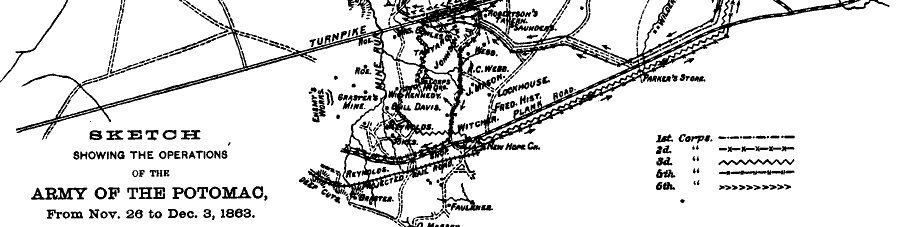
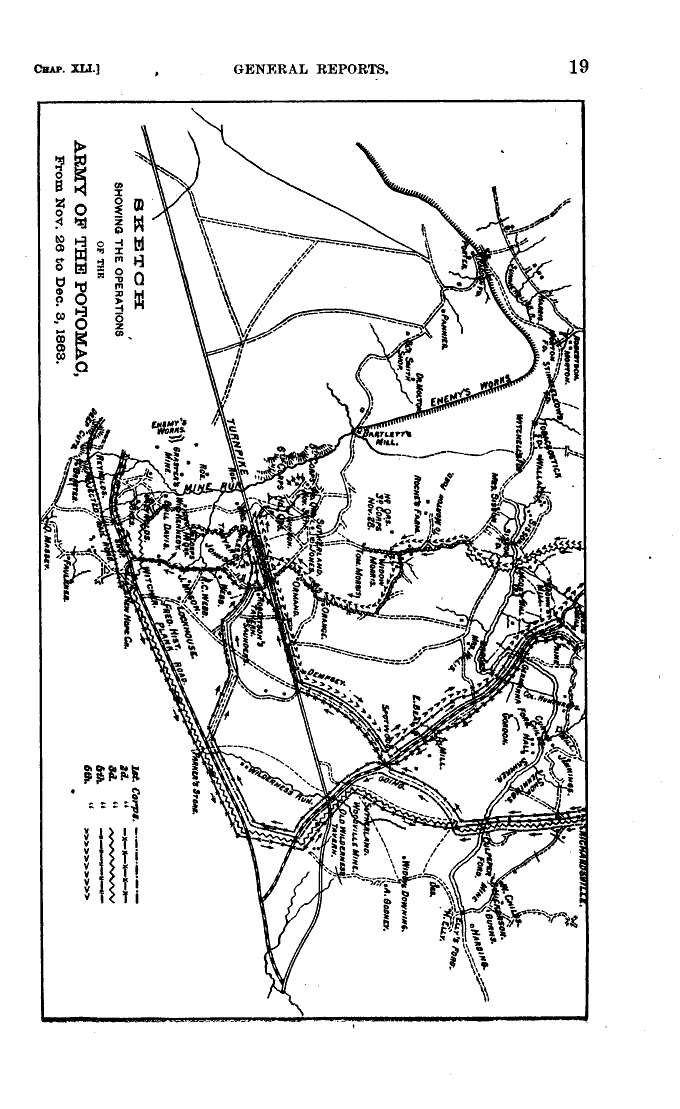
Mine Run map detail

As George Gordon Meade waits for Washington’s reaction to his failed Mine Run Campaign he looks into the future. And what does he see? “I suppose after awhile it will be discovered I was not at Gettysburg at all.”

I am yet on the anxious bench; not one word has been vouchsafed me from Washington. To-day I have sent in my official report, in which I have told the plain truth, acknowledged the movement was a failure, but claimed the causes were not in my plans, but in the want of support and co-operation on the part of subordinates. I don’t know whether my report will be published, but if it is, it will make a sensation, and undoubtedly result in some official investigation. I have received a very kind letter from Cortlandt Parker (written before he had received yours), in which he sympathizes with me in the failure, but says he is satisfied I have done right, and that I have not lost the confidence of intelligent people, and he hopes I will not resign, but hold on till the last. I have also received a very kind and complimentary letter from Gibbon, saying he had as much confidence as ever in my ability to command, and that military men would sustain me. I telegraphed General Halleck that I desired to visit Washington, but his reply was couched in such terms that, though it gave me permission to go, clearly intimated that my presence was not desired, so far as he was concerned. I have in consequence not gone, and now shall not go unless they send for me.

I see the Herald is constantly harping on the assertion that Gettysburg was fought by the corps commanders and the common soldiers, and that no generalship was displayed. I suppose after awhile it will be discovered I was not at Gettysburg at all.

Meade’s correspondence taken from The Life and Letters of George Gordon Meade, Major-General United States Army, Vol. 2, (New York: Charles Scribner’s Sons, 1913), pp. 156-9. Available via Google Books.

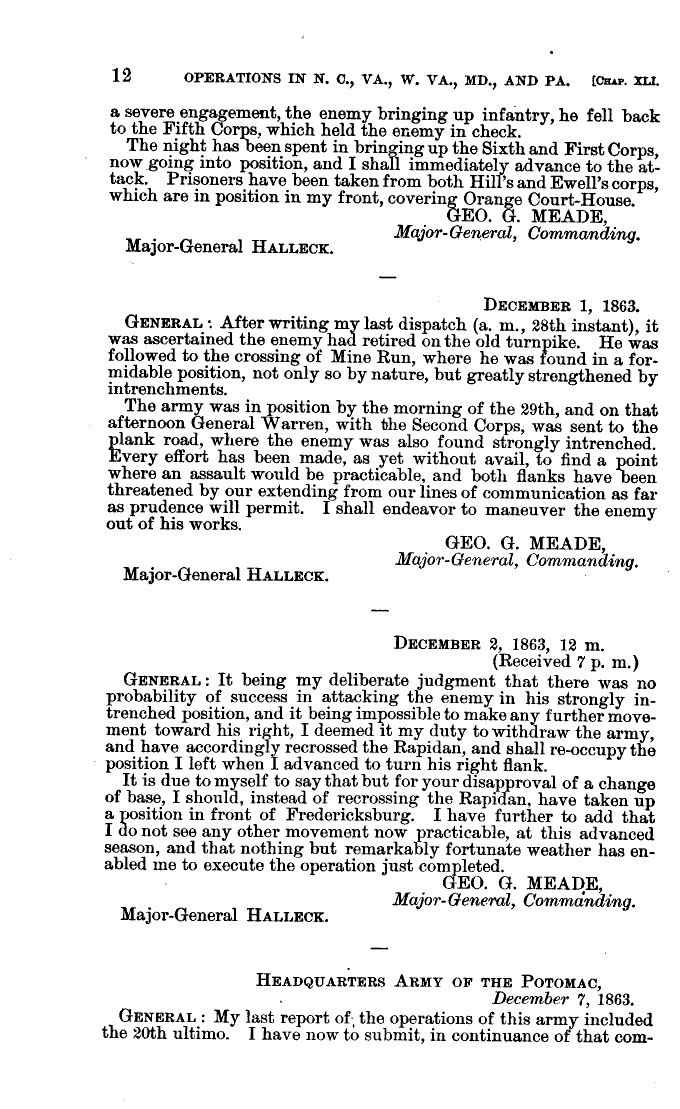
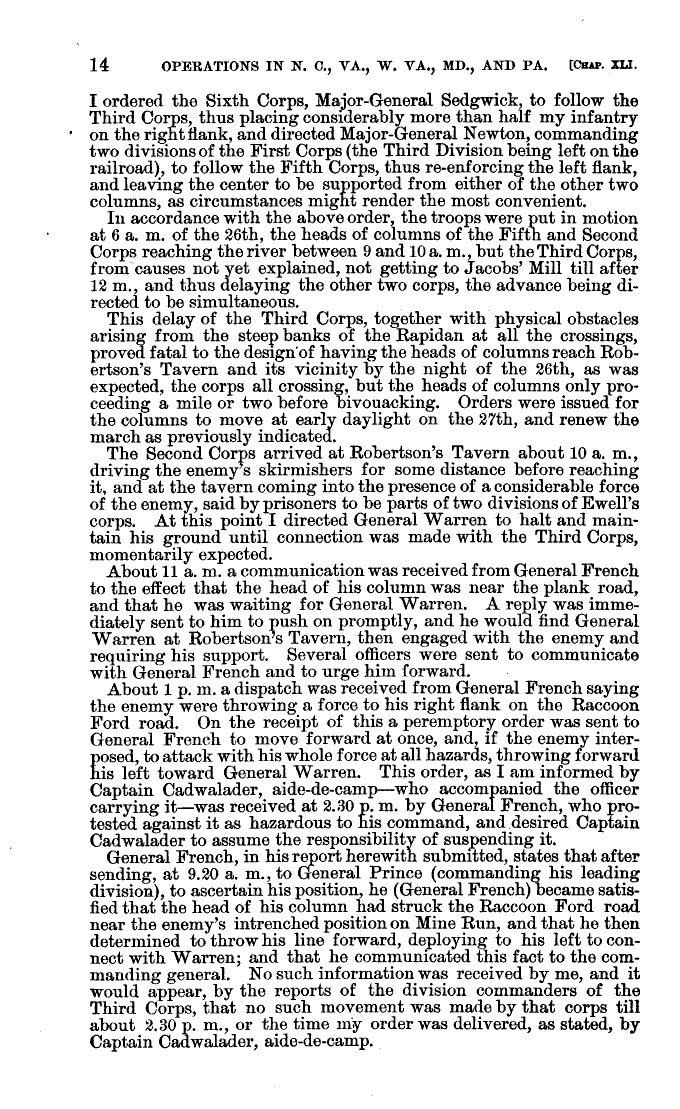
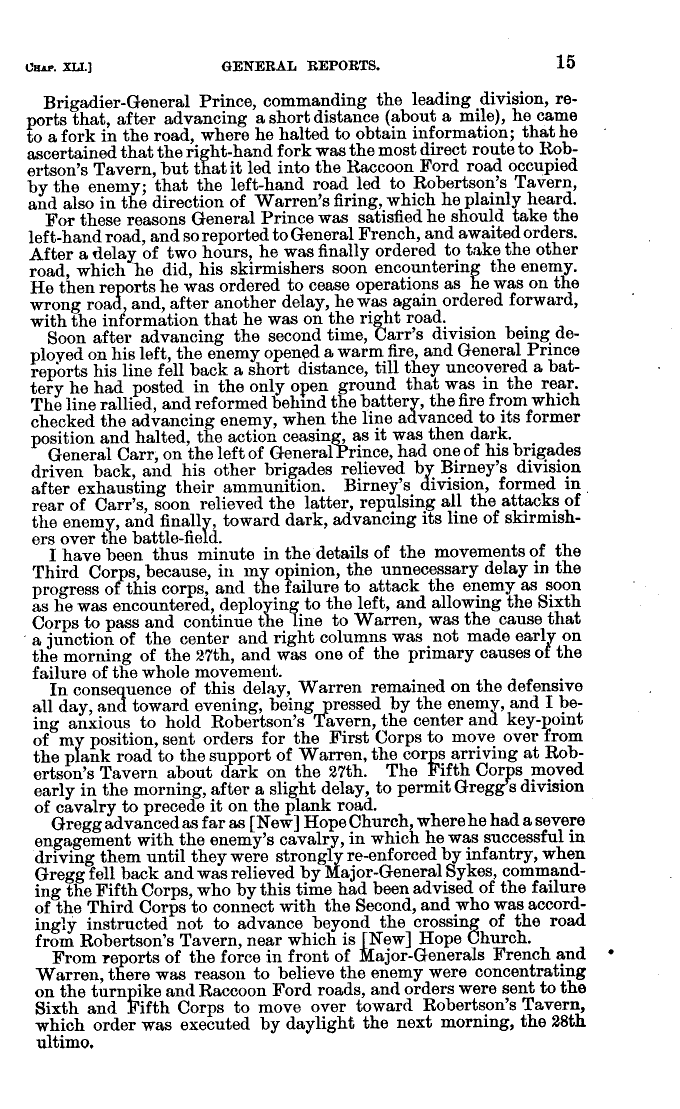
Following are the scanned pages of Meade’s official report on Mine Run, from The War of the Rebellion: A Compilation of the Official Records of the Union and Confederate Armies (Washington, DC: Government Printing Office, 1880-1901), Vol. XXIX, Pt. I: 12-20. The scans are from the Cornell University Library’s invaluable online version of the Official Records. Click on each thumbnail to enlarge.

Mine Run1

Page 1

Page 2

Page 2

Page 3

Page 3

Page 4

Page 4

Page 5

Page 5

Page 6

Page 6

page 7

page 7

Page 8

Page 8

Page 9

Page 9

Silence from Washington (December 3, 1863)

The Charlotte Ingraham whom Meade mentions in his letter of December 3 was the daughter of his sister Elizabeth, who had married Mississippian Alfred Ingraham and moved south with him. Elizabeth became an ardent rebel. In June 1863 Union forces reached her home, Ashwood, during the Vicksburg campaign and generals McClernand and McPherson made their headquarters there. It’s not clear whether she told them that her brother commanded the Army of the Potomac’s V Corps. Meade had mentioned her in his letter of  February 1. Her son Frank fought with the 1st MS and was killed not at Gettysburg but at Mayre’s Heights on May 3, 1863, during the Chancellorsville fighting.

After the war the Ingrahams were buried in All Saints’ Episcopal Cemetery outside Philadelphia. When the three sons, two of whom had been Confederate soldiers, were buried there local Quakes had to stand by the grave and prevent interference by an angry mob. (The third son, Thomas, had died of yellow fever in 1860.) Elizabeth’s diary was published in 2010.

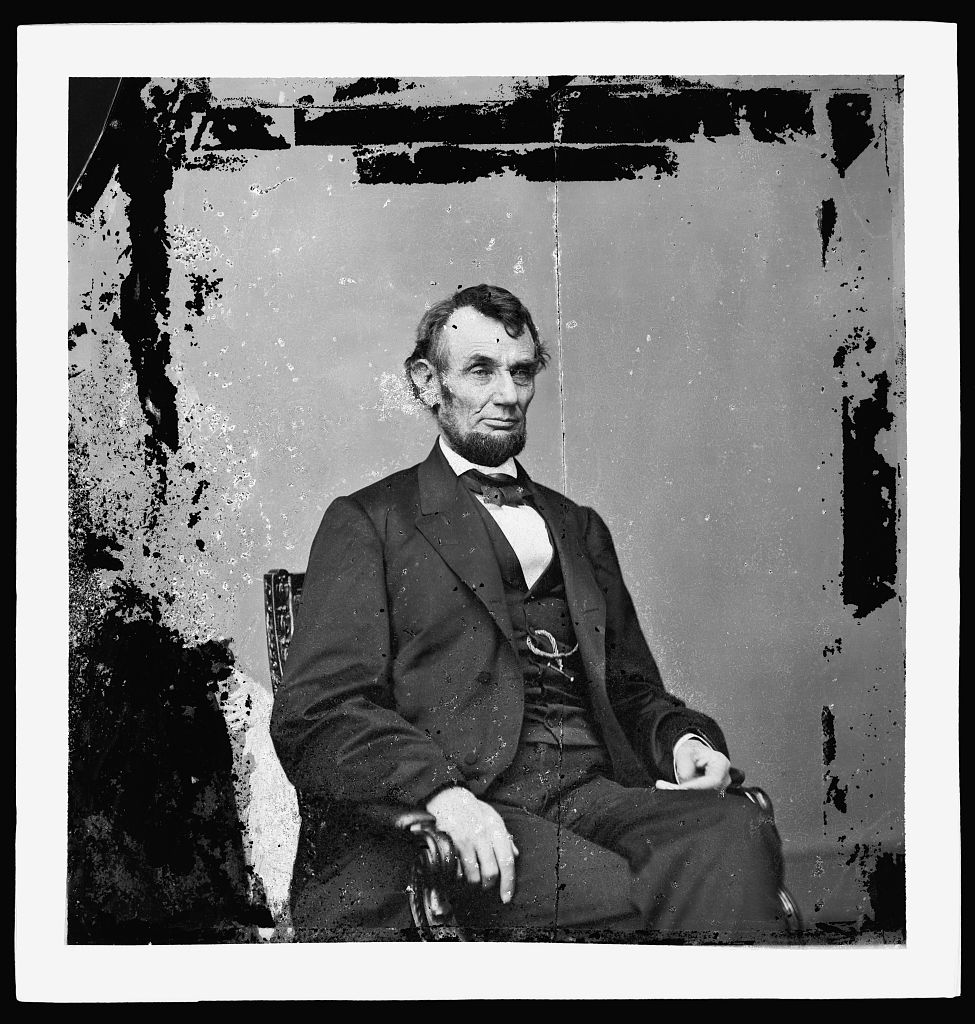
President Abraham Lincoln was greatly distressed by Robert E. Lee's escape back to Virginia after Gettysburg, but on July 21 he wrote to Gen. O.O. Howard and said “General Meade has my confidence as a brave and skillful officer and a true man" (Library of Congress).

President Abraham Lincoln was greatly distressed by Robert E. Lee’s escape back to Virginia after Gettysburg, but on July 21 he wrote to Gen. O.O. Howard and said “General Meade has my confidence as a brave and skillful officer and a true man” (Library of Congress).

Two days have now elapsed since I officially announced the return of the army, and yet not a word or line has been vouchsafed me from Washington. I am somewhat at a loss to know what the silence of the authorities means. My despatch simply stated the fact that, finding Lee too strongly posted and entrenched to justify my attacking him, and not being able to make any further tactical movement on his flank, I had felt it my duty to withdraw the army, and feared the lateness of the season would prevent any other offensive operations. I made no explanations of the causes of the failure of my plans, nor have any been asked. I did think at one time of writing to the President, who has always treated me with great kindness, but, upon reflection, I deemed it best to communicate only officially, and in a day or two I shall make an official report, which will set the whole matter right. Of one thing I am sure, that my course has met the full approbation of the army and increased the confidence they before had in me.

I yesterday received a letter from Charlotte Ingraham. She tells me all her brothers, and one brother-in-law, lie on the battlefield, thus confirming the report I had heard that Frank had been killed at Gettysburg. She says her parents are at Port Gibson, completely ruined, and that they have all to begin anew the world. Is not this terrible?

I enclose you a curious correspondence just received to file among the historical papers of the war. Poor Mr. Holstein has committed a very bold act, and I fear it will not be long before he will have to repent. I have written him a letter of thanks and send him my photograph, my hair being too gray to display in Bridgeport and my coats requiring all the buttons they have on them. Is not this a funny world?

Meade’s correspondence taken from The Life and Letters of George Gordon Meade, Major-General United States Army, Vol. 2, (New York: Charles Scribner’s Sons, 1913), pp. 159-60. Available via Google Books.

All Responsibility (December 2, 1863)

In a letter that reads less like a missive from a husband to a wife and more like a brief for the defense, George Gordon Meade outlines the reasons why he called off the attack on Lee’s defenses at Mine Run.

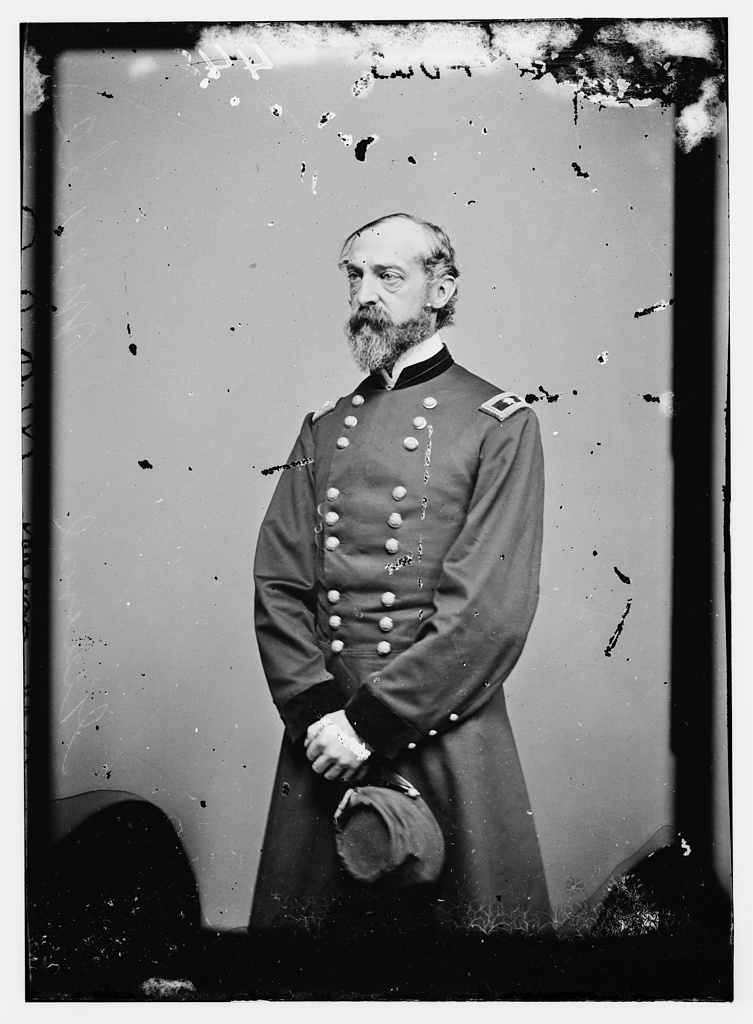
Major General George Gordon Meade (lLibrary of Congress).

Major General George Gordon Meade (lLibrary of Congress).

I expect your wishes will now soon be gratified, and that I shall be relieved from the Army of the Potomac. The facts are briefly these: On the 26th ultimo I crossed the Rapidan, intending to turn the right flank of General Lee and attack him, or compel him to attack me out of his formidable river entrenchments. I had previously been advised, by deserters and others, that he had commenced a line of works running perpendicular to the river, but only extending a few miles, but which he designed covering his flank, and permitting him to leave the lower fords unguarded. I accordingly made my plans to cross in three columns, to unite at a common point below his entrenchments, and then to advance rapidly and attack him before he could prepare any defenses. The plan was a good one, but owing to the failure of others to whom its execution was necessarily intrusted, it failed. In the first place, one corps [William French and the III] was three hours behind time in arriving at the river, and slow of movement afterwards; which caused a delay of one day, enabled the enemy to advance and check my columns before they united, and finally to concentrate his army in a very formidable position, behind entrenchments almost as strong as those I was making a long detour to avoid. Again, after I had come up with the enemy, one corps commander [Warren] reported he had examined a position where there was not the slightest doubt he could carry the enemy’s works, and on his positive and unhesitating judgment, he was given twenty-eight thousand men, and directed to attack the next morning at eight o’clock. At the same time another attack was to be made by fifteen thousand men, at a point where the enemy evidently was not fully prepared. On the eventful morning, just as the attack was about being made, I received a despatch from the officer commanding the twenty-eight thousand men, saying he had changed his opinion, and that the attack on his front was so hopeless, that he had assumed the responsibility of suspending it till further orders were received. This astounding intelligence reached me just ten minutes before the hour of attacking, and barely in time to suspend the other attack, which was a secondary one, and which, even if successful, could not be supported with so large a portion of my force away for the main attack. This lost me another day, during which the enemy so strengthened the point threatened by the secondary attack as to render it nearly as strong as the rest of his line, and to have almost destroyed the before probable chances of success. Finding no possibility of attacking with hope of success, and power to follow up success, and that the only weak point visible had been strengthened during the delay caused by the change of opinion of a corps commander, I determined not to attempt an assault. I could not move any further around the enemy’s flank, for want of roads, and from the danger at this season of the year of a storm, which would render locomotion, off the prepared roads, a matter of impossibility. After reviewing all the circumstances, notwithstanding my most earnest desire to give battle, and in the full consciousness of the fact that my failure to do so was certain personal ruin, I, having come to the conclusion that an attack could not be successful, determined to, and did, withdraw the army. I am fully aware it will be said I did wrong in deciding this question by reasoning, and that I ought to have tried, and then a failure would have been evidence of my good judgment; but I trust I have too much reputation as a general to be obliged to encounter certain defeat, in order to prove that victory was not possible. Political considerations will, however, enter largely into the decision, and the failure of the Army of the Potomac to do anything, at this moment, will be considered of vital consequence, and if I can be held responsible for this failure, I will be removed to prove that I am. I therefore consider my fate as settled; but as I have told you before, I would rather be ignominiously dismissed, and suffer anything, than knowingly and wilfully have thousands of brave men slaughtered for nothing. It was my deliberate judgment that I ought not to attack; I acted on that judgment, and I am willing to stand or fall by it at all hazards. I shall write to the President, giving him a clear statement of the case, and endeavoring to free his action as much as possible, by assuming myself all the responsibility. I feel of course greatly disappointed; a little more good fortune, and I should have met with brilliant success. As it is, my conscience is clear. I did the best I could. If I had thought there was any reasonable degree of probability of success, I would have attacked. I did not think so; on the contrary, believed it would result in a useless and criminal slaughter of brave men, and might result in serious disaster to the army. I determined not to attack, no other movements were practicable, and I withdrew. There will be a great howl all over the country. Letter writers and politicians will denounce me. It will be proved as clear as the light of day, that an attack was perfectly practicable, and that everyone, except myself, in the army, particularly the soldiers, was dying for it, and that I had some mysterious object in view, either in connection with politics, or stock-jobbing, or something else about as foreign to my thoughts, and finally the Administration will be obliged to yield to popular clamor and discard me. For all this I am prepared, fortified as I said before by a clear conscience, and the conviction that I have acted from a high sense of duty, to myself as a soldier, to my men as their general, and to my country and its cause, as the agent having its vital interests solemnly entrusted to me, which I have no right wantonly to play with and to jeopardize, either for my own personal benefit, or to satisfy the demands of popular clamor, or interested politicians.

George was sent with one of the messages to suspend the attack; his horse fell with him, he was a little bruised and cut about the eye, but nothing serious.

Meade’s correspondence taken from The Life and Letters of George Gordon Meade, Major-General United States Army, Vol. 2, (New York: Charles Scribner’s Sons, 1913), pp. 156-9. Available via Google Books.

Slowness and Want of Detail (December 1, 1863)

"Scene at Germanna Ford--6th Corps returning from Mine Run" by Alfred Waud (Library of Congress).

“Scene at Germanna Ford–6th Corps returning from Mine Run” by Alfred Waud. Click to enlarge (Library of Congress).

And so ends Meade’s Mine Run campaign. Theodore Lyman details the Army of the Potomac’s return to camp.

As I put my head out of my tent this morning, I beheld the heavy guns going to the rear, and I thought, well, we shall follow to-night. And so we did. The 1st Corps marched, in the afternoon, to Germanna Ford and halted, to hold the crossing. At dark the 5th marched, by the turnpike, followed by the 6th; and the 3d, followed by the 2d, took the plank road to Culpeper Ford. There was a piercing cold wind, the roads were frozen, and ice was on the pools; but the night was beautiful, with a lovely moon, that rose over the pine trees, and really seemed to me to be laughing derisively at our poor doughboys, tramping slowly along the road. Just at sunset I rode to the front and took a last look at the Rebels. Through my glass they looked almost near enough to speak to, as they stood, in groups of a dozen, and twenty, on the parapet of their breastworks. Some were on the glacis, seeking, I suppose, for firewood for their camps, whose smoke rose in a thin line, as far as the eye could reach, on either side. The Headquarters waited for some time at Robertson’s Tavern, till the 5th Corps had passed, and then followed on. The road was horribly rough, full of great holes and big stones. We crawled, at a snail’s pace, till we got clear of the troops, and then the General slammed ahead at a rate that threatened the legs of all our horses; and which gave two or three officers most awful falls on the frozen ground. At 2 oclock this morning {December 2) we crossed the Rapid Ann, and were glad to roll ourselves in our blankets in the same camp we had the night of the 26th. And so ends what I think I shall call the Great Seven-days’ Flank. If you ask what were the causes of failure, they lie in a nutshell — Slowness and want of Detail. We have fought for two years and a half, but it takes no wiseacre to see that we yet have much to learn. Were it not for the remarkable intelligence of the men, we could not do even as well as we do. . . .

Theodore Lyman’s letter is from Meade’s Headquarters, 1863-1865: Letters of Colonel Theodore Lyman from the Wilderness to Appomattox, pp. 58-9. Edited by George R. Agassiz. Boston, Massachusetts Historical Society, 1922. Available via Google Books.

Moral Courage (November 30, 1863)

Alfred Waud titled this sketch "Rebel line on the left at the railroad cutting. Mine Run--opposite Warrens last position." Warren and then Meade both decided that Lee's entrenched position was too strong to attack. Click to enlarge (Library of Congress).

Alfred Waud titled this sketch “Rebel line on the left at the railroad cutting. Mine Run–opposite Warrens last position.” Warren and then Meade both decided that Lee’s entrenched position was too strong to attack. Click to enlarge (Library of Congress).

We continue with an account by Theodore Lyman as he details the climax—the anti-climax actually—of George Meade’s Mine Run campaign. As I write in Searching for George Gordon Meade: The Forgotten Victor of Gettysburg, Gouverneur Warren had planned to launch his offensive the next morning, with an artillery barrage signaling the start of the attack. Warren would go in at 8:00, and then John Sedgwick, on the opposite end of Robert E. Lee’s line, would begin his movement. The guns began roaring on time at 8:00, but at 8:50 Capt. Washington Roebling (of later Brooklyn Bridge fame) came galloping up to Meade’s headquarters with a message from Warren. Meade read it. “My God!” he exclaimed. “General Warren has half my army at his disposition!”

Warren had carefully surveyed the enemy position opposite his and decided, on his own authority, that the Confederates had strengthened it so much during the night that it was now much too strong to attack.

The Mine Run defenses did appear strong indeed. Chaplain Alexander Stewart of the 102nd Pennsylvania felt certain an attack on them would lead to a great loss of life. The men in his regiment agreed, and as the day passed they came to him and filled his pockets with all the mementos of the lives they expected would soon end—money, photographs, rings, watches. Some soldiers began pinning their names to their coats so their bodies could be identified. What impressed Stewart, though, was that despite the terrible odds, these soldiers were still willing to go into battle.

Lt. Col. Charles H. Morgan of the II Corps staff suspected that many officers shared their soldiers’ misgivings but kept their doubts to themselves. One picket from the 1st Minnesota, not realizing that Morgan was an officer, didn’t hide anything. He told Morgan the enemy position was “a damned sight worse than Fredericksburg” and added, “I am going as far as I can travel; but we can’t get more than two-thirds of the way up the hill.”

Pvt. Wilbur Fisk of the 2nd Vermont, at the other end of the Union line with Sedgwick’s VI Corps, studied the Confederate defenses with great interest because there seemed a pretty fair chance that he would soon be testing them personally. “There was a deep creek between us and the enemy, and the rebels had been busy digging rifle-pits and strengthening their position ever since we came up to them,” he wrote. “Both banks were abrupt and steep and difficult to get over, while on the rebel side they had added to these disadvantages by placing every conceivable obstacle in the way of our advance. Trees were felled, abattis made, breastworks were thrown up until they occupied a position that if we had occupied we should have considered impregnable against all the rebels in the universe.”

After consulting with Warren and examining the defenses for himself, Meade reluctantly agreed with his subordinate’s opinion—attacking Lee’s position here would be nothing more than a useless slaughter, another Fredericksburg. Meade suspected someone else would have to take the responsibility for renewing the war against the Army of Northern Virginia, because he expected to be removed from command for canceling his attack.

Meade and his corps commanders. Gouverneur Warren (II Corps) is seated at left; William French (III Corps) stands next to Warren. Then, left to right, are Meade, artillery chief Henry Hunt, and chief of staff Andrew Humphreys (Library of Congress).

Meade and his corps commanders. Gouverneur Warren (II Corps) is seated at left; William French (III Corps) stands next to Warren. Then, left to right, are Meade, artillery chief Henry Hunt, chief of staff Andrew Humphreys, and the V Corps’ George Sykes (Library of Congress).

Almost before daylight our waggons were loaded and away, for the Headquarters are only a few hundred yards in the rear of our heavy guns and directly on the road, so that we expected a nice lot of shells, say at 8.10 A.m. A little before that the General mounted and rode towards General [John] Newton’s quarters, and, while near there, bang! went a cannon on the right; then boom! boom! from the 32 pounders, and then, bang, boom, bang, pretty generally. In all the woods the troops were massed for the attack, waiting orders. We rode back to Headquarters, and, a moment after, Captain [Augustus] Roebling from General Warren’s Staff, galloped up. He is the most immovable of men, but had, at that moment, rather a troubled air. He handed a scrap of paper. General Meade opened it and his face changed. “My God!” he said, “General Warren has half my army at his disposition!” Roebling shrugged his shoulders. The note was to the effect that General Warren had made a careful examination of the enemy’s works, had altered his opinion of last evening, and considered an assault hopeless!!! Orders were at once issued to cease firing. We tried to take it all philosophically, but it was hard, very hard. Most of all to General Meade and General [Andrew] Humphreys, who really took it admirably, for both of them have excellent tempers of their own, which, on occasions, burst forth, like twelve-pounder spherical case. In a little while the General again rode away; this time to see General Warren, some four miles off. Two aides, besides myself, went with him. We rode along the rear of our batteries, which were still, from time to time, exchanging shots with those opposite; though not when I chanced to be passing, I am happy to say. General Warren had a sad face, as well he might. He drew aside, with the two other generals, and there they stood, in long consultation, over a fire which had been made for them, for the air was sharp. Then we started back again, stopping half-way at General [William] French’s, whom we found in a fuming passion, partly because two of his divisions had been, in some way, put under guidance of General Warren, and partly because he was all ready for the assault and had pushed his skirmish line to within 300 yards of the Rebel works, while the storming parties were in a great rage at not being led on. Alas! it was of no use; General Humphreys, with a heavy sigh, pronounced the opportunity (if it had ever existed) now past; and, when he cries no fight, you may be sure there is not much chance. At a meeting that evening, the other generals concurred. It was physically impossible to flank any more on either side, and the only thing that remained was:

The King of France with forty thousand men,
Marched up a hill; and then marched down again.

Wherever the fault lies, I shall always be astonished at the extraordinary moral courage of General Meade, which enabled him to order a retreat, when his knowledge, as an engineer and a soldier, showed that an attack would be a blunder. The men and guns stood ready: he had only to snap his fingers, and that night would probably have seen ten thousand wretched, mangled creatures, lying on those long slopes, exposed to the bitter cold, and out of reach of all help! Then people would have said: “He was unsuccessful; but then he tried hard, and did not get out.”

Theodore Lyman’s letter is from Meade’s Headquarters, 1863-1865: Letters of Colonel Theodore Lyman from the Wilderness to Appomattox, pp. 56-8. Edited by George R. Agassiz. Boston, Massachusetts Historical Society, 1922. Available via Google Books.

Preparing for the Assault (November 29, 1863)

Once again Theodore Lyman provides our narrative. Gouverneur Warren,  with his own II Corps and a portion of the VI, prepares to outflank Robert E. Lee’s Army of Northern Virginia.

Major General Gouverneur Kemble Warren

Major General Gouverneur Kemble Warren. Library of Congress photo.During the Mine Run campaign he commanded the II Corps while Winfield Scott Hancock recovered from his Gettysburg wound.

I rode to and along our front to see the enemy’s position, which is a fearfully strong one. Within about a mile of our position, there runs a high, gradually sloping ridge, which trends in a northerly and southerly direction, and crosses the turnpike at right angles, where it is naked, though to the right and left it is wooded in some parts. Between this and a parallel high ground, occupied by us, is a shallow ravine, in which was a small stream, Mine Run. Along their ridge the Rebels have thrown up a heavy and continuous breastwork, supported by entrenched batteries; and, in some places at least, they probably have a second line. Any troops, advancing to the assault, would be exposed to a heavy artillery fire from the very outset, over the space of a mile, besides having to encounter the still worse musketry at the end. At daylight this morning, General Warren, with his own corps and a division of the 6th, marched towards our extreme left, where, it was understood, the right of the enemy could be turned. His attack was to be a signal for attacking in other places on the line. However, despite that the rain had ceased, the bad roads delayed a good deal, and a false report of entrenchments delayed more; so that, when he got there, after driving in an outlying force, the day was too far advanced for an attack. Major Ludlow, however, came back with a fine account from General Warren of the prospects, and all things were made ready for an assault, next day. . . .

Theodore Lyman’s letter is from Meade’s Headquarters, 1863-1865: Letters of Colonel Theodore Lyman from the Wilderness to Appomattox, pp. 55-6. Edited by George R. Agassiz. Boston, Massachusetts Historical Society, 1922. Available via Google Books.

Towards the Front (November 28, 1863)

Theodore Lyman celebrates an anniversary while the Army of the Potomac slogs forward on the Mine Run Campaign. This is Lyman’s letter from November 28. Meade, with other things on his mind, remains silent today.

I thought that our wedding day would be celebrated by a great battle, but so it was not fated. Let us see, a year ago, we were in Paris; and this year, behold me no longer ornamenting the Boulevards but booted and spurred, and covered with an india-rubber coat, standing in the mud, midst a soft, driving rain, among the dreary hills of Old Virginny. It was early in the morning, and we were on the crest, near Robertson’s Tavern. On either side, the infantry, in line of battle, was advancing, and a close chain of skirmishers was just going into the woods; while close in the rear followed the batteries, laboriously moving over the soft ground. The enemy had fallen back during the night, and we were following. When the troops had got well under way, the General took shelter in the old tavern, to wait for the development. He had not to wait long, before a brisk skirmish fire, followed by the light batteries, announced that we had come on them. Immediately we mounted and rode rapidly towards the front, slop, slop, slop, through the red mud, and amid ambulances and artillery and columns, all struggling forward. We had come on them sure enough, and on their line of works into the bargain, whereof we had notice beforehand, by spies. A halt was therefore ordered and the different corps ordered into position. This was a tremendous job, in the narrow wood-roads, deep with mud; and occupied fully the whole day. If you consider that the men must often move by fours, then a division of 4000 men, closed up, would occupy in marching some 1000 yards, and, by adding the space for pack horses, and the usual gaps and intervals, it would be nearer a mile; so you see how an army would string out, even with no artillery. You must remember also that these long columns cannot move over two miles in an hour; often not so much. . . .

Theodore Lyman’s letter is from Meade’s Headquarters, 1863-1865: Letters of Colonel Theodore Lyman from the Wilderness to Appomattox, pp. 54-5. Edited by George R. Agassiz. Boston, Massachusetts Historical Society, 1922. Available via Google Books.

Payne’s Farm (November 27, 1863)

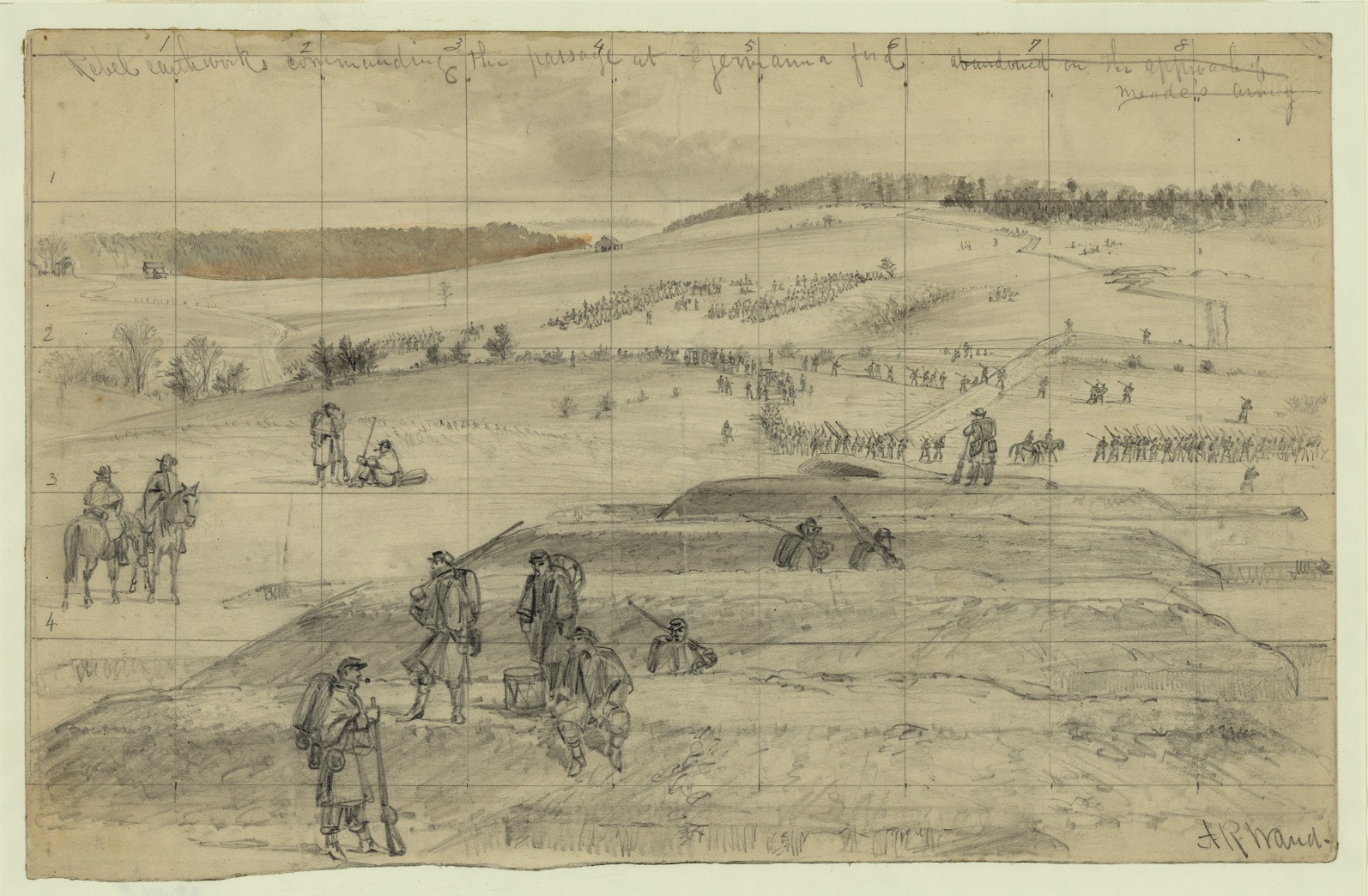
Artist Alfred Waud labeled this sketch "Rebel earthworks commanding the passage at Germanna ford, abandoned on the approach of Meade's army" (Library of Congress).

Artist Alfred Waud labeled this sketch “Rebel earthworks commanding the passage at Germanna ford, abandoned on the approach of Meade’s army” (Library of Congress). Click to enlarge.

In his letter of November 27, Theodore Lyman details the beginning of Meade’s Mine Run campaign. It was an inauspicious start, marked by delays and disappointments. Here’s how I described the situation in Searching for George Gordon Meade: The Forgotten Victor of Gettysburg:

Meade planned to cross his army at various fords along the Rapidan below Lee’s right and make a flanking attack instead of risking a frontal assault against his strong entrenchments. The III Corps would cross at Jacob’s Ford, with the VI Corps following, and then make its way through various woods roads to a place called Robertson’s Tavern. The roads the army had to follow were narrow and winding, as they still are today. The II Corps would cross at Germanna Ford, while the I and V Corps would use Culpeper Mine Ford. Cavalry would guard the flanks. “The plan promised brilliant success,” said chief of staff Andrew Humphreys; “to insure it required prompt, vigorous action, and intelligent compliance with the programme on the part of the corps and other commanders.”

 Therein lay the proverbial rub. Meade wanted his army to rumble into motion on November 24, but heavy rainfall delayed the movement until the twenty-sixth. Then [William] French and the III Corps were two hours late in reaching their ford. Two pontoon bridges turned out to be too short, forcing the engineers to do some time-consuming improvisation, and the banks on the opposite side of the river were steep and difficult to climb. Like many best-laid plans, Meade’s attempt to flank Lee began to unravel. Things slipped further and further behind schedule, giving the Confederates time to react to the Federals’ threatening move.

A native of Eastport, Maine, Henry Prince commanded a division of William French's III Corps (Library of Congress).

A native of Eastport, Maine, Henry Prince commanded a division of William French’s III Corps (Library of Congress).

[Gouverneur K.] Warren and the II Corps reached Robertson’s Tavern on November 27 and began “a brisk little contest” with the rebels there. But French’s III Corps was nowhere to be found. That’s because once the commander of French’s lead division, Brig. Gen. Henry Prince, managed to cross the river, he sat at a crossroads for a couple hours while he tried to determine which road to take; a historical marker stands at this crossroads now.

After driving around here I can understand how the generals became confused. I spend a lot of time stopped at crossroads myself as I peer at my directions and try to figure out which way to go. The stakes, though, were considerably higher for French and Prince. Around 11:30 headquarters finally received a message from French. He said he was waiting for Warren—who was already at Robertson’s Tavern skirmishing with the enemy. Steam must have been shooting out of Meade’s ears at this point. But before French could join Warren, he stumbled into battle on the land of a man named Payne.

The Battle of Payne’s Farm was the only serious fighting of the Mine Run Campaign—although I’m sure the skirmishers and other soldiers who had been killed and wounded in other actions would have said their fights had been serious enough. The Confederates here were commanded by Maj. Gen. Edward “Allegheny” Johnson, also known as “Clubby.” The thirty-two thousand men of the III Corp greatly outnumbered Johnson and his fifty-three hundred troops, but the Confederates fought stubbornly enough to delay French even longer.

Humphreys later complained that French’s tardiness and the holdup at Payne’s Farm essentially paralyzed the entire operation. By the time the army was in a position to attack on the twenty-eighth, Lee had moved his army to a strong position behind Mine Run, a line “crowned with intrenchments for infantry and artillery, strengthened by abates,” said Humphreys. Any frontal assault appeared doomed, but Warren thought he could shift his forces and, reinforced by a division of the VI Corps, attack Lee’s weak right flank. Meade later gave him two additional divisions from the III Corps. While the V and VI Corps made a diversionary attack on the enemy’s left, Warren would make the main attack on its right.

Here we are, camped south of the Rapid Ann, and I find a leisure moment to write you a letter, or rather to begin one. My last formal note, I believe, informed you we were to move “to-morrow” (26th). And, sure enough, yesterday we kept our Thanksgiving by marching, horse, foot, and artillery, as hard as we could paddle towards Germanna Ford.

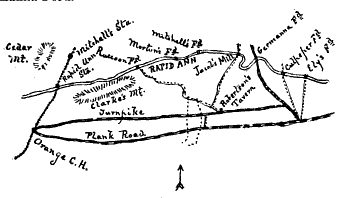
Lyman mapThe above rough map, with the other I sent when I wrote ;at Centreville, will sufficiently explain our moves. From Rapid Ann Station to Morton’s Ford, the Rebels have a strong line of entrenchments, but, beyond that, it is practicable to force a crossing, because the north bank commands the south. Our forces were encamped in a sort of semi-circle, of which one end rested on Kelly’s Ford on the Rappahannock, and the other (at the north) on a tributary of the same river; the centre being about at Brandy Station. . . . The artillery officers had placed two masked batteries, ready to open on the south bank. On the other side of the river there were extensive breastworks, which, however, seemed not occupied. Nevertheless, we could not tell that the woods were not full of them. As the main resistance might be offered here, it was necessary that all the corps should force the passage at the same time, if possible. It so happened that General French was much delayed by heavy roads and other causes, so we had to wait till past twelve before throwing the pontoons. When this was done, there was no opposition whatsoever; but the engineers were stupid enough not to have enough boats, and this made more delay. However, about two P.m. the troops and artillery began to cross, one division having already forded. The solemn and punctual Sykes crossed below, at twelve. But the 3d and 6th, being very large, did not all get over till night, and their artillery, by reason of bad roads, had to come over by Germanna Bridge, and was not over till five the next morning. We (Headquarters) camped on the north bank of the river, near the reserve artillery. It was a magnificent night, but cold. The trains came in after dark, and we had quite a time in finding tents and bedding. Everything is comparative: when I got my tent pitched, my roll of bedding in position, and a little end of a candle lighted, I felt as comfortable as if I came home to a nicely furnished house, with a good fire burning and the tea-table just set! I was up this morning a good deal before daylight. The moon shone very bright and the hoar frost glittered on the tents. … At an early hour the Staff crossed, passing on the steep bank crowds of ambulances and waggons, which of course made the General very mad. . . . Do you know the scrub oak woods above Hammond’s Pond, a sort of growth that is hard for even a single man to force his way through for any great distance? That is the growth of most of this country, minus the stones, and plus a great many ‘‘runs” and clay holes, where, in bad weather, vehicles sink to their axles. Along this region there are only two or three roads that can be counted on. These are the turnpike, the plank road south of it, and the plank road that runs from Germanna Ford. There are many narrow roads, winding and little known, that in good weather may serve for the slow passage of columns (though they are mere farmers’ or woodcutters’ thoroughfares); but a day’s rain will render them impassable for waggons and artillery. This whole region (which includes the field of Chancellorsville, a little to the east) is known as the “Wilderness.” Over much of it there is no chance to deploy troops, scarcely skirmishers, and no place for artillery. . . .

Somewhere about 10.30 we got to the turnpike and halted, say a mile before Robertson’s Tavern; where the 2d Corps had arrived and found the enemy in front; about eleven they had heavy skirmishing and drove the enemy back, getting also a few prisoners. They then formed line of battle and waited news from French on the right, and Sykes on the left, coming on the plank road. The day was raw and we stood near the road, over some fires we had built, waiting for news of French, to form a junction and attack at once; for Warren alone formed a weak centre and could not risk an engagement. Officer after officer was despatched to him, piloted by niggers who said they knew the country. The indefatigable Ludlow went in the opposite direction, and reported Sykes coming along all right. . . . At 12.30 we heard cannon on our extreme right, which seemed to announce French; still no authentic news, and the precious minutes fled rapidly. At last, late in the afternoon, came authentic despatches that General French’s advance had had a heavy fight with the Rebels, in force, and had driven them from the field; but had thus been greatly delayed, and besides had found no roads, or bad roads, and could not effect a junction that evening. And so there was Sedgwick’s Corps jammed up in the woods behind, and kept back also! So we pitched camp and waited for morning.

Theodore Lyman’s letter is from Meade’s Headquarters, 1863-1865: Letters of Colonel Theodore Lyman from the Wilderness to Appomattox, pp. 51-4. Edited by George R. Agassiz. Boston, Massachusetts Historical Society, 1922. Available via Google Books.

Don’t forget: Searching for George Gordon Meade: The Forgotten Victor of Gettysburg makes a superb Christmas present for the Civil War enthusiast on your list! You can order the book from Amazon or Barnes and Noble.

The Eve of Battle (November 25, 1863)

Newspaper vendors with the Army of the Potomac in November 1863 in a photography by Alexander Gardner (Library of Congress).

Newspaper vendors with the Army of the Potomac in November 1863 in a photography by Alexander Gardner (Library of Congress).

Both Meade and Theodore Lyman took the time to write letters home on November 25. For the Army of the Potomac it was the eve of battle—the start of the ill-fated Mine Run campaign. Meade felt he had one last chance to strike a major blow before winter put an end to campaigning for the season. Weather was on the mind of both men on November 25, which underscores how much of an impact it had on the performances of Civil War armies. The year had begun with Ambrose Burnsides’ disastrous “Mud March,” and obviously Meade preferred not to repeat that episode.

Yesterday it stormed, which required a postponement of the contemplated movement. I was going to advance to-morrow, and may yet do so, although at present the sky is overcast and threatening. It is of the utmost importance to the success of any movement to have good weather, particularly at this season of the year, when the roads, after a day’s rain, become impassable. I think if I advance we shall have a great and decisive battle, with what result, He who reigns above alone can tell in advance. My army is in excellent condition and in high spirits, and confident of success, if they can get anything of a fair chance, and so far as mortals can anticipate such doubtful matters as battles, I have a right to be hopeful. Let us trust it may please God to crown our efforts with victory, and to extend to me, as He has hitherto so signally done, His mercy and protection.

George is quite well; he has been occupied, taking care of the English Guardsmen, who are so pleased with their visit they are remaining to see the fight.

 Here’s Lyman’s view of events from the same day.

I write a line, merely to say that the entire army is under marching orders, for daylight to-morrow; the men in high spirits. As to the officers, you would suppose they were all going on a merrymaking, to hear them when the order was issued. Our object is to fight the enemy, which I pray we may do, and with success, but Dieu dispose.

Our stopper has been the weather, which to-night promises to be set fair, and the roads are passable, though not good. I wish some critics, who complain of our inactivity, could be compelled to take a soldier’s load and march twenty miles through this mud. Their next article would, I think, clearly set forth the necessity of doing nothing till the driest of weather.

Meade’s correspondence taken from The Life and Letters of George Gordon Meade, Major-General United States Army, Vol. 2, (New York: Charles Scribner’s Sons, 1913), p. 156. Available via Google Books.

Theodore Lyman’s letter is from Meade’s Headquarters, 1863-1865: Letters of Colonel Theodore Lyman from the Wilderness to Appomattox, pp. 50-1. Edited by George R. Agassiz. Boston, Massachusetts Historical Society, 1922. Available via Google Books.