A Wonderful Escape (October 3, 1864)

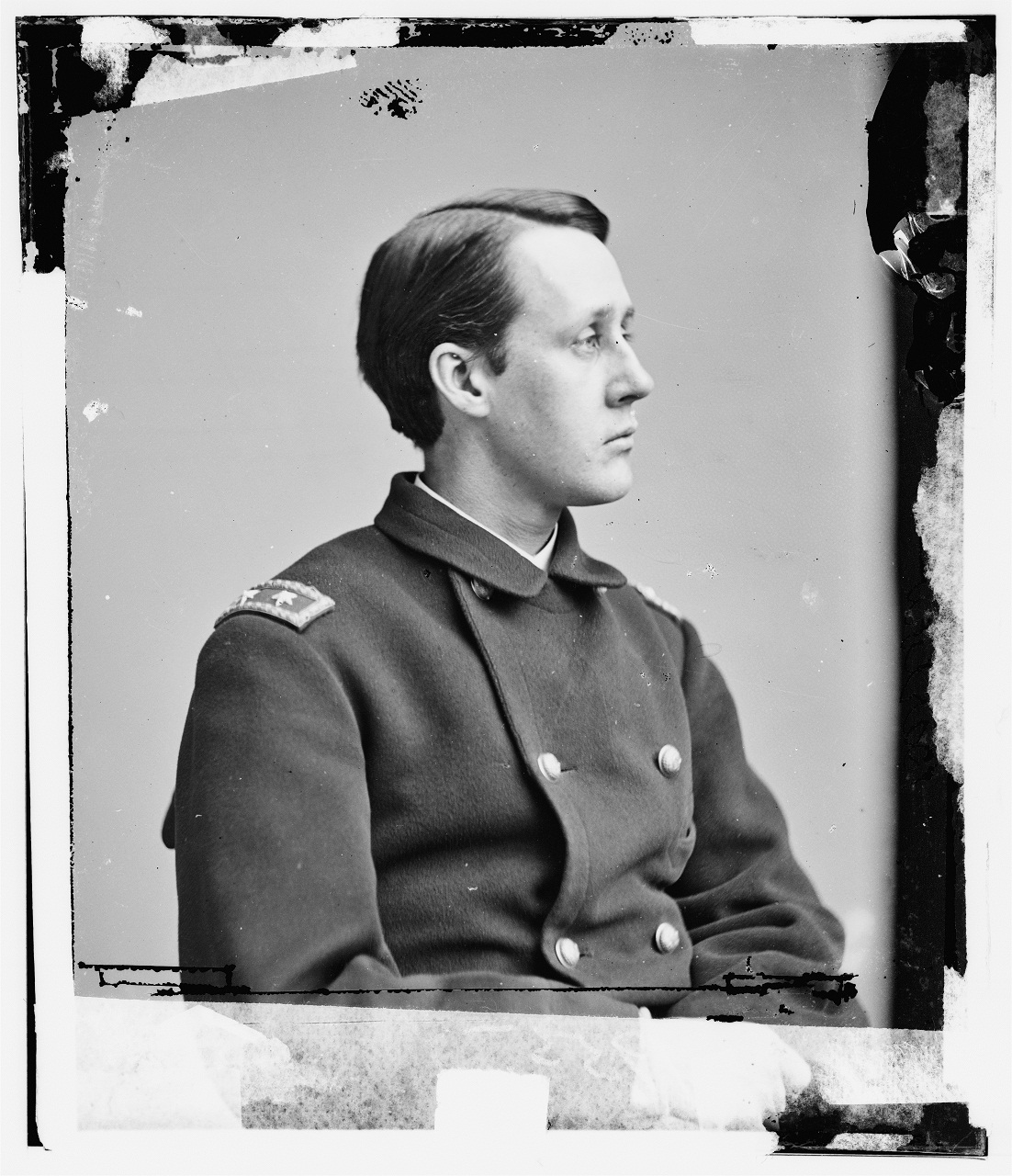
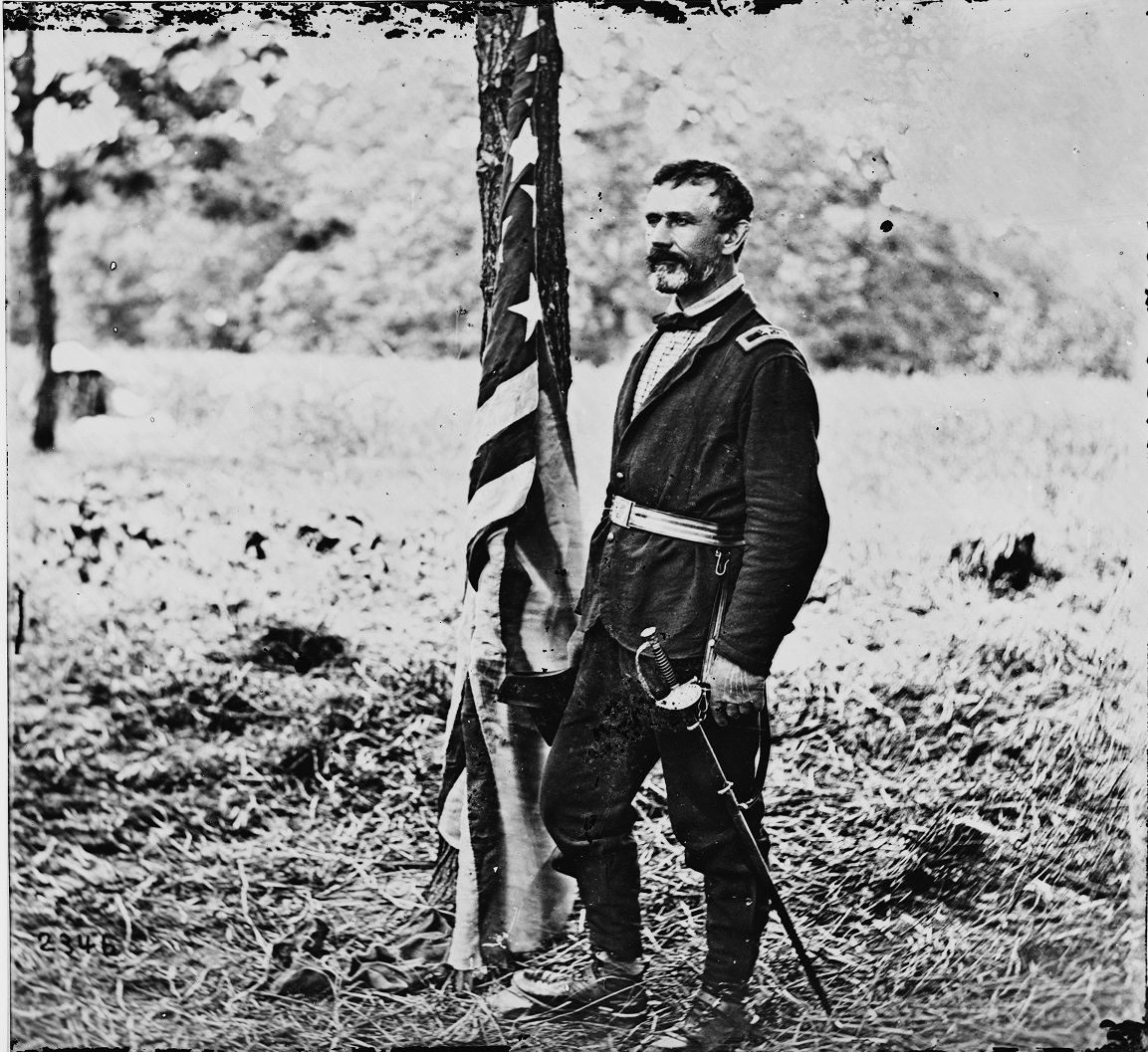
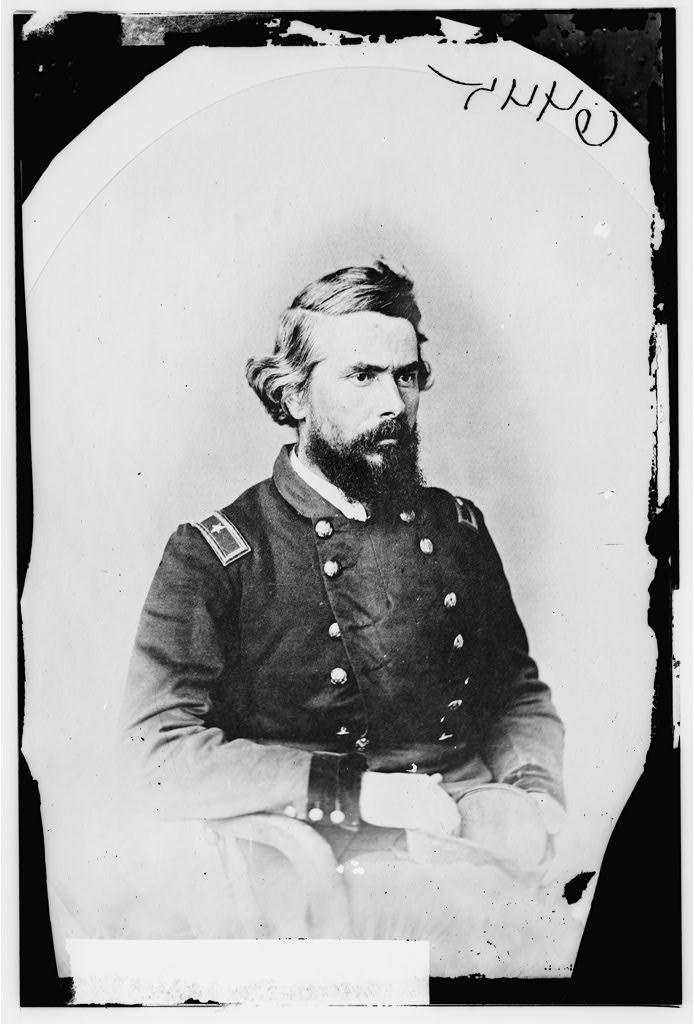
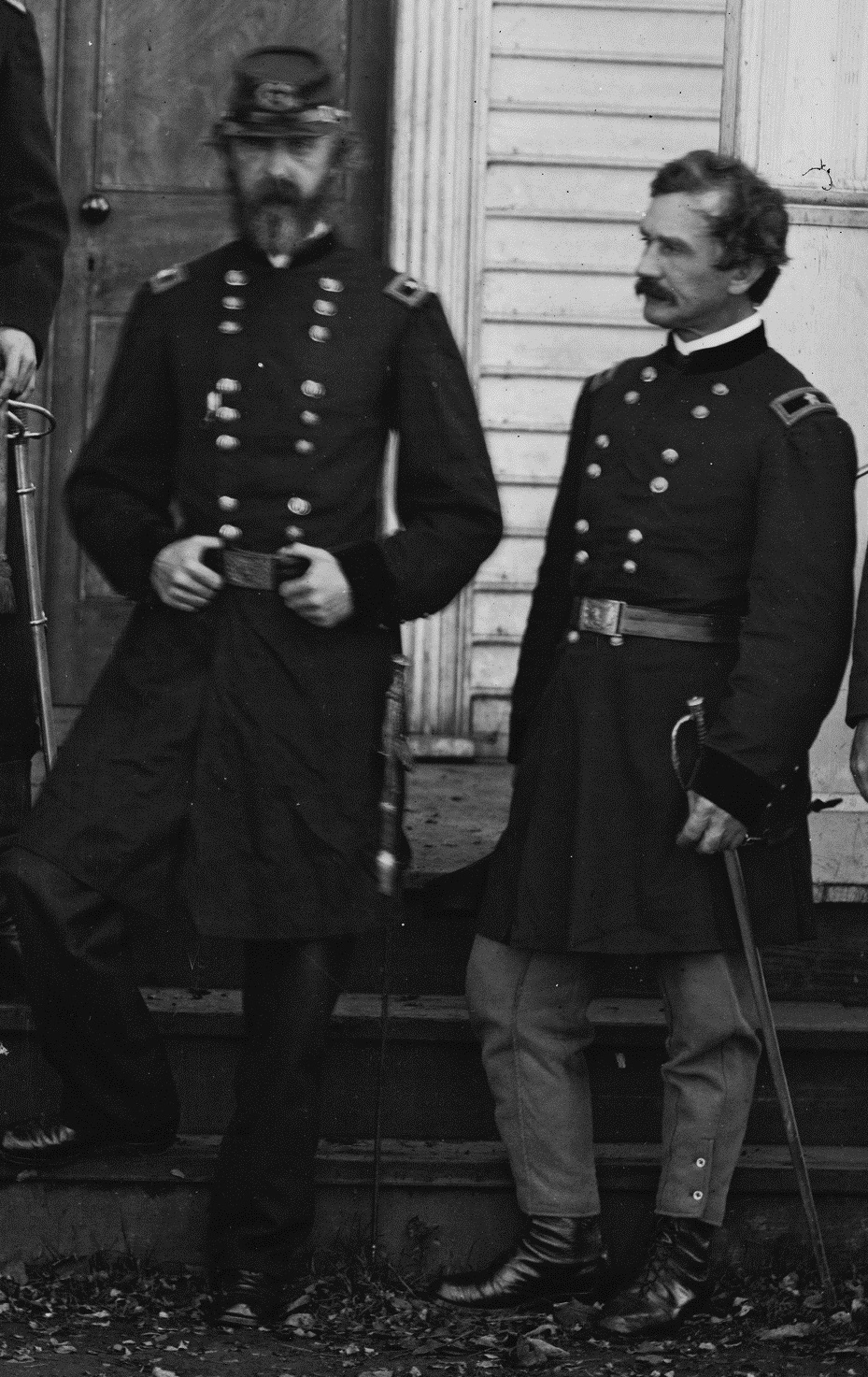
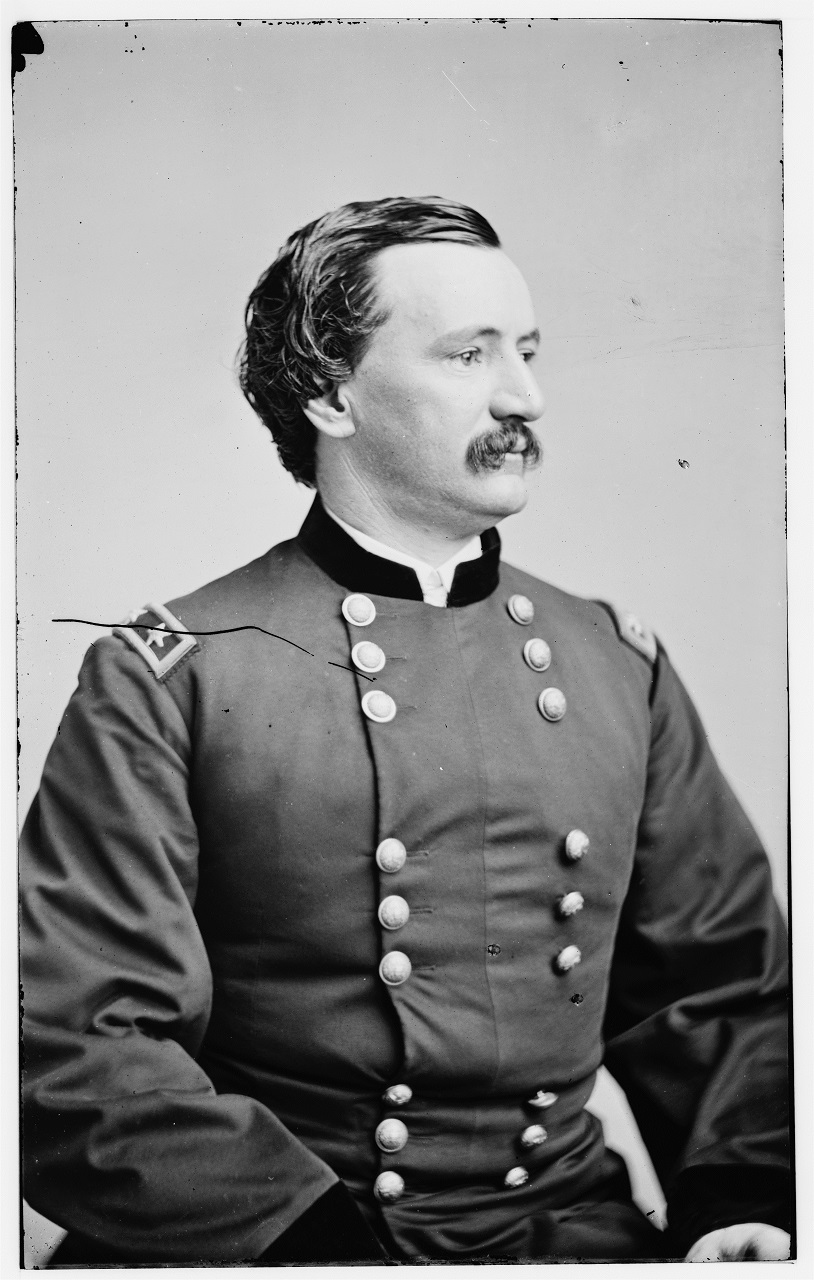
Joseph Bartlett (Library of Congress).

Joseph Bartlett (Library of Congress).

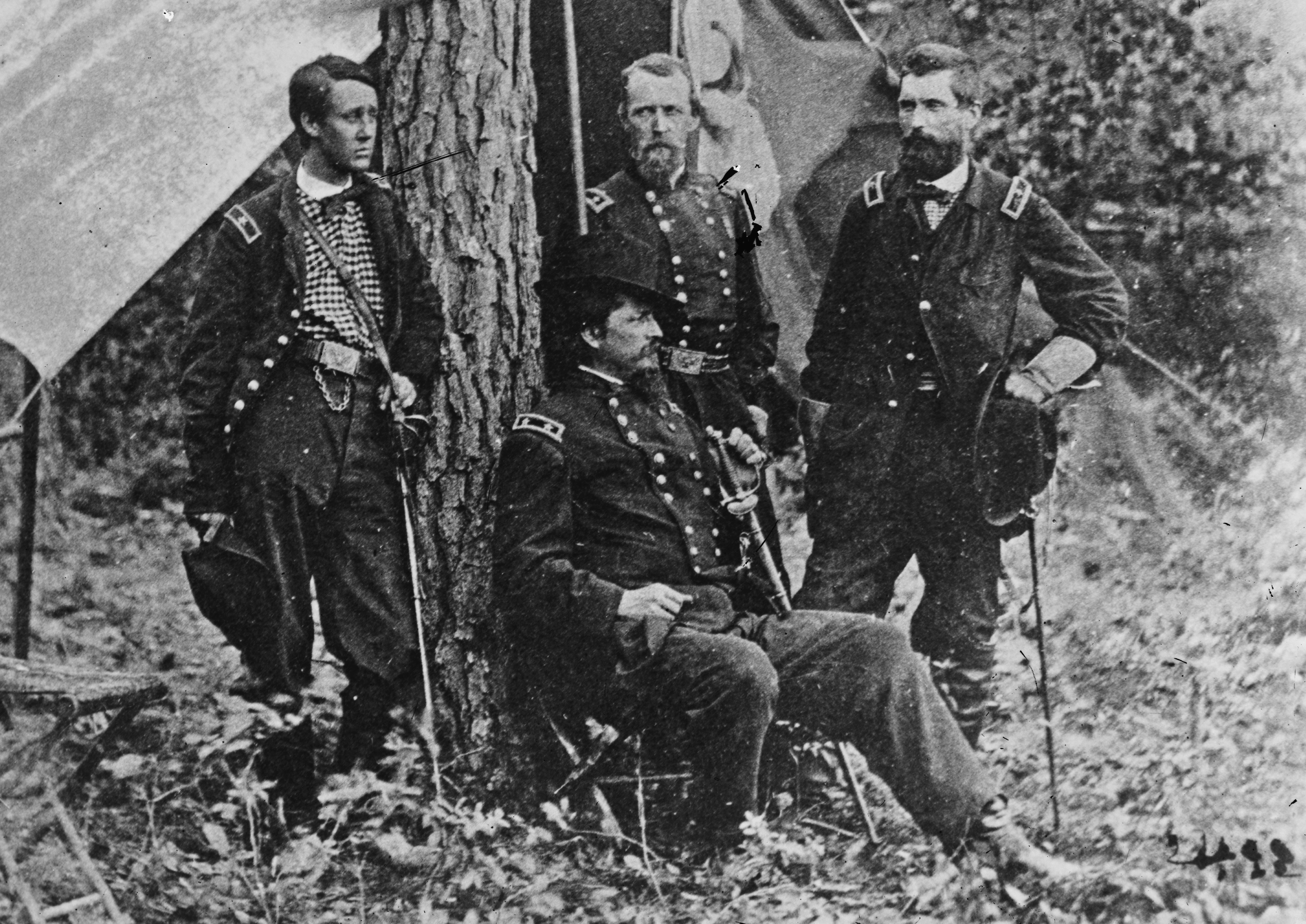
George Meade tells his wife about his narrow escape from an artillery shell. Theodore Lyman mentioned this incident in his letter from yesterday. The generals who shared Meade’s brush with death are Andrew Humphreys, Charles Griffin, and Joseph Bartlett. I would like to know what happened to the shell. Perhaps it’s in the collections of the Massachusetts Historical Society.

I have not been able to write you for several days, as I have been so absorbed in our recent movements, which I believe are now successful. These consisted in a movement by Butler on the north side of the James, in the hope of surprising the enemy, and possibly getting into Richmond. The enemy was surprised, and part of his third line of defenses taken from him and is still held by us. As Lee was obliged to detach heavily to meet Butler’s movement, it was thought probable I might, by extending to the left, get into Petersburg. I did extend my lines some two and a half miles, had quite a brisk affair with the enemy, but did not succeed in taking Petersburg. Of course, extending both flanks in this way, we had to weaken our centre, and this is the danger of this kind of movement; but Lee appears so determined to be prudent and cautious. He confines himself strictly to the defensive, and lets slip the chances for a coup we offer him.

On the second day, whilst I was on horseback on the field, talking to Generals Griffin and Bartlett, surrounded by my staff and escort, a shell fell in our midst, grazing Humphreys’s horse, grazing and striking my left leg, just below the knee, passing between Griffin and Bartlett, and embedding itself in the ground in the centre of a group of officers, covering them all with earth, but without exploding or injuring a soul. A more wonderful escape I never saw. At first I thought my leg was gone, as I felt and heard the blow plainly, but it only rubbed the leather of my riding-boot, without even bruising the skin. Afterwards Colonel Lyman had the shell dug up, and is going to preserve it. How would you like to have me back minus a leg and on crutches?

I have seen your brother Willie several times. He seems in good spirits and quite pleased at being assigned to the Army of the Potomac instead of Butler’s army. I had no place on my staff for your friend Captain Wister, but General Humphreys will take him for the present, as two of his aides have just left him, their times being out, though they intend trying to get new commissions to rejoin him. George is quite well. He was in the crowd when the shell dropped among us.

The two officers Lyman describes in this letter—Lt. Col. Charles G. Loring and Maj. Philip M. Lydig—had both been aides to General Burnside but had been sent on leave after the crater debacle. Here Lyman offers some more insights into Meade’s style of command, especially the way he liked to keep his officers on edge. Poor James C. Biddle often served as the butt of the staff’s humor.

Yesterday afternoon arrived Lieutenant-Colonel Loring and Major L_____ . The former looks in better health and immediately set to work on the duties of his office, as Inspector-General, under the easy rule of General Parke, who succeeds the rule of Burnside the Fat. L_____, always fancy, comes in much store clothes, a new shell jacket, double-breasted, and a pair of cerulean riding tights with a broad gold band, into which, according to report, he must be assisted by two strong men. Also his sabre newly burnished, and the names of the battles engraved on it, with other new and elegant touches. He was the young gentleman, you know, of whom the Reb paper said it was unworthy an honest officer to clasp the hand dipped in the gore of their brethren, even though cased in a glove of delicate kid! This was a quiet day, wherein we lay still and made ourselves comfortable. The “comfortable” meant, with many of the officers, lying abed till the classic hour of Richard and Robin; for the General, these last days, has been getting up and riding out at fitful and uncertain hours. I think, when he feels anxious and responsible himself, that he likes to keep others a little on the stretch also. So he would give no orders overnight, but suddenly hop up in the morning and begin to call for breakfast, orderlies, aides, horses, etc. I am sharp, and, at the first sound he makes, I am up and speedily dressed; whereas the others get caught and have to leave suddenly. Biddle is the funniest. There he was, trotting along, the other morning, talking away, like a spinster who had lost her lap dog. “Well, I do think it is too bad! The General never tells anyone when he is going out, and here I am with no breakfast—no breakfast at all!” And here B. opened his fingers and disclosed one boiled egg! To think of a Major on the General Staff riding after his General, with the reins in one hand and a boiled egg in the other!

Meade’s correspondence taken from The Life and Letters of George Gordon Meade, Major-General United States Army, Vol. 2, (New York: Charles Scribner’s Sons, 1913), pp. 231-2. Available via Google Books.

Theodore Lyman’s letter is from Meade’s Headquarters, 1863-1865: Letters of Colonel Theodore Lyman from the Wilderness to Appomattox, pp. 239-40. Edited by George R. Agassiz. Boston, Massachusetts Historical Society, 1922. Available via Google Books.
Quite a Stampede (October 2, 1864)

Lyman’s letters jump back and forth in time a bit. In this letter from October 2 he writes some more about his journey back to the army. The U.S. Christian Commission had been established in 1861 and continued its efforts until the end of the war. Lyman wrote down his impressions of the events from October 2 four days later, but I have included that account with today’s letter. General Meade will tell his wife about his narrow escape from the shell in his letter tomorrow.

. . . The Washington boat was much in the style of the other — rather worse and more crowded, people and freight similar. There were more Christian Commissioners, who were joined by those who had come with me. The funniest people you ever saw! Their great and overshadowing anxiety was dinner; that was the thing. Accordingly they had deputed the youngest—a divinity student, and supposed to be a terribly sharp fellow—to lie in wait at sundry times and secure tickets for the meal. “I have arranged it all with the steward; we shall sit together,” said this foxy one. Long before the hour, they all went down and stood against the door, like the queue at a French theatre. One of them came up, a little after, wiping his mouth; and asked me with surprising suddenness, if I “was on the side of the Lord.” They were mostly Methodists, and of course very pious. One of the soldiers on the lower deck, suddenly cried out: “Oh, H____!” upon which a Christian Commissioner said: “Mr. Smith, did you think to bring a bundle of the tracts on swearing?” I told him I hoped he had brought a good many, and of several kinds, as there was a wide field in the army. All of which reminds me of an anecdote. A group of these gentlemen, going on foot and with their carpet-bags towards the front, were addressed by a veteran with “Hullo! got any lemons to sell?” “No, my friend, we belong to the army of the Lord.” Veteran, with deep scorn: “Oh, ye—es; stragglers! stragglers!” I respect these Christian Commissioners, though they are somewhat silly often. Some of them had come all the way from Wisconsin. I arrived in camp somewhat after dark and was tenderly welcomed by all, from the General down. Barstow and Humphreys were highly pleased with their gifts. To-day a curious thing occurred. While I was away, looking for a place for the new camp, General Meade rode out with the Staff. There came a conical shell, which shaved a patch of hair off the tail of General Humphrey’s horse, scraped the leg of General Meade’s boot, passed between General Ricketts and Griffin who were standing within a foot of each other, and buried itself in the ground, covering several officers with sand and dirt. Four Generals just escaping by a turn of the head, so to speak! I got this shell and shall send it home as a great curiosity.

Lyman wrote this description of the events of October 2 on October 6. In his journal entry he describes a bit more about the scare the confederates gave “Abou Ben Butler.” “Butler has a stampede on–he sent one of his theatrical despatches saying he had a rebel deserter, an officer whom he had ‘put on his life,’ to give a correct account, and who made out pretty much all Lee’s people were over there, sworn to crush Gen. B ‘if it took every man they had!'”

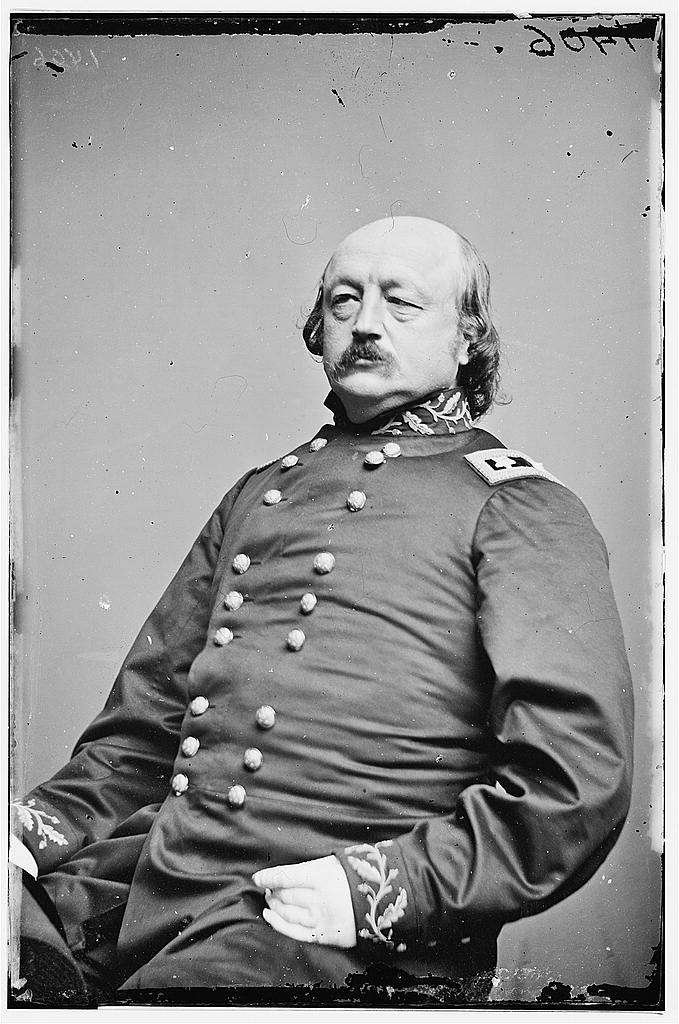
Benjamin Butler. He was a mediocre general but a wily politician (Library of Congress).

Benjamin Butler. He was a mediocre general but a wily politician (Library of Congress).

Abou Ben Butler had quite a stampede last night. Having got so far away from home, he conceived that the whole southern host was massed to crush him, and communicated the same with much eloquence, by the instrumentality of the magnetic telegraph; whereat Major-General Humphreys, Chief-of-Staff, had the brutality to laugh! We made our usual peregrination to Globe Tavern, where we got about 10 o’clock. Here General Meade sent me to look for a new camp, first enquiring if I felt well enough for that arduous service, as he looks on me as a tender convalescent! It was a tedious business getting a spot; for the whole country was either occupied, or was very dirty from old camps. At quarter to eleven, as I was poking about, I heard firing to the left, pretty sharp for a few minutes, and supposed there might be quite a fight; but it died away, shortly, except the cannon, which were not frequent. I got to the front about one, and met General Meade at the Peeble house. He had been to the Pegram house and it was near there he had such a narrow escape from a shell. I told them that, had I been there, I should have been the odd man that would have been hit; for they all said that the Staff could not well have been arranged again so that there would have been room for a three-inch shot to pass without hitting somebody. The cause of the firing was, that the whole line advanced, except the right division, and established a front position at the Pegram house. . . .

The engineers were trotting round briskly, you may depend, ordering a redoubt here and a battery there, all intent on fencing in our new property. Luckily, the soil is very light and easy to dig, for our earthworks have now to be measured by miles. Not only must the front be protected, but the exposed flank and the rear. With what men we have, we do a great deal. Since we left Culpeper, I have not seen the troops look so healthy. If we could work a little more backbone into that 9th Corps, it would help wonderfully; but they started green and that is no way to ripen men. Many faults there have been also in the command. The men are in good spirits, I think, and well conditioned for the prosecution of the campaign. The evening of Sunday we went to our new camp, having lived nearly three months in the old one. It seemed quite like leaving home; for you get used to your little canvas house, pitched in a particular spot. The new camp is well enough placed, but in a region of evil savors. There is a timber bridge near by, and, every waggon that went over it, the General would jump and say, “By Jove, there is heavy musketry!” Gradually he learned the difference of sound and settled down quietly. The weather has been very warm the last day or two.

Theodore Lyman’s letter is from Meade’s Headquarters, 1863-1865: Letters of Colonel Theodore Lyman from the Wilderness to Appomattox, pp. 231-2 and 237-8. Edited by George R. Agassiz. Boston, Massachusetts Historical Society, 1922. Available via Google Books.
Peebles’ Farm (September 30, 1864)

Theodore Lyman provides a good description of the battle known as Peeble’s Farm. It was part of Grant’s strategy to force Lee to stretch his lines until they broke. While the Army of the James was attacking Lee’s left north of the James River, Meade’s Army of the Potomac hit the right. Fighting will continue on October 1.

If the General will ride out at 8.30 A.m., and get back at 10.30 P.m., and fight a good part of the day, how am I to feel wakeful and lively to write to you? I am very well and getting stronger; was in part of the battle beyond the railroad; but only had a few bullets and one solitary cannonball in my neighborhood. This going from Beverly to battle is quite a sharp contrast. Our advantage was signal and important if we have good luck in holding on, which I think we shall. There may be fighting to-morrow, but I incline to think not.

Globe Tavern, a landmark near the Weldon Railroad. The information for this image at the Library of Congress identifies the tavern as having been Meade's headquarters at Malvern Hill, which is not true. Meade was sent home wounded before that battle (Library of Congress).

Globe Tavern, a landmark near the Weldon Railroad. The information for this image at the Library of Congress identifies the tavern as having been Meade’s headquarters at Malvern Hill, which is not true. Meade was sent home wounded before that battle (Library of Congress).

On October 4, Lyman wrote out a more complete account of the events of September 30. I include it here for the sake of chronological consistency. Gouverneur Warren commands the V Corps. John Parke had replaced Ambrose Burnside at the head of the IX Corps. Samuel Crawford and Charles Griffin command V Corps divisions. Griffin is the profane general whom Grant wanted Meade to arrest for insubordination at the Wilderness; Meade had assured him that Griffin’s intemperate speech was only “his way.”

General John G. Parke (Library of Congress).

General John G. Parke (Library of Congress).

At 8.30 in the morning, the General, with the combative [Andrew] Humphreys and all the Staff, rode towards the left, stopping of course at the irresistible Hancock’s. At noon we got to Globe Tavern, which is some six miles from our old Headquarters. [Samuel] Crawford’s division still held the works on the Weldon road, while Warren, with two divisions, followed by [John] Parke, with two divisions of the 9th Corps, had moved out to the west, and already we could hear the Rebel artillery shelling our advance. . . . . At the Poplar Grove Church the Rebels began to throw shells, with a good deal of accuracy, into the road; for they had the range, though they could not see for the woods. Near here was a swampy run, where our skirmishers drove those of the enemy across, and the division then got over and kept ahead. General Meade, meantime, staid at the Globe Tavern, waiting for the movement to develop. He sent out an aide or two, to tell Warren he was there and to bring news of the progress. Warren sent in word that; having got across the run, he would soon see what could be done. At 12.45 we could hear pretty brisk musketry, which continued a short time and then ceased. Some time after, an aide came in from General Warren, with news that Griffin had captured a strong line and a redoubt, in handsome style. Not long after, the General rode to the front, where we arrived at 2.45. Most of the road was through a pleasant wood, chiefly oak. Passing the “church” (a little, old, wooden building that might seat forty persons), we turned to the right and came out on a large, open farm. On a roll of land, just ahead, was the Peeble house (pretty well riddled with bullets), and hence you looked over more open land ending in a fringe of wood. Perhaps 400 yards in front was the captured line and the redoubt: the former very strongly and handsomely made; the latter not quite finished inside, wanting still the platforms for the guns; otherwise it was done, with a ditch outside and an abattis. So far as I can learn, the occupying force was about equal to the attacking; but they did not make as good a fight as usual. The two assaulting brigades advanced very handsomely and rushed over the works. The enemy began at once to draw off their cannon, but the horses of one piece were shot, and it fell into our hands. The loss was very small in the assault, not over 100, which shows how much safer it is to run boldly on: the enemy get excited and fire high. I went into the redoubt. A Rebel artillery-man lay dead on the parapet, killed so instantly, by a shot through the head, that the expression of his face was unchanged. In front they were burying two or three of our men and a corporal was marking their names on a headboard, copying from letters found in their pockets. Parke was now ordered to form on the left of Warren ([Romeyn] Ayres being on the right of Griffin), and it was understood that the whole line would then advance from its present position, near the Pegram house, and see if it were practicable to carry the second line, which lay perhaps three fourths of a mile beyond. As I understand it, General Meade’s orders were not properly carried out; for Griffin did not form, so as to make an extension of Parke’s line. At 5.30 we were sitting in the Peeble house, waiting for the development of the attack, when we heard very heavy musketry beyond the narrow belt of the woods that separated us from the Pegram farm; there was was cheering, too, and then more musketry, and naturally we supposed that Parke was assaulting. But presently there came from the woods a considerable number of stragglers, making their way to the rear; then came even a piece of a regiment, with its colors, and this halted inside the captured works. The musketry now drew plainly nearer, and things began to look ticklish. I watched anxiously a brigade of the 5th Corps that stood massed in the edge of the wood, beyond the redoubt. Suddenly it filed to the left, at a double-quick, the brigade colors trotting gaily at the head, then formed line and stood still. In another moment the men leveled their muskets, fired a heavy volley and charged into the wood. The musketry receded again; a battery went forward and added itself to the general crash, which was kept up till darkness had well set in; while we sat and watched and listened, in comparative safety, just beside the captured redoubt. [Robert] Potter had been taken in the flank by the Rebels charging, and had been driven back in confusion. Griffin had advanced and restored the retired line. And who rides hither so placidly? It is General Humphreys: he has stolen off and, bless his old soul, has been having a real nice time, right in the line of battle! “A pretty little fight,” said he gingerly, “a pretty little fight. He! he! he!” Poor Potter! it wasn’t his fault. Our extreme advance was driven back, but the day was a great success, with important strategic bearing.

Theodore Lyman’s letter is from Meade’s Headquarters, 1863-1865: Letters of Colonel Theodore Lyman from the Wilderness to Appomattox, p. 231 and 234-7. Edited by George R. Agassiz. Boston, Massachusetts Historical Society, 1922. Available via Google Books.
Massaponax Church (May 21, 1864)

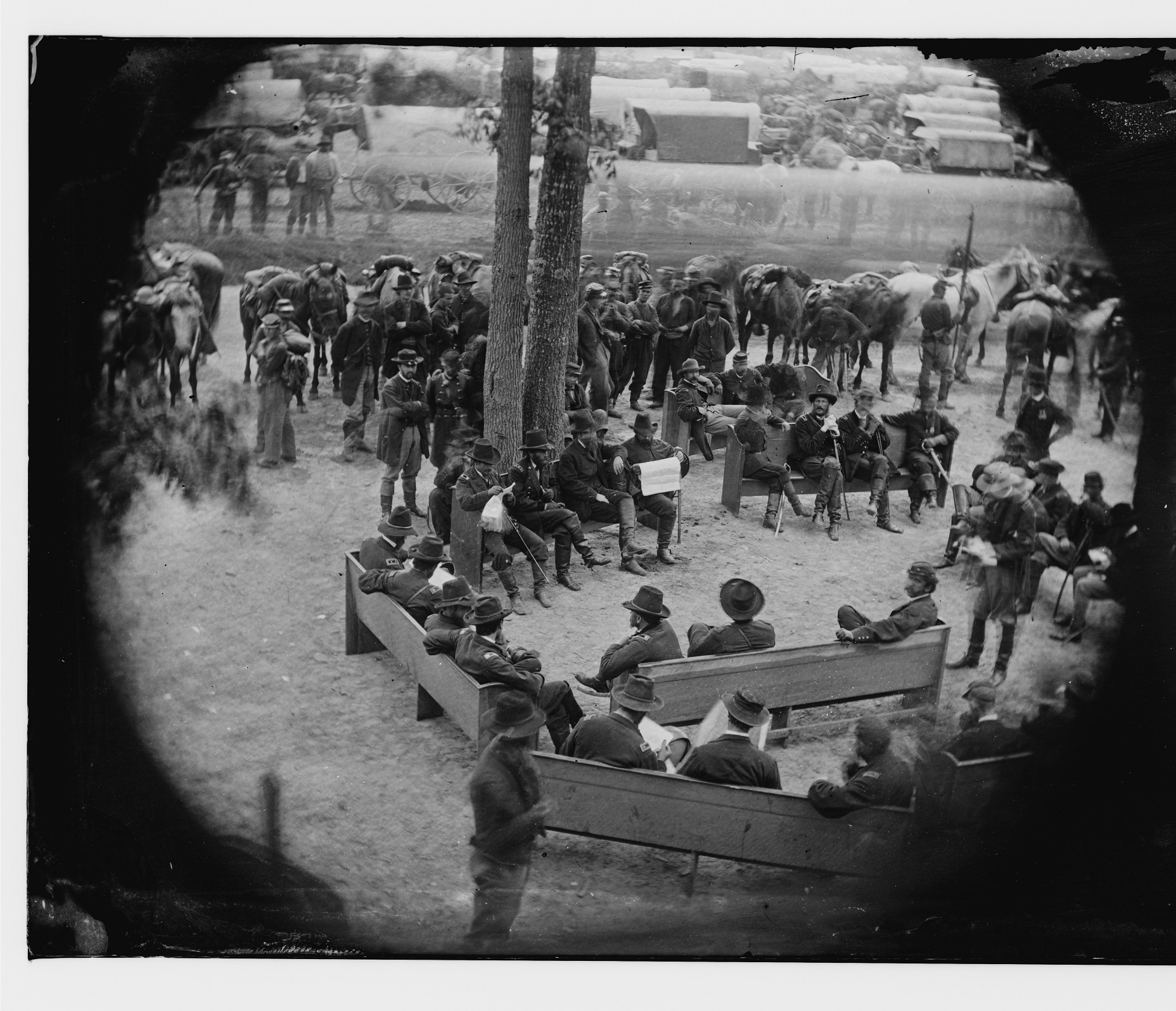
massaponnox croppedToday is the 150th anniversary of one of the most famous photographs from the Civil War. It was exactly a century and a half ago when Timothy O’Sullivan lugged his camera equipment up to the second floor of a little brick building called Massaponax Church and captured an image of Union officers, among them Grant and Meade, sitting outside on pews their staffs had hauled outside. They are tremendous photos. In this one you can see Meade at the end of the pew to the left, looking at a map. Theodore Lyman sits next to him. Andrew Humphreys sits at the end of the adjacent pew, reading a paper. Grant sits next to him, puffing on one of his ever-present cigars. After the long, bloody stalemate at Spotsylvania Court House, the Army of the Potomac was on the move, shifting to the left to pass by Lee’s flank and head south. The wagons of the V Corps are in the background in the photo. (This image is from the Library of Congress; click to enlarge).

Charles A. Dana (Library of Congress).

Charles A. Dana (Library of Congress).

Sitting next to Grant is Charles Dana, the assistant secretary of war. Lyman described him as “a combination of scholar and newspaper editor, with a dab of amiability, a large dab of conceit, and another large dab of ultraism.” Dana had accompanied Grant during the Vicksburg Campaign, and Lincoln dispatched him from Washington to report from Virginia. In a memoir Dana recounted his rather critical impressions of Meade. “He was a tall, thin man, rather dyspeptic, I should suppose from the fits of nervous irritation to which he was subject,” Dana said. “He was totally lacking in cordiality toward those with whom he had business, and in consequence was generally disliked by his subordinates. With General Grant Meade got along always perfectly, because he had the first virtue of a soldier–that is, obedience to orders. He was an intellectual man, and agreeable to talk with when his mind was free, but silent and indifferent to everybody when he was occupied with that which interested him.”

Massaponax Church as it appears today (Tom Huntington photo).

Massaponax Church as it appears today (Tom Huntington photo).

Below is an engraved version based on O’Sullivan’s image. The population of generals has increased substantially! If you read the caption to the print, you’ll also see the artist has added the presence of generals who were nowhere near–not only Winfield Scott Hancock, who had moved with the II Corps ahead of the army, but also General William T. Sherman, who was making his way through Georgia at the time, Daniel Sickles, George Thomas, and James Garfield.

Here's an artist's conception of that scene. He has allowed his imagination some free play. If you read the caption to the print, you'll also see that has added the presence of generals who were nowhere near--not only Hancock, who had moved with the II Corps ahead of the army, but also General Sherman, who was making his way through Georgia at the time, and General Sickles.

Here’s an artist’s conception of that scene. He has allowed his imagination some free play (Library of Congress. Click to enlarge).

Generals (May 20, 1864)

In this image taken at Cold Harbor in 1864, Winfield Scott Hancock (seated) poses with (left to right) Francis Barlow, David Birney, and John Gibbon. Lyman mentions all four generals in his letter of May 20, 1864 (Library of Congress).

In this image taken at Cold Harbor in 1864, Winfield Scott Hancock (seated) poses with (left to right) Francis Barlow, David Birney, and John Gibbon. Lyman mentions all four generals in his letter of May 20, 1864 (Library of Congress).

There’s no letter from Meade on May 20, but Theodore Lyman contributes another detailed report. One of the people he mentions is Francis Barlow. Like Lyman, Barlow was a Harvard man. He had practiced law before the war and looked more like a newsboy than a general, but Barlow had been wounded at Antietam and left for dead at Gettysburg (after posting his XI Corps division in a too-extended position). He carried an especially large sword—so that when he hit stragglers with it, he would hurt them, he told Lyman. Lyman called him “an eccentric officer.”

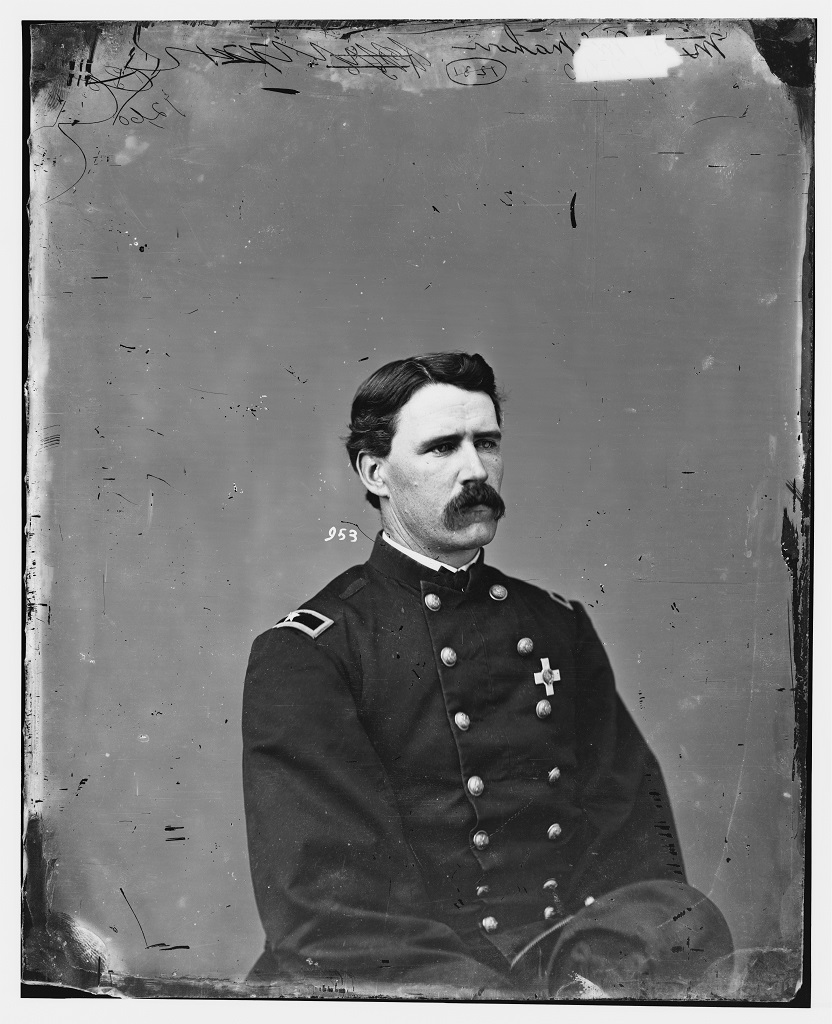
Lyman also writes about the death of Maj. Gen. John Sedgwick. Col. Martin McMahon, the officer who informed Lyman of General John Sedgwick’s death, wrote an account of the incident that appeared in Battles and Leaders of the Civil War (Vol IV, p. 175). Here’s what he wrote:

Col. Martin McMahon (Library of Congress).

Col. Martin McMahon (Library of Congress).

I gave the necessary order to move the troops to the right, and as they rose to execute the movement the enemy opened a sprinkling fire, partly from sharp-shooters. As the bullets whistled by, some of the men dodged. The general said laughingly, “What! what! men, dodging this way for single bullets! What will you do when they open fire along the whole line? I am ashamed of you. They couldn’t hit an elephant at this distance.” A few seconds after, a man who had been separated from his regiment passed directly in front of the general, and at the same moment a sharp-shooter’s bullet passed with a long shrill whistle very close, and the soldier, who was then just in front of the general, dodged to the ground. The general touched him gently with his foot, and said, “Why, my man, I am ashamed of you, dodging that way,” and repeated the remark, “They couldn’t hit an elephant at this distance.” The man rose and saluted, and said good-naturedly, “General, I dodged a shell once, and if I hadn’t, it would have taken my head off. I believe in dodging.” The general laughed and replied, “All right, my man; go to your place.”

For a third time the same shrill whistle, closing with a dull, heavy stroke, interrupted our talk, when, as I was about to resume, the general’s face turned slowly to me, the blood spurting from his left cheek under the eye in a steady stream. He fell in my direction; I was so close to him that my effort to support him failed, and I fell with him.

Colonel Charles H. Tompkins, chief of the artillery, standing a few feet away, heard my exclamation as the general fell, and, turning, shouted to his brigade-surgeon, Dr. Ohlenschlager. Major Charles A. Whittier, Major T. W. Hyde, and Lieutenant-Colonel Kent, who had been grouped near by, surrounded the general as he lay. A smile remained upon his lips but he did not speak. The doctor poured water from a canteen over the general’s face. The blood still poured upward in a little fountain. The men in the long line of rifle-pits, retaining their places from force of discipline, were all kneeling with heads raised and faces turned toward the scene; for the news had already passed along the line.

I was recalled to a sense of duty by General Ricketts, next in command, who had arrived on the spot, and informed me, as chief-of-staff, that he declined to assume command of the corps, inasmuch as he knew that it was General Sedgwick’s desire, if anything should happen to him, that General Horatio G. Wright, of the Third Division, should succeed him. General Ricketts, therefore, suggested that I communicate at once with General Meade, in order that the necessary order should bo issued. When I found General Meade he had already heard the sad intelligence, and had issued the order placing General Wright in command. Returning I met the ambulance bringing the dead general’s body, followed by his sorrowing staff. The body was taken back to General Meade’s headquarters, and not into any house. A bower was built for it of evergreens, where, upon a rustic bier, it lay until nightfall, mourned over by officers and soldiers. The interment was at Cornwall Hollow, Connecticut.

Now let’s see what Lyman had to say on May 20, 1864.

To-day has been entirely quiet, our pickets deliberately exchanging papers, despite orders to the contrary. These men are incomprehensible— now standing from daylight to dark killing and wounding each other by thousands, and now making jokes and exchanging newspapers! You see them lying side by side in the hospitals, talking together in that serious prosaic way that characterizes Americans. The great staples of conversation are the size and quality of rations, the marches they have made, and the regiments they have fought against. All sense of personal spite is sunk in the immensity of the contest.

Francis C. Barlow (Library of Congress).

Francis C. Barlow (Library of Congress).

In my letter of yesterday I got you as far as the evening of Sunday the 8th. On Monday, the 9th, early, Burnside was to come down the Spotsylvania and Fredericksburg road to the “Gate,” thus approaching on the extreme left; Sedgwick and Warren respectively occupied the left and right centre, while Hancock, in the neighborhood of Todd’s Tavern, covered the right flank; for you will remember that the Rebel columns were still moving down the Parker’s Store road to Spotsylvania, and we could not be sure they would not come in on our right flank and rear. Betimes in the morning General Meade, with three aides, rode back to General Hancock, and had a consultation with him. The day was again hot and the dust thicker and thicker. As we stood there under a big cherry tree, a strange figure approached; he looked like a highly independent mounted newsboy; he was attired in a flannel checked shirt; a threadbare pair of trousers, and an old blue kepi; from his waist hung a big cavalry sabre; his features wore a familiar sarcastic smile. It was General Barlow, commanding the 1st division of the 2d Corps, a division that for fine fighting cannot be exceeded in the army. There, too, was General Birney, also in checked flannel, but much more tippy than Barlow, and stout General Hancock, who always wears a clean white shirt (where he gets them nobody knows); and thither came steel-cold General Gibbon, the most American of Americans, with his sharp nose and up-and-down manner of telling the truth, no matter whom it hurts. . . .

Major General John Sedgwick. His men called him "Uncle John" (Library of Congress).

Major General John Sedgwick. His men called him “Uncle John” (Library of Congress).

It was about ten o’clock, and I was trotting down the Piney Branch road, when I met Colonel McMahon, Adjutant-General of the 6th Corps; I was seriously alarmed at the expression of his face, as he hurriedly asked where General Meade was. I said, “What is the matter?” He seemed entirely unnerved as he replied: “They have hit General Sedgwick just here under the eye, and, my God, I am afraid he is killed!” It was even so: General Sedgwick, with a carelessness of consequences for which he was well known, had put his Headquarters close on the line of battle and in range of the sharpshooters. As he sat there, he noticed a soldier dodging the bullets as they came over. Rising from the grass, he went up to the man, and, laying his hand on his shoulder, said, “Why, what are you dodging for? They could not hit an elephant at that distance.” As he spoke the last word, he fell, shot through the brain by a ball from a telescopic rifle. . . . The dismay of General Sedgwick’s Staff was a personal feeling; he was like a kind father to them, and they loved him really like sons. So fell “good Uncle John,” a pure and great-hearted man, a brave and skilful soldier. From the commander to the lowest private he had no enemy in this army. . . .

General Andrew Atkinson Humphreys. (Library of Congress)

General Andrew Atkinson Humphreys. (Library of Congress)

I found General Meade with Generals Wright, Warren, and Humphreys consulting together in the same spot where Grant sat yesterday among the bullets, for no apparent reason. You never saw such an old bird as General Humphreys! I do like to see a brave man; but when a man goes out for the express purpose of getting shot at, he seems to me in the way of a maniac. … In the afternoon there was some fighting on the right centre, without result; Burnside pushed down on the left, driving the enemy before him; and so the day closed, our army crowding in on Lee and he standing at bay and throwing up breastworks.

Theodore Lyman’s letter is from Meade’s Headquarters, 1863-1865: Letters of Colonel Theodore Lyman from the Wilderness to Appomattox, pp 106-108. Edited by George R. Agassiz. Boston, Massachusetts Historical Society, 1922. Available via Google Books.

More Historicus (March 22, 1865)

In this print, titled "Grant and his Generals," George Meade does make an appearance off to Grant's right (Library of Congress).

George Meade does appear in this print, titled “Grant and his Generals,” off to Grant’s right, next to William Sherman (Library of Congress).

In this letter Meade mentions the newspaper article by “Historicus” and the replies by a V Corps staff officer and General James Barnes. You can read those items here.

Grant is emphatically an executive man, whose only place is in the field. One object in coming here is to avoid Washington and its entourage. I intend to give him heartiest co-operation, and so far as I am able do just the same when he is present that I would do were he absent.

[Winfield Scott] Hancock is in Washington and will be down to-morrow. He was before the committee to-day. [Andrew] Humphreys has returned, having been before the committee, where he gave testimony about Gettysburg. Have you seen the article in the Herald, signed “Staff Officer, Fifth Corps,”  and one in Monday’s (yesterday’s) paper signed by General Barnes? I think Historicus after awhile will be sick of his only true and authentic account of the battle.

Meade’s correspondence taken from The Life and Letters of George Gordon Meade, Major-General United States Army, Vol. 2, (New York: Charles Scribner’s Sons, 1913), p. 182. Available via Google Books.

Humphreys (March 5, 1864)

Gen. Andrew Humphreys, in a photo taken during the 1862 Peninsula campaign (Library of Congress).

Gen. Andrew Humphreys, in a photo taken during the 1862 Peninsula campaign (Library of Congress).

While George Meade is in Washington, dealing with some unpleasant matters on Capitol Hill and elsewhere (more about that in tomorrow’s post), Theodore Lyman writes a letter from the Army of the Potomac’s winter quarters. One thing he notes is the failure of the Kilpatrick/Dahlgren raid, and he touches on the political winds blowing the army’s way from Washington (including the movement up there to replace Meade with Joe Hooker).

He also writes about Andrew Humphreys, who became Meade’s chief of staff shortly after the battle of Gettysburg. Here’s what I wrote about him in Searching for George Gordon Meade: The Forgotten Victor of Gettysburg: “Humphreys was from Philadelphia. An engineer like Meade, he had graduated from West Point four years before him. He had served on McClellan’s staff and later commanded a division at Antietam and during the bloody battle for Marye’s Heights at Fredericksburg. As a division commander in the III Corps at Gettysburg he had held the right of Sickles’s advanced position. ‘He was a small, bow-legged man, with chopped-off, iron gray moustache; and when he lifted his army hat you saw a rather low forehead, and a shock of iron-gray hair,’ a staff member recalled. ‘His blue-gray dauntless eyes threw into his stern face the coldness of hammered steel.’ Assistant Secretary of War Charles Dana, who would get to know Humphreys during the Virginia Campaign of 1864, considered him to be ‘the great soldier of the Army of the Potomac.’ ‘He was a very interesting figure,’ Dana wrote. ‘He used to ride about in a black felt hat, the brim of which was turned down all around, making him look like a Quaker. He was very pleasant to deal with, unless you were fighting against him, and then he was not so pleasant. He was one of the loudest swearers that I ever knew.’ Although Humphreys desired a corps command, he consented to become Meade’s chief of staff, Dana believed, out of pure patriotism.”

Truman Seymour (Library of Congress).

Truman Seymour (Library of Congress).

The “Florida Reverse” Lyman mentions was the Battle of Olustree, a defeat for Union general Truman Seymour. Meade served with but did not like Seymour. In letters to his wife he had complained about the way Seymour used to suck up to John Reynolds, their Pennsylvania reserves division commander. Back in August 1862 Meade had written, “I am sad to say that Reynolds appears to be greatly under Seymour’s influence and I fear my position in the Reserves will not be as agreeable as it has been.” He reports a conversation in which Reynolds told Seymour that he, Seymour, would probably not be with the division long because he would certainly be made a major general. At that Reynolds caught Meade’s eye and hastily added, “Meade too for that matter.” No doubt Meade experienced a bit of schadenfreude over Seymour’s reverse.

General Andrew Atkinson Humphreys. (Library of Congress)

General Andrew Atkinson Humphreys. (Library of Congress)

I found myself late and galloped four miles in about twenty minutes, only to find I had heated the mare for nothing, insomuch that the venerable Humphreys had put off dinner to six p.m. That young man of fifty has gone in his ambulance to see, I presume, some ladies, and I will here and now wager that we don’t dine till eight p.m. Sich is his nature. Really he should be dismissed the service for conduct to the prejudice of good order and military discipline. Au reste, there never was a nicer old gentleman, and so boyish and peppery that I continually want to laugh in his face. I am in fear he won’t be confirmed as major-general. There are some persons, the very dregs of politicians, whom he tried by court-martial, when under him, that now do all they can against his promotion. I find that politicians, like [Charles] Sumner and company, have a way of saying of officers who have had their very clothes shot off their back and have everywhere displayed the utmost skill and courage, that “their hearts are not in the cause,” or “they are not fully with us”; meaning that these officers do not happen to fully agree with every political dogma the party may choose to enunciate. I am of the opinion that the question is: Does such and such an officer fight bravely and with skill? Anyone who has been under fire will be ready to acknowledge that it is a pretty good place to test principles; and if a man goes into the thick of it time and again, I do not ask any better proof of his earnestness. However, it would appear that Washington people often think the best test of faithfulness is to stay away from the fighting and make a good many speeches to people who entirely agree with your sentiments. To my certain knowledge, great exertions are now making to put a man at the head of this army who has made one of the most bloody failures of the War, and who is utterly incompetent to the post. Why is he pushed? Because he professes to be an ultra-Republican, ah, voila! . . .

Pa Meade is at Washington but I hope to have him back to-morrow. Behold my prophecy in regard to Killcavalry’s raid fulfilled. I have heard many persons very indignant with him. They said he went to the President and pressed his plan; told Pleasonton he would not come back alive if he didn’t succeed; that he is a frothy braggart, without brains and not over-stocked with desire to fall on the field; and that he gets all his reputation by newspapers and political influence. These charges are not new and I fancy Kill has rather dished himself. It is painful to think of those poor prisoners hearing the sound of his guns and hoping a rescue was at hand! Now all that cavalry must be carried back in steamers, like a parcel of old women going to market! Bah! Pour moi, I say nothing, as I never criticize superior officers; but I have mine own opinions, quite strong. However, these raids and the like do not much affect the War one way or the other. Nor does such a thing as the Florida reverse. Things have narrowed down now to two or three great centres, and upon large operations there depends the result. It is a favorite remark of General Meade, that “there is but one way to put down this rebellion, namely, to destroy the military power of the Rebels.” Their great armies must be overwhelmed, and there will end their hopes. . . .

Theodore Lyman’s letter is from Meade’s Headquarters, 1863-1865: Letters of Colonel Theodore Lyman from the Wilderness to Appomattox, pp 78-80. Edited by George R. Agassiz. Boston, Massachusetts Historical Society, 1922. Available via Google Books.

The Raid (March 1, 1864)

Judson Kilpatrick, the controversial cavalry commander (Library of Congress).

Judson Kilpatrick, the controversial cavalry commander (Library of Congress).

Here’s Theodore Lyman’s behind-the-scenes look at the start of the Kilpatrick/Dahlgren raid  on Richmond. Maj. Gen. John Sedgwick’s VI Corps and Custer’s brigade of cavalry were designed to divert Confederate attention from the raid. After Lyman’s letter I include the report that Meade prepared for Henry Halleck (still the commander-in-chief of the Union armies, but not for long) on March 1 about the raid’s progress to that point. General Andrew Humphreys is Meade’s chief of staff.

. . . For some days General Humphreys has been a mass of mystery, with his mouth pursed up, and doing much writing by himself, all to the great amusement of the bystanders, who had heard, even in Washington, that some expedition or raid was on the tapis, and even pointed out various details thereof. However, their ideas, after all, were vague; but they should not have known anything. Que voulez-vous? A secret expedition with us is got up like a picnic, with everybody blabbing and yelping. One is driven to think that not even the prospect of immediate execution will stop Americans from streaming on in their loose, talking, devil-may-care ways. Kilpatrick is sent for by the President; oh, ah! everybody knows it at once: he is a cavalry officer; it must be a raid. All Willard’s chatters of it. Everybody devotes his entire energies to pumping the President and Kill-cavalry! Some confidential friend finds out a part, tells another confidential friend, swearing him to secrecy, etc., etc. So there was Eleusinian Humphreys writing mysteriously, and speaking to nobody, while the whole camp was sending expeditions to the four corners of the compass! On Saturday, at early morn, Uncle John Sedgwick suddenly picked up his little traps and marched with his Corps through Culpeper and out towards Madison Court House, away on our right flank. The next, the quiet Sabbath, was broken by the whole of Birney’s division, of the 3d Corps, marching also through Culpeper, with the bands playing and much parade. We could only phancy the feeling of J. Reb contemplating this threatening of his left flank from his signal station on Clark’s Mountain. Then the flaxen Custer, at the head of cavalry, passed through, and wended his way in the same direction. All this, you see, was on our right. That night Kilpatrick, at the head of a large body of cavalry, crossed at Ely’s Ford, on our extreme left, and drew a straight bead on Richmond! At two oclock that night he was at Spotsylvania C. H., and this is our last news of him. He sent back word that he would attack Richmond at seven this morning. The idea is to liberate the prisoners, catch all the rebel M. C.’s that are lying round loose, and make tracks to our nearest lines. I conceive the chances are pretty hazardous, although the plan was matured with much detail and the start was all that could be asked. . . .

Theodore Lyman’s letter is from Meade’s Headquarters, 1863-1865: Letters of Colonel Theodore Lyman from the Wilderness to Appomattox, pp 76-8. Edited by George R. Agassiz. Boston, Massachusetts Historical Society, 1922. Available via Google Books.

 Meade’s report is from the Official Records, ser. 1, Vol. 33, p. 169:

Meade March 1

Excellent Spirits (February 22, 1864)

For those who can’t get past the image of George Gordon Meade as “the old goggle-eyed snapping turtle,” the idea of the general cracking jokes and telling stories may come as a surprise. But such accounts provide the joy of reading Theodore Lyman’s accounts of his life with the Army of the Potomac and the detailed portraits of Meade and the other generals he encounters. Here he talks about not only Meade but also chief of staff Andrew Humphreys, another general with a temper (and an admirable command of profanity).

In this letter Lyman touches on the question of African-Americans serving in the army. Lyman was not in favor of it. Later in the spring he will write, “Can we not fight our own battles, without calling on these humble hewers of wood and drawers of water, to be bayoneted by the unsparing Southerners?” The idea that these may also be the black man’s battles did not seem to cross his mind. Ironically, one of Lyman’s Harvard friends had been Robert Gould Shaw, who will die commanding the black troops of the 54th Massachusetts.

The Mr. Kennedy of the Census Bureau was Joseph C.G. Kennedy, who served as the bureau’s head from 1853-1855 and again from 1860-1865. According to the bureau’s website, “Joseph Kennedy was a major innovator in census taking; specializing schedules to cover specific demographic areas and centralizing data processing to improve control and efficiency.”

A tale of two tempers: Meade and Humphreys (Library of Congress).

A tale of two tempers: Meade and Humphreys (Library of Congress).

General Meade is in excellent spirits and cracks a great many jokes and tells stories. You can’t tell how different he is when he has no movement on his mind, for then he is like a firework, always going bang at someone, and nobody ever knows who is going to catch it next, but all stand in a semi-terrified state. There is something sardonic in his natural disposition, which is an excellent thing in a commander; it makes people skip round so. General Humphreys is quite the contrary. He is most easy to get on with, for everybody; but, practically, he is just as hard as the Commander, for he has a tremendous temper, a great idea of military duty, and is very particular. When he does get wrathy, he sets his teeth and lets go a torrent of adjectives that must rather astonish those not used to little outbursts. There came down with the General (who returned yesterday from Washington) a Mr. Kennedy, Chief of the Census Bureau, a very intelligent man, full of figures. He can tell you how many people have pug noses in Newton Centre, and any other little thing you want. There was a bill passed in the House of Reps to raise 100,000 negro troops, from the free colored men of the North. When the bill came before the Senate, Mr. Kennedy sent in word that there were less than 50,000 colored men who were free and capable of bearing arms in the whole North, which rather squelched the bill! He says that the free negroes South increase hardly at all; while those in the North even decrease; but the slaves increase more than any other class. So I think it will be best to free the whole lot of them and then they will sort of fade out.

There are perfect shoals of womenkind now in the army — a good many, of course, in Culpeper, where they can live in houses. The rest of them must live a sort of Bedouin life. The only one I have seen of late is Mrs. Captain Commissary Coxe, for behold we had a service al fresco, near General Patrick’s tent. There was Mr. Rockwell as clergyman, quite a good preacher, and very ready to speak, nevertheless not too long in his remarks. I marched over with a camp-stool very solemnly. There were quite a collection of officers from the Headquarters, also a company of cavalry, which was marched down dismounted and stood meekly near by; for this cavalry belongs to General Patrick, and the General is pious, and so his men have to be meek and lowly. Likewise came some of the red-legs, or Zouaves, or 114th Pennsylvania, who finally had an air of men who had gone to a theatre and did not take an interest in the play. There too were some ladies, who were accommodated with a tent open in front, so as to allow them to see and hear. The band of the Zouaves sang the hymns and were quite musical. .. . To-night is a great ball of the 2d Corps. The General has gone to it; also General Humphreys. None of the Staff were invited, save George Meade, to the huge indignation of the said Staff and my great amusement.

Theodore Lyman’s letter is from Meade’s Headquarters, 1863-1865: Letters of Colonel Theodore Lyman from the Wilderness to Appomattox, pp 73-5. Edited by George R. Agassiz. Boston, Massachusetts Historical Society, 1922. Available via Google Books.
A Taste of Combat (February 7, 1864)

Artist Alfred Waud captured in pencil the same scene Lyman sketched in words. He titled this drawing "Scene at the late reconnaisance at Morton Ford -(night). It appeared as an engraving in Harper's Weekly on March 5, 1864. Click to enlarge (Library of Congress).

Artist Alfred Waud captured in pencil the same scene Lyman sketched in words. He titled this drawing “Scene at the late reconnaisance at Morton Ford -(night).” It appeared as an engraving in Harper’s Weekly on March 5, 1864. Click to enlarge (Library of Congress).

In this descriptive letter from February 7, Theodore Lyman describes an action that took place the previous day. He also included an account of these events in his journals, edited by David W. Lowe and published in 2007 by Kent State University Press as Meade’s Army: The Private Notebooks of Lt. Col.  Theodore Lyman. In that version, Lyman included this detail: “On the other side saw a soldier laid out for burial, as sad a sight as could be; his white hands folded across his breast and the cape of his coat folded up over his face.” Perhaps Lyman kept this from his letter because he wanted to shield his family back home from this glimpse of death. Lowe reports the casualties from this brief encounter as 255 (dead, wounded and missing) for Warren’s II Corps and 15 for the cavalry. With Meade still ill back in Philadelphia, John Sedgwick had temporary command of the Army of the Potomac.

It is one in the morning and I have, so to speak, just taken a midnight dinner, having come in from the front between 11 and 12 oclock. Well, who would have thought of marching out of comfortable winter quarters, to go poking round the Rapidan! . . . Only last night orders were suddenly issued to the 1st and 2d Corps to march at sunrise, the one on Raccoon, the other on Morton’s Ford; where they were to make a strong demonstration and perhaps cross at Morton’s (Raccoon being too strong). Certain cavalry, also, were to go to other points, with special orders. The whole thing was very sudden, all round, and none of our fish. This morning we took an early breakfast, which, with the ready horses, quite reminded one of campaigning times. General Sedgwick was over, being in command, as viceroy. At 10.30 we began to hear the cannon, but General Humphreys would not stir, as he said he must stay to attend to the despatches and telegraph. However, at 3 p.m., he suddenly did start, with his own aides and Biddle, Mason, Cadwalader and myself, de la part de General Meade; also Rosencrantz. To Morton’s Ford is some ten miles, but you might as well call it fifty, such is the state of the roads. Mud, varying from fetlocks to knees, then holes, runs, ditches and rocks — such was the road. With utmost diligence it took fully two hours. . . . Here we had thrown across a division, and General Warren was with them. The enemy had offered a good deal of opposition, with a skirmish fire and with artillery; despite which the whole division had waded the stream, up to their waists (cold work for the 6th of February!), and were now in line, behind some ridges; while a heavy skirmish line covered their front. Enclosing them, almost in a semi-circle, were the Rebel earthworks. It looked a shaky position for us! All was quiet; the men were making coffee, and nothing broke the stillness but an occasional shot from the sharpshooters. “Well,” said General Humphreys, “I must go across and look about, while there is light left. I don’t want many to go. McClellan, you will come; and Major Biddle and Colonel Lyman, if you would like, I shall be glad of your company.” So off we four rode, and met Warren coming back, before we got to the river. But he at once turned horse and kept on with us. The ford was very bad, deep and with steep sides, but we floundered over, and I was once again south of the Rapid Ann. … As we got to the main line, “Now,” said General Warren, “get off here and I will take you as far as you can go, very soon.” We dismounted and remained, while the two Generals went some 150 yards to Morton’s house on the crest of the ridge, where they no sooner got than a sharpshooter fired at them and the ball flew harmless over our heads, though it came close to General Warren. But hang it all! We had not been there five minutes when that infernal old sound came, whing-z-z-z-z, and over went a spherical case! “Fall in, fall in!” shouted the colonels, and the men took their arms. Whing-z-z! Bang! came another, right into the infantry, killing a poor man. “Steady! steady!” roared the colonels. Whing-z-z-z-z! Bang! and one of the pieces struck close to me, while one of the bullets struck the scabbard of the orderly next me, who coolly picked up the missile. We were a little sheltered by the road, but, I don’t care who knows it, I did duck when that spherical case came over. By this time the Generals got back and mounted, the enemy continuing the fire but throwing their shot too high. We had not got far towards the river, when they began with musketry, a very heavy skirmish fire, and seemed about to make a general attack; but it turned out to be a strong attempt to drive back our skirmish line from a favorable fence they had secured; and the artillery was a cover for their advance. When we got back to the high ground by Robinson’s, we could look across and see the fight, though it was growing dark and the air was very foggy. Our artillery opened on them also, and, in course of an hour or so, night set in, and the firing ceased, our line holding its own everywhere. And now the poor wounded fellows began to come in, some alone, some supported, and some in ambulances. The surgeons were numerous and all that could be wished for. Except one or two mortally hurt, there was nothing sad in it, so manly were the men and so cheerful. Not a groan, not a complaint. I asked one man who was staggering along, if he were much hurt. “Very slightly,” he remarked, in a lively tone. I found what he called “very slightly” was a musket-ball directly through the thigh. These men are wonderful, much more so, I think (proportionately), than the officers. There was a whole division wet to the waist, on a rainy February day, exposed each instant to attack, and yet making little pots of coffee, in the open air, as calmly as if at Revere House.

Oh! what a ride had we home! It took us over three hours, with the help of a lantern. . . .

Theodore Lyman’s letter is from Meade’s Headquarters, 1863-1865: Letters of Colonel Theodore Lyman from the Wilderness to Appomattox, pp 68-71. Edited by George R. Agassiz. Boston, Massachusetts Historical Society, 1922. Available via Google Books.