Old Baldy Goes Home (April 24, 1864)

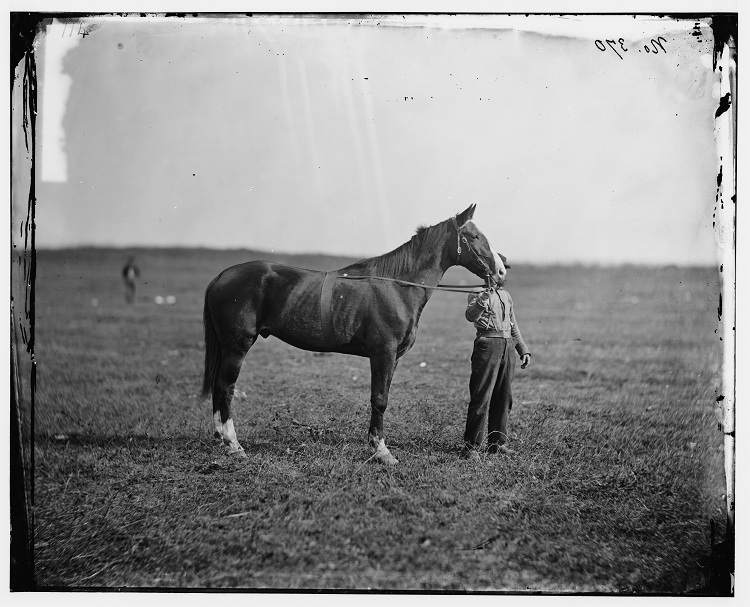
Old Baldy, in a photo taken after the war. The horse survived his master and marched, riderless, in Meade's funeral procession (Library of Congress).

Old Baldy, in a photo taken after the war. The horse survived his master and marched, riderless, in Meade’s funeral procession (Library of Congress).

The spring campaign is about to begin, and Meade decides to part with an old campaigner. It’s time for Old Baldy, Meade’s long-suffering horse, to head to retirement. Baldy suffered his first wound during First Bull Run, when Gen. David Hunter owned him. Meade bought Baldy from the quartermaster for $150 in 1861. His aides learned to dislike Baldy because the horse moved at an awkward pace somewhere between a walk and a run, making it difficult to keep pace, but Meade thought him a loyal and steadfast mount.

Baldy received a second wound at Second Bull Run; at Antietam he was so badly injured that Meade gave him up for dead. Baldy suffered his final wound during the second day at Gettysburg. He carried the Confederate bullet he received there inside him for the rest of his life. “I did not think he could live, but the old fellow has such a wonderful tenacity of life that I am in hopes he will,” Meade wrote to his wife back in Philadelphia.

On November 11, 1872, Baldy marched, riderless, in Meade’s funeral procession. The horse lived for another ten years, until the ailing steed was put down at the ripe old age of 30 on December 16, 1882. That Christmas Day two Union veterans received permission to remove his head and have it mounted. They attached the relic to a wooden plaque outlining Baldy’s war record and presented it to the George Meade Post of the Grand Army of the Republic (GAR) in Philadelphia.

A pin from Old Baldy's "grand unveiling."

A pin from Old Baldy’s “grand unveiling.”

I have a soft spot for the horse, which Meade referred to as “the old brute.” I first became acquainted with the General Meade Society of Philadelphia when my wife and I attended the “grand unveiling” of Old Baldy’s head at the Grand Army of the Republic Museum and Library. The museum had just won a custody battle to get the head back into its collections and a bunch of people showed up to celebrate. It was a fun day and my wife got her picture, gazing respectfully at Old Baldy, in the Philadelphia Inquirer the next day.

In this letter Meade mentions Cram, who was Henry A. Cram, his wife’s brother-in-law. John Cadwalader was another Philadelphia resident and later a U.S. District Court judge. Like many others, Meade is still trying to get an accurate impression of Ulysses S. Grant. Zachary Taylor was the general under whom Meade served in Mexico and comparing Grant to him was high praise indeed.

Cram and John Cadwalader arrived yesterday afternoon. To-day Cram went to church with me, where we heard an excellent sermon from a Mr. Adams, a distinguished Presbyterian clergyman from New York. After church I drove Cram and Cadwalader to Culpeper, where we paid a visit to General Grant. After coming away, I plainly saw Cram was disappointed. Grant is not a striking man, is very reticent, has never mixed with the world, and has but little manner, indeed is somewhat ill at ease in the presence of strangers; hence a first impression is never favorable. His early education was undoubtedly very slight; in fact, I fancy his West Point course was pretty much all the education he ever had, as since his graduation I don’t believe he has read or studied any. At the same time, he has natural qualities of a high order, and is a man whom, the more you see and know him, the better you like him. He puts me in mind of old Taylor, and sometimes I fancy he models himself on old Zac.

Old Baldy as he appears at his current home in Philadelphia.

Old Baldy as he appears at his current home in Philadelphia.

Yesterday I sent my orderly with old Baldy to Philadelphia. He will never be fit again for hard service, and I thought he was entitled to better care than could be given to him on the march.

I have just had a visit from a very intelligent young Englishman, named Stanley, a son of Lord Stanley, of Alderney. He is no relative, I believe, to the Earl of Derby, though his father is in the Ministry as Secretary for the Colonies. He is quite young (only twenty-four) but highly educated, very smart and clever, and full of information. He brought me a letter from Mr. Seward, and spent a day with us seeing the army sights.

Meade’s correspondence taken from The Life and Letters of George Gordon Meade, Major-General United States Army, Vol. 2, (New York: Charles Scribner’s Sons, 1913), p. 191. Available via Google Books.

More Reviews (April 16, 1864)

The headquarters of Joseph B. Carr in Culpeper, Virginia. Carr commanded the 3rd division of the III Corps but was transferred to the Army of the James just before the Overland Campaign began (Library of Congress).

The headquarters of Joseph B. Carr in Culpeper, Virginia. Carr commanded the 3rd division of the III Corps but was transferred to the Army of the James just before the Overland Campaign began. You can read more about this building and its fate here (Library of Congress).

General Grant returned yesterday. The papers will tell you I was present the other day when [Winfield Scott] Hancock reviewed Birney’s division, and the next day, when he reviewed [Joseph B.] Carr’s and [John] Gibbon’s divisions. These troops all looked splendidly, and seemed, officers and men, in fine spirits.

The reorganization, now that it is over, meets with universal approbation, and I believe I have gained great credit for the manner in which so disagreeable an operation was made acceptable to those concerned. Even General [David] Birney, of the smashed up Third Corps, is, I believe, reconciled.

How much I should like to see you all. At times I feel very despondent about the termination of this war and the prospect of my return, but I try to keep up my spirits and hope for the best.

Meade’s correspondence taken from The Life and Letters of George Gordon Meade, Major-General United States Army, Vol. 2, (New York: Charles Scribner’s Sons, 1913), p. 190. Available via Google Books.

General-in-Chief (April 13, 1864)

Meade's staff at the general's headquarters at Brandy Station in April 1865. Andrew Humphreys stands facing left in the center (Library of Congress. Click to enlarge).

Meade’s staff at the general’s headquarters at Brandy Station in April 1865. Andrew Humphreys stands facing left in the center (Library of Congress. Click to enlarge).

When it comes to Meade’s relationship with Ulysses S. Grant, so far, so good. Before getting to Meade’s letter, here is what Grant communicated to Meade regarding his plans, in an order written on April 9:

“For information and as instruction to govern your preparations for the coming campaign, the following is communicated confidentially for your own perusal alone.

“So far as practicable all the armies are to move together, and towards one common centre. Banks has been instructed to turn over the guarding of the Red River to General Steele and the navy, to abandon Texas with the exception of the Rio Grande, and to concentrate all the force he can, not less than 25,000 men, to move on Mobile. This he is to do without reference to other movements. From the scattered condition of his command, however, he cannot possibly get it together to leave New Orleans before the 1st of May, if so soon. Sherman will move at the same time you do, or two or three days in advance, Jo. Johnston’s army being his objective point, and the heart of Georgia his ultimate aim. If successful he will secure the line from Chattanooga to Mobile with the aid of Banks.

“Sigel cannot spare troops from his army to reinforce either of the great armies, but he can aid them by moving directly to his front. This he has been directed to do, and is now making preparations for it. Two columns of his command will make south at the same time with the general move; one from Beverly, from ten to twelve thousand strong, under Major-General Ord; the other from Charleston, Va., principally cavalry, under Brig.-General Crook. The former of these will endeavor to reach the Tennessee and Virginia Railroad, about south of Covington, and if found practicable will work eastward to Lynchburg and return to its base by way of the Shenandoah Valley, or join you. The other will strike at Saltville, Va., and come eastward to join Ord. The cavalry from Ord’s command will try to force a passage southward, if they are successful in reaching the Virginia and Tennessee Railroad, to cut the main lines of the road connecting Richmond with all the South and South-west.

“Gillmore will join Butler with about 10,000 men from South Carolina. Butler can reduce his garrison so as to take 23,000 men into the field directly to his front. The force will be commanded by Maj.-General W. F. Smith. With Smith and Gillmore, Butler will seize City Point, and operate against Richmond from the south side of the river. His movement will be simultaneous with yours.

“Lee’s army will be your objective point. Wherever Lee goes, there you will go also. The only point upon which I am now in doubt is, whether it will be better to cross the Rapidan above or below him. Each plan presents great advantages over the other with corresponding objections. By crossing above, Lee is cut off from all chance of ignoring Richmond and going north on a raid. But if we take this route, all we do must be done whilst the rations we start with hold out. We separate from Butler so that he cannot be directed how to co-operate. By the other route Brandy Station can be used as a base of supplies until another is secured on the York or James rivers.

“These advantages and objections I will talk over with you more fully than I can write them.

“Burnside with a force of probably 25,000 men will reinforce you. Immediately upon his arrival, which will be shortly after the 20th inst., I will give him the defence of the road from Bull Run as far south as we wish to hold it. This will enable you to collect all your strength about Brandy Station and to the front.

“There will be naval co-operation on the James River, and transports and ferries will be provided so that should Lee fall back into his intrenchments at Richmond, Butler’s force and yours will be a unit, or at least can be made to act as such. What I would direct then, is that you commence at once reducing baggage to the very lowest possible standard. Two wagons to a regiment of five hundred men is the greatest number that should be allowed, for all baggage, exclusive of subsistence stores and ordnance stores. One wagon to brigade and one to division headquarters is sufficient and about two to corps headquarters.

“Should by Lee’s right flank be our route, you will want to make arrangements for having supplies of all sorts promptly forwarded to White House on the Pamunkey. Your estimates for this contingency should be made at once. If not wanted there, there is every probability they will be wanted on the James River or elsewhere.

“If Lee’s left is turned, large provision will have to be made for ordnance stores. I would say not much short of five hundred rounds of infantry ammunition would do. By the other, half the amount would be sufficient.”

This is what Meade’s aide, Theodore Lyman, wrote about Grant on April 12: “Grant is a man of a good deal of rough dignity; rather taciturn; quick and decided in speech. He habitually wears an expression as if he had determined to drive his head through a brick wall, and was about to do it. I have much confidence in him.”

Grant has not given an order, or in the slightest degree interfered with the administration of this army since he arrived, and I doubt if he knows much more about it now than he did before coming here. It is undoubtedly true he will go with it when it moves, and will in a measure control its movements, and should success attend its operations, that my share of the credit will be less than if he were not present. Moreover, whilst I have no doubt he will give me all the credit I am entitled to, the press, and perhaps the public, will lose sight of me in him. Nevertheless he is so much more active than his predecessor, and agrees so well with me in his views, I cannot but be rejoiced at his arrival, because I believe success to be the more probable from the above facts. My position before, with inadequate means, no power myself to increase them, and no effort made by others to do so, placed me in a false position, causing me to be held responsible, when in fact I could do nothing. My duty is plain, to continue quietly to discharge my duties, heartily co-operating with him and under him.

Meade’s correspondence taken from The Life and Letters of George Gordon Meade, Major-General United States Army, Vol. 2, (New York: Charles Scribner’s Sons, 1913), p. 189. Available via Google Books.

Pure Inventions (April 4, 1864)

Ulysses S. Grant, in a print based on an illustration by Thomas Nast (Library of Congress).

Ulysses S. Grant, in a print based on an illustration by Thomas Nast (Library of Congress).

George Meade was never a fan of the press and here he vents a bit about the false stories being told about Ulysses S. Grant.

If you believe all you see in the papers about Grant, you will be greatly deceived. All that I have seen are pure inventions. I mean such stories as his being opposed to reviews, balls, etc., having given orders to stop them; of inviting soldiers into his car; of announcing his displeasure at the luxury of the officers of the Army of the Potomac, that all he wanted was soldiers’ fare, pork and beans; of the enthusiasm with which he is received by the soldiers, etc., etc. All these are humbugs, and known to the writers to be without foundation, but are persistently put forth for some purpose unknown. When he first came down he said he wished to keep out of Washington as much as possible, and it was his intention while in this part of the country to remain with my army, and he asked me where he could find a good house for his headquarters. I told him his only chance was either in Warrenton or Culpeper; that the former was rather out of the way, and that I thought he could readily get one in the latter place, which he did; whereupon the newspapers announced him as establishing his headquarters eight miles nearer the enemy than even I did. Not content with puffing him, they must have a fling at me. Grant is very much annoyed at the foolish way they are mentioning his name; but it is a matter he cannot very well notice. As I have before told you, he is very well disposed towards me, and has talked very freely and properly about my particular friends Hooker, Sickles and Butterfield.

Meade’s correspondence taken from The Life and Letters of George Gordon Meade, Major-General United States Army, Vol. 2, (New York: Charles Scribner’s Sons, 1913), p. 187. Available via Google Books.

Before the Committee (April 2, 1864)

The United States Capitol Building in July 1863 (Library of Congress).

The United States Capitol Building in July 1863 (Library of Congress).

Meade continues to chew over his difficulties in Washington. For the letter he mentions (and Lincoln’s response), see the correspondence regarding Historicus. Pennie is his son Spencer.

I left Washington this morning, bidding dear Pennie good-bye at the hotel, which he was to leave half an hour after me. He has had a pretty pleasant time, and his visit has been a source of great happiness to me.

I enclose you a letter I addressed the Department, with an autograph reply from the President. I feel quite sure the President meant to be very kind and complimentary in paying me the distinguished honor of writing a reply in his own hand, and under this conviction I am bound to be satisfied. You will perceive, however, that the main point of my request is avoided, namely, my desire that the letter of Historicus should be submitted, with my letter, to General Sickles, and if he acknowledged or endorsed it, then I wished a court of inquiry, not otherwise. However, Mr. Stanton told me the true reason, which was that it was concluded submitting the letter to Sickles was only playing into his hands; that a court of inquiry, if called at my request, although it might exonerate me, yet it would not necessarily criminate him; and that, on the whole, it was deemed best not to take any action. [Daniel] Butterfield, I hear, was very bitter in his testimony, and made wonderful revelations. I went before the committee yesterday and replied only to his assertion that I instructed him to draw up an order to retreat. This I emphatically denied; also denied any knowledge of his having drawn up such an order; presented documentary evidence to show that, if I had any such idea, that my orders and despatches were contradictory, and referred to numerous officers who ought to have and would have known if I entertained any idea of the kind.

Michigan's Senator Zachariah Chandler. (National Archives.)

Michigan’s Senator Zachariah Chandler. (National Archives.)

I find I have three warm friends on the committee—[Moses] Odell of New York, [Daniel] Gooch of Massachusetts, and [Benjamin] Harding of Oregon. It is believed [Bnjamin] Wade, of Ohio, is favorably inclined. If either he or one of the others should prove so, it would make a majority in my favor. Old Zach Chandler is my bitterest foe and will show me no quarter. While going up to Washington I had a long and satisfactory talk with Grant, who has expressed himself and acted towards me in the most friendly manner. Among other things he said he heard Horace Greeley had been in Washington, demanding my removal, and that [George] Thomas be brought here. Grant said, if he saw Greeley he should tell him that when he wanted the advice of a political editor in selecting generals, he would call on him. The President, Secretary, indeed every one I met, were civil and affable to me.

Meade’s correspondence taken from The Life and Letters of George Gordon Meade, Major-General United States Army, Vol. 2, (New York: Charles Scribner’s Sons, 1913), pp. 186-7. Available via Google Books.

Easter (March 27, 1864)

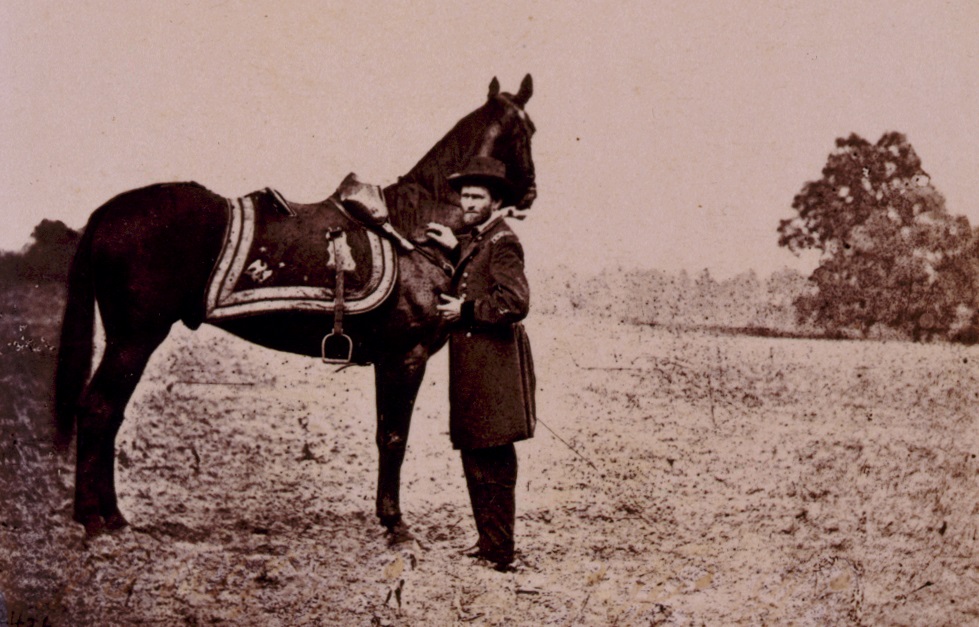
Ulysses S. Grant with his horse Cincinnati (Library of Congress).

Ulysses S. Grant with his horse Cincinnati (Library of Congress).

In 1864 Easter Sunday fell on March 27, explaining the presence of Bishop H. B. Whipple with the Army of the Potomac. In 1872 Whipple will give the address at George Meade’s funeral in Philadelphia. Meade’s Easter letter strikes a sad note regarding the health of John Sergeant Meade. From this point forward many of Meade’s letters contain anguished passages about his oldest son but when it came time to publish them in Meade’s Life and Letters, his editors (son George and grandson) cut much of that overly personal material.

It would be interesting to learn what Mrs. Meade had to say about Grant. Most likely she resented the way the new general-in-chief was overshadowing her husband.

Your letter of the 25th inst. arrived this afternoon. I am very much distressed to hear of Sergeant’s continued weakness. As to my going home, that is utterly out of the question. You must not expect to see me till next winter, unless, as before, I am brought home on a litter. Whatever occurs, I shall not voluntarily leave the field.

We have had most interesting services to-day by Bishop Whipple, who administered the Holy Communion to quite a number of officers and soldiers, hastily collected from the staff and the detachments on duty at these headquarters. We had afternoon services, and afterwards the bishop and his assistant, with General Seth Williams, dined with me. The bishop brought down with him a magnificent bouquet of flowers, with which our rude altar was adorned. The bishop is a most interesting man, about forty years of age, but full of life and energy. He preached two most appropriate and impressive discourses, well adapted to all classes of his hearers.

General Grant went up to Washington to-day, expecting to return to-morrow. You do not do Grant justice, and I am sorry to see it. You do not make a distinction between his own acts and those forced on him by the Government, Congress and public opinion. If left to himself, I have no doubt Grant would have let me alone; but placed in the position he holds, and with the expectations formed of him, if operations on a great scale are to be carried on here, he could not well have kept aloof. As yet he has indicated no purpose to interfere with me; on the contrary, acts promptly on all my suggestions, and seems desirous of making his stay here only the means of strengthening and increasing my forces. God knows I shall hail his advent with delight if it results in carrying on operations in the manner I have always desired they should be carried on. Cheerfully will I give him all credit if he can bring the war to a close.

Meade’s correspondence taken from The Life and Letters of George Gordon Meade, Major-General United States Army, Vol. 2, (New York: Charles Scribner’s Sons, 1913), p. 184-5. Available via Google Books.

Reorganizing (March 24, 1865)

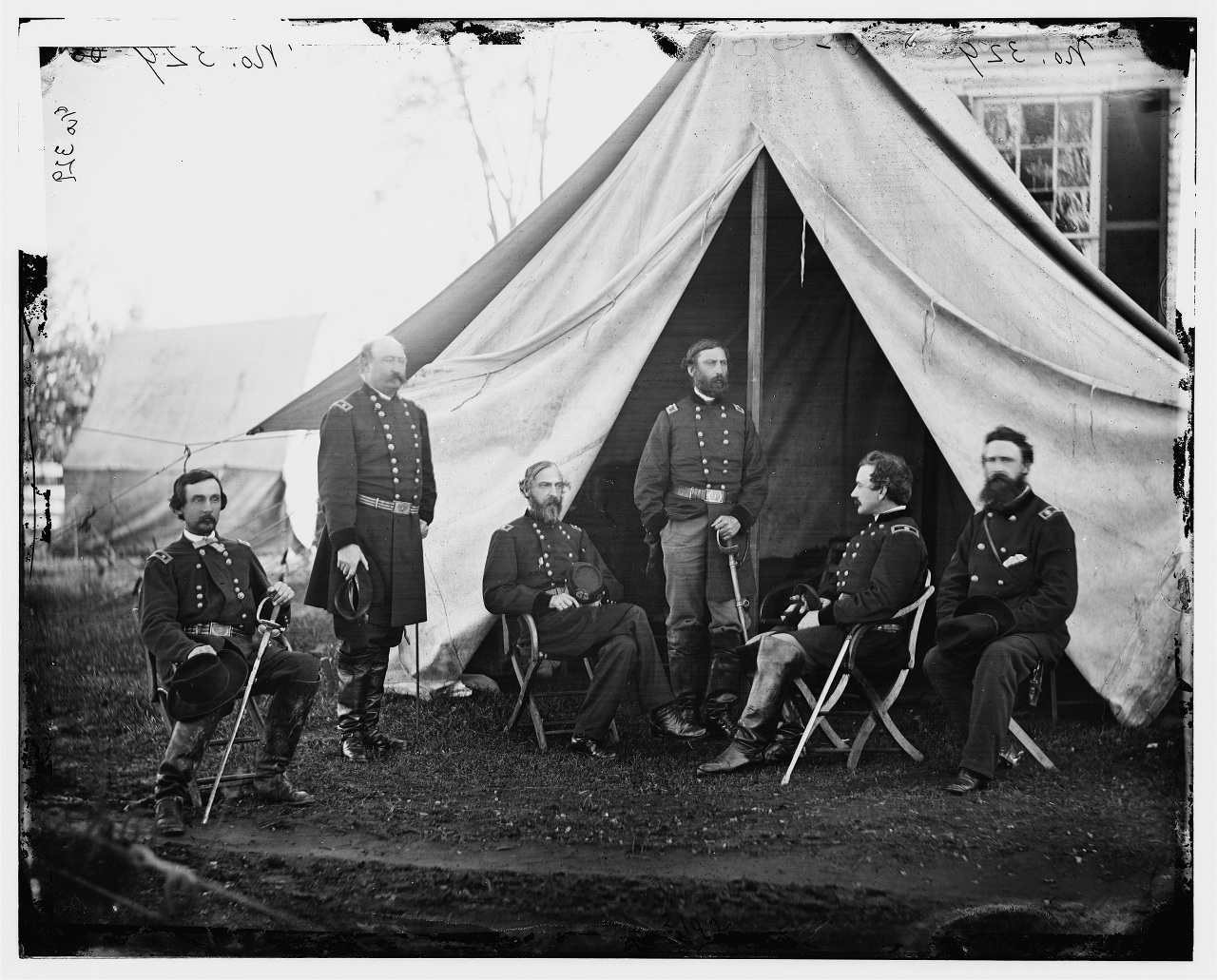
Taken in September 1863 outside Culpeper, this image shows Meade with his corps commanders. From left to right we have Gouverneur Warren, then in command of the II Corps, William French (III Corps), Meade, artillery chief Henry Hunt, chief of staff Andrew Humphreys, and George Skyes (V Corps).

Taken in September 1863 outside Culpeper, this image shows Meade with his corps commanders. From left to right we have Gouverneur Warren, then in command of the II Corps, William French (III Corps), Meade, artillery chief Henry Hunt, chief of staff Andrew Humphreys, and George Skyes (V Corps). Now French and Sykes are out and Warren has command of the V Corps (Library of Congress).

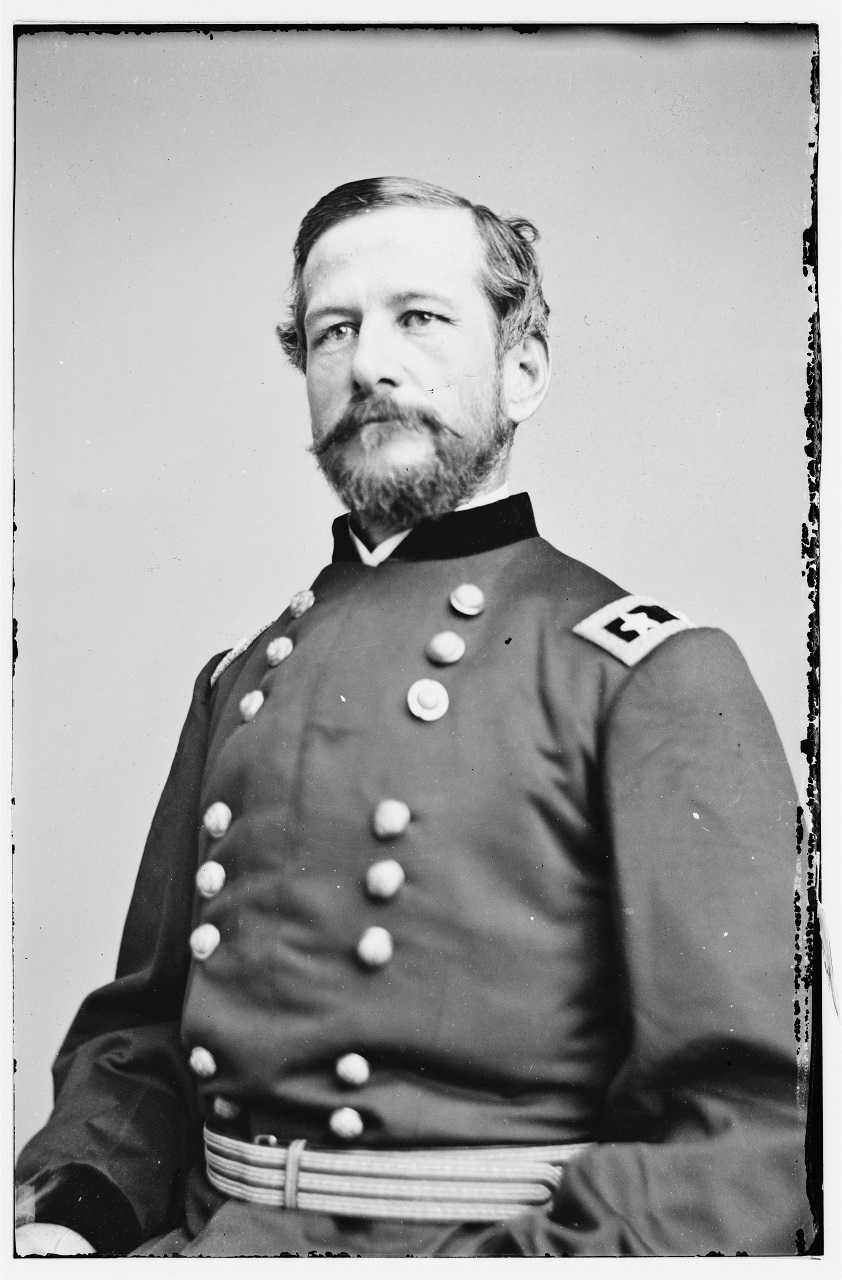
Alfred Pleasonton headed the cavalry corps for the Army of the Potomac (Library of Congress).

Alfred Pleasonton headed the cavalry corps for the Army of the Potomac (Library of Congress).

I have been very busy to-day. The much-talked-of order for reorganizing the Army of the Potomac has at last appeared. Sykes, French and Newton are relieved. Sedgwick, Hancock and Warren command the three corps. This evening an order has arrived relieving General Pleasanton, which, although I did not originate it, yet was, I presume, brought about by my telling the Secretary that the opposition I had hitherto made to his removal I no longer should make. As the Secretary has been desirous of relieving him ever since I have had command, and I have been objecting, he has taken the first chance to remove him as soon as my objections were withdrawn.

Grant arrived to-day. I met him at the depot near my headquarters and accompanied him to Culpeper, where I spent several hours and returned. He was as affable as ever, and seems not at all disposed to interfere with my army in any details.

I hear Butterfield is in Washington, and is going to swear that I told him to prepare an order to retreat, and from what Gibbon writes me, it is evident he did prepare such an order; but I trust by the concurrent testimony of every other officer on the field, the documentary evidence in the shape of orders at different periods of the day, and my own sworn statement, to prove that the preparation of this order was not authorized by me, and that it was due to Butterfield’s own fears. I understand the Secretary is very indignant at his coming to Washington, and has ordered him back to his post.

Get the last number of the Spirit of the Times, in which there is a scathing article on Grant, Sherman, McPherson, Schofield and myself, and lauding, as usual, Joe Hooker.

Meade’s correspondence taken from The Life and Letters of George Gordon Meade, Major-General United States Army, Vol. 2, (New York: Charles Scribner’s Sons, 1913), pp. 182-3. Available via Google Books.

More Historicus (March 22, 1865)

In this print, titled "Grant and his Generals," George Meade does make an appearance off to Grant's right (Library of Congress).

George Meade does appear in this print, titled “Grant and his Generals,” off to Grant’s right, next to William Sherman (Library of Congress).

In this letter Meade mentions the newspaper article by “Historicus” and the replies by a V Corps staff officer and General James Barnes. You can read those items here.

Grant is emphatically an executive man, whose only place is in the field. One object in coming here is to avoid Washington and its entourage. I intend to give him heartiest co-operation, and so far as I am able do just the same when he is present that I would do were he absent.

[Winfield Scott] Hancock is in Washington and will be down to-morrow. He was before the committee to-day. [Andrew] Humphreys has returned, having been before the committee, where he gave testimony about Gettysburg. Have you seen the article in the Herald, signed “Staff Officer, Fifth Corps,”  and one in Monday’s (yesterday’s) paper signed by General Barnes? I think Historicus after awhile will be sick of his only true and authentic account of the battle.

Meade’s correspondence taken from The Life and Letters of George Gordon Meade, Major-General United States Army, Vol. 2, (New York: Charles Scribner’s Sons, 1913), p. 182. Available via Google Books.

Butterfield (March 20, 1864)

Daniel Buttefield. In the words of early Gettysburg historian John Bachelder, he "has never lost the occasion to stab General Meade's reputation under the fifth rib" (Library of Congress).

Daniel Butterfield. In the words of early Gettysburg historian John Bachelder, he “has never lost the occasion to stab General Meade’s reputation under the fifth rib” (Library of Congress).

No one can deny that George Meade had a knack for making enemies. One of them was Daniel Butterfield. Back in 1862 Ambrose Burnside appointed Butterfield to command the V Corps. Meade pointed out that he outranked Butterfield and the position should have been his. Burnside agreed, and Meade took over from Butterfield. He thought he and Butterfield smoothed things over afterwards, but apparently not. Joe Hooker later appointed Butterfield his chief of staff. “I believe Hooker is a good soldier,” Meade wrote to his wife back then; “the danger he runs is of subjecting himself to bad influences, such as Dan Butterfield and Dan Sickles, who, being intellectually more clever than Hooker, and leading him to believe they are very influential, will obtain an injurious ascendancy over him and insensibly affect his conduct.” Once Meade took command of the Army of the Potomac he tried to find someone to replace Butterfield as chief of staff, but he could not find anyone willing to take the job. When John Sedgwick heard that Butterfield would keep his position, the VI Corps commander “looked solemn and said he regretted it, that he knew Butterfield well, that he was a bold bad man and that Meade would live to regret it.” Sedgwick was right. When the Joint Committee on the Conduct of the War began investigating Meade and Gettysburg, Butterfield, who had been sent west, traveled to Washington without leave to provide damaging testimony. He said that on July 2 Meade had told him to prepare an order directing the Army of the Potomac to retreat from the battlefield, a charge Meade vehemently denied.

I have received a letter from [John] Gibbon which has worried me a great deal. It is now evident that Butterfield, either intentionally or otherwise, misconstrued something that I said to him on the 2d of July into instructions to prepare an order to withdraw the army. To-be-sure, this order was never issued; it is also certain I never intended it to be prepared, much less issued. Nevertheless, the fact that he did prepare it, and, as he will swear, was ordered to do so, notwithstanding it was never issued, will operate against me, as people disposed to find fault will say I was all the time anticipating defeat, and hampered accordingly. God knows my conscience is clear that I never for a moment thought of retreating, although I presume I held in view the contingency that the enemy might compel me so to do, and I may have told Butterfield to familiarize himself with the roads, etc., so that if it became necessary we would be prepared to do it promptly and in good order. Out of this he has manufactured the lie that I intended at the time to do so. The falsehoods that have been uttered against me, and the evidence of a regular conspiracy which has been organizing almost since the date of the battle, make me heartsick. I believe now that Butterfield commenced deliberately, from the time I assumed command, to treasure up incidents, remarks and papers to pervert and distort in the future to my injury. How otherwise to account for his having a copy of this pretended order? Not only is no such order or paper found among the records of the Adjutant General’s Office, but the clerks and others have no recollection of any order.

It is hard that I am to suffer from the malice of such men as Sickles and Butterfield.

Grant is expected here next Wednesday. He spoke very fairly when here last, and from all I can hear of what he has said of me to others, I ought to be satisfied, as I understand he expressed every confidence in me, and said no change would be made in the command, as far as he was concerned. Still, he undoubtedly will have the power, and will exercise it, of bringing here such a force as will effect results that hitherto I have been unable to effect, and this will by the ignorant public be set down to his superior merit and quoted against me. However, I shall do my duty to the best of my ability, and trust to Providence.

Meade’s correspondence taken from The Life and Letters of George Gordon Meade, Major-General United States Army, Vol. 2, (New York: Charles Scribner’s Sons, 1913), p. 181-2. Available via Google Books.*

“Almost a Farce” (March 18, 1863)

I see General Grant’s assuming command and announcing that his headquarters will be with the Army of the Potomac, is in the public journals, and by to-morrow will be known in Richmond. Of course this will notify the rebels where to look for active operations, and they will prepare accordingly.

You need not think I apprehend any trouble about my being relieved. I don’t think I have at any time been in any danger. It would be almost a farce to relieve the man who fought the battle of Gettysburg, nine months after the battle, not for retreating, not for ordering a retreat, but for preparing an order, which was never issued; for such is the last and most serious charge against me.

Meade’s correspondence taken from The Life and Letters of George Gordon Meade, Major-General United States Army, Vol. 2, (New York: Charles Scribner’s Sons, 1913), p. 181. Available via Google Books.